
What Are the Most Common Residential Garage Door Repairs in Long Beach?
Garage doors usually give some warning before a problem becomes more disruptive. A new grinding sound, an uneven door, a delayed opener, a loose cable, a door that will not close correctly, or a sudden change in weight can all point to parts that deserve inspection.
This guide explains the most common residential garage door repairs Long Beach homeowners encounter and how springs, cables, tracks, rollers, openers, sensors, panels, and hardware can affect one another.
Garage Door Repair Long Beach By On The Spot
Long Beach, CA • (424) 310-0074
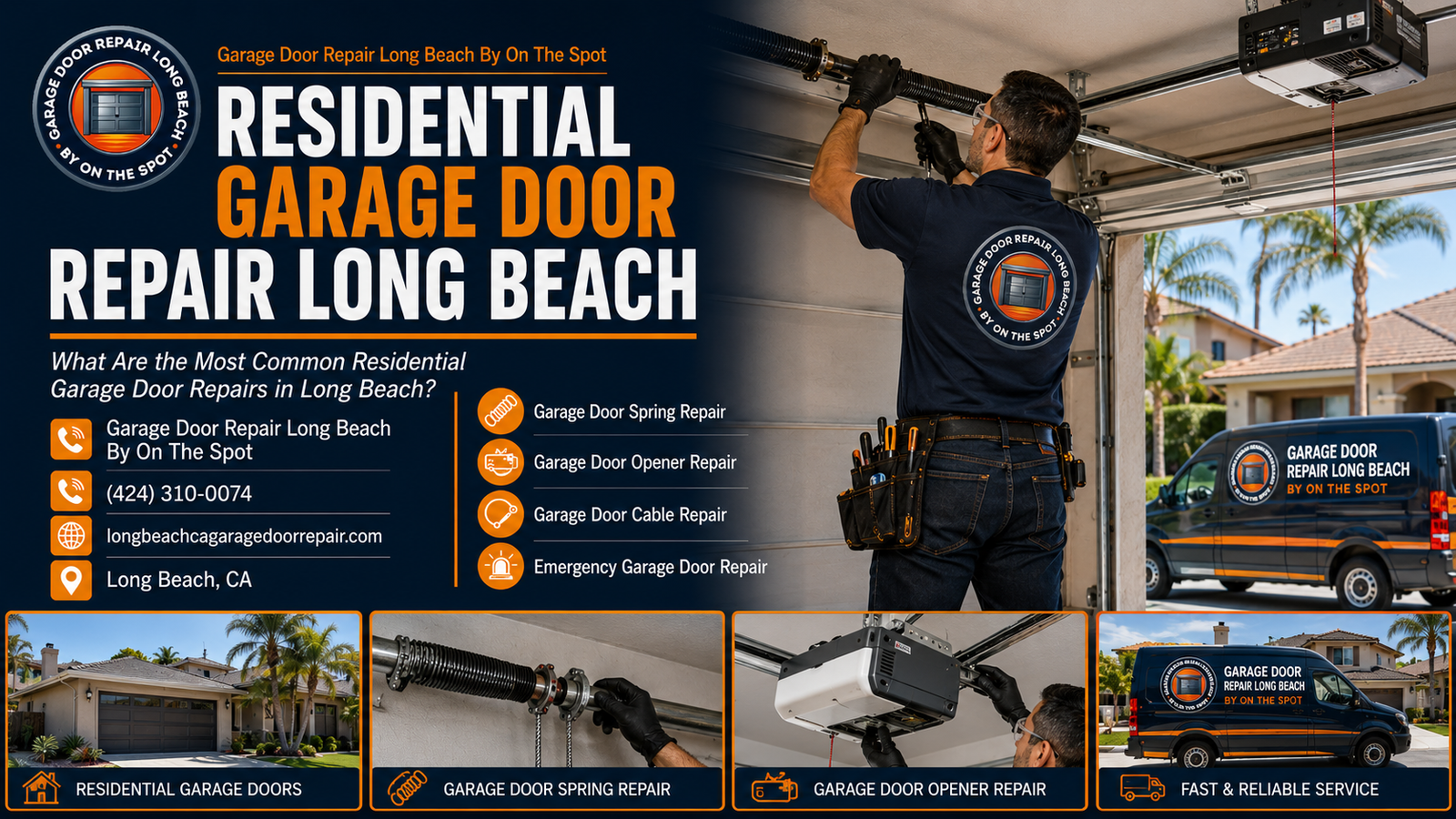
Direct Answer: What Are the Most Common Residential Garage Door Repairs in Long Beach?
The most common residential garage door repairs involve broken or weakened springs, garage door opener problems, misaligned or obstructed safety sensors, damaged or loose cables, worn rollers, bent or misaligned tracks, damaged panels, and loose or worn hinges and other hardware. Noisy operation and poor door balance can also indicate that maintenance or repair is needed.
The visible symptom is not always the only issue. A crooked door, for example, can involve a cable, roller, track, spring, bracket, or balance problem. An opener that sounds strained may actually be trying to move a door whose spring system is no longer supporting the door properly.
If the door is unusually heavy, crooked, off track, unstable, or moving unpredictably, stop operating it and avoid forcing it with the opener. A system-level inspection is the safer way to determine which connected parts need adjustment, repair, or replacement.
Why Residential Garage Door Repairs Matter
A residential garage door is a large moving system rather than a single appliance. The door sections, spring system, cables, drums, rollers, tracks, hinges, opener, controls, sensors, and safety features must work together for the door to travel in a controlled way.
That matters for Long Beach homeowners because a garage often serves as an everyday entry point. A door that suddenly stops working can affect vehicle access, household routines, deliveries, storage, tenant coordination, or access to an attached garage. For landlords and property managers, even a relatively small problem can become more complicated when residents need to coordinate access. Investors and remodelers may also need to determine whether an older door should be repaired or whether a new system better fits the project.
Business owners and managers may face similar concerns with garage or service doors used for regular access. Although this article focuses primarily on homes, the same principle applies: the symptom should be considered in the context of the connected door system.
A practical starting point is to describe exactly what changed. Did the door suddenly become noisy? Is one side lower? Does the motor run without lifting the door? Does it reverse before closing? Did you hear a loud bang? Is there a visible gap in a spring or a loose cable near one side of the door?
These observations can help a technician narrow down the likely problem before evaluating the complete system. For an overview of available services, visit Long Beach garage door services.
Most Common Residential Garage Door Repairs in Long Beach
Residential garage door repair in Long Beach can involve anything from a control issue to a mechanical lifting problem. Some repairs are relatively localized, while others involve several components that should be inspected together.
1. Spring and Balance Problems
A broken or weakened spring may leave the door unusually heavy, cause uneven travel, or make the opener appear to struggle. Springs, cables, drums, bearings, rollers, and door balance should be considered together.
2. Garage Door Opener Problems
The motor may run without moving the door, operation may become intermittent, or remotes and wall controls may stop responding. The opener should be evaluated separately from the mechanical condition of the door.
3. Sensor and Closing Problems
A door that will not close may have an obstructed or misaligned photo-eye, damaged wiring, a door-alignment issue, an opener setting problem, or another condition affecting safe closing.
4. Cable Problems
Loose, frayed, snapped, rusted, or off-drum cables can cause uneven lifting. Because cables operate with spring tension, damaged cable systems should not be handled as a casual DIY repair.
5. Track and Roller Problems
Worn rollers, damaged tracks, loose hardware, impact, or cable problems can contribute to rough movement, shaking, scraping, or an off-track condition.
6. Panel, Hinge and Hardware Repairs
Bent panels, loose hinges, worn brackets, damaged sections, or structural deformation may affect appearance and operation. The surrounding track and roller system may also need inspection.
7. Noise and Maintenance Issues
Squeaking, rattling, popping, grinding, or shaking may point to worn rollers, hinges, bearings, loose hardware, balance problems, opener wear, or another mechanical issue.
8. Full-Door or Component Replacement
Replacement may become more practical when damage is structural, matching parts are unavailable, multiple major components are failing, or the homeowner is already planning a broader garage-door upgrade.
Garage Door Spring and Balance Repairs
The spring system offsets much of the garage door's weight so the door can move with controlled effort. Depending on the system, a residential door may use torsion springs mounted above the opening or extension springs positioned alongside the horizontal tracks.
When a spring breaks or becomes unable to support the door correctly, the homeowner may notice a loud bang, a visible separation in a torsion spring, a door that feels unexpectedly heavy, uneven movement, an opener that strains, or a door that rises only a short distance before stopping.
A spring-related symptom should not be considered in isolation. The technician may also need to look at lifting cables, drums, bearings, rollers, track alignment, hardware, and the actual balance of the door. A cable can move incorrectly when a lifting system is uneven, and an opener can be placed under unnecessary load when the spring system is no longer doing its share of the work.
Broken Spring vs Weak or Unbalanced Door
A completely broken spring can sometimes be visually obvious, but an unbalanced door does not always have an immediately visible failure. A spring may still appear intact while the door behaves differently than it did before.
That is why simply replacing the first visible part may not be enough. The service decision should account for the overall door weight, the condition of the lifting components, how evenly the door travels, and whether the components are compatible with the existing system.
Important Spring Safety Note
Garage door springs, cables, drums, and bottom brackets may be under significant tension. Do not attempt to wind, unwind, cut, release, or replace tension-loaded components based on an online tutorial. If the door has suddenly become heavy or unstable, avoid repeatedly using the opener to lift it and arrange an inspection.
Garage Door Repair Long Beach By On The Spot provides a verified garage door repair service in Long Beach for homeowners who need the broader system inspected rather than assuming one visible symptom explains the entire problem.
Garage Door Opener, Remote, Keypad and Wall-Control Repairs
Not every garage door problem originates in the lifting hardware. Sometimes the door itself moves normally when disconnected from the opener, but the opener or one of its controls is not operating correctly.
Common symptoms include a motor that runs while the door stays in place, inconsistent response to a remote, a keypad that no longer provides access, a wall control that does not activate the system, unusual opener noise, or a door that stops or reverses during travel.
Opener diagnosis may involve the power supply, controls, remote programming, keypad operation, wall controls, wiring, gears, belt or chain components, travel settings, force settings, sensor inputs, and the connection between the opener and the door.
Opener Problem or Door-Balance Problem?
This distinction is important. The opener is designed to move a properly functioning garage door; it should not have to compensate for a failed spring or a door that is binding in its tracks.
If the motor seems strained, the door is unusually heavy, or movement is uneven, checking only the opener may overlook the actual cause. Door balance, rollers, tracks, cables, springs, and hardware may need to be evaluated before deciding that the opener itself requires replacement.
When Opener Replacement May Be Considered
Repair may be practical when the problem is limited to a replaceable control or opener component and the rest of the system remains appropriate for the door. Replacement may make more sense when significant opener problems are combined with compatibility concerns, repeated failures, or a homeowner's desire for different access features.
Depending on the chosen system, features such as smart access, battery backup, lighting, keypad access, or quieter operation may be considerations. These features should be evaluated based on the homeowner's needs rather than assuming every older opener must be replaced.
For opener-specific issues, the company also maintains a verified garage door opener repair page.
Garage Door Sensor Repairs and Doors That Will Not Close
A garage door that opens normally but refuses to close can be frustrating, particularly when the garage needs to be secured. The photo-eye safety system is one possible cause, but it is not the only one.
A homeowner can safely observe whether an object is blocking the photo-eyes, whether dirt is covering the lenses, whether the units appear visibly knocked out of position, or whether their indicator lights have changed. These are non-invasive observations and do not require bypassing any safety feature.
If nothing obvious is blocking the sensors, the issue could involve alignment, wiring, opener travel, door movement, track alignment, or another mechanical condition.
Repeatedly increasing opener force is not a substitute for determining why a door is resisting movement. Similarly, permanently bypassing a garage door safety sensor removes an important protective function and is not an appropriate repair.
After relevant opener or sensor work, safety-reversal and photo-eye operation should be checked as part of returning the system to normal use.
Garage Door Cable, Track and Roller Repairs
Cables, tracks, and rollers play different roles, but problems involving one can quickly affect the others. Cables help transfer spring force to the door. Rollers guide the sections through the tracks. Tracks establish the path the door follows.
Common Garage Door Cable Problems
A lifting cable may become loose, frayed, damaged, rusted, snapped, or displaced from its drum. A homeowner may notice that one side of the door is lower than the other, a cable appears loose near the side of the door, or the door begins to rise unevenly.
If a cable is visibly frayed or disconnected, observe it from a safe distance rather than pulling or repositioning it. The lifting system may still contain spring tension even if the door is not moving.
When a cable problem is diagnosed, both sides of the lifting system should be considered. The technician may also inspect cable drums, bottom brackets, springs, bearings, rollers, and track position to understand why the cable moved incorrectly.
Common Garage Door Track Problems
Tracks may become misaligned, bent, loose, or damaged following impact or prolonged mechanical stress. A door may scrape, shake, bind, or appear to move toward the edge of the track.
Track adjustment may be practical when the track remains serviceable but is no longer positioned correctly. Track repair may be appropriate for certain localized problems. Track replacement may make more sense when the track is significantly damaged or can no longer provide a safe, consistent travel path.
Worn or Damaged Garage Door Rollers
Rollers can contribute to rough movement, vibration, squeaking, or inconsistent travel. Their condition should be evaluated together with tracks, hinges, brackets, and door alignment.
A noisy roller does not automatically mean that every roller needs replacement, just as replacing one roller will not correct a bent track or damaged hinge. The useful question is what is causing the movement pattern and which components are actually worn or damaged.
Do Not Force an Off-Track or Crooked Door
If the door is visibly off track, hanging crooked, partially supported, or moving unpredictably, stop operating it. Continued opener use can worsen damage or place additional load on panels, cables, tracks, rollers, brackets, and hinges.
Garage Door Panel, Hinge and Hardware Repairs
Garage door panels can be damaged by vehicle contact, objects in the door's path, repeated stress, or general wear. Damage may be mainly cosmetic, or it may affect the structural movement of the door.
A shallow dent that does not change the way the door travels is different from a section that is sharply bent, cracked, split, separating, or interfering with the rollers and tracks. Structural panel damage can place additional stress on hinges, rollers, tracks, and surrounding sections.
Can a Single Garage Door Panel Be Replaced?
Sometimes. A single-panel replacement may be possible when a compatible section is available and the rest of the door remains suitable for continued service. Matching can involve panel design, dimensions, finish, color, window layout, insulation, and compatibility with the existing door.
Replacement becomes more complicated when a matching section is unavailable or the door has multiple damaged panels. In those situations, comparing panel work with a complete door replacement can provide a clearer decision.
Hinges, Brackets and Other Hardware
Loose or damaged hinges and hardware can contribute to rattling, section movement, poor alignment, or rough travel. Hardware inspection is particularly useful when a door has been struck or when a panel has visibly shifted.
Not every loose fastener requires major repair, but hardware attached to tension-loaded components should not be adjusted casually. Bottom brackets, for example, can be connected to the lifting cable system and should be left for trained service personnel.
Noisy Garage Door Repairs and Maintenance Visits
A garage door that becomes louder does not always need a major repair, but a change in sound is worth investigating. Squeaking, grinding, rattling, popping, shaking, scraping, or other unusual noises can provide clues about how the system is moving.
Rollers, hinges, fasteners, tracks, bearings, springs, cables, opener components, door balance, and panel alignment can all influence sound. The goal is not simply to make the noise disappear. The more useful goal is to identify whether the sound represents routine wear, poor alignment, a loose component, an opener problem, or a developing mechanical failure.
What a Garage Door Tune-Up Can and Cannot Do
A tune-up can be useful for inspection, testing, routine hardware review, door-balance evaluation, controls, sensors, and general maintenance. It may help identify wear before it develops into a more disruptive problem.
However, maintenance is not a substitute for replacing a broken spring, repairing a snapped cable, stabilizing an off-track door, or addressing structurally damaged panels.
Long Beach homeowners interested in preventive service can review the company's garage door tune-up service.
Safe Homeowner Maintenance Observations
- Listen for new or changing noises during normal operation.
- Observe whether the door travels evenly from side to side.
- Look from a safe distance for obviously frayed or loose cables.
- Check whether the photo-eye path is visibly obstructed.
- Note whether the opener, keypad, remote, and wall control respond consistently.
- Watch for new gaps, panel movement, or weather-seal deterioration.
- Stop operating the door if movement becomes unstable or unpredictable.
These observations do not require adjusting spring tension, cables, bottom brackets, drums, or other high-tension components.
Garage Door Maintenance vs Repair vs Component Replacement vs New Door
One of the most useful questions after a garage door inspection is not simply, “Can this part be fixed?” It is, “Which option makes sense for the condition of the entire system?”
Maintenance, repair, component replacement, and complete door replacement solve different problems. A tune-up can address maintenance needs but cannot restore a broken lifting cable. A component replacement can correct a localized failure but may be less practical when the door has multiple structural problems.
| Option | Best Fit | Common Signs | What Should Be Inspected | Possible Limitation | When a Larger Replacement May Make Sense |
|---|---|---|---|---|---|
| Maintenance / Tune-Up | Door generally works but needs inspection or routine attention. | Minor noise, vibration, changing movement, general wear. | Rollers, hinges, hardware, tracks, springs, cables, balance, opener, sensors and controls. | Cannot repair a broken or structurally damaged component by itself. | When inspection reveals major mechanical or structural failure. |
| Targeted Repair | A specific component or adjustment is causing the problem. | Intermittent opener issue, sensor problem, localized hardware or track issue. | The failed component plus connected systems affecting it. | May not be enough when several related parts are worn or damaged. | When repeated failures or broader system problems are present. |
| Component Replacement | A spring, cable, roller, panel, opener component or other part has failed. | Broken part, significant wear, structural damage or incompatibility. | Compatibility, connected hardware, balance, travel and safety systems. | A matching or compatible replacement may not always be available. | When multiple major components or several door sections need replacement. |
| New Garage Door | Major structural damage, remodeling, extensive wear or planned upgrade. | Multiple damaged sections, poor compatibility, broad deterioration or design change. | Opening measurements, clearance, tracks, springs, cables, rollers, seals, hardware and opener compatibility. | Requires a larger project decision and product selection. | This is already the full-system replacement option. |
A written estimate should make this distinction understandable. If replacement is recommended instead of repair, the homeowner should be able to ask what condition makes replacement more practical and which components are included in the proposed work.
What Should a Residential Garage Door Inspection Include?
The exact inspection depends on the symptom, but a useful diagnosis generally looks beyond the part that first caught the homeowner's attention.
Garage Door Repair Long Beach By On The Spot describes its service approach around listening to what the customer sees or hears, inspecting connected garage-door components, explaining the likely cause, reviewing appropriate repair or replacement options, and testing relevant functions afterward.
For a Mechanical Lifting Problem
The inspection may involve springs, cables, drums, bearings, rollers, tracks, brackets, hinges, door sections, and balance. If the door is crooked, the technician needs to determine why the two sides are no longer traveling evenly.
For an Opener Problem
The door's mechanical balance should be considered along with the opener motor, controls, wiring, remotes, keypad, travel, sensors, and drive components. This helps avoid replacing an opener when the underlying problem is actually a difficult-to-move door.
For a Closing or Reversing Problem
Photo-eyes, wiring, indicator lights, door alignment, track condition, travel settings, door resistance, and safety reversal may be relevant.
For Noise or Vibration
Rollers, hinges, bearings, fasteners, tracks, springs, cables, panel alignment, door balance, and opener operation may all contribute.
After service, appropriate balance, travel, controls, sensors, and safe operation should be checked when relevant to the repair that was completed.
Residential Garage Door Repair in Long Beach: Local Considerations
Long Beach includes a wide mix of housing types and garage configurations. Homeowners may have attached garages used as a primary entrance, detached garages behind a home, street-facing doors, compact driveways, or garages positioned close to living areas.
Those differences can influence what matters most during a repair. A noisy door near a bedroom or shared wall may deserve more attention than the same sound in a detached structure. A narrow driveway can make dependable door travel particularly important when vehicles need to enter and exit without much clearance.
Areas such as Belmont Shore, Naples Island, Bixby Knolls, California Heights, El Dorado Park, Downtown Long Beach, and Rose Park also include different home styles and garage layouts. Appearance becomes particularly relevant when panel damage or a complete door replacement is being considered.
Traditional raised-panel, carriage-inspired, contemporary flush-panel, windowed, or other door styles may fit different homes, but design decisions should still be coordinated with opening dimensions, hardware, tracks, spring requirements, and opener compatibility.
Coastal and Environmental Exposure
Long Beach-area garage doors can be exposed to salt air, humidity, direct sun, wind-blown debris, dust, and seasonal rain. These environmental conditions can be considered during inspection and maintenance, especially when evaluating metal hardware, tracks, seals, electronics, or visible corrosion.
However, the presence of coastal conditions does not prove that a specific part failed because of the environment. The actual cause should be determined from the condition of the door and its connected systems.
Rental and Multi-Unit Properties
Landlords and property managers may also need to coordinate garage door access with tenants or arrange service for small multi-door properties. Providing the service company with the exact door location, access instructions, symptoms, and contact information can help avoid confusion during scheduling.
Service coverage may include Long Beach ZIP codes 90802, 90803, 90804, 90807, 90808, and 90815, depending on current scheduling. ZIP codes describe service coverage and should not be interpreted as separate company offices or physical business locations.
Questions to Ask Before Approving Residential Garage Door Repair
A clear estimate is easier to evaluate when the homeowner understands both the diagnosis and the scope of the proposed work. These questions can help.
- What is causing the garage door problem?
- Which connected components were inspected?
- Is the problem limited to one part, or does it involve the spring, cable, track, roller, panel, opener, sensor, or hardware system?
- Is repair practical, or is component replacement recommended?
- If replacement is recommended, what condition makes replacement the better option?
- What exactly is included in the written estimate?
- Are the proposed parts compatible with the door's size, weight and existing hardware?
- Will the door's balance and travel be tested after the work?
- If the opener is involved, will the safety reversal and photo-eye system be checked?
- If a cable or uneven lifting issue is involved, are both sides of the lifting system being inspected?
- If a panel is being replaced, is a compatible matching section available?
- Are programming, final testing, disposal or other services included where relevant?
- Is same-day service currently available for my Long Beach location?
- What appointment window should I expect?
- Are there any current offers or new-customer promotions?
- What warranty applies to the proposed work, and can the terms be provided in writing?
- What maintenance is recommended after the repair?
If you are ready to discuss the symptoms of your door, you can request a garage door estimate or call (424) 310-0074.
Garage Door Repair Red Flags to Watch For
A repair recommendation should be understandable. Be cautious when the scope is unclear or the recommendation does not appear connected to the actual symptoms.
- A firm repair recommendation is made without inspecting the garage door system.
- No written estimate or clear scope is offered.
- The actual cause of the failure is not explained.
- Only the visibly damaged part is discussed even though connected components may also be involved.
- You are pressured to approve work immediately without an explanation of alternatives.
- You are instructed to bypass sensors or continue operating a visibly unstable door.
- No one discusses door balance, travel testing, or relevant safety testing after service.
- The proposed replacement part's compatibility is not explained.
- Fees appear without a clear explanation of what they cover.
- Warranty language is vague or cannot be provided in writing.
- A universal fixed repair is promised without seeing the condition of the door.
- A guaranteed response time or permanent fix is promised without supporting details.
- Full payment is requested before there is a clear work scope.
- A replacement panel is proposed without discussing matching and compatibility.
- Scare tactics or unsupported claims are used to push a larger repair.
Why Consider Garage Door Repair Long Beach By On The Spot?
Garage Door Repair Long Beach By On The Spot is worth considering when you want a Long Beach-focused company that handles both everyday residential garage door problems and broader repair or installation needs.
Relevant services include garage door spring repair and replacement, opener service, opener replacement and installation, cable repair and replacement, off-track service, track adjustment and replacement, roller-related service, panel repair, sensor and control service, tune-ups, maintenance, emergency garage door repair, and new or custom garage door installation.
For a general residential repair problem, one of the most useful aspects of the service approach is looking at connected components rather than assuming the first visible symptom is the only issue. A crooked door may involve cables and tracks. A strained opener may be responding to poor balance. A damaged panel may have affected hinges or rollers.
The company also serves homes and businesses in the Long Beach area. Free estimate requests may be available, and same-day appointments may be offered depending on location and the current schedule.
The company advertises 24/7 emergency garage door service, but current dispatch availability should always be confirmed by phone rather than assuming an immediate arrival time.
Call (424) 310-0074 to discuss current scheduling, estimate details, emergency availability, and coverage.
Long Beach and Nearby Garage Door Service Areas
Long Beach remains the primary service area. Neighborhood references below are provided for useful local context and do not represent separate company branches or physical offices.
Long Beach Neighborhoods and Districts
Nearby Communities
Service availability outside Long Beach may vary. Call (424) 310-0074 to confirm current coverage, emergency availability, and scheduling.
Frequently Asked Questions About Residential Garage Door Repair in Long Beach
Common repairs include garage door springs, openers, cables, sensors, rollers, tracks, panels, hinges, controls and other hardware. Noise, poor balance and uneven movement may also lead to maintenance or repair. The correct repair depends on which connected components are causing the symptom.
Signs can include a loud bang, a visible spring gap, an unusually heavy door, uneven movement, limited opening or an opener that appears to strain. Spring systems are tension-loaded and should be inspected rather than adjusted as a DIY project.
The problem may involve the opener connection, drive system, controls or another opener component, but a broken spring or poorly balanced door can produce a similar symptom. The mechanical door system should be checked before assuming the motor is the only problem.
A crooked door can involve a cable, drum, spring, roller, track or other lifting-system problem. Stop operating a visibly uneven or unstable door because continued movement may worsen damage.
Photo-eye alignment, dirty lenses, wiring, opener travel, track alignment or door movement can all affect closing. Do not permanently bypass the safety sensors; the cause should be diagnosed and the safety-reversal system checked.
A single panel may sometimes be replaced when a compatible section is available and the rest of the door remains serviceable. Matching the design, dimensions, finish, windows, insulation and existing hardware may affect whether panel replacement is practical.
Repair may be practical when the problem is localized and compatible replacement parts are available. A complete door replacement may deserve consideration when damage is structural, multiple major components are affected or matching sections are unavailable.
Same-day appointments may be available depending on the location, service need and current schedule. Call Garage Door Repair Long Beach By On The Spot at (424) 310-0074 to check current availability.
Long Beach Garage Door Repair Article Silo
Continue through the Long Beach garage door repair series in this top-to-bottom order. This keeps the topic path moving from common residential repairs into company selection, mobile service, and finally 24-hour repair decisions.
- Residential Garage Door Repair Long Beach – What Are the Most Common Residential Garage Door Repairs in Long Beach?
- Best Garage Door Repair Long Beach – How Do I Choose the Best Garage Door Repair Company in Long Beach?
- Mobile Garage Door Repair Long Beach – Can a Mobile Garage Door Repair Service in Long Beach Fix My Door the Same Day?
- 24 Hour Garage Door Repair Long Beach – When Should I Call a 24 Hour Garage Door Repair Service in Long Beach?
Request Residential Garage Door Repair in Long Beach
If your garage door is noisy, uneven, unusually heavy, refusing to close, struggling to open, or showing visible damage, Garage Door Repair Long Beach By On The Spot can inspect the symptoms and connected components before reviewing the appropriate repair or replacement path.
Call Garage Door Repair Long Beach By On The Spot at (424) 310-0074 to request a free estimate and check current residential garage door service availability in Long Beach and nearby communities.