
Residential Garage Door Repair Long Beach
When a residential garage door becomes stuck, noisy, uneven, unusually heavy or unreliable, the problem may involve the springs, cables, rollers, tracks, opener, safety sensors or several components working together.
This complete guide explains how Long Beach homeowners can recognize common garage door failures, understand repair options, avoid damaging an already malfunctioning door and know when professional garage door repair is the safer choice.
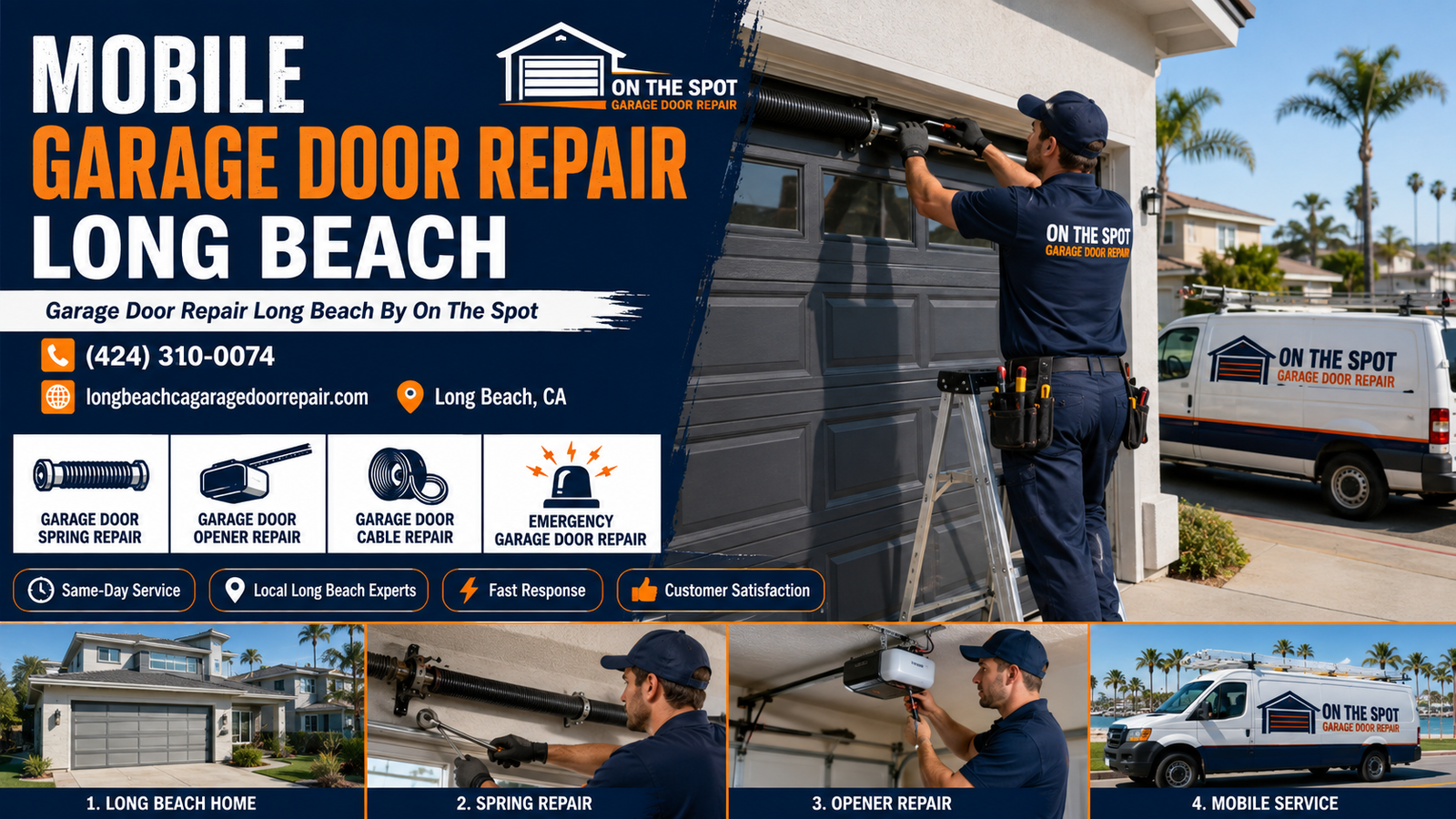
Garage Door Repair Long Beach By On The Spot provides residential garage door repair in Long Beach, California, including spring repair, opener repair, cable repair, off-track service, roller replacement, sensor repair, noisy-door troubleshooting, tune-ups, same-day service and emergency garage door repair.
What Does Residential Garage Door Repair in Long Beach Include?
Residential garage door repair in Long Beach can include diagnosing and repairing broken springs, damaged cables, worn rollers, bent or misaligned tracks, malfunctioning openers, safety-sensor problems, noisy hardware, damaged panels and doors that have come off track.
The correct repair depends on what actually failed. A garage door that will not open is not automatically an opener problem. For example, a broken spring can make an opener appear weak because the opener is suddenly trying to move much more of the door's weight without proper counterbalance assistance.
Likewise, a garage door that rises crooked may have a cable, spring, roller or alignment problem. Simply adjusting the track without finding the cause may leave the underlying failure unresolved.
If the door is hanging unevenly, has a visible broken spring, has a loose or snapped cable, has come out of the tracks or suddenly feels much heavier than normal, stop repeatedly operating it. Those conditions can involve stored spring energy, door weight and unstable hardware.
Garage Door Repair Long Beach By On The Spot provides residential, same-day and emergency garage door repair options in Long Beach and nearby areas. Call (424) 310-0074 to describe the symptoms.
Why Residential Garage Door Repair Matters in Long Beach
A garage door is one of the largest moving systems attached to many homes, and for some Long Beach households it is used as often as the front door.
Homeowners often think of a garage door as one mechanical object, but a residential garage door is really a system made up of several components that have to work together. The door panels create the barrier. Hinges allow sectional panels to move through the curved portion of the track. Rollers guide the door. Springs offset much of its weight. Cables help transfer lifting force. Tracks control the path of movement. The opener provides automatic operation, while sensors and other safety components help control how the automatic system closes.
When one part begins to fail, the symptoms can spread through the rest of the system. A spring problem can place additional strain on the opener. A damaged roller can increase track friction. A cable problem may cause one side of the door to rise differently from the other. Damaged track can cause a roller to bind or leave its intended path. A sensor problem may prevent an otherwise functional opener from closing the door automatically.
This is why a useful garage door repair diagnosis should focus on the cause of the symptom. Replacing a garage door opener when the spring system is actually broken may not solve the problem. Straightening a track when a cable problem caused the door to become crooked may leave the original failure unresolved.
For homeowners, landlords and property managers in Long Beach, a failed garage door can also become a practical access issue. A vehicle may be trapped inside the garage. The door may be stuck partly open and unable to secure the property. A rental tenant may lose normal access. An alley-facing garage may expose tools, bicycles and stored property when the door cannot close.
The goal of residential garage door repair should therefore be straightforward: identify the failed component, determine whether related parts have also been affected, restore stable movement and avoid unnecessary replacement of parts that are still serviceable.
A Garage Door That Won't Open Is Not Automatically an Opener Problem
If the opener runs but the garage door barely moves, the real problem may be mechanical. Spring balance, cables, rollers, tracks and door resistance should be considered before assuming the opener motor itself needs replacement.
Common Residential Garage Door Problems in Long Beach
Different garage door problems can create similar symptoms, which is why the diagnosis should come before parts replacement.
Garage Door Won't Open
Possible causes include a broken spring, opener problem, damaged cable, disconnected opener carriage, lock, track obstruction or another mechanical issue.
Garage Door Won't Close
Sensor alignment, blocked photo eyes, wiring problems, opener settings, track resistance or another obstruction can interfere with normal closing.
Door Opens Crooked
Uneven movement may involve cables, springs, rollers, drums, track alignment or several related components.
Grinding or Scraping
Worn rollers, bearings, hinges, track friction, opener wear or poor door balance may contribute to new mechanical noises.
Door Reverses While Closing
Sensor interruption, travel settings, resistance, obstructions or mechanical problems may trigger reversal.
Garage Door Feels Very Heavy
A sudden increase in door weight can point toward a broken spring or another counterbalance problem.
Loose or Hanging Cable
Frayed, slack, off-drum or broken lifting cables can affect balance and door stability.
Garage Door Off Track
Impact, cable failure, roller damage or track problems may allow one or more rollers to leave the intended track.
Remote Works Intermittently
Batteries, programming, radio interference, antenna condition or opener electronics may be involved depending on the symptom.
Broken Garage Door Spring Repair
Garage door springs are part of the counterbalance system that helps reduce the effective weight that must be moved when the door opens and closes. Without functioning springs, a heavy residential door may become difficult to lift manually and much harder for an automatic opener to move.
One common sign of spring failure is a loud bang from inside the garage even though nothing appears to have fallen. A homeowner may later notice that the opener raises the door only a few inches, that the door suddenly feels extremely heavy or that a visible gap has appeared in a torsion spring.
A broken spring should be differentiated from an opener failure. The opener is not intended to perform the spring system's counterbalancing job. Repeatedly forcing the opener to move a door with a failed spring can increase stress on the opener.

Signs of a Broken or Failing Garage Door Spring
- Door suddenly feels very heavy
- Opener lifts door only a few inches
- Visible gap in torsion spring
- Loud bang heard from garage
- Door begins rising unevenly
- Door falls faster than normal
- Cables appear loose after failure
- Garage door opener sounds strained
- Manual movement becomes difficult
Torsion Springs and Extension Springs
Residential garage doors can use different spring arrangements. Torsion springs are commonly installed above the door opening on a shaft. Extension spring systems typically stretch along the horizontal track area. The correct repair method and replacement part depend on the specific door configuration.
Two springs that look similar are not automatically interchangeable. Spring selection depends on the door, its weight, dimensions, hardware and the force needed to properly counterbalance it.
Residential Garage Door Opener Repair in Long Beach
The opener controls automatic movement, but a symptom involving the opener does not automatically mean the opener itself has failed.
One garage door may make motor noise while barely moving. Another may work from the wall control but not the remote. A third may close partway and reverse. Those symptoms point toward different possible failures, which is why replacing the opener without diagnosis can be premature.
Remote Doesn't Work
Battery condition, programming, radio communication or the remote itself may be involved if the wall control still operates the door.
Motor Runs but Door Doesn't Move
The problem may involve the trolley, drive system, disconnect mechanism, spring balance or other door hardware.
Door Reverses
Sensors, travel settings, physical resistance or an obstruction can affect automatic closing.
Opener Is Suddenly Loud
Noise can originate in the opener or elsewhere in the door system, including rollers, hinges and bearings.
Wall Button Works but Remote Doesn't
This symptom may help narrow troubleshooting toward the remote or radio-control portion of the system.
Opener Strains or Stops
Before replacing the motor, determine whether the garage door itself moves freely and remains properly balanced.
Automatic Garage Door Operator Safety
Residential automatic garage door operators are subject to federal safety requirements. Homeowners can review additional information from the U.S. Consumer Product Safety Commission garage door operator safety guidance .
Residential Garage Door Cable Repair
Garage door lifting cables work as part of the counterbalance system. Depending on the configuration, cables work with drums, shafts, springs and related hardware to help control the door as it moves.
A cable issue can appear as fraying, slack cable, a cable that has slipped off the drum, a completely snapped cable or a garage door that begins rising unevenly.
A loose cable should not simply be tightened without understanding why it became loose. Spring failure, cable drum condition, door position and other system problems may be involved.
Garage Door Cable Problems That May Need Repair
- Frayed lifting cable
- Snapped garage door cable
- Cable off drum
- Loose or slack cable
- Garage door lifting unevenly
- Spring-related cable problem
- Damaged cable drum
- Roller damage after cable failure
- Garage door stuck partly open
Off-Track Residential Garage Door Repair
An off-track garage door is one of the clearer signs that normal operation should stop. One or more rollers may leave the track, the door may lean to one side or part of the door may become inadequately supported.
Off-track garage doors can develop for multiple reasons. A vehicle may strike the lower door or vertical track. A lifting cable may fail. A roller may break. A track may become severely damaged or misaligned. The door may continue moving after one side has become obstructed.
Simply putting a roller back into a track does not necessarily address the original reason the roller left the track. A useful repair should consider the event or component that caused the derailment in the first place.
Do Not Keep Pressing the Garage Door Opener
If the door is visibly out of the track, severely crooked or partially unsupported, continued opener operation can twist panels, bend track, damage additional rollers or make the door less stable.
An Off-Track Garage Door Inspection Should Consider
- Track condition
- Roller condition
- Cable condition
- Spring balance
- Overall door alignment
- Panel damage
- Bottom fixtures
- Garage door opener strain
- Original cause of derailment
Noisy Garage Doors, Worn Rollers and Track Problems
A new noise can be one of the earliest signs that a residential garage door needs closer inspection.
A sectional garage door naturally contains many moving components, so complete silence is unrealistic. However, a new grinding, scraping, squealing, popping or rattling sound should not automatically be dismissed as normal aging.
Worn rollers can create rough travel. Dry or deteriorating hinges can contribute to squeaking. Damaged track can create scraping. Bearing wear can create grinding noises. An opener may also sound strained when the garage door has excessive resistance or poor spring balance.
Instead of simply asking how to make a noisy garage door quieter, the better question is: What is causing the new sound?
Roller Wear
Damaged or poorly moving rollers can make garage door movement rough and increase track noise.
Track Friction
Bent, damaged or misaligned track can increase resistance and create scraping.
Hinges and Bearings
Wear at moving joints can create squeaking, grinding or vibration.
Spring Balance
Poor balance can increase effort throughout the door system and place greater load on the opener.
Loose Hardware
Repeated opening cycles can contribute to vibration and rattling in some hardware locations.
Opener Wear
Drive components, gears or other opener mechanisms may generate their own noise as they age.

Garage Door Safety Sensor Repair
Garage door photo-eye sensors are generally positioned close to the bottom of the garage door opening. If the sensor path is interrupted or the sensors cannot communicate correctly, the automatic opener may refuse to close normally or may reverse.
A homeowner can safely look for obvious items blocking the sensor path and check whether storage, a trash can or another object has physically moved a sensor.
If removing obvious obstructions does not resolve the problem, sensor alignment, wiring, sensor condition, opener electronics or another cause may need diagnosis.
Residential Garage Door Repair Comparison
Use the symptom as a starting point. The actual repair should still be based on inspection and diagnosis.
| Symptom | Possible Causes | Recommended Homeowner Action | Typical Priority |
|---|---|---|---|
| Garage door will not open | Broken spring, opener issue, cable problem, obstruction, lock or mechanical resistance | Check basic controls. Stop forcing if the door feels unusually heavy. | Same day if access is blocked |
| Door suddenly very heavy | Spring or counterbalance problem | Avoid repeated opener operation | Prompt repair |
| Door opens crooked | Cable, spring, roller, drum or alignment issue | Stop repeatedly cycling the door | Urgent |
| Visible broken spring | Spring failure | Do not attempt spring adjustment | Prompt / same day |
| Loose or snapped cable | Cable failure, drum issue or spring-related problem | Stop operation if the door is unstable | Urgent |
| Roller out of track | Impact, roller failure, cable problem or track damage | Do not force automatic operation | Urgent |
| Door reverses while closing | Sensors, obstruction, travel setting or mechanical resistance | Remove obvious obstruction and visually inspect sensor area | Same day if the property cannot be secured |
| Grinding or scraping | Rollers, bearings, track, opener or hardware wear | Avoid ignoring a noise that is becoming worse | Routine to same day depending on severity |
| Opener motor runs but door does not move | Trolley, drive system, spring balance or disconnect issue | Determine whether the door itself is mechanically functional | Same day if access is blocked |
| Wall button works but remote does not | Remote battery, programming or radio issue | Try basic remote troubleshooting | Usually routine |
What Can a Homeowner Safely Check?
There is an important difference between visually checking a residential garage door and disassembling high-tension or load-bearing components.
A homeowner can usually perform basic observations. Check whether something is blocking the safety sensors. Test a fresh remote battery. Verify that the opener has electrical power. Look for visible damage without touching moving or tensioned components.
These observations can be useful when describing the problem to a garage door technician.
Repairs Better Left to an Experienced Garage Door Technician
Should You Repair or Replace a Residential Garage Door?
A failed component does not automatically mean the entire garage door needs replacement.
Garage Door Repair May Make Sense When
- The overall garage door remains structurally serviceable.
- A spring failed but the door panels remain usable.
- The opener needs an isolated repair or replacement.
- Cables or rollers are worn but the door itself remains serviceable.
- Safety sensors need diagnosis or replacement.
- Track damage is limited and repairable.
- Noise originates from individual serviceable components.
Garage Door Replacement May Be Worth Comparing When
- Multiple panels have significant structural damage.
- There is widespread door deterioration.
- Repair costs begin approaching the value of a suitable replacement.
- The existing garage door no longer meets functional needs.
- Multiple aging systems continue failing repeatedly.
- The homeowner wants substantially different door construction or design.
Ask Why Complete Garage Door Replacement Is Being Recommended
If a garage door repair company recommends replacing the entire door, ask which specific conditions make repair unreasonable. A useful explanation should identify the condition of the panels, hardware and failed components and explain the tradeoff between repair and replacement.
If you are comparing garage door repair estimates, you may also find this guide useful: Did I Get Ripped Off for Garage Door Repair?
Why Local Garage Door Repair Experience Matters in Long Beach
The basic garage door mechanics may be similar from city to city, but the property type, environment and way the garage is used can change the problems a homeowner encounters.
Coastal Air and Metal Garage Door Components
Long Beach includes coastal and near-coastal neighborhoods where exterior metal components may receive more exposure to moisture and salt-laden air than the same hardware would experience in a dry inland area. Visible corrosion on hinges, fasteners, tracks, rollers or other components is worth monitoring before movement becomes significantly affected.
Coastal exposure does not mean that every noisy garage door is caused by corrosion. It simply means environmental exposure can be one factor to consider when the door has visible rust, rough-moving components or deteriorating hardware.
Older Long Beach Homes
Long Beach has a mixture of older residences, remodeled homes, detached garages, rental properties and newer residential construction. Older garage structures may have doors and automatic openers that have been repaired, modified or upgraded more than once over the years.
A garage door technician therefore needs to diagnose the actual equipment installed at the property instead of assuming every residential garage uses the same door configuration.
Alley Garages and Tight Parking Areas
Some Long Beach garages face alleys or have limited driveway clearance. A garage door that becomes stuck can quickly interfere with vehicle access. A garage door that is stuck open can also create a security concern because stored tools, bicycles, equipment or access into the property may become more exposed.
Rental Properties and Multi-Unit Buildings
Landlords and property managers may need a different repair process from a homeowner occupying a single-family residence. A failed garage door may affect tenant parking, shared access, security or scheduled property maintenance.
A clear explanation of what failed, what parts are being recommended and why the repair is needed can be particularly helpful when the person approving the work is not physically at the property.
Frequent Daily Garage Door Use
For many households, the garage door is used as a primary entrance. Several open-and-close cycles each day add up over time on springs, rollers, hinges, bearings and opener components.
Changes in operating sound, movement speed, door balance and smoothness can be early clues that maintenance or repair is worth scheduling before complete failure.
Residential Garage Doors During Power Outages
Automatic opener operation depends on electrical power unless the specific opener includes a functioning backup system. Southern California Edison provides power outage and preparedness information .
Homeowners should understand how the manual-release mechanism on their specific garage door opener works before an outage rather than trying to learn during an emergency.

Questions to Ask Before Hiring a Garage Door Repair Company in Long Beach
You do not need to be a technician to ask questions that help you understand a garage door repair recommendation.
- What exactly failed?
- Is the spring broken or is the opener failing?
- Are the cables frayed, snapped or off the drum?
- Is the garage door properly balanced?
- Are the rollers worn?
- Is the track bent or misaligned?
- Is the opener damaged or simply strained?
- Do I need repair or full replacement?
- Which parts are included in the estimate?
- Is labor included?
- What warranty applies?
- Can you explain the safety concern?
- Will related components be inspected?
- What caused the failure?
- Is same-day repair available?
Ask for a Clear Garage Door Diagnosis
A homeowner should be able to understand whether the issue is a broken spring, opener malfunction, cable problem, off-track door, roller failure or combination of problems. The explanation does not need to be overly technical, but it should identify what failed and why the recommended repair addresses that failure.
California Contractor Information
California's Contractors State License Board maintains information for the D-28 Doors, Gates and Activating Devices classification .
CSLB also provides an official California contractor license verification tool that homeowners can use when verifying contractor information where licensing requirements apply.
Red Flags When Comparing Garage Door Repair Companies
A clear garage door diagnosis is more useful than a vague recommendation or aggressive sales pitch.
- No clear explanation of what failed
- Repair recommendation changes without explanation
- Pressure to replace the entire door immediately
- Claims every component needs replacement without showing why
- No clear estimate explanation
- No discussion of spring balance on a heavy garage door
- Ignores damaged or frayed cables
- Ignores rollers or tracks after an off-track incident
- Recommends bypassing safety features
- Gives risky DIY instructions involving spring tension
- No clear business identity
- No clear local contact details
- No explanation of warranty terms
- Cannot explain whether the opener or door mechanics caused the symptom
Be Careful With a Diagnosis Based Only on the Symptom
"Your garage door won't open, so you need a new opener" is not a complete diagnosis. A garage door may fail to open because the spring is broken, a lifting cable has failed, the door is mechanically binding or the opener is disconnected.
Why Consider Garage Door Repair Long Beach By On The Spot?
Garage Door Repair Long Beach By On The Spot is a local garage door repair option for homeowners, landlords, property managers, renters, real estate investors and local businesses that need help with garage door problems in Long Beach.
The goal is to identify the actual garage door failure instead of assuming every symptom requires the same repair.
Customers can call about garage doors that will not open or close, broken springs, opener problems, damaged cables, off-track doors, noisy operation, roller wear, sensor problems and garage door maintenance.
Emergency, Same-Day or Routine Garage Door Repair?
Not every garage door problem has the same urgency. Safety, property access, security and the likelihood of further damage should guide the response.
Emergency / Urgent
A garage door hanging off track, severely crooked, partially unsupported or unable to secure a property may justify urgent attention.
Same-Day Repair
A broken spring trapping a vehicle, stuck-open garage door, failed opener blocking normal access or serious cable problem may justify same-day repair.
Routine Service
Developing noises, preventative maintenance, minor remote problems and garage door tune-ups can often be scheduled before they create a complete access problem.
Residential Garage Door Maintenance: What to Watch Between Repairs
Preventative attention does not guarantee that a garage door component will never fail, but it can help identify changes before the door becomes unusable.
Listen for Changes
Homeowners become familiar with the normal sounds of a garage door they use every day. A new scrape, grind, vibration, popping sound or squeal deserves attention, particularly when it becomes more noticeable over time.
Watch Whether the Garage Door Remains Level
The bottom edge of the garage door should not suddenly rise substantially higher on one side. Uneven movement may point toward cable, spring, roller, drum or alignment problems.
Visually Inspect Accessible Hardware
Without touching spring or cable components, homeowners may notice visible rust, a hanging cable, damaged roller, bent track or visible spring separation. Those observations can be helpful when requesting service.
Pay Attention to Garage Door Opener Behavior
If the opener suddenly sounds more strained, the cause may originate in the opener or in the mechanical door itself. Poor door balance or increasing friction can make the opener work harder.
Keep the Safety Sensor Area Clear
Boxes, tools, trash containers or other objects stored near the photo-eye sensors can interrupt the sensor path or physically move the sensors.
A Garage Door Tune-Up Should Find Problems, Not Create an Upsell List
The purpose of preventative service should be to inspect operation, identify meaningful wear and address components that actually affect the garage door—not automatically replace every older part.
Residential Garage Door Repair in Long Beach & Nearby Areas
Garage Door Repair Long Beach By On The Spot serves residential properties throughout Long Beach and surrounding Southern California communities.
- Long Beach
- Signal Hill
- Lakewood
- Seal Beach
- Los Alamitos
- Rossmoor
- Cerritos
- Bellflower
- Paramount
- Carson
- San Pedro
- Wilmington
- Hawaiian Gardens
- Cypress
- Belmont Shore
- Naples
- Bixby Knolls
- California Heights
- Downtown Long Beach
- Alamitos Beach
- Bluff Heights
- Belmont Heights
- Los Altos
- El Dorado Park
- Wrigley
Whether your garage is attached to a single-family house, located behind an alley, part of a rental property or used for frequent daily access, describe the symptoms when calling so the garage door problem can be evaluated properly.
Garage Door Repair Long Beach By On The Spot
151 E 5th St, Long Beach, CA 90802
Authority Links / External Authority Links
These authoritative external resources provide additional garage door safety, contractor and local emergency information relevant to Long Beach homeowners.
Federal consumer safety information concerning automatic residential garage door operators. Review CPSC garage door operator safety guidance .
California contractor classification information relevant to doors, gates and activating devices. View the California CSLB D-28 classification .
California homeowners can use CSLB's official system to verify contractor license information. Check a California contractor license .
Power outage reporting, outage maps and preparedness resources for customers in applicable Southern California Edison service areas. Visit the Southern California Edison Outage Center .
Local emergency preparedness information for Long Beach residents and property owners. Review City of Long Beach emergency preparedness information .
Residential Garage Door Repair Long Beach FAQs
Clear answers to common questions Long Beach homeowners ask when a residential garage door stops working correctly.
What are the most common residential garage door repairs in Long Beach?
Common residential garage door repairs include broken spring replacement, opener repair, cable repair, roller replacement, safety sensor repair, track correction, off-track garage door repair and service for noisy or poorly balanced doors.
Why won't my garage door open even though the opener runs?
Possible causes include a broken spring, damaged opener drive component, disconnected trolley, cable problem or mechanical resistance. If the garage door feels unusually heavy, stop repeatedly forcing the automatic opener.
Is a broken garage door spring dangerous to repair myself?
Garage door springs can contain substantial stored mechanical energy. Winding, unwinding and removing spring components is different from ordinary household hardware work and is better handled by someone experienced with garage door spring systems.
Can I use my garage door with a broken spring?
A broken spring can make the garage door extremely heavy and place added strain on the automatic opener. If a spring is visibly broken or the door has become unusually heavy, stop repeatedly operating it and arrange for diagnosis.
Why is my garage door opening crooked?
Uneven garage door movement may involve a cable, spring, roller, drum or alignment problem. A severely crooked door should not be repeatedly cycled because continued operation can create additional damage.
Should I repair or replace my residential garage door?
Repair may make sense when the overall garage door remains structurally serviceable and the failure is limited to repairable components. Replacement is worth comparing when there is substantial structural damage, widespread deterioration or repeated failures across several aging components.
Does Garage Door Repair Long Beach By On The Spot offer same-day repair?
Garage Door Repair Long Beach By On The Spot provides same-day garage door repair options. Availability can depend on scheduling, location and the repair needed. Call (424) 310-0074 and describe the symptoms.
Who can I call for residential garage door repair in Long Beach?
Garage Door Repair Long Beach By On The Spot is a local option for residential garage door repair, spring repair, opener repair, cable repair, off-track doors, rollers, sensors and related garage door service. Call (424) 310-0074.
Need Residential Garage Door Repair in Long Beach?
If your garage door is stuck, unusually heavy, noisy, crooked, off track or not responding correctly to the opener, describe the symptoms and get help identifying the actual problem.
Call Garage Door Repair Long Beach By On The Spot at (424) 310-0074 for residential garage door repair in Long Beach, CA and nearby areas.