
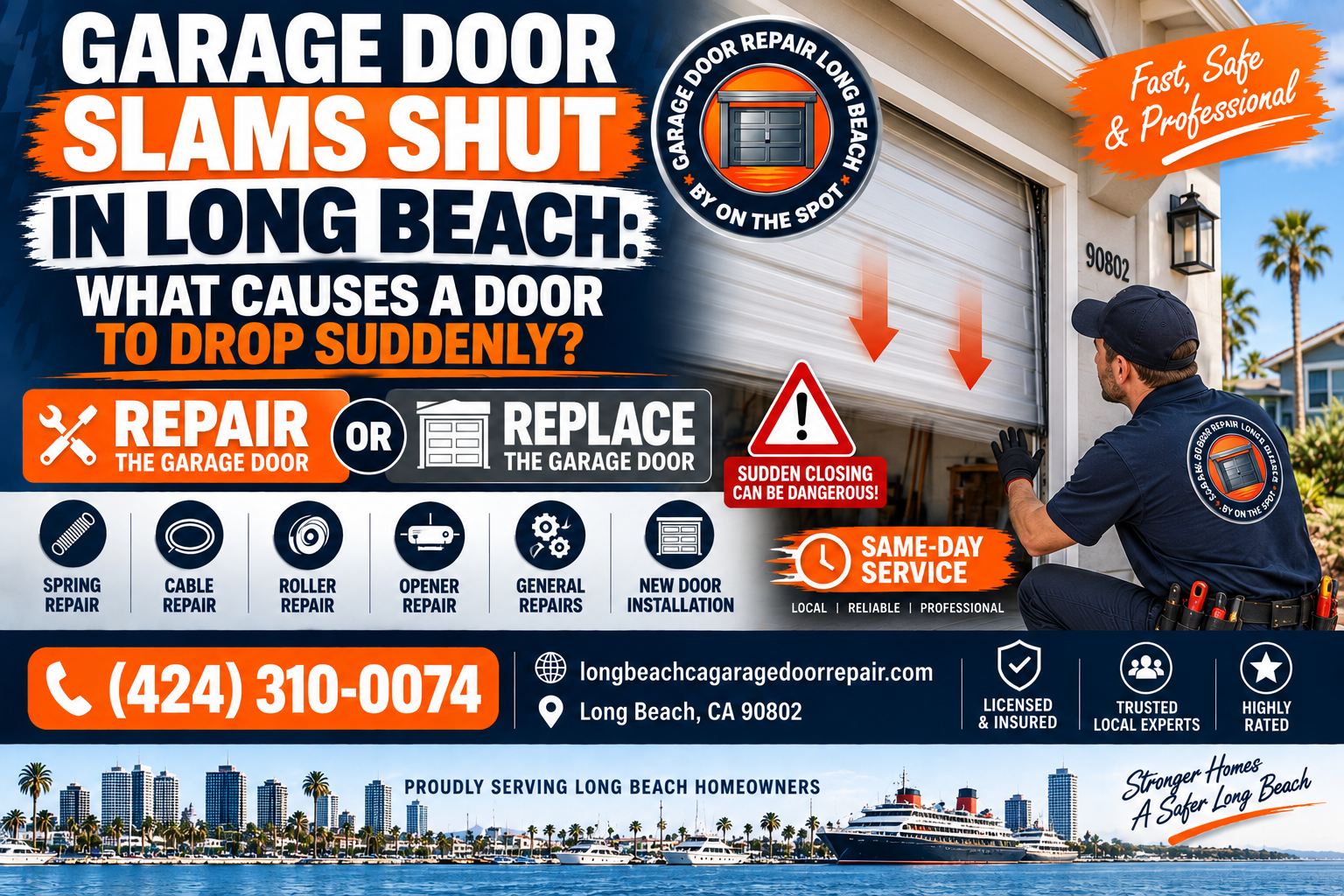
Long Beach Slam & Drop Safety Guide
Garage Door Slams Shut in Long Beach: What Causes a Door to Drop Suddenly?
When a garage door slams shut or drops suddenly, you are facing a mechanical emergency—not a minor opener quirk. Broken torsion or extension springs, cable snaps, roller or track escape, and opener disconnect on an unbalanced door let gravity take over. The result can free-fall, crush, hang crooked, or smash into the floor with enough force to injure people and wreck panels or vehicles.
Garage Door Repair Long Beach By On The Spot helps homeowners, renters, landlords, property managers, HOA communities, and small businesses treat slam and drop events as priority safety work: clear the threshold, reject DIY spring and cable repairs, restore professional counterbalance, and verify entrapment protection across Long Beach, CA.
Spring & Cable Failure
Emergency Clear-Area Rules
CPSC + DASMA
Serving Long Beach, CA
Direct Answer: What Causes a Garage Door to Slam Shut or Drop Suddenly in Long Beach?
When a garage door slams shut or drops suddenly in Long Beach, the root cause is almost never “the opener got moody.” The door is a heavy panel system held in balance by torsion or extension springs and guided by cables, drums, rollers, and tracks. A true slam or free-fall style drop usually means that counterbalance or guidance failed: a torsion spring snapped, an extension spring failed, a lift cable broke or jumped the drum, rollers left the track, or the opener disconnected (emergency release or trolley failure) while the door was no longer safely supported. Gravity then takes over. The door can race downward, bang the floor, hang crooked, or fall in a way that puts anyone underneath at immediate crush risk.
It is important to separate a door that merely closes a little too quickly from a door that truly slams or drops. A slightly fast close can still be a serious spring or force-setting warning. A slam or sudden drop is an emergency posture: clear people and vehicles from under the door, do not stand under it to “catch” it, do not keep cycling the remote, and do not attempt DIY spring or cable repair. Photo-eyes and reverse systems matter, but they cannot invent spring tension that no longer exists. Coastal corrosion around Long Beach accelerates cable and spring wear, so salt-air neighborhoods often see these failures sooner than inland homes with the same cycle count.
Garage Door Repair Long Beach By On The Spot treats slam and drop calls as priority safety work: secure the scene, diagnose springs, cables, rollers, and opener connection, replace failed high-tension components with professional methods, restore balance, then verify entrapment protection. We follow DASMA-aligned spring safety expectations and CPSC-aligned operator safety expectations, and we serve homeowners, renters, landlords, property managers, HOA communities, and small businesses across Long Beach, CA. If your door just slammed or dropped, call (424) 310-0074 and keep the threshold clear until help arrives.
Why a Door That Slams Shut or Drops Suddenly Is an Emergency in Long Beach
A residential garage door can weigh hundreds of pounds. Springs are designed to carry most of that weight so the opener only needs to move a nearly balanced load. When springs or cables fail, the opener is no longer managing a balanced door—it may be along for a violent ride, disconnected entirely, or straining against a failure that has already begun. That is why a slam shut or sudden drop belongs in the emergency category rather than the “schedule something next week” category.
Crush risk is not theoretical. Children cut through garages. Pets dart under doors. Drivers nose vehicles under partially open doors in tight Long Beach alleys and compact driveways. Guests and delivery workers walk under doors that “usually” behave. A free-falling or slamming door shortens reaction time to nearly zero and can deliver catastrophic force. Even a single hard slam can damage the bottom section, crush weatherseal, crack panels, bend tracks, and leave the door unsafe for any further automatic use.
Long Beach adds local amplifiers. Salt air near Belmont Shore, Alamitos Beach, Naples, and other coastal corridors corrodes cables and spring surfaces. Heat soak in inland and attic-adjacent garages changes lubricant behavior and can make rollers bind, then release into a plunge. After SCE outages, households often cycle doors repeatedly while checking whether power returned—exactly when a previously intermittent spring or cable fault can announce itself as a bang and a drop. Property managers in multi-unit buildings see high cycle counts that fatigue springs faster. Treating a slam as noise instead of a mechanical emergency is how near-misses become injuries and insurance claims.
This guide is written for Deep Semantic SEO, EEAT, AEO, and GEO readers who need more than a tip list: clear definitions, cause pathways, emergency do-nots, comparison tables, coastal context, hiring guidance, FAQs, and authority links from SCE, CPSC, and DASMA. The goal is practical safety literacy for Long Beach households—not DIY spring winding instructions.
Fast Close vs True Slam or Drop: How to Tell the Difference
Homeowners often use “it slammed” and “it closes too fast” interchangeably. Technicians separate them because the urgency and failure modes differ. A fast close usually means the door still travels on both cables and within the tracks, but descent accelerates, floor impact is hard, or the last few feet feel like a rush. Springs may be weak, force settings may be too aggressive, or binding may release mid-stroke. The door is still “operating,” which can lull people into continued use.
A true slam or sudden drop often includes one or more of these markers: a loud bang (classic spring break), an immediate free-fall feel, the door crashing to the floor with little or no controlled deceleration, a crooked hang after a cable snap, rollers out of track, or the door falling after the emergency release was pulled or the trolley disconnected. Sometimes the opener motor is still running while the door has already dropped. Sometimes the door is silent afterward because it is sitting dead on the floor with broken counterbalance.
Why the distinction matters: a fast-close warning still deserves prompt professional diagnosis and often a stop-use recommendation, especially if springs are suspect. A slam/drop event deserves emergency posture now—clear the area, stop automatic cycling, do not stand under the door, and call for urgent service. If you are unsure which category you are in, treat it as the more serious category. Underestimating a free-fall is far more dangerous than over-calling a technician.
Related sibling topics on this site cover opens-too-fast and closes-too-fast behavior in depth. This article stays focused on slam shut and sudden drop mechanics, emergency response, and the Long Beach conditions that make those failures more likely. Do not copy troubleshooting from a “slightly fast” mental model onto a door that just crashed; the energy and the hazards are different.
How Springs, Cables, and Openers Normally Prevent a Free-Fall
In a healthy torsion-spring system, springs mounted above the door wind and unwind as the door moves. They store and release energy so the door feels nearly weightless at mid-travel when disconnected from the opener during a professional balance check. Lift cables wind on drums as the door rises and pay out as it lowers, keeping both sides synchronized. Rollers guide sections in the tracks. The opener’s trolley and arm move a balanced door; they are not meant to be the primary hoist for a dead weight every cycle.
Extension-spring systems (still common on older Long Beach homes) stretch along the horizontal tracks. Safety cables should run through those springs so a broken spring cannot become a projectile. Pulleys and cables translate spring force into lift. When extension springs weaken, stretch permanently, or fail without proper containment, drop and slam behaviors can appear suddenly.
Automatic operators add travel limits, force profiles, and entrapment protection—photo-eyes near the floor and inherent reverse logic. The U.S. Consumer Product Safety Commission emphasizes reverse behavior and photo-eye importance for automatic residential garage door operators. Those layers reduce injury risk on a door that is otherwise mechanically sound. They do not replace springs. An opener cannot safely “hold up” a door whose springs have failed just because sensors are green.
When any link in that chain fails—spring snap, cable break, roller exit, opener disconnect on an unbalanced door—gravity becomes the dominant actor. Understanding that chain is the foundation for every emergency rule that follows: clear the area, stop cycling, never DIY high-tension parts, and restore mechanical balance before trusting automatic close again.
Broken Torsion Springs: The Classic Bang and Sudden Drop
A broken torsion spring is one of the most common explanations for a garage door that suddenly will not stay up, becomes extremely heavy, or drops hard. Many Long Beach homeowners hear a single loud bang that sounds like something fell in the garage or a car hit the house. That bang is often the spring releasing stored energy as it snaps. Afterward, the door may refuse to open, open only a few inches with motor strain, or close with a terrifying slam if it was open when the failure completed.
Single-spring systems lose essentially all counterbalance when that spring breaks. Dual-spring systems may limp on one spring for a short, unsafe period—often with crooked stress on cables, drums, and the opener. Limping is not a plan. Continuing to use the opener as a crane after one spring fails can damage the opener, stretch or snap cables, and set up a worse drop later. The correct response is stop automatic use and schedule professional spring replacement, typically as a matched set when the design calls for paired springs.
Visually, a broken torsion spring often shows a clear gap in the coils. You can observe that gap from a safe distance with a flashlight—without climbing onto ladders into the spring area and without putting tools on winding cones. Do not insert winding bars. Do not try to “bridge” the gap. Do not YouTube a quarter-turn fix. DASMA safety tips exist because consumer DIY spring work causes severe injuries every year.
Coastal corrosion does not always look dramatic before failure. Surface rust can coexist with springs that still have life—or with springs one cycle from snapping. Cycle count, age, prior heat damage, and poor prior installation quality matter as much as looks. If you heard the bang and the door now drops or will not lift, treat the diagnosis as spring failure until a professional proves otherwise.
Extension Spring Failure: Stretch, Snap, and Missing Safety Cables
Extension springs fail differently from torsion springs, but the end result for a Long Beach household can look the same: a door that slams, drops, or becomes dangerously heavy. Extension springs stretch along the sides of the door. Over years they can lose tension, stretch permanently, or snap. If a safety cable was never installed, was removed, or has frayed through, a broken extension spring can become a high-energy hazard in the garage—not only a lift failure.
Symptoms before a full snap can include a door that is harder to lift manually, uneven travel, rubbing noises along one side, or a close that seems to rush as remaining spring help fades. After a snap, one side may drop, the door may rack in the tracks, and the opener may strain or disconnect behaviorally as loads spike. Homeowners sometimes keep pressing the remote, which worsens cable and roller damage.
Older Long Beach housing stock still carries many extension systems. Retrofits to torsion are sometimes recommended during major repairs for performance and containment reasons, but that is a professional design decision—not a weekend project. What every extension-system owner should verify through a technician is whether safety cables are present and intact. A missing safety cable is a red flag even before any slam occurs.
Never stretch or hook extension springs by hand. Never remove them under load. Never substitute rope, bungee, or chain for a proper spring. Call for professional service if the door slammed, dropped, or shows extension hardware damage. Garage Door Repair Long Beach By On The Spot can evaluate whether repair, spring replacement, safety-cable installation, or a system upgrade is the safest path for your door and cycle needs.
Cable Snap and Drum Problems: Crooked Drop and Sudden Slam
Lift cables are the flexible links between drums and bottom brackets. When a cable frays, rusts through, jumps a drum groove, or snaps, the door can drop on one side with shocking speed. A crooked hang is a classic cable emergency: one corner down, the other still up, panels twisted, rollers stressed. Continuing to operate the door in that state can rip bottom brackets, bend tracks, destroy the remaining cable, and cause a full collapse.
Coastal Long Beach is harsh on cables. Salt aerosol and humidity attack strands near bottom brackets where moisture and abrasion concentrate. Fuzzy “meat hook” strands, rust bloom, and cables that no longer seat cleanly on drums are stop-use warnings. Ignoring them until a slam happens is how panel replacement gets added to a cable invoice. If you can see fray from a safe distance while the door is fully down and still, do not wait for the snap.
Drum issues amplify cable failures. Loose set screws, worn grooves, mismatched drums, and cables wound incorrectly from a prior DIY attempt all create intermittent take-up. During close, inconsistent cable support feels like sudden speed or a one-sided drop. The opener RPM did not turn into a racecar; the door lost synchronized support.
Safe response: stop using the opener, keep people and cars out from under the door, and call for professional cable and spring service. Do not re-wrap cable on a drum while springs are tensioned. Do not kick the low side to “level it.” Do not pull the emergency release to manually force a crooked door—those moves can complete a failure with you in the path.
Roller Failure and Track Escape: When Guidance Collapses Mid-Travel
Rollers keep each door section aligned in the track. When bearings seize, stems bend, nylon tires shatter, or rollers climb out of a damaged track, the door can bind and then release into a plunge that feels like a slam. In worse cases, a section leaves the track entirely and the door drops or hangs in a way that looks like a structural collapse. Long Beach garages with dented tracks from prior vehicle bumps are especially prone to this pattern.
Bind-and-release plunges often repeat at the same height—exactly where a track joint, dent, or flag-bracket misalignment sits. Households describe it as “it gets stuck, then it falls.” That is not a personality quirk of the opener; it is stored energy releasing when friction briefly wins and then loses. Lubricating randomly may quiet squeaks without fixing geometry. Bent tracks need professional realignment or replacement. Worn rollers need replacement as a set when wear is widespread.
After a true track escape, stop all automatic use. A door with rollers outside the track can fall further, pinch fingers, or collapse onto a vehicle. Do not try to hammer rollers back in while someone holds the remote. Do not pull downward on a hanging section with a rope tied to a bumper—an internet idea that damages doors and people. Secure the area and call for emergency garage door service.
Coastal grit, sand from beach trips, and dried-out hinges increase roller stress. Inland heat softens some lubricants and can make plastic components brittle over years. Both environments appear across Long Beach’s neighborhoods. Regular professional maintenance catches flat-spotted rollers and loose track bolts before they become slam events.
Opener Disconnect While the Door Free-Falls: Release Cord, Trolley, and Arm Failures
The emergency release cord exists so you can disconnect the door from the opener during a power outage or opener failure and move the door manually—if and only if the door is still reasonably balanced. When springs are already broken or cables are failing, pulling the release can allow an immediate drop. That is one of the most misunderstood slam pathways in residential garages: someone pulls the red cord expecting a gentle disconnect, and the door slams because counterbalance was already gone.
Trolley and arm failures create similar outcomes without anyone touching the cord. A worn trolley can slip. An arm fastener can loosen. A carriage can disengage under shock loads from a prior hard close. If the door was open and springs are weak, disconnect equals drop. If the door was closed, disconnect may not produce a visible slam until the next attempt to lift—then the door may feel impossibly heavy or may not stay open.
After SCE outages, Long Beach households often pull the release to get a car out, then forget to reconnect, or reconnect incorrectly. A door left on the release with weak springs is a standing hazard. Another pattern: someone reconnects, runs the opener, and the door slams because springs failed during the outage period or were already near end of life. Power restoration checks should include spring and cable awareness, not only whether the opener lights came back.
Rule of thumb: never pull the emergency release on a door that already feels heavy, crooked, or spring-failed. Never pull the release to “test” why the door slammed. If the door is disconnected and will not stay open safely, do not improvise props with lumber under a live failure—call professionals who can secure and repair high-tension systems correctly.
Emergency Response: Clear People and Cars, Do Not Stand Under the Door
If your garage door just slammed shut or dropped suddenly, prioritize people over property. Move children and pets out of the garage and away from the threshold. Do not let anyone stand under the door “to see if it moves again.” Do not try to catch a moving door. If a vehicle is under a partially dropped door, do not gun the engine to escape unless a professional or first-responder context says that is the safer option—panic driving under a hanging door can make a cable snap complete. When in doubt, clear people first and call for help.
Stop using remotes, wall buttons, and keypads. Collect remotes so kids cannot play with open/close. Put a note on the wall console: DO NOT USE — door dropped / spring or cable failure suspected. Guests and delivery drivers cannot read your mind. If a keypad is outdoors, consider temporarily disabling codes until the door is repaired.
Do not DIY spring or cable repair while adrenaline is high. Do not insert winding bars. Do not clamp cables with vise-grips as a “temporary fix.” Do not disable photo-eyes to force operation. Do not tape sensors. Those shortcuts convert a repair call into an injury report. Safe observation from outside the door’s path—listening, looking for a spring gap, noting crooked hang—is enough information for a dispatcher.
Call (424) 310-0074 for Garage Door Repair Long Beach By On The Spot and describe what you saw: bang, slam, crooked hang, rollers out, release pulled, or free-fall from open height. Ask for urgent or emergency scheduling when the door is unsafe. While you wait, keep the garage closed to foot traffic if the door is down, or follow dispatcher guidance if the door is stuck open. Stay off the spring shaft. Clear clutter from the floor under the door so technicians can work safely when they arrive.
Never DIY Spring or Cable Repair After a Slam or Drop
High-tension garage door springs store enough energy to cause catastrophic injury when released incorrectly. Cables under load can whip. Bottom brackets can become projectiles if improperly unloaded. DASMA publishes safety tips for garage door systems because consumers underestimate these forces. After a slam, the system may be in a partially failed state that is even less predictable than a routine replacement on a stable door.
Online videos that show spring winding in minutes omit training, correct bar sizes, locking procedures, and failure modes. A Long Beach homeowner watching a tutorial after a bang is in a high-risk emotional state: the door failed, the car may be trapped, and the temptation to “just fix it tonight” is strong. That temptation is how emergency rooms happen. Professional technicians bring the right tools, matched springs, cable sets, and procedures to unload and reload energy safely.
Safe homeowner actions still exist. You can keep people clear, stop automatic cycling, photograph frayed cables from a safe distance, note a visible spring gap without touching it, check SCE outage status if power events coincided, and call for service. You can verify that photo-eyes were not obviously kicked—without climbing into the torsion area. What you must not do is put tools on spring cones, remove cables under tension, or brace a hanging door with random lumber while someone presses a remote.
Garage Door Repair Long Beach By On The Spot performs spring and cable work with professional methods and explains findings in plain language: which springs failed, whether cables must be replaced as a pair, whether drums, bearings, and rollers need attention, and how opener force and limits will be reset only after balance is restored. That sequence protects households from the false comfort of a temporary clamp or a force-knob workaround.
Photo-Eyes and Entrapment Protection After a Slam: Necessary but Not Sufficient
Photo-eyes create a beam near the floor. If something breaks the beam during close, a correctly functioning system should reverse. After a slam or drop, households sometimes focus only on sensors because the opener light is blinking or the door will not close. Sensors matter—but if springs or cables failed, fixing sensors alone will not make the door safe. Conversely, replacing springs while leaving sensors misaligned leaves reverse protection incomplete.
CPSC consumer guidance on automatic residential garage door operators underscores why reverse behavior and photo-eyes are non-negotiable. That guidance assumes an operator controlling a door within design intent—not a free-falling panel. Use authority sources as literacy tools, not as permission to keep cycling a slammed door because the sensor LEDs look okay.
After professional spring or cable repair, sensors should be re-aimed and tested with a non-body obstruction. Track work and door height changes nudge brackets. Sun glare at certain Long Beach hours, dirty lenses, and wiring damaged during a violent drop can all create intermittent faults. Solve those faults before celebrating a repaired slam.
Never disable sensors to “get one close.” Never use a person, child, or pet as a reverse test. Never assume that because the door reversed once on a broomstick after a violent failure, it is safe for unsupervised family traffic. Balance first, then sensors, then fine force and limit settings.
Safe Observation Checks After a Slam Without Touching High-Tension Parts
From outside the door’s path, with remotes secured, observe only what you can see without standing under the door. Is the door fully down, partially open, or hanging crooked? Is there a visible gap in a torsion spring coil? Are cables off the drum or fuzzy near the bottom brackets? Are rollers outside the track? Did anyone pull the red release cord today? Was there a loud bang earlier?
Listen for grinding if anything still moves—but do not run cycles to gather audio. One violent event is enough data. Look for new dents in the bottom section, crushed weatherstrip, tire marks on the door, or debris that indicates impact. Note whether the opener motor ran after the door had already dropped. That detail helps technicians separate disconnect events from spring-only failures.
Check household context: recent DIY force changes, prior spring age if known, coastal parking of salt-covered bikes that kicked sensors, SCE outage earlier in the day, or a vehicle bump against the track last week. Write those notes before you call. Then phone (424) 310-0074 and stay clear of the spring shaft while you wait.
If the door is open and will not stay safely open, ask the dispatcher for interim guidance rather than improvising props. If someone is injured, call emergency medical services first—garage door injuries can be severe. Property repair comes after people are safe.
What Never to Do When a Garage Door Slams Shut or Drops
Never stand under the door to catch it, hold it, or test it with your body. Never let children or pets return to the threshold “because it already fell.” Never keep pressing the remote after a slam or crooked hang. Never pull the emergency release on a door that already feels spring-failed. Never disable or tape photo-eyes. Never raise opener force to shove a damaged door closed. Never attempt DIY spring winding or cable re-wrapping under tension.
Never prop a partially failed door with random objects and leave it as a daily workaround. Props shift. Kids climb. Pets squeeze. Never tow the door down with a vehicle. Never ignore a bang that sounded like a spring break because the opener still moves something. Never assume coastal rust is only cosmetic. Never wait for a crush incident to take a free-fall seriously.
Never hire the cheapest unknown responder who offers to “tighten the spring in ten minutes” without explaining balance, cable condition, and safety testing. After a slam, you need competent high-tension repair—not a race to the lowest bid that skips matched springs or safety cables.
Symptom Comparison Table: Slam, Drop, Fast Close, Crooked Hang, and Opener Disconnect
Use this table as a conversation aid with a dispatcher or technician—not as a DIY repair map. When in doubt, choose the more urgent row.
| What you notice | Likely primary suspects | Immediate action | DIY? |
|---|---|---|---|
| Loud bang, then door extremely heavy or will not stay open | Broken torsion spring; possible dual-spring limp | Stop automatic use; clear threshold; call urgent repair | No — professional springs only |
| Door crashes shut from mid-height with free-fall feel | Spring failure; cable failure; opener disconnect on unbalanced door | Emergency posture; keep people/cars clear; call now | No |
| One side down, door crooked | Cable snap; drum issue; bottom bracket stress | Do not cycle; do not pull release; call emergency service | No |
| Rollers outside track or section jammed then plunged | Track dent; roller failure; flag-bracket shift | Stop use; clear area; professional re-track | No hammering rollers back under power |
| Door dropped right after red cord pulled | Release on already weak/broken springs | Leave disconnected state alone if unsafe; call for secure/repair | No spring DIY |
| Closes hard/fast but still level and on both cables | Weak springs; aggressive force; bind-and-release | Reduce use; schedule diagnosis soon; treat as safety warning | No force-knob as permanent fix |
| Opener runs after door already on floor | Disconnect/trolley slip; cable failure mid-cycle | Kill further commands; inspect only from safe distance; call | No |
| Extension spring hanging or missing safety cable visible | Extension failure / containment failure | Keep clear of spring path; professional containment and repair | No |
If your symptoms span multiple rows—bang plus crooked hang, for example—expect a combined spring-and-cable repair ticket. Coastal Long Beach doors often need cables replaced whenever springs are replaced after corrosion-related failures.
Red Flags That Mean Call Emergency Garage Door Service Now
Call for emergency or same-day urgent service when any of the following are true: the door free-fell or slammed from a significant open height; the door is hanging crooked; cables are off the drum or visibly broken; rollers are outside the track; a spring shows a clear break gap; the door will not stay open and is blocking a medically necessary vehicle; or someone was nearly struck and the door remains unstable.
Also escalate when the garage is the only egress for a household member with mobility limits, when a business cannot secure inventory overnight, or when a multi-unit garage door failed in a shared lane. Property managers should take shared-door slam events out of service immediately and post warnings rather than letting residents keep trying remotes.
Non-emergency but still prompt scheduling still applies when the door closes harder than before without a full free-fall, when cables show early fray, or when a bang was heard but the door still moves level. “Prompt” is not “next month.” Springs that announced themselves with a bang rarely improve with time.
Garage Door Repair Long Beach By On The Spot can help you triage over the phone at (424) 310-0074. Describe safety facts first: people cleared, door position, crooked or level, bang or no bang, release pulled or not. That information shapes whether the visit is emergency securing plus repair or a scheduled balance restoration.
Repair vs Replace After a Slam: Springs, Cables, Hardware, Panels, or Opener?
Most slam and drop events are repaired by replacing failed springs and any damaged cables, then inspecting drums, bearings, rollers, tracks, and the opener for collateral damage. Matched spring sets, correct wire size and length, and proper winding are non-negotiable. Cheap mismatched springs invite repeat failure. Cables are often replaced in pairs, especially on coastal doors with visible corrosion.
Panel replacement enters the conversation when the bottom section is crushed, cracked, or bent enough that weatherseal and structural integrity are gone. Track replacement or realignment is required when dents or spreads prevent safe roller travel. Openers are replaced when gearing, boards, or carriages were destroyed trying to lift a springless door—or when age and parts availability make repair unreasonable. An opener is rarely the first part to blame for a true free-fall; springs and cables usually lead.
Full door replacement becomes rational when the door is old, heavily corroded, repeatedly failing, energy-inefficient, and already needing multiple sections plus hardware. A technician should explain options with safety first and cost clarity second—not upsell panic. Ask what must be fixed before the door can be used automatically again, what can wait, and what maintenance will extend the next service interval.
After any repair path, demand a balance check, sensor verification, and controlled close demonstration. A slam repair is not done when parts are installed; it is done when the door behaves like a balanced system again and entrapment protections are confirmed.
Long Beach Heat, Coastal Corrosion, and How They Contribute to Slam and Drop Failures
Long Beach sits in a coastal basin where salt air, marine layer moisture, and bright sun cycles punish metal hardware. Cables near Belmont Shore, Alamitos Beach, Naples, and peninsula-adjacent streets often show corrosion earlier than identical doors in drier inland microclimates. Rust pits on springs and fuzzy cable strands are not aesthetic issues; they are precursors to bang-and-drop failures.
Heat in inland corridors, west-facing garages, and attic-adjacent spaces changes lubricant viscosity and can make rollers bind. Bind-and-release plunges feel like overspeed even when springs are intact. Dried hinges and dirty tracks add friction that households sometimes “solve” by raising opener force—setting up harder closes that stress cables further. The coastal corrosion story and the heat-bind story often coexist in one city, sometimes on the same street depending on exposure.
SCE outage cycles add a behavioral amplifier. After power returns, people test doors repeatedly. Weak springs that were one cycle from failure announce themselves. Released doors get forgotten. Battery backup quirks confuse households into pulling the release unnecessarily. Checking the SCE Outage Center helps separate true utility events from opener or spring failures—but outage status never makes DIY spring work safe.
Practical local advice: schedule professional inspections more often if you live near the water, rinse salt spray from exterior hardware when appropriate without spraying electronics, keep tracks clean of beach sand, and treat early cable fray as urgent. Long Beach doors do not get a free pass on physics; they get a faster path to corrosion-assisted failure when maintenance is deferred.
Same-Day and Emergency Help When the Door Slams or Drops in Long Beach
When a door has slammed or dropped, same-day and emergency response exists to secure the hazard and restore safe function—not to impress with speed alone. A quality urgent visit still includes diagnosis: spring condition, cable integrity, roller/track status, opener connection, and sensor health. Rushing only a spring without checking cables after a violent event can leave the next failure queued.
Have ready: gate codes, pet status, whether a vehicle is trapped, whether the door is crooked, and whether anyone heard a bang. Clear driveway access if you can do so safely. If the door is open and unstable, keep people away rather than repeatedly trying to close it before help arrives.
Garage Door Repair Long Beach By On The Spot serves Long Beach and nearby communities with diagnosis-first repair. Call (424) 310-0074 or request service through the contact page. For navigation, use the Google Maps listing: Maps CID 5381478035707257267. Our NAP remains constant: Garage Door Repair Long Beach By On The Spot | 151 E 5th St, Long Beach, CA 90802 | (424) 310-0074.
After hours, still call and leave clear safety details. A door that free-fell does not become safer at midnight. If someone is injured, contact emergency medical services immediately while another person handles the door company call.
Questions to Ask Before Hiring Help for a Door That Slammed or Dropped
Ask whether the technician is prepared to replace torsion or extension springs with matched components and proper tools. Ask whether cables, drums, and rollers will be inspected as part of a slam event—not only the obvious broken spring. Ask how balance will be verified before the opener is trusted again. Ask whether photo-eyes will be tested after mechanical repair.
Ask for a plain-language explanation of what failed and why continued DIY use is unsafe. Ask about warranty on springs and labor. Ask whether safety cables will be present on extension systems. Ask how pricing changes if panels or the opener were damaged by the drop. Clear answers beat vague “we’ll take a look” brush-offs when your family shares a threshold with a failed door.
Ask how long the door should stay out of automatic service if parts must be ordered. Ask what temporary securing looks like if a full repair cannot finish in one visit. Document the answers. After a traumatic slam, memory gets fuzzy; notes help.
Red Flags When Hiring Garage Door Repair After a Slam
Be wary of anyone who offers to tighten springs with adjustable wrenches instead of proper winding bars. Be wary of quotes that skip cable inspection after a drop. Be wary of technicians who disable sensors to force a close for payment photos. Be wary of cash-only strangers with no local identity who appear after storms or outages with high-pressure tactics.
Be wary of “lifetime guarantee” claims that cannot be explained in writing. Be wary of replacing only one spring in a dual-spring design without a clear engineering reason. Be wary of opener replacement pitched before springs and cables are evaluated—unless the opener is obviously destroyed. Be wary of anyone who mocks DASMA or CPSC safety guidance as optional.
Prefer companies with a verifiable Long Beach NAP, a real phone line, and a willingness to explain balance-first sequencing. Garage Door Repair Long Beach By On The Spot operates from 151 E 5th St, Long Beach, CA 90802, and can be reached at (424) 310-0074.
Why Consider Garage Door Repair Long Beach By On The Spot?
Slam and drop calls demand calm sequencing: secure the scene, diagnose high-tension failures, repair with matched parts, restore balance, and verify entrapment protection. Garage Door Repair Long Beach By On The Spot builds service around that sequence rather than around guesswork force adjustments. We work on torsion and extension systems, cable and drum problems, roller and track escapes, and opener disconnect issues that turn into free-falls when springs are already compromised.
Local familiarity matters. Coastal corrosion patterns in Long Beach are not abstract; they show up on cables and springs we see weekly. Alley garages, compact driveways, multi-unit shared doors, and SCE-related release confusion are familiar contexts. We explain findings so homeowners, renters, landlords, property managers, HOA boards, and small-business operators can make informed decisions without being pushed into panic upsells.
Safety culture matters more than slogans. We align with DASMA-style expectations that consumers should not DIY high-tension spring work, and with CPSC-aligned expectations that automatic operators must reverse appropriately and that photo-eyes are critical. We reset opener settings after mechanical balance is restored—not as a substitute for springs. We encourage households to keep people clear during failures and to call early when fray, bangs, or hard closes appear.
Reach us at (424) 310-0074, visit longbeachcagaragedoorrepair.com, or find us at 151 E 5th St, Long Beach, CA 90802. For maps, use our Google Maps CID listing. When a door slams, you want a team that treats gravity as the enemy it is—not as a quirk to ignore.
Areas Served From the Long Beach Location
From 151 E 5th St, Long Beach, CA 90802, Garage Door Repair Long Beach By On The Spot helps households and properties across Long Beach neighborhoods and nearby communities with slam, drop, spring, cable, and related safety repairs. Service context commonly includes Belmont Shore, Belmont Heights, Naples, Alamitos Beach, Downtown Long Beach, Bixby Knolls, Los Altos, Lakewood-adjacent edges, Signal Hill-adjacent corridors, and other local areas where coastal air, heat, and high cycle counts stress garage door hardware.
Property managers and HOA communities with shared garages should treat a slam event as a building safety ticket. Post warnings, restrict remotes if needed, and schedule professional repair before residents keep testing failed doors. Renters should notify landlords quickly; landlords should not delay high-tension repairs that affect egress and crush risk.
If you are unsure whether your address is in range, call (424) 310-0074 with your neighborhood and door symptoms. Slam and drop emergencies are triaged by safety need as well as geography.
- Belmont Shore & Belmont Heights
- Naples & Alamitos Beach
- Downtown Long Beach & East Village
- Bixby Knolls & California Heights
- Los Altos & El Dorado area corridors
- Wrigley & West Long Beach
- Traffic Circle & nearby arterials
- Signal Hill-adjacent and Lakewood-edge service contexts
Google Map Location
Garage Door Repair Long Beach By On The Spot is listed at 151 E 5th St, Long Beach, CA 90802. Call (424) 310-0074 or open the Google Maps CID listing for directions.
FAQs About Garage Doors That Slam Shut or Drop Suddenly in Long Beach
Why did my garage door slam shut all of a sudden?
Sudden slam-shut events usually trace to broken or failed springs, a cable snap, roller/track escape, or an opener disconnect on a door that was no longer balanced. Gravity then dominates. Have the system professionally diagnosed; do not keep cycling the opener.
Is a door that drops suddenly different from one that closes too fast?
Yes. Fast close can be a serious warning about weak springs or aggressive force settings while the door still tracks level. A true drop or slam—especially with a bang, crooked hang, or free-fall from height—is an emergency posture requiring cleared thresholds and urgent professional help.
I heard a loud bang in the garage. Could that be a spring?
Very often yes. A torsion spring snap commonly produces a single loud bang. Afterward the door may become extremely heavy, refuse to stay open, or drop hard. Stay clear of the spring area and call for professional spring service.
Can I fix a broken garage door spring myself?
No. High-tension spring work is not a DIY project. Improper winding or unloading can cause severe injury. DASMA safety guidance exists for this reason. Call trained technicians with proper tools and matched parts.
The door is hanging crooked after it dropped. What should I do?
Stop all automatic operation. Keep people and vehicles out from under the door. Do not pull the emergency release to yank it level. Crooked hang often means cable failure. Call emergency garage door repair.
Will photo-eyes stop a free-falling door?
Photo-eyes and reverse systems are critical on a normally operating door, but they cannot invent counterbalance when springs or cables have failed. Sensors are necessary after repair; they are not a substitute for springs during a free-fall event.
Does coastal Long Beach weather make slam failures more likely?
Salt air and moisture accelerate cable and spring corrosion, especially near Belmont Shore, Naples, and Alamitos Beach. Heat and grit elsewhere in the city contribute to roller bind-and-release plunges. Local conditions amplify maintenance needs.
I pulled the emergency release and the door crashed. Why?
The release disconnects the opener. If springs were already broken or severely weak, disconnect removes the last controlled restraint and the door can drop. Never pull the release to test a slammed door; call professionals to secure and repair.
Should I replace cables when springs are replaced after a slam?
Often yes, especially if cables show fray, rust, or were stressed by the failure. Coastal Long Beach doors frequently need cable attention alongside springs after violent events. Your technician should inspect and recommend based on condition.
Can an SCE outage cause a garage door to slam?
Outages themselves do not snap springs, but outage-related behavior—release pulls, repeated cycling after power returns, battery confusion—can reveal or trigger failures on weak hardware. Check the SCE Outage Center for utility status, then address mechanical safety separately.
Is it safe to park under a door that slammed once but “still works”?
No. A door that slammed is telling you counterbalance or guidance is compromised. Parking under it risks vehicle damage and personal injury if a second failure occurs. Take the door out of service until repaired.
How do I get urgent help in Long Beach?
Call Garage Door Repair Long Beach By On The Spot at (424) 310-0074. Describe bang, slam, crooked hang, and whether people are clear. Visit longbeachcagaragedoorrepair.com for contact options. Location: 151 E 5th St, Long Beach, CA 90802.
Call for Help If Your Garage Door Slams Shut in Long Beach
If your garage door slammed shut, dropped suddenly, hangs crooked, or free-fell after a bang, treat it as a safety emergency for anyone near the threshold. Clear people and cars, stop automatic cycling, and do not attempt DIY spring or cable repair.
Garage Door Repair Long Beach By On The Spot
151 E 5th St, Long Beach, CA 90802
(424) 310-0074
longbeachcagaragedoorrepair.com
Google Maps
Maintenance Habits That Reduce Surprise Slam and Drop Failures
No maintenance plan eliminates physics, but disciplined habits reduce surprise free-falls. Schedule professional inspections on a cadence that matches coastal exposure and cycle count. Beach-adjacent homes often need more frequent cable and spring attention than doors in milder microclimates. Ask technicians to document spring cycle ratings, install dates, and cable condition with photos you can keep.
Listen for new noises: chirps from cables, grinding rollers, metallic ticks from tired springs. Look for fuzzy cable strands near bottom brackets while the door is fully closed and still. Note harder floor impacts even if the door still looks level. Early hard closes are often the polite warning before a slam. Treat them as appointments, not as personality quirks of an old house.
Keep tracks reasonably clean of sand and debris after beach trips. Avoid spraying lubricant onto photo-eyes, motors, or sensors. Do not “preventively” wind springs yourself. Do test photo-eye reverse occasionally with a non-body obstruction once the door is known to be balanced—never as a substitute for spring service. After SCE outages, reconnect doors carefully and watch one controlled cycle rather than hammering the remote ten times.
Landlords and HOAs should log slam near-misses and prioritize shared doors with high cycles. A maintenance calendar is cheaper than emergency panel replacement after a collapse onto a parked car. Educate residents not to yank release cords unless they understand balance risk.
What a Diagnosis-First Service Visit Looks Like After a Slam
A competent visit begins with scene safety: where the door is, whether it is crooked, whether people are clear, and whether temporary securing is required before deep diagnosis. Technicians then inspect springs for breaks or weakness, cables for fray and drum seating, rollers and tracks for escape or dents, and the opener for disconnect, trolley, or arm damage. Only after mechanical reality is understood do force and limit conversations matter.
Expect plain-language findings: “torsion spring broken,” “cables corroded and due,” “roller out at this height,” or “release was pulled on a weak door.” Expect options: repair now with matched springs and cables, address panels if crushed, and verify sensors after mechanical work. Expect a demonstration of controlled travel and a reverse check when it is safe to run the door.
You should not expect a five-minute force-knob miracle as the primary fix for a free-fall. You should not expect one spring replaced in a dual system without explanation. You should not expect sensors to be left dark. Ask questions until the sequence makes sense. Garage Door Repair Long Beach By On The Spot aims for that clarity on Long Beach calls.
After the van leaves, keep invoices and photos. Note the date. Watch the first week of cycles for new noises. Call back promptly if anything feels wrong—do not wait for a second slam to validate your concern.
Rentals, Alleys, Condos, and Coastal Garages: Special Slam Cases
Renters often lack authority to hire repairs directly. If a door slams, notify the landlord or property manager immediately in writing, keep people clear, and document the hazard with photos from a safe distance. Habitability and safety issues around garage doors should not wait for a routine maintenance queue. If a vehicle is trapped and someone needs medical transport, escalate clearly.
Alley garages in Long Beach create tight geometry. A crooked drop can block the alley or pinch a neighboring stall. Do not try to drive out under a hanging door. Warn neighbors if a shared alley is affected. Condos and HOAs may have vendor lists; still insist on technicians who will not DIY-shame safety rules or skip cable inspection after a violent failure.
Coastal garages should assume corrosion is part of the story until proven otherwise. Even a “new looking” door can have cables aging faster than inland cousins. Request coastal-aware inspections. Small-business bays with high cycles need preventive spring planning; a slam during business hours can strand customers and staff.
Historic or older extension-spring doors deserve extra attention to safety cables. If a technician finds missing containment, prioritize that correction even if you came in only for a slam repair. Containment prevents the next failure from becoming a projectile event.
Quick AEO Summary: Garage Door Slams Shut in Long Beach
What causes it? Broken torsion or extension springs, cable snaps, roller/track escape, or opener disconnect on an unbalanced door—often worsened by coastal corrosion in Long Beach.
Is it an emergency? Yes when the door free-fell, slammed from height, hangs crooked, or remains unstable. Clear people and cars; do not stand under the door.
Can I DIY? No high-tension spring or loaded cable repair. Safe actions are clearing the area, stopping remotes, and calling professionals.
Do sensors fix it? Photo-eyes are essential after repair but cannot replace failed springs during a free-fall.
Who to call? Garage Door Repair Long Beach By On The Spot — (424) 310-0074 — 151 E 5th St, Long Beach, CA 90802 — https://longbeachcagaragedoorrepair.com/
Authority reading? SCE Outage Center for power context; CPSC automatic operator FAQ for reverse/photo-eye literacy; DASMA safety tips for spring hazard awareness.
Experience Notes: What Usually Gets Misdiagnosed After a Slam
Misdiagnosis one: “the opener is bad” because the motor sounds strained. Reality: the opener may be trying to lift a springless door. Replacing the opener first wastes money and leaves the free-fall hazard intact. Misdiagnosis two: “just needs force turned up” after a hard close that was actually a spring warning. Reality: higher force makes the next slam more dangerous. Misdiagnosis three: “sensors are dirty” as the whole story when a cable already jumped a drum. Reality: sensors may also need attention, but cables and springs lead.
Misdiagnosis four: “it is fine because it closed after the bang.” Reality: dual springs can limp; cables can be one strand from failure; rollers can be half-out. Misdiagnosis five: “pull the release and operate manually forever.” Reality: manual operation on failed springs is how people get hurt and how doors drop in the night. Misdiagnosis six: “coastal rust is only cosmetic.” Reality: rust is often the visual companion to reduced cross-section and upcoming snaps.
Correct framing after a slam: mechanical counterbalance and guidance first, opener and sensors second, lifestyle workarounds never as a substitute. That framing matches how experienced Long Beach technicians actually stabilize homes after bang-and-drop calls.
Step-by-Step Decision Path: Observe, Clear, Call, Repair Balance, Then Automate
Step one: if the door is moving unsafely, get people and pets out of the path immediately. Step two: stop remotes and wall controls; label the console. Step three: from a safe distance, note bang, crooked hang, spring gap, cable off drum, rollers out, or release status—without tools on springs. Step four: call (424) 310-0074 with those facts and ask for urgent help if unstable.
Step five: while waiting, keep the threshold clear; do not improvise props under a live failure unless a professional directs a specific securing method. Step six: allow diagnosis-first repair of springs, cables, and guidance hardware. Step seven: verify balance, then photo-eyes and reverse, then controlled automatic operation. Step eight: file invoices, note dates, and schedule follow-up maintenance appropriate to coastal Long Beach conditions.
If at any point someone is injured, insert emergency medical services before or alongside the door call. Property is secondary to people. If a vehicle is trapped under a hanging door, describe that clearly to the dispatcher so the technician arrives prepared for securing and extrication-support procedures that do not casually yank on failed cables.
This path intentionally delays opener settings and DIY experiments until after balance exists again. That delay is the difference between a repair story and an injury story.
Practical Scenarios: How Long Beach Homeowners Meet Slam and Drop Problems
Scenario A: A Belmont Shore household hears a bang at 6 a.m. The door will not lift for work commute. They almost pull the release to force it up, then remember springs may be broken. They call for urgent spring service instead, keep the car on the street, and avoid a drop injury. Outcome: matched torsion springs and coastal-worn cables replaced the same day; sensors re-aimed; commute resumes next morning.
Scenario B: A downtown alley garage door closes crooked and pinches a side seal. The resident keeps tapping the remote. The low side drops further and a cable peels off the drum. Outcome after emergency call: door secured, cable set replaced, drum set screws addressed, track checked for bend from the racking event. Lesson: stop at first crooked motion.
Scenario C: After an SCE outage, a family pulls the release to get a medical appointment car out. The door feels heavy but they muscle it. Later someone reconnects and the door slams during close because a spring had failed during the week. Outcome: professional repair plus household rule changes—never pull release without considering balance; check SCE Outage Center for context but treat mechanical failure separately.
Scenario D: A property manager in a multi-unit building gets three texts about a “slamming gate.” It is a shared garage door with fatigued springs. Residents keep trying remotes. Manager posts a do-not-use notice, calls Garage Door Repair Long Beach By On The Spot, and schedules after-hours repair to reduce tenant conflict. Outcome: springs and cables replaced; HOA updates maintenance calendar for high-cycle doors.
Scenario E: An inland Long Beach garage has rollers that bind at a dent from a prior bumper tap. The door plunges the last foot and residents call it a slam. Springs test okay; track and rollers are the fix. Outcome: still treated seriously—plunge energy can injure—without wrongly replacing springs as a guess. Diagnosis-first prevents wasted parts.
Scenario F: A Naples coastal door shows fuzzy cables for months. Nobody schedules service. One evening the door free-falls from mid-height while a delivery driver stands near the threshold. Near-miss. Outcome: emergency repair plus a hard conversation about ignored fray. Early cable replacement would have been quieter and safer.
Torsion vs Extension Springs: How Each System Creates Slam Symptoms
Torsion systems concentrate energy along a shaft above the door. A snap often announces with a bang and an immediate loss of lift. Dual-spring torsion setups can hide partial failure if one spring remains, producing uneven cable loads that later snap cables or destroy drums. Professional replacement typically renews springs as a designed pair and inspects shaft, bearings, drums, and cables together.
Extension systems stretch along the tracks. Failure may present as a sudden side drop, a spring in the garage space if containment was missing, or a progressive loss of balance that ends in a slam. Safety cables through extension springs are critical. If your Long Beach home still uses extension springs, ask specifically about containment during any service visit—especially after a violent event.
Neither system is “safe to DIY” when failed. The winding and stretching forces differ in geometry but not in injury potential. Conversion from extension to torsion can be a valid long-term upgrade during major repairs, but it is a design and installation project—not a same-afternoon experiment with leftover parts. Discuss options after the emergency is stabilized.
Homeowners identifying system type from a safe distance can help dispatchers: torsion shaft across the header versus springs along the sides. Identification does not authorize adjustment. It only speeds the right truck configuration.
Cable and Drum Deep Dive: Fray Stages, Drum Grooves, and Stop-Use Rules
Cable failure rarely begins at the dramatic snap. Stages often include surface rust, broken outer wires that create fuzzy hooks, diameter reduction, poor seating in drum grooves, and finally strand cascade failure under load. Coastal Long Beach compresses that timeline. A cable that looked “okay” in January can be unsafe by autumn if salt exposure and cycles are high.
Drum grooves must guide cable in orderly wraps. Worn or damaged grooves allow pile-up and sudden dump of cable length—felt as a drop. Loose set screws let drums slip on the shaft, desynchronizing sides. After any slam, drums deserve inspection even if the visible villain was a spring. Shock loads move fasteners.
Stop-use rules: fuzzy hooks near bottom brackets, cable off the drum, cable behind the drum, or cable with birdcaging (wires splayed) mean no automatic cycles. Photograph from a safe distance. Do not push the cable on with a screwdriver while springs are loaded. Do not cut cables under tension. Professional unloading sequences exist for a reason.
When springs are replaced after a slam, replacing aged cables at the same time is frequently the cost-effective safety choice. Labor overlap is already happening; leaving marginal cables in place is how callbacks happen. Ask for before/after photos of cable condition for your records.
Force Settings and Learning Modes After a Slam Repair
Once springs and cables restore balance, opener force and travel can be commissioned correctly. Doing this earlier—on a broken door—teaches the opener to push like a tow truck. Modern learning modes will happily memorize unsafe effort if you run them on a binding or springless door. After repair, re-learn or re-set on the healthy door so close is firm enough to seal without becoming a hammer.
Older openers with manual force pots are easy to leave too aggressive after a scary failure—“so it never gets stuck again.” Resist that urge. Excess close force raises crush severity if sensors fail or if someone is in the path during a glitch. CPSC-aligned thinking treats reverse and appropriate force as life-safety topics, not comfort dials.
If your door slammed after a DIY force increase last month, tell the technician. That history explains collateral stress on cables and gearing. Honest history shortens diagnosis and prevents shamelessly repeating the same knob turn after new springs are in.
Final commissioning should include a controlled close, a photo-eye interruption test with a non-body object, and a discussion of any remaining track drag. Settings are the last chapter, not the first.
Family and Workplace Safety Routines While Waiting for Slam Repair
Write rules on a sticky note: nobody walks under the door; pets blocked from the threshold; remotes in a drawer; keypad codes paused if feasible; guests told to knock at the front door. If the garage is a kids’ play path, redirect immediately. If the door is stuck open, ask the dispatcher whether leaving it open is safer than attempting closes—answers depend on spring state and securing options.
Workplaces and clinics with garage bays should assign one person to meet the technician and keep staff clear. Do not allow customers to wait under an unstable door for shade. Inventory doors that slammed need loss-prevention attention as well as repair—an open bay overnight is a security issue layered on a safety issue.
If you must leave home while waiting, lock pedestrian doors, note the hazard for any roommate, and ensure the technician has access instructions that do not require standing under the failed door to reach a keypad. Simple logistics prevent second emergencies.
Expanded Safety Context for Long Beach Slam and Drop Events
Garage doors are among the largest moving objects in a residence. Closing direction is historically where crush and entrapment injuries concentrate because gravity assists failure. That is why this slam-focused guide pairs CPSC operator guidance with DASMA spring safety tips and local SCE outage literacy. Authority links are not decoration; they are the public backbone for “do not DIY” and “sensors matter but springs must exist.”
Long Beach’s mix of coastal corrosion, older housing stock, alley loading, multi-unit garages, and high vehicle ownership means slam complaints arrive with local flavor. A Naples cable may be salt-eaten. A Bixby Knolls roller may heat-bind. A downtown manager may face a door that slammed between tenant cars. Repair principles stay consistent while storytelling matches the city people live in.
Search behavior rewards honest depth. People type panic phrases: slammed shut, dropped on car, spring exploded, door fell. Answering with emergency steps, cause pathways, tables, FAQs, and clear NAP serves better than a thin tip list. This rewrite aims at that standard with original prose—distinct from sibling posts on opens-too-fast, closes-too-fast, power loss, or release-cord reconnection.
If you remember only five lines: clear the area; stop cycling; never DIY springs or loaded cables; balance before force settings; call On The Spot at (424) 310-0074 for Long Beach help. Everything else in this article elaborates those lines so fear after a bang has a calmer map than a random video.
Putting It All Together: From Bang to Balanced Door Again
A garage door that slams shut or drops suddenly in Long Beach is telling a mechanical truth: counterbalance or guidance failed. Springs, cables, rollers, tracks, and opener connection are the usual cast. Coastal corrosion and heat-bind patterns make the city a frequent setting for these failures. Emergency response is human-first: clear people and cars, do not stand under the door, do not DIY high-tension repairs.
Professional repair restores matched springs and sound cables, corrects guidance hardware, verifies photo-eyes and reverse behavior, and only then fine-tunes opener settings on a balanced door. Authority sources from SCE, CPSC, and DASMA reinforce power-context literacy, operator safety expectations, and spring hazard awareness. Local NAP details make it obvious who to call and where the company sits in Long Beach.
Garage Door Repair Long Beach By On The Spot is ready to help at 151 E 5th St, Long Beach, CA 90802, phone (424) 310-0074, web https://longbeachcagaragedoorrepair.com/, maps https://www.google.com/maps?cid=5381478035707257267. If your door already slammed, you already know enough to take the next safe step: clear the threshold and call.
Bottom Brackets, Hinges, and Collateral Damage After a Violent Drop
When a door drops or racks, bottom brackets take enormous stress. Bent brackets, torn cable attachment points, and distorted hinge leaves are common collateral findings. Continuing to operate a door with damaged bottom brackets risks a cable detachment that turns a bad day into a catastrophic collapse. Technicians inspecting after a slam should examine brackets and the first few hinges deliberately—not only the obvious broken spring.
Section joints can shift. Weatherseal can tear. Bottom panels can oil-can or crack. These are not cosmetic footnotes; they affect whether the door can seal, stay square, and travel without new binds that recreate plunge behavior. A honest repair ticket lists collateral items with priorities: must-fix before automatic use, should-fix soon, and monitor.
Homeowners sometimes want the cheapest spring-only invoice after a scare. If brackets are bent, spring-only is incomplete. Ask what was inspected. Ask to see the bent part. Documentation protects you if a later failure occurs and insurance or landlord disputes arise.
Opener Strain After Lifting a Springless Door: When the Motor Becomes a Victim
Openers that ran repeatedly against broken springs may show stripped gears, burned logic components, or damaged carriages. The opener did not “cause” the free-fall; it suffered trying to substitute for springs. After spring repair, technicians should test opener health. Sometimes a gear kit restores function; sometimes age plus shock load justifies replacement.
Do not reverse the order. A new opener on broken springs will fail the same way—or create a false sense of security until the next drop. Balance first, opener second. If a salesperson leads with opener replacement before looking at springs on a slam call, treat that as a hiring red flag.
Battery backup units can confuse post-outage behavior but rarely explain a true mechanical free-fall. If backup engaged oddly during an SCE event, mention it, then still insist on spring and cable inspection when a slam occurred.
Insurance, Landlord Documentation, and Photo Evidence After a Slam
If a door damaged a vehicle or injured someone, document from a safe distance: wide shots of door position, close shots of broken spring gaps or cables off drums without entering the fall path, timestamps, and witness names. Call medical help first when injuries exist. Notify insurers as required. Do not stage photos by standing under the door.
Renters should notify landlords in writing the same day. Include that the door is out of service and unsafe for automatic use. Landlords should not delay high-tension repairs that affect safety and egress. Property managers should log the out-of-service status for shared garages and communicate with residents clearly.
Keep the repair invoice that lists springs, cables, and safety tests. That paperwork supports future disclosures, warranty claims, and clearer triage if symptoms return years later. Safety culture is partly mechanical and partly documentary.
Seasonal and Post-Storm Checks That Catch Drop Risks Early
After major wind events, check for track dents from flying debris and for doors that came partially open. After heat waves, listen for new bind points. After marine-layer weeks, look for accelerated cable rust near the beach. After SCE multi-hour outages, watch reconnection behavior carefully for one supervised cycle—then stop if anything lurched, crooked, or banged.
Spring seasonally is not a gimmick when coastal corrosion is real. Put cable photos on your calendar twice a year. If fuzzy strands appear, schedule service before vacation travel leaves a weak door unattended. HOAs can batch-inspect shared doors on a quarterly plan rather than waiting for the evening slam call.
None of these checks require tools on springs. Eyes, ears, and a willingness to call early are enough. The households that avoid free-falls are often the ones that treated early hard closes and early fray as actionable.
Short Answer Snippets for Common Slam Searches
Garage door slammed shut—what do I do? Clear people and cars, stop using remotes, do not stand under the door, do not DIY springs, and call professional repair such as On The Spot at (424) 310-0074 in Long Beach.
Why did my garage door fall closed? Usually broken springs, cable failure, roller/track escape, or opener disconnect on an unbalanced door. Gravity took over.
Is it safe to open a door that slammed? Not until a technician confirms balance and hardware integrity. Limping on one spring or a damaged cable risks a worse collapse.
Can photo-eyes prevent all slam injuries? No. They are essential for normal entrapment protection but cannot replace failed counterbalance during a free-fall.
Final Homeowner Checklist Before and After Professional Slam Repair
- People and pets cleared from the threshold
- Remotes secured; console labeled DO NOT USE if still unsafe
- Bang, crooked hang, spring gap, cable, roller, and release facts noted for dispatch
- SCE outage context checked if relevant—without delaying mechanical safety
- No DIY winding bars, cable clamps, or sensor defeat tricks
- Technician inspects springs, cables, drums, rollers, tracks, brackets, opener
- Matched springs and needed cables installed professionally
- Balance verified before trusting automatic close
- Photo-eyes aimed and reverse tested with a non-body object
- Force/learn settings commissioned only on the balanced door
- Invoice and photos saved; maintenance cadence set for coastal Long Beach
- NAP confirmed: Garage Door Repair Long Beach By On The Spot | 151 E 5th St, Long Beach, CA 90802 | (424) 310-0074
Use this checklist as a calm script when adrenaline is high. A slammed garage door is frightening. A clear sequence turns fear into action that protects your household and restores a door you can trust again.
One Response