
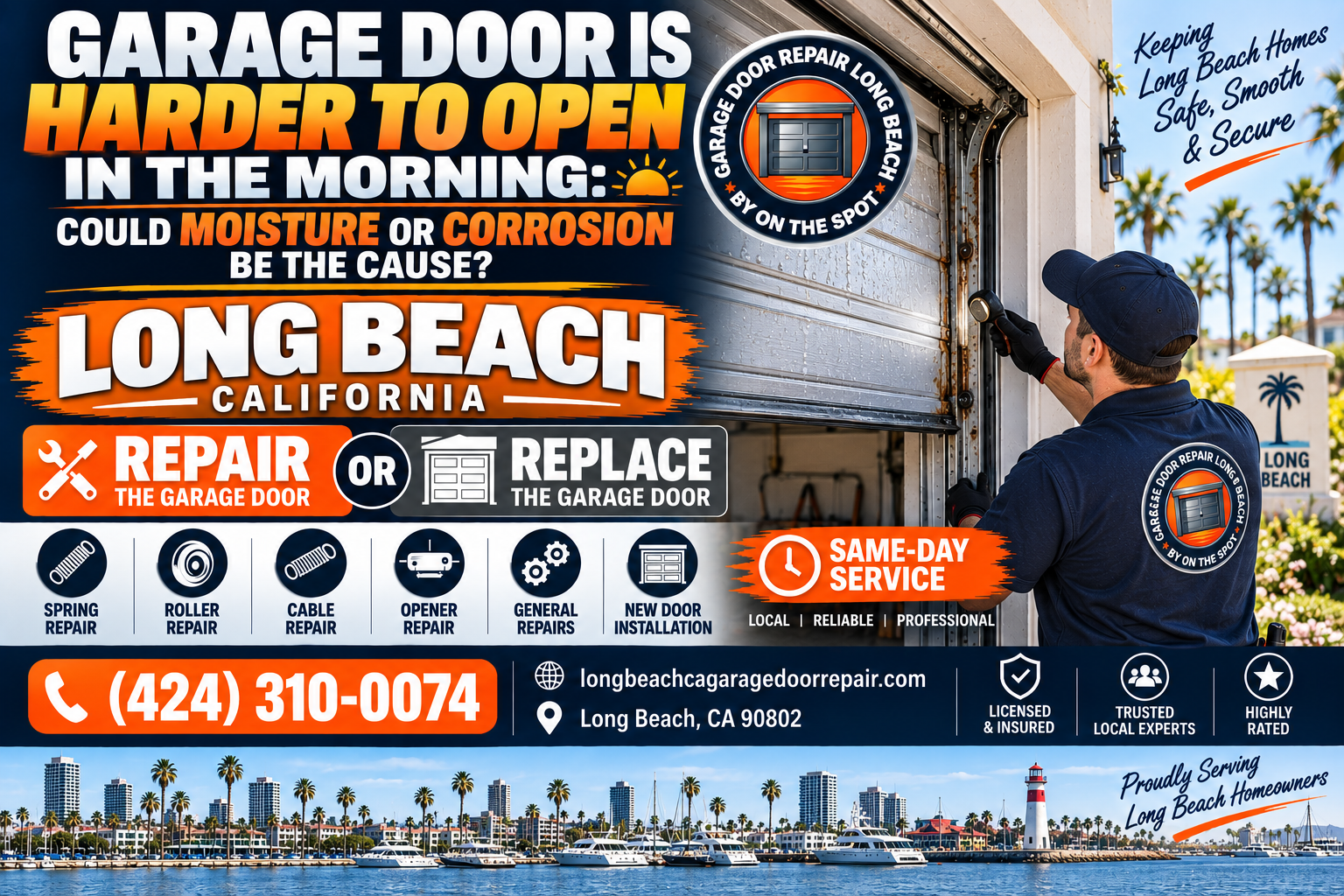
Long Beach Morning Moisture & Corrosion Guide
Garage Door Is Harder to Open in the Morning: Could Moisture or Corrosion Be the Cause?
When a garage door is harder to open in the morning, overnight moisture, coastal corrosion on rollers, hinges, and tracks, cold lubricant that thickened overnight, and spring balance shifts with temperature are common Long Beach causes—especially under the marine layer.
Garage Door Repair Long Beach By On The Spot helps homeowners, renters, landlords, property managers, HOA communities, and small businesses separate morning friction from high-tension spring failures before anyone forces the door or attempts DIY spring work. Diagnosis-first repair restores smooth morning travel across Long Beach, CA.
Moisture & Corrosion
Marine Layer Patterns
CPSC + DASMA + SCE
Serving Long Beach, CA
Direct Answer: Why Is a Garage Door Harder to Open in the Morning?
A garage door that is harder to open in the morning usually faces overnight moisture film, coastal corrosion on rollers, hinges, and tracks, lubricant that thickened in cooler night air, and small spring-balance changes as temperature drops. In Long Beach, the marine layer often leaves a damp, salty film on metal hardware by dawn. That film raises friction exactly when households need the door most. Wood doors can also pick up overnight humidity at edges and panels, while steel doors still suffer sticky rollers and gummy hinges. The opener may strain, reverse, or sound louder even when nothing “broke overnight.” Safe morning checks include watching for crooked travel, listening for grinding, and confirming photo eyes are clear—never winding springs or removing cables yourself.
If the door eases by midday as moisture evaporates and lubricant thins, weather-friction is a strong suspect. If the door stays heavy all day, hangs unevenly, shows orange rust dust, or has spring/cable warning signs, schedule professional diagnosis. Garage Door Repair Long Beach By On The Spot at (424) 310-0074 focuses on finding the friction source first rather than raising opener force to smash through a morning bind.
Why Morning Is Harder: Overnight Physics, Not Bad Luck
Morning difficulty is rarely random. Overnight, garage air cools, relative humidity rises, and condensation can form on cold steel tracks, roller stems, and hinge knuckles. Coastal salt ions hitchhike on that moisture. Static overnight periods also let grit settle into damp lubricant films. At first light, the first opening cycle asks rollers to break static friction—stiction—against a surface that is cooler, damper, and often saltier than it was the evening before.
Temperature also nudges torsion or extension spring behavior. Springs do not “fail overnight” solely because of a fog bank, but cooler metal and higher door friction change the force the opener must supply. A marginally balanced door that felt acceptable in warm afternoon air can feel heavy at 7 a.m. Households then blame the opener remote, the wall button, or “weak batteries,” when the real story is friction plus balance context.
Long Beach mornings intensify the pattern because marine layer clouds limit early sun, so drying is slow. Alleys, shaded carports, and north-facing garages stay wet longer. Doors that sit closed all night accumulate more overnight film than doors that cycled late. Understanding that timeline helps homeowners describe symptoms accurately: harder at dawn, quieter by afternoon, worse after foggy nights, worse near the waterfront.
None of this excuses forcing the door, kicking panels, or climbing ladders to “tighten springs.” Morning hardness is a diagnostic clue. Used correctly, it points technicians toward rollers, hinges, tracks, seals, lubricant condition, and balance testing—not toward guessing that a new opener alone will fix corrosion.
Long Beach Marine Layer Patterns and Garage Door Friction
Long Beach sits under a classic Southern California marine layer for much of the year. Overnight and early-morning low clouds bring cool, moist air inland from the Pacific. Neighborhoods closer to Belmont Shore, Alamitos Bay, the Port, and the Peninsula often feel the damp first. Inland pockets near the 405 or farther north may warm sooner, but shaded garages still hold overnight moisture.
Marine layer days create a repeatable garage-door pattern: evening open feels normal; morning open feels stiff, noisy, or opener-strained; late morning or afternoon feels better. Homeowners sometimes wait weeks thinking the door will “break in,” while rollers keep scoring tracks and corrosion keeps progressing. Seasonal May gray and June gloom stretches the window of morning hardness. Winter drizzle adds liquid water that washes lubricant and packs grit into paste.
Salt air does not require a beachfront address. Onshore breezes carry chlorides across much of the city. Once chlorides sit on bare steel or worn plating, overnight moisture activates corrosion cells. Orange dust on hinges, blackened roller bearings, and rough track channels are common findings on doors that “only stick in the morning.”
Practical takeaway: treat marine layer mornings as a stress test for garage door hardware. If your door consistently fails that test, schedule service before a vacation departure, a landlord turnover, or a week of heavy fog locks you out of a reliable exit.
Overnight Moisture Paths: Condensation, Seals, and Closed-Door Humidity
Moisture reaches garage door hardware through several overnight paths. Condensation forms when warm daytime air trapped in a closed garage cools against metal tracks and hardware. Bottom weatherstrips sitting on damp concrete wick moisture upward. Side seals that do not seat evenly leave gaps for fog-laden air. Roof leaks or driveway splash can wet the bottom section overnight. Cars parked hot and wet drip into the garage after evening errands, raising humidity until dawn.
Wood doors absorb humidity into unfinished edges, decorative overlays, and older coatings with micro-cracks. Even a small overnight swell can increase panel-to-jamb friction. Steel insulated doors resist panel swell but still collect moisture on exterior skins and interior hardware. Aluminum or glass-panel doors can show cold-surface condensation that runs into hinges.
Moisture also changes how dirt behaves. Dry dust rolls; damp dust becomes paste. Paste in track radii and roller bearings raises morning drag dramatically. Once the sun returns and the garage dries, paste can harden into abrasive cake that scores rollers on every later cycle.
Homeowners can reduce overnight moisture load without touching springs: park wet cars briefly with the door open when safe, fix obvious roof drips, keep floor drains clear, and avoid hosing the garage late at night. These steps help—but they do not reverse established corrosion or replace failed rollers. Moisture control is complementary to professional hardware service, not a substitute.
Coastal Corrosion on Rollers, Hinges, and Tracks
Corrosion is one of the strongest answers to “could moisture be the cause?” in Long Beach. Rollers need smooth stems and free bearings or nylon tires. Salt-driven rust pits stems, freezes bearings, and flattens tires. Hinges need free knuckles; rusted knuckles bind section flex as the door arches into the horizontal track. Tracks need clean channels; rust bloom and marine film raise rolling resistance even when the track is still geometrically straight.
Morning is when corrosion shows first because cooler, damper films maximize friction. By afternoon, some moisture evaporates and the same corroded parts may feel “almost normal,” which tricks households into delaying service. Meanwhile, each forced morning cycle accelerates wear. Opener gears and motors work harder. Force settings get nudged upward by DIY attempts, masking the problem until a cable or spring symptom appears.
Visual clues include orange dust under hinges, rough roller faces, black oily rust streaks, pitted bottom brackets, and track discoloration near the ocean-facing side of the garage. Audible clues include grinding at the start of travel, squeals at section hinges, and intermittent thumps as sticky rollers break loose.
Professional remediation may include roller replacement, hinge service or replacement, track cleaning and alignment verification, corrosion-appropriate lubrication, and balance testing after friction is reduced. Painting over rust without mechanical correction is cosmetic only. On The Spot emphasizes fixing the moving interfaces that carry door weight—not covering symptoms with thicker grease.
Cold Lubricant Thickening Overnight
Garage door lubricants are not all equal, and temperature changes their behavior. Greases that feel fine at 75°F can thicken noticeably in a cool Long Beach garage overnight, especially in winter or during strong marine layer events. Wrong products—automotive grease packed into tracks, household oils that attract grit, or silicone sprayed into photo-eye lenses—create morning sludge. Correct hinge and roller lubrication should remain functional across coastal temperature swings; contaminated or washed-out films do not.
Overnight thickening combines with moisture. A film that absorbed salt spray or driveway dust becomes a viscous paste by dawn. The first opener cycle shears that paste with a groan. Later cycles feel easier after the paste warms and redistributes—again producing the classic “harder in the morning” story.
Safe homeowner lubrication is limited: light application of a garage-door-rated lubricant on hinge pivots and roller stems after wiping obvious grit, avoiding tracks as grease traps, and never spraying springs as a DIY “fix” for balance. If lubrication seems to do nothing, or if the door is heavy even when dry and warm, stop and call for diagnosis. Over-lubing a corroded system often worsens grit adhesion.
Technicians evaluate whether morning hardness is primarily lubricant rheology, corrosion, wood swell, seal drag, or spring imbalance. That triage prevents the common mistake of pouring more product onto a door that needs rollers replaced.
Spring Balance Changes With Temperature—and Why That Matters at Dawn
Torsion and extension springs store energy that counterbalances door weight. Metal springs respond subtly to temperature; cooler springs and cooler doors can alter the feel of lift. More importantly, temperature-driven friction changes mean the same spring setting must overcome higher resistance at dawn. A door that was barely balanced in summer may feel opener-dependent on cool, damp mornings.
This is where households confuse “weak opener” with “needs spring adjustment” or worse, attempt DIY winding. Springs are high-tension components. Incorrect winding can cause sudden failure, flying parts, cable derailment, and severe injury. Morning hardness alone is not a license to touch winding cones, stretch extension springs, or remove cables.
Professional balance testing usually includes disconnecting the opener (safely) and checking whether the door holds mid-travel, drifts, or feels drastically heavier than expected. Testing should occur after obvious friction sources are addressed; otherwise friction masquerades as spring failure. Sometimes both exist: corroded rollers plus fatigued springs. The repair plan should sequence friction correction and then verify spring performance.
If you see a visible spring gap, hear a bang history, notice frayed cables, or find the door crooked, treat the situation as urgent high-tension service—not a moisture wait-and-see. Call (424) 310-0074 and keep people clear of the door path.
Wood vs Steel Doors: How Morning Moisture Shows Up Differently
Wood doors commonly gain overnight dimensional change at rails, stiles, and decorative overlays. Humid marine air swells wood fibers; swollen edges rub jambs or bind at the top corners. Older varnish and paint systems with cracks absorb moisture faster. Morning rub marks, fresh paint scuffs, and a door that frees after a dry afternoon are classic wood-moisture signatures.
Steel doors rarely swell like wood, yet they are not immune to morning hardness. Their vulnerability is hardware and seals: steel tracks sweat, rollers corrode, hinges rust, and rubber bottom seals stick to damp slabs. Insulated steel doors can hide internal condensation issues at hardware mounts. Homeowners who assume “steel means no weather problems” delay roller service until the opener starts reversing daily.
Hybrid doors—steel frames with wood overlays, or wood doors with steel hardware—can show both patterns. Glass-light doors add cold glass condensation that drips onto bottom rails. Vinyl or composite skins behave differently again, but shared steel tracks and rollers still corrode in Long Beach air.
Material identity should guide maintenance and coating care, not DIY cutting or planing of swollen wood while wet. Permanent wood fit fixes belong after moisture content stabilizes and often require professional evaluation of jambs, stops, and hardware alignment. Steel door morning issues usually prioritize roller, hinge, track, seal, and balance service.
Safe Morning Checks You Can Do Without Touching High-Tension Parts
Safe checks are observational. Stand clear of the door path. Confirm the photo-eye lenses are clean and aligned, with indicator lights behaving normally. Look for obvious debris on the floor at the threshold. Listen through one full open and close cycle from a safe distance. Note whether difficulty is worst at the first inch of travel, mid-rise, or near the top. Note grinding, squealing, scraping, or popping. Look for orange rust dust under hinges and rollers. Check whether the door looks level across the bottom.
If the opener is connected, do not stand under the door while testing. If you know how to use the emergency release safely and local conditions require manual operation, follow manufacturer guidance and keep fingers away from rollers, hinges, springs, and cables. Many households should skip manual operation entirely when the door feels unusually heavy—heaviness can indicate spring failure, not just moisture.
Document patterns for a few mornings: foggy vs clear, after rain vs dry spell, wood vs steel door type, and whether afternoon operation improves. Photos of rust, track dirt, and seal condition help technicians. These checks never include winding springs, removing cables, prying tracks aggressively, or raising opener force settings to “power through” morning drag.
If anything looks crooked, if cables look loose or frayed, if a spring shows a gap, or if the door fell or slammed recently, stop cycling and call professional help immediately.
Safe Morning Checks vs DIY Spring Work: Draw a Hard Line
Morning moisture and corrosion explain many hard-to-open doors—but springs and cables sit in a different risk category. DIY spring winding, stretch adjustments, and cable reinstallation are among the most dangerous homeowner garage projects. High-tension energy can release suddenly. Tools slip. Cones seize. Cables whip. Injuries and property damage are well documented across the industry.
Even if temperature affects spring feel, the correct response is professional balance testing after friction sources are evaluated. A technician may replace springs when fatigued, re-cable when needed, and set turns to specification for door weight—not to a guess based on a foggy morning. Homeowners should not count winding turns from memory videos or “tighten until it feels better.”
Authority safety culture from CPSC garage door operator guidance and DASMA system safety tips reinforces professional service for critical components and respect for entrapment protection. Raising force controls to overcome morning corrosion is the opposite of that culture. Keep photo eyes working. Keep reverse function intact. Fix friction and balance properly.
On The Spot’s stance is simple: observe safely, lubricate lightly only when appropriate, never DIY springs or cables, and call (424) 310-0074 when morning hardness persists or warning signs appear.
Rollers, Hinges, and Tracks: The Morning Friction Triangle
Most morning hard-to-open complaints that are not spring failures live in the friction triangle of rollers, hinges, and tracks. Rollers carry vertical and horizontal loads; sticky rollers make the opener drag the door instead of rolling it. Hinges articulate each section; frozen hinges force sections to fight each other. Tracks guide the path; dirty or lightly corroded channels amplify both problems.
Nylon rollers can crack or flat-spot; steel rollers can rust at bearings; stem wear creates play that chatters at dawn when films are thickest. End hinges and center hinges experience different loads; coastal corrosion often attacks bottom hardware first because of splash and longer wet time. Horizontal track sections collect dust that mixes with overnight condensation.
Track geometry matters too. A track that is slightly pinched, out of parallel, or dented may feel acceptable when lubricant is warm and dry, then bind when overnight conditions raise friction. Technicians measure clearances and alignment rather than hammering tracks casually. Hammer “fixes” often hide deeper roller failures.
Replacing a full roller set, servicing hinges, cleaning tracks correctly, and applying the right lubricant frequently transforms morning behavior. That package is more durable than weekly WD-40 rituals that wash out and attract grit.
Opener Strain, Force Reverse, and Hard Mornings
Openers are designed to move balanced doors with free hardware—not to act as winches against corroded rollers. On hard mornings, motors sound labored, belts or chains jerk, and force-sensing systems may reverse mid-travel, interpreting friction as an obstruction. Households sometimes increase force limits. That choice can defeat a safety margin and still fail to fix corrosion.
Smart openers may log overnight error events that cluster at first morning cycles. Those logs are useful for technicians, but they do not replace hardware inspection. Battery backup units can also struggle more when mechanical load spikes at dawn; do not assume a weak battery is the only story if rollers are orange with rust.
Storm-related power questions should be separated using SCE outage information when electronics behave oddly after weather. Mechanical morning hardness with normal power is still a friction and balance diagnosis. Mixing power troubleshooting with corrosion neglect wastes time.
After professional friction and balance repairs, opener force and travel limits should be verified so the system protects people and property again. That verification step is part of quality morning-door service in Long Beach.
Symptom Comparison Table: Moisture, Corrosion, Lube, Springs, Opener
| What you notice | Likely morning-related suspects | Immediate action | DIY? |
|---|---|---|---|
| Harder at dawn; easier by afternoon after fog | Overnight moisture film; thickened lube; early corrosion | Document pattern; schedule inspection; avoid forcing | Observation yes; spring work no |
| Orange dust; grinding rollers/hinges on first cycle | Coastal corrosion on rollers/hinges/tracks | Limit cycles; professional hardware service | No roller removal under tension |
| Door heavy even when dry and warm; bang history | Spring/cable issue revealed by friction or fatigue | Stop use; urgent professional repair | No spring/cable DIY |
| Opener reverses mostly on cool damp mornings | Force sensor hitting moisture friction; marginal balance | Do not raise force; diagnose friction/balance | No sensor defeat |
| Wood scuffs at jambs after humid nights | Overnight wood moisture gain at edges | Note pattern; professional fit/hardware check | No planing wet wood |
| Bottom seal sticks to damp slab at open start | Seal adhesion + moisture; threshold grit | Clear floor; dry area; inspect seal | Floor clear yes |
| Electronics odd after storm; hardware feels fine midday | Power event context; opener fault (verify SCE) | Check outage context; professional opener diagnosis | Only safe local resets |
Red Flags That Mean Stop Using the Door and Call Now
Stop cycling the door and call for help if you notice a visible spring separation, frayed or off-drum cables, a door that is crooked or jammed in the track, a door that slammed or dropped, grinding metal with sparks or severe binding, or an opener that strains violently against a door that will not move. Morning moisture does not make those signs “normal weather.”
Also stop if children or pets are tempted to “help lift,” if someone already tried DIY spring tools, or if brackets are pulling away from wood framing. Coastal corrosion can weaken fasteners over years; dawn hardness can be the day a neglected bracket fails.
Keep the doorway clear. Use another exit if needed. Call Garage Door Repair Long Beach By On The Spot at (424) 310-0074.
Seasonal Maintenance for Long Beach Morning Moisture Patterns
Align maintenance with marine layer seasons and winter drizzle. Before prolonged May gray/June gloom, inspect rollers, hinges, tracks, and seals. Replace worn rollers proactively if they already squeal on cool mornings. Clean tracks without packing grease into channels. Confirm weatherstrips seat without tearing. Test opener safety reverse and photo eyes after any hardware service.
Mid-season, reassess doors that worsened after foggy weeks. After winter storms, check for washed-out lubricant, debris paste, and water intrusion at the bottom section. Property managers should calendar multi-unit alleys that stay shaded and damp.
Lubrication intervals on the coast are often shorter than inland desert advice suggests. Salt air is not optional in Long Beach—it is a design condition. Maintenance that ignores chlorides fails early.
Repair Versus Waiting for Afternoon Sun
Waiting for afternoon improvement is fine as a temporary coping strategy for a single foggy day when the door still travels safely and evenly. It is a poor long-term plan when morning hardness repeats for weeks, when rust dust accumulates, or when the opener reverses regularly at dawn. Afternoon sun evaporates moisture; it does not reverse pitting in bearings or fatigue in springs.
Households that wait until a vacation morning lockout, a missed work departure, or a damaged opener gearbox pay more than those who schedule diagnosis during the first clear pattern of morning-only difficulty. Repair restores reliable dawn exits—the moment most people actually need the door.
Same-Day Help When the Door Is Harder to Open in the Morning in Long Beach
When morning hardness blocks work, school, caregiving, or business receiving hours, same-day diagnosis matters. Describe the time-of-day pattern, door material, noises, and any red flags when you call. Clear access to the garage. Keep remote controls available. Note whether the door improved later yesterday—that detail helps triage moisture friction versus constant mechanical failure.
Garage Door Repair Long Beach By On The Spot serves Long Beach from 151 E 5th St with diagnosis-first service aimed at free, safe travel—not force masking. Call (424) 310-0074.
Questions to Ask Before Hiring Help for Morning Hard-to-Open Doors
Ask whether the visit includes roller, hinge, track, seal, lubricant, and balance evaluation—not only an opener sales pitch. Ask how they handle coastal corrosion. Ask whether they adjust force settings only after mechanical friction is corrected. Ask about spring safety practices and whether they discourage DIY winding. Ask for clarification on wood swell versus hardware bind if you have a wood door.
Ask how photo-eye and reverse testing fit into the job. Ask what maintenance interval they recommend for your distance from the water. Clear answers signal a safety-minded provider.
Hiring Red Flags for Morning Moisture and Corrosion Repairs
Be wary of anyone who only raises opener force, who packs thick grease into tracks as a universal fix, who offers to teach spring winding on the spot for a cash discount, who dismisses rust dust as “normal coastal color,” or who quotes a new door before inspecting rollers and balance. Also be wary of parts-only swaps with no safety testing afterward.
Quality service explains findings in plain language, separates moisture friction from high-tension defects, and leaves the door safer than it found it.
Why Consider Garage Door Repair Long Beach By On The Spot?
On The Spot focuses on Long Beach coastal realities: marine layer mornings, salt air corrosion, and the difference between safe observation and dangerous DIY spring work. The company serves homeowners, renters, landlords, property managers, HOA communities, and small businesses with diagnosis-first repair. NAP: Garage Door Repair Long Beach By On The Spot | 151 E 5th St, Long Beach, CA 90802 | (424) 310-0074 | https://longbeachcagaragedoorrepair.com/ | Maps Google Maps CID.
When your garage door is harder to open in the morning, you get hardware-aware troubleshooting instead of a one-size opener replacement guess.
Areas Served From the Long Beach Location
Service focus includes Long Beach neighborhoods and nearby coastal communities where morning marine layer and salt air affect garage doors: Belmont Shore, Belmont Heights, Naples, Alamitos Beach, Downtown Long Beach, Bixby Knolls, Los Altos, El Dorado Park area, California Heights, Wrigley, West Long Beach, and adjacent areas where damp dawn conditions create hard-to-open symptoms. Property managers with multi-site portfolios can coordinate roller and hinge maintenance before fog season peaks.
If you are unsure whether your microclimate is “coastal enough” for corrosion to matter, err on the side of inspection—chlorides travel farther inland than many residents expect.
Google Map Location
Garage Door Repair Long Beach By On The Spot is listed at 151 E 5th St, Long Beach, CA 90802. Call (424) 310-0074 or open the Google Maps CID listing for directions.
FAQs About Garage Doors That Are Harder to Open in the Morning
Why is my garage door harder to open in the morning in Long Beach?
Overnight moisture, coastal corrosion on rollers/hinges/tracks, cold lubricant thickening, and temperature-related balance feel are the usual causes—especially under the marine layer. Wood doors may also swell slightly overnight.
Could moisture or corrosion really be the cause?
Yes. Condensation and salt air raise friction on metal hardware by dawn. Corrosion pits rollers and binds hinges. Moisture is often the trigger; neglected hardware is often the underlying cause.
Why does it get easier in the afternoon?
Moisture evaporates, lubricant thins as it warms, and seals release. Afternoon improvement supports a weather-friction pattern, but progressive rust still needs service.
Is it safe to lubricate the door myself?
Light, correct lubrication on hinges and roller stems can help some doors. Avoid packing grease in tracks, spraying photo eyes, or treating lube as a spring repair. Never DIY springs or cables.
Do steel doors have morning problems too?
Yes. Steel panels swell less than wood, but rollers, hinges, tracks, and seals still respond to overnight moisture and coastal corrosion.
When are springs involved?
When the door stays heavy after drying, hangs crooked, shows spring gaps or frayed cables, or has a slam history. Extra morning friction can push marginal springs into failure—call urgently.
Should I raise my opener force for mornings?
No. Raising force to smash through corrosion or moisture drag reduces safety margins. Fix friction and verify balance instead.
Can the marine layer alone ruin a door?
Marine layer moisture accelerates wear on unprotected or aging hardware. Alone it may cause temporary stiffness; combined with corrosion and neglect it causes chronic hard mornings.
What morning checks are safe?
Visual and auditory observation, photo-eye cleaning, floor debris clearing, and pattern notes. No spring winding, cable work, or ladder work near torsion springs.
Who should I call in Long Beach?
Garage Door Repair Long Beach By On The Spot at (424) 310-0074, 151 E 5th St, Long Beach, CA 90802.
Do power outages cause morning hardness?
Outages affect openers and electronics; verify via SCE when storms coincide. Pure mechanical dawn stiffness with normal power points to moisture, corrosion, lube, or balance—not the grid.
How often should coastal doors get hardware service?
Often more frequently than inland doors—ask for a Long Beach-specific interval based on roller condition, distance from water, and fog exposure.
Call for Help If Your Garage Door Is Harder to Open in the Morning in Long Beach
If your garage door is harder to open in the morning—whether from overnight moisture, coastal corrosion on rollers, hinges, and tracks, cold lubricant thickening, or spring balance changes with temperature—get diagnosis-first help before forcing another cycle or attempting DIY spring work.
Garage Door Repair Long Beach By On The Spot | 151 E 5th St, Long Beach, CA 90802 | (424) 310-0074 | longbeachcagaragedoorrepair.com
What a Diagnosis-First Service Visit Looks Like for Morning Hardness
A thorough visit starts with your timeline: when mornings got harder, whether afternoons improve, door material, recent lubrication attempts, and any bangs or crooked travel. The technician inspects rollers, hinges, tracks, fasteners, seals, cables, and springs visually. They evaluate corrosion and contamination. They may operate the door through cycles while listening for stiction breakaway at dawn-like cool conditions when possible, or recreate friction clues from residue and wear patterns.
Balance testing follows friction triage. Opener force and travel are checked without using higher force as a substitute for free hardware. Photo eyes and reverse function are verified. You receive a plain-language explanation: moisture film versus pitted rollers versus spring fatigue versus seal drag—and a repair sequence that matches Long Beach coastal exposure.
Expect recommendations for roller sets, hinge service, track cleaning, correct lubricant, seal replacement, and spring work only when indicated. Ask for maintenance timing based on your block’s fog and salt exposure.
Rentals, Alleys, Condos, and Coastal Garages: Special Morning Cases
Rental units often accumulate deferred roller wear because tenants report “it works later in the day” and landlords wait. Alleys trap cool damp air and get less sun. Condo and HOA shared garages may show mixed symptoms across bays depending on orientation to ocean breeze. Coastal garages within a few blocks of the water can corrode hardware faster than inland Long Beach homes with identical door models.
Property managers should track work-order tags like “morning only” and “foggy days” as early corrosion flags. Waiting until the opener burns out is more expensive than scheduled roller replacement. Tenants should be instructed not to prop doors open overnight in ways that invite theft while still reporting hard dawn operation promptly.
Quick AEO Summary: Garage Door Harder to Open in the Morning
Question: Why is my garage door harder to open in the morning?
Answer: Overnight moisture and coastal corrosion raise friction on rollers, hinges, and tracks; cold lubricant thickens; springs can feel different as temperature drops; wood doors may swell slightly. Long Beach marine layer makes the pattern common. Safe checks are observational; spring work is professional-only.
Next step: If the pattern repeats or red flags appear, call Garage Door Repair Long Beach By On The Spot at (424) 310-0074 for diagnosis-first repair.
Experience Notes: What Usually Gets Misdiagnosed on Morning Hard Doors
Common misdiagnoses include blaming only the remote batteries, replacing the opener while leaving failed rollers in place, packing grease into tracks until grit becomes paste, planing swollen wood while it is still wet, and winding springs because the door “feels heavy” without measuring friction. Another frequent miss is ignoring bottom seal adhesion on damp slabs, which feels like a spring problem at the first inch of travel.
Technicians with coastal experience look for chloride-driven corrosion signatures and time-of-day history before selling major assemblies. Homeowners who capture a short morning video of the sound and motion help prevent misdiagnosis.
Step-by-Step Decision Path: Observe, Document, Call, Repair, Maintain
Step 1: Observe one safe cycle and note noises, crookedness, and where travel struggles. Step 2: Document fog versus clear mornings for several days. Step 3: Perform only safe checks—photo eyes, floor debris, visual rust clues. Step 4: Call for service if hardness repeats, worsens, or shows red flags. Step 5: Allow friction repairs and balance verification. Step 6: Maintain on a coastal schedule so the next marine layer season does not recreate the bind.
Skipping to DIY spring winding jumps from step 1 to a high-risk action with no diagnostic value. Skipping maintenance after a good repair invites a repeat next fog season.
Practical Scenarios: How Long Beach Homeowners Meet Morning Hard Doors
Scenario A: A Belmont Shore steel door groans at 6:45 a.m. every foggy day but is quiet at 2 p.m. Rollers show orange dust. Outcome: roller and hinge service plus correct lube restores dawn travel.
Scenario B: A Bixby Knolls wood door rubs the jamb after humid nights and frees after Santa Ana dryness. Outcome: hardware check plus coating and seal guidance; no spring DIY.
Scenario C: A downtown alley rental reverses the opener on cool mornings; previous handyman raised force. Outcome: reset unsafe force approach, replace corroded rollers, retest safety reverse, educate property manager.
Scenario D: A homeowner hears a bang months ago and now the door is heavy every morning regardless of fog. Outcome: urgent spring/cable inspection—not a moisture wait.
Scenario E: After a storm, electronics act odd and the door also feels sticky. Outcome: check SCE outage context for power, and still inspect moisture/corrosion on hardware so both paths are covered.
Moisture Science Deep Dive: Films, Hygroscopic Dirt, and Dawn Stiction
Overnight moisture on garage door hardware is often a thin film rather than visible puddles. That film changes the coefficient of friction at roller–track interfaces and hinge knuckles. Hygroscopic dirt—dust that absorbs water—swells slightly and becomes tacky. Static overnight contact lets asperities settle into that tacky film. The first motion must break stiction, which is why the initial opener surge sounds worst.
Relative humidity climbs as garage temperature falls at night. Metal tracks are thermal bridges that cool faster than room air, collecting condensation even when walls feel dry. Doors closed tightly trap that microclimate. Doors with leaking seals exchange moist marine air continuously.
Salt ions dissolve into the film, creating an electrolyte that drives corrosion cells on steel. Corrosion products roughen surfaces, which then hold even more moisture next night—a feedback loop. Breaking the loop requires mechanical cleaning/replacement of damaged interfaces and better lubrication practice, not only a dehumidifier placed once.
Understanding films and stiction helps homeowners describe symptoms precisely: “first six inches are the hardest,” “sounds like peeling,” “improves after one cycle.” Those phrases point technicians to moisture-friction rather than random opener failure.
Corrosion Deep Dive: Chlorides, Pitting, and Coastal Intervals
Long Beach chlorides arrive via salt spray, fog, and onshore wind. On plated or painted hardware, damage often starts at chips and wear points. Roller bearings and hinge pins are prime sites because motion scrapes protective films. Bottom brackets and fasteners near splash zones corrode earlier. Once pitting starts, lubricant cannot fully separate rough surfaces.
Corrosion intervals vary by distance from water, garage openness, whether cars drip seawater after beach trips, and whether prior service used inappropriate lubricants. A door two blocks from Alamitos Bay may need roller attention sooner than a sheltered inland garage—even on the same brand and year.
Technicians distinguish surface rust stains from functional binding. Surface stains may clean; functional binding needs parts. Reusing deeply pitted stems inside new bearings is a false economy. Full roller replacement sets are often the durable coastal answer.
After corrosion service, keep a photo baseline of hardware color and dust. New orange dust within weeks after service can indicate residual contamination or an aggressive microclimate needing shorter intervals.
Lubricant Temperature Deep Dive: Viscosity, Washout, and Contamination
Viscosity rises as temperature falls. A lubricant that sheared nicely in afternoon heat can resist motion at dawn. Products not rated for garage door hinges may thicken excessively or separate. Water washout after drizzle removes protective films and leaves binders that gum overnight. Silicone overspray on tracks can feel slick briefly then combine with dust into streaks that grab.
Best practice uses garage-door-appropriate lubricants on pivot points and roller stems, keeps track channels relatively clean rather than grease-packed, and re-applies on coastal intervals. If morning hardness vanishes for two days after light correct lubrication and then returns with grinding, suspect worn rollers rather than “needs more oil.”
Never use lubricant to quiet a spring that is failing. Noise changes after a bang event are diagnostic warnings, not invitations to spray and ignore.
Temperature and Balance Deep Dive: Why Dawn Feels Different
Door weight is constant in the short term; required lift force is not, because friction changes. Springs calibrated in warm conditions may feel insufficient when dawn friction spikes. Cooler spring temperature itself contributes a smaller effect than friction for most Long Beach ranges, but both can stack.
Professionals measure balance with the opener disconnected only when safe, looking for drift and holding points. They compare cool-morning complaints with actual hardware drag. If drag is high, they fix rollers/hinges first. If drag is normal and the door still fails balance, springs or cables are addressed with proper tools and containment practices.
Homeowners should treat persistent heaviness after dry warm afternoons as a balance red flag independent of fog. Morning-only heaviness that tracks marine layer days leans moisture/corrosion first.
Family and Workplace Safety Routines While Waiting for Repair
While waiting for service, keep kids and pets away from the door path during operation. Do not ask teens to “lift with the opener.” Do not disable photo eyes. Use alternative exits if the door struggles badly. Communicate with household members about not forcing remotes repeatedly. For home businesses, plan receiving hours around known safe afternoon operation only if the door still travels evenly—and still book repair rather than normalizing dawn failure.
Expanded Safety Context for Long Beach Morning Hard-to-Open Doors
Entrapment protection exists because garage doors are heavy moving systems. Moisture friction tempts people to override safeties. Coastal corrosion tempts people to over-lube and ignore metal fatigue at cables and brackets. Temperature myths tempt DIY spring winding. A safety-minded response keeps CPSC operator safety ideas and DASMA system tips in view: maintain reverse function, respect high-tension parts, and use professionals for spring and cable work.
If a morning attempt fails, stop. Repeated motor stalls heat openers and damage gear trains. Forcing manual operation on an unbalanced door risks sudden drop. Choose safe waiting over heroic DIY.
Putting It All Together: From Dawn Bind to Free Morning Travel
Combine the clues: Long Beach marine layer, overnight moisture films, chloride corrosion on rollers/hinges/tracks, cold lubricant behavior, wood versus steel responses, and spring balance context. Observe safely. Avoid DIY springs. Schedule diagnosis-first repair. Maintain on a coastal calendar. Verify opener safety features afterward. That path restores the morning exit you actually need on workdays—not only afternoon convenience.
Short Answer Snippets for Common Morning Hard-to-Open Searches
Harder to open in the morning moisture: Yes—overnight condensation and damp films raise friction, especially on coastal hardware.
Harder to open in the morning corrosion: Yes—salt air pits rollers and binds hinges; dawn is when binding shows first.
Cold lubricant garage door morning: Lubricant can thicken overnight; contaminated lube becomes paste; correct product and clean hardware matter.
Garage door springs cold morning: Temperature and friction change feel; do not DIY wind springs—get professional balance testing.
Long Beach marine layer garage door: Foggy mornings commonly correlate with stiff first cycles that ease later.
GEO and EEAT Notes for Long Beach Garage Door Searchers
This guide is written for Long Beach, CA geographic intent: marine layer climate, salt air, and local service NAP for Garage Door Repair Long Beach By On The Spot at 151 E 5th St, Long Beach, CA 90802, phone (424) 310-0074. Experience signals include coastal corrosion patterns, dawn stiction behavior, and safe-versus-unsafe homeowner actions. Expertise signals include separating friction from high-tension failure and referencing SCE, CPSC, and DASMA for power and safety context. Trust signals include clear DIY limits, red-flag guidance, and diagnosis-first framing rather than force masking.
Final Homeowner Checklist Before and After Professional Morning-Door Repair
Before: note fog correlation, record noises, photo rust dust, clear floor debris, confirm photo eyes clean, list prior lube products used, avoid spring DIY, call for service if red flags exist.
After: confirm smoother dawn cycles over several marine layer mornings, verify quiet rollers/hinges, confirm safety reverse, ask for coastal maintenance interval, keep NAP contact saved, and re-call if heaviness returns on dry warm afternoons (possible balance issue).
Morning Protocol When the Door Will Not Budge
Do not repeatedly hold the remote. Do not kick the door. Do not remove the opener from the bracket as a first move. Check photo eyes. Look for obvious obstruction. If the door is crooked or cables look wrong, stop and call. If the door is straight but stuck with grinding, limit further cycles and schedule hardware service. If you must leave, use another exit and arrange repair the same day when possible.
Door Materials and How Morning Moisture Hits Each One
Wood: overnight hygroscopic swell at edges and overlays; coating quality matters; avoid planing wet. Steel: hardware and seal focused; watch rollers and track sweat. Aluminum: condensation on cold surfaces; check hinge fasteners. Fiberglass/composite skins: still rely on steel tracks/rollers that corrode. Glass-panel doors: drip paths onto bottom hardware. In every material class, Long Beach chlorides still attack ferrous parts.
Track Geometry When Temperature and Moisture Shift Overnight
Tracks expand and contract slightly with temperature; moisture adds film thickness and dirt swell in channels. A marginal pinch may bind only at dawn. Technicians measure spacing and alignment rather than relying on hammer taps. After roller replacement, tracks should be rechecked because new roller diameters and wear patterns change contact points.
Weatherstripping, Thresholds, and Sticky Morning Seals
Bottom seals can adhere to damp concrete overnight, creating a strong first-inch pull that feels like a spring problem. Side seals can soften and grab jambs when wet. Thresholds with mud or algae add suction. Cleaning the slab and replacing hardened seals often removes a surprising share of “morning only” complaints—after confirming rollers are not also failing.
Opener Rails, Chains, Belts, and Cool Garages
Opener rails and drives also sit in cool overnight air. Dry chain links or contaminated belt dust can add minor drag, but they rarely equal the friction of corroded door rollers. Service should still include a glance at the rail for debris and proper lubrication points per manufacturer guidance—without treating rail oil as a cure for track rust.
A Coastal Morning Maintenance Calendar for Long Beach Doors
Early spring: inspect rollers and hinges before May gray intensifies; replace noisy rollers proactively. Late spring through early summer: expect marine layer mornings; re-lubricate correct points if cycles sound dry; do not grease-pack tracks. Early fall: reassess after summer beach traffic and salt exposure; check bottom seals. Winter: after drizzle periods, clear debris paste, check washout, verify opener safety functions, and watch for new orange dust.
Quarterly: photo-document hardware condition for rentals and HOA bays. Annually: professional tune-up with balance test, especially if dawn hardness appeared any season. After any flood splash or roof leak: immediate inspection for accelerated corrosion at bottom sections.
Mark fog-season reminders on the household calendar the same way you mark HVAC filter changes. Morning door reliability is a commuting safety issue, not a cosmetic preference.
Cost Context: Service vs Forced-Damage Repairs
Replacing a roller set and servicing hinges on a coastal schedule usually costs less than replacing an opener gear train damaged by months of dawn overload, less than repairing track damage from forced cycles, and far less than emergency spring/cable failures after chronic imbalance and friction. Waiting for a vacation lockout adds secondary costs: missed flights, locksmith-adjacent stress, and rushed decision-making.
Quotes should itemize hardware, labor, spring work if needed, and safety testing. Beware of ultra-low bids that only spray lubricant and leave. Ask how long coastal rollers typically last on your street’s exposure profile.
Myths About Garage Doors That Are Harder to Open in the Morning
Myth: “If it opens in the afternoon, nothing is wrong.” Reality: afternoon relief often means moisture friction and early corrosion are already active.
Myth: “Steel doors do not care about fog.” Reality: steel hardware corrodes; seals stick; openers still strain.
Myth: “More force on the opener fixes mornings.” Reality: it masks danger and can worsen failures.
Myth: “WD-40 weekly is maintenance.” Reality: wrong products and over-spray create grit paste.
Myth: “Heavy in the morning means tighten springs yourself.” Reality: springs are professional-only; heaviness needs diagnosis.
Myth: “Only beachfront homes get salt damage.” Reality: marine air reaches much of Long Beach.
Myth: “New opener solves corrosion.” Reality: openers move doors; they do not replace rollers.
Photo Documentation Tips for Faster Morning-Door Service
Photograph rollers close-up, hinge knuckles, track channels, bottom seal contact line, spring overview from a safe distance without climbing into the spring area, and the door bottom across the opening to show level. Short video of the first morning opening cycle helps capture sound. Share fog versus clear day notes. Avoid photographing while standing under a moving door.
Talking With Neighbors, HOAs, and Landlords About Dawn Hardness
Neighbors in the same alley often share marine layer timing. If several doors groan at dawn, corrosion intervals may be due for the block. HOAs should budget roller programs rather than repeated opener complaints. Landlords should treat “works later” tickets as maintenance signals. Shared language—“morning moisture friction” versus “broken opener”—improves dispatch accuracy.
Friction, Stiction, and Why Morning Is Worst
Stiction is the extra force needed to start motion from rest against a sticky interface. Overnight, damp films and cooled lubricant maximize stiction at rollers and hinges. Once moving, kinetic friction is often lower, so the door “gets better” mid-cycle even before the sun arrives. That physics explains why the first remote press feels worst and why repeated short attempts stress openers.
Reducing stiction means smoother, cleaner rolling interfaces and appropriate lubricant films—not stronger motors alone.
Water Intrusion Paths Into Garages and Doors Overnight
Driveway slope splash, irrigation overspray at night, roof edge drip, condenser condensate lines, and wet vehicles all raise overnight humidity. Side-load garages facing ocean breezes exchange moist air through imperfect seals. Addressing intrusion reduces how often hardware sits wet—but already pitted rollers still need replacement.
Quiet Operation Versus Free Operation
A door can be quiet yet hard to lift if thick grease damps sound while packing grit. Conversely, a free door can squeak without being unsafe. Prioritize free, balanced, safe travel over silence alone. Morning evaluation should ask: does it roll freely at dawn, not only does it sound nicer after spray.
Emergency Release Cords on Hard Mornings
The emergency release disconnects the opener for manual operation. On a moisture-bound but balanced door, manual lift may still be difficult. On a spring-failed door, manual lift can be dangerous or impossible. If the door feels extremely heavy after release, stop and call professionals. Do not pull the release while the door is open unless you understand the risks of an unbalanced door dropping. Follow manufacturer guidance and prioritize personal safety.
Kids, Pets, and Morning Door Rules
Rush-hour mornings are chaotic. Set a rule: only adults operate a door that has been sticking. Keep pets from dashing under a hesitating door. Do not let kids “help lift” panels. If the opener reverses, treat it as a stop signal, not a challenge. Teach teens that photo eyes are safety devices, not obstacles to bypass with cardboard.
Business Continuity When a Bay Door Sticks at Dawn
Small businesses receiving early deliveries cannot rely on afternoon sun. A sticky dawn bay delays staff, trucks, and customers. Keep a service contact posted, schedule pre-fog-season hardware checks, and avoid force overrides that risk downtime from opener failure. Document morning incidents for maintenance budgets.
What Technicians Recheck After Morning Moisture and Corrosion Repairs
After repairs, technicians recheck roller freedom, hinge articulation, track clearances, lubricant placement, door balance, opener force and travel limits, photo-eye alignment, and reverse performance. They may advise a follow-up after the next heavy marine layer week. Homeowners should report if dawn hardness returns quickly—that feedback refines whether seals, intrusion, or residual corrosion need another pass.
More Homeowner Questions About Morning Hard-to-Open Doors
Can I leave the door slightly open overnight to reduce humidity? That may reduce condensation in some garages but raises security and pest risks; it is not a substitute for hardware service.
Does a dehumidifier fix corrosion? It can reduce moisture load inside sealed spaces but will not rebuild pitted rollers.
Are stainless rollers required near the beach? Upgraded materials can help in aggressive exposure; ask during estimate about coastal-rated options.
Why did hardness start suddenly after months of fog? Wear is cumulative; a bearing can seize quickly after progressive damage.
Can earthquake sensors or smart features cause dawn issues? Usually not the primary cause of moisture friction; still mention recent add-ons when you call.
Why Full-Depth Guidance Matters for This Symptom
Morning hardness sits at the intersection of climate, chemistry, mechanics, and safety behavior. Thin tip lists that only say “lubricate” leave households forcing doors and winding springs. Full-depth guidance connects Long Beach marine layer patterns to rollers, hinges, tracks, lubricant rheology, wood versus steel responses, and professional spring limits. That depth supports better homeowner decisions and better conversations with technicians.
Expanded Coastal Cases Across Long Beach Microclimates
Peninsula and Belmont Shore exposure often means stronger salt and cooler dawns. Downtown canyon streets can hold shade dampness. Near-port industrial edges may add dust that becomes morning paste. Inland Long Beach neighborhoods still see marine layer push but may dry faster after sunrise. Hills and open western exposures differ from enclosed courtyards. Describe your microclimate when booking: shaded alley, ocean block, inland, second-row condo garage—each changes corrosion speed and moisture dwell time.
Additional Long Beach Morning Moisture Depth Notes (1)
Additional depth note set 1: Harder-to-open mornings remain a moisture-and-friction story until spring or cable evidence proves otherwise. Homeowners should keep describing dawn versus afternoon differences, material type, and noise character. Technicians should keep refusing force-masking as a fog-season tune-up. Authority links to SCE, CPSC, and DASMA remain relevant whenever storms, entrapment protection, or high-tension components enter the conversation.
Repeatable education reduces panic. A neighbor who already scheduled coastal roller service can model good behavior for the block. A landlord who funds hinges before June gloom funds fewer emergency lockouts. A business that checks the bay door the evening before a forecast marine layer avoids dawn chaos.
Keep floors reasonably dry after washing cars in the garage late at night. Keep salt-heavy beach gear from dripping directly on bottom brackets when possible. Keep storage from pressing weatherstrips into deformed shapes that grab when wet. Keep ladders from leaning into tracks overnight.
If you upgraded to a smart opener, use event logs as clues for morning force events, then still fix hardware. If you still have a legacy opener, do not interpret age alone as the dawn-stiffness cause. If you are between wood and steel replacement quotes, ask how each option handles coastal overnight moisture—not only insulation R-value.
This depth section exists to ensure homeowners receive full-context guidance rather than a thin tip list. The practical next step is still the same: safe observation, then call Garage Door Repair Long Beach By On The Spot at (424) 310-0074 when the garage door is harder to open in the morning.
Additional Long Beach Morning Corrosion Depth Notes (2)
Additional depth note set 2: Coastal corrosion on rollers, hinges, and tracks often announces itself at dawn before it announces itself at noon. Orange dust is not “paint aging.” Grinding on first open is not “character.” An opener that smells hot after morning use is not “warming up.” Those signals mean interfaces are fighting.
Chloride-driven pitting is progressive. Each wet night adds electrochemical activity on unprotected steel. Each forced cycle ploughs rough surfaces against track walls. The economic choice is earlier roller replacement, not later opener replacement. Households that document the first month of morning hardness usually spend less than households that endure a full fog season of denial.
For wood doors, corrosion still matters because hinges and tracks are metal. For steel doors, corrosion is often the main story. For glass-light doors, drip lines create localized corrosion maps that look mysterious until you watch condensation paths.
Ask technicians to show you the worn parts they remove. Seeing flattened roller tires or rust-locked bearings converts abstract advice into concrete understanding for the next maintenance cycle.
Call (424) 310-0074 when corrosion signs accompany morning hardness in Long Beach.
Additional Long Beach Cold Lubricant and Spring Context Notes (3)
Additional depth note set 3: Cold lubricant thickening explains some dawn stiffness without condemning every door to new springs. Contaminated lubricant explains even more. Spring temperature effects exist but are frequently over-blamed by DIY videos. The disciplined approach tests friction first, then balance, then spring replacement if needed.
Homeowners should inventory what products were sprayed in the last year. Silicone on photo eyes, grease in tracks, and oil on nylon roller tires can each create distinct morning behaviors. Bring the product names to the appointment. Honesty about DIY attempts helps technicians clean correctly instead of layering new product on sludge.
If a spring bang already happened, skip lubricant experiments. High-tension failure modes override weather narratives. Keep clear and schedule urgent service.
If no bang occurred and afternoons are fine, moisture-corrosion-lube triage remains first-line. Either way, avoid winding cones yourself.
On The Spot can separate these layers on-site across Long Beach microclimates.
Additional Long Beach Safe-Check and Family Routine Notes (4)
Additional depth note set 4: Safe morning checks protect families while preserving diagnostic clues. Watching from the side, listening for grind location, noting whether the bottom seal peels slowly, and confirming photo-eye lights take minutes and prevent bad decisions. Teaching every licensed driver in the household the same rules prevents the teen with a morning class from raising force settings secretly.
Print a simple rule card near the wall button: “Hard at dawn? Do not force. Check eyes. Call On The Spot (424) 310-0074 if crooked, grinding badly, or heavy all day.” Rule cards sound simple because morning stress is high and memory is low.
Pets should be leashed or gated away from the door during troubleshooting weeks. Delivery drivers should be warned if the door is intermittent. Package theft risk rises when doors are left open to “air out” overnight; prefer hardware repair over security compromises.
These routines bridge the gap between noticing a problem and completing professional repair without injuries or secondary damage.
Additional Long Beach Morning Hard-to-Open Depth Notes (5)
Additional depth note set 5: A garage door that is harder to open in the morning is asking for a coastal diagnosis, not a lecture about patience until noon. Overnight moisture, corrosion on rollers, hinges, and tracks, cold lubricant thickening, and spring balance changes with temperature form a coherent symptom cluster for Long Beach. Wood versus steel changes the panel story but not the need for safe limits around springs. Authority references from SCE, CPSC, and DASMA frame power context and safety culture when storms or entrapment protection enter the picture.
Semantic SEO for this topic should stay faithful to user intent: time-of-day hardness, moisture, corrosion, marine layer, and safe next steps. EEAT means local NAP clarity, practical experience notes, and honest DIY boundaries. AEO means direct answers early. GEO means Long Beach climate specificity.
If you remember only one action: observe safely, do not DIY springs, and call Garage Door Repair Long Beach By On The Spot at (424) 310-0074 when morning hardness repeats or red flags appear. Address: 151 E 5th St, Long Beach, CA 90802. Website: longbeachcagaragedoorrepair.com.
This final depth block reinforces that full-context guidance beats thin tips. Free morning travel is achievable with the right hardware service and coastal maintenance habits.