
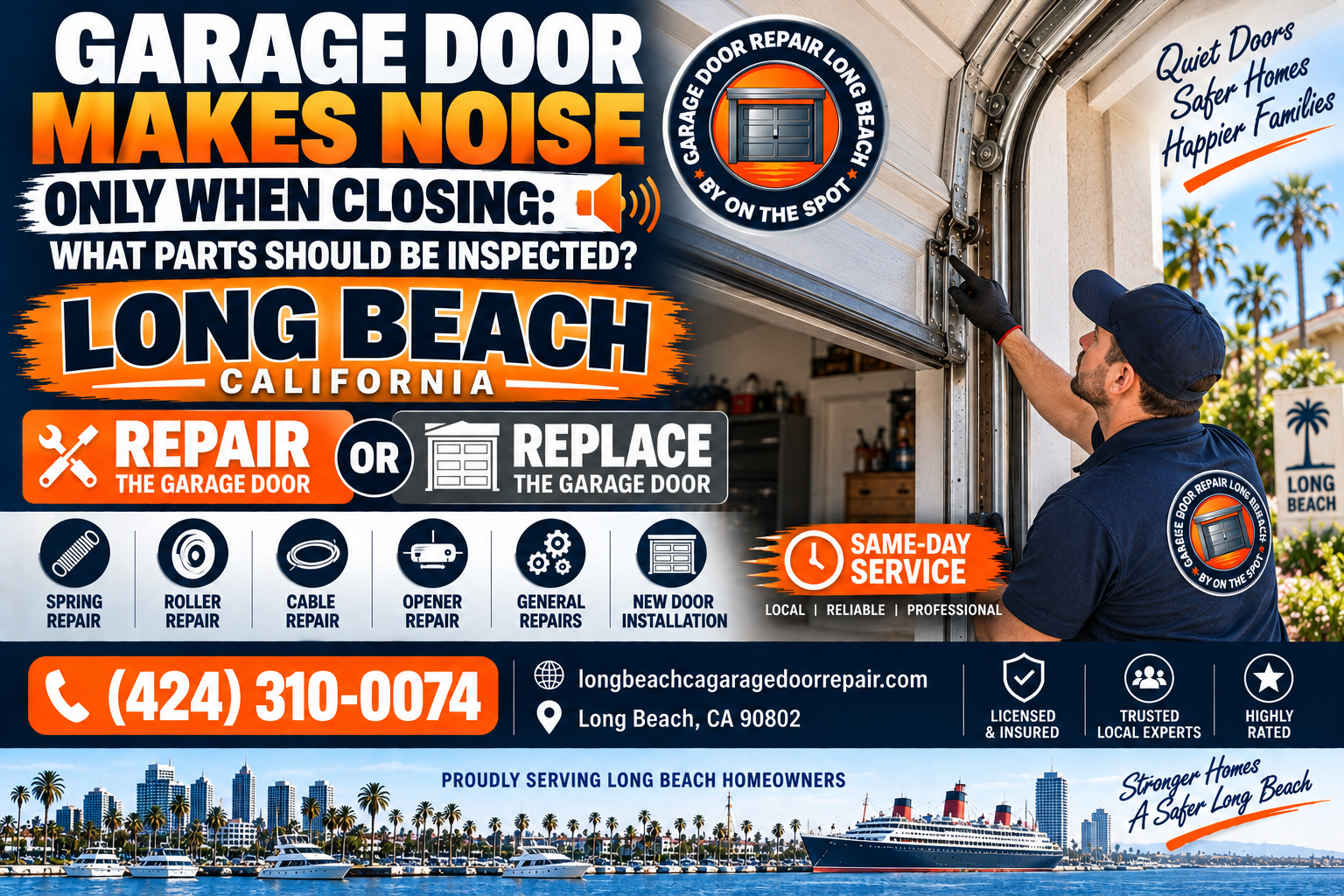
Long Beach Closing-Noise Inspection Guide
Garage Door Makes Noise Only When Closing: What Parts Should Be Inspected?
When a garage door makes noise only when closing, rollers, hinges, tracks, lift cables, opener gear/chain/belt under closing load, loose hardware, and loose panels are the prime inspection targets—especially where Long Beach coastal corrosion turns squeaks into grinds.
Garage Door Repair Long Beach By On The Spot helps homeowners, renters, landlords, property managers, HOA communities, and small businesses map grinding vs squeaking vs popping with safe listening diagnosis—without DIY spring work. Diagnosis-first repair restores quieter, safer closing across Long Beach, CA.
Rollers · Hinges · Tracks
Cables & Opener Drive
CPSC + DASMA + SCE
Serving Long Beach, CA
Direct Answer: Why Does a Garage Door Make Noise Only When Closing?
A garage door that makes noise only when closing usually points to parts that are under higher load, different roller contact angles, or opener drive strain during the downward travel—not a random mystery. Closing loads press rollers into tracks differently than opening loads, can tighten cable wrap on drums, and force hinges to articulate under panel weight plus opener push. Typical inspection targets include rollers (worn bearings, flat spots, nylon vs steel), hinges (worn knuckles, missing fasteners), tracks (dents, misalignment, corrosion scale), lift cables (fray, improper seating), opener gear/chain/belt systems under closing load, loose hardware, and loose or rattling panels.
Grinding often suggests metal-on-metal roller or gear wear; squeaking often tracks to dry hinges, rollers, or weather seals; popping or banging can mean loose hinges, panel joints, or cable/drum seating issues. In Long Beach, coastal corrosion accelerates dry squeaks into grinding and can make closing travel noisier first because salt films and pitting concentrate where rollers scrub hardest on the way down.
Safe listening diagnosis means standing clear of the door path, noting where in the close cycle the sound starts, whether it is one-sided, and whether the door still reverses on obstruction—without adjusting torsion or extension springs yourself. DIY spring work is unsafe. Call Garage Door Repair Long Beach By On The Spot at (424) 310-0074 for diagnosis-first inspection at 151 E 5th St, Long Beach, CA 90802.
Why Noise Shows Up Only When Closing—Not When Opening
Homeowners often assume a garage door should sound the same going up and going down. In practice, the closing cycle creates a different mechanical story. During opening, the opener (or balanced springs) lifts against gravity with rollers typically lightening against certain track faces. During closing, gravity assists, but the opener must control descent while rollers may bear harder against opposite track surfaces, hinges fold under panel stack weight, and cables wrap under changing tension profiles.
That asymmetry explains a classic complaint: quiet on the way up, noisy on the way down. A roller with a failing bearing may spin acceptably under lighter opening contact yet grind when closing pressure increases. A hinge with a dry knuckle may squeak only when panels fold under closing articulation. A loose track bracket may stay quiet until closing vibration excites it. An opener drive gear that is worn may chatter when pushing the door closed against residual spring imbalance.
Long Beach coastal homes add salt air and marine-layer moisture that thicken contamination films overnight and between uses. Closing often becomes the first cycle of the day that reveals the noise after the door has sat open or closed with damp hardware. Understanding closing-only noise as a load-direction symptom keeps diagnosis focused on rollers, hinges, tracks, cables, opener drive under closing load, hardware torque, and panel integrity—rather than guessing at unrelated electronics.
Direction-specific symptoms are diagnostic gifts. When you tell a technician the door is quiet opening but noisy closing, you have already narrowed the mechanical hypotheses. That saves time and reduces the chance of an unnecessary opener replacement when rollers or hinges were the real cause.
Safe Listening Diagnosis: What to Note Before Anyone Touches Hardware
Safe diagnosis starts with ears and eyes, not wrenches on springs. Stand well clear of the door’s travel path and keep children, pets, and vehicles out of the bay. Operate the door from a safe vantage and note: (1) where in the close cycle the noise begins—top third, mid-travel, or near the floor; (2) whether the sound is left side, right side, or centerline; (3) whether it is grinding, squeaking, popping, buzzing, or rattling; (4) whether noise intensity changes if you pause mid-close (if your opener allows a safe stop); (5) whether photo eyes and auto-reverse still work.
Do not place hands near rollers, cables, springs, or the opener rail while the door moves. Do not disconnect the opener with the emergency release unless you understand the door may be heavy or unbalanced. Listening notes help a technician prioritize: mid-track grind often implicates rollers or track scale; hinge-line squeak suggests hinges; drum-area pop may involve cables; motor-head grind under closing load suggests gear/chain/belt issues.
Document with a short phone video from a safe angle if helpful for remote triage—then schedule an on-site inspection. Garage Door Repair Long Beach By On The Spot uses listening clues as a starting map, then verifies with hands-on checks of rollers, hinges, tracks, cables, opener drive, and hardware—without asking homeowners to DIY high-tension parts.
A simple notepad works: write left grind at mid height or squeak at panel two. Those phrases map directly to inspection order. Avoid repeating dozens of cycles just to show a neighbor; each noisy close can worsen wear while you wait for service.
Rollers: Closing Load, Bearings, Flat Spots, and Coastal Wear
Garage door rollers are among the most common sources of closing-only noise. Each roller rides in a track and must rotate freely as sections move. When bearings wear, nylon tires crack, or steel rollers lose lubrication, the wheel may skid or chatter—especially under the higher side-load that closing can apply on certain track faces.
Inspect (professionally) for flat spots, cracked nylon, seized bearings, excessive play on stems, and rollers that are not fully seated in the track. Closing noise that travels with a specific section often tracks to that section’s rollers. Coastal Long Beach salt air corrodes roller stems and bearings; salt films raise friction so that closing scrubbing becomes audible first.
Worn rollers rarely fix themselves. Continuing to run a grinding roller can score tracks, increase opener strain, and escalate from squeak to metal grind. Replacement with quality rollers matched to your track size and door weight is a frequent, high-value repair. Nylon rollers can quiet operation; steel rollers may suit heavier doors—but either type fails when bearings seize. A technician chooses based on door design, not marketing alone.
Homeowners should not force a grinding door through repeated cycles hoping it will work itself free. That approach can convert a roller job into track replacement and opener stress. If closing grind is loud, intermittent, or one-sided, treat rollers as a top inspection priority.
On heavier insulated doors, roller quality matters even more under closing load. Cheap rollers may quiet briefly then seize. Investing in appropriate rollers reduces repeat closing-noise calls and protects track interiors from scoring that is expensive to correct later.
Hinges: Knuckles, Fasteners, and Popping Under Closing Articulation
Sectional garage doors articulate on hinges between panels. During closing, hinges fold and unfold under changing panel weights and opener push. Dry knuckles squeak; worn pins create play; missing or loose bolts allow panels to shift and pop. Closing-only hinge noise is common because hinge loading and angle change differently than during opening.
Look for elongated holes, rusted hinge leaves, missing center hinges on multi-hinge doors, and fasteners that have backed out. Coastal corrosion pits hinge pins and leaves, turning a quiet hinge into a squeaking or grinding joint. Popping near panel joints during the last half of closing often implicates hinges or loose panel hardware rather than the opener motor itself.
Lubrication with a garage-door-appropriate lubricant can quiet dry hinges temporarily, but lubrication is not a cure for worn pins, cracked leaves, or missing fasteners. Over-greasing with the wrong product can attract grit that later grinds. Professional inspection separates needs lube from needs hinge replacement and from panel or track geometry is forcing hinge bind.
Never ignore hinge noise that coincides with visible panel misalignment. A hinge failure mid-travel can allow a section to shift dangerously. Closing-only noise is an early warning that deserves planned repair, not wait-until-it-breaks habits.
Wide doors with multiple hinges per joint need a full hinge-line survey. Maintaining only end hinges while center hinges loosen is a common reason popping returns after incomplete service.
Tracks: Dents, Misalignment, Scale, and Closing Scrub
Vertical and horizontal tracks guide rollers. Even small dents, flared edges, or out-of-plumb brackets change how rollers scrub—often more audibly on the way down. Closing can press rollers into damaged spots that opening clears with lighter contact. Corrosion scale inside tracks acts like sandpaper; salt air in Long Beach accelerates that scale near the coast, alleys with poor drainage, and garages that see fog drip.
Track inspection covers bracket tightness, gap consistency, junction alignment between vertical and horizontal sections, and clearances at the flag bracket area. A track that pings or grind-squeals during mid-close may have a localized deformation. Forcing the door or raising opener force to push through a track bind is unsafe and can damage rollers, cables, and the opener.
Track adjustment and repair require careful measurement; DIY track bending risks making binding worse. Professionals correct geometry, replace damaged sections, and recheck roller travel through a full close cycle. If your closing noise is a sharp scrape at the same height every time, mark that height with tape on the wall (not on the moving door) so a technician can correlate track position quickly.
Horizontal track sag can make the late-close handoff noisy as rollers negotiate the curve. Bracket spacing and lag depth into framing matter; vibration from closing loosens brackets over years, especially with corrosion under bracket plates.
Lift Cables and Drums: Closing Wrap, Fray, and Popping Risks
Lift cables and drums are high-tension partners of the spring system. During closing, cable wrap geometry on the drums changes as the door descends. A cable that is frayed, improperly seated, or rubbing can click, pop, or squeal more on closing. Uneven cable tension can also make one side noisier.
Cable problems are safety-critical. Do not attempt to rewind drums, cut cables, or adjust spring tension to quiet a cable noise. A failing cable can snap and allow sudden door movement. Closing-only cable noise—especially with visible fray, bird-caging, or rust—means stop casual use and call for professional service.
Long Beach coastal corrosion attacks cable strands. Moisture from the marine layer plus salt residues create rust that reduces cable flexibility and increases noise under closing wrap. Technicians inspect cable condition, drum grooves, set screws, and related hardware as a system—not as isolated squeaks.
If you hear a sharp pop near the end stilts or drums during closing, treat it as a red flag: clear the area, avoid further cycles if unsafe, and contact Garage Door Repair Long Beach By On The Spot at (424) 310-0074.
From the ground you may notice fuzzy-looking strands or rust color changes—photograph if safe, do not touch. Closing pops plus visual fray equal high priority service.
Opener Gear, Chain, and Belt Under Closing Load
The opener motor and drive (chain, belt, or screw drive, plus internal gears on many units) experience different load profiles when closing versus opening. A worn worm gear, loose chain, stretched belt, or dry rail can protest more when the opener is pushing the door closed against residual imbalance, sticky rollers, or track friction.
Closing-only opener noise often localizes at the motor head or along the rail: grinding gears, rattling chains, chirping belts, or humming strain. Distinguish opener drive noise from door hardware noise by listening near the motor head versus near tracks and hinges—from a safe distance. Do not remove opener covers if you are not trained; capacitors and gears can be hazardous.
Raising force settings to overcome noise or binding is the wrong fix. Force and travel limits exist for safety. After mechanical repairs to rollers, hinges, tracks, or balance, a technician rechecks opener force and photo-eye function. CPSC consumer guidance on automatic residential garage door operators emphasizes entrapment protection themes that matter whenever opener behavior changes—see authority sources below.
Belt drives are often quieter than chains, but a worn belt still chirps under load. Chains need correct tension—not overtightening. Screw drives need proper lubrication. Closing-load noise can also mean the door is out of balance so the opener works too hard on the way down; balance checks belong to trained technicians because springs are involved.
Opener replacement is warranted when gears have clearly failed or the unit lacks modern safety features—and after the door itself travels freely. If rollers were seized, fix them first and reassess.
Loose Hardware and Loose Panels: Rattles, Pops, and Closing Vibration
Garage doors vibrate. Closing vibration plus gravity can loosen lag bolts, hinge screws, strut fasteners, and handle hardware over years. Loose hardware rattles and pops more on closing because panel stack dynamics change. Loose panels or failing struts can slap or flex audibly.
A careful visual check (door stopped and secured) may reveal shiny wear rings around bolt heads, missing screws, or gaps at panel joints. Do not tighten randomly near spring anchors or cable drums. Safe hardware retorque is part of professional maintenance; homeowners can note loose-looking fasteners and report them without climbing ladders into the spring area.
Coastal corrosion undercuts fastener bite in wood framing and rusts fasteners themselves. Long Beach homes near the water often need more frequent hardware inspections. Closing-only rattles that appear after windy, damp nights may combine corrosion-loosened fasteners with moisture-swollen wood frames.
Panel damage—dents, delamination on insulated doors, or cracked wood—can also create closing noise when sections flex. Inspection should include panel integrity, not only rollers and tracks.
Grinding vs Squeaking vs Popping: How Sound Maps to Parts
Grinding usually suggests metal-on-metal contact: seized roller bearings, track scale, worn steel rollers, or opener gear wear. Closing grind that follows a roller path is often hardware; grind at the motor head is often drive gears. Continuing to operate through heavy grind risks scoring tracks and stripping gears.
Squeaking often means dry hinges, dry roller stems, dry weather seals rubbing, or thin corrosion films. Squeaks are early warnings. In Long Beach, squeaks that worsen after foggy mornings frequently relate to moisture and salt films on hinge knuckles and roller stems.
Popping or banging can mean loose hinges, fasteners backing out, cable seating shifts, panel joints moving, or torsional settle in worn parts. A single pop once may be a loose item; repeated pops at the same point in closing deserve inspection.
Buzzing or humming strain from the opener during close can mean the motor is working against binding hardware or imbalance. Address mechanical bind first; do not assume the motor alone is failing.
Rattling often points to loose brackets, chain slap, or unsecured accessories. Mapping sound type to likely parts speeds professional diagnosis and keeps DIY away from springs.
Safe Listening vs DIY Spring Work: Draw a Hard Line
It is reasonable to listen, watch from a safe distance, verify photo eyes are clean and aligned, and note symptoms. It is not reasonable for untrained homeowners to adjust torsion springs, extension springs, wind cables, or remove spring-related fasteners to chase noise. Springs store dangerous energy. Cable systems are under high tension. DIY spring work causes serious injuries.
DASMA safety tips for garage door systems reinforce professional handling of high-tension components and safer homeowner habits. If closing noise coincides with a door that feels heavy, rises unevenly when disconnected, or shows spring gap abnormalities, stop and call professionals. Do not help the door by lifting while someone else adjusts springs.
Lubricating accessible hinges and roller stems with an appropriate product—following manufacturer guidance and avoiding spring coils unless the manufacturer specifies—may be a limited homeowner maintenance step on some doors. Even then, if noise persists, schedule service. Never substitute lubricant for roller replacement or track repair.
Garage Door Repair Long Beach By On The Spot prioritizes diagnosis-first service: identify the noisy part under closing load, repair or replace safely, recheck balance and opener safety systems, and advise on coastal maintenance intervals.
Long Beach Coastal Corrosion and Closing-Only Noise
Long Beach’s marine layer, salt air, and fog drip create a distinctive corrosion profile for garage door hardware. Chlorides settle on rollers, hinges, tracks, cables, and fasteners. Moisture films activate corrosion between cycles. Closing travel often reveals corrosion noise first because rollers scrub oxidized track surfaces and hinge knuckles flex under damp films.
Homes nearer Belmont Shore, Naples, Alamitos Beach, and other coastal pockets may see faster hardware aging than inland neighborhoods—but chlorides travel; inland Long Beach is not immune. Alleys with poor airflow, garages used as workshops with chemical vapors, and doors that sit unused for days can concentrate corrosion effects.
Corrosion turns squeaks into grinds. It pits roller bearings, freezes stems, roughens track interiors, and frays cables. Closing-only noise after a stretch of May gray or heavy fog is a classic coastal pattern. Maintenance intervals should be tighter near the water: inspect rollers and hinges more often, keep drains clear so fog drip does not pool at track bases, and schedule professional lubrication and hardware checks before fog season peaks.
Corrosion also weakens fasteners so rattles appear. A coastal closing-noise diagnosis should always include corrosion assessment—not only a quick spray that masks symptoms temporarily with the wrong product.
Belmont Shore and Naples see strong marine influence; downtown and port-adjacent areas add industrial grit; inland pockets still receive night fog. Closing-noise maintenance intensity scales with exposure and cycle frequency.
Red Flags: Stop Using the Door and Call Now
Stop casual operation and call for help if you see or hear: grinding that suddenly worsens; cable fray or a cable off the drum; a door that closes crooked; springs with visible gaps or separation; a door that drops or surges; opener force that seems to smash through resistance; failed reverse on a soft obstruction test performed safely with a suitable object as manufacturers describe; burning smells from the motor; or hardware that is visibly coming apart.
Also stop if closing noise accompanies a door that is hard to lift when safely disconnected by a professional—or if you already know the door is heavy because springs are compromised. Closing noise plus imbalance is a serious combination.
For power-related confusion during storms (opener behaves oddly while hardware also squeaks), check utility status via Southern California Edison’s outage resources when relevant, but do not treat an outage center as a garage-door repair manual. Mechanical closing noise still needs hardware diagnosis.
Photo Eyes, Reverse, and Why Noise Fixes Must Preserve Safety
Whenever technicians service rollers, tracks, or openers for closing noise, they should re-verify photo-eye alignment and auto-reverse behavior. A quieter door that no longer reverses properly is not a successful repair. CPSC FAQ material on automatic residential garage door operators underscores consumer safety expectations around entrapment protection.
Homeowners can gently clean photo-eye lenses and ensure nothing blocks the beam path—but should not bypass sensors to stop nuisance reversals caused by binding hardware. Fix the bind; keep the sensors honest.
Closing noise sometimes leads people to increase force settings so the door pushes through. That is dangerous. Force is not a substitute for free-traveling rollers and aligned tracks.
Maintenance Habits That Reduce Closing Noise in Long Beach
Schedule periodic professional inspections—more often near the coast. Keep tracks reasonably clean of grit without spraying abrasive cleaners into bearings. Use garage-door-appropriate lubricants on hinges and roller stems as recommended; avoid greasing open track interiors where grit packs. Watch for early squeaks after fog events. Retorque accessible non-spring hardware during maintenance visits. Replace rollers before they seize. Address dents and misalignment early.
Weather stripping that squeaks on close may need cleaning or replacement; do not confuse seal squeak with hinge failure, but do not ignore either. Keep the garage interior drier when possible: fix roof leaks, improve airflow, and avoid storing wet gear against tracks.
A coastal maintenance calendar might include a seasonal hardware check before peak fog months and another check before winter storm season. Property managers with multiple Long Beach units can batch roller and hinge service to control noise complaints and reduce emergency calls.
Repair Now vs Waiting Until the Noise Gets Louder
Waiting rarely shrinks repair scope for closing-only noise. Rollers that squeak become rollers that grind and score tracks. Loose hinges become elongated holes. Corroded cables become frayed cables. Opener gears that chatter under closing load can strip. Early inspection often means parts and labor that are smaller than emergency replacements after a failure.
Noise also signals strain that can trip safety systems or encourage unsafe DIY. Repair now protects schedule predictability for families and businesses that rely on the bay daily.
If the door is still quiet on opening and only mildly noisy on closing, that is still a valid reason to book service—closing-only is a diagnostic clue, not proof that the problem is trivial.
Same-Day Help When Closing Noise Escalates in Long Beach
When grinding intensifies, popping starts near cables, or the door begins to bind while closing, same-day professional help reduces risk. Garage Door Repair Long Beach By On The Spot serves Long Beach homeowners, renters (with landlord coordination), landlords, HOAs, and small businesses from 151 E 5th St, Long Beach, CA 90802. Call (424) 310-0074 or visit longbeachcagaragedoorrepair.com.
Describe that noise happens only when closing, where in the cycle it occurs, sound type, and any coastal corrosion context. That information helps dispatch and on-site prioritization.
Questions to Ask Before Hiring Help for Closing-Only Noise
Ask whether the technician will inspect rollers, hinges, tracks, cables, opener drive under closing load, and hardware—not only spray lubricant. Ask how they verify photo eyes and reverse after repairs. Ask about parts quality for coastal environments. Ask whether spring balance will be checked safely if imbalance is suspected. Ask for clear pricing communication before work proceeds.
Ask how they handle doors with mixed symptoms (noise plus slow close, or noise plus reverse trips). A diagnosis-first provider explains findings before recommending opener replacement when rollers were the real cause.
Hiring Red Flags for Noise and Corrosion Repairs
Be wary of anyone who only lubricates without inspecting rollers and tracks; who offers to teach DIY torsion spring adjustment; who wants to raise force settings as the primary fix; who dismisses cable fray; who cannot explain closing-versus-opening load differences; or who pressures opener replacement before checking door free travel. Prefer clear NAP identity, local accountability, and safety-first communication.
Why Consider Garage Door Repair Long Beach By On The Spot?
Garage Door Repair Long Beach By On The Spot focuses on diagnosis-first garage door repair for Long Beach’s coastal conditions. Closing-only noise is treated as a load-direction and corrosion-aware problem: rollers, hinges, tracks, cables, opener drive, and hardware are inspected in context. Safety boundaries around springs are non-negotiable. Authority-aligned habits (CPSC operator safety themes, DASMA system safety tips, and SCE power-context awareness when relevant) support responsible service culture.
Contact: Garage Door Repair Long Beach By On The Spot | 151 E 5th St, Long Beach, CA 90802 | (424) 310-0074 | https://longbeachcagaragedoorrepair.com/ | Maps: Google Maps CID.
Symptom Comparison Table: Closing-Only Noise Sources
| Symptom pattern | Likely parts | Risk if ignored | Typical next step |
|---|---|---|---|
| Grind mid-track, one side, closing only | Rollers, track scale/dent | Scored track, opener strain | Roller/track inspection |
| Squeak at panel joints during close | Hinges, dry knuckles | Worn pins, panel shift | Hinge service/lube/replace |
| Pop near drums/end stilts on close | Cables, drum seating | Cable failure, sudden drop risk | Stop DIY; pro cable/spring check |
| Rattle/vibration whole door closing | Loose hardware, panels, brackets | Fastener loss, misalignment | Hardware retorque, panel check |
| Gear grind at motor head on close | Opener gears, chain/belt load | Drive failure, unsafe force creep | Opener diagnosis after door free travel check |
| Worse after foggy Long Beach mornings | Corrosion films on rollers/hinges/tracks | Accelerated wear | Coastal maintenance + part replacement as needed |
| Buzzing opener, door still moves | Bind + opener working hard | Motor overheating, reverse issues | Fix bind; verify photo eyes/force |
| Scraping same height every close | Track deformation at that height | Roller damage | Track geometry repair |
Use this table as a conversation aid with a technician—not as a DIY repair checklist for springs or cables.
Areas Served From the Long Beach Location
Service focus includes Long Beach neighborhoods and nearby coastal communities where closing-only garage door noise often ties to rollers, hinges, tracks, cables, opener drive wear, loose hardware, and salt-air corrosion: Belmont Shore, Belmont Heights, Naples, Alamitos Beach, Downtown Long Beach, Bixby Knolls, Los Altos, El Dorado Park area, California Heights, Wrigley, West Long Beach, and adjacent areas. Property managers with multi-site portfolios can coordinate roller and hinge replacements before fog season amplifies squeaks into grinds.
If you are unsure whether your microclimate is coastal enough for corrosion to matter, err on the side of inspection—chlorides travel farther inland than many residents expect.
Google Map Location
Garage Door Repair Long Beach By On The Spot is listed at 151 E 5th St, Long Beach, CA 90802. Call (424) 310-0074 or open the Google Maps CID listing for directions.
FAQs About Garage Doors That Make Noise Only When Closing
Why does my garage door only make noise when closing?
Closing changes roller side-loads, hinge articulation, cable wrap, and opener push compared with opening. Worn rollers, dry hinges, track scale, cables, opener gears/chain/belt under closing load, or loose hardware often get louder on the way down—especially with Long Beach coastal corrosion films.
What parts should be inspected first for closing-only noise?
Prioritize rollers, hinges, tracks, lift cables and drums, opener gear/chain/belt under closing load, loose fasteners, and panel integrity. A technician correlates sound location and type with these parts.
Is grinding more serious than squeaking?
Grinding often means metal-on-metal wear that can score tracks or damage gears quickly. Squeaking is an earlier warning, often dry hinges/rollers or thin corrosion films. Both deserve inspection; grinding usually raises urgency.
Can I lubricate the door myself to stop closing noise?
Limited lubrication of hinges and roller stems with a garage-door-appropriate product may help dry squeaks, but it will not fix seized bearings, bent tracks, frayed cables, or worn opener gears. Never adjust springs to chase noise.
Why is closing noise worse after foggy Long Beach mornings?
Marine-layer moisture and salt residues create films and corrosion on rollers, hinges, and tracks. Closing scrubbing makes those films audible. Coastal maintenance and timely part replacement reduce recurrence.
Could the opener be fine even if it sounds loud when closing?
Yes. Door hardware bind can make a healthy opener strain and sound loud. Always check free travel of the door system before condemning the motor. Conversely, true gear wear can also present as closing-load grind at the head.
When should I stop using a noisy closing door?
Stop if you see cable fray, uneven travel, spring damage signs, sudden worsening grind, burning smells, failed reverse, or hardware coming apart. Call professionals rather than forcing cycles.
Is popping during closing a cable problem?
It can be—especially near drums—but popping can also be loose hinges or fasteners. Because cables are high-tension, treat drum-area pops as a reason for professional inspection without DIY cable work.
Do photo eyes cause closing noise?
Photo eyes do not usually create mechanical grinding or squeaking. They can cause the door to reverse or hesitate if misaligned. Noise plus reverse issues means inspect both mechanical bind and sensor alignment.
How does On The Spot approach closing-only noise calls?
Diagnosis-first: listen and localize, inspect rollers/hinges/tracks/cables/opener drive/hardware, respect spring safety, repair the root cause, then verify opener safety systems. Serving Long Beach from 151 E 5th St; call (424) 310-0074.
Can loose panels make noise only when closing?
Yes. Closing vibration and panel stacking dynamics can rattle loose panels, struts, or fasteners more than opening. Inspection should include panel integrity and hardware torque.
Are nylon rollers quieter for closing noise?
Quality nylon rollers often run quieter than worn steel rollers, but the right roller depends on door design and weight. Seized nylon rollers still grind. Professional matching matters more than material myths alone.
Call for Help If Your Garage Door Makes Noise Only When Closing in Long Beach
If your garage door makes noise only when closing—whether from rollers, hinges, tracks, cables, opener gear/chain/belt under closing load, loose hardware, loose panels, or Long Beach coastal corrosion—get diagnosis-first help before forcing cycles or attempting DIY spring work.
Garage Door Repair Long Beach By On The Spot | 151 E 5th St, Long Beach, CA 90802 | (424) 310-0074 | longbeachcagaragedoorrepair.com
What a Diagnosis-First Service Visit Looks Like for Closing Noise
A typical visit starts with a symptom interview: when noise happens, sound type, side, height in travel, recent fog or storms, and any prior DIY. The technician observes a close cycle from a safe position, then inspects rollers for wear and play, hinges for knuckle wear and fasteners, tracks for dents and alignment, cables for fray and seating, opener drive for gear/chain/belt condition under closing load, and hardware torque on brackets and panels.
If imbalance is suspected, spring systems are evaluated with professional methods—not homeowner winding. After repairs, the door is cycled, photo eyes checked, and reverse behavior verified. The technician may recommend coastal maintenance intervals so squeaks do not return as grinds within a season.
You should receive a clear explanation of what caused closing-only noise and what was replaced or adjusted. Ask for maintenance tips specific to your distance from the water and door material.
Diagnosis-first means the visit is not a lubricant-only spray-and-pray. Findings are explained before major replacements. That protects you from paying for an opener when rollers were the root cause of closing grind.
Rentals, Alleys, Condos, and Coastal Garages: Special Closing-Noise Cases
Renters should report closing noise to property managers promptly—especially grinding or cable pops—while avoiding DIY spring work that can violate leases and create liability. Landlords benefit from proactive roller and hinge replacement in coastal units before tenants complain or force damaged doors.
Alley garages collect grit that packs into tracks and amplifies closing scrub noise. Condo and HOA sites may have shared bay patterns: identical doors aging together, so one unit’s closing grind predicts neighbors’ upcoming needs. Coastal street-facing garages see more salt spray on exterior hardware and bottom weather seals that squeak on close.
Business storefronts and warehouses with frequent cycles wear rollers faster; closing noise under commercial duty cycles deserves quicker turnaround to protect operations.
HOAs may have preferred vendor rules—still insist on diagnosis-first safety practices. Landlords should treat cable and spring risks as urgent safety items, not cosmetic noise.
Quick AEO Summary: Garage Door Makes Noise Only When Closing
Direct answer: inspect rollers, hinges, tracks, cables, opener gear/chain/belt under closing load, loose hardware, and panels; map grinding vs squeaking vs popping; use safe listening; do not DIY springs; account for Long Beach coastal corrosion.
Call Garage Door Repair Long Beach By On The Spot at (424) 310-0074 for diagnosis-first help. Address: 151 E 5th St, Long Beach, CA 90802. Website: longbeachcagaragedoorrepair.com.
Authority framing: SCE outage center for power context; CPSC operator FAQ for reverse/safety culture; DASMA safety tips for high-tension system habits.
People also ask what parts to inspect when a garage door makes noise only when closing—the parts list above is the short answer engines and featured snippets should reflect.
Experience Notes: What Usually Gets Misdiagnosed on Closing-Only Noise
Common misdiagnosis one: blaming the opener motor when seized rollers are forcing closing strain. Common misdiagnosis two: endless lubricant on tracks that should have roller replacement and track cleaning instead. Common misdiagnosis three: ignoring cable condition because the sound seems like a hinge. Common misdiagnosis four: raising force settings to push through bind. Common misdiagnosis five: treating coastal corrosion as irrelevant inland of the beach cities.
Accurate diagnosis separates door free-travel issues from true opener drive failure. Closing-only presentation is a clue: use it. Video from a safe angle helps, but on-site inspection remains definitive.
Another frequent miss: loose center hinges on multi-hinge doors that pop only when panels stack on the way down. Technicians who check every hinge line catch what a motor-only swap would miss.
Misdiagnosis six: assuming weatherseal squeak at the final inch is a mid-track roller problem—or the reverse. Location in the close cycle separates seal chirps from roller grinds.
Step-by-Step Decision Path: Listen, Document, Call, Repair, Maintain
Step 1: Clear people and pets from the bay. Step 2: Listen safely during a close cycle; note sound type, side, and travel height. Step 3: Check whether photo eyes look clean and unblocked—without bypassing them. Step 4: Look for obvious red flags (frayed cables, crooked door, spring damage signs) without touching high-tension parts. Step 5: Document notes or a safe video. Step 6: Call Garage Door Repair Long Beach By On The Spot at (424) 310-0074. Step 7: Allow diagnosis-first repair of the implicated parts. Step 8: Adopt coastal maintenance so closing quiet lasts.
If red flags appear at step 4, skip further cycling and call immediately. If mild squeak only, still schedule soon—fog season can accelerate the timeline.
After repair, keep a simple log: date of service, parts replaced, and next fog-season check. Property managers can template this across units.
Practical Scenarios: How Long Beach Homeowners Meet Closing-Only Noise
Scenario A: A Belmont Shore homeowner hears mid-track grinding only when closing after a week of marine layer. Rollers are pitted; replacement restores quiet. Scenario B: A downtown condo door pops near the end of closing; a loose hinge and backing-out fasteners are retorqued and one hinge replaced. Scenario C: A Bixby Knolls belt-drive opener chirps on close; the belt is worn and rollers are dry—both addressed so the opener is not wrongly condemned alone.
Scenario D: An alley garage scrapes at the same height every close; a dented vertical track section is repaired and rollers replaced. Scenario E: A landlord hears tenant complaints of squeaking on close; coastal corrosion on hinges across three units leads to a batch maintenance visit. Scenario F: Cable fray with popping near drums—door use limited, professional cable and related system service completed the same day.
These scenarios share a theme: closing-only noise is actionable information. Treat it as a map, not an annoyance to ignore.
Scenario G: A Los Altos homeowner lubricates weekly yet grinding returns; bearings are seized inside nylon rollers—lubricant cannot revive them. Scenario H: West Long Beach fog plus grit creates track scale; cleaning and roller replacement quiet the close cycle.
Roller Science Deep Dive: Side Load, Bearings, and Closing Scrub
Rollers experience radial and side loads that change with track geometry and door position. During closing, the door’s weight vector and opener push can increase contact force against a particular track face. A bearing with brinelling or corrosion pits transmits vibration as grind or growl. Nylon tires can develop flat spots if the door sits for long periods; those flats slap more under closing dynamics.
Stem play allows rollers to cock in the track, creating rhythmic scraping synchronized with rotation. Stem corrosion from Long Beach salt air is a frequent root cause. Sealed bearings last longer when not blasted with grit from over-greased tracks. Professional roller replacement includes checking that the new roller diameter and stem length match the door design.
Closing scrub also polishes a wear stripe inside the track. Technicians read those stripes to see where contact is abnormal. If scrub marks concentrate at dents, geometry correction accompanies roller work.
For insulated doors with more weight, roller quality matters more under closing load. Cheap rollers may quiet briefly then seize. Investing in appropriate rollers reduces repeat closing-noise calls.
When rollers are replaced for closing-only grind, pairing new rollers with track inspection prevents immediate re-scoring. Closing travel tests after install confirm the grind is gone through the full height. Coastal customers should ask about recommended inspection intervals so the next fog season does not silently pit new bearings.
Hinge and Panel Articulation Deep Dive During Closing
As a sectional door closes, relative angles between panels change continuously. Hinge knuckles see oscillating friction. Boundary lubrication films break down when contaminated with salt and dust, producing squeaks timed to articulation. Worn center hinges on wide doors allow panel bow that pops under closing.
End hinges near rollers couple hinge wear with roller path errors. A failing end hinge can sound like a track problem. Inspection must include both. Fastener torque into wood vs steel frames differs; coastal wood framing can lose bite so hinges loosen and rattle on close.
Struts add stiffness; loose strut bolts rattle during closing vibration. Panel skins that have delaminated can oil-can and pop. Differentiating panel skin pop from hinge pop takes experienced listening plus hands-on checks with the door safely stopped.
Wide residential doors with multiple hinges per joint distribute load—but if only end hinges are maintained, center hinges can loosen and pop during closing articulation. A full hinge-line survey is part of thorough closing-noise diagnosis.
Track Geometry Deep Dive: Why Closing Hits Dents Harder
A minor dent may allow a roller to climb past on the way up with lighter contact yet catch with a scrape on the way down. Out-of-parallel tracks create pinch that varies by direction. Flag bracket misalignment affects the transition into horizontal tracks—often noisier in one direction.
Horizontal track sag can make the door handoff noisy during late closing as rollers negotiate the curve. Bracket spacing and lag depth into framing matter; vibration from closing loosens brackets over years, especially with corrosion under bracket plates.
Professionals measure gaps, plumb, and alignment rather than eyeballing alone. Shim and adjust carefully; do not hammer tracks aggressively. After geometry correction, recheck full closing travel for residual noise.
Alley grit packed into track bottoms raises rollers slightly and changes scrub angles—another reason closing sounds different after weeks without sweeping near the door.
Cable and Drum Dynamics When the Door Is Closing
Cable wrap radius and fleet angles change through travel. A damaged strand can click each drum revolution more audibly during closing wrap. Soft fray progresses to bird-caging. Rust stiffens cables so they resist smooth wrap and squeal.
Equalizer issues or uneven cable lengths create one-sided noise and crooked travel. These are not DIY projects. Closing pops near end bearing plates demand professional evaluation of the entire counterbalance system.
If a cable has jumped a groove, stop operating the door. Continuing can destroy drums and create sudden failure. Closing-only onset sometimes means the cable was marginally seated and closing wrap pulled it into a worse position.
DASMA safety culture supports leaving high-tension corrections to trained technicians. Homeowners contribute by spotting visual fray from the ground and calling early.
Opener Drive Load Deep Dive: Gears, Chains, Belts, and Closing Push
Many openers use a worm gear set. Wear patterns can chatter more under the torque profile of closing, especially if the door is slightly heavy because springs are weak. Chain slap on loose chains is often louder when the opener pushes. Belt teeth can skip chirp under load. Screw drives bind if dry or bent.
Rail brackets that are loose transmit closing vibration as buzz. Trolley wear can click. Logic boards do not usually grind, so mechanical localization matters. After door hardware is freed, retest opener noise before replacing the entire unit.
Travel limits set where closing stops; bad limits can make the door press into the floor or reverse, creating odd noises. Limits are adjusted after mechanical freedom is restored—not as a first fix for grind.
Chain-to-belt conversions can reduce rail noise but will not silence bad hinges. Closing-load gear grind that persists with a freely moving door points to the head. Always reprogram remotes and recheck photo eyes after opener work.
Corrosion Deep Dive: Chlorides, Pitting, and Closing Noise Timelines
Chloride ions disrupt passive films on steel hardware. Pitting on roller races creates cyclic grind. Hinge pin pitting creates squeak-to-grind progression. Track interiors develop scale that rollers convert into audible scrub on closing.
Timelines in Long Beach vary: beach-adjacent doors may need roller attention every few years under heavy use; farther inland may go longer—but fog seasons still matter. Unused vacation-home doors can seize quietly until the first closing grind announces the problem.
Coatings, stainless or coated fasteners, and timely lubrication help but do not eliminate inspection needs. Closing noise is often the earliest user-facing signal that corrosion has crossed from microscopic to functional.
Condos near the beach may share hallway reports of squeaks that are actually unit doors. Alleys trap moisture. Tailor intervals rather than assuming one citywide schedule.
Family and Workplace Safety Routines While Waiting for Repair
Keep kids from using the noisy door as a play feature. Park outside if closing grind is severe or red flags exist. Do not test the door repeatedly. Keep remote controls away from children. Ensure everyone knows not to walk under a moving door.
Workplaces should tag a noisy bay door out of service if cable or spring risk is suspected. Coordinate with property management. Document the symptom for the technician.
If you must leave the door open for ventilation while waiting, secure the site against unauthorized entry. If you must leave it closed, use man-doors for egress and avoid forcing the noisy door.
After repairs, confirm reverse still works using manufacturer-recommended checks. A quiet door that fails reverse is unsafe.
Putting It All Together: From Closing Noise to Quiet Travel
Closing-only noise is a directional load clue. Rollers, hinges, tracks, cables, opener drive under closing load, loose hardware, and panels form the inspection set. Sound type maps urgency and likely parts. Long Beach coastal corrosion shortens timelines from squeak to grind. Safe listening helps; DIY springs do not. Authority sources from SCE, CPSC, and DASMA frame power context and safety culture.
Call Garage Door Repair Long Beach By On The Spot at (424) 310-0074 when closing noise appears or worsens. Address 151 E 5th St, Long Beach, CA 90802. Quiet, safe closing is achievable with the right diagnosis.
Remember the dual goal: quieter closing and preserved entrapment protection. Never trade photo-eye honesty or reverse function for a temporary quiet cycle.
Short Answer Snippets for Common Closing-Noise Searches
Garage door makes noise only when closing: inspect rollers, hinges, tracks, cables, opener gear/chain/belt, loose hardware, panels; consider coastal corrosion in Long Beach.
Grinding when closing garage door: often rollers, track scale, or opener gears—schedule service soon.
Squeaking garage door on the way down: often dry hinges/rollers or moisture films—lubricate appropriately and inspect for wear.
Popping noise closing garage door: hinges, fasteners, or cables—cable-area pops need professional checks without DIY.
Should I DIY garage door springs for noise? No. Springs are high-tension; call professionals.
Garage door noisy closing but quiet opening: treat as load-direction clue, not proof the opener is fine or broken by itself.
GEO and EEAT Notes for Long Beach Garage Door Searchers
GEO: Long Beach marine layer, salt air, fog drip, coastal neighborhoods, and alley grit patterns shape closing-noise causes and maintenance intervals. NAP: Garage Door Repair Long Beach By On The Spot, 151 E 5th St, Long Beach, CA 90802, (424) 310-0074, longbeachcagaragedoorrepair.com, Google Maps CID listing.
EEAT: experience notes on misdiagnosis, explicit DIY spring boundaries, authority links to SCE, CPSC, and DASMA, and clear service process descriptions. AEO: direct answer section early with parts list and sound mapping.
Originality: this guide is written for closing-only noise inspection priorities and is not a copy of morning-moisture or cold-damp stuck-door articles in the same series.
Final Homeowner Checklist Before and After Professional Closing-Noise Repair
Before: clear the bay, note sound type/side/height, check photo eyes visually, list red flags, avoid spring DIY, call (424) 310-0074. After: confirm quieter closing, verify reverse still works, ask which parts were replaced, schedule coastal follow-up, keep remotes secured, watch for returning squeaks after heavy fog.
If noise returns quickly, call back—recurrence can mean missed corrosion, track geometry, or balance issues needing another look.
Keep invoices and part lists; they help the next technician understand coastal wear history on your specific door.
Door Materials and How Closing Noise Presents on Steel, Wood, and Aluminum
Steel doors transmit roller and hinge noise clearly; dents in steel panels can oil-can on close. Wood doors can squeak at hinges and swell slightly with moisture so closing rubs seals more. Aluminum and specialty doors may use different roller systems but still follow closing-load logic. Insulation and glass inserts change weight and vibration; heavier insulated doors punish weak rollers during closing.
Material does not remove the need for track alignment or cable safety. It changes which secondary noises (panel slap vs metal grind) you might hear.
Wood doors in Long Beach marine layer may show morning seal squeaks on close that improve later—still inspect hinges and rollers so corrosion is not missed beneath the seal story.
Weatherstripping and Bottom Seals That Squeak on Close
Bottom seals and side weatherstripping can squeak or chirp during final closing inches—especially when dry, dirty, or warped after coastal sun and salt. Clean seals with mild methods recommended for the material; replace brittle seals. Do not confuse seal squeak with mid-travel roller grind; location in the cycle tells them apart.
Thresholds that have heaved can scrape on close. Address flooring/threshold issues alongside door hardware when relevant.
Seal squeaks are usually lower urgency than cable pops or mid-track grinding, but ignored brittle seals also let more fog moisture into the garage, feeding corrosion elsewhere.
Cost Context: Early Parts vs Forced-Damage Repairs
Replacing rollers and servicing hinges early usually costs less than replacing scored tracks, burned openers, and damaged cables after prolonged grinding. Coastal homes that defer maintenance often pay for multiple parts at once when corrosion has progressed.
Ask for itemized findings. A transparent quote that separates door hardware from opener replacement helps you see value. Quiet closing and preserved safety systems are the outcome metrics that matter.
Batching roller and hinge work across rental units can reduce per-door mobilization cost for landlords managing Long Beach portfolios.
Myths About Garage Doors That Make Noise Only When Closing
Myth: If it opens quietly, nothing is wrong. Fact: Closing loads differ. Myth: More force fixes noise. Fact: Force masks bind and risks entrapment protection. Myth: Any spray lubricant cures grind. Fact: Seized bearings need replacement. Myth: Cables can be tightened by homeowners safely. Fact: Cable/spring systems are professional-only. Myth: Inland Long Beach skips corrosion. Fact: Marine influence still reaches many neighborhoods.
Myth: Popping is always harmless settling. Fact: Repeated pops can be hinges or cables. Myth: Belt openers never need door hardware service. Fact: Belts quiet the rail but not bad rollers.
Myth: Closing noise is only cosmetic. Fact: Noise often precedes scoring, imbalance stress, and safety-system trips.
Photo and Video Documentation Tips for Faster Closing-Noise Service
Film from the side at a safe distance showing the full close. Narrate when the noise starts. Capture close-ups of rollers and hinges only with the door fully stopped and opener power considered. Do not climb ladders into the spring area for selfies. Share notes about fog timing and whether opening is quiet.
Still photos of frayed cables (from ground level) help urgency triage. Avoid touching cables.
A fifteen-second video that captures the grind height is more useful than a five-minute tour of the entire garage.
Talking With Neighbors, HOAs, and Landlords About Closing Noise
Closing grind can bother shared walls and alley neighbors. Report early. HOAs may have preferred vendor rules—still insist on diagnosis-first safety practices. Landlords should treat cable and spring risks as urgent habitability and safety items, not cosmetic noise.
Batching maintenance across similar units reduces repeat truck rolls and keeps closing quiet community-wide.
Be a good neighbor: avoid late-night repeated test cycles of a grinding door while waiting for morning service.
Friction, Closing Load, and Why Opening Can Stay Quiet
Friction force depends on normal load and surface condition. Closing often increases normal load on certain track faces and hinge knuckles. Opening may unload those same surfaces. That is why opening can remain quiet while closing announces wear.
Stiction—static friction breakaway—can add a chirp at the start of motion; if the door has been sitting closed, the first opening move may chirp, but continuous grind during the close cycle still points to dynamic scrubbing of worn parts.
Salt films raise the friction coefficient. Fog residue plus grit becomes a lapping compound inside tracks. Closing then polishes and noisily wears rollers faster.
Emergency Release Cords and Noisy Closing Doors
Do not pull the emergency release to diagnose noise unless you understand balance risks. A noisy door may also be heavy. If a technician uses the release during diagnosis, they control the door carefully.
If the opener is straining loudly on close because of bind, disconnecting without a plan can leave a heavy door free to move. Call professionals for that scenario.
After professional repair, confirm the trolley reconnects correctly so the next close cycle is controlled by the opener again.
Kids, Pets, and Rules Around a Noisy Closing Door
Teach household members that a grinding or popping door is not a toy and not a DIY project. Keep pets from darting under a closing door—especially if reverse timing might be affected by bind.
Store remotes out of children’s reach while awaiting repair. Use the man-door when possible if the garage door is tagged for limited use.
Explain in simple terms: quiet opening does not mean safe closing when strange noises appear.
Business Continuity When a Bay Door Is Noisy on Close
Retail and light industrial sites in Long Beach that depend on bay access should treat escalating closing grind as operational risk. Schedule off-peak repair windows before failure strands deliveries.
Tag the door, notify staff, and avoid raising force to keep shipping on schedule. Document downtime costs versus early roller replacement to support maintenance budgets.
Multi-bay sites should inspect sibling doors when one shows closing-only noise—shared age and coastal exposure often mean shared wear.
What Technicians Recheck After Closing-Noise Repairs
After parts service, technicians typically recheck roller seating, hinge fasteners, track alignment, cable condition, opener drive tension or gear mesh, travel limits, force settings within safe norms, photo-eye alignment, and reverse behavior.
A closing quiet-check through full travel confirms the complaint is resolved. Coastal customers may receive a maintenance interval recommendation tied to fog season and proximity to the water.
If any spring work was required because imbalance contributed to opener closing strain, spring safety procedures and balance verification are part of the closeout—not optional extras.
Additional Closing-Noise Depth: Roller Replacement and Track Pairing
Extended guidance for Long Beach homeowners dealing with a garage door that makes noise only when closing: continue to prioritize rollers, hinges, tracks, cables, opener gear and chain or belt systems under closing load, loose hardware, and panel integrity. Coastal corrosion from salt air and marine-layer moisture remains a major accelerator of squeaking that becomes grinding on the down cycle. Safe listening diagnosis means standing clear, noting travel height and sound type, and verifying that photo eyes are not blocked—without adjusting torsion or extension springs.
Garage Door Repair Long Beach By On The Spot at 151 E 5th St, Long Beach, CA 90802 provides diagnosis-first service. Call (424) 310-0074. Authority context continues to include the SCE outage center for power-related confusion during storms, the CPSC FAQ on automatic residential garage door operators for reverse and entrapment-protection culture, and DASMA safety tips for garage door systems regarding high-tension component habits.
Closing-only noise is not trivial. Opening may stay quiet while closing loads reveal worn bearings, dry hinge knuckles, track scale, cable wrap issues, or opener drive wear. Document symptoms, avoid DIY spring work, and schedule professional inspection before minor grind becomes scored tracks or failed gears. Property managers should treat repeated tenant reports of closing squeaks as a maintenance queue trigger across coastal portfolios.
Practical takeaway: treat audible closing symptoms as maintenance signals tied to real hardware states—rollers that scrub, hinges that articulate, tracks that guide, cables that wrap, openers that push, and fasteners that loosen—especially where salt air and marine-layer moisture accelerate wear. Schedule diagnosis-first help when symptoms persist or red flags appear.
Semantic SEO for this topic should stay faithful to user intent: noise only when closing, parts to inspect, grinding versus squeaking versus popping, coastal corrosion, and safe next steps. EEAT means local NAP clarity, practical experience notes, and honest DIY boundaries. AEO means direct answers early. GEO means Long Beach climate specificity.
Homeowners who document when the sound starts in the travel cycle help technicians finish faster and with fewer exploratory part swaps. Repeating close cycles to hear it again for guests can worsen wear. One careful observation pass is enough for notes. Then rest the door until professional service if grind is significant.
Section focus note 1: Roller Replacement and Track Pairing. Quiet, safe closing in Long Beach is a maintenance outcome supported by correct part replacement, coastal intervals, and respect for spring safety—not luck and not force-setting increases.
Additional Closing-Noise Depth: Hinge Patterns on Wide Doors
Extended guidance for Long Beach homeowners dealing with a garage door that makes noise only when closing: continue to prioritize rollers, hinges, tracks, cables, opener gear and chain or belt systems under closing load, loose hardware, and panel integrity. Coastal corrosion from salt air and marine-layer moisture remains a major accelerator of squeaking that becomes grinding on the down cycle. Safe listening diagnosis means standing clear, noting travel height and sound type, and verifying that photo eyes are not blocked—without adjusting torsion or extension springs.
Garage Door Repair Long Beach By On The Spot at 151 E 5th St, Long Beach, CA 90802 provides diagnosis-first service. Call (424) 310-0074. Authority context continues to include the SCE outage center for power-related confusion during storms, the CPSC FAQ on automatic residential garage door operators for reverse and entrapment-protection culture, and DASMA safety tips for garage door systems regarding high-tension component habits.
Closing-only noise is not trivial. Opening may stay quiet while closing loads reveal worn bearings, dry hinge knuckles, track scale, cable wrap issues, or opener drive wear. Document symptoms, avoid DIY spring work, and schedule professional inspection before minor grind becomes scored tracks or failed gears. Property managers should treat repeated tenant reports of closing squeaks as a maintenance queue trigger across coastal portfolios.
Practical takeaway: treat audible closing symptoms as maintenance signals tied to real hardware states—rollers that scrub, hinges that articulate, tracks that guide, cables that wrap, openers that push, and fasteners that loosen—especially where salt air and marine-layer moisture accelerate wear. Schedule diagnosis-first help when symptoms persist or red flags appear.
Semantic SEO for this topic should stay faithful to user intent: noise only when closing, parts to inspect, grinding versus squeaking versus popping, coastal corrosion, and safe next steps. EEAT means local NAP clarity, practical experience notes, and honest DIY boundaries. AEO means direct answers early. GEO means Long Beach climate specificity.
Homeowners who document when the sound starts in the travel cycle help technicians finish faster and with fewer exploratory part swaps. Repeating close cycles to hear it again for guests can worsen wear. One careful observation pass is enough for notes. Then rest the door until professional service if grind is significant.
Section focus note 2: Hinge Patterns on Wide Doors. Quiet, safe closing in Long Beach is a maintenance outcome supported by correct part replacement, coastal intervals, and respect for spring safety—not luck and not force-setting increases.
Additional Closing-Noise Depth: When Opener Replacement Is Actually Warranted
Extended guidance for Long Beach homeowners dealing with a garage door that makes noise only when closing: continue to prioritize rollers, hinges, tracks, cables, opener gear and chain or belt systems under closing load, loose hardware, and panel integrity. Coastal corrosion from salt air and marine-layer moisture remains a major accelerator of squeaking that becomes grinding on the down cycle. Safe listening diagnosis means standing clear, noting travel height and sound type, and verifying that photo eyes are not blocked—without adjusting torsion or extension springs.
Garage Door Repair Long Beach By On The Spot at 151 E 5th St, Long Beach, CA 90802 provides diagnosis-first service. Call (424) 310-0074. Authority context continues to include the SCE outage center for power-related confusion during storms, the CPSC FAQ on automatic residential garage door operators for reverse and entrapment-protection culture, and DASMA safety tips for garage door systems regarding high-tension component habits.
Closing-only noise is not trivial. Opening may stay quiet while closing loads reveal worn bearings, dry hinge knuckles, track scale, cable wrap issues, or opener drive wear. Document symptoms, avoid DIY spring work, and schedule professional inspection before minor grind becomes scored tracks or failed gears. Property managers should treat repeated tenant reports of closing squeaks as a maintenance queue trigger across coastal portfolios.
Practical takeaway: treat audible closing symptoms as maintenance signals tied to real hardware states—rollers that scrub, hinges that articulate, tracks that guide, cables that wrap, openers that push, and fasteners that loosen—especially where salt air and marine-layer moisture accelerate wear. Schedule diagnosis-first help when symptoms persist or red flags appear.
Semantic SEO for this topic should stay faithful to user intent: noise only when closing, parts to inspect, grinding versus squeaking versus popping, coastal corrosion, and safe next steps. EEAT means local NAP clarity, practical experience notes, and honest DIY boundaries. AEO means direct answers early. GEO means Long Beach climate specificity.
Homeowners who document when the sound starts in the travel cycle help technicians finish faster and with fewer exploratory part swaps. Repeating close cycles to hear it again for guests can worsen wear. One careful observation pass is enough for notes. Then rest the door until professional service if grind is significant.
Section focus note 3: When Opener Replacement Is Actually Warranted. Quiet, safe closing in Long Beach is a maintenance outcome supported by correct part replacement, coastal intervals, and respect for spring safety—not luck and not force-setting increases.
Additional Closing-Noise Depth: Cable Visual Cues Homeowners Can Spot Safely
Extended guidance for Long Beach homeowners dealing with a garage door that makes noise only when closing: continue to prioritize rollers, hinges, tracks, cables, opener gear and chain or belt systems under closing load, loose hardware, and panel integrity. Coastal corrosion from salt air and marine-layer moisture remains a major accelerator of squeaking that becomes grinding on the down cycle. Safe listening diagnosis means standing clear, noting travel height and sound type, and verifying that photo eyes are not blocked—without adjusting torsion or extension springs.
Garage Door Repair Long Beach By On The Spot at 151 E 5th St, Long Beach, CA 90802 provides diagnosis-first service. Call (424) 310-0074. Authority context continues to include the SCE outage center for power-related confusion during storms, the CPSC FAQ on automatic residential garage door operators for reverse and entrapment-protection culture, and DASMA safety tips for garage door systems regarding high-tension component habits.
Closing-only noise is not trivial. Opening may stay quiet while closing loads reveal worn bearings, dry hinge knuckles, track scale, cable wrap issues, or opener drive wear. Document symptoms, avoid DIY spring work, and schedule professional inspection before minor grind becomes scored tracks or failed gears. Property managers should treat repeated tenant reports of closing squeaks as a maintenance queue trigger across coastal portfolios.
Practical takeaway: treat audible closing symptoms as maintenance signals tied to real hardware states—rollers that scrub, hinges that articulate, tracks that guide, cables that wrap, openers that push, and fasteners that loosen—especially where salt air and marine-layer moisture accelerate wear. Schedule diagnosis-first help when symptoms persist or red flags appear.
Semantic SEO for this topic should stay faithful to user intent: noise only when closing, parts to inspect, grinding versus squeaking versus popping, coastal corrosion, and safe next steps. EEAT means local NAP clarity, practical experience notes, and honest DIY boundaries. AEO means direct answers early. GEO means Long Beach climate specificity.
Homeowners who document when the sound starts in the travel cycle help technicians finish faster and with fewer exploratory part swaps. Repeating close cycles to hear it again for guests can worsen wear. One careful observation pass is enough for notes. Then rest the door until professional service if grind is significant.
Section focus note 4: Cable Visual Cues Homeowners Can Spot Safely. Quiet, safe closing in Long Beach is a maintenance outcome supported by correct part replacement, coastal intervals, and respect for spring safety—not luck and not force-setting increases.
Additional Closing-Noise Depth: Soft Obstruction Awareness After Repairs
Extended guidance for Long Beach homeowners dealing with a garage door that makes noise only when closing: continue to prioritize rollers, hinges, tracks, cables, opener gear and chain or belt systems under closing load, loose hardware, and panel integrity. Coastal corrosion from salt air and marine-layer moisture remains a major accelerator of squeaking that becomes grinding on the down cycle. Safe listening diagnosis means standing clear, noting travel height and sound type, and verifying that photo eyes are not blocked—without adjusting torsion or extension springs.
Garage Door Repair Long Beach By On The Spot at 151 E 5th St, Long Beach, CA 90802 provides diagnosis-first service. Call (424) 310-0074. Authority context continues to include the SCE outage center for power-related confusion during storms, the CPSC FAQ on automatic residential garage door operators for reverse and entrapment-protection culture, and DASMA safety tips for garage door systems regarding high-tension component habits.
Closing-only noise is not trivial. Opening may stay quiet while closing loads reveal worn bearings, dry hinge knuckles, track scale, cable wrap issues, or opener drive wear. Document symptoms, avoid DIY spring work, and schedule professional inspection before minor grind becomes scored tracks or failed gears. Property managers should treat repeated tenant reports of closing squeaks as a maintenance queue trigger across coastal portfolios.
Practical takeaway: treat audible closing symptoms as maintenance signals tied to real hardware states—rollers that scrub, hinges that articulate, tracks that guide, cables that wrap, openers that push, and fasteners that loosen—especially where salt air and marine-layer moisture accelerate wear. Schedule diagnosis-first help when symptoms persist or red flags appear.
Semantic SEO for this topic should stay faithful to user intent: noise only when closing, parts to inspect, grinding versus squeaking versus popping, coastal corrosion, and safe next steps. EEAT means local NAP clarity, practical experience notes, and honest DIY boundaries. AEO means direct answers early. GEO means Long Beach climate specificity.
Homeowners who document when the sound starts in the travel cycle help technicians finish faster and with fewer exploratory part swaps. Repeating close cycles to hear it again for guests can worsen wear. One careful observation pass is enough for notes. Then rest the door until professional service if grind is significant.
Section focus note 5: Soft Obstruction Awareness After Repairs. Quiet, safe closing in Long Beach is a maintenance outcome supported by correct part replacement, coastal intervals, and respect for spring safety—not luck and not force-setting increases.
Additional Closing-Noise Depth: Microclimates Across Long Beach
Extended guidance for Long Beach homeowners dealing with a garage door that makes noise only when closing: continue to prioritize rollers, hinges, tracks, cables, opener gear and chain or belt systems under closing load, loose hardware, and panel integrity. Coastal corrosion from salt air and marine-layer moisture remains a major accelerator of squeaking that becomes grinding on the down cycle. Safe listening diagnosis means standing clear, noting travel height and sound type, and verifying that photo eyes are not blocked—without adjusting torsion or extension springs.
Garage Door Repair Long Beach By On The Spot at 151 E 5th St, Long Beach, CA 90802 provides diagnosis-first service. Call (424) 310-0074. Authority context continues to include the SCE outage center for power-related confusion during storms, the CPSC FAQ on automatic residential garage door operators for reverse and entrapment-protection culture, and DASMA safety tips for garage door systems regarding high-tension component habits.
Closing-only noise is not trivial. Opening may stay quiet while closing loads reveal worn bearings, dry hinge knuckles, track scale, cable wrap issues, or opener drive wear. Document symptoms, avoid DIY spring work, and schedule professional inspection before minor grind becomes scored tracks or failed gears. Property managers should treat repeated tenant reports of closing squeaks as a maintenance queue trigger across coastal portfolios.
Practical takeaway: treat audible closing symptoms as maintenance signals tied to real hardware states—rollers that scrub, hinges that articulate, tracks that guide, cables that wrap, openers that push, and fasteners that loosen—especially where salt air and marine-layer moisture accelerate wear. Schedule diagnosis-first help when symptoms persist or red flags appear.
Semantic SEO for this topic should stay faithful to user intent: noise only when closing, parts to inspect, grinding versus squeaking versus popping, coastal corrosion, and safe next steps. EEAT means local NAP clarity, practical experience notes, and honest DIY boundaries. AEO means direct answers early. GEO means Long Beach climate specificity.
Homeowners who document when the sound starts in the travel cycle help technicians finish faster and with fewer exploratory part swaps. Repeating close cycles to hear it again for guests can worsen wear. One careful observation pass is enough for notes. Then rest the door until professional service if grind is significant.
Section focus note 6: Microclimates Across Long Beach. Quiet, safe closing in Long Beach is a maintenance outcome supported by correct part replacement, coastal intervals, and respect for spring safety—not luck and not force-setting increases.
Additional Closing-Noise Depth: Answer-Engine Friendly Takeaways
Extended guidance for Long Beach homeowners dealing with a garage door that makes noise only when closing: continue to prioritize rollers, hinges, tracks, cables, opener gear and chain or belt systems under closing load, loose hardware, and panel integrity. Coastal corrosion from salt air and marine-layer moisture remains a major accelerator of squeaking that becomes grinding on the down cycle. Safe listening diagnosis means standing clear, noting travel height and sound type, and verifying that photo eyes are not blocked—without adjusting torsion or extension springs.
Garage Door Repair Long Beach By On The Spot at 151 E 5th St, Long Beach, CA 90802 provides diagnosis-first service. Call (424) 310-0074. Authority context continues to include the SCE outage center for power-related confusion during storms, the CPSC FAQ on automatic residential garage door operators for reverse and entrapment-protection culture, and DASMA safety tips for garage door systems regarding high-tension component habits.
Closing-only noise is not trivial. Opening may stay quiet while closing loads reveal worn bearings, dry hinge knuckles, track scale, cable wrap issues, or opener drive wear. Document symptoms, avoid DIY spring work, and schedule professional inspection before minor grind becomes scored tracks or failed gears. Property managers should treat repeated tenant reports of closing squeaks as a maintenance queue trigger across coastal portfolios.
Practical takeaway: treat audible closing symptoms as maintenance signals tied to real hardware states—rollers that scrub, hinges that articulate, tracks that guide, cables that wrap, openers that push, and fasteners that loosen—especially where salt air and marine-layer moisture accelerate wear. Schedule diagnosis-first help when symptoms persist or red flags appear.
Semantic SEO for this topic should stay faithful to user intent: noise only when closing, parts to inspect, grinding versus squeaking versus popping, coastal corrosion, and safe next steps. EEAT means local NAP clarity, practical experience notes, and honest DIY boundaries. AEO means direct answers early. GEO means Long Beach climate specificity.
Homeowners who document when the sound starts in the travel cycle help technicians finish faster and with fewer exploratory part swaps. Repeating close cycles to hear it again for guests can worsen wear. One careful observation pass is enough for notes. Then rest the door until professional service if grind is significant.
Section focus note 7: Answer-Engine Friendly Takeaways. Quiet, safe closing in Long Beach is a maintenance outcome supported by correct part replacement, coastal intervals, and respect for spring safety—not luck and not force-setting increases.
Additional Long Beach Closing-Noise Depth Notes (1)
Extended guidance for Long Beach homeowners dealing with a garage door that makes noise only when closing: continue to prioritize rollers, hinges, tracks, cables, opener gear and chain or belt systems under closing load, loose hardware, and panel integrity. Coastal corrosion from salt air and marine-layer moisture remains a major accelerator of squeaking that becomes grinding on the down cycle. Safe listening diagnosis means standing clear, noting travel height and sound type, and verifying that photo eyes are not blocked—without adjusting torsion or extension springs.
Garage Door Repair Long Beach By On The Spot at 151 E 5th St, Long Beach, CA 90802 provides diagnosis-first service. Call (424) 310-0074. Authority context continues to include the SCE outage center for power-related confusion during storms, the CPSC FAQ on automatic residential garage door operators for reverse and entrapment-protection culture, and DASMA safety tips for garage door systems regarding high-tension component habits.
Closing-only noise is not trivial. Opening may stay quiet while closing loads reveal worn bearings, dry hinge knuckles, track scale, cable wrap issues, or opener drive wear. Document symptoms, avoid DIY spring work, and schedule professional inspection before minor grind becomes scored tracks or failed gears. Property managers should treat repeated tenant reports of closing squeaks as a maintenance queue trigger across coastal portfolios.
Practical takeaway: treat audible closing symptoms as maintenance signals tied to real hardware states—rollers that scrub, hinges that articulate, tracks that guide, cables that wrap, openers that push, and fasteners that loosen—especially where salt air and marine-layer moisture accelerate wear. Schedule diagnosis-first help when symptoms persist or red flags appear.
Semantic SEO for this topic should stay faithful to user intent: noise only when closing, parts to inspect, grinding versus squeaking versus popping, coastal corrosion, and safe next steps. EEAT means local NAP clarity, practical experience notes, and honest DIY boundaries. AEO means direct answers early. GEO means Long Beach climate specificity.
Homeowners who document when the sound starts in the travel cycle help technicians finish faster and with fewer exploratory part swaps. Repeating close cycles to hear it again for guests can worsen wear. One careful observation pass is enough for notes. Then rest the door until professional service if grind is significant.
Section focus note 8: Additional Long Beach Closing-Noise Depth Notes (1). Quiet, safe closing in Long Beach is a maintenance outcome supported by correct part replacement, coastal intervals, and respect for spring safety—not luck and not force-setting increases.
Additional Long Beach Closing-Noise Depth Notes (2)
Extended guidance for Long Beach homeowners dealing with a garage door that makes noise only when closing: continue to prioritize rollers, hinges, tracks, cables, opener gear and chain or belt systems under closing load, loose hardware, and panel integrity. Coastal corrosion from salt air and marine-layer moisture remains a major accelerator of squeaking that becomes grinding on the down cycle. Safe listening diagnosis means standing clear, noting travel height and sound type, and verifying that photo eyes are not blocked—without adjusting torsion or extension springs.
Garage Door Repair Long Beach By On The Spot at 151 E 5th St, Long Beach, CA 90802 provides diagnosis-first service. Call (424) 310-0074. Authority context continues to include the SCE outage center for power-related confusion during storms, the CPSC FAQ on automatic residential garage door operators for reverse and entrapment-protection culture, and DASMA safety tips for garage door systems regarding high-tension component habits.
Closing-only noise is not trivial. Opening may stay quiet while closing loads reveal worn bearings, dry hinge knuckles, track scale, cable wrap issues, or opener drive wear. Document symptoms, avoid DIY spring work, and schedule professional inspection before minor grind becomes scored tracks or failed gears. Property managers should treat repeated tenant reports of closing squeaks as a maintenance queue trigger across coastal portfolios.
Practical takeaway: treat audible closing symptoms as maintenance signals tied to real hardware states—rollers that scrub, hinges that articulate, tracks that guide, cables that wrap, openers that push, and fasteners that loosen—especially where salt air and marine-layer moisture accelerate wear. Schedule diagnosis-first help when symptoms persist or red flags appear.
Semantic SEO for this topic should stay faithful to user intent: noise only when closing, parts to inspect, grinding versus squeaking versus popping, coastal corrosion, and safe next steps. EEAT means local NAP clarity, practical experience notes, and honest DIY boundaries. AEO means direct answers early. GEO means Long Beach climate specificity.
Homeowners who document when the sound starts in the travel cycle help technicians finish faster and with fewer exploratory part swaps. Repeating close cycles to hear it again for guests can worsen wear. One careful observation pass is enough for notes. Then rest the door until professional service if grind is significant.
Section focus note 9: Additional Long Beach Closing-Noise Depth Notes (2). Quiet, safe closing in Long Beach is a maintenance outcome supported by correct part replacement, coastal intervals, and respect for spring safety—not luck and not force-setting increases.
Additional Long Beach Closing-Noise Depth Notes (3)
Extended guidance for Long Beach homeowners dealing with a garage door that makes noise only when closing: continue to prioritize rollers, hinges, tracks, cables, opener gear and chain or belt systems under closing load, loose hardware, and panel integrity. Coastal corrosion from salt air and marine-layer moisture remains a major accelerator of squeaking that becomes grinding on the down cycle. Safe listening diagnosis means standing clear, noting travel height and sound type, and verifying that photo eyes are not blocked—without adjusting torsion or extension springs.
Garage Door Repair Long Beach By On The Spot at 151 E 5th St, Long Beach, CA 90802 provides diagnosis-first service. Call (424) 310-0074. Authority context continues to include the SCE outage center for power-related confusion during storms, the CPSC FAQ on automatic residential garage door operators for reverse and entrapment-protection culture, and DASMA safety tips for garage door systems regarding high-tension component habits.
Closing-only noise is not trivial. Opening may stay quiet while closing loads reveal worn bearings, dry hinge knuckles, track scale, cable wrap issues, or opener drive wear. Document symptoms, avoid DIY spring work, and schedule professional inspection before minor grind becomes scored tracks or failed gears. Property managers should treat repeated tenant reports of closing squeaks as a maintenance queue trigger across coastal portfolios.
Practical takeaway: treat audible closing symptoms as maintenance signals tied to real hardware states—rollers that scrub, hinges that articulate, tracks that guide, cables that wrap, openers that push, and fasteners that loosen—especially where salt air and marine-layer moisture accelerate wear. Schedule diagnosis-first help when symptoms persist or red flags appear.
Semantic SEO for this topic should stay faithful to user intent: noise only when closing, parts to inspect, grinding versus squeaking versus popping, coastal corrosion, and safe next steps. EEAT means local NAP clarity, practical experience notes, and honest DIY boundaries. AEO means direct answers early. GEO means Long Beach climate specificity.
Homeowners who document when the sound starts in the travel cycle help technicians finish faster and with fewer exploratory part swaps. Repeating close cycles to hear it again for guests can worsen wear. One careful observation pass is enough for notes. Then rest the door until professional service if grind is significant.
Section focus note 10: Additional Long Beach Closing-Noise Depth Notes (3). Quiet, safe closing in Long Beach is a maintenance outcome supported by correct part replacement, coastal intervals, and respect for spring safety—not luck and not force-setting increases.
Additional Long Beach Closing-Noise Depth Notes (4)
Extended guidance for Long Beach homeowners dealing with a garage door that makes noise only when closing: continue to prioritize rollers, hinges, tracks, cables, opener gear and chain or belt systems under closing load, loose hardware, and panel integrity. Coastal corrosion from salt air and marine-layer moisture remains a major accelerator of squeaking that becomes grinding on the down cycle. Safe listening diagnosis means standing clear, noting travel height and sound type, and verifying that photo eyes are not blocked—without adjusting torsion or extension springs.
Garage Door Repair Long Beach By On The Spot at 151 E 5th St, Long Beach, CA 90802 provides diagnosis-first service. Call (424) 310-0074. Authority context continues to include the SCE outage center for power-related confusion during storms, the CPSC FAQ on automatic residential garage door operators for reverse and entrapment-protection culture, and DASMA safety tips for garage door systems regarding high-tension component habits.
Closing-only noise is not trivial. Opening may stay quiet while closing loads reveal worn bearings, dry hinge knuckles, track scale, cable wrap issues, or opener drive wear. Document symptoms, avoid DIY spring work, and schedule professional inspection before minor grind becomes scored tracks or failed gears. Property managers should treat repeated tenant reports of closing squeaks as a maintenance queue trigger across coastal portfolios.
Practical takeaway: treat audible closing symptoms as maintenance signals tied to real hardware states—rollers that scrub, hinges that articulate, tracks that guide, cables that wrap, openers that push, and fasteners that loosen—especially where salt air and marine-layer moisture accelerate wear. Schedule diagnosis-first help when symptoms persist or red flags appear.
Semantic SEO for this topic should stay faithful to user intent: noise only when closing, parts to inspect, grinding versus squeaking versus popping, coastal corrosion, and safe next steps. EEAT means local NAP clarity, practical experience notes, and honest DIY boundaries. AEO means direct answers early. GEO means Long Beach climate specificity.
Homeowners who document when the sound starts in the travel cycle help technicians finish faster and with fewer exploratory part swaps. Repeating close cycles to hear it again for guests can worsen wear. One careful observation pass is enough for notes. Then rest the door until professional service if grind is significant.
Section focus note 11: Additional Long Beach Closing-Noise Depth Notes (4). Quiet, safe closing in Long Beach is a maintenance outcome supported by correct part replacement, coastal intervals, and respect for spring safety—not luck and not force-setting increases.
Additional Long Beach Closing-Noise Depth Notes (5)
Extended guidance for Long Beach homeowners dealing with a garage door that makes noise only when closing: continue to prioritize rollers, hinges, tracks, cables, opener gear and chain or belt systems under closing load, loose hardware, and panel integrity. Coastal corrosion from salt air and marine-layer moisture remains a major accelerator of squeaking that becomes grinding on the down cycle. Safe listening diagnosis means standing clear, noting travel height and sound type, and verifying that photo eyes are not blocked—without adjusting torsion or extension springs.
Garage Door Repair Long Beach By On The Spot at 151 E 5th St, Long Beach, CA 90802 provides diagnosis-first service. Call (424) 310-0074. Authority context continues to include the SCE outage center for power-related confusion during storms, the CPSC FAQ on automatic residential garage door operators for reverse and entrapment-protection culture, and DASMA safety tips for garage door systems regarding high-tension component habits.
Closing-only noise is not trivial. Opening may stay quiet while closing loads reveal worn bearings, dry hinge knuckles, track scale, cable wrap issues, or opener drive wear. Document symptoms, avoid DIY spring work, and schedule professional inspection before minor grind becomes scored tracks or failed gears. Property managers should treat repeated tenant reports of closing squeaks as a maintenance queue trigger across coastal portfolios.
Practical takeaway: treat audible closing symptoms as maintenance signals tied to real hardware states—rollers that scrub, hinges that articulate, tracks that guide, cables that wrap, openers that push, and fasteners that loosen—especially where salt air and marine-layer moisture accelerate wear. Schedule diagnosis-first help when symptoms persist or red flags appear.
Semantic SEO for this topic should stay faithful to user intent: noise only when closing, parts to inspect, grinding versus squeaking versus popping, coastal corrosion, and safe next steps. EEAT means local NAP clarity, practical experience notes, and honest DIY boundaries. AEO means direct answers early. GEO means Long Beach climate specificity.
Homeowners who document when the sound starts in the travel cycle help technicians finish faster and with fewer exploratory part swaps. Repeating close cycles to hear it again for guests can worsen wear. One careful observation pass is enough for notes. Then rest the door until professional service if grind is significant.
Section focus note 12: Additional Long Beach Closing-Noise Depth Notes (5). Quiet, safe closing in Long Beach is a maintenance outcome supported by correct part replacement, coastal intervals, and respect for spring safety—not luck and not force-setting increases.
Additional Long Beach Closing-Noise Depth Notes (6)
Extended guidance for Long Beach homeowners dealing with a garage door that makes noise only when closing: continue to prioritize rollers, hinges, tracks, cables, opener gear and chain or belt systems under closing load, loose hardware, and panel integrity. Coastal corrosion from salt air and marine-layer moisture remains a major accelerator of squeaking that becomes grinding on the down cycle. Safe listening diagnosis means standing clear, noting travel height and sound type, and verifying that photo eyes are not blocked—without adjusting torsion or extension springs.
Garage Door Repair Long Beach By On The Spot at 151 E 5th St, Long Beach, CA 90802 provides diagnosis-first service. Call (424) 310-0074. Authority context continues to include the SCE outage center for power-related confusion during storms, the CPSC FAQ on automatic residential garage door operators for reverse and entrapment-protection culture, and DASMA safety tips for garage door systems regarding high-tension component habits.
Closing-only noise is not trivial. Opening may stay quiet while closing loads reveal worn bearings, dry hinge knuckles, track scale, cable wrap issues, or opener drive wear. Document symptoms, avoid DIY spring work, and schedule professional inspection before minor grind becomes scored tracks or failed gears. Property managers should treat repeated tenant reports of closing squeaks as a maintenance queue trigger across coastal portfolios.
Practical takeaway: treat audible closing symptoms as maintenance signals tied to real hardware states—rollers that scrub, hinges that articulate, tracks that guide, cables that wrap, openers that push, and fasteners that loosen—especially where salt air and marine-layer moisture accelerate wear. Schedule diagnosis-first help when symptoms persist or red flags appear.
Semantic SEO for this topic should stay faithful to user intent: noise only when closing, parts to inspect, grinding versus squeaking versus popping, coastal corrosion, and safe next steps. EEAT means local NAP clarity, practical experience notes, and honest DIY boundaries. AEO means direct answers early. GEO means Long Beach climate specificity.
Homeowners who document when the sound starts in the travel cycle help technicians finish faster and with fewer exploratory part swaps. Repeating close cycles to hear it again for guests can worsen wear. One careful observation pass is enough for notes. Then rest the door until professional service if grind is significant.
Section focus note 13: Additional Long Beach Closing-Noise Depth Notes (6). Quiet, safe closing in Long Beach is a maintenance outcome supported by correct part replacement, coastal intervals, and respect for spring safety—not luck and not force-setting increases.
Additional Long Beach Closing-Noise Depth Notes (7)
Extended guidance for Long Beach homeowners dealing with a garage door that makes noise only when closing: continue to prioritize rollers, hinges, tracks, cables, opener gear and chain or belt systems under closing load, loose hardware, and panel integrity. Coastal corrosion from salt air and marine-layer moisture remains a major accelerator of squeaking that becomes grinding on the down cycle. Safe listening diagnosis means standing clear, noting travel height and sound type, and verifying that photo eyes are not blocked—without adjusting torsion or extension springs.
Garage Door Repair Long Beach By On The Spot at 151 E 5th St, Long Beach, CA 90802 provides diagnosis-first service. Call (424) 310-0074. Authority context continues to include the SCE outage center for power-related confusion during storms, the CPSC FAQ on automatic residential garage door operators for reverse and entrapment-protection culture, and DASMA safety tips for garage door systems regarding high-tension component habits.
Closing-only noise is not trivial. Opening may stay quiet while closing loads reveal worn bearings, dry hinge knuckles, track scale, cable wrap issues, or opener drive wear. Document symptoms, avoid DIY spring work, and schedule professional inspection before minor grind becomes scored tracks or failed gears. Property managers should treat repeated tenant reports of closing squeaks as a maintenance queue trigger across coastal portfolios.
Practical takeaway: treat audible closing symptoms as maintenance signals tied to real hardware states—rollers that scrub, hinges that articulate, tracks that guide, cables that wrap, openers that push, and fasteners that loosen—especially where salt air and marine-layer moisture accelerate wear. Schedule diagnosis-first help when symptoms persist or red flags appear.
Semantic SEO for this topic should stay faithful to user intent: noise only when closing, parts to inspect, grinding versus squeaking versus popping, coastal corrosion, and safe next steps. EEAT means local NAP clarity, practical experience notes, and honest DIY boundaries. AEO means direct answers early. GEO means Long Beach climate specificity.
Homeowners who document when the sound starts in the travel cycle help technicians finish faster and with fewer exploratory part swaps. Repeating close cycles to hear it again for guests can worsen wear. One careful observation pass is enough for notes. Then rest the door until professional service if grind is significant.
Section focus note 14: Additional Long Beach Closing-Noise Depth Notes (7). Quiet, safe closing in Long Beach is a maintenance outcome supported by correct part replacement, coastal intervals, and respect for spring safety—not luck and not force-setting increases.
Additional Long Beach Closing-Noise Depth Notes (8)
Extended guidance for Long Beach homeowners dealing with a garage door that makes noise only when closing: continue to prioritize rollers, hinges, tracks, cables, opener gear and chain or belt systems under closing load, loose hardware, and panel integrity. Coastal corrosion from salt air and marine-layer moisture remains a major accelerator of squeaking that becomes grinding on the down cycle. Safe listening diagnosis means standing clear, noting travel height and sound type, and verifying that photo eyes are not blocked—without adjusting torsion or extension springs.
Garage Door Repair Long Beach By On The Spot at 151 E 5th St, Long Beach, CA 90802 provides diagnosis-first service. Call (424) 310-0074. Authority context continues to include the SCE outage center for power-related confusion during storms, the CPSC FAQ on automatic residential garage door operators for reverse and entrapment-protection culture, and DASMA safety tips for garage door systems regarding high-tension component habits.
Closing-only noise is not trivial. Opening may stay quiet while closing loads reveal worn bearings, dry hinge knuckles, track scale, cable wrap issues, or opener drive wear. Document symptoms, avoid DIY spring work, and schedule professional inspection before minor grind becomes scored tracks or failed gears. Property managers should treat repeated tenant reports of closing squeaks as a maintenance queue trigger across coastal portfolios.
Practical takeaway: treat audible closing symptoms as maintenance signals tied to real hardware states—rollers that scrub, hinges that articulate, tracks that guide, cables that wrap, openers that push, and fasteners that loosen—especially where salt air and marine-layer moisture accelerate wear. Schedule diagnosis-first help when symptoms persist or red flags appear.
Semantic SEO for this topic should stay faithful to user intent: noise only when closing, parts to inspect, grinding versus squeaking versus popping, coastal corrosion, and safe next steps. EEAT means local NAP clarity, practical experience notes, and honest DIY boundaries. AEO means direct answers early. GEO means Long Beach climate specificity.
Homeowners who document when the sound starts in the travel cycle help technicians finish faster and with fewer exploratory part swaps. Repeating close cycles to hear it again for guests can worsen wear. One careful observation pass is enough for notes. Then rest the door until professional service if grind is significant.
Section focus note 15: Additional Long Beach Closing-Noise Depth Notes (8). Quiet, safe closing in Long Beach is a maintenance outcome supported by correct part replacement, coastal intervals, and respect for spring safety—not luck and not force-setting increases.