
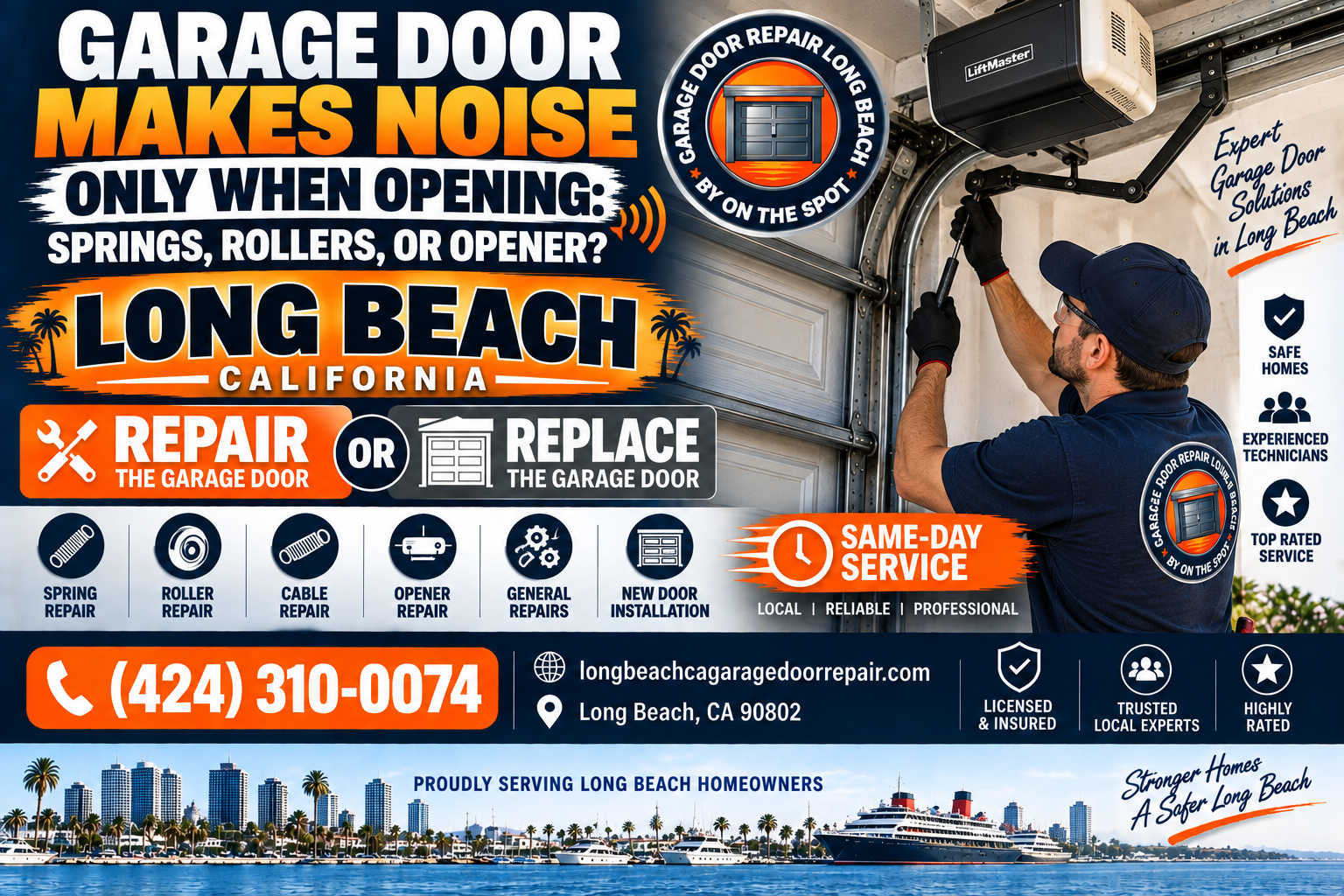
Long Beach Opening-Noise Diagnosis Guide
Garage Door Makes Noise Only When Opening: Springs, Rollers, or Opener?
When a garage door makes noise only when opening, springs under lift, rollers on the climb, and the opener under pull load are the prime suspects—along with cable stretch sounds, drum issues, and loose struts—especially where Long Beach coastal corrosion turns mild squeaks into opening grinds.
Garage Door Repair Long Beach By On The Spot helps homeowners, renters, landlords, property managers, HOA communities, and small businesses map groans vs grinds vs chirps with safe listening diagnosis—without DIY spring work. Diagnosis-first repair restores quieter, safer opening across Long Beach, CA.
Springs · Rollers · Opener
Cables · Drums · Struts
CPSC + DASMA + SCE
Serving Long Beach, CA
Direct Answer: Why Does a Garage Door Make Noise Only When Opening?
A garage door that makes noise only when opening usually means something is complaining under opening load—the phase when springs, cables, rollers, drums, and the opener work hardest to lift the door’s weight against gravity. Closing can stay relatively quiet because gravity assists the downward travel and changes how rollers, hinges, and cables load. Opening-only noise is therefore a directional clue, not a random coincidence.
The three most common opening-load suspects are torsion or extension springs (groan, creak, or metallic ring as they deliver assist under lift), rollers and bearings (grind or squeal as wheels take upward side-loads through the vertical and curve), and the garage door opener (gear growl, belt chirp, or chain slap while the motor pulls the door up). Cable stretch sounds near drums, loose horizontal struts that buzz on lift, and drum seating issues also show up more clearly on the way up.
In Long Beach, coastal moisture and salt air accelerate dry bearings, corroded spring hardware, and stiff rollers—so an opening squeak that started mild can become a grind within a foggy season. Safe diagnosis starts with listening location, sound type, and cycle stage—never with DIY winding of high-tension springs. DASMA safety guidance and CPSC operator FAQ themes both reinforce professional spring/cable handling and preserving automatic reverse and photo-eye protection after any repair.
Garage Door Repair Long Beach By On The Spot at 151 E 5th St, Long Beach, CA 90802 can map opening-only noise to springs, rollers, opener drive, cables, drums, or loose struts with a diagnosis-first visit. Call (424) 310-0074 when noise escalates, when travel feels jerky, or when you hear cable pops near the drums.
Why Noise Shows Up Only When Opening—Not When Closing
Opening and closing are mechanically different jobs. On open, the torsion spring(s) (or extension springs) deliver stored energy to help the opener lift roughly the door’s weight. Rollers climb the vertical track and negotiate the radius into the horizontal run while carrying panel weight. Lift cables work under tension around drums. The opener motor and gear train pull against gravity for most of the travel.
On close, gravity assists. Springs rewind under a different torque profile. Roller side-loads reverse. Opener force is often lower on the way down if the door is well balanced. Wear that only “loads loudly” under lift therefore stays quiet when descending. That is why homeowners report grinding only on open, a spring groan only as the door leaves the floor, or an opener growl only while climbing—while the close cycle stays surprisingly calm.
Directional noise is diagnostically valuable. Closing-only noise often points to roller scrub, hinge squeak under downward articulation, track dents hit on descent, or opener push against a bind. Opening-only noise more often implicates spring condition under assist, roller bearings fighting upward climb, cable stretch under lift, drum issues, loose struts resonating as the door accelerates up, or opener gear/chain/belt under pull load.
Long Beach microclimates add a twist: morning moisture films can make opening the first noisy cycle of the day even when afternoon closes stay smooth. Coastal corrosion increases friction precisely when the system asks for more torque to start the lift. Understanding that asymmetry keeps you from chasing the wrong part—and from lubricating a spring end bearing when the real issue is a dry nylon roller on the climb.
Safe Listening Diagnosis: What to Note Before Anyone Touches Hardware
Before anyone reaches for a wrench—or worse, a winding bar—document the noise safely from outside the door’s path. Stand clear of the door’s travel plane. Keep kids, pets, and vehicles out of the garage bay. Do not pull the emergency release unless a trained technician instructs you and the door is secured. Do not attempt to adjust torsion spring tension yourself.
Note when the sound starts: floor breakaway, first two feet of climb, mid-travel curve, or near the open stop. Note which side (left, right, or motor head). Note sound type: spring groan or metallic ring, roller grind or squeal, cable stretch chirp near drums, strut buzz, opener gear growl, chain slap, or belt chirp. Note whether the door hesitates, jerks, or travels smoothly despite the noise.
Video from a safe angle helps a technician correlate sound with travel stage. Capture one full open and one full close for comparison. If noise is opening-only, that contrast is gold. Also note weather: foggy Belmont Shore morning versus dry inland afternoon in Los Altos can change symptoms. Write down any recent work—opener swap, roller lube that didn’t stick, storm outage, or a hard slam that might have shifted tracks.
- Clear people and pets from the bay; never stand under a moving door.
- Record open vs close for directional comparison.
- Log side, height stage, and sound character.
- Check SCE outage tools if opener behavior seems electrical—then return focus to mechanical noise.
- Stop cycles if you hear cable pops, sudden bangs, or see a gap in cable seating on a drum.
Safe listening is not DIY repair. High-tension springs and cables store dangerous energy. DASMA safety tips for garage door systems emphasize professional service for those components. Your job as a homeowner is to observe, document, and call—not to wind, unwind, or clamp springs.
Springs Under Opening Load: Groans, Rings, and Balance Clues
Torsion springs above the door and extension springs along the tracks are the counterbalance system. When opening begins, springs deliver stored energy to help lift. Worn, under-tensioned, or corroded springs can groan, creak, or ring as coils move under load. End bearing plates can squeal if dry or salt-pitted. A spring that is losing coils or showing gaps between coils while the door is closed is a red-flag condition—stop DIY curiosity and call a pro.
Opening-only spring noise often appears right as the door leaves the floor or through the first third of travel—when spring assist and opener pull share the heaviest lift. If the door feels heavy when disconnected by a technician for a balance test, springs are implicated regardless of how “quiet” they seem. Noise plus heaviness is a stronger signal than noise alone.
Never attempt DIY spring adjustment. Winding bars, mismatched spring wire size, or incorrect turns can cause sudden failure and severe injury. Cable systems tied to spring drums are equally hazardous when tension is wrong. Long Beach coastal air can hide corrosion in spring hardware until a loud opening groan announces that lubrication films failed and metal-on-metal contact began.
A professional opening-noise diagnosis includes spring condition, balance, drum alignment, cable integrity, and whether the opener is compensating for weak springs by pulling harder—which itself creates gear noise that sounds like an “opener problem” when the root cause is counterbalance. Dual torsion pairs must be evaluated together; replacing only one tired spring often leaves opening noise and uneven travel behind.
Cycle counting matters. Doors that open for every delivery app visit accumulate spring wear faster than quiet households admit. Coastal corrosion shortens rated cycle life. When opening groan arrives with morning fog, schedule inspection before a bang announces a broken spring and a door the opener can no longer lift.
Rollers Under Opening Climb: Bearings, Flat Spots, and Curve Noise
Rollers carry panel weight into the tracks. On opening, rollers climb vertically, then navigate the curved transition into the horizontal track. That climb and curve create side-loads and bearing stress different from closing descent. Worn steel rollers squeal; nylon rollers with failed bearings grind; flat spots thump at regular intervals on the way up; dirty or salt-crusted stems bind in hinges.
Opening-only roller noise often localizes to one side and intensifies at the curve. Closing may stay quiet because descent loads the opposite roller face or because gravity reduces the scrub angle. Coastal Long Beach garages see accelerated roller wear from chlorides and morning condensation. A roller that “survives” close can still scream on open after a damp night.
Inspection looks at roller material, stem wear, track cleanliness, hinge tightness, and whether replacement with sealed bearings is warranted. Lubricating a destroyed bearing is a temporary mask at best. Pairing new rollers with track cleaning and alignment prevents the new set from dying young. Opening climb is the moment when bad rollers announce themselves—listen there first.
Replace rollers in matched sets so diameters stay consistent. Cheap open-bearing wheels fail quickly in Belmont Shore salt air. Stem diameter must match hinges; oversized or undersized stems create wobble that opens noisily. After replacement, the acceptance test is a quiet curve transition on open—not only a quieter vertical rise.
Opener Under Opening Pull: Gears, Chain, Belt, and Motor Strain
The opener’s hardest typical work is lifting. Worm gears, sprockets, chain tension, belt tracking, and motor bearings all load more when pulling against gravity—especially if springs are weak and the opener is doing spring work it was never sized for. Opening-only opener noise includes gear growl at the head, chain slap on a loose trolley rail, belt chirp on a dry or glazed belt, and motor hum that rises with climb effort.
Critical rule: diagnose door balance and free travel before condemning the opener. A loud opener on open may be a symptom of heavy door / weak springs / binding rollers, not a failed gear alone. Raising force settings to “muscle through” opening noise is unsafe and conflicts with CPSC-oriented reverse-safety thinking. Fix the bind or balance; then evaluate the drive.
After storms, use SCE’s outage center to separate power events from mechanical grind. A door that groans on open after an outage may still be a spring/roller issue that just became noticeable when cycles resumed—not a “power ghost.” Photo eyes and reverse must remain correctly aimed and tested after any opener or track work.
When opener replacement is truly warranted—stripped gears, shredded belts, failed motors on a free balanced door—retest safety systems afterward. Smart features do not silence weak springs. Mounting bolts loosened by vibration can buzz on open acceleration and are often missed when attention fixates only on the gear box.
Cable Stretch Sounds, Drum Issues, and Opening Tensions
Lift cables transmit spring force to the door. Under opening load, cables can chirp, tick, or “stretch-sound” as strands settle, especially if slightly corroded, undersized for the door, or unevenly tensioned left-to-right. Drum issues—cable riding out of the groove, crossed wrap, or drum not square on the torsion tube—often announce themselves as opening pops near the end stilts or header.
Cable failure is a drop-risk hazard. If you see a frayed cable, a cable off the drum, or hear sharp pops near drums during open, stop using the door and call a professional. Do not try to reseat cables under spring tension yourself. Opening is when cable load is often most visible in sound and motion asymmetry—one side climbing faster is a related clue.
Long Beach salt air attacks cable strands and drum edges. Visual checks from a safe distance (door closed, no DIY tension work) can spot obvious fray; anything requiring drum rotation or spring discharge belongs with a trained technician. Mild surface rust is actionable near the coast, not merely cosmetic, when opening chirps already exist.
Loose Struts, Brackets, and Vibration That Buzzes on Open
Horizontal struts stiffen wide doors. Loose strut screws or brackets can buzz, rattle, or drum when the door accelerates upward—yet stay quiet on the slower, gravity-assisted close. Opening vibration excites loose panels and hardware differently than closing. Homeowners often describe a “tinny buzz only when it goes up.”
Technicians retorque strut fasteners to spec, check panel integrity, and verify that noise isn’t masking a more serious hinge or roller failure. Coastal corrosion can loosen fasteners as threads pit. A quick hardware pass during opening-noise service often quiets surprising amounts of racket—after springs, rollers, and cables are confirmed safe.
Wide two-car doors and glass-heavy modern panels need correct strut counts. Under-supported centers flutter on open acceleration. Off-center opener mounts can rack the door so opening sounds like roller grind even when wheels are healthy—geometry belongs in the diagnosis.
How Opening-Only Noise Differs From Closing-Only Noise
Opening-only noise clusters around lift physics: spring assist quality, upward roller climb, cable/drum tension, opener pull, and vibration of loose struts during acceleration against gravity. Closing-only noise clusters around descent physics: roller scrub under reverse side-load, hinge knuckle squeak, track dents hit going down, and opener push into a bind.
If your door is noisy both ways, expect shared friction sources—dry rollers, filthy tracks, severe corrosion—or multiple concurrent faults. If it is noisy only one way, use that directionality. This guide is the opening-direction twin of closing-noise inspection thinking: same city, same coastal factors, different load story.
Misdiagnosis happens when someone oils the opener rail because opening growls, when springs are weak; or replaces an opener when rollers are flat-spotted on the climb. Directional listening plus balance testing prevents expensive wrong turns. Keep open-vs-close videos side by side when comparing contractor opinions.
Grinding vs Groaning vs Chirping vs Buzzing: Mapping Sound to Parts
Sound character is a shortcut when paired with location and travel stage:
- Deep spring groan / metallic coil ring on early open: spring coils, end bearings, or balance stress—professional spring inspection only.
- High grind or squeal along tracks mid-climb: rollers/bearings, track scale, stems in hinges.
- Sharp chirps or ticks near drums/header: cables stretching, drum seating, strand issues—stop if fray seen.
- Gear growl at motor head while climbing: opener drive under pull—or opener compensating for heavy door.
- Chain slap or belt chirp on open: drive tension/tracking under lift load.
- Tinny buzz across panels on acceleration up: loose struts, fasteners, or panel play.
- Thump-thump cadence on open: flat-spotted rollers.
Write the mapping down before service; it speeds diagnosis and keeps the visit focused on opening-load reality rather than a generic “lube everything” pass. Phone audio is usually good enough to separate groan from grind for a remote triage call.
Safe Listening vs DIY Spring Work: Draw a Hard Line
Lubricating accessible hinges and roller stems with a garage-door-rated lubricant (away from floors that become slippery) can be a homeowner maintenance habit—after reading product directions and staying clear of spring winding cones, cables under tension, and the opener’s internal gears. That is not the same as spring repair.
DIY high-tension spring work is never appropriate for this symptom. DASMA’s garage door system safety tips support professional handling of springs and related hardware. A wrong turn on a winding bar can permanently injure. Cable work under load is in the same danger class. If opening noise localizes to the torsion tube, drums, or extension spring paths, your next step is a phone call, not a YouTube winding tutorial.
On The Spot’s diagnosis-first approach separates safe homeowner observation from technician-only tasks. Call (424) 310-0074 when in doubt—especially if the door is heavy, uneven, or popping near cables. Refuse any contractor who asks you to hold a winding bar “just for a second.”
Long Beach Coastal Conditions and Opening-Only Noise
Long Beach combines marine air, morning low clouds, port-area particulates, and sunny afternoons that bake moisture into mineral films on tracks and bearings. Opening is the first high-torque demand after a damp overnight sit. That is why Belmont Shore, Naples, Alamitos Beach, and Downtown garages often report opening squeals that fade later—or worsen as corrosion pits deepen.
Inland-leaning pockets like parts of El Dorado Park or Los Altos still see enough chloride drift and temperature swing to dry out nylon bearings. Alleys with poor airflow hold moisture against doors. Condos with shared walls transmit opening grind to neighbors sooner than closing squeaks, raising HOA pressure to fix fast.
Coastal maintenance habits—periodic professional lubrication of correct points, roller replacement before bearings seize, spring inspection on schedule, and never ignoring cable rust—cut opening-noise lifespan short. Waiting until the opener smells hot is waiting too long. Map your microclimate honestly when planning intervals.
Red Flags: Stop Using the Door and Call Now
- Cable fray, cable off drum, or sharp pops near drums on open.
- Door opens crooked / one side leads badly.
- Sudden bang from the torsion area; door feels very heavy afterward.
- Visible gap between torsion spring coils when door is closed (possible broken spring).
- Opener struggles, lights flicker, burning smell, or repeated reverse without obstruction.
- Loose strut or bracket hanging into the travel path.
- Door opened partly and stuck—do not force cycles.
Stop, secure the opening by other means if needed, keep people clear, and schedule professional service. Do not disconnect the opener to lift a suspiciously heavy door by hand. Pedestrian doors exist for a reason when the bay is tagged out.
Photo Eyes, Reverse, and Why Opening-Noise Fixes Must Preserve Safety
CPSC consumer FAQ material on automatic residential garage door operators underscores entrapment protection—photo eyes and reverse behavior matter after any mechanical service. Opening-noise repairs that involve tracks, rollers, or opener mounts can bump sensor alignment. Always retest: sensors aligned, indicator status normal, reverse on contacting a proper test obstruction on the close cycle as specified for your operator.
Never “fix” opening strain by maxing force. That hides binds and risks unsafe close force. Balance and free-travel first; opener settings second; safety verification always. An opening repair that leaves reverse broken is not finished work.
Maintenance Habits That Reduce Opening Noise in Long Beach
Schedule seasonal professional tune-ups before peak fog months. Keep tracks free of abrasive grit without spraying lubricant into the track race in ways that cake dirt—technicians choose methods carefully. Lubricate hinges and roller stems with appropriate products; avoid greasy messes on floors. Replace rollers in sets when bearings fail. Inspect springs and cables visually from a safe distance for rust and fray; leave tension work to pros.
After windstorms or SCE-reported outages, cycle once carefully and listen. Note new opening noises early. Property managers should log bay-by-bay symptoms so coastal corrosion patterns become visible across portfolios. First-cycle morning squeaks deserve the same attention as all-day grinds because nightly films restart the clock.
Repair Now vs Waiting Until Opening Noise Gets Louder
Opening noise rarely self-heals. Rollers flat-spot further. Springs lose balance quietly until they fail loudly. Openers overheat compensating for heavy doors. Cables strand-break. Early roller or hardware service is usually cheaper than opener replacement plus track scoring plus a broken spring event.
Waiting also normalizes danger: families walk under a door that is quietly getting worse. If noise is mild but directional, still book diagnosis—especially near the coast. If noise is severe or paired with heavy travel, treat it as urgent. Cost context favors early parts over forced-damage cascades.
Same-Day Help When Opening Noise Escalates in Long Beach
When opening grind or spring groan escalates overnight, same-day diagnosis prevents a morning commute surprise—door stuck halfway, opener clicking without lift, or a cable failure. Garage Door Repair Long Beach By On The Spot serves homeowners, renters (with owner approval paths), landlords, HOAs, and small businesses from 151 E 5th St. Call (424) 310-0074 with your listening notes ready: side, stage, sound type, open-vs-close contrast.
Questions to Ask Before Hiring Help for Opening-Only Noise
- Will you perform a door balance / free-travel check before condemning the opener?
- Do you service torsion and extension springs professionally (no DIY encouragement)?
- Will rollers, cables, drums, struts, and opener drive all be considered for opening-load noise?
- How do you handle coastal corrosion findings common in Long Beach?
- Will photo eyes and reverse be retested after repairs?
- What warranty covers parts replaced for opening-noise faults?
Hiring Red Flags for Opening-Noise and Spring-Related Repairs
- Quotes that skip balance testing and jump straight to opener replacement.
- Technicians who invite you to help wind springs.
- No mention of cable/drum inspection when noise is near the header.
- Force-setting increases offered as the primary “fix.”
- Unwillingness to discuss CPSC reverse/photo-eye retest after work.
- No local NAP transparency or vague pricing without diagnosis logic.
Why Consider Garage Door Repair Long Beach By On The Spot?
On The Spot focuses on diagnosis-first garage door repair for Long Beach conditions—coastal corrosion, opening-load symptoms, and safety-critical spring/cable systems. The team maps grinding, groaning, chirping, and buzzing to springs, rollers, opener drive, cables, drums, and loose struts without treating every noise as an opener sale.
NAP: Garage Door Repair Long Beach By On The Spot | 151 E 5th St, Long Beach, CA 90802 | (424) 310-0074 | https://longbeachcagaragedoorrepair.com/ | Maps: https://www.google.com/maps?cid=5381478035707257267. Authority-aware work respects DASMA spring safety culture, CPSC operator safety themes, and practical SCE power-context checks when electrical confusion overlaps mechanical symptoms.
Symptom Comparison Table: Opening-Only Noise Sources
Use this table as a conversation aid with your technician—not as a DIY repair chart for springs or cables.
| Symptom pattern | Likely parts | Risk if ignored | Typical next step |
|---|---|---|---|
| Groan/ring at header early in open | Torsion springs, end bearings | Spring failure, heavy door, opener burnout | Professional spring/balance inspection |
| Grind mid-climb, one side, opening only | Rollers, bearings, track scale | Scored track, jerky travel | Roller/track service |
| Chirp/tick near drums on lift | Cables, drum seating | Cable failure, drop risk | Stop DIY; pro cable/drum check |
| Gear growl at motor head while climbing | Opener gears under pull; possible weak springs | Drive failure; misdiagnosis | Balance first, then opener diagnosis |
| Chain slap / belt chirp on open | Drive tension/tracking under lift | Premature drive wear | Opener drive service after free travel OK |
| Tinny buzz as door accelerates up | Loose struts, fasteners, panels | Hardware loss, vibration damage | Retorque hardware; inspect panels |
| Thump cadence on open | Flat-spotted rollers | Track wear, noise escalation | Replace rollers as a set |
| Worse on foggy Long Beach mornings | Corrosion films on rollers/springs hardware | Accelerated wear | Coastal maintenance + part replacement |
| Heavy door + opening noise | Weak/broken spring assist | Sudden failure, injury risk | Immediate professional spring service |
| Quiet close, noisy open only | Opening-load parts cluster | Wrong-part DIY chasing | Directional diagnosis path in this guide |
Areas Served From the Long Beach Location
Service focus includes Long Beach neighborhoods and nearby coastal communities where opening-only garage door noise often ties to springs under lift, rollers on the climb, opener pull load, cable/drum tension, loose struts, and salt-air corrosion: Belmont Shore, Belmont Heights, Naples, Alamitos Beach, Downtown Long Beach, Bixby Knolls, Los Altos, El Dorado Park area, California Heights, Wrigley, West Long Beach, and adjacent areas. Property managers with multi-site portfolios can coordinate spring inspections and roller replacements before fog season turns quiet opens into noisy struggles.
If you are unsure whether your microclimate is coastal enough for corrosion to matter on opening load, err on the side of inspection—chlorides travel farther inland than many residents expect, and opening torque reveals friction that closing may hide.
Google Map Location
Garage Door Repair Long Beach By On The Spot is listed at 151 E 5th St, Long Beach, CA 90802. Call (424) 310-0074 or open the Google Maps CID listing for directions.
FAQs About Garage Doors That Make Noise Only When Opening
Why does my garage door only make noise when opening?
Opening puts springs, rollers, cables, and the opener under lift load against gravity. Closing is assisted by gravity and loads parts differently, so worn springs, dry roller bearings, cable stretch, drum issues, loose struts, or opener drive strain can stay quiet on the way down—especially with Long Beach coastal corrosion films.
Is opening-only noise more likely springs, rollers, or the opener?
All three are common. Spring groans near the header early in travel, roller grinds along the climb/curve, and opener gear growls at the motor head while climbing. A balance test separates weak springs from a true opener failure. Direction, location, and sound type guide priority.
Can I fix a noisy opening garage door myself?
You can document symptoms and perform light hinge/roller-stem lubrication if you stay away from springs, cables under tension, and internal opener gears. Do not DIY torsion or extension spring adjustment. DASMA safety tips support professional spring and cable service.
Why is the noise worse on foggy Long Beach mornings?
Overnight moisture and salt films raise friction. Opening is the first high-torque cycle, so bearings and spring hardware announce corrosion sooner on open than on close.
What does a cable stretch sound on opening mean?
Chirps or ticks near drums during lift can indicate cable strand movement, corrosion, or drum seating issues. Fray or cable-off-drum is a stop-use red flag—call a professional immediately.
Could loose struts cause noise only when opening?
Yes. Acceleration against gravity can buzz loose horizontal struts or fasteners that stay quiet during a gentler close.
Should I turn up opener force if it struggles to open quietly?
No. Raising force to overcome a bind or weak springs is unsafe and can mask failures. Fix balance and free travel; preserve CPSC-oriented reverse and photo-eye protection.
How is this different from noise only when closing?
Closing-only noise more often involves roller scrub, hinge squeak, track dents on descent, or opener push into a bind. Opening-only noise centers on lift physics: springs, climb rollers, cables/drums, opener pull, and strut buzz.
When should I stop using the door?
Stop for cable pops/fray, crooked travel, sudden header bangs, very heavy door feel, burning opener smells, or a door stuck mid-travel. Keep people clear and call for service.
Do you serve Belmont Shore and Downtown Long Beach for opening-noise repairs?
Yes—Belmont Shore, Downtown, Naples, Alamitos Beach, Bixby Knolls, Los Altos, and surrounding Long Beach areas are within the service focus from 151 E 5th St.
Will photo eyes need rechecking after opening-noise repairs?
Yes if tracks, rollers, or opener mounts were disturbed. Retest alignment and reverse behavior before considering the job complete.
How do SCE outages relate to opening noise?
Outages don’t create spring groans, but they can coincide with odd opener behavior. Check SCE’s outage center to separate power events from mechanical opening-load wear—then diagnose springs, rollers, and drive hardware.
Call for Help If Your Garage Door Makes Noise Only When Opening in Long Beach
If your garage door makes noise only when opening—whether from springs under lift, rollers on the climb, opener pull load, cable stretch sounds, drum issues, loose struts, or Long Beach coastal corrosion—get diagnosis-first help before forcing cycles or attempting DIY spring work.
Garage Door Repair Long Beach By On The Spot | 151 E 5th St, Long Beach, CA 90802 | (424) 310-0074 | longbeachcagaragedoorrepair.com
What a Diagnosis-First Service Visit Looks Like for Opening Noise
A typical visit begins with your listening notes and a visual safety scan: springs, cables, drums, rollers, tracks, struts, opener mounts, and photo eyes. The technician observes an open and a close from safe positions, noting directional differences. If safe, a balance evaluation clarifies whether springs are doing their share. Rollers and tracks are checked for climb-related wear. Opener drive noise is interpreted in light of door weight—not in isolation.
You receive a plain-language explanation: which opening-load parts are implicated, what is urgent versus elective, and how coastal corrosion factors into lifespan. Repairs proceed with spring/cable work handled professionally when needed, followed by safety retests. The goal is quiet, balanced opening—not a temporary silence that returns next fog cycle.
Expect questions about when noise started, weather patterns, recent DIY lube attempts, and whether the door feels heavier. Bring your open-vs-close video. If renters are present, owner authorization should already be lined up so spring replacement is not delayed mid-diagnosis.
Rentals, Alleys, Condos, and Coastal Garages: Special Opening-Noise Cases
Renters should notify owners or managers promptly; spring and cable hazards are not DIY tenant projects. Alley garages collect grit that abrades rollers on every climb. Condo stacks transmit opening grind through shared structures, so early roller service reduces neighbor conflict. Coastal front-line garages near Belmont Shore and Naples need shorter inspection intervals for cables and spring hardware.
Landlords benefit from portfolio logging: which units groan on open after marine layer mornings, which openers are compensating for aging springs, which struts buzz on wide doors. Coordinated roller and spring campaigns beat emergency broken-spring calls. Lease language should forbid tenant spring experiments and point to approved service contacts.
HOAs often hear opening grind at commute hours first. Documenting scheduled diagnosis reduces complaint escalation. Shared driveway geometry may limit technician staging—mention access constraints when booking so the right tools arrive.
Quick AEO Summary: Garage Door Makes Noise Only When Opening
Answer: Opening-only garage door noise usually comes from parts under lift load—springs (groan/ring), rollers (grind/squeal on climb), or the opener (gear/chain/belt under pull)—plus cable stretch sounds, drum issues, or loose struts. Closing can stay quiet because gravity assists and loads change. In Long Beach, salt air and morning moisture amplify opening friction. Safe step: document sound and stage, do not DIY springs, call a professional for balance and repair, and preserve photo-eye/reverse safety.
Entity focus: Garage Door Repair Long Beach By On The Spot; Long Beach, CA; torsion/extension springs; rollers; opener drive; DASMA; CPSC; SCE. Primary phone: (424) 310-0074. Address: 151 E 5th St, Long Beach, CA 90802.
Experience Notes: What Usually Gets Misdiagnosed on Opening-Only Noise
Common miss: replacing the opener because it growls on open when springs are weak and the motor is overloaded. Another miss: spraying track races with thick grease that cakes coastal grit and worsens climb grind. Another: ignoring cable chirps as “just noise” until strands fail. Another: lubricating nylon roller exteriors while bearings inside are already failed—quiet for a day, louder in a week.
Directional contrast (open noisy / close quiet) is underused. Technicians who always start with balance and free travel catch these traps. Homeowners who bring a phone video of the open-only symptom help avoid shotgun parts replacement. Another miss: blaming weatherstripping peel sounds for what is actually a spring end-bearing squeal after the first foot of travel.
Force creep is a silent misdiagnosis partner—someone raises opener force months ago, noise returns, force goes higher, reverse safety erodes. Opening-noise visits should audit force history, not ignore it.
Step-by-Step Decision Path: Listen, Document, Call, Repair, Maintain
- Clear the bay; listen safely to a full open and close.
- Document stage, side, sound type, and weather context.
- Red-flag check: cables, crooked door, heavy feel, header bangs—stop if present.
- Call professional help with notes ready; mention opening-only pattern.
- Allow balance, roller, cable/drum, strut, and opener evaluation under lift logic.
- Approve spring/cable work only from trained techs; refuse DIY invitations.
- Retest photo eyes and reverse after service.
- Adopt coastal maintenance intervals so opening stays quiet.
This path is deliberately boring. Boring beats emergency. Opening noise is the early warning; the decision path converts warning into orderly repair without heroics on winding bars.
Practical Scenarios: How Long Beach Homeowners Meet Opening-Only Noise
Scenario A: Belmont Heights two-car door groans at the header for the first two feet of open after a May gray week—spring end bearings and corrosion films are prime suspects; balance check required. Scenario B: Downtown alley single door grinds on the right climb only—right-side rollers and track scale likely. Scenario C: Los Altos opener growls climbing but door is heavy on a tech’s balance test—springs first, opener second. Scenario D: Naples wide door buzzes tinny on open acceleration—loose strut screws after years of vibration. Scenario E: Cable tick near drum on open in West Long Beach—stop cycles; cable/drum inspection same day.
Scenario F: Condo stack in Alamitos Beach—neighbors complain about 6:15 a.m. opening squeal; sealed-bearing roller upgrade plus hinge service restores quiet and HOA peace. Scenario G: After SCE outage overnight, homeowner assumes electrical fault; mechanical opening grind was coincidental with resumed cycles—SCE check clears power; rollers still need replacement.
Each scenario shares one rule: opening load reveals the fault; closing silence does not prove the system is healthy.
Spring Science Deep Dive: Assist Load, End Bearings, and Opening Groans
Torsion springs store energy in twist. As the door opens, that energy assists lift while the spring’s coils move relative to each other and the shaft system. Dry or pitted end bearings squeal. Coil binding from corrosion can groan. Uneven left/right torsion pairs on dual-spring doors create asymmetric opening sounds and travel. Extension spring systems along tracks introduce stretch/contract noises and pulley wear that often shout on open.
Balance is the measurable truth: a properly balanced door stays roughly in place mid-travel when the opener is disconnected by a professional using safe procedures. Homeowners should not perform that disconnect casually on suspect springs. Opening groan plus failed balance equals spring priority—not an Amazon opener upgrade.
Cycle life ratings exist for springs; coastal corrosion shortens real-world life. Tracking open/close cycles mentally (commute patterns, deliveries) helps schedule replacement before failure. Failure often announces as a bang and a suddenly heavy door—opening becomes nearly impossible for the opener alone.
End bearing plates deserve specific attention in Long Beach. Salt air pits races; opening rotation under load is when squeal peaks. Lubrication helps healthy bearings; it will not resurrect pitted ones. Cone and set-screw condition belong in professional inspection—homeowners should not loosen hardware on a charged torsion tube.
When springs are replaced, drums, cables, and opener force settings should be revisited as a system. Opening quietness after spring work is expected; lingering grind then points to rollers or tracks that were masked by the louder spring story.
Roller Science Deep Dive: Climb Load, Curve Transition, and Opening Scrub
During opening, roller stems see changing vectors as panels articulate and the door climbs into the curve. Bearing balls (or bushings) that survived closing loads may chatter on climb. Nylon tires with failed hubs squeal more when supporting upward motion. Steel rollers transmit grind loudly into tracks. Flat spots from sitting create rhythmic thumps timed to wheel rotation on the way up.
Track gauge, dent location, and flag bracket alignment matter. A tiny dent at curve height can be nearly silent on close yet harsh on open. Coastal scale inside the track race increases opening friction disproportionately. Replacement strategy: rollers in matched sets, correct stem size, quality sealed bearings when appropriate, and track cleaning that does not leave abrasive paste behind.
Hinge wear couples to roller noise. Ovaled hinge holes let stems tilt so opening climb edge-loads the tire. Replacing rollers without checking hinges wastes money. Flag brackets that drifted pull tracks out of parallel; opening side-load spikes on one column of rollers.
Acceptance testing should include ten open cycles after roller work while listening at the curve. Early break-in whispers differ from persistent grind. Keep old rollers; cupping patterns explain why noise was opening-directional.
Opener Drive Deep Dive: Why Pull Load Is Noisier Than Push Load
Worm gear sets and DC drives experience higher torque demand lifting than lowering a balanced door. Worn gear teeth announce under pull. Chain catenary slap increases when the trolley climbs against resistance. Belt systems chirp if tracking is off under tension. Logic boards don’t make grind noises, but struggling motors do—and those struggles correlate with door weight and binds.
Force and travel limits are not noise cures. After mechanical repair, settings should match a free-traveling door. Safety reverse must work. If an opener is genuinely failing—cracked gear, shredded belt—replace it after confirming the door is balanced so the new unit isn’t murdered by the old spring problem.
Rail dust and dried lubricant cause ceiling-line chirps on open that homeowners misattribute to springs. Correct rail lube type matters; drips on cars create separate complaints. Isolate zones: header (springs/cables), tracks (rollers), ceiling rail (opener drive).
After opener replacement, re-aim photo eyes, retest reverse, reprogram remotes so people stop cycling the door repeatedly out of confusion—extra cycles burn spring life and invite noise back.
Cable and Drum Dynamics Deep Dive During Opening
Cable tension redistributes through opening as drums rotate and springs deliver assist. A cable with broken outer strands can chirp as remaining wires take load. A drum with cable winding out of groove creates rhythmic clicks and dangerous slack risks. Equalizer issues on extension systems show as uneven opening and noise on the lagging side.
Visual cues from a safe distance: fuzzy rusted strands, cable not seated in drum grooves, or one cable bar-tight while the other looks slack with the door closed. Any of those equals professional service, zero DIY drum work.
Bottom corner brackets where cables attach can bend after impacts; opening then ticks as geometry fights the drum. Coastal cables often corrode from the inside; mild exterior rust plus opening chirps is enough reason to schedule inspection now, not next year.
Strut and Panel Vibration Deep Dive on Opening Acceleration
When the opener and springs accelerate the door upward, panel modes vibrate. Loose strut screws act like buzz cymbals. Missing fasteners leave wide doors under-supported so center panels flutter. Opening-only buzz that correlates with acceleration—not with track height—points hardware-ward.
Technicians retorque to manufacturer patterns, replace stripped anchors, and check whether corrosion thinned fastener engagement in steel or wood framing common in older Long Beach garages. Glass panel retrofits change weight and stiffness; strut counts may need revisiting when opening buzz appears after a modernization.
Never put body parts near a moving door to “hold a strut quiet” as a test. Static checks with the door secured are the safe approach.
Corrosion Deep Dive: Chlorides, Pitting, and Opening Noise Timelines
Chlorides pit steel roller stems, cable wires, spring hardware, and track edges. Pitting raises friction coefficients exactly when opening demands torque. A timeline homeowners recognize: faint opening squeak in spring, louder grind by late summer marine layer peaks, opener heat smell by fall if ignored. Fog drip lines on the interior face of the door hint at moisture exposure even when the house feels dry.
Mitigation is inspection cadence plus correct lubrication points plus timely part replacement—not endless oil on failed bearings. Stainless or coated hardware choices during repair can extend intervals in Belmont Shore–class exposures.
Port-adjacent particulates add abrasion on top of chloride chemistry. Opening climb drags grit like sandpaper; closing may not apply the same normal force. Track cleaning intervals should tighten for alley and port-edge garages. Mention exposure when you book service so expectations match reality.
Family and Workplace Safety Routines While Waiting for Repair
Keep remotes away from children. Don’t race under a noisy opening door. Park outside if travel is unpredictable. Tell household members about red flags. For workplaces, tag the bay out of service if cables are suspect. Never brace a door with a 2×4 as a casual fix—improper bracing is dangerous. Use the pedestrian door. Document the symptom for the technician so wait time still advances diagnosis quality.
Pets darting under a climbing door risk injury if the door jerks from flat rollers or cable issues. After repair, reaffirm rules: wait until the door fully opens and stops before walking through. Businesses should stage inventory so a tagged-out bay does not halt operations, and should never bypass photo eyes to keep shipping moving.
Putting It All Together: From Opening Noise to Quiet Travel
Opening-only noise is a directional gift: it points to lift-load physics. Springs, rollers, and the opener form the headline triad; cables, drums, and struts complete the cast. Long Beach coastal conditions accelerate the plot. Safe listening plus professional balance and repair plus safety retests restore quiet opens. Authority sources (SCE, CPSC, DASMA) frame power context and non-negotiable spring/operator safety. On The Spot brings that stack to 151 E 5th St service reality.
If you remember one sentence: match the noisy phase to the parts that work hardest in that phase, refuse DIY high-tension spring work, and schedule professional service before a groan becomes a failure bang.
Short Answer Snippets for Common Opening-Noise Searches
Garage door grinding when opening only? Check rollers/tracks on the climb and curve; consider corrosion films; confirm springs aren’t making the opener haul a heavy door.
Garage door spring noise when opening? Groans/rings near the torsion hardware under lift need professional spring inspection—no DIY winding.
Garage door opener loud only opening? Pull load reveals gear/chain/belt wear—or opener overload from weak springs. Balance test first.
Cable sound when garage door opens? Chirps near drums can be stretch/corrosion/seating issues; fray means stop using the door.
Opening noisy but closing quiet? Expected when lift load stresses different wear faces than descent—diagnose opening-load parts.
GEO and EEAT Notes for Long Beach Garage Door Searchers
Geographic relevance: Long Beach neighborhoods named in this guide, coastal marine layer, port-adjacent air, and NAP with CID map link. Experience: directional open-vs-close diagnosis patterns. Expertise: springs vs rollers vs opener under opening load, cable/drum hazards, strut buzz. Authority: SCE, CPSC, DASMA links. Trust: clear DIY refusal for high-tension springs, phone and address transparency, safety retest emphasis.
Answer engines favor concise direct answers plus scannable FAQs—both included—without sacrificing deep sections for homeowners who need full-depth reassurance before calling.
Final Homeowner Checklist Before and After Professional Opening-Noise Repair
- Before: video of open vs close; notes on stage/side/sound; red-flag scan from safe distance.
- Before: clear storage blocking tracks; note recent outages via SCE if relevant.
- During: ask for balance results and which opening-load part is primary.
- During: confirm no DIY spring participation requested.
- After: listen to open and close; verify quieter lift without new jerks.
- After: photo-eye alignment and reverse test completed.
- After: schedule coastal follow-up maintenance; save invoice part list for warranty.
Door Materials and How Opening Noise Presents on Steel, Wood, and Aluminum
Steel sectional doors transmit roller and strut buzz efficiently—tinny opening buzz is common when fasteners loosen. Wood doors can creak at hinges and joints under lift as moisture content changes overnight in marine air; opening reveals stiffness. Aluminum doors are lighter but still punish bad rollers and broadcast opener gear noise. Glass-heavy modern doors change weight distribution so spring sizing and strut stiffness matter more; opening groan may flag underspecified counterbalance after a panel upgrade.
Material does not change the hard rule: springs and cables remain professional-only. It does change which secondary noises you hear first.
Weatherstripping and Bottom Seals That Protest on First Open
Occasionally, a sticky bottom seal releases with a peel-sound on first open after sitting—more annoyance than spring failure. Coastal seals harden and grab concrete. Distinguish a brief seal peel from ongoing climb grind. Seal replacement is routine; it should not distract from checking rollers and springs if noise continues through travel.
Side weatherstripping that curled into the track path can scrape on open climb. Trim or replace damaged bulb seals rather than forcing the door. Opening scrape that follows the seal line is different from bearing grind at roller height—location tells the story.
Cost Context: Early Opening-Noise Parts vs Forced-Damage Repairs
Early roller sets and hardware retorque cost less than scored tracks plus opener replacement plus emergency broken-spring service after a cable event. Opening noise is an early warning—your door is talking while it still works. Ignoring lift-load complaints turns one fault into a cascade. Ask for itemized options: repair now versus monitor with defined safety stop points.
Property managers should compare preventive coastal packages against last year’s emergency invoices; opening-noise early service usually wins on total cost of ownership.
Myths About Garage Doors That Make Noise Only When Opening
- Myth: If it closes quietly, everything is fine. Reality: Lift load reveals different wear.
- Myth: Louder opener force fixes opening noise. Reality: Unsafe and masks binds.
- Myth: All opening noise means buy a new opener. Reality: Springs/rollers often primary.
- Myth: WD-40 everywhere solves coastal grind. Reality: Wrong lube/caking; failed bearings need replacement.
- Myth: Homeowners can safely wind torsion springs from a video. Reality: DASMA-aligned practice says no.
- Myth: Cable chirps are harmless. Reality: Can precede failure—inspect professionally.
Photo and Video Documentation Tips for Faster Opening-Noise Service
Film landscape orientation from outside the path. Capture audio—phone mics pick grind vs groan well. Show the header area briefly without unsafe ladder climbs, and the motor head. Film the curve transition on open. Do a close cycle for contrast. Still photos of frayed cable from ground level with the door closed help triage urgency. Avoid flashlight glare on glossy paint that hides track dents.
Label videos with date, morning vs afternoon, and neighborhood microclimate notes. That metadata turns a fuzzy “it’s loud” ticket into an actionable opening-load diagnosis brief.
Talking With Neighbors, HOAs, and Landlords About Opening Noise
Opening grind at 6 a.m. commute time draws complaints faster than evening closes. Share that you’ve scheduled diagnosis—proof of action reduces HOA friction. Landlords: written notes linking opening-only symptoms to springs/rollers help justify repair approvals versus cosmetic paint requests. Condos: coordinate quiet hours with emergency safety exceptions when a door is unsafe.
Offer neighbors a simple explanation: lift-load wear is directional, closing quiet does not mean ignore, professional spring rules apply. Clarity beats arguments in shared driveways.
Friction, Opening Load, and Why Closing Can Stay Quiet
Friction force depends on normal force and surface condition. Opening changes normal forces at roller-track interfaces and demands spring hardware motion under torque. Closing reduces some of those normals and uses gravity. Asymmetric wear faces on roller tires mean one direction contacts smoother material. That physics stack is why “only when opening” is a coherent engineering statement, not a homeowner imagination.
Moisture films raise the coefficient overnight; first opening breaks static friction noisily. Understanding that helps you schedule inspections around marine layer seasons instead of waiting for midsummer failure.
Emergency Release Cords and Noisy Opening Doors
Do not pull the emergency release to “check” a noisy door unless you understand the door may be spring-imbalanced and could move violently. A noisy opening door with weak springs can drop hard if disconnected. Leave release-cord diagnostics to technicians who can control the door. If a release was pulled during a blackout, mention that in your service call—travel and noise may have changed.
After professional reconnection, opening noise should be reassessed; a door that was forced by hand while disconnected may have shifted rollers or tracks.
What Technicians Recheck After Opening-Noise Repairs
Post-repair open/close listen, balance spot-check, roller tracking through curve, cable seating on drums, strut tightness, opener drive under pull, photo-eye alignment, reverse function, and fasteners torqued. Coastal clients may get a maintenance interval recommendation tied to marine exposure rather than a generic annual-only reminder.
Ask for a brief teach-back: which part was primary, what to listen for next season, and when to call again. Quiet opening plus verified reverse is the dual acceptance criteria.
Additional Opening-Noise Depth: Roller Replacement Timing on Coastal Doors
Replace rollers when bearings growl on climb, when flat spots thump, or when tires show chunking—don’t wait for seizure that scores tracks. In Belmont Shore–class salt exposure, intervals shorten versus dry inland suburbs. Pair replacement with stem hinge inspection so new rollers aren’t dropped into ovaled holes. Opening climb is the acceptance test: quiet curve transition matters as much as quiet vertical rise.
Keep old rollers for the technician’s wear read; cupping patterns explain directional noise. If only one roller failed, still replace the set to keep diameter and material consistent across the door. Nylon with sealed bearings often cuts opening squeal dramatically when old open-bearing steel wheels were the culprit. Track cleaning should remove chloride crust without coating the race in sticky lube that holds grit.
After replacement, cycle open several times while listening—early break-in chirps differ from grind. Document brand and size for the next coastal service cycle so parts stay consistent across seasons.
In practical Long Beach terms, this note supports the main opening-only diagnosis path: springs vs rollers vs opener under lift, with cables, drums, and struts in supporting roles. Keep DASMA spring-safety boundaries intact, preserve CPSC-oriented operator protections, and use SCE outage context only to separate electrical confusion from mechanical grind. For hands-on help, contact Garage Door Repair Long Beach By On The Spot at (424) 310-0074.
Additional Opening-Noise Depth: Dual Torsion Pairs and Uneven Opening Sound
Many Long Beach two-car doors use dual torsion springs. If one weakens first, opening noise and travel can bias to one side. Homeowners hear a lopsided groan. Technicians measure and replace in pairs when specified, matching wire size and wind direction. Mixing spring specs invites chronic opening noise and premature failure.
Extension-spring doors need careful cable and pulley inspection because opening stretch noises often start at worn pulleys rather than the coil body alone. Safety cables on extension systems must be present and intact—opening failure without safety cables is a known hazard pattern. Never stretch or hook extension springs by hand.
Opening-only noise after a prior single-spring replacement is a clue the mate was left tired. Ask for matched work and balance verification. Coastal rust at winding cones is a visual urgency flag even before noise peaks.
In practical Long Beach terms, this note supports the main opening-only diagnosis path: springs vs rollers vs opener under lift, with cables, drums, and struts in supporting roles. Keep DASMA spring-safety boundaries intact, preserve CPSC-oriented operator protections, and use SCE outage context only to separate electrical confusion from mechanical grind. For hands-on help, contact Garage Door Repair Long Beach By On The Spot at (424) 310-0074.
Additional Opening-Noise Depth: When Opener Replacement Is Actually Warranted
Replace the opener when gears are stripped, belts shredded, motors bearing-growl independently of door load, or logic and safety systems fail—after the door itself is proven free and balanced. Opening growl that vanishes when a technician evaluates a balanced door points away from the opener. Conversely, a snarling gear box on a free door points at drive replacement.
Belt-drive swaps can quiet opening chirp if tracking and tension are correct. Chain drives need correct sag; too loose slaps on open pull; too tight wears bearings. Rail alignment affects opening noise as the trolley climbs. Mounting bolts loosened by vibration buzz on open acceleration—simple, often missed.
Smart openers still obey physics: Wi-Fi will not silence a weak spring. After opener replacement, re-aim photo eyes and retest reverse; update household remotes so people stop forcing extra cycles that wear springs.
In practical Long Beach terms, this note supports the main opening-only diagnosis path: springs vs rollers vs opener under lift, with cables, drums, and struts in supporting roles. Keep DASMA spring-safety boundaries intact, preserve CPSC-oriented operator protections, and use SCE outage context only to separate electrical confusion from mechanical grind. For hands-on help, contact Garage Door Repair Long Beach By On The Spot at (424) 310-0074.
Additional Opening-Noise Depth: Cable Visual Cues Homeowners Can Spot Safely
From the ground with the door fully closed, you can often see fuzzy cable strands, rust blooms, or uneven drum wraps without touching hardware. Do not poke cables. Do not rotate drums. Photograph and call. Opening ticks that match drum rotation strongly suggest cable or drum attention.
If one cable looks slack relative to the other while closed, stop using the door. Bottom corners where cables attach can show bent plates—another professional flag. Coastal cables fail from inside corrosion that looks mild outside until load on open pops strands.
Treat mild visual rust as actionable near the coast when opening chirps already exist. Keep ladder work off the torsion tube entirely.
In practical Long Beach terms, this note supports the main opening-only diagnosis path: springs vs rollers vs opener under lift, with cables, drums, and struts in supporting roles. Keep DASMA spring-safety boundaries intact, preserve CPSC-oriented operator protections, and use SCE outage context only to separate electrical confusion from mechanical grind. For hands-on help, contact Garage Door Repair Long Beach By On The Spot at (424) 310-0074.
Additional Opening-Noise Depth: Microclimates Across Long Beach
Naples and Belmont Shore see persistent marine moisture; opening friction spikes after night sits. Downtown alley garages add grit. Bixby Knolls may see less salt but still enough morning damp for roller squeal on first open. West Long Beach industrial edges contribute particulates that abrade tracks.
Los Altos sun can bake residue into hard films that feel quieter on close but grind on open. El Dorado Park–area doors near greenery may collect organic debris in tracks that only bites during climb. Match maintenance intensity to microclimate, not to a single citywide stereotype.
Property managers should map units to exposure tiers. Opening-only complaint density is itself a geographic signal worth tracking annually.
In practical Long Beach terms, this note supports the main opening-only diagnosis path: springs vs rollers vs opener under lift, with cables, drums, and struts in supporting roles. Keep DASMA spring-safety boundaries intact, preserve CPSC-oriented operator protections, and use SCE outage context only to separate electrical confusion from mechanical grind. For hands-on help, contact Garage Door Repair Long Beach By On The Spot at (424) 310-0074.
Additional Opening-Noise Depth: Answer-Engine Friendly Takeaways
Takeaway one: noise only when opening implicates lift-load parts—springs, rollers, opener pull, cables/drums, struts. Takeaway two: do not DIY high-tension springs; follow DASMA-aligned safety. Takeaway three: do not raise opener force to hide binds; respect CPSC reverse and photo-eye themes.
Takeaway four: check SCE outage context when electrical confusion overlaps. Takeaway five: Long Beach coastal moisture makes opening the loud first cycle. Takeaway six: call On The Spot at (424) 310-0074 for diagnosis-first help from 151 E 5th St.
These takeaways double as voice-answer snippets and FAQ fuel without fluff, supporting AEO while the deep sections serve human readers who want full proof before booking.
In practical Long Beach terms, this note supports the main opening-only diagnosis path: springs vs rollers vs opener under lift, with cables, drums, and struts in supporting roles. Keep DASMA spring-safety boundaries intact, preserve CPSC-oriented operator protections, and use SCE outage context only to separate electrical confusion from mechanical grind. For hands-on help, contact Garage Door Repair Long Beach By On The Spot at (424) 310-0074.
Additional Long Beach Opening-Noise Depth Notes: Morning First-Cycle Effect
The first open after overnight sit is the loudest for many coastal doors because moisture films and cooled grease raise static friction. Technicians distinguish first-cycle noise from continuous climb grind. If only the first open squeaks and later cycles quiet, lubrication and corrosion inspection still matter—films return nightly.
If every open is loud regardless of time, bearings or springs are likelier. Commuters who only hear the morning open sometimes underestimate daytime severity; film a midday cycle too. HOA complaints often cite morning opens specifically. Addressing root friction beats asking neighbors to ignore 6 a.m. noise.
In practical Long Beach terms, this note supports the main opening-only diagnosis path: springs vs rollers vs opener under lift, with cables, drums, and struts in supporting roles. Keep DASMA spring-safety boundaries intact, preserve CPSC-oriented operator protections, and use SCE outage context only to separate electrical confusion from mechanical grind. For hands-on help, contact Garage Door Repair Long Beach By On The Spot at (424) 310-0074.
Additional Long Beach Opening-Noise Depth Notes: Soft Obstruction Awareness After Repairs
After opening-noise repairs, test closing reverse with an appropriate soft obstruction method recommended for your operator—never a person or pet. Opening repairs can change travel feel; confirm the door still reverses properly on close. Photo eyes must see each other across the bay without being bumped during roller or track work.
If opening is quiet but closing reverse fails, do not celebrate yet—safety unfinished. CPSC-oriented operator safety expectations still apply. Opening noise fixes that leave reverse broken are incomplete. Ask the technician to demonstrate both quiet open and safe close behavior before sign-off.
In practical Long Beach terms, this note supports the main opening-only diagnosis path: springs vs rollers vs opener under lift, with cables, drums, and struts in supporting roles. Keep DASMA spring-safety boundaries intact, preserve CPSC-oriented operator protections, and use SCE outage context only to separate electrical confusion from mechanical grind. For hands-on help, contact Garage Door Repair Long Beach By On The Spot at (424) 310-0074.