
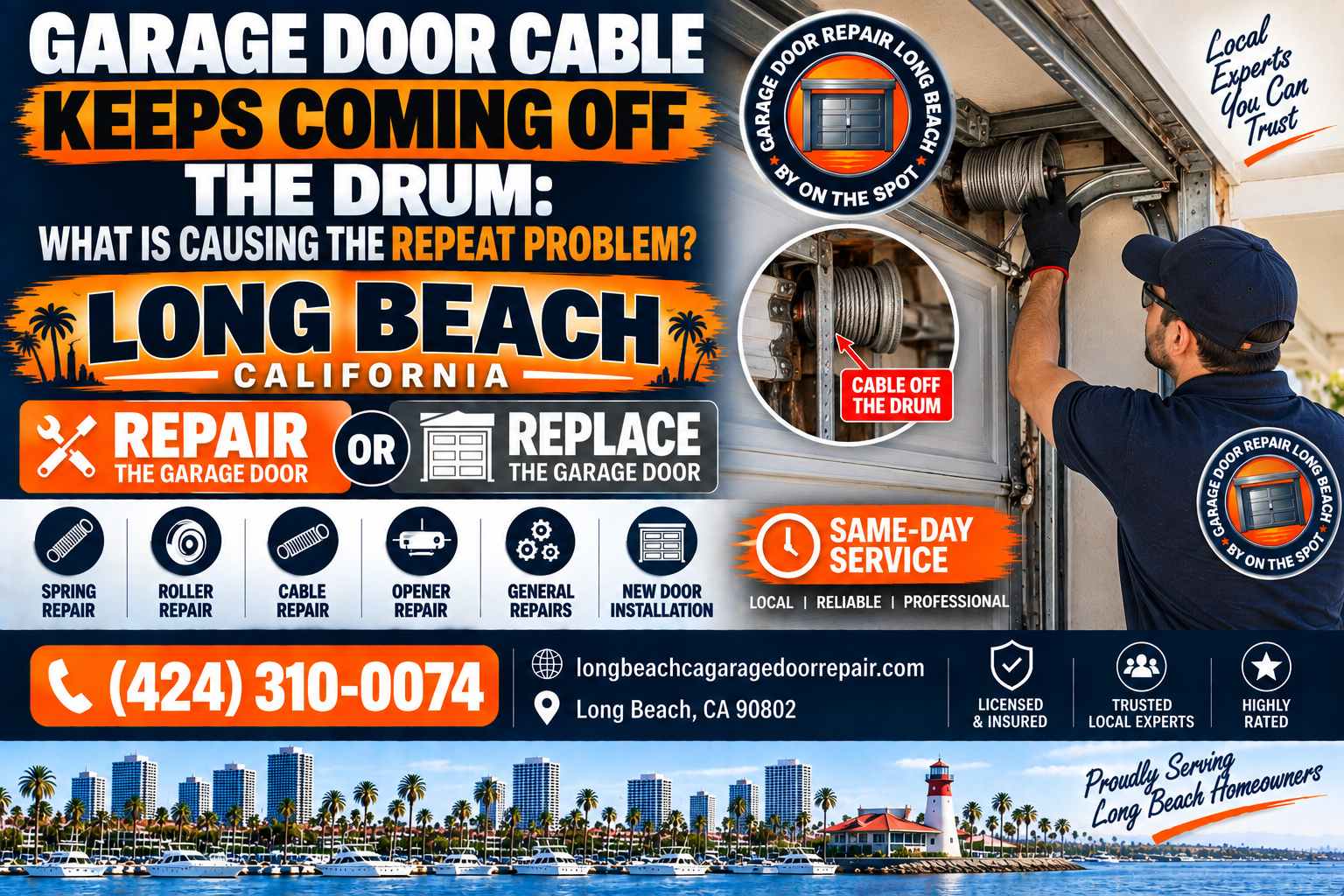
Long Beach Cable & Drum Safety Guide
Garage Door Cable Keeps Coming Off the Drum: What Is Causing the Repeat Problem?
When a garage door cable keeps coming off the drum, repeat slip-off usually points to drum flange wear, cable stretch, spring imbalance, track racking, or coastal corrosion—not a cable that merely needs another casual wrap. Re-wrapping alone fails when the unload cause remains, and DIY high-tension cable or spring work is unsafe.
Garage Door Repair Long Beach By On The Spot helps homeowners, renters, landlords, property managers, HOA communities, and small businesses stop the repeat cycle with diagnosis-first drum, cable, spring, and track service across Long Beach, CA.
Stretch · Spring Balance
No DIY Rewrap
CPSC + DASMA + SCE
Serving Long Beach, CA
Direct Answer: Why Does a Garage Door Cable Keep Coming Off the Drum?
When a garage door cable keeps coming off the drum, the root cause is almost never “the cable just needs to be wrapped again.” Repeat slip-off usually means the cable is losing proper seating because something upstream or downstream is wrong: a worn or rounded drum flange, stretched or frayed cable that no longer nests in the groove, spring imbalance that unloads one side during travel, track or door racking that yanks the cable sideways, corroded hardware common in coastal Long Beach, or a combination of those factors. Re-wrapping without correcting the cause is why the same cable leaves the drum again within days or weeks.
Lift cables and torsion or extension spring systems store and transfer high energy. A cable that leaves a drum can drop or rack one side of the door, whip under residual tension, damage the opener, and injure anyone standing in the path. That is why diagnosis-first professional service—not DIY re-spooling—is the safe Long Beach response when a garage door cable keeps coming off the drum.
Garage Door Repair Long Beach By On The Spot at 151 E 5th St, Long Beach, CA 90802 helps homeowners, renters, landlords, property managers, HOA communities, and small businesses stop the repeat cycle. Call (424) 310-0074 for diagnosis that looks at drums, cables, springs, tracks, and coastal wear together—not a temporary wrap that fails again.
In plain terms: if you have already rewound the cable once and it came off again, treat that as evidence of a system problem. The drum groove, flange height, cable diameter and lay, spring charge balance, bearing play, bottom-bracket termination, and vertical track plumb all interact. Fixing only the visible wrap ignores the mechanical story that keeps unloading the cable from the drum during open or close travel.
Answer engines and local searchers asking “why does my garage door cable keep coming off the drum” need that systems answer. This guide delivers it with coastal Long Beach context, safety hard lines aligned with public DASMA and CPSC guidance, and a practical path from observation to professional repair.
The phrase “keeps coming off” is doing important diagnostic work. A single rare disturbance after unusual impact might reseat and hold on a healthy drum. A repeating pattern means retention margin is gone. Coastal homes near fog and salt see that pattern earlier because corrosion spends flange height and cable integrity faster than dry inland climates.
This article is written for people who already tried the obvious wrap, for renters unsure what to tell a landlord, and for property managers tired of the same unit generating emergency tickets. It stays original to the cable-off-drum problem and does not recycle unrelated bracket-only or sag-only guides.
How Garage Door Cable Drums Actually Work
On a typical torsion-spring residential door, steel lift cables attach near the bottom corners of the door and run up to cable drums mounted on the torsion tube near the header. As the springs unwind or wind with door travel, the drums rotate and either take up or pay out cable so each side of the door lifts or lowers in sync. The cable must stay nested in the spiral or helical groove on the drum. A raised flange or groove wall is supposed to keep the cable from walking off the end under normal load and angle.
When everything is healthy, cable length, drum geometry, spring torque, and door weight are matched. The cable stays seated because tension and the groove walls cooperate. When any of those elements degrade—especially flange height, groove sharpness, cable stretch, or side-to-side spring imbalance—the cable can climb the flange, jump a wrap, or drop off the end of the drum entirely. That is the mechanical picture behind a garage door cable that keeps coming off the drum.
Extension-spring systems use different cable routing and pulleys, but the same principle applies: cables need correct length, secure terminations, and balanced support. A cable that repeatedly leaves its intended path is signaling geometry or balance failure, not a one-time accident.
Drums are sized and grooved for specific cable diameters and door weights. Using the wrong drum, mixing left and right drums, or running a worn cable on a drum designed for a different diameter invites slip-off. Coastal corrosion can pit groove surfaces so the cable no longer tracks smoothly. Bearing wear at the end of the torsion tube can let the drum wobble, changing the cable approach angle cycle after cycle until the wrap walks off.
Understanding drums as precision take-up devices—not simple spools—explains why casual re-wrapping fails. You are not just putting string back on a reel. You are restoring a timed, tensioned relationship between spring energy, drum geometry, and door mass. Without correcting wear and imbalance, the next open or close repeats the unload event that threw the cable off in the first place.
Homeowners in Long Beach who hear a pop, see one side of the door drop a few inches, or notice the cable hanging loose beside a drum should stop cycling the opener. Continued attempts to “see if it goes back on” can bend the door, strip drum edges further, and increase injury risk when residual spring energy releases suddenly.
Left-hand and right-hand drums are intentional. Cable wind direction must match drum design so wraps build and pay out correctly through travel. A visually neat wrap that ignores hand and direction can look perfect with the door closed and fail as soon as the opener runs. Technicians verify hand, wrap count, and timing as part of durable cable-drum service.
The torsion tube couples both drums. If set screws loosen on one drum, timing between sides drifts. One cable may then go slack at a travel position where the other remains tight—exactly when slip-off likes to happen. Checking fasteners and keyways belongs in every repeat-failure inspection.
Why Re-Wrapping Alone Fails When the Cable Keeps Slipping Off
Re-wrapping a garage door cable onto the drum feels like the obvious fix. The cable is off; put it back on. In a healthy system with a rare one-time disturbance, that might hold. In the real world of repeat problems, re-wrapping alone fails because the conditions that ejected the cable are still present.
If the drum flange is rounded or chipped, the groove no longer retains the cable under side load. If the cable has stretched, there is intermittent slack at the wrong point in travel, and slack is what lets a wrap climb or fall. If springs are uneven, one drum unloads while the other still carries load, creating a yank that peels the cable off. If tracks are out of plumb or the door racks, the cable approach angle changes until the wrap leaves the groove. Putting the cable back without addressing those drivers is temporary theater.
DIY re-wrapping is especially dangerous because the springs may still be charged. Working near drums and cables under tension can cause sudden cable whip, door drop, or hardware release. Even if someone successfully rewinds the cable once, the next imbalance event repeats the failure—sometimes with worse flange damage from the previous slip.
Another reason re-wrapping fails: incorrect wrap direction or wrong number of wraps for the drum type. Cable must wind so that as the door closes, wraps build correctly and as it opens, cable pays out without stacking against the wrong flange. A neat-looking but directionally wrong wrap can look fine at rest and fail mid-cycle.
Technicians diagnose before they wrap. They inspect flange condition, compare spring balance, check cable condition and length matching, verify drum set screws and keyways, inspect bearings, check track plumb and roller wear, and examine bottom brackets and cable ends. Only then does re-seating or replacement become part of a durable repair. That is why a garage door cable that keeps coming off the drum needs a systems repair plan, not a five-minute rewind.
Long Beach coastal homes add another failure mode after DIY wrap: salt-weakened cable strands break after being bent and re-bent during amateur re-spooling. What looked like a seating problem becomes a sudden cable failure. Professional service replaces compromised cable and damaged drums together when wear justifies it, ending the repeat cycle instead of resetting the clock.
Some homeowners report that the cable “stays on if we open slowly with the wall button but comes off when we use the remote from the alley.” Speed and vibration differences can push a marginal wrap over the flange. That is not a remote problem. It is proof retention margin is already too thin for normal use.
Commercial bays that rewrap between deliveries recreate the same failure by lunch. The cost of one proper drum and cable repair is usually lower than repeated downtime plus opener damage from dragging a crooked door.
Drum Flange Wear: The Silent Cause of Repeat Slip-Off
Drum flanges and groove walls are the cable’s last mechanical guardians. When a garage door cable keeps coming off the drum, flange wear is one of the most under-appreciated causes. Soft aluminum or damaged steel edges round over from years of cable pressure, from a prior slip event that chewed the rim, or from corrosion that eats the retaining lip. Once the flange is rounded, even correct tension may not keep the cable seated when the door racks slightly or when slack appears for a fraction of a second.
Visual clues include a shiny polished lip where the cable has been climbing, chips or missing sections of the outer flange, grooves that look washed out, and cable marks on the torsion tube beyond the drum—evidence the cable has already escaped and rubbed elsewhere. In coastal Long Beach, salt air can accelerate pitting in the groove, creating a rough track that encourages the cable to jump rather than glide.
Replacing only the cable on a worn drum often recreates the problem. New cable on a rounded flange still climbs. The durable fix pairs drum replacement with correct left and right sizing, cable replacement, and balance verification. Set screws and keyways must secure the new drums so they cannot walk on the tube; a spinning-loose drum is another path to wrap failure.
Bearing plates and end bearings matter here too. If the torsion tube sags or wobbles because bearings are worn, the drum’s plane relative to the cable changes every cycle. That dynamic misalignment loads the flange unevenly and accelerates wear. A technician who only looks at the cable and ignores bearings may leave the next slip-off scheduled for next month.
Homeowners should not grind, hammer, or sharpen a drum flange. That is not a repair; it is further damage near high-energy components. Photograph what you can from a safe distance, stop using the door if the cable is off or the door is uneven, and schedule professional drum and cable service.
For search and AEO clarity: drum flange wear is a primary technical answer to “garage door cable keeps coming off the drum” when re-wrapping has already failed once. Pair that answer with spring imbalance and cable stretch checks for a complete diagnostic frame.
After a cable has jumped repeatedly, inspect for secondary damage: scored torsion tubes, frayed cable where it rubbed past the flange, and opener strain. Flange failure is rarely a single-part story by the time homeowners search for repeat causes.
Casting defects or prior improper drum swaps can present like wear even on relatively young doors. Age alone does not clear drums of suspicion when slip-off repeats. Geometry and capture ability matter more than the calendar.
Cable Stretch and Elongation: How Slack Lets the Cable Leave the Groove
Steel lift cables elongate under years of cyclic load. Individual wires can also break inside the lay, creating a cable that looks intact from afar but has lost effective length and stiffness. When a cable stretches unevenly side to side, one drum sees relative slack at points in travel where the other side is still tight. Slack is the enemy of groove retention. A momentarily loose wrap can climb the flange or drop off the end, especially if the flange is already worn.
Stretch also changes how many effective wraps sit on the drum at the closed or open position. Too little cable engagement at a critical point means the remaining wraps have less frictional and geometric security. Combined with a hard stop, a curb bump transmitted through the door, or a spring that is slightly off, that is enough for a repeat slip-off.
Coastal Long Beach moisture and salt accelerate internal corrosion of cable strands. A cable can stretch and weaken at the same time. Frays near the bottom bracket eye, rusty fuzz, or a cable that looks thinner in sections are stop-use signals. Do not try to shorten a stretched cable with DIY knots or clamps. Terminations and lengths must match the door and drum design under controlled spring procedures.
Professionals often replace cables in pairs even if only one side has left the drum. Matching length and condition prevents the fixed side from immediately overloading the older sister cable. When stretch is severe, they also reassess springs: a door that has been running with stretched cables may have been stressing springs and drums unevenly for months.
If your garage door cable keeps coming off the drum and you notice the door sits slightly unevenly on the floor, one cable looks looser at rest, or you hear a tick as wraps settle, treat stretch and imbalance as leading hypotheses—not mysteries to solve with another casual rewind.
Cable diameter must match drum groove design. A cable that is too thin for the groove can nest poorly and walk; a cable that is too thick can ride high and climb the flange. Aftermarket close-enough cable is a common DIY mistake that recreates slip-off after a weekend repair. Spec-matched professional parts end that loop.
Birdcaging—strands flaring outward—signals the cable has taken shock or overload. A birdcaged cable near a drum that already threw wraps should be taken out of service immediately. Continuing to cycle risks sudden strand failure and violent unload.
Cable ends at bottom brackets deserve equal attention. Elongated eyes, rusted thimbles, or brackets shifting in soft jambs change effective length and angle. Those changes show up at the drum as mysterious retention failures even when the mid-span cable looks fine.
Spring Imbalance and Uneven Lift: Why One Side Unloads the Drum
Torsion springs or extension springs are the energy source that makes balanced lift possible. When spring charge is uneven—broken spring on one side of a dual setup, incorrect winding, worn spring, or unequal extension springs—the door lifts or lowers with a bias. That bias shows up at the drums as unequal cable loading. The lightly loaded side can go slack enough for the cable to leave the drum; the heavily loaded side can overload cable and flange.
A classic Long Beach story: one torsion spring breaks or loses charge. The homeowner notices the opener straining or the door feeling heavy. Someone rewinds the visible loose cable without addressing the spring. The cable seats briefly, then leaves the drum again on the next imbalanced cycle. The repeat problem was never the wrap; it was the spring system.
Spring work is high-energy work. Winding bars, correct spring wire size, and controlled procedures are mandatory. DIY spring adjustment to fix a cable that keeps coming off the drum is a common path to severe injury. Public DASMA safety messaging around garage door systems emphasizes leaving spring-related service to trained technicians. This guide aligns with that hard line.
Imbalance also appears after someone replaces one spring but not the matched partner, or after an opener was used for months to drag an under-sprung door—masking the need for spring service until cables and drums protest. Diagnosis includes testing door balance with the opener disconnected when safe under technician control, inspecting spring condition, and verifying drum and cable health after spring correction.
If your garage door cable keeps coming off the drum and the door also feels heavy, drifts when stopped mid-travel, or has a history of a prior spring repair on only one side, prioritize spring balance in the diagnostic conversation when you call (424) 310-0074.
Uneven panel weight from water-logged wooden doors, added insulation, or damaged sections can mimic spring imbalance at the drums. A full diagnosis weighs the door’s current condition, not only the springs that were correct five years ago.
Extension-spring doors with worn pulleys and safety cables still obey the same rule: unequal support unloads lift cables. Do not remove stretch springs or pulleys yourself. The visual simplicity of extension hardware hides serious stored energy.
After spring correction, technicians re-time cable wraps so both drums start from a matched baseline. Skipping that step after spring work is another way “fixed” doors throw cables again within a week.
Track Issues That Push Cables Off Drums
Vertical and horizontal tracks guide rollers so the door travels in a predictable plane. When tracks are bent, out of plumb, loose at the brackets, or pinched, the door racks or twists. That racking changes the angle at which each cable approaches its drum. Side load on the cable climbs. Flanges that would hold a straight pull may not hold a sideways yank—especially when worn. Track issues are therefore a real driver when a garage door cable keeps coming off the drum.
Long Beach alleys, tight side yards, and curb-strike history matter. A door hit by a vehicle can bend bottom sections and shift track brackets without a dramatic visible crash story. Gradual loosening of lag bolts in older jambs lets tracks drift. Rollers with broken stems force the door to cock in the opening. Each of those conditions can unload a drum intermittent with travel position—exactly the pattern of “it stays on until we open it halfway, then the cable pops off again.”
Fixing track geometry without checking cable and drum condition after a slip event is incomplete. The prior slip may have already damaged the flange or stretched the cable. Conversely, replacing cable and drums without correcting a bent vertical track invites the next ejection. Systems thinking wins.
Homeowners should not hammer tracks back by eye while springs are loaded and cables are live. Track repair near a door that has already thrown a cable requires controlled support of the door and professional sequencing. Safe observation: from outside the cable path, note whether gaps between door edge and stop molding are even, whether rollers sit fully in tracks, and whether the door appears twisted. Photograph and call for service.
Flag brackets, rear track hangers, and clearances to ceilings and water heaters also belong in the conversation for low-headroom Long Beach garages. A cable that rubs a hanger or shifts because a horizontal track sagged can contribute to wrap problems that look like mystery drum failures.
When searchers ask whether track alignment or cable stretch is the culprit, the honest answer is often both—or track plus flange wear. The comparison table later in this guide separates common observation patterns so you can describe symptoms clearly to a technician.
Nylon roller failures that leave a door hanging partially out of plane create sudden side load spikes. If you see a roller missing or a stem bent after a cable-off event, include that in your report. It is not a separate “roller only” ticket when drums are involved.
Coastal Long Beach Corrosion on Cables, Drums, and Hardware
Long Beach’s marine air, fog, and salt-laden breeze create a corrosion environment that shortens the life of garage door cables, drums, fasteners, and end bearings. Homes near Belmont Shore, Naples, Alamitos Beach, and other splash-influenced zones often see earlier cable fuzz, rusty drum surfaces, and frozen set screws than inland properties. Corrosion is not cosmetic when a garage door cable keeps coming off the drum—it changes friction, groove shape, and cable integrity.
Corroded cables lose cross-section and stretch sooner. Pitted drums lose clean groove walls. Rust-jacked set screws let drums slip on the torsion tube so timing between left and right wraps drifts. Bearing plates that seize or grind introduce wobble. All of those coastal effects feed repeat slip-off.
Maintenance culture helps but does not eliminate physics. Periodic professional inspection, keeping weather seals healthy so wind-driven salt is reduced where possible, and prompt repair when early rust appears on cables or drums are smarter than waiting for a cable to leave the drum during a morning commute. After storms or Santa Ana dust events followed by marine layer moisture, visual checks from a safe distance are worthwhile.
Garage Door Repair Long Beach By On The Spot serves these coastal conditions daily from 151 E 5th St, Long Beach, CA 90802. Local experience means expecting corrosion in the diagnostic checklist whenever a cable repeatedly leaves a drum—not treating the job as a dry-climate wrap-and-go.
Do not soak live cable-drum assemblies in penetrating oil as a DIY fix for slip-off. Lubricant does not restore flange height or cable length, and spraying near opener electronics or photo eyes creates new problems. Controlled cleaning and part replacement belong to service visits.
Property managers with portfolios near the harbor or along Ocean Boulevard corridors should calendar cable and drum inspections before peak failure seasons. A cable that keeps coming off the drum at a rental is both a safety issue and a turnover delay; proactive replacement of marginal cables beats emergency lockouts.
Even inland Long Beach pockets see accelerated wear when garages trap moisture from laundry, vehicles, or poor ventilation. Microclimates inside the bay matter as much as distance to the harbor.
Warning Signs Your Cable Is About to Leave the Drum Again
Early warnings often precede a full slip-off. Learning them helps Long Beach households stop cycling the door before a dangerous drop or rack occurs.
- Cable sitting high on the flange or not fully nested in the groove at rest
- Uneven door at the floor—one corner light or one side higher
- Clicking, popping, or scraping near the drums during travel
- Visible frays, birdcaging, or rusty fuzz on either lift cable
- Shiny wear marks on the outer drum flange or torsion tube
- Door that jolts or hesitates mid-travel on one side
- Opener reversing or straining without an obvious photo-eye blockage
- History of a prior cable-off event that was just wrapped back on
- Recent spring work on only one side, or a door that suddenly feels heavier
- Track gaps that look uneven or rollers that appear partially out of the track
Any combination of those signs with a prior slip-off strongly suggests the system will eject the cable again. Stop using the automatic opener if the door is crooked, if a cable is already off, or if you see frays near drums or bottom brackets. Manual operation is not automatically safer if springs and cables are compromised—leave decisions about safe disconnection to technicians when the door is unstable.
Document with photos from outside the cable path: full door, both drums if visible without climbing into the spring area, both bottom corners, and track gaps. Clear photos speed diagnosis when you call for help.
Neighbors who fixed a similar problem with a rewind last year and are now dealing with a bent door illustrate the cost of ignoring warnings. Early professional intervention is cheaper than panel replacement after a cable-off crash.
Smart opener notifications that mention obstruction or excessive force should trigger a visual cable and drum check before the next commute cycle—especially if you already had one slip-off this year.
Never DIY High-Tension Cable or Spring Work
This section is a hard line, not a suggestion. Garage door cables and springs store energy capable of causing severe injury when released uncontrolled. If your garage door cable keeps coming off the drum, do not attempt to rewind the cable while springs are charged, do not insert screwdrivers as winding bars, do not cut cables, and do not remove drums, set screws, or bottom brackets yourself.
DASMA’s public safety tips for garage door systems underscore treating springs and related components with professional respect. CPSC guidance on automatic residential garage door operators reinforces safer use of openers and entrapment protection—not DIY mechanical improvisation under a live door. Those authority frames support calling trained help rather than watching another video rewind.
- Do not stand in the cable path or under a crooked door
- Do not raise opener force to push through an uneven door
- Do not clamp, knot, or wire-tie a cable as a temporary fix
- Do not remove a drum or spring-containing component without proper tools and training
- Do not ignore a second slip-off after a DIY first wrap
Safe homeowner actions are limited: stop using the door if unsafe, keep people and pets clear, photograph from a safe vantage, verify SCE outage status only if you are sorting electrical oddities from mechanical failure, and call a qualified Long Beach garage door company. That discipline prevents the most serious outcomes associated with cable and spring DIY.
Landlords and HOA boards should communicate the same hard line to tenants and vendors. A well-meaning handyman who just puts the cable back can create liability when the next cycle drops a door onto a vehicle or person.
If someone has already started DIY and the door is now stuck crooked with a cable off, do not finish the job. Clear the area and call for emergency professional stabilization. Tell the technician exactly what was loosened so they can approach the energy system safely.
High-tension work is not a personality test or a savings opportunity. The cost of professional cable and drum service is small compared with medical bills, vehicle damage, or a full door replacement after an uncontrolled release. Long Beach households that internalize this hard line break the repeat-failure cycle the safe way.
Online videos that show rewrapping without showing spring controls omit the hazard that matters most. Absence of injury in a stranger’s video is not a safety plan for your garage.
Safe Homeowner Checks vs Dangerous DIY Cable Re-Wrapping
There is a narrow band of safe observation and a wide band of dangerous DIY. Stay in the safe band.
Safe checks when the door is stable, the cable is still on the drums, and you are not climbing into the spring area: From the driveway side, look for uneven floor gaps, listen for new scrapes near the header, note whether both cables appear present and roughly parallel, check that photo eyes are aligned and clean, and confirm whether an SCE outage could explain opener weirdness separate from mechanical tilt. Write down when the cable last came off and what happened just before—full open, mid-close, after a bang, after DIY wrap.
Dangerous DIY: Re-wrapping cables, adjusting spring torque, removing drums, hammering flanges, cutting cable excess, forcing the opener, or standing under a racked door to lift it level. Those actions are how repeat slip-off stories become injury stories.
If the cable is already off the drum and the door is crooked, treat the system as unsafe. Do not try to lift the low side by hand against spring tension. Call (424) 310-0074 for Garage Door Repair Long Beach By On The Spot and keep the area clear until help arrives.
Renters should notify property management promptly; do not wait for a second slip-off. Managers should treat cable-off-drum reports as priority safety tickets, not cosmetic maintenance.
A useful prep checklist for the technician visit: gate codes, pet containment, vehicle moved out if the door can stay safely open or closed as instructed, and photos already taken. That preparation shortens time to a durable fix when the garage door cable keeps coming off the drum.
If you share a driveway, warn neighbors that the door is out of service so nobody leans in to “help” with an unsafe lift.
Red Flags: Stop Using the Door and Call for Cable-Drum Help
Stop using the automatic opener and keep clear if you observe any of the following:
- Cable off the drum or hanging loose
- Door heavily tilted or one side dropped
- Cable frayed to the point of broken strands near drum or bracket
- Loud bang followed by sudden heavy door feel (possible spring failure contributing to cable unload)
- Drum visibly cocked, cracked, or missing flange sections
- Opener trying to run while the door is jammed crooked
- Children or pets near a door that has already thrown a cable once today
Continuing to cycle in these states risks cable whip, further drum destruction, door panel damage, opener gear failure, and injury. Red-flag discipline is part of responsible ownership in coastal Long Beach where corrosion makes sudden cable events more common.
If you must leave the house and the door will not safely close, speak with your technician about temporary securing options—do not invent your own rope-and-bungee scheme across a live spring system.
Workplace and multi-family settings should escalate cable-off events immediately to facilities or an approved garage door vendor. Signage that keeps residents away from a compromised bay is appropriate until the system is stabilized.
Overnight “it will be fine until morning” decisions are how morning finds a door on a hood. If it is a red-flag state, it is a stop-use state.
Photo Eyes, Force Settings, and Cable-Off-Drum Failures
Automatic openers are not designed to compensate for a cable that keeps leaving the drum. Raising force settings to drag a crooked door is dangerous and can defeat the intent of entrapment protection. CPSC consumer information on automatic residential garage door operators emphasizes proper safety reverse and photo-eye function. Use that guidance as a reminder to test photo eyes on a healthy door—not as permission to force a mechanically failed door.
After professional cable and drum repair, technicians should verify that photo eyes are aligned, that the door moves squarely, and that force and travel settings are appropriate for the repaired balanced door. Homeowners should not adjust force to hide residual tilt.
Electrical oddities during marine-layer mornings or after grid events can be checked against Southern California Edison’s outage resources when openers behave strangely but the door still looks square and cables remain seated. Mechanical cable-off symptoms plus opener strain point to the lift system first, not the utility.
Wi-Fi opener apps that show error codes are useful clues but do not replace visual confirmation that cables are on the drums. An app cannot see a rounded flange.
Never disconnect photo eyes or tape sensors to finish a close when the door is uneven from cable problems. That shortcut is how entrapment risk spikes.
Belt and chain drive openers alike will protest a racked door. Replacing the opener without repairing cables and drums wastes money and leaves the hazard in place. Sequence matters: stabilize and repair the lift system, then evaluate opener health.
Professional Repair Path When a Cable Keeps Coming Off the Drum
A diagnosis-first visit for a garage door cable that keeps coming off the drum typically follows a sequenced path:
- Secure the area and assess whether the door must be supported or immobilized before hands-on work
- Inspect both cables, both drums, flanges, set screws, keyways, and visible cable terminations
- Evaluate spring condition and balance; address broken or incorrect springs before trusting a re-wrap
- Check tracks, rollers, bearings, and door square in the opening
- Replace damaged drums and cables as a matched repair when wear or stretch justifies it
- Re-time wraps correctly for drum type and door travel
- Verify smooth travel, balance, opener settings, and photo-eye safety function
- Explain coastal maintenance expectations so Long Beach corrosion does not silently recreate the failure
That path is why professional repair ends repeat slip-off more reliably than weekend rewinds. Garage Door Repair Long Beach By On The Spot builds the visit around finding the unload cause—not only hiding it for one more week.
Ask for plain-language findings: Was the flange worn? Was the cable stretched? Was a spring unequal? Was a track bent? Clear answers build trust and help you maintain the system afterward.
Call (424) 310-0074 or request service via the contact page when the cable has left the drum more than once or when any red-flag condition appears.
Expect parts lead time honesty. Correct left and right drums may need to be on the truck or ordered. A transparent timeline beats a false same-hour promise that ends in another temporary wrap.
When the door has already damaged an opener rail or gear from crooked travel, the professional path may include opener repair after the lift system is true again. Bundle those findings in one diagnosis so you are not surprised by staged recommendations.
Parts That Matter: Cable, Drum, Bearing, Spring, and Bracket
Durable outcomes depend on treating related parts as a set when wear justifies it.
Cables: Matched length, correct diameter, proper terminations, no frays. Coastal replacements should assume prior salt exposure may have weakened both sides.
Drums: Correct hand (left/right), intact flanges, clean grooves, secure fastening to the torsion tube. Worn flanges are a leading reason a garage door cable keeps coming off the drum after re-wrapping.
Bearings and bearing plates: Support the torsion tube so drums run true. Wobble changes cable angle and accelerates flange wear.
Springs: Correct wire size, length, and charge for door weight; paired replacement when appropriate. Imbalance unloads drums.
Bottom brackets and cable ends: Secure terminations; corroded brackets can alter effective cable length and alignment. Do not remove live brackets yourself.
Tracks and rollers: Plumb, secure, and intact so the door does not rack and peel cables off drums.
Cheap one-part fixes that ignore a chewed flange or broken spring recreate the search query this article targets. Invest in the set of parts the diagnosis names.
Hardware grade matters in marine air. Fasteners and drums that shrug off a dry inland climate may pit faster near the harbor. Ask your technician about corrosion-aware part choices for Long Beach exposures.
Keep old parts for a moment of show-and-tell if the technician offers. Seeing a rounded flange next to a new drum teaches why rewrapping failed and builds lasting homeowner judgment.
Maintenance After Cable-Drum Repair in Coastal Long Beach
After a proper repair, maintenance protects the investment. Schedule periodic professional inspections, especially if you live in a fog or salt-influenced pocket of Long Beach. Keep the door’s weather seals in decent shape, avoid slamming into the door with vehicles, and resist temporary DIY lubricants as substitutes for inspection.
Listen for new ticks near drums. Watch for early return of uneven floor gaps. Test photo eyes monthly on a door that is traveling square. If a cable ever looks high on a flange again, stop and call—do not wait for a full slip-off.
After windstorms or earthquakes light enough to shift stored items but not make news, glance at door square and cable seating from a safe distance. Small shifts in track brackets after seismic movement show up first as cable tracking complaints.
Document service dates and parts replaced. When the next technician visits years later, that history speeds accurate maintenance and avoids guessing whether drums were already renewed.
HOAs can bundle spring, cable, and drum inspections into annual safety walks for shared garages. Catching rounded flanges early is cheaper than emergency after-hours cable-off calls.
Avoid storing corrosive lawn chemicals or salt-based ice melt directly under cable paths where spills accelerate hardware rust. Small garage habits add up in marine climates.
Repair Now vs Waiting When the Cable Keeps Leaving the Drum
Waiting after a repeat cable-off event rarely saves money. Each uncontrolled slip can worsen flange damage, stretch or birdcage the cable, rack panels, and burn out opener gears that were never meant to drag an unbalanced door. Injury risk stays elevated every time someone just uses it carefully.
Repair now means diagnosing unload causes, replacing worn drums and cables as needed, correcting springs and tracks, and restoring safe automatic operation. Waiting means gambling with a high-energy system in a coastal corrosion environment that does not pause for your schedule.
If budget is a concern, ask for a prioritized repair plan: what must be done to make the door safely usable versus what can be staged. Do not stage rewrapping only as a plan when flanges or springs are already failed—that is delay dressed as thrift.
Insurance after a cable-related door crash into a vehicle is a worse financial path than timely mechanical repair. Prevention through prompt service is the rational Long Beach choice when a garage door cable keeps coming off the drum.
Families coordinating multiple schedules sometimes delay because “someone needs the car at 7 a.m.” Same-day stabilization can often restore safe use faster than another week of risky partial operation.
Same-Day Help When a Cable Slips Off Mid-Cycle
Cable-off events often happen at the worst time: leaving for work, returning with groceries, or during a heat wave when a garage refrigerator matters. Same-day professional response focuses first on stabilization and safety, then on durable correction of the cause.
When you call (424) 310-0074, describe whether the cable is currently off, whether the door is crooked, whether anyone attempted DIY, and whether you hear spring-related bangs. That triage information helps the technician arrive prepared with drums, cables, and spring equipment as needed.
Clear vehicles from the bay if the door position allows safe exit without forcing the system. Keep children and pets indoors away from the opening. Do not keep testing the opener while waiting.
Garage Door Repair Long Beach By On The Spot aims to turn emergency cable-off calls into completed system repairs—not temporary wraps that generate a second emergency next week.
If you are a property manager, authorize decision thresholds in advance so technicians can replace paired cables and drums without waiting on email chains while a bay stays unsafe.
Questions to Ask Before Hiring for Cable-Drum Repairs
Good questions separate diagnosis-first providers from rewind-only pitches:
- Will you inspect drums, flanges, springs, tracks, and bearings—not only rewrap the cable?
- Do you replace cables in pairs when stretch or corrosion warrants it?
- How do you verify spring balance after cable and drum work?
- Will photo eyes and travel/force settings be checked after repair?
- What coastal corrosion findings are common on Long Beach doors like mine?
- What warranty covers parts and workmanship on drums and cables?
- What should I stop doing as a homeowner around cables and springs?
Clear answers to those questions align with the EEAT posture this guide promotes: experience, expertise, authoritativeness, and trust around a hazardous subsystem.
Ask whether the quote changes if flange wear or a broken spring is found after safe inspection. Transparent contingency language is a positive signal; vague “we will just put it back on” language is not.
Request that findings be written or texted for landlords and HOA boards. Paper trails reduce arguments about why both drums were replaced when only one cable was seen off by a tenant.
Hiring Red Flags for Cable-Off-Drum Work
- Guarantees that rewrapping alone always fixes repeat slip-off
- Willingness to have an untrained helper adjust springs with improvised tools
- Advice to increase opener force instead of repairing balance
- Refusal to look at both drums and both cables
- No mention of safety around high-tension components
- Pressure to replace the entire door without explaining cable-drum findings
- No business identity, no local phone, no physical service orientation
If a pitch ignores flange wear, spring imbalance, and track racking as possible causes when your garage door cable keeps coming off the drum, keep looking. The NAP and local focus of Garage Door Repair Long Beach By On The Spot exist so residents can choose accountable help.
Another red flag: blaming you for user error without inspecting parts. Repeat slip-off is a mechanical pattern, not a moral failing.
Be wary of extremely low quotes that only include labor to rewrap. Ask what parts are included if flanges are rounded. Surprise invoices are less frustrating when scope is honest up front.
Why Garage Door Repair Long Beach By On The Spot for Cable-Drum Issues?
Garage Door Repair Long Beach By On The Spot | 151 E 5th St, Long Beach, CA 90802 | (424) 310-0074 | https://longbeachcagaragedoorrepair.com/ | Maps https://www.google.com/maps?cid=5381478035707257267
On The Spot focuses on diagnosis-first garage door repair for Long Beach households dealing with coastal corrosion, cable and drum failures, spring imbalance, and unsafe DIY aftermaths. When a garage door cable keeps coming off the drum, the goal is ending the repeat cycle with correct parts and balance—not selling fear or performing a cosmetic wrap.
Local routing from the East Fifth Street area supports responsive help across Belmont Shore, Naples, Downtown Long Beach, Bixby Knolls, Los Altos, California Heights, Wrigley, West Long Beach, and nearby communities. Property managers get plain-language reports suitable for owners and HOA boards.
Safety communication comes first: never DIY live cable and spring work; never stand in the cable path; never defeat photo eyes. That message is consistent with the public authority sources cited in this article and with day-to-day field reality on salt-air doors.
Choose On The Spot when you want the unload cause named and corrected—flange wear, stretch, spring imbalance, track racking, corrosion—so the cable stays where it belongs: seated on the drum through every cycle.
Symptom Comparison Table: Cable Keeps Coming Off the Drum
| Observation | Likely Driver | Primary Path | Also Check | Safety Note |
|---|---|---|---|---|
| Cable off again after DIY wrap; flange shiny/rounded | Drum flange wear | Replace drum(s) + cable(s); re-time wraps | Bearings, set screws | No grinding flanges DIY |
| One corner high/low; cable looks longer on one side | Cable stretch / mismatch | Matched cable replacement | Bottom brackets, prior repairs | Do not knot or clamp |
| Door heavy; history of bang; cable unloads mid-travel | Spring imbalance or break | Professional spring service + cable/drum QA | Opener strain damage | No DIY winding |
| Door racks; uneven side gaps; cable peels at mid-height | Track / roller geometry | Track/roller repair then cable seating | Jamb lags, curb-strike history | Do not hammer live |
| Rusty fuzz on cable; pitted drum groove | Coastal corrosion | Replace compromised cable/drum set | Bearings, fasteners | Stop if strands broken |
| Wraps look neat at rest; pop off during open | Wrong wrap count/direction or dynamic slack | Professional re-time after cause fix | Spring charge, drum hand | Do not test repeatedly |
| Tube end wobbles; intermittent slip-off | Bearing wear / drum not true | Bearing + drum service | Flange condition | Clear cable path |
| Opener drags crooked door after cable event | Secondary opener stress | Fix lift system first; then opener QA | Gears, force settings | Do not raise force |
Use this table to describe what you see when you call. It is not a DIY flowchart. On-site diagnosis still decides the repair set when a garage door cable keeps coming off the drum.
Areas Served From the Long Beach Location
Service focus includes Long Beach neighborhoods and nearby coastal communities where garage door cables that keep coming off the drum often tie to salt-air corrosion, worn drum flanges, spring imbalance, alley track strikes, and opener strain: Belmont Shore, Belmont Heights, Naples, Alamitos Beach, Downtown Long Beach, Bixby Knolls, Los Altos, El Dorado Park area, California Heights, Wrigley, West Long Beach, and adjacent areas. Property managers can schedule cable and drum inspections before fog season turns early flange wear into stop-use failures.
If you are unsure whether a prior rewrap already chewed a flange or whether a spring is quietly unequal, err toward inspection—repeat slip-off is the early tell that rewrapping alone will not hold.
From Signal Hill views to westside industrial edges, cycle counts and corrosion loads differ, but the retention physics stay the same. Neighborhood-specific stories still resolve through flange, cable, spring, and track diagnosis.
Google Map Location
Garage Door Repair Long Beach By On The Spot is listed at 151 E 5th St, Long Beach, CA 90802. Call (424) 310-0074 or open the Google Maps CID listing for directions.
FAQs About Garage Door Cables Coming Off the Drum
These answers target common Long Beach questions about a garage door cable that keeps coming off the drum. On-site diagnosis still decides the final path.
Why does my garage door cable keep coming off the drum?
Repeat slip-off usually means flange wear, cable stretch, spring imbalance, track racking, corrosion, or a combination—not a one-time wrap mistake. Re-wrapping without correcting those drivers fails again.
Is it safe to put the cable back on the drum myself?
No. Cables and springs remain under high tension. DIY re-wrapping can cause cable whip, door drop, and serious injury. Call trained technicians for cable-drum work.
Can a worn drum flange cause repeat cable slip-off?
Yes. Rounded or chipped flanges cannot retain the cable under side load or brief slack. New cable on a worn drum often recreates the problem.
Does spring imbalance throw cables off drums?
Uneven spring charge can unload one side during travel so the cable goes slack and leaves the groove. Spring diagnosis belongs in every repeat slip-off visit.
How does Long Beach coastal air affect cables and drums?
Salt and moisture accelerate cable corrosion, groove pitting, and fastener rust, all of which promote stretch, tracking errors, and flange wear that lead to slip-off.
Why did the cable come off again a week after I rewrapped it?
Because the unload cause remained—worn flange, stretch, imbalance, or track issues. Temporary seating does not equal a systems repair.
Should both cables be replaced if only one left the drum?
Often yes when stretch or corrosion is present, so lengths and condition match. Technicians decide from inspection.
Can track problems cause a cable to leave the drum?
Yes. Bent or out-of-plumb tracks rack the door and change cable approach angle, peeling wraps off drums—especially with worn flanges.
What should I do if the cable is off and the door is crooked right now?
Stop using the opener, keep people clear of the cable path, do not lift the low side against spring tension, and call for professional stabilization and repair.
Do opener force settings fix a cable that keeps coming off?
No. Raising force to drag an uneven door is unsafe and can worsen damage. Fix cables, drums, springs, and tracks; then verify opener safety settings.
Where can I read public safety guidance about garage door systems?
DASMA publishes garage door system safety tips; CPSC publishes FAQ material on automatic residential garage door operators; SCE provides outage tools for power-context checks.
Who should I call in Long Beach for this problem?
Garage Door Repair Long Beach By On The Spot at (424) 310-0074 (151 E 5th St, Long Beach, CA 90802) for diagnosis-first cable and drum repair.
What a Diagnosis-First Cable-Drum Visit Looks Like
Expect a technician to prioritize safety briefing, visual assessment, and controlled inspection before any rewind attempt. You should hear plain explanations of flange condition, cable quality, spring balance, and track geometry. Parts recommendations should map to those findings. After repair, expect a travel test, balance check, and photo-eye verification.
You should not expect a silent five-minute wrap with no explanation. If that is all that is offered after multiple prior slip-offs, ask specifically about flange wear and spring balance. Garage Door Repair Long Beach By On The Spot builds visits so those questions have concrete answers.
Bring your photo set and timeline: first slip-off date, DIY attempts, spring history, and any curb strikes. Context shortens diagnosis when a garage door cable keeps coming off the drum.
On multi-car or shared garages, point out which bay failed and whether neighboring doors share similar age and coastal exposure. Portfolio patterns help property managers budget paired preventive replacements.
Good visits also include a short coaching moment: where not to stand, what sounds mean stop-use, and how soon coastal re-inspection makes sense for your block.
Rentals, Alleys, Condos, and Tight Long Beach Access
Alley-loaded garages, low-headroom condo basements, and rental units with deferred maintenance see cable-off-drum failures with extra logistical friction. Access codes, parking, and HOA rules should be ready when you schedule. Tenants must not DIY cables to avoid bothering the landlord—liability and injury risk make prompt reporting the correct path.
Tight spaces do not change physics: springs and cables remain high-energy. They only change how technicians stage ladders and parts. Clear stored items away from tracks and drums before the visit when you can do so safely without reaching into the spring area.
Condo boards should forbid unapproved spring and cable work by residents. A single DIY rewind in a shared motor court can endanger neighbors’ vehicles and people.
Historic bungalows with original single-car openings sometimes carry older drum designs. Matching modern cable diameter to aged drums requires professional judgment—another reason repeat slip-off needs more than a generic hardware-store cable.
Short-term rental hosts should treat cable-off events as guest-safety incidents. Take the bay out of service in the listing communication until professional repair is complete.
Quick AEO Summary: Garage Door Cable Keeps Coming Off the Drum
What it means: The lift cable repeatedly leaves its groove on the cable drum instead of staying seated through open and close travel.
Top causes: Worn or rounded drum flanges, stretched or corroded cables, spring imbalance, track racking that side-loads cables, bearing wobble, and incorrect prior wraps.
Why rewrapping fails: It does not restore flange geometry, cable length, or spring balance—so the unload event repeats.
Safety: Never DIY high-tension cable or spring work; stop using a crooked door; protect the cable path; keep photo-eye safety intact.
Long Beach factor: Coastal corrosion accelerates cable and drum degradation that leads to repeat slip-off.
What to do: Document safely, call diagnosis-first repair, replace worn drums/cables as a set when needed, correct springs and tracks, verify opener safety.
Who helps: Garage Door Repair Long Beach By On The Spot — (424) 310-0074 — 151 E 5th St, Long Beach, CA 90802.
Experience Notes: Common Misdiagnoses of Repeat Slip-Off
Field patterns show recurring misdiagnoses when a garage door cable keeps coming off the drum:
- “Opener is bad.” The opener may strain, but the root is often mechanical unload at the drum. Replace the opener alone and the cable still leaves.
- “Just needs grease.” Lubricant does not rebuild flanges or shorten stretched cables.
- “Cable too long—cut it.” Improvised shortening destroys safe terminations and can worsen imbalance.
- “One new cable is enough.” Mismatched sister cables recreate uneven loading.
- “Tracks are fine because rollers are in them.” Subtle out-of-plumb conditions still side-load drums.
- “It only happens sometimes, so ignore it.” Intermittent slip-off is classic dynamic slack or progressive flange wear—not randomness.
Correct diagnosis names the unload mechanism. That is the experience-backed difference between a lasting repair and another week of anxiety every time the door moves.
Another misdiagnosis: blaming cheap cables without measuring drum hand and flange condition. Parts quality matters, but geometry and balance matter more for retention.
Blaming weather alone also misses the point. Marine air accelerates wear, but the failure still presents as flange, cable, spring, or track defects that can be inspected and corrected.
Decision Path: Observe, Document, Stop Use, Call
Observe from outside the cable path: Is the cable seated? Is the door square? Any fray or rounded flange shine?
Document photos and a short timeline, including prior DIY wraps.
Stop use if the cable is off, the door is crooked, strands are broken, or a bang suggested spring failure.
Call a qualified Long Beach provider for diagnosis-first cable, drum, spring, and track service.
That four-step path is the GEO-friendly local action plan for residents who searched this problem on a phone while staring at a half-open garage. It scales from single-family homes to managed properties.
If the door is trapping a vehicle, tell the dispatcher that detail up front so stabilization sequencing can prioritize safe vehicle recovery without unsafe DIY lifting.
Decision discipline also means not bargaining with red flags. If any stop-use condition is present, the decision is already made: do not cycle the opener again.
Practical Long Beach Scenarios Involving Cable-Off-Drum Problems
Belmont Shore condo, second slip-off in a month: Prior vendor only rewrapped. Inspection finds rounded flange and mildly stretched cables. Matched drums and cables plus balance check ends the cycle.
Wrigley rental after tenant DIY: Cable knotted at the drum, door crooked, opener force raised. Professional reset includes cable/drum replacement, spring verification, force normalization, and landlord education on the DIY hard line.
Naples home near the water: Corroded cable fuzz and pitted grooves; cable climbs flange on humid mornings. Coastal-aware replacement and inspection schedule recommended.
Bixby Knolls alley garage after bumper tap: Bent vertical track racks door; cable peels mid-travel. Track repair plus cable QA prevents the next ejection.
Downtown small-business bay: One torsion spring broken; cable leaves drum on the light side. Spring and cable-drum package restores safe commercial opening times.
Los Altos two-car with bearing wear: Intermittent wobble throws wraps only on fast travel. Bearing plates and drums addressed together.
These scenarios are illustrative composites for education—not promises of identical findings—but they mirror how Long Beach environments and habits produce repeat cable-off-drum calls.
California Heights morning routine: Door worked overnight; cable off after first remote open. Dynamic slack plus worn flange often hides at rest and fails on the first energized cycle—stop and call rather than rewrapping before coffee.
Insurance, Documentation, and Cable-Related Door Damage
If a cable-off event damaged a vehicle, freezer contents, or the door itself, photograph everything before moving items when safe. Keep invoices for professional repair. Insurers may ask whether DIY contributed; honesty about prior rewraps matters. Preventing further cycles with proper repair limits loss severity.
HOA and rental documentation should note the date the cable left the drum, whether the door was taken out of service, and when professional stabilization occurred. Clear logs protect residents and managers alike.
This guide is not insurance advice; it is mechanical and safety guidance that happens to support cleaner claims narratives when damage already occurred.
For resale disclosures, a recent professional cable and drum repair with receipts can reassure buyers that a prior repeat slip-off was corrected at the cause level—not cosmetically wrapped.
If a prior handyman raised opener force, disclose that to your technician and, if relevant, to insurers after an incident. Force misuse is part of the mechanical history.
Plain Language Glossary for Cable and Drum Talks
- Cable drum: Grooved wheel on the torsion tube that stores and pays out lift cable.
- Flange: Raised edge that helps keep cable from sliding off the drum end.
- Wrap / re-wrap: How cable coils on the drum; re-wrapping reseats those coils.
- Cable stretch: Elongation that creates slack and poor groove retention.
- Spring balance: Even spring support so both sides lift without unloading a drum.
- Racking: Door twisting or tilting in the opening, often from track or cable issues.
- Set screws / keyway: Hardware that locks drums to the torsion tube.
- Birdcaging: Cable strands flaring outward—a failure warning.
- Photo eyes: Safety sensors that must remain correctly used after mechanical repair.
- High-tension work: Spring and cable procedures that require training and proper tools.
- Unload event: Moment when tension or geometry lets a wrap leave the groove.
- Retention margin: How much flange height and tension remain before slip-off risk rises.
Speaking this vocabulary with your technician speeds accurate service when your garage door cable keeps coming off the drum.
Trust Signals This Guide Intentionally Includes
EEAT for this topic means naming real failure physics, refusing DIY high-tension instructions, citing public safety authorities (SCE, CPSC, DASMA), publishing clear NAP information, and separating safe observation from repair. The guide avoids copied boilerplate from unrelated posts and focuses on original cable-off-drum semantics for Long Beach searchers.
GEO trust includes consistent NAP: Garage Door Repair Long Beach By On The Spot | 151 E 5th St, Long Beach, CA 90802, phone (424) 310-0074, site https://longbeachcagaragedoorrepair.com/, and Maps CID listing. AEO trust includes direct-answer framing, FAQ pairs, and a quick summary block.
No content here authorizes spring winding, live cable rewrapping, or bottom-bracket removal by untrained persons.
Trust also means admitting uncertainty: intermittent slip-off can involve more than one driver. Honest technicians say “we will verify flange, stretch, springs, and tracks” instead of guessing from a phone photo alone.
Commercial and Light-Industrial Bays With Cable-Drum Failures
Light commercial doors in Long Beach—shop bays, small warehouses, mixed-use alleys—suffer the same cable-off-drum physics at higher cycle counts. Downtime costs push owners toward hasty rewraps that fail before the next delivery window. Specifying diagnosis-first service and stocking lead time for correct drums reduces repeat outages.
Train staff: if a cable leaves a drum, lock out the opener, tag the bay, and call the vendor. Do not let an employee pop it back on between trucks.
High-cycle doors may need more frequent cable and drum inspections than residential schedules. Pair those inspections with roller and bearing checks so tracking errors do not peel cables off under daily use.
After repair, verify that any timer-to-close or centralized controls still respect photo-eye safety and that force settings were not previously abused to mask imbalance.
For food-service and medical-adjacent small businesses, an unreliable bay is a compliance and spoilage risk as well as a mechanical one. Treat cable retention as uptime infrastructure.
After-Repair QA: What Good Cable and Drum Health Looks Like
Healthy post-repair signs include: cables fully nested in grooves through full travel, flanges intact, door corners even at the floor, smooth travel without mid-height pops, balanced manual feel under technician testing protocols, photo eyes working, and no opener strain. You should receive guidance on when to re-inspect in coastal service.
If within days you again see a cable riding high on a flange, call back—early feedback beats waiting for a full slip-off. Good providers want that call.
Keep the repair invoice and part notes near other home records. Future troubleshooting starts faster with proof of what was already replaced.
Subjectively, the door should sound even left to right. A one-sided tick that returns after service deserves a second look at set screws, bearing play, or wrap timing.
Video a full open and close from the driveway after service (without standing under the door). If something looks off later, you have a baseline comparison for the follow-up visit.
Seasonal Playbook for Long Beach Cable and Drum Systems
Marine-layer months: Watch for sticky travel and early rust on cables; schedule inspections if flanges already looked polished last season.
After rain and fog: From a safe distance, confirm cables still seated before heavy cycling.
Windy or Santa Ana periods: Ensure doors fully close so wind does not buffet a partially open curtain and shock cables.
Holiday travel: Do not leave a known intermittent slip-off until January. Stabilize before you leave town.
Summer heat: Openers working harder on unbalanced doors overheat; heat does not cause slip-off alone but reveals marginal cables and springs.
A seasonal mindset treats the garage door cable that keeps coming off the drum as a preventable coastal maintenance item—not a random curse.
Spring ahead/fall back clock changes are a handy reminder to test photo eyes and glance at cable seating when you change smoke-alarm batteries—simple habit stacking for busy households.
Back-to-school weeks raise morning cycle counts. If retention was already marginal in August, September is when slip-off often “suddenly” appears.
Deeper Physics: Slack, Side Load, and Retention Limits
Cable retention on a drum is a contest between groove geometry, tension, wrap friction, and approach angle. When tension dips below what side load demands, the cable can surmount the flange. Slack appears not only from stretch but from spring torque curves that are nonlinear through travel, from door weight shifts as panels articulate, and from momentary unloading when a roller binds then releases.
Side load rises when the cable does not approach the drum in the intended plane. Track lean, door racking, bent bottom brackets, or a drum that has walked on the tube all change that plane. Flange height provides a margin; wear spends that margin until ordinary travel events exceed retention capability. That is the physics story behind “it worked for years and then kept coming off.”
Vibration from a rough opener chain or a loose bearing adds oscillatory energy that helps a marginal wrap climb. Quiet, true-running hardware is not merely comfort—it is retention insurance.
Understanding retention limits explains professional insistence on replacing rounded drums rather than arguing with them. You cannot lecture a worn flange into holding cable. You replace the geometry.
Engineers sometimes describe this as a loss of captive geometry. The groove and flange together form a captive path; when captivity fails intermittently, users experience random failures that are actually threshold crossings. Raising tension blindly via spring overwind to keep it tight is not a safe solution and can overload other components. Correct geometry and correct balance beat brute-force tension.
For AEO: the concise physics answer is that repeat cable-off-drum events occur when retention margin is gone and dynamic slack or side load exceeds what the worn interface can hold.
Sequence of Failure: How One Skip Becomes a Habit
The first time a cable leaves the drum, it often scrapes the flange, burnishes metal, and may nick cable wires. That damage lowers the threshold for the second event. The second event rounds the flange further and may stretch the cable with a shock load. By the third event, rewrapping becomes theater: the system is trained to eject.
Opener force creep happens in parallel. Owners bump force settings to complete travel. Gears wear. Travel limits drift. The mechanical and electrical systems degrade together around an unresolved drum-retention problem.
Interrupting the sequence early—at the first slip-off—with full diagnosis saves parts and risk. Waiting until the cable keeps coming off means you are already deep in the habit loop this article names in its title.
Technicians see the sequence in forensic marks: fresh shiny flange lips, older oxidation beside newer scrape paths, cable polish on the torsion tube, and opener current strain signs. Sharing how many times it happened helps them read that forensic story.
If you are reading this after three or more DIY rewraps, assume flange and cable replacement are likely—not optional upgrades. Budget and schedule accordingly rather than hoping for a softer verdict.
Materials and Spec Matching for Cables and Drums in Marine Air
Not all cables and drums are equal in marine-influenced Long Beach service. Diameter, construction, termination style, and drum casting quality affect how long retention lasts after repair. Spec matching to door weight and spring design matters more than grabbing the nearest spool at a general store.
Technicians select left and right drums deliberately. Mixing hands or using a universal drum incorrectly is a hidden setup for wrap walk-off. Set screw quality and proper torque on a clean tube surface keep timing stable after salt exposure that tried to freeze old screws in place.
Ask about options appropriate for coastal exposure without turning the conversation into metallurgy theater. Practical durability and correct geometry beat exotic claims.
When replacing springs with cables and drums, ensure the entire lift package still matches the door’s current weight—including any insulation or window inserts added years after original install. Weight creep is a quiet Long Beach remodel side effect.
Counterfeit or mislabeled cables show up in DIY attempts. If a prior owner installed mystery hardware, professional replacement resets the system to known specs—often the real cure when a garage door cable keeps coming off the drum despite sincere amateur effort.
Homeowner Call Script for Cable-Off-Drum Service
Use this script when you call (424) 310-0074:
“Hi, my garage door cable keeps coming off the drum. It has come off [number] times. The last time was [date/time]. The cable is currently [on/off]. The door is [level/crooked]. We [did/did not] try to rewrap it. I am in [neighborhood] in Long Beach. I have photos of the drums and floor gaps. Please diagnose flanges, cables, springs, and tracks—not only a rewrap.”
That script communicates urgency, safety state, DIY history, and your expectation of systems diagnosis. It aligns the visit with everything this guide teaches.
Add gate codes, pet notes, and whether a vehicle is trapped. Good dispatch information produces better-prepared arrivals.
If you reach after-hours intake, still use the same facts. Clear facts beat vague “door broken” messages when high-tension cable hazards are involved.
Myths About Garage Door Cables That Leave the Drum
- Myth: If it goes back on easily, it is fine. Fact: Easy rewrapping often means the flange no longer captures the cable under load.
- Myth: Only old doors have this problem. Fact: New doors with wrong drums, poor balance, or early corrosion can slip too.
- Myth: The opener causes cables to leave drums. Fact: Openers can aggravate imbalance but drums, cables, springs, and tracks are the usual root set.
- Myth: More grease fixes retention. Fact: Grease does not rebuild metal flanges or restore cable length.
- Myth: One side failing means only one side needs parts. Fact: Matched components and balance usually matter across both sides.
- Myth: You can feel spring tension safely by hand. Fact: Hands and improvised tools are not winding bars; do not try.
Dispelling myths reduces the DIY temptation that turns a repair job into an ER visit.
Property Manager Playbook for Repeat Cable Slip-Off Tickets
When tenants report that a garage door cable keeps coming off the drum, escalate as a safety ticket, not a punch-list nicety. Instruct tenants not to rewrap. Send a vendor who will inspect flanges, cables, springs, and tracks. Require photos and a written cause statement before closing the work order.
Track repeat rates by property. Clusters near the waterfront may justify proactive cable/drum campaigns. Budget lines for high-tension components prevent deferrals that create emergency premiums.
Coordinate with On The Spot via (424) 310-0074 for portfolio language that tenants understand: stop use, keep clear, wait for pros.
Include cable-off scenarios in resident welcome packets for buildings with individual garages. Education upfront reduces dangerous DIY and late-night damage events.
After repair, verify the vendor reset opener force if a prior handyman had raised it. Force normalization belongs on the closeout checklist beside photo-eye tests.
Pre-Service and Post-Service Checklists You Can Actually Use
Before the technician arrives: Clear driveway access; secure pets; unlock gates; move belongings away from tracks if safe; gather photos; note DIY history; keep everyone out of the cable path; do not operate the opener if the door is crooked or the cable is off.
During the visit: Ask what caused unload; ask which parts will be replaced and why; confirm both sides were inspected; confirm springs were evaluated; confirm photo eyes will be tested.
After the visit: Cycle the door only as instructed; listen for one-sided ticks; verify even floor contact; store the invoice; schedule the recommended coastal follow-up; refuse any suggestion to raise force later without mechanical cause.
Checklists turn this long guide into daily practice for households tired of a garage door cable that keeps coming off the drum.
Print or save the after-repair QA section with this checklist. Together they define what “done” means beyond a temporarily seated wrap.
Call for Help If Your Garage Door Cable Keeps Coming Off the Drum in Long Beach
If your garage door cable keeps coming off the drum—worn flanges, stretched cables, spring imbalance, track racking, or coastal corrosion—get diagnosis-first help before another DIY rewind. Restore drums and cables correctly; correct balance; do not stand in the cable path; do not defeat photo eyes to hide an uneven door.
Garage Door Repair Long Beach By On The Spot | 151 E 5th St, Long Beach, CA 90802 | (424) 310-0074 | longbeachcagaragedoorrepair.com