
Long Beach Cable Balance & Safety Guide
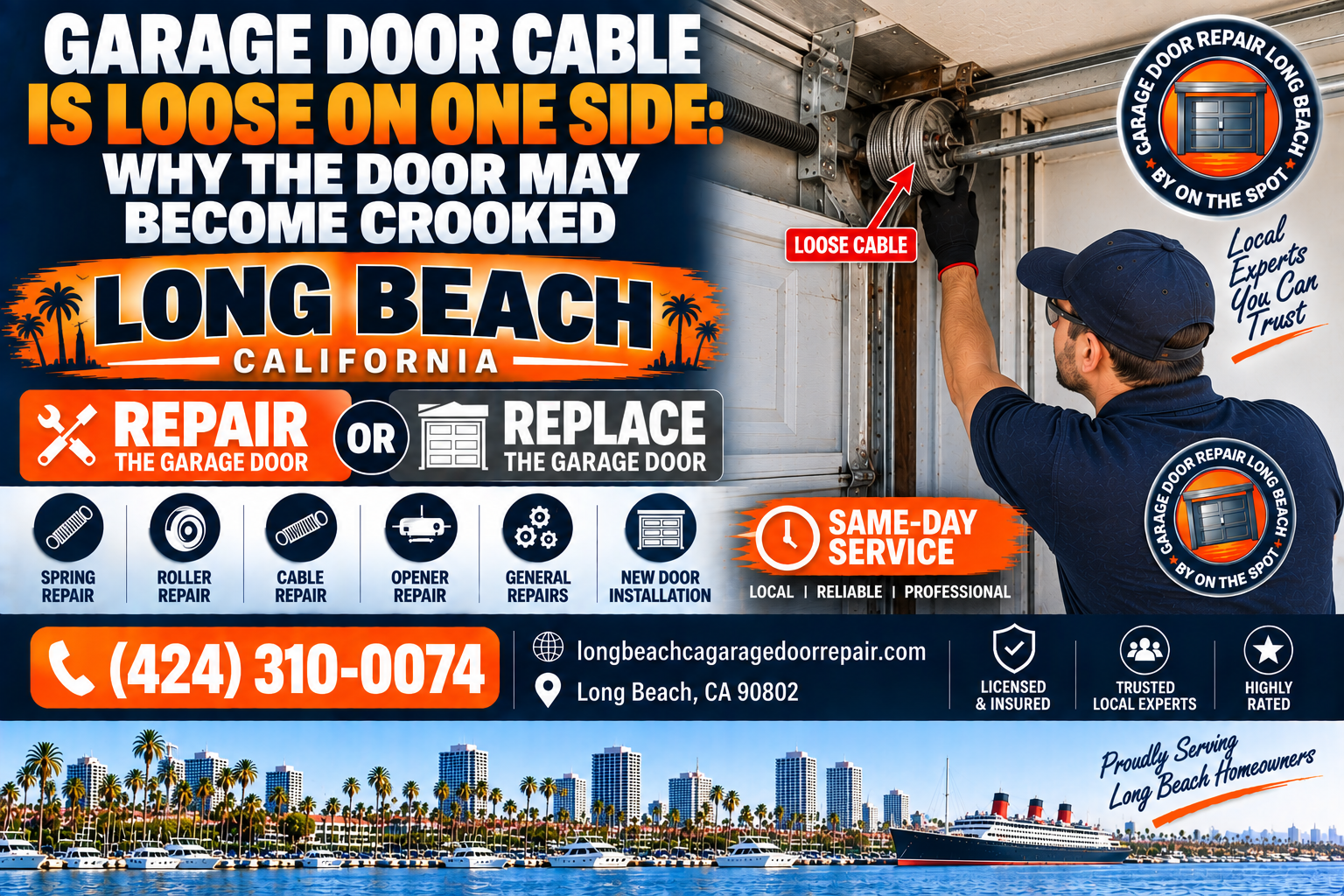
Garage Door Cable Is Loose on One Side: Why the Door May Become Crooked
When a garage door cable is loose on one side, the door may become crooked because lift is no longer equal: cable stretch, cable slip on the drum, spring failure, drum issues, or coastal corrosion can unload one corner while the other stays tight. Continuing to run the opener on a tilted door multiplies risk—and DIY cable or spring tension work is unsafe.
Garage Door Repair Long Beach By On The Spot helps homeowners, renters, landlords, property managers, HOA communities, and small businesses diagnose one-sided cable slack and restore square, balanced travel across Long Beach, CA.
Crooked Door · Tilt
Stretch vs Slip vs Spring
No DIY Tension
CPSC + DASMA + SCE
Serving Long Beach, CA
Direct Answer: Why a Loose Cable on One Side Makes the Door Crooked
When a garage door cable is loose on one side, that side of the door is no longer sharing lift the way the system was designed. Residential torsion and extension systems rely on matched cable tension so both ends of the bottom section rise and lower together. If one cable stretches, slips on its drum, loses anchorage at a bottom bracket, or goes slack because a spring failed or lost charge, the loaded side lifts while the slack side lags. The visible result is a crooked door: one corner high, one corner low, uneven side gaps, and a panel set that racks in the tracks.
Three mechanical stories dominate Long Beach service calls for this symptom. First, cable stretch or elongation—especially after years of coastal moisture, prior curb strikes, or mismatched replacement—leaves one cable effectively longer. Second, cable slip on a drum with a worn flange, loose set screws, or incorrect wrap seating lets wraps unwind on one side only. Third, spring failure or imbalance unloads one lift path so the cable on that side goes soft even if the wire itself looks intact. Drum bearing play, bottom-bracket corrosion, and track racking often ride along as co-drivers.
Continuing to run the automatic opener on a tilted door is a high-risk choice. The opener tries to pull a racked load through the center; rollers bind; tracks spread; photo-eye reverse may trip repeatedly; and force settings get wrongly raised by frustrated users. DASMA safety guidance treats springs and related high-energy cable components as professional-only territory. Homeowners should stop cycling the door, keep people and vehicles clear of the cable path, and schedule diagnosis-first repair—not DIY tensioning, clamping, or winding.
Garage Door Repair Long Beach By On The Spot approaches one-sided slack as a system problem: measure cable condition and lengths, inspect drums and flanges, verify spring charge and pairing, check bottom terminations, square the door in the tracks, then restore matched cables and balance before opener quality checks. That path protects people, property, and the opener—especially in salt-air neighborhoods where corrosion accelerates stretch and slip.
Short answer: a garage door cable loose on one side usually means stretch, drum slip, spring imbalance, or anchorage failure on that lift path. Unequal lift tilts the door. Stop using the opener, do not DIY cable or spring tension, and call trained help. Reference DASMA system safety tips and CPSC operator guidance; use SCE outage tools only to separate power events from mechanical tilt.
Short answer: A garage door cable loose on one side usually means stretch, drum slip, spring imbalance, or anchorage failure on that lift path. Unequal lift tilts the door. Stop using the opener, do not DIY cable or spring tension, and call trained help. Reference DASMA system safety tips and CPSC operator guidance; use SCE outage tools only to separate power events from mechanical tilt.
How Garage Door Cables Keep Both Sides Level
Garage door lift cables are not decorative side ropes. On a typical torsion-spring residential door, cables anchor at the bottom corners, travel up to cable drums fixed on the torsion tube, and wrap those drums as the springs unwind and wind through the open and close cycles. When spring torque and wrap geometry are correct, both cables stay taut and both bottom corners share load. Level travel is a balance outcome, not a cosmetic preference.
Think of the door as a wide panel set guided by vertical tracks. If left and right vertical forces stay matched, rollers climb evenly. If one vertical force drops because a cable goes slack, the opposite side still lifts. The door rotates in plane—becomes crooked—and rollers on the lagging side load the track flange, weather seals scrape, and the top section can bind against the header or stops.
Cable drums are handed left and right with grooves and flanges designed to keep wraps nested. A healthy flange and true drum keep the cable seated even through brief dynamic changes. When the flange rounds off, set screws loosen, or wraps are mistimed, one drum can shed tension while the other holds—exactly the pattern behind a cable that looks loose on one side only.
Extension-spring systems use different hardware, but the symmetry principle is the same: paired cables and springs must share work. A broken or unhooked extension spring on one side, a stretched cable, or a failed pulley leaves that corner soft. Homeowners sometimes see the soft cable hanging in a shallow curve while the opposite cable remains straight and singing-tight. That visual is a stop-use signal, not a DIY re-tension cue.
In Long Beach, cycle count plus marine air shortens the margin for error. Fog, salt film, and alley splash accelerate strand corrosion and drum pitting. A cable that still looks continuous can elongate enough on one side to create a visible lean long before strands fully part. Understanding that cables keep doors level by matched tension—not by hope—frames every later section of this guide.
Matched tension
Both cables share bottom-corner load so the door rises square. One soft cable breaks the pair.
Drum seating
Grooves and flanges retain wraps. Slip or flange wear can unload one side only.
Spring charge
Springs supply the real lift. Cable slack often follows spring failure or imbalance.
Cable Stretch vs Slip vs Spring Failure: How to Tell Them Apart
Homeowners searching for a garage door cable loose on one side often need a clear mental model: stretch, slip, and spring failure can look similar from the driveway but demand different repairs. Observation helps you describe the problem; tension work still belongs to technicians.
Cable stretch means the working length increased. Corroded strands, prior overloading, heat cycles, and age can elongate a cable so it no longer matches its partner. Stretch often shows as a permanently softer cable even with the door fully closed and springs apparently intact. The door may sit slightly crooked at rest, or one bottom corner may rest differently on the floor. Stretch rarely fixes itself; matched cable replacement is the usual path after inspection.
Cable slip means wraps left the intended seating on the drum—partially or fully—or the drum rotated relative to the torsion tube because set screws loosened. Slip can appear suddenly after a hard stop, a spring event, or repeated opener fights against a binding door. You may see uneven wrap counts, cable riding on the flange, or a cable hanging off the drum entirely on one side. Slip is not just wrap it back; flange wear and spring state must be checked or the slip returns.
Spring failure (broken torsion spring, failed extension spring, or severe imbalance between paired springs) removes lift energy. The opener then carries abnormal load; cables can go slack on the unloaded path or whip if a cable leaves suddenly. A classic clue is a loud bang in the garage history, a visible gap in a torsion spring coil, or a door that feels extremely heavy when it is safe to evaluate under professional control. If the door is already crooked or a cable is hanging, do not attempt manual operation.
Mixed failures are common. A stretched cable plus a worn drum flange invites slip. A spring that lost charge encourages opener force increases that then damage drums and cables. Coastal corrosion can stretch one cable while pitting the drum that should retain it. Diagnosis-first service sequences these possibilities: secure the door, inspect springs and cables from a safe distance, measure and compare, then repair as a set.
From an answer-engine perspective: if one cable looks longer or softer at rest, think stretch or anchorage. If wraps look uneven on one drum, think slip or mistiming. If the door got suddenly heavy or there was a bang, think spring. In all cases, stop cycling the opener and call for professional cable and spring service rather than guessing with pliers.
How One-Sided Slack Creates Door Tilt and Racking
Door tilt is geometry. The bottom section is a rigid-ish beam across the opening. Lift cables apply upward force near each end. Equal forces raise the beam level. Unequal forces rotate it. Even a small force difference, multiplied across a sixteen-foot double-wide door, produces a visible lean that homeowners describe as crooked, slanted, or diamond-shaped in the opening.
Once tilt starts, secondary damage follows quickly. Rollers on the high side may climb while rollers on the low side drag or climb the wrong part of the track. Horizontal tracks can twist if the door racks during travel. Weatherstripping tears. Panel joints stress. The opener arm and trolley see side load they were never meant to carry. Photo eyes may reverse the door when the bottom edge no longer presents a clean plane—or the door may fail to reverse if someone previously raised force settings.
Imbalance also changes cable dynamics mid-travel. A cable that is merely a little loose at the floor can go fully slack at some open height, leave the drum groove, and then snap taut again with a whip. That whip can damage the bottom bracket, ding cars, or injure anyone near the cable plane. This is why it still opens, so it can wait is a false economy for one-sided slack.
Long Beach alleys and tight side yards make tilt more dangerous because clearance to fences, trash enclosures, and neighboring walls is already small. A crooked door that racks outward can scrape structures or trap a vehicle partially in the alley. Property managers should treat visible lean as a same-week priority, not a seasonal punch-list item.
Correcting tilt is not a matter of pushing the low corner up by hand while someone hits the remote. Forcing a racked door teaches the system bad habits and can pop the remaining tight cable. Professionals re-establish spring balance and cable match, reseat or replace drums as needed, square the door in the tracks, then verify travel and safety reverse. The tilt disappears because the forces match again—not because someone bent the problem out of sight.
Drum Issues That Leave One Cable Loose
Cable drums are precision wear parts. Each drum’s groove path and outer flange keep wraps stacked in order. When a flange becomes rounded, chipped, or polished from prior slip events, the cable can climb out under side load or brief slack. One drum often wears faster than the other because of prior uneven travel, a past DIY rewrap, or a curb strike that racked the door toward one side.
Set screws clamp the drum to the torsion tube. If screws loosen—vibration, incomplete prior service, or corrosion under the screw tips—the drum can slip angularly. That angular slip changes effective wrap and can make one cable appear mysteriously longer. Homeowners sometimes interpret this as stretch when the real story is drum-to-tube slip. Technicians mark tube and drum, verify set-screw engagement, and replace damaged drums rather than chasing symptoms with cable tweaks alone.
Bearing wear at the end of the torsion tube lets the drum assembly wobble. Wobble introduces cyclic side load that walks a cable toward the flange edge. Combined with coastal grit in the bearing, Long Beach doors can develop this wobble earlier than inland homes with similar cycle counts. A loose cable on one side plus a noisy tube end is a strong drum-bearing clue.
Wrong-hand drums, incorrect drum size for cable diameter, or drums mismatched to spring turn counts also produce chronic one-sided problems after DIY or low-bid parts swaps. Spec matching matters: cable diameter, drum type, spring wire size, and door weight form a system. Mixing leftovers from a prior house is a common reason a new cable still looks loose on one side within days.
Never grind a flange sharp again, hammer a drum true, or tighten set screws on a live, unbalanced door as a weekend project. Drum work pairs with spring decompression procedures and safe cable handling. On The Spot diagnoses drum condition as part of every one-sided slack visit so the repair does not bounce.
Spring Failure and Unequal Lift on Cable Systems
Springs—not openers—do the heavy lifting. When a torsion spring breaks, the door’s weight transfers abruptly toward the opener and toward whatever cable geometry remains. One side may unload; cables can slack, jump drums, or bind. Extension-spring failures are often one-sided by nature: the broken side loses lift while the other side still pulls.
Unequal charge between paired torsion springs creates a slower version of the same problem. One spring weak from age or corrosion, or a prior single-spring replacement on a door that should be paired, leaves a persistent lean. Technicians measure balance with the opener disconnected under controlled conditions—not by guessing turns from a video.
Spring failure also explains why raising opener force feels like a temporary fix and then everything gets worse. The opener motors through imbalance, stresses the gear train, and encourages cable slip. CPSC consumer guidance on automatic residential garage door operators emphasizes proper reverse and photo-eye function; those protections assume a door that travels reasonably true. A spring-broken crooked door defeats that assumption.
Long Beach fog and salt do not break springs overnight, but they accelerate fatigue and corrosion at coils and cones. Doors near the marina, Naples canals, and ocean-adjacent streets often need earlier spring attention. If you heard a bang and then noticed a cable loose on one side, treat it as a spring-related emergency stop: clear the garage approach, do not try to open with the remote, and call for spring and cable service together.
DASMA safety tips for garage door systems underline why spring work is not DIY: stored energy can cause severe injury. That caution extends to any attempt to just tighten the loose cable while springs still hold charge. Professional spring service restores lift; professional cable and drum service restores symmetry; together they straighten the crooked door safely.
Bottom Brackets, Anchors, and One-Sided Cable Slack
Each lift cable typically terminates at a bottom corner bracket. If that bracket rusts through, loosens, bends from a curb strike, or loses its cable pin integrity, the cable can go effectively soft on that side even when the drum wraps look perfect. Coastal Long Beach splash from driveways and alleys attacks bottom brackets first.
A partially failed bracket may still hold enough to lift sometimes, then slip under load—producing intermittent crooked travel that confuses homeowners. Complete bracket failure can release the cable violently. Never remove a bottom bracket yourself to inspect the cable end. Bracket removal under tension is a classic injury pattern.
Technicians evaluate bracket steel condition, fastener grip into the bottom rail or wood, cable eye and pin wear, and whether prior clamps or bolts were used as unsafe improvisations. Proper repair replaces compromised brackets and cables as needed, then re-establishes drum wraps and spring balance. Painting over rust without structural repair does not restore cable trust.
Related hardware—bearing plates, flag angles, and jamb fasteners—can also shift after seismic activity or vehicle bumps common in dense Long Beach housing. A shifted track makes one cable work harder and look looser over time. Bottom-bracket and track geometry checks belong in the same visit as cable diagnosis.
Coastal Long Beach Corrosion and One-Sided Cable Looseness
Long Beach’s marine layer, salt aerosol, and seasonal Santa Ana dust create a corrosion climate that is harder on garage door cables than many inland Southern California cities. Moisture films sit on cold metal overnight. Salt residues remain after fog burns off. Cables, drums, springs, and fasteners all pay the bill.
Corrosion thins strands and invites stretch on the more exposed side of a door—often the side facing an open alley breeze or the side without a weather barrier. One cable becomes the weak link while its partner still looks acceptable. That asymmetry is why one-sided looseness appears suddenly after years of slow coastal aging.
Drum grooves pit; flanges lose crisp edges; set screws seize or lose bite; bearings roughen. Each of those changes promotes slip and unequal wrap behavior. Homes in Belmont Shore, Naples, Alamitos Beach, and westside corridors near industrial humidity often show earlier cable and drum wear for the same cycle count as a Bixby Knolls garage with better shelter.
Maintenance after repair should include inspection intervals suited to coastal exposure, not generic national averages. Keep weep paths clear, and schedule professional tune-ups that include cable and spring measurement—not just a spray of lubricant on hinges.
Corrosion also fools DIY eyes: a cable can look continuous yet have hidden elongation and broken inner strands. Professionals inspect under controlled conditions and replace cables in matched pairs when stretch or corrosion is present. That practice prevents the we fixed the loose side and the other side failed next month pattern.
Warning Signs Your Cable Is Going Loose on One Side
Watch for a door that sits or travels with one corner higher than the other; one cable hanging in a curve while the other is straight and tight; uneven wrap counts or cable riding the drum flange on one side; new scraping sounds on one track; an opener that strains, pauses, or reverses more often; visible rust fuzz, frays, or shiny polished spots on one cable; a bottom corner seal crushed on one side only; a recent bang from the garage followed by a lean; a door that looks diamond-shaped in the opening at mid-travel.
Any single sign is worth a call. Multiple signs mean stop using the automatic opener. Photograph what you can from a safe distance—full door front, each cable and drum area without climbing, and floor contact at both bottom corners—then share those with the dispatcher so the technician arrives with likely parts.
Do not test a few more cycles to see if the lean self-corrects. Self-correction is rare; progressive slip and stretch are common. Early professional intervention is cheaper than a racked door, damaged opener gearing, and emergency board-up after a cable release.
Safety Risks If the Opener Continues on a Crooked Door
Automatic openers are convenience machines built for balanced doors. When they pull a crooked door, several failure modes stack. First, the trolley and arm absorb side load; plastic gears strip; logic boards see abnormal current. Second, rollers climb track lips and can pop out, leaving a panel free to shift. Third, cables that go slack mid-travel can leave drums and then catch with dangerous whip.
Entrapment protection suffers. Photo eyes expect a reasonably level bottom edge. A tilted door may clear the beam inconsistently or strike objects differently than the last force calibration assumed. Some households respond by increasing force—the worst response—so the opener pushes harder through binding. CPSC FAQ material on residential garage door operators exists in part because improper adjustment and defeated safety features cause injuries.
Children, pets, and delivery drivers are at risk when a crooked door moves unpredictably. Parking partially under a leaning door multiplies vehicle damage odds. In alley-loaded Long Beach properties, a door that sticks halfway can block emergency egress or trash access for an entire building.
Power context matters for diagnosis but not for forcing travel. If the opener behaves oddly and the door still looks square with cables seated, check the SCE Outage Center to see whether a utility event coincides. If the door is already crooked or a cable is loose on one side, outage status does not authorize more remote clicks. Mechanical stop-use rules win.
The safe sequence is simple: stop automatic cycles, keep the area clear, call for cable/spring/drum diagnosis, restore balance, then verify photo-eye and reverse function per professional standards—not per a workaround that hides tilt. Stop-use rule: if a garage door cable is loose on one side or the door is crooked, do not keep using the opener. Do not raise force. Do not stand in the cable path. Call Garage Door Repair Long Beach By On The Spot at (424) 310-0074.
Never DIY Cable or Spring Tension Work
This guide repeats a hard line because search results are full of unsafe shortcuts. Do not wind torsion springs with makeshift bars. Do not clamp, twist, or shorten a loose cable with hardware-store fittings. Do not remove bottom brackets to reseat cables. Do not stand on ladders next to drums while someone operates the opener. Do not grind drum flanges. Do not replace one cable with a random length close enough cable from a big-box assortment.
Stored energy in springs and the whip potential of cables cause life-changing injuries every year. DASMA’s garage door system safety tips exist for consumers and technicians alike: respect high-energy components. On The Spot will never coach DIY tension procedures in a blog, chat, or phone call beyond safe observation and stop-use advice.
Even seemingly simple tasks like putting a cable back on a drum require the door to be properly secured and springs managed. A cable that looks limp can become a cutting wire when the door shifts. If a prior DIY attempt already happened, tell the technician honestly—improvised clamps and incorrect wrap directions change the repair plan and the safety briefing on arrival.
Allowed homeowner actions are observational and environmental: stop using the opener, lock out remotes if needed, move vehicles and kids away, photograph safely, note recent bangs or curb hits, and verify whether an SCE outage might explain unrelated opener symptoms on an otherwise square door. Everything involving tension is professional territory.
Safe Homeowner Checks vs Dangerous DIY Cable Tensioning
Safe checks with the door closed, staying clear of the cable plane: from the driveway, note whether one bottom corner sits higher; photograph left and right cables and drums without climbing the torsion bar; listen from a distance for scraping on one side only—then stop cycling; write down any recent bang, flood splash, or curb strike; confirm SCE outage status only if the door still looks square and cables look seated; gather opener brand/model if visible without stretching under a crooked door.
Dangerous DIY never includes tightening, clamping, knotting, or cutting cables; winding or unwinding springs; removing bottom brackets or cable pins; re-wrapping drums on a live door; raising opener force to crush through tilt; or propping the low corner with lumber while operating the opener.
If you are unsure whether a check is safe, skip it and call. A clear phone description plus a few driveway photos usually beats a risky close-up. Technicians would rather arrive with slightly less information than meet a household injured by a cable whip.
Red Flags: Stop Using the Door and Call
Stop and call when a cable is hanging loose, frayed, or off the drum on one side; when the door is clearly crooked at rest or mid-travel; when a torsion spring shows a visible gap or an extension spring is off its pulley; when a bottom bracket is bent, cracked, or pulling out; when a roller is out of track or a track is pulled away from the jamb; when the opener grinds while the door racks; when you hear cable whip noises or sudden slack during a cycle; or when anyone already attempted DIY spring or cable work.
When any red flag appears, treat the garage door as out of service. Use another entrance. Post a note for household members and tenants. For HOA or rental units, notify management immediately with photos. Call (424) 310-0074 for Garage Door Repair Long Beach By On The Spot.
Photo Eyes, Force Settings, and Crooked-Door Failures
Photo-eye sensors project a beam across the doorway near the floor. They are a primary entrapment protection layer on modern operators. A crooked door changes how the bottom edge interacts with people, pets, and clutter—and can cause nuisance reverses or, worse, encourage unsafe bypass habits.
Never unplug, tape over, or misalign photo eyes to make a tilted door work. Never raise force limits to muscle through binding. After professional cable-balance repair, technicians should verify that sensors are aligned, lenses are clean, and reverse function behaves correctly on a flat test object as appropriate to the opener design.
CPSC’s consumer FAQ on automatic residential garage door operators reinforces why these protections matter. Mechanical lift problems and electronic safety features are linked: fix the crooked travel first, then confirm operator safety behavior. Skipping either step leaves families exposed.
If photo eyes were already misadjusted before the cable went loose, mention that during the call. Coastal cobwebs, paint overspray, and sun glare on low west-facing doors are common Long Beach nuisances—but they are separate from one-sided cable slack and must not distract from stop-use rules when tilt is visible.
Professional Repair Path for a Loose Cable on One Side
A diagnosis-first visit typically follows a disciplined sequence. The technician secures the door and work area, visually assesses springs, cables, drums, tracks, and bottom brackets, and determines whether the door can be safely moved for tests. If a spring is broken or a cable is off, the first priority is controlled securing—not forcing travel.
Measurements come next: cable condition and effective length comparison, drum and flange inspection, set-screw and bearing checks, spring identification and balance assessment, track spacing and plumb, and opener condition after abnormal loading. Parts recommendations follow the measurements—often matched cables, sometimes drums, sometimes springs, sometimes brackets, frequently a combination in coastal homes.
Repair installs the correct-spec parts, re-times wraps, sets spring charge professionally, squares the door, lubricates appropriate points, and tests travel. Final QA includes listening for rubs, confirming level, checking photo eyes and reverse behavior, and reviewing maintenance with the customer.
On The Spot emphasizes explaining stretch vs slip vs spring in plain language so property owners understand why a simple tighten the loose cable request may become a broader, safer repair set. Transparency beats surprise—especially for landlords coordinating tenant access in Long Beach duplexes and small multifamily buildings.
Parts That Matter: Cable, Drum, Spring, Bracket, and Bearing
Cables: Aircraft-style lift cables sized to the door. Replace in pairs when stretch or corrosion is present so lengths match. Never reuse a frayed cable. Drums: Handed drums with intact flanges and correct diameter for the cable and door. Replace when flanges are rounded or drums are damaged from slip events.
Springs: Torsion or extension springs matched to door weight and hardware. Broken or unequal springs are frequent root causes of one-sided slack. Bottom brackets: Structural terminations; replace when rusted, bent, or loose. Do not improvise with scrap steel.
Bearings and bearing plates: Keep the torsion tube true. Wobble promotes cable walk and one-sided looseness. Fasteners and set screws: Small parts with outsized effect; corrosion or rounding here causes drum slip stories that look like cable stretch.
Cheap mismatched assortments create callbacks. Spec-correct parts plus professional setup create lasting square travel—particularly important near the coast where the next fog season is always coming.
Maintenance After One-Sided Cable Repair in Coastal Long Beach
After repair, protect the investment. Schedule periodic professional inspections sized to coastal exposure—more frequent near open ocean air and alley splash. Listen monthly for new scrapes. Watch for early lean. Keep photo eyes clean. Do not ignore a new soft-looking cable.
Lubrication helps hinges, springs per product guidance, and metal rollers; it does not heal stretch or replace a rounded flange. Avoid flooding the torsion tube and opener with hose water when washing the driveway. Report curb strikes immediately even if the door still moves.
Property managers can log cable and spring service dates per unit. Fog-season reminders are useful triggers for visual checks from the driveway. Tenants should have a clear stop-use and call path posted near the garage entry. If a new lean appears after a recent repair elsewhere, call promptly—warranty and QA conversations are easier early, and safety does not wait on paperwork.
Repair Now vs Waiting When One Cable Goes Slack
Waiting while a cable is loose on one side rarely saves money. The crooked door racks tracks, bruises panels, strips opener gears, and risks sudden cable release. A same-week repair often costs less than a later combination of cables, drums, springs, track realignment, and opener gearbox work.
Waiting also extends household risk: blocked exits, vehicle damage, and injury potential. For businesses using the garage as a bay, downtime compounds. For rentals, deferred maintenance can become habitability and liability conversations.
The only wait that makes sense is waiting for the technician instead of attempting DIY—not waiting weeks while continuing to use the opener. Board-up or temporary securing may be part of an emergency response if the door cannot be safely operated; professionals decide that on site.
Same-Day Help When the Door Tilts Mid-Cycle
When a door suddenly leans during a cycle, stop. Clear people and cars. If the door is stuck partially open, keep everyone away from the opening and the cable planes; do not crawl under to help it down. Call for same-day service and describe the lean, any hanging cable, and whether a bang preceded the event.
On The Spot prioritizes stop-use cable and spring failures because they escalate. Provide gate codes, alley access notes, and parking constraints common to Long Beach parcels so the technician can stage safely. If an SCE outage is ongoing and the door is otherwise fine, say so—but mid-cycle tilt is mechanical until proven otherwise.
Questions to Ask Before Hiring for One-Sided Cable Repairs
Ask whether the vendor will diagnose stretch vs slip vs spring before quoting a single-line cable tighten. Ask whether cables are replaced in matched pairs when stretch or corrosion is found. Ask whether drum flanges and set screws are inspected as part of one-sided slack jobs. Ask whether spring work uses proper winding bars and manufacturer practices.
Ask whether photo-eye and reverse function will be checked after the door is square again. Ask whether common coastal-corrosion parts are carried for Long Beach service calls. Ask how a crooked door that cannot be safely moved yet will be secured. Ask for a plain-language explanation of what failed and how to prevent repeats.
Good answers sound specific. Vague promises to just make it close without addressing balance are a warning sign—especially if the quote depends on you raising opener force yourself later.
Hiring Red Flags for Loose-Cable and Crooked-Door Work
Beware quotes that only say tighten cable with no spring or drum inspection; willingness to coach you through DIY winding over the phone; one new cable of unknown length with no match to the partner side; advice to raise force settings to hide tilt; no mention of photo-eye verification after repair; pressure to replace the entire opener before lift balance is restored; and cash-only unpermitted work with no written description of parts.
Hire teams that treat cables, drums, and springs as a high-energy system and that respect CPSC and DASMA safety themes. On The Spot builds visits around diagnosis, correct parts, and verification—not shortcuts.
Why Garage Door Repair Long Beach By On The Spot?
Garage Door Repair Long Beach By On The Spot operates from 151 E 5th St, Long Beach, CA 90802, serving coastal and inland Long Beach neighborhoods with diagnosis-first cable, spring, drum, and opener-adjacent service. The team understands marine-layer corrosion, alley-loaded doors, condo and HOA access limits, and the difference between stretch, slip, and spring failure when a garage door cable is loose on one side.
Call (424) 310-0074 or visit longbeachcagaragedoorrepair.com. Maps listing: Google Maps CID. The goal on crooked-door tickets is square, balanced, safe travel—not a temporary wrap that fails after the next fog week.
Symptom Comparison Table: Loose Cable on One Side
| Observation | Likely Driver | Primary Path | Also Check | Safety Note |
|---|---|---|---|---|
| One cable softer/longer at rest; door slight lean | Cable stretch / mismatch | Matched cable replacement | Corrosion, prior repairs | Do not clamp or knot |
| Uneven wraps; cable on flange; sudden slack one side | Drum slip / flange wear | Drum + cable service; re-time wraps | Set screws, bearings | No DIY rewrap |
| Bang then heavy door; cable hangs after spring event | Spring failure / imbalance | Professional spring + cable QA | Opener gear stress | No DIY winding |
| Corner rust; cable end shifting at bottom | Bottom bracket / anchorage | Bracket + cable repair | Track jamb fasteners | Never remove bracket DIY |
| Door diamonds mid-travel; scrapes one track | Racking from unequal lift | Restore balance then square tracks | Rollers, flag angles | Stop opener cycles |
| Tube end noisy; intermittent one-sided looseness | Bearing wear / drum not true | Bearing + drum service | Flange condition | Clear cable path |
| Opener strains; someone raised force already | Secondary opener overload | Fix lift first; then opener QA | Gears, travel limits | Do not raise force more |
| Rusty fuzz on one cable; partner looks newer | Coastal corrosion asymmetry | Replace compromised pair | Drums, springs | Stop if strands broken |
Use this table to describe what you see when you call. It is not a DIY flowchart. On-site diagnosis still decides the repair set when a garage door cable is loose on one side and the door may become crooked.
Areas Served From the Long Beach Location
Service focus includes Long Beach neighborhoods and nearby coastal communities where a garage door cable loose on one side often ties to salt-air corrosion, spring imbalance, drum flange wear, alley curb strikes, and opener strain: Belmont Shore, Belmont Heights, Naples, Alamitos Beach, Downtown Long Beach, Bixby Knolls, Los Altos, El Dorado Park area, California Heights, Wrigley, West Long Beach, Signal Hill edges, and adjacent areas. Property managers can schedule cable-balance inspections before fog season turns early stretch into stop-use tilt.
If you are unsure whether the soft cable is stretch, slip, or spring-related, err toward inspection—visible lean is the early tell that continued opener use will rack the door. From marina-adjacent streets to westside industrial edges, cycle counts and corrosion loads differ, but equal-lift physics stay the same. Neighborhood-specific stories still resolve through cable, drum, spring, and track diagnosis.
Google Map Location
Garage Door Repair Long Beach By On The Spot is listed at 151 E 5th St, Long Beach, CA 90802. Call (424) 310-0074 or open the Google Maps CID listing for directions.
FAQs About Garage Door Cable Loose on One Side
These answers target common Long Beach questions about a garage door cable loose on one side and a door that may become crooked. On-site diagnosis still decides the final path.
Why is my garage door cable loose on one side?
Usually cable stretch, drum slip, spring failure or imbalance, bottom-bracket anchorage issues, or coastal corrosion—often combined. Unequal lift makes the door crooked.
Why does a loose cable make the door crooked?
Lift forces at the bottom corners no longer match, so the door rotates in the opening. Rollers then bind and tracks can rack if you keep running the opener.
Is cable stretch different from cable slip?
Yes. Stretch is longer effective cable length. Slip is wraps leaving proper drum seating or the drum slipping on the tube. Both can look like one-sided slack.
Can a broken spring cause one cable to go loose?
Yes. Spring failure unloads lift energy and commonly leaves cables slack or off drums. Treat bang-then-lean events as stop-use emergencies.
Is it safe to tighten a loose garage door cable myself?
No. Cable and spring tension work is high-energy and DIY attempts cause serious injuries. Call trained technicians.
Should I keep using the opener if the door is tilted?
No. Continued cycles risk cable whip, track damage, opener gear failure, and entrapment-protection problems. Stop and call.
Does Long Beach coastal air make this more common?
Salt and moisture accelerate cable corrosion, drum pitting, and fastener issues that promote stretch and slip on one side first.
Should both cables be replaced if only one is loose?
Often yes when stretch or corrosion is present, so lengths and condition match. Technicians decide from inspection.
Will raising opener force fix a crooked door?
No. Raising force hides binding and increases damage and injury risk. Restore mechanical balance first.
How do SCE outages relate to crooked doors?
Check SCE outage tools when opener behavior is odd but the door is still square with cables seated. Outages do not explain a mechanically tilted door.
What authority guidance covers cable and spring safety?
DASMA garage door system safety tips caution against DIY high-energy spring/cable work. CPSC operator FAQs cover entrapment protection themes for openers.
Who should I call in Long Beach?
Garage Door Repair Long Beach By On The Spot at (424) 310-0074, 151 E 5th St, Long Beach, CA 90802.
What a Diagnosis-First Visit Looks Like
Arrival starts with safety: clear work zone, assess whether the door is secured, and brief the customer on stay-back distances from cables and springs. If a cable is hanging, the technician treats whip potential as real.
Visual and tactile professional inspections follow manufacturer-aware practices. Spring gaps, cable fuzz, drum flange profiles, set-screw marks, bearing play, bracket integrity, and track plumb all get attention. Photos may be taken for customer explanation and parts documentation.
If safe testing is possible, controlled movements help distinguish stretch from slip from spring imbalance. If unsafe, the door stays locked down until parts and securing steps allow progress. Customers should expect honest we cannot cycle this yet moments—those protect people.
Estimate conversations explain the system repair set. A low line-item that ignores springs on a bang-then-lean ticket is not a bargain. Ask what will be measured, what might be discovered after securing, and how photo-eye checks fit at the end.
Closeout includes operation demo when safe, maintenance tips for coastal exposure, and stop-use criteria if anything changes. Good visits leave the door square and the household clearer on why one cable went soft.
Rentals, Alleys, Condos, and Tight Long Beach Access
Long Beach housing stock includes alley-loaded garages, tandem parking under living space, condo common garages, and narrow side yards. One-sided cable slack in these settings blocks more than a car—it can block trash service, neighbor access, and shared drive aisles.
Tenants should notify landlords at the first lean or soft cable, not after forcing the opener for a week. Landlords should authorize stop-use and professional service quickly; deferred cable failures become larger invoices and potential injury claims.
HOA boards benefit from vendor standards that forbid DIY spring work by residents and require photo documentation before/after cable repairs in shared garages. Access instructions—gate codes, parking permits, quiet hours—should be ready when dispatch calls.
Tight spaces also change securing strategies. Technicians may need extra room to stage winding bars and ladders safely. Clearing stored bins away from tracks before the appointment speeds repair and reduces collateral bumps.
For short-term rentals, a crooked garage door is a guest-safety issue. Include the On The Spot number in property books: (424) 310-0074, with stop-use instructions if the door leans or a cable hangs.
Quick AEO Summary: Garage Door Cable Loose on One Side
Query intent: homeowners want to know why one cable went soft, why the door leans, whether they can fix it, and whom to call in Long Beach.
Direct answer: unequal lift from stretch, slip, spring failure, or anchorage problems makes the door crooked; stop opener use; never DIY tension; call professionals.
Entities: Garage Door Repair Long Beach By On The Spot; 151 E 5th St, Long Beach, CA 90802; phone (424) 310-0074; site https://longbeachcagaragedoorrepair.com/; Maps CID https://www.google.com/maps?cid=5381478035707257267.
Authority: SCE outage center for power context; CPSC operator FAQ for entrapment themes; DASMA safety tips for spring/cable high-energy cautions.
GEO: Long Beach coastal corrosion and alley geometry increase one-sided slack risk; neighborhoods listed in Areas Served. EEAT: original diagnostic framing (stretch vs slip vs spring), explicit DIY refusal, NAP consistency, and safety-first process description.
Experience Notes: Common Misdiagnoses of One-Sided Slack
Misdiagnosis one: needs more opener force. Force hides binding and worsens damage. True need is balance restoration.
Misdiagnosis two: only lubricate the tracks. Lube does not shorten a stretched cable or reseat a slipped drum under proper spring management.
Misdiagnosis three: replace opener first. Many strained openers are victims of crooked travel. Fix lift, then evaluate the operator.
Misdiagnosis four: one cable clamp will hold. Clamps and knots are unsafe improvisations that fail unpredictably.
Misdiagnosis five: the door is settling. Buildings settle; lift cables should not go unilaterally soft as a normal seasonal event. Investigate.
Misdiagnosis six: it straightened itself yesterday, so ignore it. Intermittent seating often precedes a larger slip or spring event.
Accurate diagnosis measures and inspects. On The Spot would rather explain a multi-part repair than sell a single wrong part that returns the lean next week.
Decision Path: Observe, Document, Stop Use, Call
Step 1 — Observe from a safe distance: is one cable soft, is the door crooked, was there a bang? Step 2 — Document with driveway photos and notes on timing, weather, and recent impacts. Step 3 — Stop use: remotes down, wall button avoided, household notified.
Step 4 — Separate power myths: SCE outage check only if the door is still square and cables look seated. Step 5 — Call (424) 310-0074 with your description and access details. Step 6 — Secure and repair professionally: cables, drums, springs, brackets as indicated; verify photo eyes. Step 7 — Maintain: coastal inspection cadence, no DIY tension, early calls on new lean.
This path is intentionally boring. Boring keeps people safe when a garage door cable is loose on one side.
Practical Long Beach Scenarios Involving One-Sided Cable Slack
Scenario A: Belmont Shore homeowner hears fog drip at night, then notices the door leaning after morning school run. Soft cable on the alley side shows rust fuzz. Matched cables and drum QA resolve it; opener gears still healthy because they stopped early.
Scenario B: Downtown loft building with shared garage—one unit’s door racks and blocks the aisle. Property manager posts stop-use and schedules service the same day. Spring imbalance plus one stretched cable found.
Scenario C: West Long Beach rental after a tenant curb strike. Bottom bracket bent, cable effectively loose on that corner. Bracket and cable repair, track check, tenant education on clearance.
Scenario D: Naples canal-adjacent garage with chronic salt exposure. One drum flange rounded from prior DIY wrap; cable keeps going soft. Drum and cable replacement with spring balance verification ends the repeat.
Scenario E: Bixby Knolls family raises force to help a tilting door; gear fails. Lift system restored first, then opener repair—costlier than early cable service would have been.
Scenario F: Small shop bay near industrial edges—extension spring failure on one side drops a cable slack mid-day. Work stops, area cleared, commercial-aware repair restores safe throughput.
Insurance, Documentation, and Crooked-Door Damage
Document lean, hanging cables, and any vehicle or property contact with dated photos. If a cable whip or door drop damaged a car, insurers may ask for repair invoices and cause narratives.
Honest cause statements help: curb strike, spring break, corrosion—whatever the technician concludes. Avoid speculative blame in writing before inspection.
HOA and landlord files should retain before/after photos and part lists. Resale conversations sometimes ask about garage door age and recent cable/spring work; clear records add trust.
Insurance never authorizes DIY spring work. If an adjuster suggests getting a handyman quote, still insist on garage-door-trained technicians for tension components.
Plain Language Glossary for Loose-Cable and Tilt Talks
Cable stretch: Cable elongated so effective length exceeds its partner. Cable slip: Wraps leave proper drum seating or drum slips on the torsion tube. Crooked / tilted door: One side higher; unequal lift or racking geometry.
Drum flange: Raised edge that helps keep cable wraps on the drum. Torsion spring: Spring on the header tube that stores lift energy. Extension spring: Stretch-type springs along horizontal tracks on some doors.
Bottom bracket: Corner hardware where the lift cable terminates. Racking: Door parallelogram distortion from uneven travel. Photo eyes: Sensors that detect obstructions near the floor.
Force setting: Opener effort limit—never a fix for mechanical tilt. Set screws: Screws clamping drums to the torsion tube. Balance: Springs carrying door weight so the opener is not overloaded.
Trust Signals This Guide Intentionally Includes
Consistent NAP: Garage Door Repair Long Beach By On The Spot | 151 E 5th St, Long Beach, CA 90802 | (424) 310-0074 | https://longbeachcagaragedoorrepair.com/.
Explicit refusal of DIY cable/spring tension procedures. Authority links to SCE, CPSC, and DASMA with contextual explanations. Original diagnostic taxonomy: stretch vs slip vs spring vs anchorage.
Coastal Long Beach GEO specificity without keyword stuffing. Clear stop-use and entrapment-protection messaging aligned with operator safety themes. Process transparency: diagnose, secure, repair as a system, verify.
Commercial and Light-Industrial Bays With One-Sided Slack
Light commercial doors in the Long Beach area share cable physics with residential doors but add cycle frequency and wider spans. One-sided slack can halt operations and create workplace housekeeping issues around a partially open bay.
Managers should train staff to stop use at first lean, not to bump the opener repeatedly. Document downtime and schedule professional service with access for trucks and parts.
Spec matching for commercial cables and drums matters even more at higher cycles. Cheap residential leftovers fail early. Ask for commercial-appropriate hardware when the door is a true bay door.
After-Repair QA: What Good Cable Balance Looks Like
Both cables seated with matched wraps. Door sits level at rest on a flat threshold. Travel is square without scrapes. Springs hold balance so lift effort feels controlled under professional demonstration. Photo eyes aligned and reverse verified. No improvised clamps. Customer understands stop-use signs for the future.
If anything still looks uneven after a visit elsewhere, call for a second opinion rather than living with a slight lean—slight leans grow.
Seasonal Playbook for Long Beach Cable Balance
Marine-layer months: visual driveway checks for early lean and rust fuzz after damp nights. Santa Ana and dusty periods: listen for abrasive track sounds that might precede cable side load.
Holiday travel weeks: schedule known soft-cable issues before family leave dates. Rain and wash runoff: watch bottom brackets for splash corrosion; do not hose openers. Annual professional tune-up: measure cables and springs, not just spray hinges.
Deeper Physics: Slack, Side Load, and Door Geometry
A garage door in motion is a guided plate under changing spring torque. Cables translate spring and drum rotation into vertical corner forces. When those forces diverge, torque appears about the vertical centerline of the door. That torque is what eyes read as crooked.
Side load on rollers grows with tilt angle. Track lips see forces they only tolerate briefly. Nylon rollers may flake; steel rollers may groove the track. Either way, friction rises and the opener current climbs—another reason force knobs get abused.
Slack is not always visible at every height. A cable can be taut at the floor and lose tension at mid-open as geometry and wrap change. Dynamic slack is why intermittent problems deserve serious attention even if a neighbor glances over and says it looks fine now.
Friction asymmetry from a binding roller can itself unload a cable briefly. That is why track and roller inspection belongs beside cable inspection. Treating only the soft cable while leaving a bent track invites repeat looseness.
Coastal moisture changes friction coefficients on metal surfaces day to day. Fog mornings can reveal scrapes that dry afternoons hide. Consistent professional measurement beats vibe-based judgments about whether a cable is tight enough.
For double-wide doors, small force differences create larger vertical discrepancies at the ends. Owners of two-car doors should treat early lean as urgent even if a single-car door neighbor might ignore a subtler gap.
Sequence of Failure: How One Loose Cable Becomes a Crooked Door
Stage 1: Micro-stretch or micro-slip begins on the more corroded or more loaded side. Door still looks acceptable. Stage 2: Visible soft cable or slight corner height difference appears. Opener current edges up.
Stage 3: Racking starts; weatherseal wear becomes one-sided; household notices scrapes. Stage 4: Cable walks toward flange or bottom bracket shifts; intermittent off-drum events possible. Stage 5: Spring breaks or cable releases; door becomes obviously crooked or stuck; injury and property damage risk peaks.
Intervening at Stage 2 is the sweet spot. Stage 5 is emergency territory. This guide exists to move readers from Stage 3 denial back to Stage 2 action—stop use and call. DIY interventions often jump the sequence backward temporarily and then forward faster: a casual rewrap without spring correction returns to Stage 4 within days.
Materials and Spec Matching for Cables and Drums
Cable diameter and construction must match drum groove design and door weight. Undersized cable elongates sooner; oversized cable seats poorly.
Drums are left- and right-handed. Installing two lefts or mixing sizes creates chronic one-sided behavior that looks mysterious until someone checks part numbers.
Spring wire size, inner diameter, and length determine turns and torque. A spring that fits the tube but not the door weight leaves cables fighting imbalance forever.
Stainless or coated cables sometimes appear in coastal bids; suitability depends on the full system. Technicians choose materials that match manufacturer guidance and local corrosion reality—not marketing buzzwords alone.
Fastener quality at set screws and brackets matters. Rounded hex sockets and seizing threads are coastal facts of life; professionals bring replacements instead of rounding fasteners further.
Homeowner Call Script for One-Sided Cable Service
Try this when you call (424) 310-0074: “My garage door cable is loose on one side and the door looks crooked. I stopped using the opener. The soft cable is on the left/right when facing the door from the street. I did/did not hear a bang. I see fray/rust/cable on flange/nothing obvious. Access notes: alley/gate code/parking. Address is in Long Beach.”
Add whether anyone already tried DIY. Add opener brand if known. Add whether photo eyes were recently adjusted. Short, factual calls dispatch faster than long apologies.
Ask for arrival window and stop-use confirmation. Ask whether to leave the door down or if it is already stuck partially open. Follow the technician’s securing advice exactly.
Myths About Garage Door Cables Loose on One Side
Myth: if it still opens, it is safe. Reality: crooked travel is a progressive hazard. Myth: lubricant tightens cables. Reality: lube does not shorten wire rope. Myth: only old doors lean. Reality: new doors lean after spring failure or bad parts matching.
Myth: YouTube winding is fine with two friends. Reality: spring injuries are severe; do not. Myth: one cable replacement is always enough. Reality: mismatched partners recreate lean. Myth: raising force is a standard adjustment for tilt. Reality: it is a misuse that CPSC-aligned safety culture rejects.
Myth: outages cause crooked doors. Reality: outages affect power; tilt is mechanical. Myth: clamps are a professional temporary fix. Reality: improper clamps are a red flag.
Property Manager Playbook for Crooked Doors
Create a stop-use SOP for any reported lean or hanging cable. Empower tenants to stop without fearing blame. Keep a preferred vendor list that includes Garage Door Repair Long Beach By On The Spot and requires DASMA-aware spring practices.
Budget for paired cable replacement and coastal corrosion reality rather than minimal single-side patches. Log unit-level service history. Repeat lean on the same door within months signals incomplete prior repair or ongoing track issues.
For shared garages, communicate aisle blockages immediately to all affected residents. After repair, require photo-eye verification notes on the invoice. File photos.
Pre-Service and Post-Service Checklists
Pre-service: stop opener use; clear cable path; move vehicles; photograph; note bangs/impacts; prepare access; restrain pets; tell household members. Pre-service: do not attempt tension fixes; do not remove brackets; do not prop corners.
Post-service: confirm door is level; confirm both cables seated; watch a full professional demo cycle; test photo eyes as instructed; schedule next inspection; save invoice. Post-service: reject any suggestion to leave force elevated just in case. Balance should make elevated force unnecessary.
Family and Workplace Safety While Waiting for Cable Repair
Treat the garage door as a hard barrier you do not operate. Use house doors for entry. Remind teens who might otherwise just try the remote once.
Keep kids toys and pet beds away from the interior door path. Cable whip space includes surprising radii near bottom brackets.
If the door is stuck open, secure the premises another way and keep people from walking under the opening. Call for priority service.
Workplaces should tag out the opener per their safety culture and notify staff with a simple sign: Door out of service—cable/spring hazard.
Delivery drivers may try the opener from the street. A note on the door and disabled remotes as appropriate reduce surprise cycles while you wait for service.
Pets darting under a partially open tilted door are a classic risk. Keep them indoors through another entrance. Teach older kids a simple rule: if the door looks crooked or a cable looks floppy, no buttons, tell an adult, stay back.
Double-Wide Doors and One-Sided Cable Sensitivity
Wider doors amplify unequal lift into larger corner height differences. A cable issue that might look subtle on an eight-foot door can look dramatic on a sixteen-foot door.
Center hinges and struts on double-wides also see racking stress sooner. Early service protects panels that are expensive to replace in coastal color matches.
Some double-wides use specialized drums and cable routes. Spec matching is non-negotiable. Bring door width and photos to the call when possible.
Two-car households that preferentially use one bay create asymmetric cycle wear on the preferred side’s rollers and seals. Combined with corrosion, that preference can show up as one-sided cable aging. Rotate usage when practical after repair.
Opener Load Coupling: Why Force Is the Wrong Knob
Openers couple to door load through the arm and trolley. When mechanical load spikes from tilt, motors draw more current and gear trains heat and crack.
Force adjustments exist for fine-tuning healthy doors within safe envelopes—not for overcoming missing spring torque or soft cables. Misuse turns a cable ticket into an opener replacement ticket.
After balance is restored, technicians re-evaluate force and travel limits to factory-reasonable settings and confirm entrapment protection. That order—mechanics first, electronics second—protects households.
If a previous technician only raised force, say so. Resetting bad force habits is part of proper QA. Smart openers that send phone alerts about obstruction reverses may spam notifications when a crooked door scrapes. Do not silence alerts and keep using the door—treat reverse spam plus lean as a stop-use pair.
Long Beach Microclimates and Early Cable Stretch
Ocean-adjacent blocks see more salt aerosol. Canal and marina zones add persistent humidity. Inland Long Beach neighborhoods still get marine layer but often with slightly slower cable corrosion.
Alleys trap moisture and splash from runoff. West-facing doors may see more sun baking of residual salt. These microclimates explain why one house shows one-sided slack years before a neighbor two miles inland.
Do not assume a new cable five years ago is still matched after coastal duty. Inspection beats calendar guesswork.
Morning marine layer leaves conductive films on cold cables; by afternoon the film dries into salt crystals that act like grit in drum grooves. Over hundreds of cycles, that grit polishes flanges and encourages one-sided slip even when spring charge still looks acceptable on a quick glance.
Homeowners who rinse driveway salt should avoid aiming hose streams at bottom brackets and photo eyes. Controlled wipe-downs of the exterior door face are safer than flooding hardware.
Cost Context: Early Cable Balance vs Delayed Tilt Damage
Early matched cables and a drum or spring correction cost less than cables plus drums plus springs plus track repair plus opener gears after months of racking.
Emergency after a cable release can add board-up, after-hours fees, and vehicle bodywork. Early daytime service is the economical safety choice.
Lowest bid that skips spring measurement is often the most expensive path over a year. Ask what is included in diagnosis.
Waiting while a cable is loose on one side rarely saves money. The crooked door racks tracks, bruises panels, strips opener gears, and risks sudden cable release.
Photo Tips That Speed One-Sided Cable Diagnosis
Take a full frontal photo showing the lean. Take left and right bottom-corner photos from the driveway angle. Take drum-area photos without climbing—use zoom from the floor if needed.
Capture any fray, rust, or cable-off-drum condition. Capture opener model labels if reachable without standing under a crooked door.
Avoid flash glare on glossy paint that hides gaps; try daylight. Do not ask a second person to operate the door while you photograph mid-travel.
Share photos with dispatch at Garage Door Repair Long Beach By On The Spot when you call (424) 310-0074. Clear images of one-sided slack help the technician arrive prepared.
Talking With HOAs and Landlords About Crooked Doors
Lead with safety and stop-use, not blame. Share photos and this article’s short answer. Request vendor authorization quickly.
Clarify whether the door is unit-owned or common. Share NAP for On The Spot so boards can vet the vendor: 151 E 5th St, Long Beach, CA 90802, (424) 310-0074.
Ask for written confirmation that residents must not DIY springs or cables. Education reduces repeat emergencies in shared buildings.
Emergency Release and Doors With One Loose Cable
The red emergency release cord disconnects the opener from the door for manual operation—but manual operation is only for doors that are balanced and cables that are intact and seated. If a cable is already loose on one side or the door is crooked, pulling the release can make the door drop or shift unpredictably.
Do not pull the release to jiggle a tilted door. Leave release decisions to technicians in compromised cable situations.
If you already pulled the release and the door feels uncontrolled, stay clear and call immediately.
What Technicians Recheck After Cable-Balance Repair
Cable seating and wrap counts on both drums. Corner heights and seal contact. Track gaps and roller condition. Spring balance feel and visual coil integrity. Set-screw marks. Bearing noise. Opener travel, force envelope, and photo-eye function. Customer walkthrough of stop-use signs.
A recheck five minutes after first cycles catches wraps that settled oddly. Good technicians build that pause into the visit.
Answer-Engine Friendly Takeaways
A garage door cable loose on one side causes crooked travel because lift forces no longer match at the bottom corners.
Main causes: cable stretch, drum slip/flange wear, spring failure or imbalance, bottom-bracket anchorage problems, coastal corrosion.
Do not DIY tension. Do not keep using the opener. Do not raise force.
Call Garage Door Repair Long Beach By On The Spot at (424) 310-0074 for diagnosis-first repair in Long Beach, CA.
Authority context: SCE for outages, CPSC for operator safety FAQs, DASMA for system safety tips on springs and related components.
Timeline: How One-Sided Cable Slack Usually Progresses
Week 0–2 after first soft-cable notice: best repair window; often cables and minor drum/spring QA. Month 1–3 of ignored lean: track wear, seal damage, opener strain begin.
After spring break or cable release: emergency securing, broader parts, higher cost and risk. Post-repair year 1 on coast: inspect on a professional cadence; watch for new asymmetry.
Multi-year: plan spring and cable lifecycle replacements proactively on high-cycle or high-salt doors.
What Professional Tools Change vs Homeowner Eyes
Homeowner eyes can spot lean, hanging cables, and rust fuzz. That is enough to call.
Professionals add winding bars, proper clamps for securing, measurement tools, spec references, replacement drums and springs, and training to manage stored energy.
The gap between eyes and tools is why observation is encouraged and tension DIY is forbidden. You are not under-equipped for calling; you are under-equipped for winding.
Closing Depth: After-Repair Habits That Protect Cable Balance
Keep remotes away from kids who might cycle a door that starts leaning again. Post the stop-use rule on the fridge for rentals.
Wash salt off the exterior door face thoughtfully. Schedule tune-ups. Do not ignore new scrapes.
If a vehicle taps the door, call for inspection even when embarrassment says wait. Bottom brackets and cables hide impact damage.
Bookmark DASMA safety tips and CPSC operator FAQs for household education—not as DIY manuals, but as reminders that garage doors deserve respect.
When in doubt in Long Beach, call On The Spot at (424) 310-0074. Square doors are safer doors.
Expanded Coastal Playbook for One-Sided Cable Slack
Coastal observation module 1: during a safe driveway visual, note whether corner height differences grow after damp nights, whether one cable shows more surface rust, whether the opener sounds more strained on the first morning cycle, and whether scrapes localize to one track. Record those notes for your service call to Garage Door Repair Long Beach By On The Spot at (424) 310-0074. Do not translate those notes into DIY tension experiments. Equal lift remains the engineering goal; matched cables, sound drums, correct spring charge, and square tracks remain the professional means. Long Beach fog will return; your repair quality and maintenance cadence should assume that return rather than a desert climate. If module 1 coincides with a visible lean, stop using the automatic opener immediately, keep people away from the cable plane, and schedule diagnosis that distinguishes stretch versus slip versus spring failure versus anchorage corrosion. Authority-aligned safety culture—DASMA for high-energy components, CPSC for operator entrapment themes, SCE only for power-context separation—keeps households from improvising dangerous fixes while waiting for parts. Property managers reading module 1 should log the unit, date, and photo filenames so recurring one-sided slack on the same door triggers a deeper track and spring review rather than another single-cable patch.
Coastal observation module 2: during a safe driveway visual, note whether corner height differences grow after damp nights, whether one cable shows more surface rust, whether the opener sounds more strained on the first morning cycle, and whether scrapes localize to one track. Record those notes for your service call to Garage Door Repair Long Beach By On The Spot at (424) 310-0074. Do not translate those notes into DIY tension experiments. Equal lift remains the engineering goal; matched cables, sound drums, correct spring charge, and square tracks remain the professional means. Long Beach fog will return; your repair quality and maintenance cadence should assume that return rather than a desert climate. If module 2 coincides with a visible lean, stop using the automatic opener immediately, keep people away from the cable plane, and schedule diagnosis that distinguishes stretch versus slip versus spring failure versus anchorage corrosion. Authority-aligned safety culture—DASMA for high-energy components, CPSC for operator entrapment themes, SCE only for power-context separation—keeps households from improvising dangerous fixes while waiting for parts. Property managers reading module 2 should log the unit, date, and photo filenames so recurring one-sided slack on the same door triggers a deeper track and spring review rather than another single-cable patch.
Coastal observation module 3: during a safe driveway visual, note whether corner height differences grow after damp nights, whether one cable shows more surface rust, whether the opener sounds more strained on the first morning cycle, and whether scrapes localize to one track. Record those notes for your service call to Garage Door Repair Long Beach By On The Spot at (424) 310-0074. Do not translate those notes into DIY tension experiments. Equal lift remains the engineering goal; matched cables, sound drums, correct spring charge, and square tracks remain the professional means. Long Beach fog will return; your repair quality and maintenance cadence should assume that return rather than a desert climate. If module 3 coincides with a visible lean, stop using the automatic opener immediately, keep people away from the cable plane, and schedule diagnosis that distinguishes stretch versus slip versus spring failure versus anchorage corrosion. Authority-aligned safety culture—DASMA for high-energy components, CPSC for operator entrapment themes, SCE only for power-context separation—keeps households from improvising dangerous fixes while waiting for parts. Property managers reading module 3 should log the unit, date, and photo filenames so recurring one-sided slack on the same door triggers a deeper track and spring review rather than another single-cable patch.
Coastal observation module 4: during a safe driveway visual, note whether corner height differences grow after damp nights, whether one cable shows more surface rust, whether the opener sounds more strained on the first morning cycle, and whether scrapes localize to one track. Record those notes for your service call to Garage Door Repair Long Beach By On The Spot at (424) 310-0074. Do not translate those notes into DIY tension experiments. Equal lift remains the engineering goal; matched cables, sound drums, correct spring charge, and square tracks remain the professional means. Long Beach fog will return; your repair quality and maintenance cadence should assume that return rather than a desert climate. If module 4 coincides with a visible lean, stop using the automatic opener immediately, keep people away from the cable plane, and schedule diagnosis that distinguishes stretch versus slip versus spring failure versus anchorage corrosion. Authority-aligned safety culture—DASMA for high-energy components, CPSC for operator entrapment themes, SCE only for power-context separation—keeps households from improvising dangerous fixes while waiting for parts. Property managers reading module 4 should log the unit, date, and photo filenames so recurring one-sided slack on the same door triggers a deeper track and spring review rather than another single-cable patch.
Coastal observation module 5: during a safe driveway visual, note whether corner height differences grow after damp nights, whether one cable shows more surface rust, whether the opener sounds more strained on the first morning cycle, and whether scrapes localize to one track. Record those notes for your service call to Garage Door Repair Long Beach By On The Spot at (424) 310-0074. Do not translate those notes into DIY tension experiments. Equal lift remains the engineering goal; matched cables, sound drums, correct spring charge, and square tracks remain the professional means. Long Beach fog will return; your repair quality and maintenance cadence should assume that return rather than a desert climate. If module 5 coincides with a visible lean, stop using the automatic opener immediately, keep people away from the cable plane, and schedule diagnosis that distinguishes stretch versus slip versus spring failure versus anchorage corrosion. Authority-aligned safety culture—DASMA for high-energy components, CPSC for operator entrapment themes, SCE only for power-context separation—keeps households from improvising dangerous fixes while waiting for parts. Property managers reading module 5 should log the unit, date, and photo filenames so recurring one-sided slack on the same door triggers a deeper track and spring review rather than another single-cable patch.
Coastal observation module 6: during a safe driveway visual, note whether corner height differences grow after damp nights, whether one cable shows more surface rust, whether the opener sounds more strained on the first morning cycle, and whether scrapes localize to one track. Record those notes for your service call to Garage Door Repair Long Beach By On The Spot at (424) 310-0074. Do not translate those notes into DIY tension experiments. Equal lift remains the engineering goal; matched cables, sound drums, correct spring charge, and square tracks remain the professional means. Long Beach fog will return; your repair quality and maintenance cadence should assume that return rather than a desert climate. If module 6 coincides with a visible lean, stop using the automatic opener immediately, keep people away from the cable plane, and schedule diagnosis that distinguishes stretch versus slip versus spring failure versus anchorage corrosion. Authority-aligned safety culture—DASMA for high-energy components, CPSC for operator entrapment themes, SCE only for power-context separation—keeps households from improvising dangerous fixes while waiting for parts. Property managers reading module 6 should log the unit, date, and photo filenames so recurring one-sided slack on the same door triggers a deeper track and spring review rather than another single-cable patch.
Coastal observation module 7: during a safe driveway visual, note whether corner height differences grow after damp nights, whether one cable shows more surface rust, whether the opener sounds more strained on the first morning cycle, and whether scrapes localize to one track. Record those notes for your service call to Garage Door Repair Long Beach By On The Spot at (424) 310-0074. Do not translate those notes into DIY tension experiments. Equal lift remains the engineering goal; matched cables, sound drums, correct spring charge, and square tracks remain the professional means. Long Beach fog will return; your repair quality and maintenance cadence should assume that return rather than a desert climate. If module 7 coincides with a visible lean, stop using the automatic opener immediately, keep people away from the cable plane, and schedule diagnosis that distinguishes stretch versus slip versus spring failure versus anchorage corrosion. Authority-aligned safety culture—DASMA for high-energy components, CPSC for operator entrapment themes, SCE only for power-context separation—keeps households from improvising dangerous fixes while waiting for parts. Property managers reading module 7 should log the unit, date, and photo filenames so recurring one-sided slack on the same door triggers a deeper track and spring review rather than another single-cable patch.
Coastal observation module 8: during a safe driveway visual, note whether corner height differences grow after damp nights, whether one cable shows more surface rust, whether the opener sounds more strained on the first morning cycle, and whether scrapes localize to one track. Record those notes for your service call to Garage Door Repair Long Beach By On The Spot at (424) 310-0074. Do not translate those notes into DIY tension experiments. Equal lift remains the engineering goal; matched cables, sound drums, correct spring charge, and square tracks remain the professional means. Long Beach fog will return; your repair quality and maintenance cadence should assume that return rather than a desert climate. If module 8 coincides with a visible lean, stop using the automatic opener immediately, keep people away from the cable plane, and schedule diagnosis that distinguishes stretch versus slip versus spring failure versus anchorage corrosion. Authority-aligned safety culture—DASMA for high-energy components, CPSC for operator entrapment themes, SCE only for power-context separation—keeps households from improvising dangerous fixes while waiting for parts. Property managers reading module 8 should log the unit, date, and photo filenames so recurring one-sided slack on the same door triggers a deeper track and spring review rather than another single-cable patch.
Coastal observation module 9: during a safe driveway visual, note whether corner height differences grow after damp nights, whether one cable shows more surface rust, whether the opener sounds more strained on the first morning cycle, and whether scrapes localize to one track. Record those notes for your service call to Garage Door Repair Long Beach By On The Spot at (424) 310-0074. Do not translate those notes into DIY tension experiments. Equal lift remains the engineering goal; matched cables, sound drums, correct spring charge, and square tracks remain the professional means. Long Beach fog will return; your repair quality and maintenance cadence should assume that return rather than a desert climate. If module 9 coincides with a visible lean, stop using the automatic opener immediately, keep people away from the cable plane, and schedule diagnosis that distinguishes stretch versus slip versus spring failure versus anchorage corrosion. Authority-aligned safety culture—DASMA for high-energy components, CPSC for operator entrapment themes, SCE only for power-context separation—keeps households from improvising dangerous fixes while waiting for parts. Property managers reading module 9 should log the unit, date, and photo filenames so recurring one-sided slack on the same door triggers a deeper track and spring review rather than another single-cable patch.
Coastal observation module 10: during a safe driveway visual, note whether corner height differences grow after damp nights, whether one cable shows more surface rust, whether the opener sounds more strained on the first morning cycle, and whether scrapes localize to one track. Record those notes for your service call to Garage Door Repair Long Beach By On The Spot at (424) 310-0074. Do not translate those notes into DIY tension experiments. Equal lift remains the engineering goal; matched cables, sound drums, correct spring charge, and square tracks remain the professional means. Long Beach fog will return; your repair quality and maintenance cadence should assume that return rather than a desert climate. If module 10 coincides with a visible lean, stop using the automatic opener immediately, keep people away from the cable plane, and schedule diagnosis that distinguishes stretch versus slip versus spring failure versus anchorage corrosion. Authority-aligned safety culture—DASMA for high-energy components, CPSC for operator entrapment themes, SCE only for power-context separation—keeps households from improvising dangerous fixes while waiting for parts. Property managers reading module 10 should log the unit, date, and photo filenames so recurring one-sided slack on the same door triggers a deeper track and spring review rather than another single-cable patch.
Coastal observation module 11: during a safe driveway visual, note whether corner height differences grow after damp nights, whether one cable shows more surface rust, whether the opener sounds more strained on the first morning cycle, and whether scrapes localize to one track. Record those notes for your service call to Garage Door Repair Long Beach By On The Spot at (424) 310-0074. Do not translate those notes into DIY tension experiments. Equal lift remains the engineering goal; matched cables, sound drums, correct spring charge, and square tracks remain the professional means. Long Beach fog will return; your repair quality and maintenance cadence should assume that return rather than a desert climate. If module 11 coincides with a visible lean, stop using the automatic opener immediately, keep people away from the cable plane, and schedule diagnosis that distinguishes stretch versus slip versus spring failure versus anchorage corrosion. Authority-aligned safety culture—DASMA for high-energy components, CPSC for operator entrapment themes, SCE only for power-context separation—keeps households from improvising dangerous fixes while waiting for parts. Property managers reading module 11 should log the unit, date, and photo filenames so recurring one-sided slack on the same door triggers a deeper track and spring review rather than another single-cable patch.
Coastal observation module 12: during a safe driveway visual, note whether corner height differences grow after damp nights, whether one cable shows more surface rust, whether the opener sounds more strained on the first morning cycle, and whether scrapes localize to one track. Record those notes for your service call to Garage Door Repair Long Beach By On The Spot at (424) 310-0074. Do not translate those notes into DIY tension experiments. Equal lift remains the engineering goal; matched cables, sound drums, correct spring charge, and square tracks remain the professional means. Long Beach fog will return; your repair quality and maintenance cadence should assume that return rather than a desert climate. If module 12 coincides with a visible lean, stop using the automatic opener immediately, keep people away from the cable plane, and schedule diagnosis that distinguishes stretch versus slip versus spring failure versus anchorage corrosion. Authority-aligned safety culture—DASMA for high-energy components, CPSC for operator entrapment themes, SCE only for power-context separation—keeps households from improvising dangerous fixes while waiting for parts. Property managers reading module 12 should log the unit, date, and photo filenames so recurring one-sided slack on the same door triggers a deeper track and spring review rather than another single-cable patch.
Coastal observation module 13: during a safe driveway visual, note whether corner height differences grow after damp nights, whether one cable shows more surface rust, whether the opener sounds more strained on the first morning cycle, and whether scrapes localize to one track. Record those notes for your service call to Garage Door Repair Long Beach By On The Spot at (424) 310-0074. Do not translate those notes into DIY tension experiments. Equal lift remains the engineering goal; matched cables, sound drums, correct spring charge, and square tracks remain the professional means. Long Beach fog will return; your repair quality and maintenance cadence should assume that return rather than a desert climate. If module 13 coincides with a visible lean, stop using the automatic opener immediately, keep people away from the cable plane, and schedule diagnosis that distinguishes stretch versus slip versus spring failure versus anchorage corrosion. Authority-aligned safety culture—DASMA for high-energy components, CPSC for operator entrapment themes, SCE only for power-context separation—keeps households from improvising dangerous fixes while waiting for parts. Property managers reading module 13 should log the unit, date, and photo filenames so recurring one-sided slack on the same door triggers a deeper track and spring review rather than another single-cable patch.
Coastal observation module 14: during a safe driveway visual, note whether corner height differences grow after damp nights, whether one cable shows more surface rust, whether the opener sounds more strained on the first morning cycle, and whether scrapes localize to one track. Record those notes for your service call to Garage Door Repair Long Beach By On The Spot at (424) 310-0074. Do not translate those notes into DIY tension experiments. Equal lift remains the engineering goal; matched cables, sound drums, correct spring charge, and square tracks remain the professional means. Long Beach fog will return; your repair quality and maintenance cadence should assume that return rather than a desert climate. If module 14 coincides with a visible lean, stop using the automatic opener immediately, keep people away from the cable plane, and schedule diagnosis that distinguishes stretch versus slip versus spring failure versus anchorage corrosion. Authority-aligned safety culture—DASMA for high-energy components, CPSC for operator entrapment themes, SCE only for power-context separation—keeps households from improvising dangerous fixes while waiting for parts. Property managers reading module 14 should log the unit, date, and photo filenames so recurring one-sided slack on the same door triggers a deeper track and spring review rather than another single-cable patch.
Coastal observation module 15: during a safe driveway visual, note whether corner height differences grow after damp nights, whether one cable shows more surface rust, whether the opener sounds more strained on the first morning cycle, and whether scrapes localize to one track. Record those notes for your service call to Garage Door Repair Long Beach By On The Spot at (424) 310-0074. Do not translate those notes into DIY tension experiments. Equal lift remains the engineering goal; matched cables, sound drums, correct spring charge, and square tracks remain the professional means. Long Beach fog will return; your repair quality and maintenance cadence should assume that return rather than a desert climate. If module 15 coincides with a visible lean, stop using the automatic opener immediately, keep people away from the cable plane, and schedule diagnosis that distinguishes stretch versus slip versus spring failure versus anchorage corrosion. Authority-aligned safety culture—DASMA for high-energy components, CPSC for operator entrapment themes, SCE only for power-context separation—keeps households from improvising dangerous fixes while waiting for parts. Property managers reading module 15 should log the unit, date, and photo filenames so recurring one-sided slack on the same door triggers a deeper track and spring review rather than another single-cable patch.
Coastal observation module 16: during a safe driveway visual, note whether corner height differences grow after damp nights, whether one cable shows more surface rust, whether the opener sounds more strained on the first morning cycle, and whether scrapes localize to one track. Record those notes for your service call to Garage Door Repair Long Beach By On The Spot at (424) 310-0074. Do not translate those notes into DIY tension experiments. Equal lift remains the engineering goal; matched cables, sound drums, correct spring charge, and square tracks remain the professional means. Long Beach fog will return; your repair quality and maintenance cadence should assume that return rather than a desert climate. If module 16 coincides with a visible lean, stop using the automatic opener immediately, keep people away from the cable plane, and schedule diagnosis that distinguishes stretch versus slip versus spring failure versus anchorage corrosion. Authority-aligned safety culture—DASMA for high-energy components, CPSC for operator entrapment themes, SCE only for power-context separation—keeps households from improvising dangerous fixes while waiting for parts. Property managers reading module 16 should log the unit, date, and photo filenames so recurring one-sided slack on the same door triggers a deeper track and spring review rather than another single-cable patch.
Coastal observation module 17: during a safe driveway visual, note whether corner height differences grow after damp nights, whether one cable shows more surface rust, whether the opener sounds more strained on the first morning cycle, and whether scrapes localize to one track. Record those notes for your service call to Garage Door Repair Long Beach By On The Spot at (424) 310-0074. Do not translate those notes into DIY tension experiments. Equal lift remains the engineering goal; matched cables, sound drums, correct spring charge, and square tracks remain the professional means. Long Beach fog will return; your repair quality and maintenance cadence should assume that return rather than a desert climate. If module 17 coincides with a visible lean, stop using the automatic opener immediately, keep people away from the cable plane, and schedule diagnosis that distinguishes stretch versus slip versus spring failure versus anchorage corrosion. Authority-aligned safety culture—DASMA for high-energy components, CPSC for operator entrapment themes, SCE only for power-context separation—keeps households from improvising dangerous fixes while waiting for parts. Property managers reading module 17 should log the unit, date, and photo filenames so recurring one-sided slack on the same door triggers a deeper track and spring review rather than another single-cable patch.
Coastal observation module 18: during a safe driveway visual, note whether corner height differences grow after damp nights, whether one cable shows more surface rust, whether the opener sounds more strained on the first morning cycle, and whether scrapes localize to one track. Record those notes for your service call to Garage Door Repair Long Beach By On The Spot at (424) 310-0074. Do not translate those notes into DIY tension experiments. Equal lift remains the engineering goal; matched cables, sound drums, correct spring charge, and square tracks remain the professional means. Long Beach fog will return; your repair quality and maintenance cadence should assume that return rather than a desert climate. If module 18 coincides with a visible lean, stop using the automatic opener immediately, keep people away from the cable plane, and schedule diagnosis that distinguishes stretch versus slip versus spring failure versus anchorage corrosion. Authority-aligned safety culture—DASMA for high-energy components, CPSC for operator entrapment themes, SCE only for power-context separation—keeps households from improvising dangerous fixes while waiting for parts. Property managers reading module 18 should log the unit, date, and photo filenames so recurring one-sided slack on the same door triggers a deeper track and spring review rather than another single-cable patch.
Coastal observation module 19: during a safe driveway visual, note whether corner height differences grow after damp nights, whether one cable shows more surface rust, whether the opener sounds more strained on the first morning cycle, and whether scrapes localize to one track. Record those notes for your service call to Garage Door Repair Long Beach By On The Spot at (424) 310-0074. Do not translate those notes into DIY tension experiments. Equal lift remains the engineering goal; matched cables, sound drums, correct spring charge, and square tracks remain the professional means. Long Beach fog will return; your repair quality and maintenance cadence should assume that return rather than a desert climate. If module 19 coincides with a visible lean, stop using the automatic opener immediately, keep people away from the cable plane, and schedule diagnosis that distinguishes stretch versus slip versus spring failure versus anchorage corrosion. Authority-aligned safety culture—DASMA for high-energy components, CPSC for operator entrapment themes, SCE only for power-context separation—keeps households from improvising dangerous fixes while waiting for parts. Property managers reading module 19 should log the unit, date, and photo filenames so recurring one-sided slack on the same door triggers a deeper track and spring review rather than another single-cable patch.
Coastal observation module 20: during a safe driveway visual, note whether corner height differences grow after damp nights, whether one cable shows more surface rust, whether the opener sounds more strained on the first morning cycle, and whether scrapes localize to one track. Record those notes for your service call to Garage Door Repair Long Beach By On The Spot at (424) 310-0074. Do not translate those notes into DIY tension experiments. Equal lift remains the engineering goal; matched cables, sound drums, correct spring charge, and square tracks remain the professional means. Long Beach fog will return; your repair quality and maintenance cadence should assume that return rather than a desert climate. If module 20 coincides with a visible lean, stop using the automatic opener immediately, keep people away from the cable plane, and schedule diagnosis that distinguishes stretch versus slip versus spring failure versus anchorage corrosion. Authority-aligned safety culture—DASMA for high-energy components, CPSC for operator entrapment themes, SCE only for power-context separation—keeps households from improvising dangerous fixes while waiting for parts. Property managers reading module 20 should log the unit, date, and photo filenames so recurring one-sided slack on the same door triggers a deeper track and spring review rather than another single-cable patch.
Coastal observation module 21: during a safe driveway visual, note whether corner height differences grow after damp nights, whether one cable shows more surface rust, whether the opener sounds more strained on the first morning cycle, and whether scrapes localize to one track. Record those notes for your service call to Garage Door Repair Long Beach By On The Spot at (424) 310-0074. Do not translate those notes into DIY tension experiments. Equal lift remains the engineering goal; matched cables, sound drums, correct spring charge, and square tracks remain the professional means. Long Beach fog will return; your repair quality and maintenance cadence should assume that return rather than a desert climate. If module 21 coincides with a visible lean, stop using the automatic opener immediately, keep people away from the cable plane, and schedule diagnosis that distinguishes stretch versus slip versus spring failure versus anchorage corrosion. Authority-aligned safety culture—DASMA for high-energy components, CPSC for operator entrapment themes, SCE only for power-context separation—keeps households from improvising dangerous fixes while waiting for parts. Property managers reading module 21 should log the unit, date, and photo filenames so recurring one-sided slack on the same door triggers a deeper track and spring review rather than another single-cable patch.
Coastal observation module 22: during a safe driveway visual, note whether corner height differences grow after damp nights, whether one cable shows more surface rust, whether the opener sounds more strained on the first morning cycle, and whether scrapes localize to one track. Record those notes for your service call to Garage Door Repair Long Beach By On The Spot at (424) 310-0074. Do not translate those notes into DIY tension experiments. Equal lift remains the engineering goal; matched cables, sound drums, correct spring charge, and square tracks remain the professional means. Long Beach fog will return; your repair quality and maintenance cadence should assume that return rather than a desert climate. If module 22 coincides with a visible lean, stop using the automatic opener immediately, keep people away from the cable plane, and schedule diagnosis that distinguishes stretch versus slip versus spring failure versus anchorage corrosion. Authority-aligned safety culture—DASMA for high-energy components, CPSC for operator entrapment themes, SCE only for power-context separation—keeps households from improvising dangerous fixes while waiting for parts. Property managers reading module 22 should log the unit, date, and photo filenames so recurring one-sided slack on the same door triggers a deeper track and spring review rather than another single-cable patch.
Coastal observation module 23: during a safe driveway visual, note whether corner height differences grow after damp nights, whether one cable shows more surface rust, whether the opener sounds more strained on the first morning cycle, and whether scrapes localize to one track. Record those notes for your service call to Garage Door Repair Long Beach By On The Spot at (424) 310-0074. Do not translate those notes into DIY tension experiments. Equal lift remains the engineering goal; matched cables, sound drums, correct spring charge, and square tracks remain the professional means. Long Beach fog will return; your repair quality and maintenance cadence should assume that return rather than a desert climate. If module 23 coincides with a visible lean, stop using the automatic opener immediately, keep people away from the cable plane, and schedule diagnosis that distinguishes stretch versus slip versus spring failure versus anchorage corrosion. Authority-aligned safety culture—DASMA for high-energy components, CPSC for operator entrapment themes, SCE only for power-context separation—keeps households from improvising dangerous fixes while waiting for parts. Property managers reading module 23 should log the unit, date, and photo filenames so recurring one-sided slack on the same door triggers a deeper track and spring review rather than another single-cable patch.
Coastal observation module 24: during a safe driveway visual, note whether corner height differences grow after damp nights, whether one cable shows more surface rust, whether the opener sounds more strained on the first morning cycle, and whether scrapes localize to one track. Record those notes for your service call to Garage Door Repair Long Beach By On The Spot at (424) 310-0074. Do not translate those notes into DIY tension experiments. Equal lift remains the engineering goal; matched cables, sound drums, correct spring charge, and square tracks remain the professional means. Long Beach fog will return; your repair quality and maintenance cadence should assume that return rather than a desert climate. If module 24 coincides with a visible lean, stop using the automatic opener immediately, keep people away from the cable plane, and schedule diagnosis that distinguishes stretch versus slip versus spring failure versus anchorage corrosion. Authority-aligned safety culture—DASMA for high-energy components, CPSC for operator entrapment themes, SCE only for power-context separation—keeps households from improvising dangerous fixes while waiting for parts. Property managers reading module 24 should log the unit, date, and photo filenames so recurring one-sided slack on the same door triggers a deeper track and spring review rather than another single-cable patch.
Household Safety Drills for Crooked-Door Events
Household safety drill 1: practice a mental stop-use response without touching the door. Who moves vehicles? Who posts a note for deliveries? Who calls (424) 310-0074? Who ensures kids and pets use another entrance? Walking through these roles before an emergency reduces panic when a garage door cable is loose on one side and the door may become crooked. Include a reminder that photo eyes must never be defeated and that opener force must never be raised to hide tilt. Include a reminder to check SCE outage status only when the door still looks square with cables seated—not as permission to force a tilted door. Include a reminder that DASMA safety tips discourage consumer spring and cable tension work. Rehearsal is free; cable whip injuries are not.
Household safety drill 2: practice a mental stop-use response without touching the door. Who moves vehicles? Who posts a note for deliveries? Who calls (424) 310-0074? Who ensures kids and pets use another entrance? Walking through these roles before an emergency reduces panic when a garage door cable is loose on one side and the door may become crooked. Include a reminder that photo eyes must never be defeated and that opener force must never be raised to hide tilt. Include a reminder to check SCE outage status only when the door still looks square with cables seated—not as permission to force a tilted door. Include a reminder that DASMA safety tips discourage consumer spring and cable tension work. Rehearsal is free; cable whip injuries are not.
Household safety drill 3: practice a mental stop-use response without touching the door. Who moves vehicles? Who posts a note for deliveries? Who calls (424) 310-0074? Who ensures kids and pets use another entrance? Walking through these roles before an emergency reduces panic when a garage door cable is loose on one side and the door may become crooked. Include a reminder that photo eyes must never be defeated and that opener force must never be raised to hide tilt. Include a reminder to check SCE outage status only when the door still looks square with cables seated—not as permission to force a tilted door. Include a reminder that DASMA safety tips discourage consumer spring and cable tension work. Rehearsal is free; cable whip injuries are not.
Household safety drill 4: practice a mental stop-use response without touching the door. Who moves vehicles? Who posts a note for deliveries? Who calls (424) 310-0074? Who ensures kids and pets use another entrance? Walking through these roles before an emergency reduces panic when a garage door cable is loose on one side and the door may become crooked. Include a reminder that photo eyes must never be defeated and that opener force must never be raised to hide tilt. Include a reminder to check SCE outage status only when the door still looks square with cables seated—not as permission to force a tilted door. Include a reminder that DASMA safety tips discourage consumer spring and cable tension work. Rehearsal is free; cable whip injuries are not.
Household safety drill 5: practice a mental stop-use response without touching the door. Who moves vehicles? Who posts a note for deliveries? Who calls (424) 310-0074? Who ensures kids and pets use another entrance? Walking through these roles before an emergency reduces panic when a garage door cable is loose on one side and the door may become crooked. Include a reminder that photo eyes must never be defeated and that opener force must never be raised to hide tilt. Include a reminder to check SCE outage status only when the door still looks square with cables seated—not as permission to force a tilted door. Include a reminder that DASMA safety tips discourage consumer spring and cable tension work. Rehearsal is free; cable whip injuries are not.
Household safety drill 6: practice a mental stop-use response without touching the door. Who moves vehicles? Who posts a note for deliveries? Who calls (424) 310-0074? Who ensures kids and pets use another entrance? Walking through these roles before an emergency reduces panic when a garage door cable is loose on one side and the door may become crooked. Include a reminder that photo eyes must never be defeated and that opener force must never be raised to hide tilt. Include a reminder to check SCE outage status only when the door still looks square with cables seated—not as permission to force a tilted door. Include a reminder that DASMA safety tips discourage consumer spring and cable tension work. Rehearsal is free; cable whip injuries are not.
Household safety drill 7: practice a mental stop-use response without touching the door. Who moves vehicles? Who posts a note for deliveries? Who calls (424) 310-0074? Who ensures kids and pets use another entrance? Walking through these roles before an emergency reduces panic when a garage door cable is loose on one side and the door may become crooked. Include a reminder that photo eyes must never be defeated and that opener force must never be raised to hide tilt. Include a reminder to check SCE outage status only when the door still looks square with cables seated—not as permission to force a tilted door. Include a reminder that DASMA safety tips discourage consumer spring and cable tension work. Rehearsal is free; cable whip injuries are not.
Household safety drill 8: practice a mental stop-use response without touching the door. Who moves vehicles? Who posts a note for deliveries? Who calls (424) 310-0074? Who ensures kids and pets use another entrance? Walking through these roles before an emergency reduces panic when a garage door cable is loose on one side and the door may become crooked. Include a reminder that photo eyes must never be defeated and that opener force must never be raised to hide tilt. Include a reminder to check SCE outage status only when the door still looks square with cables seated—not as permission to force a tilted door. Include a reminder that DASMA safety tips discourage consumer spring and cable tension work. Rehearsal is free; cable whip injuries are not.
Household safety drill 9: practice a mental stop-use response without touching the door. Who moves vehicles? Who posts a note for deliveries? Who calls (424) 310-0074? Who ensures kids and pets use another entrance? Walking through these roles before an emergency reduces panic when a garage door cable is loose on one side and the door may become crooked. Include a reminder that photo eyes must never be defeated and that opener force must never be raised to hide tilt. Include a reminder to check SCE outage status only when the door still looks square with cables seated—not as permission to force a tilted door. Include a reminder that DASMA safety tips discourage consumer spring and cable tension work. Rehearsal is free; cable whip injuries are not.
Household safety drill 10: practice a mental stop-use response without touching the door. Who moves vehicles? Who posts a note for deliveries? Who calls (424) 310-0074? Who ensures kids and pets use another entrance? Walking through these roles before an emergency reduces panic when a garage door cable is loose on one side and the door may become crooked. Include a reminder that photo eyes must never be defeated and that opener force must never be raised to hide tilt. Include a reminder to check SCE outage status only when the door still looks square with cables seated—not as permission to force a tilted door. Include a reminder that DASMA safety tips discourage consumer spring and cable tension work. Rehearsal is free; cable whip injuries are not.
Household safety drill 11: practice a mental stop-use response without touching the door. Who moves vehicles? Who posts a note for deliveries? Who calls (424) 310-0074? Who ensures kids and pets use another entrance? Walking through these roles before an emergency reduces panic when a garage door cable is loose on one side and the door may become crooked. Include a reminder that photo eyes must never be defeated and that opener force must never be raised to hide tilt. Include a reminder to check SCE outage status only when the door still looks square with cables seated—not as permission to force a tilted door. Include a reminder that DASMA safety tips discourage consumer spring and cable tension work. Rehearsal is free; cable whip injuries are not.
Household safety drill 12: practice a mental stop-use response without touching the door. Who moves vehicles? Who posts a note for deliveries? Who calls (424) 310-0074? Who ensures kids and pets use another entrance? Walking through these roles before an emergency reduces panic when a garage door cable is loose on one side and the door may become crooked. Include a reminder that photo eyes must never be defeated and that opener force must never be raised to hide tilt. Include a reminder to check SCE outage status only when the door still looks square with cables seated—not as permission to force a tilted door. Include a reminder that DASMA safety tips discourage consumer spring and cable tension work. Rehearsal is free; cable whip injuries are not.
Household safety drill 13: practice a mental stop-use response without touching the door. Who moves vehicles? Who posts a note for deliveries? Who calls (424) 310-0074? Who ensures kids and pets use another entrance? Walking through these roles before an emergency reduces panic when a garage door cable is loose on one side and the door may become crooked. Include a reminder that photo eyes must never be defeated and that opener force must never be raised to hide tilt. Include a reminder to check SCE outage status only when the door still looks square with cables seated—not as permission to force a tilted door. Include a reminder that DASMA safety tips discourage consumer spring and cable tension work. Rehearsal is free; cable whip injuries are not.
Household safety drill 14: practice a mental stop-use response without touching the door. Who moves vehicles? Who posts a note for deliveries? Who calls (424) 310-0074? Who ensures kids and pets use another entrance? Walking through these roles before an emergency reduces panic when a garage door cable is loose on one side and the door may become crooked. Include a reminder that photo eyes must never be defeated and that opener force must never be raised to hide tilt. Include a reminder to check SCE outage status only when the door still looks square with cables seated—not as permission to force a tilted door. Include a reminder that DASMA safety tips discourage consumer spring and cable tension work. Rehearsal is free; cable whip injuries are not.
Household safety drill 15: practice a mental stop-use response without touching the door. Who moves vehicles? Who posts a note for deliveries? Who calls (424) 310-0074? Who ensures kids and pets use another entrance? Walking through these roles before an emergency reduces panic when a garage door cable is loose on one side and the door may become crooked. Include a reminder that photo eyes must never be defeated and that opener force must never be raised to hide tilt. Include a reminder to check SCE outage status only when the door still looks square with cables seated—not as permission to force a tilted door. Include a reminder that DASMA safety tips discourage consumer spring and cable tension work. Rehearsal is free; cable whip injuries are not.
Household safety drill 16: practice a mental stop-use response without touching the door. Who moves vehicles? Who posts a note for deliveries? Who calls (424) 310-0074? Who ensures kids and pets use another entrance? Walking through these roles before an emergency reduces panic when a garage door cable is loose on one side and the door may become crooked. Include a reminder that photo eyes must never be defeated and that opener force must never be raised to hide tilt. Include a reminder to check SCE outage status only when the door still looks square with cables seated—not as permission to force a tilted door. Include a reminder that DASMA safety tips discourage consumer spring and cable tension work. Rehearsal is free; cable whip injuries are not.
Household safety drill 17: practice a mental stop-use response without touching the door. Who moves vehicles? Who posts a note for deliveries? Who calls (424) 310-0074? Who ensures kids and pets use another entrance? Walking through these roles before an emergency reduces panic when a garage door cable is loose on one side and the door may become crooked. Include a reminder that photo eyes must never be defeated and that opener force must never be raised to hide tilt. Include a reminder to check SCE outage status only when the door still looks square with cables seated—not as permission to force a tilted door. Include a reminder that DASMA safety tips discourage consumer spring and cable tension work. Rehearsal is free; cable whip injuries are not.
Parts Education: Talking Specs Without DIY Temptation
Parts education module 1: learn the names—cable, drum, flange, set screw, torsion spring, extension spring, bottom bracket, bearing plate, photo eye—so you can describe failures clearly. Learning names is not the same as earning permission to adjust tension. When a technician explains why your garage door cable was loose on one side, ask which part failed first and which parts were replaced as a matched set. Ask how coastal corrosion showed up on your hardware. Ask what inspection interval fits your street’s exposure. Take notes on the invoice. Store photos. This education loop builds consumer competence while keeping high-energy work inside professional practice. If a bid skips naming parts and only says fix door, ask for specificity before authorizing.
Parts education module 2: learn the names—cable, drum, flange, set screw, torsion spring, extension spring, bottom bracket, bearing plate, photo eye—so you can describe failures clearly. Learning names is not the same as earning permission to adjust tension. When a technician explains why your garage door cable was loose on one side, ask which part failed first and which parts were replaced as a matched set. Ask how coastal corrosion showed up on your hardware. Ask what inspection interval fits your street’s exposure. Take notes on the invoice. Store photos. This education loop builds consumer competence while keeping high-energy work inside professional practice. If a bid skips naming parts and only says fix door, ask for specificity before authorizing.
Parts education module 3: learn the names—cable, drum, flange, set screw, torsion spring, extension spring, bottom bracket, bearing plate, photo eye—so you can describe failures clearly. Learning names is not the same as earning permission to adjust tension. When a technician explains why your garage door cable was loose on one side, ask which part failed first and which parts were replaced as a matched set. Ask how coastal corrosion showed up on your hardware. Ask what inspection interval fits your street’s exposure. Take notes on the invoice. Store photos. This education loop builds consumer competence while keeping high-energy work inside professional practice. If a bid skips naming parts and only says fix door, ask for specificity before authorizing.
Parts education module 4: learn the names—cable, drum, flange, set screw, torsion spring, extension spring, bottom bracket, bearing plate, photo eye—so you can describe failures clearly. Learning names is not the same as earning permission to adjust tension. When a technician explains why your garage door cable was loose on one side, ask which part failed first and which parts were replaced as a matched set. Ask how coastal corrosion showed up on your hardware. Ask what inspection interval fits your street’s exposure. Take notes on the invoice. Store photos. This education loop builds consumer competence while keeping high-energy work inside professional practice. If a bid skips naming parts and only says fix door, ask for specificity before authorizing.
Parts education module 5: learn the names—cable, drum, flange, set screw, torsion spring, extension spring, bottom bracket, bearing plate, photo eye—so you can describe failures clearly. Learning names is not the same as earning permission to adjust tension. When a technician explains why your garage door cable was loose on one side, ask which part failed first and which parts were replaced as a matched set. Ask how coastal corrosion showed up on your hardware. Ask what inspection interval fits your street’s exposure. Take notes on the invoice. Store photos. This education loop builds consumer competence while keeping high-energy work inside professional practice. If a bid skips naming parts and only says fix door, ask for specificity before authorizing.
Parts education module 6: learn the names—cable, drum, flange, set screw, torsion spring, extension spring, bottom bracket, bearing plate, photo eye—so you can describe failures clearly. Learning names is not the same as earning permission to adjust tension. When a technician explains why your garage door cable was loose on one side, ask which part failed first and which parts were replaced as a matched set. Ask how coastal corrosion showed up on your hardware. Ask what inspection interval fits your street’s exposure. Take notes on the invoice. Store photos. This education loop builds consumer competence while keeping high-energy work inside professional practice. If a bid skips naming parts and only says fix door, ask for specificity before authorizing.
Parts education module 7: learn the names—cable, drum, flange, set screw, torsion spring, extension spring, bottom bracket, bearing plate, photo eye—so you can describe failures clearly. Learning names is not the same as earning permission to adjust tension. When a technician explains why your garage door cable was loose on one side, ask which part failed first and which parts were replaced as a matched set. Ask how coastal corrosion showed up on your hardware. Ask what inspection interval fits your street’s exposure. Take notes on the invoice. Store photos. This education loop builds consumer competence while keeping high-energy work inside professional practice. If a bid skips naming parts and only says fix door, ask for specificity before authorizing.
Parts education module 8: learn the names—cable, drum, flange, set screw, torsion spring, extension spring, bottom bracket, bearing plate, photo eye—so you can describe failures clearly. Learning names is not the same as earning permission to adjust tension. When a technician explains why your garage door cable was loose on one side, ask which part failed first and which parts were replaced as a matched set. Ask how coastal corrosion showed up on your hardware. Ask what inspection interval fits your street’s exposure. Take notes on the invoice. Store photos. This education loop builds consumer competence while keeping high-energy work inside professional practice. If a bid skips naming parts and only says fix door, ask for specificity before authorizing.
Parts education module 9: learn the names—cable, drum, flange, set screw, torsion spring, extension spring, bottom bracket, bearing plate, photo eye—so you can describe failures clearly. Learning names is not the same as earning permission to adjust tension. When a technician explains why your garage door cable was loose on one side, ask which part failed first and which parts were replaced as a matched set. Ask how coastal corrosion showed up on your hardware. Ask what inspection interval fits your street’s exposure. Take notes on the invoice. Store photos. This education loop builds consumer competence while keeping high-energy work inside professional practice. If a bid skips naming parts and only says fix door, ask for specificity before authorizing.
Parts education module 10: learn the names—cable, drum, flange, set screw, torsion spring, extension spring, bottom bracket, bearing plate, photo eye—so you can describe failures clearly. Learning names is not the same as earning permission to adjust tension. When a technician explains why your garage door cable was loose on one side, ask which part failed first and which parts were replaced as a matched set. Ask how coastal corrosion showed up on your hardware. Ask what inspection interval fits your street’s exposure. Take notes on the invoice. Store photos. This education loop builds consumer competence while keeping high-energy work inside professional practice. If a bid skips naming parts and only says fix door, ask for specificity before authorizing.
Parts education module 11: learn the names—cable, drum, flange, set screw, torsion spring, extension spring, bottom bracket, bearing plate, photo eye—so you can describe failures clearly. Learning names is not the same as earning permission to adjust tension. When a technician explains why your garage door cable was loose on one side, ask which part failed first and which parts were replaced as a matched set. Ask how coastal corrosion showed up on your hardware. Ask what inspection interval fits your street’s exposure. Take notes on the invoice. Store photos. This education loop builds consumer competence while keeping high-energy work inside professional practice. If a bid skips naming parts and only says fix door, ask for specificity before authorizing.
Parts education module 12: learn the names—cable, drum, flange, set screw, torsion spring, extension spring, bottom bracket, bearing plate, photo eye—so you can describe failures clearly. Learning names is not the same as earning permission to adjust tension. When a technician explains why your garage door cable was loose on one side, ask which part failed first and which parts were replaced as a matched set. Ask how coastal corrosion showed up on your hardware. Ask what inspection interval fits your street’s exposure. Take notes on the invoice. Store photos. This education loop builds consumer competence while keeping high-energy work inside professional practice. If a bid skips naming parts and only says fix door, ask for specificity before authorizing.
Parts education module 13: learn the names—cable, drum, flange, set screw, torsion spring, extension spring, bottom bracket, bearing plate, photo eye—so you can describe failures clearly. Learning names is not the same as earning permission to adjust tension. When a technician explains why your garage door cable was loose on one side, ask which part failed first and which parts were replaced as a matched set. Ask how coastal corrosion showed up on your hardware. Ask what inspection interval fits your street’s exposure. Take notes on the invoice. Store photos. This education loop builds consumer competence while keeping high-energy work inside professional practice. If a bid skips naming parts and only says fix door, ask for specificity before authorizing.
Parts education module 14: learn the names—cable, drum, flange, set screw, torsion spring, extension spring, bottom bracket, bearing plate, photo eye—so you can describe failures clearly. Learning names is not the same as earning permission to adjust tension. When a technician explains why your garage door cable was loose on one side, ask which part failed first and which parts were replaced as a matched set. Ask how coastal corrosion showed up on your hardware. Ask what inspection interval fits your street’s exposure. Take notes on the invoice. Store photos. This education loop builds consumer competence while keeping high-energy work inside professional practice. If a bid skips naming parts and only says fix door, ask for specificity before authorizing.
Parts education module 15: learn the names—cable, drum, flange, set screw, torsion spring, extension spring, bottom bracket, bearing plate, photo eye—so you can describe failures clearly. Learning names is not the same as earning permission to adjust tension. When a technician explains why your garage door cable was loose on one side, ask which part failed first and which parts were replaced as a matched set. Ask how coastal corrosion showed up on your hardware. Ask what inspection interval fits your street’s exposure. Take notes on the invoice. Store photos. This education loop builds consumer competence while keeping high-energy work inside professional practice. If a bid skips naming parts and only says fix door, ask for specificity before authorizing.
Parts education module 16: learn the names—cable, drum, flange, set screw, torsion spring, extension spring, bottom bracket, bearing plate, photo eye—so you can describe failures clearly. Learning names is not the same as earning permission to adjust tension. When a technician explains why your garage door cable was loose on one side, ask which part failed first and which parts were replaced as a matched set. Ask how coastal corrosion showed up on your hardware. Ask what inspection interval fits your street’s exposure. Take notes on the invoice. Store photos. This education loop builds consumer competence while keeping high-energy work inside professional practice. If a bid skips naming parts and only says fix door, ask for specificity before authorizing.
Parts education module 17: learn the names—cable, drum, flange, set screw, torsion spring, extension spring, bottom bracket, bearing plate, photo eye—so you can describe failures clearly. Learning names is not the same as earning permission to adjust tension. When a technician explains why your garage door cable was loose on one side, ask which part failed first and which parts were replaced as a matched set. Ask how coastal corrosion showed up on your hardware. Ask what inspection interval fits your street’s exposure. Take notes on the invoice. Store photos. This education loop builds consumer competence while keeping high-energy work inside professional practice. If a bid skips naming parts and only says fix door, ask for specificity before authorizing.
Experience Vignettes: Pattern Recognition Without DIY
Experience vignette 1: Long Beach technicians repeatedly see one-sided slack blamed on the opener, the weather, or settling when the measurable cause is cable stretch, drum slip, spring imbalance, or bottom-bracket corrosion. Naming the correct cause early prevents racked tracks and stripped gears. Homeowners who stop opener use at the first lean protect both safety and budget. Vignette 1 also reminds readers that alley splash, marine fog, and curb strikes are local accelerants—not reasons to DIY wind springs. Call (424) 310-0074 for Garage Door Repair Long Beach By On The Spot when a garage door cable is loose on one side and the door may become crooked.
Experience vignette 2: Long Beach technicians repeatedly see one-sided slack blamed on the opener, the weather, or settling when the measurable cause is cable stretch, drum slip, spring imbalance, or bottom-bracket corrosion. Naming the correct cause early prevents racked tracks and stripped gears. Homeowners who stop opener use at the first lean protect both safety and budget. Vignette 2 also reminds readers that alley splash, marine fog, and curb strikes are local accelerants—not reasons to DIY wind springs. Call (424) 310-0074 for Garage Door Repair Long Beach By On The Spot when a garage door cable is loose on one side and the door may become crooked.
Experience vignette 3: Long Beach technicians repeatedly see one-sided slack blamed on the opener, the weather, or settling when the measurable cause is cable stretch, drum slip, spring imbalance, or bottom-bracket corrosion. Naming the correct cause early prevents racked tracks and stripped gears. Homeowners who stop opener use at the first lean protect both safety and budget. Vignette 3 also reminds readers that alley splash, marine fog, and curb strikes are local accelerants—not reasons to DIY wind springs. Call (424) 310-0074 for Garage Door Repair Long Beach By On The Spot when a garage door cable is loose on one side and the door may become crooked.
Experience vignette 4: Long Beach technicians repeatedly see one-sided slack blamed on the opener, the weather, or settling when the measurable cause is cable stretch, drum slip, spring imbalance, or bottom-bracket corrosion. Naming the correct cause early prevents racked tracks and stripped gears. Homeowners who stop opener use at the first lean protect both safety and budget. Vignette 4 also reminds readers that alley splash, marine fog, and curb strikes are local accelerants—not reasons to DIY wind springs. Call (424) 310-0074 for Garage Door Repair Long Beach By On The Spot when a garage door cable is loose on one side and the door may become crooked.
Experience vignette 5: Long Beach technicians repeatedly see one-sided slack blamed on the opener, the weather, or settling when the measurable cause is cable stretch, drum slip, spring imbalance, or bottom-bracket corrosion. Naming the correct cause early prevents racked tracks and stripped gears. Homeowners who stop opener use at the first lean protect both safety and budget. Vignette 5 also reminds readers that alley splash, marine fog, and curb strikes are local accelerants—not reasons to DIY wind springs. Call (424) 310-0074 for Garage Door Repair Long Beach By On The Spot when a garage door cable is loose on one side and the door may become crooked.
Experience vignette 6: Long Beach technicians repeatedly see one-sided slack blamed on the opener, the weather, or settling when the measurable cause is cable stretch, drum slip, spring imbalance, or bottom-bracket corrosion. Naming the correct cause early prevents racked tracks and stripped gears. Homeowners who stop opener use at the first lean protect both safety and budget. Vignette 6 also reminds readers that alley splash, marine fog, and curb strikes are local accelerants—not reasons to DIY wind springs. Call (424) 310-0074 for Garage Door Repair Long Beach By On The Spot when a garage door cable is loose on one side and the door may become crooked.
Experience vignette 7: Long Beach technicians repeatedly see one-sided slack blamed on the opener, the weather, or settling when the measurable cause is cable stretch, drum slip, spring imbalance, or bottom-bracket corrosion. Naming the correct cause early prevents racked tracks and stripped gears. Homeowners who stop opener use at the first lean protect both safety and budget. Vignette 7 also reminds readers that alley splash, marine fog, and curb strikes are local accelerants—not reasons to DIY wind springs. Call (424) 310-0074 for Garage Door Repair Long Beach By On The Spot when a garage door cable is loose on one side and the door may become crooked.
Experience vignette 8: Long Beach technicians repeatedly see one-sided slack blamed on the opener, the weather, or settling when the measurable cause is cable stretch, drum slip, spring imbalance, or bottom-bracket corrosion. Naming the correct cause early prevents racked tracks and stripped gears. Homeowners who stop opener use at the first lean protect both safety and budget. Vignette 8 also reminds readers that alley splash, marine fog, and curb strikes are local accelerants—not reasons to DIY wind springs. Call (424) 310-0074 for Garage Door Repair Long Beach By On The Spot when a garage door cable is loose on one side and the door may become crooked.
Experience vignette 9: Long Beach technicians repeatedly see one-sided slack blamed on the opener, the weather, or settling when the measurable cause is cable stretch, drum slip, spring imbalance, or bottom-bracket corrosion. Naming the correct cause early prevents racked tracks and stripped gears. Homeowners who stop opener use at the first lean protect both safety and budget. Vignette 9 also reminds readers that alley splash, marine fog, and curb strikes are local accelerants—not reasons to DIY wind springs. Call (424) 310-0074 for Garage Door Repair Long Beach By On The Spot when a garage door cable is loose on one side and the door may become crooked.
Experience vignette 10: Long Beach technicians repeatedly see one-sided slack blamed on the opener, the weather, or settling when the measurable cause is cable stretch, drum slip, spring imbalance, or bottom-bracket corrosion. Naming the correct cause early prevents racked tracks and stripped gears. Homeowners who stop opener use at the first lean protect both safety and budget. Vignette 10 also reminds readers that alley splash, marine fog, and curb strikes are local accelerants—not reasons to DIY wind springs. Call (424) 310-0074 for Garage Door Repair Long Beach By On The Spot when a garage door cable is loose on one side and the door may become crooked.
Experience vignette 11: Long Beach technicians repeatedly see one-sided slack blamed on the opener, the weather, or settling when the measurable cause is cable stretch, drum slip, spring imbalance, or bottom-bracket corrosion. Naming the correct cause early prevents racked tracks and stripped gears. Homeowners who stop opener use at the first lean protect both safety and budget. Vignette 11 also reminds readers that alley splash, marine fog, and curb strikes are local accelerants—not reasons to DIY wind springs. Call (424) 310-0074 for Garage Door Repair Long Beach By On The Spot when a garage door cable is loose on one side and the door may become crooked.
Experience vignette 12: Long Beach technicians repeatedly see one-sided slack blamed on the opener, the weather, or settling when the measurable cause is cable stretch, drum slip, spring imbalance, or bottom-bracket corrosion. Naming the correct cause early prevents racked tracks and stripped gears. Homeowners who stop opener use at the first lean protect both safety and budget. Vignette 12 also reminds readers that alley splash, marine fog, and curb strikes are local accelerants—not reasons to DIY wind springs. Call (424) 310-0074 for Garage Door Repair Long Beach By On The Spot when a garage door cable is loose on one side and the door may become crooked.
Experience vignette 13: Long Beach technicians repeatedly see one-sided slack blamed on the opener, the weather, or settling when the measurable cause is cable stretch, drum slip, spring imbalance, or bottom-bracket corrosion. Naming the correct cause early prevents racked tracks and stripped gears. Homeowners who stop opener use at the first lean protect both safety and budget. Vignette 13 also reminds readers that alley splash, marine fog, and curb strikes are local accelerants—not reasons to DIY wind springs. Call (424) 310-0074 for Garage Door Repair Long Beach By On The Spot when a garage door cable is loose on one side and the door may become crooked.
Experience vignette 14: Long Beach technicians repeatedly see one-sided slack blamed on the opener, the weather, or settling when the measurable cause is cable stretch, drum slip, spring imbalance, or bottom-bracket corrosion. Naming the correct cause early prevents racked tracks and stripped gears. Homeowners who stop opener use at the first lean protect both safety and budget. Vignette 14 also reminds readers that alley splash, marine fog, and curb strikes are local accelerants—not reasons to DIY wind springs. Call (424) 310-0074 for Garage Door Repair Long Beach By On The Spot when a garage door cable is loose on one side and the door may become crooked.
EEAT and GEO Notes for Long Beach Cable-Balance Searchers
EEAT note 1: this guide refuses to publish winding-bar DIY steps, refuses force-raise advice, cites SCE/CPSC/DASMA with context, keeps NAP consistent, and explains stretch versus slip versus spring in original language for Long Beach searchers. Those choices are intentional trust signals for people who need a square door, not a viral shortcut. GEO note 1: Belmont Shore, Naples, Alamitos Beach, Downtown, Bixby Knolls, Los Altos, Wrigley, and West Long Beach share cable physics with different corrosion clocks. Equal lift still rules. On The Spot at 151 E 5th St serves those neighborhoods with diagnosis-first cable-balance repair.
EEAT note 2: this guide refuses to publish winding-bar DIY steps, refuses force-raise advice, cites SCE/CPSC/DASMA with context, keeps NAP consistent, and explains stretch versus slip versus spring in original language for Long Beach searchers. Those choices are intentional trust signals for people who need a square door, not a viral shortcut. GEO note 2: Belmont Shore, Naples, Alamitos Beach, Downtown, Bixby Knolls, Los Altos, Wrigley, and West Long Beach share cable physics with different corrosion clocks. Equal lift still rules. On The Spot at 151 E 5th St serves those neighborhoods with diagnosis-first cable-balance repair.
EEAT note 3: this guide refuses to publish winding-bar DIY steps, refuses force-raise advice, cites SCE/CPSC/DASMA with context, keeps NAP consistent, and explains stretch versus slip versus spring in original language for Long Beach searchers. Those choices are intentional trust signals for people who need a square door, not a viral shortcut. GEO note 3: Belmont Shore, Naples, Alamitos Beach, Downtown, Bixby Knolls, Los Altos, Wrigley, and West Long Beach share cable physics with different corrosion clocks. Equal lift still rules. On The Spot at 151 E 5th St serves those neighborhoods with diagnosis-first cable-balance repair.
EEAT note 4: this guide refuses to publish winding-bar DIY steps, refuses force-raise advice, cites SCE/CPSC/DASMA with context, keeps NAP consistent, and explains stretch versus slip versus spring in original language for Long Beach searchers. Those choices are intentional trust signals for people who need a square door, not a viral shortcut. GEO note 4: Belmont Shore, Naples, Alamitos Beach, Downtown, Bixby Knolls, Los Altos, Wrigley, and West Long Beach share cable physics with different corrosion clocks. Equal lift still rules. On The Spot at 151 E 5th St serves those neighborhoods with diagnosis-first cable-balance repair.
EEAT note 5: this guide refuses to publish winding-bar DIY steps, refuses force-raise advice, cites SCE/CPSC/DASMA with context, keeps NAP consistent, and explains stretch versus slip versus spring in original language for Long Beach searchers. Those choices are intentional trust signals for people who need a square door, not a viral shortcut. GEO note 5: Belmont Shore, Naples, Alamitos Beach, Downtown, Bixby Knolls, Los Altos, Wrigley, and West Long Beach share cable physics with different corrosion clocks. Equal lift still rules. On The Spot at 151 E 5th St serves those neighborhoods with diagnosis-first cable-balance repair.
EEAT note 6: this guide refuses to publish winding-bar DIY steps, refuses force-raise advice, cites SCE/CPSC/DASMA with context, keeps NAP consistent, and explains stretch versus slip versus spring in original language for Long Beach searchers. Those choices are intentional trust signals for people who need a square door, not a viral shortcut. GEO note 6: Belmont Shore, Naples, Alamitos Beach, Downtown, Bixby Knolls, Los Altos, Wrigley, and West Long Beach share cable physics with different corrosion clocks. Equal lift still rules. On The Spot at 151 E 5th St serves those neighborhoods with diagnosis-first cable-balance repair.
EEAT note 7: this guide refuses to publish winding-bar DIY steps, refuses force-raise advice, cites SCE/CPSC/DASMA with context, keeps NAP consistent, and explains stretch versus slip versus spring in original language for Long Beach searchers. Those choices are intentional trust signals for people who need a square door, not a viral shortcut. GEO note 7: Belmont Shore, Naples, Alamitos Beach, Downtown, Bixby Knolls, Los Altos, Wrigley, and West Long Beach share cable physics with different corrosion clocks. Equal lift still rules. On The Spot at 151 E 5th St serves those neighborhoods with diagnosis-first cable-balance repair.
EEAT note 8: this guide refuses to publish winding-bar DIY steps, refuses force-raise advice, cites SCE/CPSC/DASMA with context, keeps NAP consistent, and explains stretch versus slip versus spring in original language for Long Beach searchers. Those choices are intentional trust signals for people who need a square door, not a viral shortcut. GEO note 8: Belmont Shore, Naples, Alamitos Beach, Downtown, Bixby Knolls, Los Altos, Wrigley, and West Long Beach share cable physics with different corrosion clocks. Equal lift still rules. On The Spot at 151 E 5th St serves those neighborhoods with diagnosis-first cable-balance repair.
EEAT note 9: this guide refuses to publish winding-bar DIY steps, refuses force-raise advice, cites SCE/CPSC/DASMA with context, keeps NAP consistent, and explains stretch versus slip versus spring in original language for Long Beach searchers. Those choices are intentional trust signals for people who need a square door, not a viral shortcut. GEO note 9: Belmont Shore, Naples, Alamitos Beach, Downtown, Bixby Knolls, Los Altos, Wrigley, and West Long Beach share cable physics with different corrosion clocks. Equal lift still rules. On The Spot at 151 E 5th St serves those neighborhoods with diagnosis-first cable-balance repair.
EEAT note 10: this guide refuses to publish winding-bar DIY steps, refuses force-raise advice, cites SCE/CPSC/DASMA with context, keeps NAP consistent, and explains stretch versus slip versus spring in original language for Long Beach searchers. Those choices are intentional trust signals for people who need a square door, not a viral shortcut. GEO note 10: Belmont Shore, Naples, Alamitos Beach, Downtown, Bixby Knolls, Los Altos, Wrigley, and West Long Beach share cable physics with different corrosion clocks. Equal lift still rules. On The Spot at 151 E 5th St serves those neighborhoods with diagnosis-first cable-balance repair.
EEAT note 11: this guide refuses to publish winding-bar DIY steps, refuses force-raise advice, cites SCE/CPSC/DASMA with context, keeps NAP consistent, and explains stretch versus slip versus spring in original language for Long Beach searchers. Those choices are intentional trust signals for people who need a square door, not a viral shortcut. GEO note 11: Belmont Shore, Naples, Alamitos Beach, Downtown, Bixby Knolls, Los Altos, Wrigley, and West Long Beach share cable physics with different corrosion clocks. Equal lift still rules. On The Spot at 151 E 5th St serves those neighborhoods with diagnosis-first cable-balance repair.
Call for Help If Your Garage Door Cable Is Loose on One Side in Long Beach
If your garage door cable is loose on one side—stretch, drum slip, spring failure, bottom-bracket trouble, or coastal corrosion—and the door may become crooked, get diagnosis-first help before another opener cycle. Restore matched cables and balance correctly; do not stand in the cable path; do not defeat photo eyes to hide a tilted door.
Garage Door Repair Long Beach By On The Spot | 151 E 5th St, Long Beach, CA 90802 | (424) 310-0074 | longbeachcagaragedoorrepair.com
One Response