
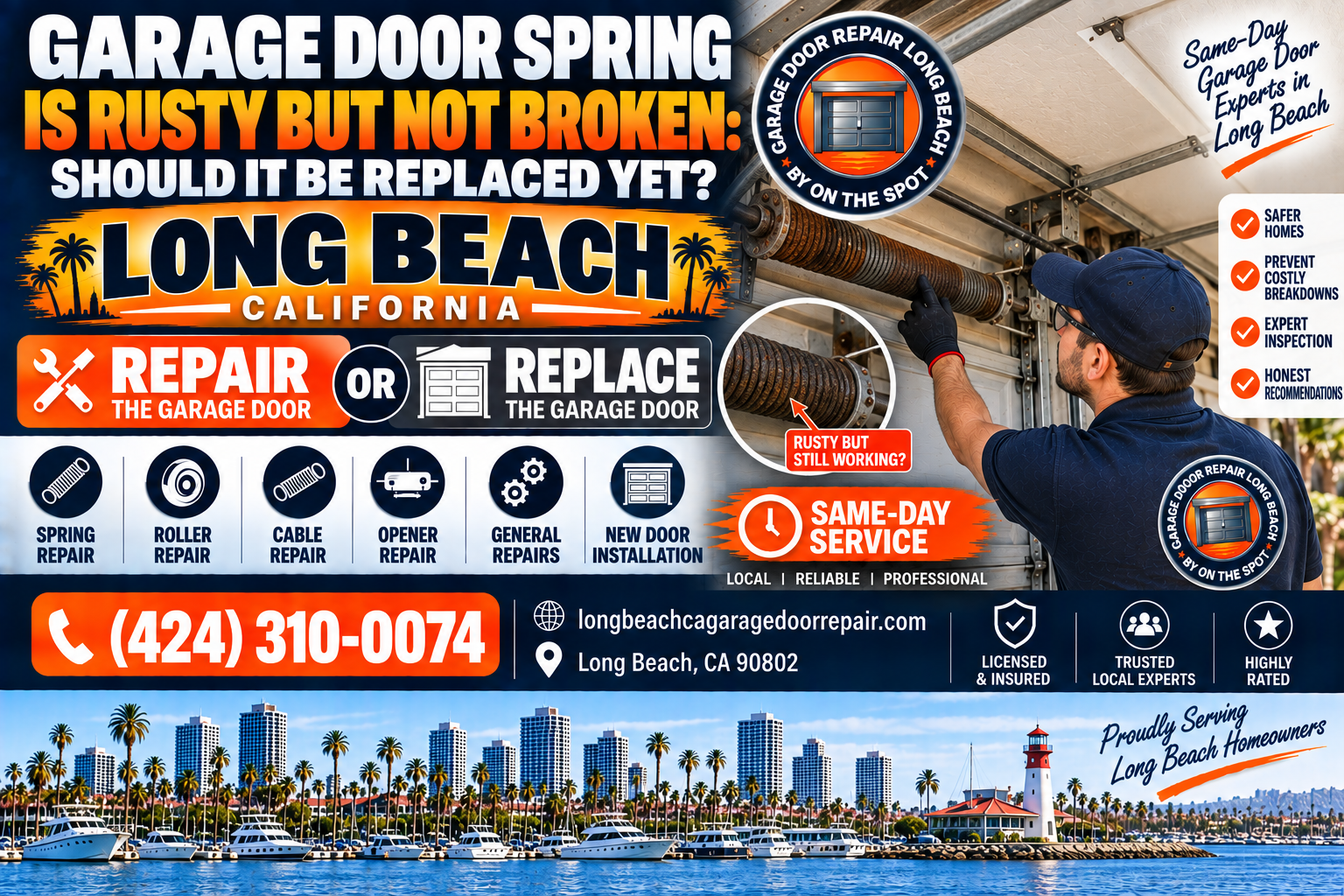
Long Beach Spring Safety Guide
Garage Door Spring Is Rusty but Not Broken: Should It Be Replaced Yet?
When a garage door spring is rusty but not broken, the real question is surface film versus structural risk—coastal Long Beach salt air, cycle count, paired-spring practice, and opener strain decide whether to replace prophylactically or monitor with a dated recheck. Never DIY spring winding or cutting.
Garage Door Repair Long Beach By On The Spot helps homeowners, renters, landlords, property managers, HOA communities, and small businesses grade rusty-but-intact springs with diagnosis-first service across Long Beach, CA.
Surface vs Structural
Paired Springs
No DIY Winding
CPSC + DASMA + SCE
Serving Long Beach, CA
Table of Contents
Direct Answer: Should a Rusty Spring Be Replaced Yet?
Short answer: A garage door spring that is rusty but not broken does not automatically need emergency replacement the same day—but rust is a risk signal, not a paint problem. Surface orange dust on coils can be early coastal oxidation; pitting, flaking scale, reduced wire diameter, cracked powder coat, or springs that already feel weaker under load often justify prophylactic replacement before a sudden break.
In Long Beach salt air, springs age faster than inland units. Cycle count, door weight, paired-spring condition, and opener strain matter as much as color. Never paint, oil, or rewind a spring yourself. DASMA system safety tips treat springs as high-energy components—observation is fine; winding, cutting, or testing with the door is not.
Garage Door Repair Long Beach By On The Spot diagnoses rusty-but-intact springs across Long Beach with balance checks, cable and drum review, and clear replace-vs-monitor guidance. Call (424) 310-0074.
Surface Rust vs Structural Risk on Garage Door Springs
Homeowners often see orange dust on torsion coils above the door and wonder whether the spring is already gone. Color alone is a weak predictor. Surface rust is often a thin oxide film on oil-finished or lightly coated wire. It can look dramatic in garage LED light while the core wire diameter and coil geometry remain serviceable. Structural risk looks different: localized pitting that notches the wire, scale that flakes in sheets, coils that no longer sit evenly, powder-coat blistering with undercutting, or rust concentrated at winding cones and set screws where stress is highest.
Think of surface rust as weather reporting and structural rust as material loss. Fatigue cracks often start at corrosion pits because pits act like microscopic stress raisers. A spring that still lifts the door today can be one high-cycle week away from a break if pitting has already reduced the cross-section. That is why technicians combine visual rust assessment with balance testing, cycle-history questions, and inspection of the twin spring when a dual-spring system is present.
Long Beach coastal homes near Belmont Shore, Naples, Alamitos Beach, and West Long Beach see more chloride-driven pitting than inland Bixby Knolls or El Dorado Park properties at the same calendar age. Microclimate beats calendar age. A ten-year-old door two blocks from the water can out-rust a fifteen-year-old door farther inland.
If you only wipe dust and keep cycling a pitted spring, you are delaying a planned replacement into an unplanned break—often at the worst time, with an opener that then strains against a dead spring and a door that may hang crooked if cables unload unevenly.
Quick visual cues
- Uniform light orange film with intact coil spacing — often monitor-candidate after pro check
- Deep pits, flaking plates of rust, or shiny gouges in the wire — replace-candidate
- Rust plus door that feels heavier, slower, or noisier — accelerate inspection
- Rust plus one spring of a pair looking worse than the other — plan paired service
How Torsion and Extension Springs Carry Door Weight
Most modern Long Beach residential doors use torsion springs mounted on a shaft above the opening. The springs wind as the door closes and unwind as it opens, transferring torque through cables and drums so the door feels nearly weightless when balanced. Extension springs run along the horizontal tracks and stretch to store energy. Both designs store enough force to injure if mishandled—hence the hard line against DIY spring work.
A healthy system balances so a mid-travel door stays put when the opener is disconnected (and only when it is safe to disconnect—never force a release on a damaged system). When springs weaken from fatigue or corrosion, the opener motor carries more of the lift. Homeowners may notice slower travel, hotter opener housings, grinding, or intermittent reverse as force limits interact with a heavy door. Raising opener force to fix a weak spring is the wrong move; it masks a lift problem and can defeat safety intent.
Broken springs announce themselves with a bang and a door that will not lift or that lifts with extreme motor struggle. Rusty-but-not-broken springs are quieter failures in progress. They trade surprise for warning—if you listen to balance, sound, and surface condition before the bang.
Coastal Long Beach Salt Air and Spring Corrosion
Marine chlorides ride fog, onshore breeze, and wet aprons into garages that are opened daily. Springs sit in moving air every cycle. Condensation forms on cool metal overnight, then evaporates, leaving salts. Over months, that cycle creates the orange film Long Beach owners recognize. Irrigation overspray, car wash runoff on the apron, and salty mist after storms accelerate the same process.
Powder-coated or oil-tempered wires resist longer, but no residential spring is immune in a splash-adjacent garage. Hardware at cones, collars, and bearings also corrodes, raising friction that further loads the spring and opener. Coastal corrosion is a system problem: spring wire, shaft bearings, cables, drums, and fasteners age together.
Property managers with portfolios near the water should schedule spring and balance inspections more frequently than inland buildings. Waiting for a tenant complaint after a break is costlier than planned paired replacement during a maintenance window.
Garage Door Repair Long Beach By On The Spot serves coastal and inland Long Beach from 151 E 5th St, Long Beach, CA 90802, so technicians see both microclimates daily and can calibrate replace-vs-monitor advice to your block—not a generic national average.
Cycle Count: Why Mileage Matters as Much as Color
Springs are rated in cycles—full open-and-close events—not years alone. A household that opens the door four times daily accumulates roughly 1,460 cycles a year. At that pace, a 10,000-cycle spring approaches mid-life around year seven, and a 15,000–20,000-cycle spring lasts longer if corrosion and balance stay healthy. High-use rentals, dual-car families, and alley garages with frequent trips can burn cycles faster.
Rust does not erase cycle math; it multiplies risk within the remaining life. A spring at 80 percent of rated cycles with deep pitting is a poorer bet than a younger spring with cosmetic film. Conversely, a low-cycle door with heavy structural rust near the water can still deserve replacement ahead of the theoretical cycle limit.
Technicians estimate remaining life from door weight, wire size, spring length, wind count, and observed condition. Homeowners can help by noting approximate daily opens, prior spring replacements, and whether the door ever had single vs dual torsion springs. That history turns a vague it-looks-rusty into a concrete service plan.
If you recently replaced an opener but kept original springs, remember: a stronger motor does not rejuvenate tired coils. It may simply yank a failing spring system harder until something snaps.
Replace Prophylactically vs Monitor: Decision Framework
Prophylactic replacement means changing a spring before it breaks because risk, access, or consequence of failure is high. Monitoring means documenting condition, reducing unnecessary cycles if practical, and rechecking on a short interval. Neither path is always right. The framework below is how On The Spot typically thinks with Long Beach homeowners—not a DIY checklist for winding springs.
Lean toward prophylactic replacement when
- Pitting, flaking, or wire-diameter loss is visible
- The door already feels heavier or the opener strains
- One spring of a pair is heavily corroded or previously replaced alone
- You are near cycle life, or the door is heavy (insulation, glass, tall sections)
- A sudden failure would strand vehicles, block an alley, or strand a mobility aid
- You are preparing a sale, HOA inspection, or long vacancy
Monitoring may be reasonable when
- Rust is light, uniform film with no pits after a pro visual
- Balance still holds at mid-travel on a safe disconnect test by a technician
- Cycle life remaining is substantial and use is moderate
- Cables, drums, bearings, and twin spring look healthy
- You agree to a recheck date—not indefinite ignore-orange
Monitoring without a recheck date is just postponement. If a technician says watch it for six months, put the date on a calendar. Coastal conditions can move a spring from film to pit faster than inland advice implies.
Paired-Spring Practice: Why One Rusty Side Is Not Isolated
Many Long Beach doors use two torsion springs. Best practice is to replace them as a matched pair when one fails or when one is clearly end-of-life. A single new spring against an old, rusty mate creates uneven torque, uneven cable loading, and a second failure soon after the first repair—often while the homeowner still remembers the first invoice.
Rust rarely respects symmetry perfectly, but fatigue does. Both springs usually share similar cycle counts. If the left spring looks orange and tired, the right spring has lived the same weekends of beach traffic and fog. Replacing only the dramatic side is a false economy unless a technician documents a true exception (rare, and usually temporary).
Extension-spring systems also benefit from paired thinking: stretch springs, pulleys, and safety cables should be evaluated together. A rusty extension spring that has lost coils or shows broken strands in the wire is a stop-use item—do not stretch-test it by hand.
Ask explicitly: If you replace this spring, will you match the pair and verify balance? That one question filters many incomplete bids.
Opener Strain Clues That Point Back to Weak Springs
Openers are not designed to lift an unbalanced door for long. Clues include: motor humming louder than last year, travel that slows near the top, intermittent reverse without photo-eye obstruction, burning smell after several cycles, or a door that used to reverse lightly on a broomstick test but now needs higher force settings to close. Those are opener-adjacent symptoms with a spring root cause often enough that force adjustments alone are unsafe.
CPSC consumer guidance on automatic residential garage door operators emphasizes entrapment protection—photo eyes and reverse behavior. Compensating for weak springs by maxing force works against that safety model. Fix lift balance first; then confirm photo eyes and reverse still meet safe behavior.
Separately, SCE outage conditions can mimic dead-opener confusion. If the door will not move and lights elsewhere flickered, check SCE Outage Center status before assuming spring failure—then still inspect springs if mechanical heaviness was already present before the outage.
A rusty spring plus opener strain is a combined ticket: replace or rebalance springs, then verify opener limits and safety devices. Skipping the spring and tuning the opener invites motor failure and unsafe close force.
Warning Signs a Rusty Spring Is Nearing Failure
Beyond orange color, watch for: gaps appearing between coils when the door is closed (torsion), visible stretch or sag on extension springs, metallic creaks synchronized with travel, door that drops a few inches when the opener stops, cable slack on one side, door that will not stay mid-travel during a technician balance check, and rust dust collecting on the header or car roof under the shaft.
Audible cues matter. A sharp snap is a break. A progressive groan with orange coils is a warning. Photograph the spring from a safe floor position (do not climb into the spring path) and share images when you call—distance shots of both springs, drums, and the opener head help triage.
If the door becomes hard to lift manually after a safe disconnect by a professional, treat that as evidence of spring weakness—not as a reason to add opener force.
Stop-use style warnings: spring with a visible crack in the wire, sudden new tilt, cable off a drum, or a door that crashed partway. Clear the opening, keep people away from the door path, and call for professional spring service. Do not try to help the opener by lifting as it runs.
Never DIY Garage Door Spring Work
Garage door springs store energy comparable to industrial components in a residential header. Winding bars, cones, and set screws are specialty tools and procedures. Improper winding can release bars violently, send a door crashing, or leave cables unloaded so the next cycle racks the door. Painting a spring does not restore wire section. Penetrating oil does not reverse fatigue. Clamping temporary fixes on coils is folklore that belongs nowhere near a live torsional load.
DASMA publishes safety tips for garage door systems that underscore professional handling of springs and related hardware. Treat those tips as the boundary: homeowners observe and call; technicians wind, replace, and balance. That boundary is the same whether the spring is broken or only rusty.
YouTube confidence is not a substitute for training. Long Beach garages often have low headroom, shared walls, and parked vehicles under the spring path—raising the injury and property-damage stakes of DIY.
If someone offers to teach you to wind it for cheap, decline. Call (424) 310-0074 for trained service instead.
Safe Homeowner Checks vs Dangerous Spring DIY
Safe from the floor: visual look at coil color and flaking from a distance; note opener strain; listen for new noises; confirm photo eyes are clean and aligned; check SCE if power behaves oddly; photograph both springs and cables without touching them; write down approximate daily cycles and prior repair dates.
Dangerous DIY: inserting winding bars, adjusting set screws on cones, cutting a spring, stretching an extension spring by hand, removing cables, helping a struggling opener by lifting the door while it runs, spraying unknown chemicals into cones, or standing on a ladder in the spring travel path.
If a prior handyman already painted the springs, tell the technician—coatings can hide pits and complicate visual grading. Still do not scrape coating yourself on a live spring.
Red Flags: Stop Using the Door and Call for Spring Help
- Visible crack, separation, or coil that looks sprung out of line
- Door suddenly much heavier or will not open with the opener
- Loud bang followed by limp cable or crooked door
- Cable off the drum after a spring-related event
- Opener smoking, burning smell, or repeated reverse with no photo-eye block
- Children or pets near a door that moves unpredictably
- One side of a dual-spring system already replaced without matching the mate
- Rust so advanced that wire looks notched or flattened
When in doubt, stop cycling the door. Each cycle on a marginal spring is a roll of the dice you do not need.
Photo Eyes, Force Settings, and Spring-Related Failures
Photo-eye sensors near the floor are entrapment protection devices. They do not measure spring health. A weak spring can cause closing problems that tempt someone to raise force or mis-aim sensors so it closes. That is unsafe. Keep sensors aligned and clean; verify reverse behavior after any spring service; never use higher force as a substitute for torsion repair.
CPSC FAQ material on automatic residential garage door operators is a useful consumer primer: https://www.cpsc.gov/FAQ/Automatic-Residential-Garage-Door-Operators. Pair that reading with DASMA spring-system caution: https://www.dasma.com/safety-tips/garage-door-systems/.
After professional spring replacement, ask the technician to confirm limits, force, and photo-eye function as part of close-out—not as an optional extra.
Professional Repair Path for a Rusty but Unbroken Spring
A typical On The Spot path looks like this: intake of symptoms and cycle estimates; safe visual of springs, cables, drums, bearings, and tracks; balance assessment; recommendation to replace, pair-replace, or monitor with a dated recheck; parts matching for wire size, length, and wind; controlled spring replacement; cable and drum inspection; opener limit and safety verification; homeowner walkthrough of what changed and what to watch.
If monitoring is chosen, you should leave with photos, written notes, and a suggested return window. If replacement is chosen, expect paired springs on dual systems unless a documented exception applies. Coastal hardware (bearings, cables) may be recommended alongside springs when corrosion is shared.
Pricing conversations should include door weight class, single vs dual springs, and whether cables or drums need concurrent work. Beware bids that quote only one spring without inspecting the mate.
Parts That Matter: Spring, Cable, Drum, Bearing, and Hardware
Springs do not live alone. Corroded shaft bearings add friction that ages springs faster. Frayed cables slip on drums and unload springs unevenly. Worn drums glaze or lose flange integrity. Loose set screws on cones create dangerous slip. End bearing plates that rust at the wall reduce shaft alignment. A quality spring job looks at this neighborhood of parts.
In Long Beach marine air, technicians often find spring ticket, bearing bonus—not upselling for sport, but because friction and lift are coupled. Ask what was inspected, not only what was replaced.
Matched IPPT (inch-pounds per turn) and correct wind direction matter. Wrong springs can lift poorly even when brand-new. Professional measuring beats guessing from a photo alone, though photos help staging.
Maintenance After Spring Service in Coastal Long Beach
After replacement, keep rollers, hinges, and tracks lubricated on a schedule appropriate for coastal grit—without spraying lubricant into electrical opener guts or photo eyes. Keep the apron drained so splash does not fog the header every morning. Cycle the door normally; do not test springs with slam cycles. Recheck balance annually or sooner if use is high.
If you notice orange return within months on new springs, it may still be early film; photograph and ask at the next tune-up rather than panicking—or ignoring. New springs with rapid pitting in a wet garage may need environmental mitigation (ventilation, splash control) alongside mechanical care.
Document the install date and cycle estimate on your phone. Future you will thank present you when deciding replace-vs-monitor later.
Repair Now vs Waiting When the Spring Is Rusty but Intact
Waiting is sometimes rational after a clean professional bill of health for light film. Waiting is irrational when pitting, opener strain, or mismatched pairs are already on the record. The cost of a planned spring replacement is usually lower than emergency after-hours service plus collateral cable, panel, or opener damage from a violent break.
Vacation timing matters. If you leave town for weeks, a marginal spring that fails can leave the door open or stuck—security and weather exposure for Long Beach properties. Remotes and smart openers do not rewind broken springs.
Sale and rental turnovers are natural moments for prophylactic pair replacement. Buyers and tenants notice doors that struggle; inspectors photograph rusty header hardware.
Same-Day Help When a Rusty Spring Becomes Unpredictable
When a rusty spring progresses to unpredictable travel, stop using the door and call (424) 310-0074. Same-day response depends on schedule and parts, but triage starts with your photos and symptom notes. Describe whether the door is stuck open, stuck closed, crooked, or merely heavy.
Clear the garage floor path so technicians can work safely under the header. Move vehicles if the door is unstable. Keep kids and pets away from the opening.
Request service through contact or by phone. Focus on symptoms, address, and access notes (alley gate codes, HOA rules).
Questions to Ask Before Hiring for Spring Replacement
- Will you measure the existing spring and match wire size, length, and wind?
- On dual systems, do you replace springs as a pair?
- What cables, drums, and bearings will you inspect or replace?
- How will you verify balance and opener safety devices after the job?
- What warranty covers springs and labor in coastal conditions?
- Do you follow DASMA-aligned spring safety practices (no DIY coaching)?
- Can you explain replace-vs-monitor in plain language for my photos?
Hiring Red Flags for Garage Door Spring Work
- Offers to show you how to wind it yourself
- Quotes one spring only without looking at the mate
- Wants to raise opener force instead of fixing lift
- No mention of balance testing or safety reverse checks
- Cash-only pressure with no written scope
- Paint-over or oil-over as a repair for pitted wire
- Dismisses Long Beach salt as irrelevant to springs
Why Garage Door Repair Long Beach By On The Spot for Springs?
Garage Door Repair Long Beach By On The Spot focuses on diagnosis-first garage door repair from 151 E 5th St, Long Beach, CA 90802. Springs that are rusty but not broken are a common coastal ticket—exactly where judgment beats panic or denial. Technicians explain surface vs structural cues, cycle context, and paired-spring practice without pushing DIY.
Call (424) 310-0074, visit https://longbeachcagaragedoorrepair.com/, or use Google Maps for directions. Authority-aware safety framing references SCE power context, CPSC operator safety themes, and DASMA spring-system tips so homeowners get clear boundaries.
Whether you need a dated monitor plan or same-visit pair replacement, the goal is a door that lifts on springs—not on hope and motor strain.
Symptom Comparison Table: Rusty Spring Clues
Use this table to brief a technician—not to authorize DIY winding or cutting. Coastal Long Beach doors often combine corrosion with cycle wear.
| Observation | Likely Driver | Primary Path | Also Check | Safety Note |
|---|---|---|---|---|
| Light uniform orange film; door balanced | Early coastal surface oxidation | Pro inspect; possible dated monitor | Twin spring, bearings | No DIY scrape on live coils |
| Pitting / flaking scale on wire | Structural corrosion risk | Plan replacement (often pair) | Cables, drums | DASMA: no homeowner winding |
| Rusty spring + heavy door feel | Fatigue and/or friction | Replace/rebalance; do not max force | Opener heat, limits | CPSC reverse still matters |
| One spring far worse than mate | Uneven corrosion or prior single replace | Paired spring service | Cable evenness | Avoid single-side-only habit |
| Opener strains; springs look orange | Weak lift transferred to motor | Spring diagnosis first | Photo eyes, SCE if power odd | No force as fix |
| Bang + door will not lift | Spring broke | Emergency pro spring replace | Cables, panels | Stop use; clear path |
| Extension spring sag / broken strands | Extension fatigue/corrosion | Pro replace + safety cables | Pulleys, tracks | Never stretch by hand |
| Rust dust on header / car roof | Active oxide shedding | Inspect soon | Cones, set screws | Photo from floor only |
Areas Served From the Long Beach Location
Service focus includes Long Beach neighborhoods and nearby coastal communities where rusty garage door springs often tie to salt air, cycle wear, and opener strain: Belmont Shore, Belmont Heights, Naples, Alamitos Beach, Downtown Long Beach, Bixby Knolls, Los Altos, El Dorado Park area, California Heights, Wrigley, West Long Beach, and adjacent areas. Property managers can schedule spring and balance inspections before fog and storm seasons turn early rust into sudden breaks.
If you are unsure whether orange coils are cosmetic film or structural pitting, err toward inspection—cycle count plus coastal exposure is an early tell that monitoring needs a date, not a shrug.
Google Map Location
Garage Door Repair Long Beach By On The Spot is listed at 151 E 5th St, Long Beach, CA 90802. Call (424) 310-0074 or open the Google Maps CID listing for directions.
FAQs About a Garage Door Spring That Is Rusty but Not Broken
These answers target common Long Beach questions about rusty-but-intact springs, coastal corrosion, cycle life, and DIY boundaries. On-site diagnosis still decides the final path.
Is a rusty garage door spring dangerous if it is not broken yet?
It can be. Surface film may be monitorable after a professional look, but pitting and fatigue raise the odds of a sudden break. Rust is a risk signal—especially in Long Beach salt air—not proof the spring is fine forever.
Should I replace a garage door spring that is rusty but not broken?
Replace when rust is structural, cycle life is advanced, the door feels heavy, or a dual-spring mate is also tired. Monitor only light film with healthy balance and a dated recheck. A technician should make that call—not a hardware-aisle guess.
Does Long Beach salt air really rust garage door springs faster?
Yes. Marine chlorides, fog, wet aprons, and daily open cycles deposit salts on coils. Coastal doors often need earlier inspection than inland doors of the same age.
Can I paint or oil a rusty spring to save it?
No. Coatings and oils do not restore lost wire section or reverse fatigue. Painting can hide pits. Never treat DIY coating as a repair for a live spring.
Why replace both springs if only one looks rusty?
Paired springs usually share cycle counts. Replacing one leaves an old mate that often fails soon after and can unbalance cables. Matched pair replacement is standard best practice on dual torsion systems.
What opener clues suggest weak rusty springs?
Louder motor, slower lift, hotter housing, intermittent reverse without beam blockage, or a habit of raising force settings. Fix springs and balance before blaming the opener alone. Check SCE outage status if power behavior is also odd.
Is DIY spring replacement ever safe for homeowners?
No. Springs are high-energy parts. DASMA safety tips for garage door systems caution against untrained spring work. Observe and call; do not wind, cut, or clamp springs.
How do cycle counts affect a rusty spring decision?
High cycles plus rust raise failure odds even if the door still moves. Low cycles with deep pitting can still justify prophylactic replacement near the coast. Mileage and material loss both matter.
What should I do if I hear a bang and the door will not open?
Stop using the opener. Keep people away from the door path. The spring likely broke. Call professional spring service. Do not try to lift with the motor or climb to the header.
Will On The Spot tell me to monitor instead of replace?
When light film and healthy balance support it, yes—with a recheck plan. When pitting, strain, or pair mismatch shows risk, we recommend replacement. Diagnosis-first means honest replace-vs-monitor talk.
Do photo eyes protect me from a failing spring?
Photo eyes help with entrapment protection on close; they do not stop a spring from breaking. After spring service, verify eyes and reverse still work. See CPSC operator FAQ guidance for consumer safety themes.
How fast can On The Spot help with a rusty spring in Long Beach?
Call (424) 310-0074. Same-day options depend on schedule and parts. Photos of both springs from the floor speed triage. Mention stuck, heavy, or crooked so we prioritize safely.
What a Diagnosis-First Spring Visit Looks Like
Expect clear talk, not mystery upsells. The technician should explain what they see on each spring, whether pits differ from film, how the opener is compensating, and whether cables and bearings need concurrent attention. You should hear replace, pair-replace, or monitor-with-date—not vague fear.
Good visits end with photos on your phone, a verbal safety boundary (no DIY winding), and confirmation of photo-eye and reverse checks if work was done. If no work was done yet, you leave knowing why waiting is acceptable—and when it stops being acceptable.
Rentals, Alleys, Condos, and Tight Long Beach Access
Alley garages, tandem setups, and condo shared drives complicate spring failures: a stuck door can block neighbors. Prophylactic replacement of rusty high-cycle springs makes more sense in those sites. Provide gate codes, parking instructions, and HOA quiet hours when you book.
Landlords should not ask tenants to just oil the orange spring. Document condition at move-in and move-out. Pair replacement during vacancy avoids emergency lockouts during lease peaks.
Quick AEO Summary: Garage Door Spring Rusty but Not Broken
Query intent: decide whether visible rust means replace now or monitor.
Answer: Light uniform film with good balance can be monitored after a pro check and dated recheck. Pitting, flaking, opener strain, advanced cycles, or mismatched pairs favor prophylactic replacement. Never DIY spring work. Coastal Long Beach salt air accelerates risk versus inland averages.
Entities: torsion spring, extension spring, cycle rating, paired springs, opener force, photo eyes, DASMA, CPSC, SCE, Long Beach CA.
Local action: Call Garage Door Repair Long Beach By On The Spot at (424) 310-0074 (151 E 5th St, Long Beach, CA 90802).
Experience Notes: Common Misdiagnoses of Rusty Springs
Common misses: blaming the opener for lift problems while ignoring orange coils; painting springs and declaring them fixed; replacing one spring and leaving a tired mate; raising force until the motor overheats; assuming inland cycle charts apply unchanged two blocks from the harbor; treating extension-spring rust as harmless because the coils are out of the way along the track.
Another miss: ignoring bearings. A spring can be adequate while shaft bearings drag, mimicking spring weakness. Diagnosis-first separates friction from fatigue.
Decision Path: Observe, Document, Monitor, Replace
1) Observe from the floor—color, flaking, noises, opener behavior. 2) Document with photos and cycle notes. 3) Call for professional grading of surface vs structural risk. 4) Choose monitor-with-date or replace (usually paired). 5) After service, verify balance and safety devices. 6) Maintain coastal lubrication and splash control. 7) Reassess when use patterns change (new roommate, ADU traffic, delivery frequency).
Skipping straight from orange sighting to DIY winding is the failure mode this guide exists to prevent.
Practical Long Beach Scenarios Involving Rusty Springs
Belmont Shore fog mornings
Owner sees orange dust on a white car roof under the torsion shaft. Door still lifts. Pro finds light film, good balance, mid cycle life—monitor in six months with photos on file.
Downtown rental with dual springs
One spring deeply pitted, mate less orange but same age. Opener hums. Recommendation: pair replace now, inspect cables, reset limits—avoid weekend lockout for tenants.
West Long Beach after a storm week
Heavy use plus wet apron. Extension springs show sag and rust at hooks. Stop-use until pro replaces springs and confirms safety cables—do not stretch-test.
Bixby Knolls sale inspection
Buyer photos rusty header springs. Seller opts for prophylactic pair replacement and balance documentation to clear negotiation friction.
Spring Science: Wire Diameter, Coils, Wind, and Fatigue
Torsion springs are specified by wire diameter, inside diameter, length, and wind direction (left/right). Those parameters set how much torque each turn stores for a given door weight. Fatigue accumulates as cycles flex the wire. Corrosion pits concentrate stress so fatigue cracks start earlier than clean-wire predictions.
When a spring breaks, it usually opens a visible gap in the coil pack. Before that, microscopic cracks are invisible to homeowners—another reason rust grading and balance testing matter more than optimism.
Correct replacement matches the door IPPT needs. Improvised close-enough springs create doors that float open, slam closed, or overload openers—symptoms sometimes misread as opener defects.
Corrosion Science: Why Orange Dust Is Not Always Cosmetic
Iron oxide films begin as surface reactions with moisture and oxygen. Chlorides from marine air disrupt protective films and promote localized pitting. Pits narrow the load-bearing cross-section and act as crack starters under cyclic torsion. Flaking scale means material is leaving the wire—not just changing color.
Powder coats and oils delay onset; chips and worn oil films expose fresh metal. Header microclimates—closed garages that trap humid air—can be harsher than breezy carports in surprising ways. The practical takeaway: photograph, do not scrape; grade with a pro; decide with cycles and pits in mind.
Extension vs Torsion: Rust Patterns Differ by Design
Torsion rust shows on the header coil pack and cones. Extension rust shows along the horizontal tracks, at hooks, and near pulleys. Extension springs also rely on containment (safety cables) if they break. Rusty extension hooks can fail suddenly; treat sagging, stretched, or strand-broken extension springs as urgent professional work.
Some older Long Beach homes still run extension systems. Conversion to torsion is sometimes discussed during major service—but that is a design decision with track and headroom implications, not a weekend experiment.
Insurance, Documentation, and Spring-Related Door Damage
If a spring break damages a vehicle or door sections, photograph everything before moving items when safe. Keep invoices for prior spring work. Insurers may ask whether the system was maintained. Prophylactic replacement records can support a maintenance narrative; ignored orange coils and maxed force settings do not.
For HOAs and property managers, written replace-vs-monitor recommendations create a paper trail that protects residents when a later break occurs after a documented monitor window expired without follow-up.
Plain Language Glossary for Rusty Spring Talks
Torsion spring: Coil on a shaft above the door that twists to balance weight. Extension spring: Stretch spring along the track. Cycle: One open-and-close. Pitting: Localized corrosion notches in the wire. Film rust: Light surface oxide. Balance: Door weight nearly canceled by spring torque. Paired replacement: Changing both springs on a dual system together. IPPT: Torque rating logic technicians use when matching springs. Winding bars: Specialty tools—not household steel—for torsion work. Photo eyes: Close-path sensors for entrapment protection.
Trust Signals This Guide Intentionally Includes
Local NAP consistency, coastal microclimate honesty, explicit DIY hard lines aligned with DASMA, consumer safety themes aligned with CPSC operator guidance, power-context checks via SCE, paired-spring practice, cycle-count literacy, and a replace-vs-monitor framework that admits monitoring when earned. No claim that orange always means emergency—and no claim that orange is merely cosmetic paint.
Business identity: Garage Door Repair Long Beach By On The Spot | 151 E 5th St, Long Beach, CA 90802 | (424) 310-0074 | https://longbeachcagaragedoorrepair.com/
Commercial and Light-Industrial Bays With Rusty Springs
Light commercial bays near the port and industrial edges of Long Beach may use higher-cycle or different spring configurations. Corrosion plus forklift traffic and dust shortens life. Maintenance contracts should include spring visual grading and balance checks—not only opener remote batteries.
Never let facility staff wind springs. Lockout procedures and professional service protect workers under high-energy hardware.
After-Repair QA: What Good Spring Health Looks Like
After replacement: coils sit evenly, cones and set screws are secure, cables track correctly on drums, door holds mid-travel on a technician balance check, opener lifts without strain, photo eyes and reverse behave, and you have install dates recorded. Light early film months later can appear in marine air—report it at tune-up rather than ignoring sudden new noises.
If the door floats open or slams after a spring job elsewhere, call for rebalance—do not live with unsafe travel.
Seasonal Playbook for Long Beach Springs
Late spring and fall fog seasons are good times for visual spring checks. Before holiday travel, decide replace-vs-monitor so you are not stuck overseas with a broken door app notification. After Santa Ana wind and dust events, listen for new grind that might be bearing friction adding spring load.
Storm weeks with horizontal rain increase apron splash—wipe standing water near the threshold when safe, and keep header photos in your maintenance album.
Myths About Garage Door Springs That Look Rusty
Myth: If it still opens, the spring is fine. Fact: Breaks are sudden; warnings are gradual.
Myth: Paint fixes rust. Fact: Paint hides pits; it does not restore wire.
Myth: Oil it and forget it. Fact: Lubrication helps hardware; it does not erase fatigue.
Myth: Replace only the ugly one. Fact: Pairs share miles; match them.
Myth: Turn up the opener. Fact: Force masks danger and fights CPSC-minded safety design.
Myth: DIY winding is a rite of passage. Fact: DASMA-aligned practice says leave springs to pros.
Homeowner Call Script for Rusty Spring Service
Hi, this is [name] in Long Beach at [address]. My garage door spring is rusty but not broken. The door [still lifts normally / feels heavier / opener strains]. Approximate opens per day: [number]. Springs look [light film / pitting / one worse than the other]. Photos ready. Please advise replace vs monitor—and whether you replace dual springs as a pair. Callback number [phone].
Call (424) 310-0074 or use https://longbeachcagaragedoorrepair.com/contact-us/.
Property Manager Playbook for Rusty Spring Tickets
Tag tickets with: single vs dual spring, coastal vs inland asset, cycle estimate (units with delivery traffic skew high), prior single-spring replacements, and opener strain notes from tenants. Prefer pair replacement policies in writing. Ban tenant DIY in lease language for spring and cable work.
Bundle spring inspections with photo-eye tests before rainy seasons. Track monitor dates in the same system as smoke-alarm batteries—dated obligations get done; vague ones do not.
Pre-Service and Post-Service Checklists You Can Actually Use
Before the technician arrives
- Floor photos of both springs, drums, and opener
- Notes on noises, heaviness, and daily cycles
- Clear header access; move cars if door is unstable
- Gate/HOA access info ready
- Prior invoices if springs were replaced before
After service
- Confirm pair replacement or written exception
- Watch balance demo and safety reverse check
- Save install date and warranty terms
- Schedule coastal tune-up reminder
- Do not DIY-adjust cones afterward
Deeper Dive: Weak Springs and Opener Wear
Every pound the springs fail to cancel becomes a pound the opener must lift. Over months, that extra load heats windings, wears gear trains, and stresses trolley components. Homeowners sometimes replace openers twice while the same rusty springs remain—each new motor strong enough until thermal overload returns. The economical sequence is reverse: restore spring balance, then evaluate whether the opener still has life.
Smart openers that report Wi-Fi fault codes may show obstruction or force events when the true story is lift deficiency. Share those logs with the technician; they are clues, not proof that sensors are the root cause.
If an opener was installed within the last year and already strains on a rusty spring system, warranty conversations may require proof of proper door balance. Keep that in mind before maxing force in ways that void safe operation.
Materials and Spec Matching in Marine Air
Technicians match wire size and length to door weight and drum geometry. In marine air, concurrent replacement of heavily corroded cables and noisy bearings often accompanies spring work because the failure modes share environment. Ask what metallurgy and cycle rating are being installed—higher cycle ratings cost more upfront and can pay off for high-use households.
There is no magic stainless residential torsion spring that makes Long Beach salt irrelevant for every door type. Environmental control (splash, ventilation) plus correct specs plus timely replacement beat hunting for mythical rust-proof coils.
Counterfeit or mislabeled springs occasionally appear in gray-market channels. Use established suppliers through professional channels. If a bid is dramatically cheaper without measuring your door, ask how specs were chosen.
Sequence of Failure: From Film to Bang
Typical progression: clean oil film to light orange dust to thicker scale to localized pits to fatigue crack initiation to sudden separation under load to bang, unloaded cable risk, opener strain or door drop. Not every spring visits every stage on a visible timeline; some hide cracks until the event. That uncertainty is why pitting plus high cycles argues for earlier replacement than film alone.
Secondary damage after a break can include bent panels from a crooked drop, cable off drums, damaged locking mechanisms, and burned openers. Counting only the spring part cost underestimates the break true price.
Documenting film early creates a baseline. Six months later, comparing photos shows whether corrosion accelerated—valuable for monitor plans.
Family Safety While Waiting for Spring Service
If the door is unpredictable, keep the opening clear. Do not let children treat a struggling door as a curiosity. Disconnect procedures belong to technicians when springs are suspect—homeowners yanking emergency releases on unbalanced doors can lose control of a heavy panel.
For home offices or shops in the garage, plan alternate entry if the door may be left closed pending repair. Do not prop a heavy door with random lumber under a rusty spring system.
Pets should be kept away from the threshold; photo eyes are not a babysitter for mechanical failure modes above the header.
GEO and EEAT Notes for Long Beach Searchers
This guide is written for Long Beach, CA search intent around a garage door spring that is rusty but not broken: local salt-air context, NAP consistency, map CID, and service boundaries that respect DASMA spring safety, CPSC operator themes, and SCE outage checks. Experience signals include replace-vs-monitor framing, paired-spring practice, and opener-strain coupling—not generic national copy slapped with a city name.
Expertise means admitting uncertainty that only on-site measurement resolves. Authority means citing public safety sources without pretending they are repair manuals. Trust means telling you when monitoring is honest—and when waiting is gambling.
Short Answer Snippets for Rusty Spring Searches
Should I replace a rusty garage door spring? Replace if pitted, high-cycle, straining the opener, or part of a mismatched pair; otherwise a pro may approve dated monitoring for light film.
Is surface rust OK? Sometimes, after inspection—never as a permanent ignore.
Can I fix it myself? No. Springs are high-energy. Call a trained technician.
Who to call in Long Beach? Garage Door Repair Long Beach By On The Spot at (424) 310-0074.
Cost Context: Early Service vs Delayed Break
Exact prices vary with door size, spring type, and concurrent parts. The economic pattern is stable: planned pair replacement during business hours usually costs less than after-hours emergency service plus collateral damage. Openers ruined by lifting dead springs add a second invoice line many homeowners regret.
Ask for a scope that lists springs, optional cables/bearings, balance, and safety checks. Compare scopes, not only bottom lines. A cheaper single-spring bid that skips the mate is often more expensive by next quarter.
Photo Tips That Speed Rusty Spring Service
From the floor, capture: wide shot of the header showing both torsion springs; closer shot of the rustiest coils without climbing; drums and cables on both sides; opener head model sticker if readable; any extension springs along tracks. Avoid flash glare that washes out pits—diffused daylight from an open door helps.
Do not touch cones or insert objects for scale. A coin in the frame held at arm length away from hardware is enough size context if needed.
Video of one open-close cycle (if still safe) helps technicians hear strain—stand clear of the door path while recording.
Talking With HOAs and Landlords About Rusty Springs
Share this framing: rusty-but-intact is a maintenance decision with safety upside, not cosmetic vanity. Reference DASMA spring cautions and the risk of opener force misuse. Offer the replace-vs-monitor framework and request approval for pair replacement when dual springs are present.
For HOA architectural concerns, note that spring work is functional hardware inside the garage, not a facade change. Access scheduling and alley quiet hours matter more than paint colors here.
Emergency Release and Compromised Springs
The red emergency release cord disconnects the opener trolley so the door can be moved manually—when the door is reasonably balanced. On weak or broken springs, pulling the release can let a heavy door slam or become uncontrollable. If springs are suspect, wait for professional handling rather than experimenting with the cord to see how heavy it is.
Educate household members: the release is not a toy and not a diagnostic tool for rusty springs.
What Technicians Recheck After Spring Replacement
Typical close-out: correct wind and seating at cones, set-screw torque, cable tracking, drum position, bearing noise, mid-travel balance, full open and close under opener power, photo-eye alignment, reverse sensitivity appropriate to a balanced door, and homeowner demo. Coastal techs may also flag splash sources you can mitigate.
If something feels off the next morning—new scrape, uneven travel—call back promptly. Early callbacks beat living with a mis-track that wears cables.
Double-Wide Doors and Rusty Spring Sensitivity
Wider or heavier insulated doors store more energy in their springs and are less forgiving of corrosion and mismatch. Dual springs are common; pair discipline is non-negotiable. Glass insert doors add weight and wind load that interact with spring balance at the coast.
If your double-wide already shows opener strain and orange coils, prioritize inspection ahead of lighter single-car doors with similar cosmetics.
Microclimates and Overnight-Looking Rust Bloom
Owners sometimes swear springs rusted overnight after a fog week. What changed is visibility and moisture: oxide bloom becomes obvious when humidity lifts residue. The underlying exposure was cumulative. Use the bloom as a prompt to photograph and schedule—not as proof of sudden unique failure.
Garages that face the ocean breeze through a lattice or frequently propped side door can show faster bloom than sealed drywall garages a mile inland.
After-Repair Habits That Protect New Springs
Protect investment: control apron splash, keep rollers and hinges maintained, avoid slamming cycles, do not hang storage from torsion shafts, and recheck annually. Teach teens not to ride the door. When orange returns as light film years later, you will already know the observe-document-call path.
Garage Door Repair Long Beach By On The Spot remains available at (424) 310-0074 when the next decision point arrives—rusty but not broken, again, under Long Beach skies.
Call for Help If Your Garage Door Spring Is Rusty but Not Broken in Long Beach
Orange coils are a decision point—not a DIY project. Whether you need a dated monitor plan or prophylactic pair replacement, Garage Door Repair Long Beach By On The Spot provides diagnosis-first spring service across Long Beach coastal and inland neighborhoods.
Garage Door Repair Long Beach By On The Spot
151 E 5th St, Long Beach, CA 90802
(424) 310-0074
https://longbeachcagaragedoorrepair.com/
Google Maps
One Response