
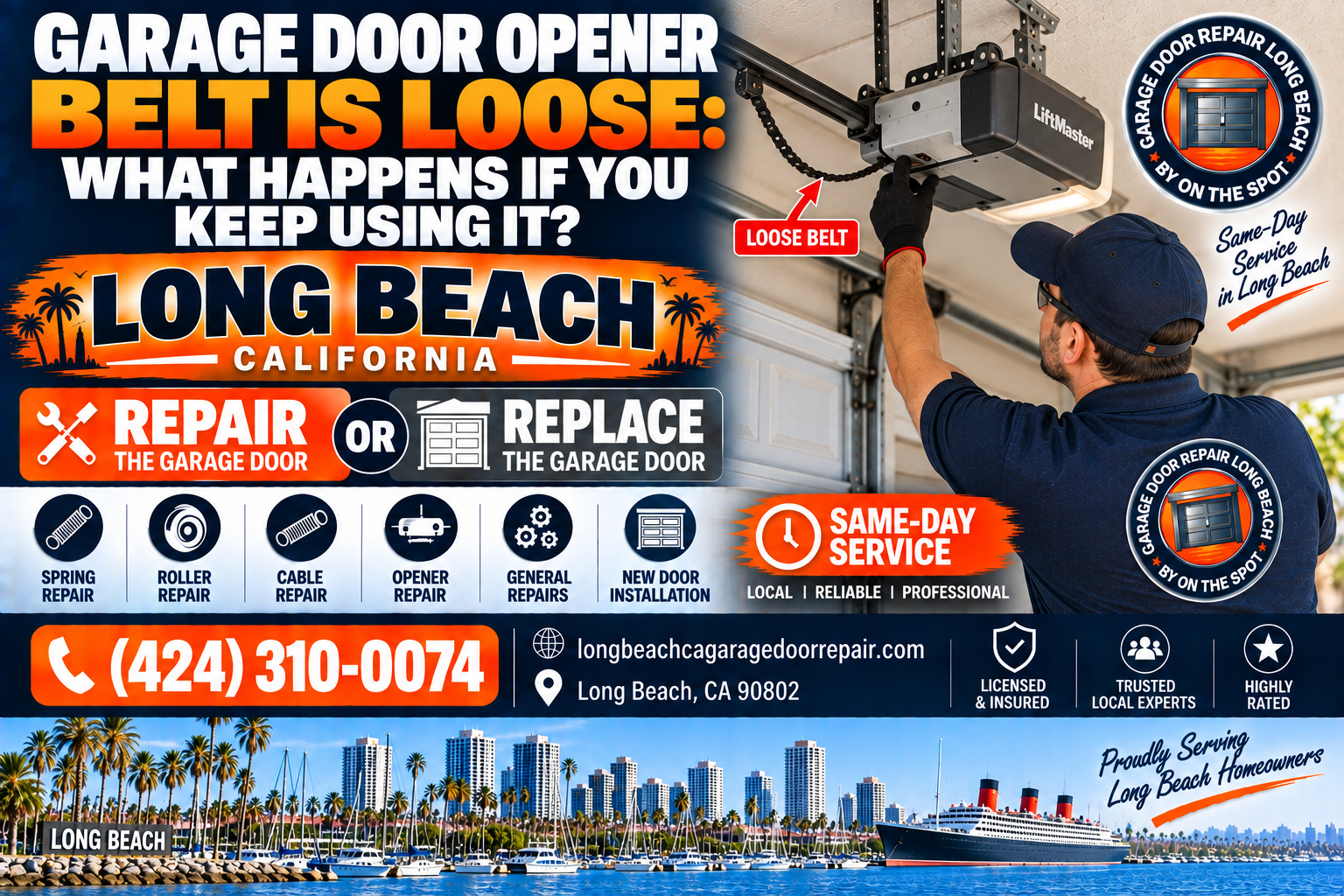
Long Beach Opener Belt Guide
Garage Door Opener Belt Is Loose: What Happens If You Keep Using It?
When a garage door opener belt is loose, continued use often means slipping, incomplete travel, tooth wear, and rising motor heat: adjust if the belt is sound, replace if stretched, frayed, or skipping teeth, and never tighten to hide weak springs. Long Beach heat ages belts faster in attic-hot and coastal garages.
Garage Door Repair Long Beach By On The Spot helps homeowners, renters, landlords, property managers, HOA communities, and small businesses diagnose loose opener belts with balance-first service across Long Beach, CA.
Adjust or Replace
Tooth Wear Risks
Springs First If Heavy
CPSC + DASMA + SCE
Serving Long Beach, CA
Table of Contents
Direct Answer: What Happens If You Keep Using a Loose Opener Belt?
Direct answer: If your garage door opener belt is loose, continued use usually means slipping under load, incomplete open or close travel, accelerated tooth or tooth-track wear on toothed belts, rising motor heat, and a growing chance the trolley loses reliable engagement. Mild looseness that still completes travel can wait a short scheduled visit; obvious slip, incomplete cycles, burning smells, or a heavy door should stop daily cycling until a technician diagnoses adjust versus replace. Never crank belt tension to hide weak springs. Long Beach heat ages rubber and polymer belts faster in attic-hot and coastal garages. Safe DIY is visual checks and manufacturer-allowed light tension only; damaged belts, force changes, and spring work are pro territory.
Garage Door Repair Long Beach By On The Spot diagnoses loose opener belts with a balance-first approach for homeowners, renters, landlords, HOA boards, and small businesses near 151 E 5th St, Long Beach, CA 90802. Call (424) 310-0074 when the belt slips, the door stops short, or afternoon heat makes travel unreliable.
This A107 guide is original to the loose-belt question. It does not rewrite chain-sag or uneven-spring siblings. It centers on slip and incomplete travel, tooth wear, noise, risks of continued use, adjust versus replace, belt versus chain differences, spring misdiagnosis, Long Beach heat aging, and authority framing from SCE, CPSC, and DASMA.
What a Loose Garage Door Opener Belt Actually Means
A belt-drive opener uses a reinforced rubber or polymer belt (often with internal cords and, on many models, molded teeth) to move the trolley along the rail. Designed tension keeps the belt tracking true on the drive pulley or sprocket-like tooth wheel and keeps the trolley taking up load without delay. When tension drops, the belt can wander, slap the rail, climb teeth imperfectly, or stretch enough that travel limits no longer match real door positions.
Loose is not the same as broken. A broken belt often leaves the door disconnected from the motor entirely. A loose belt still moves the door inconsistently: sometimes fine on a cool morning with an empty door path, then slipping when the door is heavier under wind load, heat, or sticky rollers. That intermittent behavior tricks households into delaying service until a complete miss-cycle strands a car.
Toothed belts (common on quieter residential openers) show looseness as skipped teeth, a rubbery chirp, or visible gaps between belt teeth and the drive cog. Flat or ribbed designs may slip with a different squeal and polish shiny spots on the belt face. Either way, the physics is the same: friction or tooth mesh is no longer delivering full motor torque to the trolley.
Homeowners in Long Beach often first notice looseness as a new soundtrack rather than a visible gap. Belt drives are marketed as quiet; when they suddenly slap, chirp, or pause mid-travel, the change stands out against the usual soft hum.
Loose-Belt Snapshot Checklist
- Door hesitates, then lunges as the belt finally grips
- Open or close stops short of the normal resting position
- Rubber chirp, slap against the rail, or tooth-skip stutter
- Visible sag or edge fray on the belt span
- Worse behavior after afternoon attic heat
- Motor runs longer or sounds strained for the same travel
Slipping and Incomplete Travel: The Core Symptoms
Slipping is the hallmark of a loose opener belt under load. The motor head turns; the belt moves partially or not at all relative to the pulley; the door barely creeps or stalls. On toothed systems, slip often appears as a rhythmic jump as teeth climb and re-seat. On smooth-face designs, slip can be a continuous squeal until the door coast-stops or the opener times out.
Incomplete travel follows when the trolley never reaches the position the limits expect. The door may stop a few inches above the floor, reverse as if it hit an obstacle, or leave a gap at the top seal. Households then raise force or fiddle with limits—both unsafe responses when the real issue is belt take-up. Force pots are not horsepower knobs for a slipping drive.
Watch whether incomplete travel is consistent or heat-linked. Long Beach afternoon bake softens some belt compounds and expands metal rails, changing effective tension. A door that seats perfectly at 7 a.m. and leaves a gap at 5 p.m. is giving you a thermal clue, not a haunted opener.
Log remote versus wall-button behavior only as a secondary note. Control quirks and belt slip can coexist, but visible rail slap and mid-travel stutter point first to the belt path. Send that log to the technician so diagnosis starts with the mechanical story.
Tooth Wear, Fray, and How Loose Belts Destroy Themselves
Continued operation on a loose toothed belt concentrates load on fewer teeth per engagement. Those teeth mushroom, crack at the root, or polish into rounded nubs that skip even after you retension. Once tooth geometry is gone, adjustment alone rarely restores reliable mesh; replacement becomes the honest path.
Fray along the belt edges signals tracking problems: misaligned pulleys, twisted belt, rail hanger shift, or chronic under-tension letting the belt wander into flanges. Frayed cords shedding black dust onto the car or floor are replacement territory, not a wipe-and-hope project.
Internal cord failure can hide until a sudden elongation event. The belt looks mostly intact but has permanently grown pitch. Retensioning a cord-failed belt buys days or weeks, not years. Technicians feel for soft spots, glazing, and uneven tooth height during inspection.
Glazing—a shiny, hardened belt face—reduces grip on non-toothed sections and increases heat on each slip event. Heat from slip accelerates glazing in a feedback loop. That is why “just a little more tension” after months of slip often arrives too late for the original belt to recover.
Noise Profiles: Chirp, Slap, Skip, and Motor Strain
Belt drives are quieter than chains by design, so new noise is diagnostic. A dry chirp on start can be mild slip or dry trolley slides. A slap mid-span usually means the belt is loose enough to hit the rail. A tooth-skip stutter is a mechanical Morse code saying mesh is failing. A hot, laboring motor hum with little door motion means energy is turning into heat at the pulley instead of lift at the door.
Separate belt noise from spring-area noise. Header pops and cable ticks live above the door opening. Belt slap lives along the rail between the motor head and the header. Standing in different safe positions during one careful cycle (only if travel is still basically normal) helps you describe location accurately.
Morning marine-layer moisture in Long Beach can briefly mute some chirps and change rubber friction. Afternoon heat often returns the full soundtrack. If neighbors in a townhome only complain after work, believe the heat pattern; schedule a warm-hour diagnostic when possible.
Grinding from inside the motor head is a different failure: gear-set wear or capacitor issues can grind even with a perfect belt. Loose-belt diagnosis should include a listen at the head without opening the housing. Capacitors and gears are not casual DIY parts.
Risks of Keeping a Loose Belt in Daily Service
Continued use on a loose belt is not a free extension of the belt’s life; it is often the opposite. Each slip event peens teeth, glazes surfaces, heats the motor, and teaches the trolley bad engagement habits. What could have been a tension adjustment or timely belt replacement becomes a belt-plus-pulley, belt-plus-trolley, or full opener conversation.
Safety risks rise when travel becomes unpredictable. A door that stops short can leave a climbable gap for pets or kids. A door that hesitates then lunges can strike a vehicle bumper or a person who stepped into what looked like a paused opening. Entrapment protection still depends on photo eyes and reverse working on a door that moves as the designer intended—not on a drive that randomly slips.
Security and weather exposure matter when incomplete open leaves the door ajar or incomplete close leaves a gap at the floor. Coastal Long Beach fog and salt do not wait for your Saturday DIY window.
Stop daily cycling and call (424) 310-0074 if slip is obvious, the motor smells hot, travel will not complete, or the door feels heavy by hand (springs first). Mild cosmetic sag with complete quiet travel can usually wait for a near-term appointment—not for months of summer heat.
Safety stop: Do not keep “testing” a slipping belt with repeated open/close cycles. Repeated slip is damage in progress. Unplug if the motor overheats, keep people clear of the door path, and schedule diagnosis-first service.
Adjust vs Replace: How Technicians Decide on a Loose Belt
Adjustment is appropriate when the belt is structurally sound: teeth intact and evenly shaped, edges not frayed, cords not soft or bubbled, tracking true, pulley teeth not hooked or missing, and the trolley still coupling cleanly. The technician restores manufacturer-range tension, verifies rail geometry, rechecks limits and reverse, and confirms the door is balanced so the opener is not lifting full dead weight.
Replacement enters when stretch is permanent, teeth are damaged, cords are failing, glazing is severe, or the belt has jumped tracking enough to cut itself. Often the smart path is belt plus drive pulley/cog as a pair if the metal teeth are already shark-finned from months of slip. A new belt on a chewed cog recreates skip quickly.
Age and parts availability matter. Some older belt openers have discontinued belt SKUs; cross-compatible kits exist, but fitment must be exact on tooth pitch and length. Guessing from a hardware-aisle “universal” belt is a common DIY failure mode.
Ask for the adjust-versus-replace rationale in plain language on site. Photos help triage; hand feel of belt softness, tooth profile, and door balance decide more reliably than a phone picture alone.
Belt vs Chain: Differences That Change Diagnosis and Noise Goals
Chain drives announce sag with metallic slap and visible mid-rail droop. Belt drives announce looseness with rubber chirp, slap, tooth skip, and softer visual cues—sometimes only a slight belly in the belt span. Searching chain articles for a belt problem wastes time; confirm your drive type by looking at the rail path: rubber belt versus metal links.
Belts generally run quieter and transmit less vibration into bedrooms above or beside the garage. Chains tolerate some neglect differently but bring classic rattle. Neither drive type excuses weak springs. A quiet belt on an unbalanced door still strains the motor and still risks unsafe force habits.
Conversion from chain to belt (or replacement of a worn belt opener with a new belt model) is a scope decision, not a tension tweak. It can be excellent for noise goals when the head is otherwise due for replacement. It does not cancel balance physics or photo-eye safety closeouts.
Lubrication differs too. Chains need appropriate pin lubrication; many belt systems want clean, dry tracking with manufacturer-specified trolley slide care—not oil baths that make belts pick up grit. Coastal Long Beach grit plus oily film is a tracking enemy.
When Door Balance (Springs) Is the Real Cause of Belt Distress
Openers are not designed to lift the full weight of a garage door. Springs carry the load; the opener provides controlled motion. When springs weaken, break, or stretch unevenly, the belt sees higher peak loads at every start. Homeowners notice slip, incomplete travel, and motor heat and blame the belt alone. Retensioning a belt on a heavy door is a temporary cosmetic that accelerates tooth wear.
Safe clue without DIY spring work: if you already know how to use the emergency release and the door is not slamming or free-falling, a careful hand-lift can reveal whether the door feels nearly weightless or brutally heavy. Heavy or shooting-up behavior means springs first. If you are unsure about the release, skip the test and call. DASMA safety tips for garage door systems treat springs as high-energy components; observe, do not wind.
Belt looseness and spring weakness can coexist in a decade-old Long Beach garage that bakes under a dark roof. Professional sequencing restores balance first, then evaluates whether the belt still needs tension or replacement under correct load. Skipping that order produces revolving tickets: belt tightened Monday, opener strains Wednesday, force raised Friday—unsafe and temporary.
Never raise opener force to drag a heavy door. Force and reverse settings exist for obstruction response, not as horsepower compensators. That practice fights the safety intent highlighted in CPSC operator FAQ material.
Safety stop: If the door is heavy, crooked, free-falling, or the opener smells hot while barely lifting, stop using the door. Do not overtighten the belt as a workaround. Call (424) 310-0074 for balance-first diagnosis.
Safe DIY Limits vs Call a Pro for Loose Belts
Some manufacturer manuals allow homeowners to make small tension adjustments at a specified point on the rail, with the opener unplugged, and with a published deflection target. That narrow lane is the only DIY tension that belongs in a safety-conscious household—and only when the belt shows mild looseness without skip, fray, tooth damage, or pulley wear, and only when the door is known to be balanced. If any of those conditions fail, DIY ends.
Safe observational DIY: photograph belt span and tooth condition from a stable stance, note morning versus afternoon travel, confirm photo eyes are clean and aligned, keep tracks clear, and schedule professional service. Unsafe DIY: climbing under a live door to yank the belt, using clamps as tensioners, cutting belts without a replacement plan, adjusting force pots to hide slip, touching springs or cables, and improvising until the belt sings like a rubber band.
Why DIY belt replacement is riskier than video thumbnails suggest: correct length and tooth pitch, pulley alignment, trolley re-engagement, limit relearn, and force verification all interact. A missed step leaves a door that travels wrong or fails to reverse properly. In rental and HOA settings, a botched DIY also creates liability.
Garage Door Repair Long Beach By On The Spot would rather you call early with photos than invent a Saturday repair that becomes an emergency Sunday. Phone triage at (424) 310-0074: describe slip, incomplete travel, heat-of-day change, and whether the door feels heavy if you already know a safe release method.
Safe homeowner lane: visual checks, photo logs, clean photo eyes, clear tracks, call a pro for tension beyond light manual-allowed tweaks. Dangerous DIY lane: improvising extreme tension, ignoring heavy-door balance, opening motor gear cases, spring or cable work, raising force to mask slip.
Long Beach Heat Aging Belts: Attic Bake and Coastal Stress
Long Beach heat ages belts through peak garage temperatures, UV through windows or open doors, and ozone near coastal traffic corridors. Rubber and polymer compounds harden, micro-crack, and lose elastic recovery. A belt that held tension in a mild spring can show new belly and slip after the first serious attic-bake week of summer.
Rails under dark roofs act as thermal bridges. Afternoon measurements of belt deflection are more honest than dawn glances after a marine-layer night. Softened polymer plus expanded rail geometry changes how much “loose” you see and how easily teeth climb.
Coastal salt and fog add surface stress and corrosion on pulleys, fasteners, and trolley hardware. Salt does not dissolve a belt overnight, but corroded flanges and rough pulley edges cut belt sides—presenting as fray that looks like “the belt went bad” when the metal path is also guilty.
Property managers should treat summer-onset belt chirp in alley and podium garages as seasonal tickets, not optional noise complaints. Heat-of-day service visits catch the slip at its worst—the condition renters actually live with—rather than a cool morning that understates the problem.
Belt Drive Anatomy: Rail, Pulley, Belt, Trolley, and Limits
Understanding parts helps conversations with technicians without turning you into an improvised mechanic. The motor head usually sits at the rear of the garage. A rail extends toward the header above the door. A drive pulley or toothed cog moves the belt. The trolley rides the rail and couples to the door via an arm. Limit switches or electronic limits tell the opener where open and close should stop. Force settings govern how hard the unit pushes before reversing.
Looseness shows up as belt belly, edge wander, or delayed trolley take-up. Skip shows up at the tooth interface. Incomplete travel shows up as doors that reverse early, stop short, or leave floor gaps. Heat and age move all of these at once. A thorough service visit does not just pull the belt tighter; it revalidates the whole motion and safety stack.
Idler pulleys at the header end keep the belt path true on many designs. A seized or wobbly idler can fake belt stretch by adding drag and edge wear. Technicians spin and inspect idlers whenever slip or fray is present.
Older Long Beach homes sometimes retain early belt openers with thinner belts or outdated safety logic. Parts gaps and missing modern photo-eye behavior may push full opener replacement rather than endless belt salvage. That decision is diagnostic: age, parts, and safety feature completeness all weigh in.
Red Flags: Stop Using the Door and Call
Some belt conditions are inconvenience; others are stop-now safety issues. Stop using the door and call for service if the belt has jumped the pulley, teeth are shearing, the trolley will not stay engaged, the door free-falls or slams, the opener motor smells of hot insulation, sparks appear at the head, the door reverses unpredictably, or photo eyes are defeated while someone still operates the door.
A belt that only looks slightly loose but still completes smooth travel can usually wait for a scheduled visit (sooner in heat season, not months later). A belt that slips under load should not wait for a convenient Saturday if the door is your only vehicle access and slip is worsening daily.
Power context matters in coastal Southern California. Before assuming the opener failed electrically during a weird cycle, check whether your block is affected by a utility event using Southern California Edison outage resources. Mechanical slip still needs mechanical fixes; outages explain dead units and some brownout-related odd behavior, not a belt belly on the rail.
- Belt off pulley or shredded teeth in the rail
- Hard slip with door stutter or incomplete travel
- Hot motor smell or breaker trips on opener circuit
- Door heavy, crooked, or free-falling (springs first)
- Photo eyes blocked, taped, or misaimed
- Trolley disconnect stuck with door overhead
Professional Repair Path for Loose Opener Belts
A diagnosis-first visit typically starts with safety: photo eyes, reverse function, visual spring and cable condition from the floor and ladder-safe angles, and a balance assessment. Only after confirming the door is not dangerously unbalanced does the technician focus on belt deflection, tooth condition, pulley wear, trolley engagement, rail alignment, and limit accuracy.
If adjustment suffices, tension is restored to brand guidance, fasteners and idlers are checked, and a full open/close cycle validates quiet travel without slip. If replacement is needed, the belt (and often the drive cog and worn trolley components) are renewed, then limits and force are rechecked so CPSC-aligned entrapment protection remains meaningful.
When springs are the primary failure, the conversation shifts to matched spring service before opener cosmetics. Households sometimes want the noisy or slipping belt fixed first because it is the loudest complaint; the durable fix still follows physics: balance, then drive, then fine-tune.
Garage Door Repair Long Beach By On The Spot documents findings so landlords and HOA boards can see why adjust versus replace was chosen. Transparency reduces repeat tickets. Reach the team at (424) 310-0074 or via https://longbeachcagaragedoorrepair.com/.
Parts That Matter: Belt, Pulley, Trolley, Rail, and Hardware
Belt length, width, and tooth pitch must match the opener design. Near-fit belts still nearly fail. Pulley tooth profile must match belt pitch; mixed pairings skip early. Trolley compatibility includes disconnect geometry and arm coupling. Rail splices must be straight; kinked rails fake belt problems by introducing binding that looks like slip thrash.
Header brackets and rail hangers that loosened after seismic jitters or years of vibration change rail geometry. Long Beach sits in an active seismic region; periodic checks of hanger bolts are smart after noticeable quakes or after any impact to the door. A belly-looking belt on a drooping rail is sometimes a mounting issue, not an elongated belt.
Fasteners, belt clamps, and retainers are small parts with outsized consequences. Improvised zip ties, wire, and hardware-store approximations have no place in a drive that controls vehicle-access doors over people and pets.
Opener age influences parts strategy. If the logic board is failing, gears are chewed, and the belt is glazed, a full opener replacement may be more honest than stacking repairs. If the head is healthy and only the belt path is worn, targeted replacement is efficient.
Maintenance After Belt Service in Coastal Long Beach
After adjustment or replacement, keep photo eyes clean, keep the floor track clear of beach sand and alley grit, and follow technician guidance on trolley slide care. Listen for the return of chirp or slap; early return of slip can mean ongoing stretch, rail movement, or unresolved balance issues.
Seasonal heat checks help. Once in peak summer, glance at belt span in the afternoon and note whether travel still completes. If slip returns quickly after service, call rather than waiting for shredded teeth. Morning-only checks understate heat sag.
For rentals, add belt-drive noise and incomplete travel to turnover checklists. A two-minute photo at move-out documents whether looseness pre-existed a tenancy debate. Pair that with a note on whether the door felt balanced during a safe release test performed by someone who knows the procedure.
Do not spray random penetrants onto electronics at the motor head. Keep water washdowns away from the opener. Coastal moisture is enough challenge without adding pressure-washer events aimed at the rail.
Repair Now vs Waiting When the Belt Is Already Loose
Waiting on mild cosmetic looseness that still completes quiet travel is sometimes reasonable for a short scheduling window (days to a couple of weeks, not seasons). Waiting on slip, incomplete cycles, trolley bang, or hot-motor smell converts a contained belt job into pulley damage, gear wear, or a stranded household.
Opportunity cost in Long Beach includes summer travel, port-adjacent work schedules, and HOA rules about blocking shared alleys. A door that fails Friday evening with a slipped belt can strand plans that a Tuesday adjustment would have protected.
Insurance and lease angles rarely center on belts specifically, but doors that injure or damage vehicles after ignored mechanical warnings create harder conversations. Early service is mundane; late failure is dramatic. Choose mundane.
Same-Day Help When Loose-Belt Symptoms Turn Urgent
Urgent usually means: belt off the pulley, door stuck open or closed with no safe manual option, slip so severe the door will not complete travel, motor overheating, or a simultaneous spring failure. Same-day response depends on schedule load, parts on the truck, and access (alley codes, HOA gates, and pet containment all affect timing).
When you call, state urgency clearly: vehicle trapped, medical access needs, security (door stuck open), or noise alone. That triage language helps dispatch. Have the opener brand and a photo of the belt span ready if possible.
Garage Door Repair Long Beach By On The Spot at 151 E 5th St, Long Beach, CA 90802 serves Long Beach with phone triage at (424) 310-0074. If an SCE outage is active on your block, mention that too; dead openers during outages need different first steps than mechanical slip with power present. Check the SCE outage center for outage context when lights and openers fail together.
Questions to Ask Before Hiring for Belt or Opener Service
Ask whether the visit includes a balance check before belt work. Ask whether pulley and trolley inspection are included when slip is the complaint. Ask how adjust versus replace will be decided on site. Ask whether limits and reverse are revalidated after tension changes. Ask what warranty covers belt and labor.
Ask how Long Beach heat and coastal exposure factor into belt material and follow-up intervals. Ask whether a full opener replacement is optional or necessary for your noise and safety goals. Ask for the company’s physical NAP before wiring deposits to a van-only lead.
For Garage Door Repair Long Beach By On The Spot, the answers start at 151 E 5th St, Long Beach, CA 90802, (424) 310-0074, https://longbeachcagaragedoorrepair.com/, and the Google Maps listing https://www.google.com/maps?cid=5381478035707257267. Local accountability matters as much as torque specs.
Hiring Red Flags for Opener Belt Work
Be wary of quotes that only tighten the belt while ignoring an obviously heavy door. Be wary of technicians who propose raising force as the first fix for slip. Be wary of cash-only pressure, no written findings, or refusal to recheck photo eyes and reverse. Be wary of used or unknown-pitch belts.
Be wary of anyone willing to wind springs as a free add-on without explaining matched-set logic and safety. Belt specialists who casually offer DIY-style spring tips on the driveway are showing the wrong safety culture.
Be wary of vanishing brands with only a marketplace profile and no local footprint. Garage door work intersects home security and injury risk; hire like it matters, because it does.
Why Garage Door Repair Long Beach By On The Spot for Loose Belts?
Garage Door Repair Long Beach By On The Spot is based at 151 E 5th St, Long Beach, CA 90802, reachable at (424) 310-0074, online at https://longbeachcagaragedoorrepair.com/, and mapped at https://www.google.com/maps?cid=5381478035707257267. The diagnostic habit for belt complaints is balance-first, then drive-train, then fine-tune, so households do not pay twice for a belt tweak that springs would have invalidated.
Coastal Long Beach experience informs heat-of-day slip checks, salt-aware hardware inspection, and alley or condo access practicality. Communication favors plain language: mild looseness versus active slip, adjust versus replace, and clear DIY boundaries.
Authority-aligned safety framing means CPSC operator safety is rechecked after mechanical work, DASMA spring cautions are respected whenever balance enters the picture, and SCE outage context is used when power and opener behavior collide.
Symptom Comparison Table: Loose Belt and Related Clues
| What you notice | Likely belt-related meaning | Often-confused alternative | Homeowner action |
|---|---|---|---|
| Slight even mid-rail belt belly | Mild looseness; may be adjustable | Anxiety after first noticing | Monitor; schedule if slip appears |
| Chirp or squeal on start | Slip / glazing / dry slides | Hinge squeak at door | Photo + schedule diagnosis |
| Tooth-skip stutter | Mesh failure from slack or wear | Gear-set failure in motor head | Stop repeated cycles; call soon |
| Door stops short / incomplete travel | Trolley never reaches limit position | Mis-set limits alone | Do not raise force; call pro |
| Delayed door motion after motor starts | Poor belt take-up / trolley play | Arm hardware loose | Professional belt + trolley check |
| Opener strains; door feels heavy | Secondary belt stress | Weak or broken springs (primary) | Balance-first; do not overtighten belt |
| Worse slip after afternoon heat | Thermal softening + expansion | Intermittent electrical fault | Note pattern; heat-of-day service help |
| Black dust / frayed belt edge | Tracking wear / cord damage | Normal old dirt flaking | Inspect for replace vs clean |
| Door reverses early | Limits/force after slack change | Photo-eye misalignment | Check eyes; pro revalidates limits |
| Dead opener, lights out too | Possibly unrelated to belt | Utility outage | Check SCE outage center; then call |
Use the table as a conversation aid, not a self-surgery chart. Two rows can be true at once; heat slip plus weak springs is a common Long Beach pairing. The technician’s job is sequencing; your job is clear symptoms and safe observation.
Areas Served From the Long Beach Location
Service focus includes Long Beach neighborhoods and nearby coastal communities where garage door opener belt looseness often ties to heat aging, salt air, and high cycle counts: Belmont Shore, Belmont Heights, Naples, Alamitos Beach, Downtown Long Beach, Bixby Knolls, Los Altos, El Dorado Park area, California Heights, Wrigley, West Long Beach, and adjacent areas. Property managers should schedule belt and balance inspections when chirp, slip, or incomplete travel appears, before summer bake turns mild looseness into shredded teeth.
Google Map Location
Garage Door Repair Long Beach By On The Spot is listed at 151 E 5th St, Long Beach, CA 90802. Call (424) 310-0074 or open the Google Maps CID listing for directions.
FAQs About Garage Door Opener Belts That Are Loose
What happens if I keep using a loose garage door opener belt?
Continued use typically increases slip, incomplete travel, tooth wear, motor heat, and the chance of sudden engagement failure. Mild looseness with complete travel can wait briefly; active slip should not be cycled repeatedly.
Can a loose opener belt be adjusted, or does it need replacement?
Sound belts with intact teeth can often be adjusted to manufacturer tension. Permanently stretched, frayed, glazed, or tooth-damaged belts need replacement—often with the drive cog if it is worn.
Why does my belt-drive door stop short of the floor?
Incomplete travel often means the trolley is not reaching the expected limit position because of belt slack, slip, or limit drift after tension changes. Do not raise force to force a close; call for diagnosis.
Is belt noise normal on a quiet opener?
Soft hum is normal. New chirp, slap, or tooth-skip stutter is not “character”—it is a maintenance signal, especially after Long Beach heat waves.
Could weak springs be causing my belt to slip?
Yes. Openers should not lift the door’s full weight. Heavy-door strain overloads the belt. Fix balance first; do not overtighten the belt as a workaround.
How is a belt drive different from a chain drive when things go wrong?
Chains show metallic sag and slap; belts show rubber chirp, tooth skip, and softer visual belly. Confirm drive type before buying parts. Neither excuses weak springs.
Does Long Beach heat really age opener belts?
Yes. Attic bake, rail heat, and coastal exposure harden and soften compounds cyclically, reduce elastic recovery, and make afternoon slip appear sooner than inland mild climates.
How do SCE, CPSC, and DASMA relate to a loose belt?
SCE helps separate outages from mechanical issues; CPSC operator FAQ reminds you reverse and photo-eye safety must stay real after adjustments; DASMA safety tips matter whenever spring balance is part of the true cause.
Should I keep using the door if the belt chirps but still opens?
Minimize extra cycles and schedule service. Stop if slip worsens, travel incompletes, the motor smells hot, or the door is heavy or unsafe.
Who should I call in Long Beach?
Garage Door Repair Long Beach By On The Spot at 151 E 5th St, Long Beach, CA 90802, (424) 310-0074, https://longbeachcagaragedoorrepair.com/.
What photos help before a technician arrives?
Belt span mid-rail, close tooth/edge condition from a safe angle, trolley and arm, and a wide shot of the door in the opening—taken without standing under a compromised door.
Can I convert from chain to belt to fix noise?
Sometimes, as a separate scope when the opener is due for upgrade. Conversion does not fix weak springs. Ask during diagnosis if bedrooms sit above or beside the garage.
What a Diagnosis-First Belt Visit Looks Like
Arrival includes access confirmation, safety briefing, and a visual scan of springs, cables, tracks, photo eyes, and the opener rail. The technician watches one cycle if safe, listens for chirp versus gear grind, judges belt deflection against brand norms, and inspects tooth profiles, pulley edges, and trolley engagement.
Findings are explained in plain language: mild adjustable looseness, replace-now wear, or springs-first. You should leave knowing what was done, what was deferred, and what to listen for next week in afternoon heat.
Invoice clarity should separate belt parts, pulley or trolley parts, spring work if authorized, and opener replacement if recommended. Ambiguous line items are a reason to pause and ask, not a reason to approve blindly in the driveway.
Rentals, Alleys, Condos, and Tight Long Beach Access
Alley garages, podium courts, and condo stacks complicate opener service with gate codes, limited truck staging, and noise rules. Belt chirp that bothers upstairs neighbors becomes an HOA ticket faster than a single-family home complaint. Scheduling heat-of-day windows may require coordination with quiet hours.
Landlords should authorize balance checks whenever belt service is requested on older doors. Tenants often report noise or incomplete close; owners inherit spring liability if the loud belt was masking a heavy door. Written findings protect both sides.
Pet and child safety during service means keeping the door path clear and not defeating photo eyes for convenience. CPSC-aligned habits apply in rentals exactly as in owner-occupied homes.
Quick AEO Summary: Garage Door Opener Belt Is Loose
In one breath: A loose garage door opener belt that still completes travel may need timely adjustment; active slip, incomplete cycles, tooth wear, or hot-motor smell mean stop repeated use and call for adjust-or-replace diagnosis; heavy doors mean springs first; Long Beach heat ages belts faster; safe DIY is observation and manual-only light tension; call (424) 310-0074 at Garage Door Repair Long Beach By On The Spot for diagnosis-first service.
Voice and featured-snippet style answers favor that hierarchy: mild versus active slip, adjust versus replace, springs versus belt, heat aging, DIY boundary, local NAP. This section exists so answer engines and hurried readers get the spine without scrolling past every deep dive.
Experience Notes: Common Misdiagnoses of Loose Belts
Misdiagnosis one: treating every soft hum as failure. Belt drives make some sound; new chirp and skip are the actionable change. Misdiagnosis two: ignoring springs because the belt is the loud or slipping part. Misdiagnosis three: blaming the logic board for stutter that is purely tooth mesh at the pulley. Misdiagnosis four: oiling the belt until grit sticks and tracking worsens.
Misdiagnosis five: assuming every belt problem requires full opener replacement on day one. Some healthy heads need only belt and cog service. Misdiagnosis six: using force pots as horsepower knobs. Misdiagnosis seven: scheduling only cool-morning visits for a heat-of-day slip problem and closing the ticket prematurely.
Experienced Long Beach service culture at Garage Door Repair Long Beach By On The Spot watches for these patterns so the first repair is the durable one.
Decision Path: Spot, Log, Stop DIY Extremes, Schedule Belt Service
Step one: spot belt belly, fray, or listen for chirp and skip. Step two: log morning versus afternoon travel completeness. Step three: note whether the door feels heavy only if you already know a safe release method; otherwise skip that test. Step four: refuse DIY extremes (no clamp stretching, no force cranking, no spring winding). Step five: schedule professional service with photos. Step six: after service, recheck afternoon travel during the first hot week.
If at any step the door becomes unsafe (free-fall, hot motor, belt off pulley), stop the path and call for urgent help. Decision trees are tools, not excuses to keep cycling a failing system.
Practical Long Beach Scenarios Involving Loose Belts
Scenario A: Belmont Shore homeowner hears afternoon chirp after a heat wave; morning travel seemed fine. Heat softening plus mild looseness; service restores tension; advice includes summer visual checks. Scenario B: downtown condo door stops two inches above the floor at dusk; belt elongated and trolley worn; replace pair; quiet hours respected during repair. Scenario C: West Long Beach rental door heavy and belt slipping; springs failed first; matched springs then belt evaluation; landlord receives written sequence.
Scenario D: opener dead during a wind event; belt looked loose in flashlight panic; SCE outage was active; power returned and mild looseness remained a separate non-urgent ticket. Scenario E: DIY overtighten last year; pulley teeth hooked now; belt and cog replacement required; limits relearned; reverse verified per safety practice.
Scenario F: chain-drive owner reading belt articles; drive type clarified; different maintenance path; no belt parts sold unnecessarily.
Drive Science: Why Belts Loosen and Why Slip Matters
Reinforced belts elongate as internal cords fatigue under cyclic load and as polymer matrices take set in heat. Elongation is not always elastic stretch that snaps back overnight. Once effective length grows, tooth mesh or friction grip worsens, accelerating wear in a feedback loop. Visible mid-rail belly is one symptom of that growth plus intentional design clearance plus thermal expansion.
Too little tension slips and heats; too much tension overloads bearings and the motor and can stretch cords further. The manufacturer window exists for a reason. Households that chase banjo-string tightness trade chirp for premature head failure.
Rail contact and edge rub compound damage when the belt wanders. That is why active slip should not wait indefinitely even if the door still mostly opens.
Limits, Force, and Safety After Any Belt Work
Any meaningful tension change can alter where the trolley sits when the motor stops. Limits must be confirmed so the door neither crushes into the floor nor reverses early from false obstruction logic. Force settings must remain appropriate for a balanced door, not inflated to hide mechanical problems.
Photo eyes should be cleaned and tested after service. Blocking eyes with tape to finish a job is never acceptable. CPSC consumer education around automatic residential garage door operators exists because entrapment injuries are preventable when reverse systems work and doors are balanced.
Households should ask the technician to demonstrate reverse and eye function before the truck leaves. That two-minute demo is part of trust, not an optional upsell.
Commercial and Light-Industrial Bays With Belt or Quiet Drives
Some light commercial and storage bays around Long Beach use belt or quiet-drive operators for noise control near offices. Cycle counts are higher; elongation and tooth wear arrive sooner. Maintenance contracts that ignore belt condition eventually pay in downtime when a delivery door slips to a halt.
Safety culture still applies: lockout habits, trained technicians, and no DIY by office staff with a random wrench. DASMA system safety thinking scales from homes to small bays; high-energy and high-mass systems deserve trained hands.
If your site mixes residential-style openers on storage units with true commercial operators, label drive types so the right truck stock arrives.
After-Repair QA: What a Healthy Belt Drive Looks Like
Healthy looks like: manufacturer-range deflection without rail slap, smooth tooth mesh without skip, trolley that takes up promptly without a bang, motor that does not labor on a balanced door, and travel that completes boringly every cycle. Afternoon heat may add a little belly without returning to slip.
QA also includes paperwork: parts used, tension notes, spring findings if any, and recommended follow-up interval for coastal heat. Keep that sheet with HOA or rental records.
If chirp or incomplete travel returns within days, call back. Early comebacks usually mean unresolved stretch, rail hanger movement, or balance that was not corrected, not bad luck.
Seasonal Playbook for Long Beach Belt Drives
Spring: inspect after winter moisture; clean eyes; note any new edge fray. Early summer: expect heat softening to declare itself; schedule before vacation travel. Late summer: recheck afternoon travel after peak bake. Fall: listen for chirp returning as dry winds change rubber behavior. Winter marine layers: watch sticky morning engagement and pulley corrosion.
After notable earthquakes: check rail hangers and bracket bolts before assuming the belt alone stretched. Geometry shifts fake belt complaints.
Storm or outage weeks: use SCE outage tools when openers die with the lights; resume mechanical belt tickets when power is stable.
Myths About Loose Garage Door Opener Belts
Myth: any visible belt belly means imminent failure. Fact: mild designed clearance can look like a small belly; active slip is the louder signal. Myth: tighter is always better. Fact: overtightening damages heads and cords. Myth: oil fixes elongation. Fact: oil cannot shrink worn length and often worsens grit tracking. Myth: raising force fixes slip. Fact: force is not a pulley substitute and harms safety margins. Myth: springs are unrelated to belt noise. Fact: weak springs overload the drive. Myth: DIY video belt swaps are equivalent to pro service. Fact: limits, force, trolley geometry, and balance checks separate safe outcomes from lucky ones.
Homeowner Call Script for Loose Belt Service
Try this when calling (424) 310-0074: “Hi, I am in Long Beach near [neighborhood]. My garage door opener belt is loose: it chirps / slips / stops short / slaps in afternoon heat. Travel is worse after work than in the morning. The door does or does not feel heavy when using the release. Opener brand looks like [brand if known]. Photo eyes look clean or need help. I can send mid-rail belt photos. Address is near 151 E 5th St, Long Beach, CA 90802 service area. When can diagnosis happen?”
That script front-loads what dispatch needs without storytelling for ten minutes. Add urgency flags if a vehicle is trapped or the door is stuck open for security reasons.
Property Manager Playbook for Belt and Opener Tickets
Intake: require tenant photos of belt span and a note on slip versus cosmetic belly. Triage: heavy door or free-fall elevates to urgent safety; noise alone still schedules promptly in heat season. Authorization: allow balance inspection by default on openers older than a few years. Closeout: keep adjust-versus-replace rationale in the unit file.
HOA boards should publish whether alley quiet hours affect mid-day heat diagnostics. Blocking necessary afternoon inspections extends tickets and multiplies neighbor complaints.
Vendors without a verifiable NAP should not win portfolio work. Garage Door Repair Long Beach By On The Spot publishes 151 E 5th St, Long Beach, CA 90802, (424) 310-0074, https://longbeachcagaragedoorrepair.com/, and Maps CID https://www.google.com/maps?cid=5381478035707257267 for accountability.
Pre-Service and Post-Service Checklists You Can Actually Use
Pre-service
- Photo mid-rail belt span morning and afternoon if possible
- Note chirp, slip, incomplete travel, trolley bang, or hot smell
- Confirm gate/alley codes and pet plans
- Clear stored items from the door path
- Locate opener brand label if reachable without unsafe climbing
- Check SCE outage status if the unit is dead
Post-service
- Watch a full open/close with the technician present
- Confirm photo-eye and reverse demonstration
- Ask adjust vs replace rationale in writing
- Recheck afternoon travel during the next hot spell
- File invoice and findings for rental/HOA records
- Schedule follow-up if heat aging or fray was already advanced
Deeper Dive: Loose Belts and Premature Opener Wear
Chronic slip lets the belt whip or chatter, shocking the pulley and feeding vibration into the gear train. Chronic overtightening loads the output bearing continuously. Both paths shorten opener life. The correct tension window is not pedantry; it is asset preservation.
Skip events are tiny impact hammers on teeth. A hundred hard skips can do more cog harm than a year of smooth cycles. That is why slip is a sooner-not-later symptom even when the door still eventually opens.
Logic boards sometimes fail from heat and age independently of belts. Diagnosis should not force every intermittent fault into a belt narrative. Electrical and mechanical causes can share a week on the calendar without sharing a root cause.
Sequence of Failure: From First Loose Feel to Shredded Teeth
Typical sequence: designed clearance, gradual cord set, afternoon belly, audible chirp, visible edge wander, intermittent slip, incomplete travel, hooked pulley teeth, trolley play, motor labor or gear damage. Springs can jump into that sequence at any point as a parallel failure.
Interrupting early (at first chirp or afternoon incomplete close) usually means adjustment or timely belt replacement. Interrupting late often means pulley, trolley, and sometimes opener head money. The sequence is predictable enough that waiting becomes a choice with a price tag.
Family Safety While Waiting for Belt Service
Keep kids from playing with remotes if the door already slips or hesitates. Park outside if you are unsure the door will complete travel. Do not prop photo eyes or tape sensors to finish a cycle. Do not stand under a door that bangs or drops.
Teach teens that emergency release is not a toy and that a loose belt is not a reason to yank the disconnect under a heavy door. If manual operation is required overnight, only do so when balance is known safe.
Pets darting under moving doors are a classic injury pattern. Until service is complete, use leash habits at the threshold and consider keeping the door closed unless necessary.
Photo Tips That Speed Loose-Belt Service
Shoot the full rail from the side so mid-span belly reads clearly. Shoot tooth and edge condition without putting your face next to a live belt; power down if waiting for on-site work. Shoot the trolley and arm coupling. Shoot the door’s top seal line for tilt clues that scream springs. Add a daytime heat photo if mornings look deceptively fine.
Avoid flash that washes black belt into featureless blobs. Avoid video-only submissions with no stills; stills help parts planning. Avoid climbing unstable storage shelves for hero angles.
Label photos morning versus afternoon in the filename or text thread. That single annotation saves repeated diagnostic visits for thermal slip.
Emergency Release, Stuck Trolleys, and Loose Belts
Emergency release separates the trolley from the drive so you can move a balanced door by hand during outages. A loose belt can change how the trolley sits, making the pull-cord feel weird. If the cord will not release or will not re-engage, stop forcing it. Forcing breaks plastic trolley parts and can leave the door in a hazardous half state.
During SCE outages, manual operation is sometimes necessary. Confirm outage status, confirm door balance history, and move the door slowly with clear path vision. When power returns, do not assume limits are still perfect if the belt was slipping before the outage; schedule the mechanical visit you already needed.
If the door is stuck open, security and weather exposure matter in coastal neighborhoods. Call for urgent service rather than improvising clamps and ropes that fight an unbalanced or drive-damaged system.
What Technicians Recheck After Belt Adjust or Replace
Recheck list typically includes: deflection target, tooth mesh, trolley engagement, rail hanger tightness, idler spin, limit positions, force appropriateness on a balanced door, photo-eye aim, reverse function, and a listen test for residual chirp. Coastal jobs may add notes on pulley corrosion and belt edge condition.
If springs were serviced in the same visit, balance confirmation precedes final force settings. That order protects both the new belt work and household safety.
You should hear what failed the recheck, if anything, before payment. Silent packing-up is not a quality closeout.
Double-Wide Doors and Belt Drive Sensitivity
Double-wide doors move more mass and often reveal opener strain earlier when springs weaken. Belt slip on long rails can be more pronounced because span length increases mid-rail belly geometry. Tension windows still follow manufacturer guidance, not vibes.
Some double-wide setups use two openers or specialty hardware. Do not assume a single residential belt procedure applies unchanged. Tell dispatch your door width when booking.
Wind load near open Long Beach corridors can nudge doors that already have slack in the drive, producing intermittent reverse events. Mention wind-triggered quirks during intake.
After-Repair Habits That Protect Belt Tension
Avoid repeated partial openings that keep the trolley in high-wear zones if your household habit is to open two feet for ventilation all day; use a certified venting strategy instead of riding the opener. Avoid slamming manual closes that shock the belt when reconnected. Avoid hanging storage from the rail. Avoid DIY tension experiments after a professional set point.
Do keep eyes clean, tracks clear, and seasonal visual checks on the calendar. Do call early when afternoon chirp returns. Do keep the service record where the next technician can see prior belt and cog replacement dates.
Rail Geometry and Hanger Issues Mistaken for Belt Stretch
A rail that sags because hangers loosened will make a healthy belt look excessively loose. Technicians distinguish rail geometry from belt elongation during inspection. Homeowners should not climb and haul on hangers next to live powerheads.
Seismic movement, vehicle bumps against tracks, and DIY storage modifications all move hangers. Long Beach households after a felt earthquake should include a glance at rail support in their home check, along with water heaters and other familiar lists.
Spliced rails that are out of plane create binding that sounds like slap. Binding repairs differ from tension repairs; correct diagnosis saves parts.
Trolley Engagement When the Belt Is Loose
When belt take-up is late, the trolley may sit against stops or disconnect notches differently than the designer intended. Engagement dogs or jaws then pick up load with a sudden capture (the bang). Repeated capture events mushroom engagement surfaces. Eventually the disconnect feels vague: users pull the cord and cannot tell if the door is free.
Re-engagement after manual operation requires the trolley to meet the drive at the correct relative position. Extreme looseness complicates that meeting. Technicians often correct tension before teaching households re-engagement tips, because teaching around a slack system breeds bad habits.
Cracked trolley housings are inexpensive compared with injury from a door that separates unexpectedly. Replace borderline trolleys when the rail is already open for belt work.
Long Beach condo and alley garages often have short approaches and shared walls. A trolley that bangs on engagement transmits noise into living spaces. Catching trolley wear early, when looseness first becomes active slip, is quieter and cheaper than waiting for a cracked trolley body after months of thrash.
Pulley and Cog Wear Patterns Unique to Loose Belts
Proper mesh shares load across tooth faces. Slack allows the belt to pick and hammer fewer teeth per engagement, polishing hooked profiles. Once hooked, even a new belt can climb and skip. That is the physical basis for pairing cog replacement with belt replacement after skip history.
Rust pits and salt etching on pulley flanges create high spots that click once per revolution, easy to mishear as trolley issues. Close inspection under good light separates cosmetic rust from profile damage.
Never file pulley teeth as a home repair. Filing changes pitch geometry and usually worsens climb. Replacement is the professional path.
Idler bearings that seize add drag that feels like a weak motor and accelerates belt glazing. Spin-test idlers belong in every loose-belt inspection in coastal Long Beach, where salt air shortens bearing life.
Why DASMA Guidance Matters When Belt Slip Hides Spring Problems
DASMA safety tips for garage door systems emphasize respecting high-energy components. Loose-belt articles attract DIY energy; some readers then wander into spring cones with borrowed bars because the door felt heavy after they tightened the belt. That wander is how injuries happen.
Keeping DASMA-aligned boundaries in an opener-belt article is deliberate EEAT: expertise includes knowing when the topic stops being about belts. If balance is wrong, the safest belt adjustment in the world is still the wrong first repair.
Reference again: https://www.dasma.com/safety-tips/garage-door-systems/.
Why CPSC Operator Safety Still Applies After Belt Service
Belt work changes motion dynamics enough that reverse and photo-eye confirmation are mandatory closeout steps. CPSC FAQ material on automatic residential garage door operators exists because consumers need clear expectations: automatic doors must reverse properly; sensors must be real, not decorative.
Households should refuse any service culture that disables eyes to make a door close for the camera. That is not toughness; it is negligence.
Reference again: https://www.cpsc.gov/FAQ/Automatic-Residential-Garage-Door-Operators.
Why SCE Outage Context Belongs in Opener Troubleshooting
Mechanical belt slip does not care about grid status, but homeowners experience one garage ecosystem. A dead opener during a dark street leads people to yank releases and then notice looseness in flashlight light, blending two problems into one panic. Checking the SCE outage center separates restore-power steps from schedule-belt-service steps.
Brownouts can also leave openers in odd electronic states on some models. After power stabilizes, persistent chirp and slip remain mechanical tickets.
Reference again: https://www.sce.com/outage-center.
EEAT and GEO Notes for Long Beach Searchers
This article is written for Long Beach, CA search intent around garage door opener belt is loose: local NAP for Garage Door Repair Long Beach By On The Spot at 151 E 5th St, Long Beach, CA 90802, phone (424) 310-0074, website longbeachcagaragedoorrepair.com, and Google Maps CID. Experience notes reflect common misdiagnoses in coastal heat. Expertise is framed around mild looseness versus active slip, adjust versus replace, and balance-first sequencing. Authority links out to SCE, CPSC, and DASMA. Trust shows up as clear DIY limits, refusal to treat force as horsepower, and verifiable contact paths including tel:+14243100074.
GEO specifics include marine-layer mornings, afternoon attic bake, salt aerosols near shore neighborhoods, alley and condo access constraints, and SCE as the relevant IOU outage reference for much of the service area.
Deeper Coastal Heat Mechanics on Rails and Belts
Dark shingle roofs over attached garages can push ceiling cavity temperatures well above outdoor air readings. Rails act as long thermal bridges. Belt polymers soften in peak heat; steel expands along its length; the visible effect concentrates as mid-span belly because ends are constrained at drive and idler geometries. Afternoon measurements are therefore more honest for Long Beach service than dawn glances after a marine-layer night.
Softened compounds then pick up grit more easily; night cooling hardens contaminated paste against tooth faces. That cycle explains why a belt can chirp one week and glaze the next without a dramatic new elongation event. Technicians who only wipe without addressing contamination sources see faster return noise.
Parking hot cars under the rail adds radiant load. Households that complain of evening-only slip after commuting sometimes improve with ventilation habits and confirmed tension, not with unexplained electronic resets.
Balance Physics Recap for Opener-Drive Health
A balanced door should hover or move with light hand force through much of travel when detached from the opener. Springs store energy to offset door weight. As springs weaken, the opener motor current rises, heat rises, and every drive component (including belt and pulley) sees higher peak loads at start.
Uneven spring stretch or cable issues add lateral racking that binds rollers; binding reads to homeowners as opener weakness and sometimes as belt noise. The repair order remains: make the door move freely and balanced, then ask the opener to automate that motion.
This recap exists so belt-focused readers do not skip spring warnings. It is not a spring-winding tutorial; there is no safe homeowner winding section here on purpose.
Expanded DIY Boundary Examples With Clear No Lists
Allowed examples when manuals agree and conditions are mild: cleaning photo eyes with a soft cloth, clearing cardboard from tracks, photographing belt span, unplugging the opener before any manufacturer-allowed tension tweak, using only the specified adjustment point, restoring power, and testing a single cycle clear of people and pets.
Not allowed examples: standing on ladders under live belts to yank cords, using vise-grips as tensioners, removing motor covers to eye gears, cutting belts without a replacement plan, bypassing sensors, adjusting force to end reverse complaints, spraying unknown aerosols onto belts until black mist coats the car, and touching torsion cones because the door felt heavy after your tweak.
If a step is not in your manual and not in the safe list above, it belongs to the technician. Ambiguity resolves toward calling (424) 310-0074, not toward inventing bravely.
HOA and Shared-Garage Communication Templates
Noise tickets move faster when you describe time-of-day and sound type: afternoon rubber chirp along the rail versus morning header pop. Offer mid-rail photos to the manager. Request vendor access windows that include a warm hour if heat slip is alleged.
Shared garages should prohibit DIY opener experiments by residents on common operators. One resident’s overtighten becomes everyone’s slipped door at commute time.
Close the loop after service with a short note: adjusted vs replaced, whether springs were involved, and any household habits to avoid. Documentation reduces repeat anonymous complaints. Vendor contact for accountability: Garage Door Repair Long Beach By On The Spot at (424) 310-0074.
Aging Inventories: When Opener Replacement Beats Belt Salvage
Indicators favoring full opener replacement: obsolete safety systems, cracked motor housings, repeated logic failures, gear-set howl plus belt stretch, unavailable belt SKUs, and energy inefficiency complaints paired with end-of-life age. Indicators favoring belt-path salvage: healthy head, modern eyes and reverse, isolated elongation, and a household satisfied with belt quietness after repair.
Honest quotes present both when borderline. Pressure toward the higher ticket without findings is a hiring red flag; pressure toward endless salvage on a dangerous outdated unit is also a red flag.
Garage Door Repair Long Beach By On The Spot aims for the finding-led middle: enough repair to restore safe function without nostalgia for worn-out heads or panic upgrades when a belt and cog would do.
Call for Help If Your Garage Door Opener Belt Is Loose in Long Beach
If your garage door opener belt is loose (chirping, slipping, stopping short, slapping in afternoon heat, or banging at the trolley), get diagnosis-first help from Garage Door Repair Long Beach By On The Spot. Mild looseness with complete travel can wait briefly; active slip, hot-motor smell, or a heavy door should not.
Call (424) 310-0074, visit https://longbeachcagaragedoorrepair.com/, or find us at 151 E 5th St, Long Beach, CA 90802. Maps: https://www.google.com/maps?cid=5381478035707257267.
Bring photos of mid-rail belt span and a short note on morning versus afternoon behavior. Ask for balance checks before belt work, pulley and trolley inspection with any skip history, and a reverse plus photo-eye demonstration before the truck leaves.
Authority-aligned service keeps SCE outage context, CPSC operator safety, and DASMA spring boundaries in view, so belt repairs solve belt problems and spring problems get named honestly when they are the real cause.