
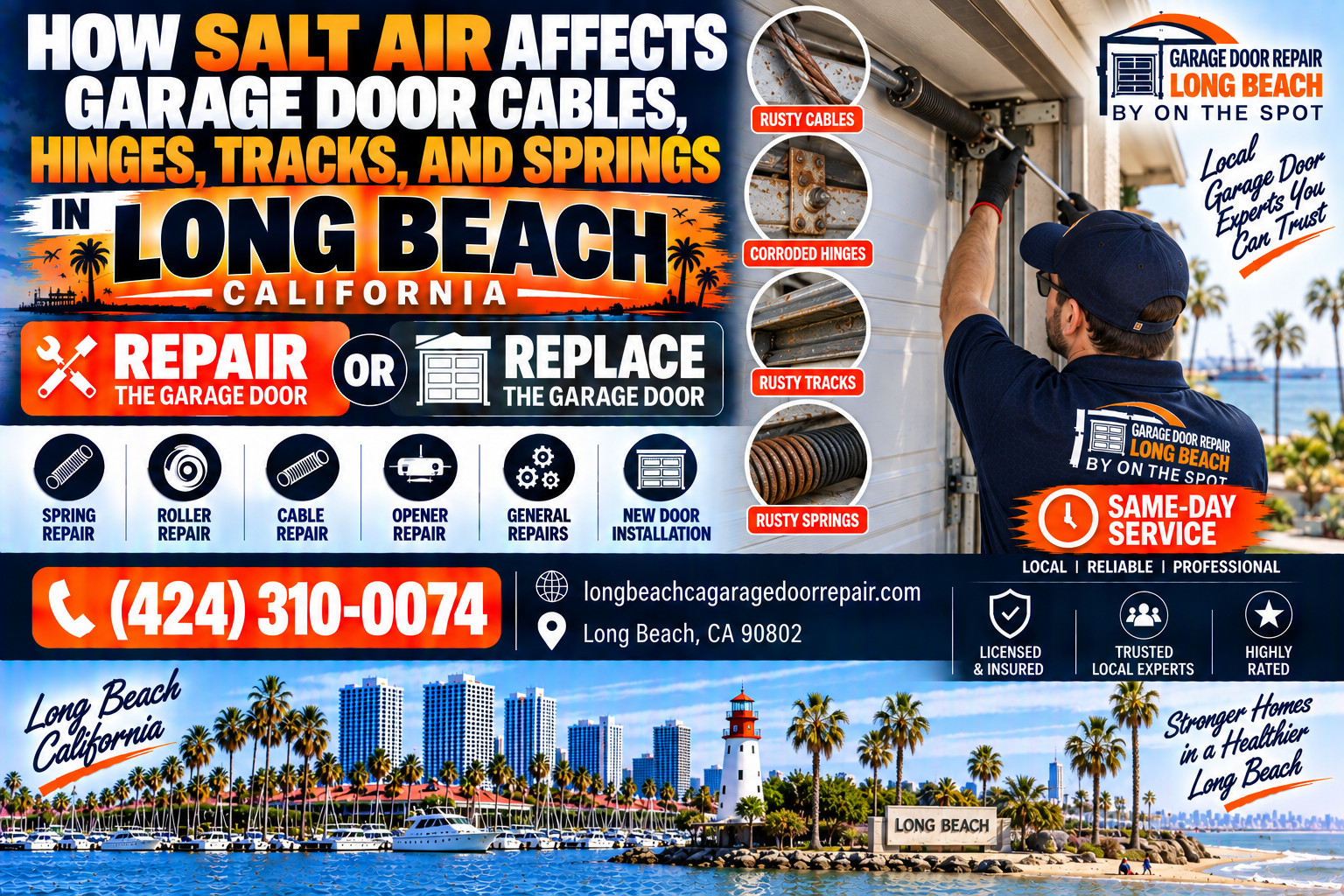
Long Beach Salt-Air Hardware Guide
How Salt Air Affects Garage Door Cables, Hinges, Tracks, and Springs in Long Beach
How does salt air affect garage door cables, hinges, tracks, and springs in Long Beach? Learn chloride corrosion mechanisms, coastal maintenance intervals, hardware choices for Belmont Shore, Naples, and Alamitos Beach, when noise/stiffness/rust means replace, and why high-tension spring and cable work is never DIY.
Garage Door Repair Long Beach By On The Spot helps homeowners, renters, landlords, property managers, HOA communities, and small businesses protect lift hardware from marine-air wear with diagnosis-first service across Long Beach, CA.
Hinges & Tracks
Maintenance Intervals
Belmont Shore / Naples / Alamitos
CPSC + DASMA + SCE
Serving Long Beach, CA
Table of Contents
Direct Answer: How Salt Air Affects Cables, Hinges, Tracks, and Springs in Long Beach
Salt air in Long Beach deposits chloride-rich film on garage door cables, hinges, tracks, and springs. That film holds moisture against steel, accelerates rust, thickens into grit paste in moving joints, and shortens the safe life of high-tension parts. Cables lose strand strength and may fray; hinges seize and squeak; tracks collect scale that scrapes rollers; springs pit under coil stress and can fail suddenly. Maintenance intervals should be tighter near Belmont Shore, Naples, Alamitos Beach, and other marine-fog corridors than on inland blocks. Hardware choices matter: stainless or coated fasteners, sealed rollers, galvanized or powder-coated tracks, and coastal-rated spring packages slow damage—but they do not eliminate inspection. Noise, stiffness, orange dust, whisker strands, and visible pitting are replace signals, not forever-lubricate signals. High-tension spring and cable work is never a DIY project.
Garage Door Repair Long Beach By On The Spot diagnoses salt-air wear in system order—springs and cables for safety first, then hinges, rollers, tracks, brackets, and fasteners—so repair matches the real failure mode instead of masking it with more spray lube. Call (424) 310-0074 when coastal hardware noise, stiffness, or rust shows up on your Long Beach door.
Salt air corrodes and abrades cables, hinges, tracks, and springs through chloride film + moisture + motion; shorten service intervals near the water, choose marine-friendlier hardware, replace when noise/stiffness/rust show structural wear, and never DIY springs or cables.
What Salt Air Really Does to Garage Door Hardware in Long Beach
Long Beach sits on a marine edge where fog, onshore breeze, and overnight condensation repeatedly wet garage door steel. Salt does not need a visible white crust to do damage. Invisible chloride ions ride fog and fine spray, land on cables and coil springs, and stay active whenever relative humidity rises. Inside an attached garage, trapped moisture and temperature swings keep that film wet longer than many homeowners expect.
Salt air is not only a paint problem. Cables are multi-strand ropes that flex around drums; each strand is a tiny surface that can rust between neighbors. Hinges are pin-and-leaf joints that fretting-wear under tiny motion while salt grit acts like sandpaper. Tracks are vertical and horizontal channels that become reservoirs for salty dust. Springs are highly stressed steel wires; pits act like stress concentrators that make sudden break more likely over time.
This guide focuses on those four families—cables, hinges, tracks, and springs—because they control safe lift balance, quiet travel, and alignment. Panels, weather seals, and openers matter too, but when salt air is the story, these load-bearing and motion parts are where safety and cost concentrate. Related beach-zone rust order guides answer which part fails first; this article answers how salt air attacks each part, how often to maintain, which hardware lasts longer, and when symptoms mean replace.
Property managers and HOAs in coastal Long Beach often see the same pattern across units: doors that were quiet two years ago now grind, bind, or leave orange dust on the floor. That pattern is usually chemistry plus motion, not “cheap doors” alone. Understanding the mechanism helps you schedule inspections before a cable or spring becomes an emergency.
Corrosion Mechanisms: Chlorides, Fog, Condensation, and Motion Wear
Chloride ions disrupt the thin protective oxide film that normally slows steel rust. Once that film breaks, anodic sites form pits. In still air a pit grows slowly; on a garage door, every open/close cycle flexes cables, rotates hinge pins, rolls steel in tracks, and winds or unwinds springs. Flex cracks rust scale, exposes fresh metal, and packs grit into joints.
Fog and marine layer events in Long Beach can leave surfaces damp for hours. Condensation on cold metal overnight reactivates yesterday’s salt. Irrigation overspray and driveway rinse water can splash bottom brackets and lower track legs. Even enclosed garages import salt on cars and on air exchange when the door cycles.
Motion wear multiplies chemistry. Fretting corrosion at hinge pins creates fine oxide dust that looks like brown powder. Cable strands rub neighbors under load. Rollers drag through track grit. Spring coils rub adjacent coils when lubrication fails and scale builds. The result is a feedback loop: corrosion creates particles; particles abrade coatings; abrasion invites more corrosion.
Temperature and sun angle change the timeline. West-facing doors near Alamitos Bay or the peninsula can bake salt films dry mid-day, then rewet at night—repeated wet-dry cycles that are harsh on coatings. Shaded northern exposures may stay damp longer. Both patterns hurt steel; they just look different on a timeline.
Opener motors do not create salt damage, but they reveal it. When springs lose balance or tracks drag, the opener works harder. That can show up as slower travel, mid-travel hesitations, or safety reversals if force limits and photo eyes interact with a sticky door. Always treat opener strain as a clue to inspect cables, hinges, tracks, and springs—not as a reason to crank force settings higher and ignore hardware.
Lift Cables Under Salt Air: Strand Corrosion, Fray, and Drum Wear
Lift cables transfer spring torque (or extension spring force) into lifting the door. In salt air, cable jackets—if present—can crack, and bare galvanized strands lose zinc protection over time. Rust between strands is hard to see until outer wires show orange, then fray into “whiskers.” Whiskers are not cosmetic; they mean load is concentrating on fewer remaining wires.
Cable ends and drum wraps are high-stress, high-moisture zones. Bottom brackets near the slab see splash and fog. Drum grooves can trap grit that abrades cable as it winds. A cable that looks “mostly fine” in the middle can be critically worn at the drum or at the bottom fitting.
Symptoms of salt-damaged cables include reddish staining on the cable path, uneven door lift (one side leading), clicking or popping near drums, visible broken strands, and a door that feels heavier on one side when the opener is disconnected for a safe professional check. Homeowners should not climb ladders to inspect drums closely if that means putting a body near torsion springs.
Maintenance for cables is mostly inspection and environment control—not DIY replacement. Keep bottom areas cleaner of standing water. Ask a technician to evaluate cable rust during coastal tune-ups. Replacement is usually done in pairs with spring and drum inspection, because mismatched cables and worn drums recreate failure.
Never attempt cable removal, cable shortening, or “tightening” around drums yourself. Cables are part of a high-tension system. Sudden release can cause severe injury. When salt air has started strand failure, the correct response is professional cable and spring-system service, not garage-shelf wire or clamps.
Broken outer strands (whiskers), heavy rust at drum or bottom fittings, uneven lift, or cable jump off drum grooves—schedule professional replacement. Do not wrap, clamp, or re-tension cables DIY.
Hinges Under Salt Air: Pins, Fretting, Stiffness, and Noise
Sectional garage doors flex at hinges between panels. Each hinge pin is a small bearing surface. Salt film plus fine grit creates a grinding paste. Fretting corrosion sheds brown/orange dust onto panels and the floor. Early noise is often a squeak or chirp at the start of travel; later noise becomes a grind, and panels may hitch as a hinge binds.
Stiffness at hinges changes how the door stacks and how rollers enter the horizontal track. Binding hinges increase opener load and can mimic “bad springs” to an untrained eye. A proper diagnosis separates hinge drag from true spring balance loss.
Coastal maintenance for hinges includes periodic cleaning of visible grit (without spraying messy lubricants into photo eyes or onto floors in a way that creates slip hazards), then light application of a garage-door-appropriate lubricant on pins—not heavy grease that traps more salt. If pins are scored, leaves are bent, or holes are oblong from wear, replace the hinge rather than drowning it in oil.
Hardware choices: hinges with better coatings, stainless pins where appropriate, and correct gauge for door weight last longer near the water. Mixing random hardware-store hinges of the wrong size creates alignment issues. Technicians match hinge numbers and reinforcement plates to the door design.
When noise and stiffness return days after lubrication, salt-driven wear has likely progressed past “needs oil” into “needs parts.” That is especially common on older multi-hinge doors facing marine fog. Replace early hinges before a seized pin forces a panel kink or roller failure.
Tracks Under Salt Air: Grit Paste, Scale, and Alignment Drag
Tracks guide rollers. They are not supposed to be heavily lubricated like hinges; dirty oil in a track collects grit into a paste that increases friction. Salt air worsens that paste. Scale can form on track edges and brackets. Fasteners that hold track to jambs and flags can rust and loosen, allowing track to drift out of parallel.
Symptoms include scraping sounds, roller chatter, doors that scrape a stop or weatherseal, and visible rust blooms at lag bolts and angle brackets. Bent track from prior impact plus salt corrosion at the bend is a common Long Beach combo after parking bumps.
Maintenance intervals near the coast should include vacuuming or wiping loose grit from track channels (carefully, with the door secured and without forcing rollers), checking that tracks look parallel and firmly fastened, and scheduling professional alignment if gaps or scrapes appear. Do not hammer tracks DIY to “straighten” them; small mistakes create big binding.
Hardware choices: quality galvanized or powder-coated track systems, corrosion-resistant fasteners into sound framing, and sealed or nylon rollers matched to the track reduce salt-air drag. Worn rollers chewing a track will keep failing new parts if only one side of the system is renewed.
Replace or overhaul track sections when corrosion has thinned metal, when bends cannot be safely corrected, or when bracket failure has shifted geometry. Mild surface rust on a still-true track may clean and continue with better fasteners and cleaner habits; structural rust or deformation means parts.
Springs Under Salt Air: Coil Scale, Pitting, and Balance Loss
Torsion springs (above the opening) and extension springs (along the horizontal tracks) store the energy that makes a door feel light. Salt air pits spring wire. Pits concentrate stress each cycle. Lubrication slows surface rust and reduces coil rub, but it cannot heal a pit. A spring can look “only a little orange” and still be near end of life if pitting is advanced.
Balance loss shows up as a door that is hard to lift manually (when a technician safely checks), an opener that strains, uneven travel, or a door that will not stay halfway when properly tested by a professional under controlled conditions. A sudden loud bang and a door that will not open is classic spring break—more common when corrosion and cycle count stack.
Coastal Long Beach doors often need earlier spring replacement than inland cycle charts predict, because corrosion shortens life independent of cycle count. Homes that open the door many times daily (rentals, busy families, alley-loaded units) stack cycles on top of salt damage.
Hardware choices include oil-tempered springs of correct wire size and length, proper winding plugs and shafts inspected for rust, and cable drums true and matched. Cheap mismatched springs are a false economy near the beach. Extension-spring systems need intact safety cables; corroded safety cables are a red flag.
Never DIY spring winding, unwinding, stretch, or “add a turn.” Springs are under extreme tension. Salt-weakened springs are especially unpredictable. Professional replacement includes correct sizing, safe winding, cable inspection, and opener force/limit checks after balance is restored.
Orange dust alone is not a DIY repair cue. Visible gaps in coils after a bang, severe pitting, or a door that slammed or will not lift safely = professional spring service immediately. Keep people and pets clear of a failed door.
Maintenance Intervals for Coastal Long Beach Garage Doors
Inland Long Beach blocks may do well with a thorough professional inspection about once a year, plus homeowner visual checks seasonally. Within roughly a mile of open water—Belmont Shore, Naples canals, Alamitos Beach, peninsula exposures—plan on professional coastal inspections every 6–12 months, and visual homeowner checks monthly for cable whiskers, hinge dust, track grit, and spring scale.
After major marine-layer weeks, Santa Ana dust events that mix with later fog, or any flood/irrigation splash at the door, add an extra visual check. If you recently pressure-washed the driveway, look at bottom brackets and lower tracks for new wet salt lines.
Lubrication intervals: light, correct lubricant on springs, hinges, and rollers as recommended by a technician—often every 3–6 months near the water, not weekly heavy grease baths. Over-oiling tracks is counterproductive. Wipe excess so grit has less to stick to.
Photo eyes, safety reversal behavior, and opener strain should be checked whenever hardware service happens. Salt-air drag changes the force the opener needs; safety settings must remain protective. For operator safety context, see the CPSC FAQ linked in Authority Sources.
Property managers: put cable/hinge/track/spring checks on a recurring work order for coastal buildings. Waiting until a tenant reports a bang usually costs more than scheduled spring or cable renewal.
Hardware Choices That Survive Salt Air Better
Not all hardware is equal in chloride air. Prefer galvanized, zinc-rich, powder-coated, or stainless fasteners where they correctly match the application. Sealed bearings or quality nylon rollers often outlast open metal rollers in grit. Hinges with robust pins and coatings resist fretting longer. Tracks should be true, adequately gauge-thick for the door, and fastened with corrosion-aware hardware into sound wood or properly anchored structure.
Springs should be correctly engineered for door weight and cycle expectations; “close enough” wire size is how early failure and opener damage happen. Cable quality and proper drum match matter as much as cable diameter rumors from a parts aisle.
Weather seals and bottom retainers do not stop salt air from reaching springs above the door, but they reduce splash and fog pumping into the garage. Pair perimeter sealing with hardware upgrades for a fuller coastal strategy.
Avoid random mixed kits that change one roller style without checking stem fit, or that swap one hinge leaf thickness and alter panel stack geometry. Coastal upgrades work best as a diagnosed package: worn family of parts renewed together so the door stays balanced and quiet.
Ask your technician what is appropriate for your exposure: a canal-front Naples garage may justify more stainless and more frequent cable inspection than a door five miles inland. Matching spend to exposure is smarter than buying the most expensive part for every inland unit.
Coastal Neighborhood Patterns: Belmont Shore, Naples, Alamitos, and Inland
Belmont Shore: short path from marine air to alley and street-facing garages; frequent fog; many older multi-car and single-car setups with high cycle use. Expect faster hinge fretting and cable staining; schedule shorter inspection intervals.
Naples and canal-adjacent homes: moisture is a lifestyle. Reflective water and stagnant damp periods increase condensation on metal. Bottom brackets, lower tracks, and cable ends near the slab need extra eyes. Extension-spring alleys should not be ignored.
Alamitos Beach and east ocean-proximate blocks: onshore flow and evening cool-downs create classic wet-dry chloride cycles. West- and south-facing doors can show spring scale and track bracket rust earlier than shaded inland twins of the same age.
Downtown, traffic-corridor, and more inland Long Beach: salt dose is lower but not zero. Irrigation, marine layer that still reaches inland, and older uncoated hardware still corrode—just on a longer clock. Do not skip inspections because you are “not on the sand.”
Across all neighborhoods, parking habits matter. Doors opened many times daily accumulate wear cycles that combine with salt chemistry. Condos and rentals with shared alley access often show cable and spring issues in clusters when buildings share install eras.
When Noise, Stiffness, or Rust Means Replace—Not Just Lubricate
Lubricate when: light squeak is new, parts still move freely, no broken cable strands, springs show only light surface film, tracks are true, and a recent professional inspection found remaining life. Lubrication is maintenance, not resurrection.
Replace when: cable whiskers or jumped cables appear; hinges seize or pins score; rollers flat-spot or grind despite clean track; track is bent, thinned, or loose from rusted fasteners; springs show deep pitting, broken tips, or the door’s balance is clearly unsafe; bottom brackets show section loss near cable anchors.
Noise that returns immediately after oil usually means metal is already worn. Stiffness that makes panels hitch is a binding or alignment problem. Rust that sheds flakes or shows holes is structural. Orange dust alone is a warning to inspect—pairing it with performance loss is a replace conversation.
Openers that reverse or strain are not fixed by raising force limits as a first response. That can hide a dangerous door. Diagnose cables, hinges, tracks, and springs first; then set opener limits/force correctly for a balanced door. CPSC guidance on automatic residential operators exists for a reason—entrapment protection must remain effective.
If you hear a bang, see a gap in a torsion spring coil, or the door is suddenly heavy, stop using the opener, keep clear, and call professional spring service. Salt air makes that failure mode more likely over a shorter calendar life.
Never DIY High-Tension Spring or Cable Work
Torsion springs, extension springs, lift cables, bottom brackets under cable load, and winding cones are high-tension components. They store enough energy to cause life-changing injuries. Salt corrosion makes failure behavior less predictable, which is another reason DIY videos are the wrong teacher for coastal Long Beach doors.
Safe homeowner actions: visual look from the ground for whiskers and heavy rust; listen for new noises; keep photo eyes clean and aligned; keep the path clear; note whether the opener struggles; call a pro with those notes. Wipe obvious grit from lower track legs if you can do so without putting yourself under a partially open door that is unsupported.
Unsafe DIY: winding bars on torsion springs, stretching extension springs, cutting cables, clamping frayed cables, removing bottom brackets, “temporary” wire substitutions, and bypassing photo eyes because a sticky door reverses.
DASMA system-safety thinking treats the door as a system—springs, cables, tracks, openers, and safety devices together. Patching one corroded corner while ignoring tensioned parts is how secondary failures happen. Professional techs bring the right tools, matching parts, and torque/tension procedures.
If a landlord or flip checklist tempts a cheap DIY spring change, reconsider. Liability and injury risk dwarf the service call. Call (424) 310-0074 for salt-air hardware diagnosis instead.
Field Inspection Flow: From Salt Film to Safe Repair Decision
1) Interview the symptom: noise, stiffness, visible rust, uneven travel, opener strain, recent bang, or fog-season change. 2) Visual safety scan from a safe position: cable condition, spring gaps or scale, hinge dust, track fasteners, bottom brackets. 3) Disconnect opener only if trained and the door is controlled—technicians check balance and listen for hinge/track drag. 4) Separate balance problems (springs/cables) from friction problems (hinges/rollers/tracks). 5) Decide lubricate vs replace per part family. 6) Renew safety-critical parts before cosmetic panel work. 7) Retest travel, limits, photo eyes, and force after repairs. 8) Set a coastal follow-up interval.
This flow prevents the classic mistake of replacing an opener because salt-damaged hinges and dry springs made the motor sound dying. Motors fail too—but coastal Long Beach tickets are hardware-heavy more often than homeowners guess.
Comparison Table: Cables vs Hinges vs Tracks vs Springs in Salt Air
| Part | How salt air attacks it | Early signs | Maintain vs replace | DIY? |
|---|---|---|---|---|
| Lift cables | Chlorides between strands; grit at drums; splash at bottom fittings | Orange stain, whiskers, uneven lift | Inspect often; fray = replace (usually pairs) | Never DIY tensioned cable work |
| Hinges | Fretting + salt grit paste on pins | Squeak, orange dust, panel hitch | Clean/lube if free; scored/seized = replace | Light wipe/lube only |
| Tracks | Grit reservoir; fastener rust; scale on channels | Scrape, chatter, loose brackets | Clean grit; bent/thinned = repair/replace | No hammering/bending DIY |
| Torsion / extension springs | Pitting on stressed wire; coil rub under scale | Orange scale, heavy door, opener strain | Lube film helps early; pits/balance loss = replace | Never DIY |
| Rollers (with tracks) | Stem/bearing corrosion in salty paste | Grind, flat spots | Worn = replace with track check | Pro recommended |
| Bottom brackets | Slab splash + cable tension + fog | Heavy corner rust, cable stain | Section loss = replace with cable service | Never under tension |
Use the table as a triage aid, not a substitute for on-site judgment. Combined failures are common: salty hinges plus dry springs can show up as one “noisy heavy door” complaint.
False Fixes That Waste Time on Salt-Air Hardware Problems
Drowning tracks in grease: traps salt grit and worsens drag. Cranking opener force: hides binding and risks unsafe operation. Clamping a frayed cable: fails under load and endangers people. WD-40 as forever hinge fix: may quiet briefly, then wear continues. Painting over spring pits: hides warning signs without restoring strength. Replacing only one cable or one spring when the pair is aged: invites rapid repeat failure. Ignoring photo-eye issues because the door is sticky: defeats safety design.
Another false fix is waiting for “the next rainy season” when whiskers are already visible. Cable strand failure does not wait for your calendar.
Red Flags: Stop DIY and Schedule Coastal Hardware Service Now
Stop DIY and call for service if you see broken cable strands; a cable off the drum; a spring with a visible gap after a bang; a door that is suddenly very heavy; bottom bracket metal loss near a live cable; track hanging loose; rollers jumping; or an opener that reverses repeatedly while hardware is visibly corroded.
Also stop if anyone suggests bypassing safety sensors to “get the door closed for now.” Secure the vehicle another way and get the system repaired.
Professional Path: Diagnosing and Renewing Salt-Damaged Hardware
A coastal hardware visit from Garage Door Repair Long Beach By On The Spot typically includes symptom intake, safe visual inspection, balance and friction diagnosis, part measurements, and a clear lubricate-versus-replace recommendation. When springs or cables are due, technicians replace with correctly matched components, inspect drums and shafts, renew related worn rollers or hinges as needed, and verify opener safety behavior.
You get a system result: quieter travel, safer balance, and a maintenance interval tuned to your neighborhood’s salt dose—not a one-spray quiet that fades in a week of fog.
Materials, Coatings, and Fasteners for Marine-Air Doors
Galvanized and coated springs still need inspection; coating buys time, not immortality. Stainless fasteners shine in splash zones when specified correctly. Nylon or coated rollers reduce metal-on-metal grit noise. Powder-coated track and hardware shed salt slightly better if kept clean. Avoid mixing incompatible metals in ways that accelerate galvanic corrosion at fasteners—your technician should choose coherent packages.
Panel steel gauge and paint systems matter for cosmetics and dent resistance, but they do not replace spring and cable maintenance. Budget first for tensioned safety parts, then for quieting hinges and rollers, then for appearance.
Homeowner Habits That Slow Salt Damage Between Service Visits
Rinse driveway salt splash thoughtfully without blasting hinge and spring bearings with a pressure tip. Fix irrigation that sprays the door. Keep photo eyes clean. Listen once a week for new sounds. Glance for cable whiskers monthly near the coast. Do not park so close that you bend track. After windy beach days, expect more grit and schedule cleaning. Log cycle-heavy use if you run a home business through the garage.
Small habits stretch intervals between part replacements; they do not cancel chemistry. Pair habits with professional inspections.
Fix Now vs Waiting When Salt Air Symptoms Look Mild
Waiting is reasonable when a technician confirms light surface film, free-moving hinges, true tracks, intact cables, and acceptable balance—with a dated follow-up. Waiting is unreasonable when whiskers, seizures, opener strain, uneven lift, or spring pitting already exist. Coastal failure can move from “annoying” to “door down” quickly after a foggy week.
Cost-wise, planned spring or cable replacement beats emergency service after a break that may also bruise panels or stress openers. Planned hinge and roller sets beat track damage from grinding stems.
Same-Day Help When Salt Air Affects Safe Door Operation
Same-day help matters when the door will not open for work, a spring has broken, a cable has failed, or the door is unsafe to leave. Call (424) 310-0074. Describe neighborhood, door type if known (torsion vs extension), and symptoms. Keep clear of broken spring paths and do not try to “help” the door with props that can kick out.
Questions to Ask Before Hiring for Salt-Air Garage Door Repair
Ask: Will you inspect springs, cables, hinges, rollers, tracks, and brackets as a system? Do you replace cables in pairs when wear is present? How will you verify balance and opener safety after repair? What maintenance interval do you recommend for my distance from the water? Are parts matched to door weight? Will you avoid force-limit tricks as a substitute for hardware repair?
Clear answers are a good EEAT signal. Vague “we’ll lube everything” without inspection detail is not.
Why Garage Door Repair Long Beach By On The Spot for Salt-Air Hardware
Garage Door Repair Long Beach By On The Spot operates from 151 E 5th St, Long Beach, CA 90802, serving coastal and inland neighborhoods with diagnosis-first garage door repair. Salt-air cable, hinge, track, and spring problems are everyday local work—not theoretical. The team emphasizes safe high-tension practices, honest replace-versus-maintain calls, and follow-up intervals that match marine exposure.
NAP: Garage Door Repair Long Beach By On The Spot | 151 E 5th St, Long Beach, CA 90802 | (424) 310-0074 | https://longbeachcagaragedoorrepair.com/ | Maps https://www.google.com/maps?cid=5381478035707257267.
Areas Served From the Long Beach Location
Service coverage includes Belmont Shore, Naples, Alamitos Beach, Downtown Long Beach, Bixby Knolls, Los Altos, El Dorado Park area, Traffic Circle, Rose Park, Wrigley, West Long Beach, and nearby Long Beach communities where salt air, fog, and daily cycles wear garage door cables, hinges, tracks, and springs.
If you are unsure whether your block counts as “coastal enough” for shorter intervals, err toward inspection—marine layer does not stop at the first inland arterial.
Google Map Location
Find Garage Door Repair Long Beach By On The Spot at 151 E 5th St, Long Beach, CA 90802. Use this Google Maps link for directions and business details: https://www.google.com/maps?cid=5381478035707257267.
Phone (424) 310-0074 before visiting if you need to discuss salt-air cable fray, hinge stiffness, track grit, or spring scale. Most lubricate-versus-replace decisions are diagnosed on site with the door hardware in view.
FAQs About Salt Air, Cables, Hinges, Tracks, and Springs in Long Beach
How does salt air damage garage door cables in Long Beach?
Chlorides and moisture corrode strands from the outside in and at fittings; flex around drums accelerates wear. Frayed whiskers and uneven lift mean professional replacement—never DIY clamps.
Why do my hinges squeak more during marine layer weeks?
Fog reactivates salt film and grit on pins, increasing fretting and friction. Clean and lubricate correctly if parts are free; replace if seized or scored.
Should I grease the tracks to fight salt air?
No heavy grease baths. Tracks need to stay relatively clean; grease traps salty grit. Wipe grit and fix alignment; lubricate rollers/hinges/springs as appropriate instead.
How often should coastal Long Beach doors be inspected?
Often every 6–12 months professionally near the water, with monthly visual checks for cables, hinge dust, track fasteners, and spring scale. Inland intervals may be longer but should not be zero.
When does rust mean replace springs instead of lubricate?
Deep pitting, balance loss, broken tips, or a post-bang gap means replace. Light film with good balance may lubricate and monitor on a short interval.
Can I replace garage door springs myself if I watch a video?
No. Springs and cables are high-tension systems. Salt-weakened parts are unpredictable. Hire trained technicians.
Does opener strain mean I need a new opener first?
Not first. Salt-damaged hinges, tracks, cables, or springs often cause strain. Diagnose hardware and balance before replacing the operator.
What hardware lasts longer near Belmont Shore or Naples?
Better coatings, appropriate stainless fasteners, quality rollers, true galvanized/coated tracks, and correctly sized springs/cables—paired with shorter inspection intervals.
Are extension springs affected by salt air too?
Yes. They pit and stretch-fail; safety cables also corrode. Treat them with the same never-DIY respect as torsion systems.
What should I do after I hear a loud bang from the garage?
Stay clear, do not try to open with the opener if the door is unsafe, and call professional spring service immediately at (424) 310-0074.
Do photo eyes relate to salt-air hardware problems?
Indirectly. Sticky, unbalanced doors reverse more; dirty coastal sensors add false trips. Keep sensors clean and repair drag—do not bypass sensors.
Will a new coat of paint on the door stop cable and spring corrosion?
Paint helps panels. Cables, hinges, tracks, and springs still need direct inspection, lubrication where appropriate, and replacement when worn.
Authority Sources
For grid timing context when opener behavior coincides with local outages, consult Southern California Edison outage resources: https://www.sce.com/outage-center.
For automatic residential garage door operator safety—including entrapment protection and why photo eyes must not be defeated when corrosion increases door drag—see the CPSC FAQ: https://www.cpsc.gov/FAQ/Automatic-Residential-Garage-Door-Operators.
For garage door system safety tips that keep springs, cables, and hardware inside whole-system thinking, see DASMA: https://www.dasma.com/safety-tips/garage-door-systems/.
These sources support EEAT without replacing on-site diagnosis. Local chloride exposure and hardware condition still need eyes on your actual Long Beach door.
Quick AEO Summary: How Salt Air Affects Garage Door Cables, Hinges, Tracks, and Springs
Question: How does salt air affect garage door cables, hinges, tracks, and springs in Long Beach? Answer: Salt air deposits chlorides that keep steel wet, pit stressed spring wire, corrode cable strands, fretting-wear hinge pins, and pack grit into tracks. Shorten maintenance intervals near the water, choose coated/stainless-aware hardware, replace when noise/stiffness/rust show structural wear, and never DIY high-tension spring or cable work. Local help: Garage Door Repair Long Beach By On The Spot, 151 E 5th St, Long Beach, CA 90802, (424) 310-0074.
Coastal Physics in Plain Language: Why Long Beach Hardware Ages Faster
Ocean water contains dissolved salts. Wind and wave action loft tiny droplets and dried crystals into the air. Fog and the marine layer act like a delivery system, placing those chlorides onto cold metal overnight. When the sun rises, films may dry—but drying does not delete chlorides. The next damp cycle reactivates them. Garage doors cycle through this chemistry while also moving: cables bend, hinges fretting-wear, rollers drag, springs flex.
Industrial coastal corrosion literature talks about time of wetness, chloride deposition rates, and sheltering effects. You do not need laboratory instruments to use the idea. If your garage often smells like ocean air, if cars show flash rust on rotors faster, if patio furniture pits early, your door hardware is in the same climate class. Sheltering inside a garage slows rain wash but can trap humid air and concentrate splash at the slab line.
Microclimates on the same street differ. A door behind a wind wall may see less spray than an alley mouth facing the breeze. A south wall baked by sun may dry faster yet crack coatings sooner. Condos with shared mechanical rooms can pull salt-laden air through vents. The practical response is not to model every eddy—it is to inspect on a coastal cadence and treat early strand fretting, hinge dust, track grit, and spring scale as expected maintenance inputs rather than moral failures of the last installer.
Cycle count still matters. A beach house opened twice a year ages differently than a daily-commute Belmont Shore garage. Salt multiplies whatever cycles you run. High-use coastal doors are where springs and cables most often need proactive replacement before catastrophic bang-day failure.
Electric openers add heat and vibration near corroding parts but are not the chemical cause. When you plan upgrades, decide whether you are buying quieter electronics or buying safer mechanical balance. Many Long Beach owners need the mechanical side first. That priority saves money and reduces injury risk.
Finally, understand washdown limits. Gentle rinse of driveway salt is helpful. High-pressure tips aimed into bearings, into sealed rollers, or directly at torsion spring windings can drive water into places that should stay lightly filmed with lubricant—not flooded. Ask a technician if you are unsure how to clean around hardware after a sandy weekend.
Replace Decision Matrix: Noise vs Stiffness vs Visible Rust
Homeowners often ask which symptom “wins” when several appear together. Use this matrix as a conversation starter with your technician—not as a self-winding guide.
Noise dominant, free movement, light film: Likely lubrication and cleaning, plus inspection of pins and rollers. Reassess after one fog week. If noise returns immediately, escalate to parts.
Stiffness dominant, hitching panels, opener strain: Suspect hinge bind, roller failure, or track geometry before blaming the motor. Springs may also be weak; balance testing separates the stories.
Visible rust dominant on springs with still-quiet hinges: Prioritize spring evaluation. Surface orange may still be monitorable; pits and balance loss push to replace.
Visible rust dominant on cables with whiskers: Replace cables (typically pairs) and inspect drums/brackets. Do not negotiate with frayed load paths.
Track scrape with loose brackets: Fasteners and alignment first; renew rollers if damaged by the scrape. Corroded thin track sections may need replacement metal, not more paint.
Multiple families symptomatic after years of deferred service: Package repairs are normal on coastal doors. Sequencing safety-critical springs/cables ahead of cosmetic panel work is the trusted order.
Document decisions with photos for landlords and HOAs. Coastal portfolios benefit from identical rubrics so one property is not endlessly lubed while another is endlessly ignored until failure.
When in doubt, choose inspection now over another month of hoping. Salt chemistry does not pause for budget cycles. A planned morning visit is cheaper than an emergency after the door traps a car before a flight out of Long Beach Airport.
Landlord and HOA Notes for Salt-Air Garage Door Hardware
Rental and shared-ownership properties multiply risk: more cycles, more delayed reporting, more DIY temptation by well-meaning occupants. Write rules into lease or HOA docs: occupants must report bangs, heavy doors, and frayed cables immediately; occupants must not adjust springs or bypass sensors; management schedules coastal inspections on a fixed calendar.
Vendor scopes should name cables, hinges, tracks, and springs explicitly. “Garage door tune-up” without those words sometimes becomes a spray-and-pray visit. Require written notes on lubricate vs replace, pair replacements for cables/springs when aged together, and opener safety verification after mechanical work.
Budget lines: expect earlier spring replacements near the water; keep a spare calendar slot before summer travel peaks and before winter marine-layer stretches. Emergency after-hours spring calls cost more and stress residents.
For alley-loaded buildings in Belmont Shore and similar fabric, coordinate access so technicians can work safely without blocked lanes. Clear cardboard and storage that press into tracks—storage damage plus salt grit is a common dual failure.
Insurance and liability angle: documenting professional spring/cable work and sensor tests after complaints shows duty of care. Encouraging DIY winding videos in a tenant Facebook group does the opposite.
Opener Safety When Salt Air Makes Doors Drag
Automatic residential garage door operators must reverse on obstruction and rely on photo eyes near the floor. Salt grit on lenses, misaligned brackets from corroded fasteners, and high friction from hinges/tracks all interact with those safety systems. The dangerous “fix” is unplugging sensors so a sticky door will close. That choice trades convenience for entrapment hazard.
Correct path: clean lenses with a soft wipe; check alignment; repair mechanical drag; then confirm force and limit settings on a balanced door. If the operator still fails safety checks, repair or replace the operator—but only after hardware is honest.
CPSC FAQ material on automatic residential garage door operators is linked in Authority Sources for consumer-facing safety context. DASMA system tips remind everyone that springs and cables are part of the same safety story as the motor on the ceiling.
Smart-phone alerts that the door failed to close are useful—but they are not a corrosion inspection. Pair app notices with physical hardware checks in coastal homes.
Typical Coastal Timelines: From Film to Failure
Timelines vary, but patterns repeat. Months 0–12 on a new coastal install: light film appears on springs and fasteners if untended; hinges may still be quiet. Years 1–3: hinge fretting dust becomes noticeable on high-cycle doors; track grit builds if over-lubricated; cable color darkens at drums. Years 3–7: many coastal springs show scale that warrants close balance and pit inspection; cables may approach whisker risk on splash-exposed ends; bracket fasteners loosen. Beyond that, deferred maintenance clusters into multi-part failures.
These ranges are not warranties. A neglected high-cycle Naples door can need springs earlier. A carefully maintained inland door can outlast them. Use timelines to motivate inspections, not to delay action when symptoms already scream.
Aftermarket “lifetime” marketing rarely means lifetime in chloride air without service. Read fine print as cycle expectations under ordinary conditions—then shorten expectations for marine fog corridors.
When buying a home in Long Beach, include garage door hardware in inspections. Sellers may lube for quiet on showing day; ask specifically about spring age, cable condition, and prior coastal replacements.
Practical Long Beach Scenarios for Salt-Air Cable, Hinge, Track, and Spring Wear
Scenario A — Belmont Shore alley garage: Homeowner hears morning squeaks after fog nights. Orange dust under mid-door hinges. Cables look stained but no whiskers yet. Professional visit cleans and lubricates hinges, flags early cable rust for a 90-day recheck, and sets a six-month coastal interval. Outcome: quiet door, documented cable watch, no unsafe DIY.
Scenario B — Naples canal-adjacent double door: One side lifts higher. Bottom bracket shows heavy rust near cable stud. Technician finds strand wear and recommends paired cable replacement plus bracket renewal, spring inspection, and roller check. Outcome: even travel restored; waiting would have risked cable snap and panel slam.
Scenario C — Alamitos Beach condo with shared opener complaints: Board thinks motors are dying. Inspection shows dry torsion springs with scale, gritty tracks, and seized end hinges. Hardware package renews springs, selected hinges/rollers, and cleans tracks; openers retained after force/limits reset. Outcome: lower cost than four opener replacements and safer balance.
Scenario D — Inland Long Beach home near irrigation overspray: Lower tracks rust at lags; springs only lightly filmed. Fix fasteners, adjust irrigation, lubricate springs, schedule annual check. Outcome: salt-plus-water splash addressed without overselling full coastal package.
Scenario E — Sudden bang before work commute: Extension spring broken, door extremely heavy. Owner does not force opener. Same-day spring and safety-cable service returns function. Outcome: injury avoided by not DIY stretching a remaining spring.
Scenario F — Property manager portfolio on peninsula blocks: Recurring noisy-door tickets. Standardized coastal checklist catches cable whiskers on two units and hinge seizures on five during one service sweep. Outcome: planned parts beats scattered emergencies.
Scenario G — Homeowner greased tracks weekly: Door got louder. Pro strips grit paste, replaces flat-spotted rollers, educates on correct lube points. Outcome: false-fix reversed.
Scenario H — West-facing door with afternoon heat and night fog: Spring scale accelerates relative to shaded neighbor. Earlier spring replacement predicted by exposure, not by cycle count alone. Outcome: calendar matches microclimate.
Myths About Salt Air and Garage Door Hardware
Myth: If I cannot taste salt on the door, salt air is not affecting cables and springs. Reality: Chloride films can be invisible while still driving pits and fretting.
Myth: More grease always equals more coastal protection. Reality: Wrong grease in tracks becomes sandpaper. Correct light lubricant on the right parts helps; excess harms.
Myth: Stainless everything forever. Reality: Wrong stainless fasteners in wrong places, or stainless with neglected cables still in carbon steel, leaves the weak link unfixed. System matching beats buzzwords.
Myth: Openers cause most beach-area problems. Reality: Openers reveal hardware drag and imbalance. Many “motor” tickets are springs, cables, hinges, and tracks.
Myth: A little cable fray is fine until it breaks. Reality: Fray means capacity is already reduced; failure can be abrupt.
Myth: Painting springs stops failure. Reality: Paint can hide pits; it does not restore wire section or relieve stress concentration.
Myth: DIY winding is safe with two people. Reality: Tension energy does not care about headcount. Training and tools matter.
Myth: Inland Long Beach never needs coastal intervals. Reality: Marine layer and splash still corrode; intervals may be longer, not nonexistent.
Myth: Quiet after WD-40 means fixed. Reality: Temporary solvent quiet can precede faster dry-out and continued wear.
Myth: Photo eyes can be unplugged if salt grit makes the door reverse. Reality: That removes entrapment protection. Clean sensors and fix drag instead.
Deep Dive: Cable Metallurgy, Strand Geometry, and Salt Creep
Garage door lift cables are typically wire rope constructions: multiple strands, each made of multiple wires, wrapped around a core. That geometry creates capillary paths where chloride-laden moisture can sit between wires. Once zinc coating is consumed locally, carbon steel wires begin to pit. Pits reduce cross-section. Because the cable bends over a drum, outer wires see cyclic tension and reverse bending—perfect conditions for fatigue after corrosion roughens the surface.
Strand fretting inside the rope is hard to see. Outer broken wires (birdcaging or whiskers) are the late, visible stage. By then, internal wires may already be compromised. That is why coastal technicians treat visible whiskers as replace-now evidence, not as a curiosity.
Drum interfaces matter. Rust scale in drum grooves acts like sandpaper each cycle. Misaligned drums or unequal cable lengths create side-to-side wear differences—common when one bottom bracket corroded earlier than the other. Replacing only the “bad” cable leaves the aged twin ready to fail next month.
Bottom fittings and bearing plates live in the splash belt. Fog plus irrigation plus tire mist concentrate chlorides there. Section loss on a bracket next to a live cable is a stop-work safety item. Cable replacement without addressing a crumbling bracket is incomplete.
Lubricants marketed for wire rope can reduce internal friction in some industrial contexts, but residential garage door cables are not a DIY oiling science project. Excess sticky lubricant can attract grit. Follow technician guidance; prioritize inspection cadence over homebrew rope dressings.
From an AEO perspective, queries like “frayed garage door cable near beach” and “garage door uneven side Long Beach salt” map to this mechanism: corrosion + bending fatigue + unequal ends. The actionable answer remains professional paired replacement and system check—not clamps, knots, or hardware-store wire.
Deep Dive: Hinge Pins, Bushings, and Fretting Corrosion
Hinge pins experience small-amplitude oscillation each door cycle. In the presence of salt and oxide particles, fretting corrosion removes material and creates the familiar brown powder. The powder is both symptom and abrasive. As clearance grows, panels shift, roller angles change, and end hinges—especially on heavier wide doors—take more abuse.
Numbered hinges on sectional doors are not interchangeable decorations. Center vs end hinges and reinforcement plates distribute load. Coastal replacements should preserve design intent. Undersized universal hinges may quiet briefly then elongate holes in soft panel skins.
Bushings and pin coatings vary by manufacturer. When pins gall, replacing the hinge set on the affected section is usually smarter than forcing a dry pin through another season of fog. If multiple hinges show fretting, budget a hinge package rather than one leaf at a time—labor efficiency and even travel improve.
Lubrication technique: wipe grit, apply a small amount of appropriate lubricant to the pin line, cycle the door, wipe drip. Do not spray clouds toward photo eyes or ceiling sensors. Do not use the track as a grease trench.
Noise mapping helps diagnosis: squeak at first motion often hinge; grind through travel may be roller/track; rhythmic ticks near the shaft may be spring/cable related. Salt air can produce all three at once; trained ears and eyes separate them so you do not buy springs when you needed hinges—or the reverse.
Deep Dive: Track Channels as Salt-Grit Reservoirs
Vertical tracks set the door’s side clearance and weatherseal compression. Horizontal tracks carry the door’s weight back into the garage as it opens. Flag brackets, jamb brackets, and lag fasteners keep geometry true. Salt air corrodes fasteners and bracket edges first in many Long Beach garages, allowing slow drift. Drift shows up as seal rub, light gaps, or roller pressure against one track face.
The channel interior collects sand, paint chips, and salt crystals. Add sticky over-lubrication and you have paste. Rollers climbing through paste heat, flat-spot, and shed more debris. Cleaning is maintenance; ignoring paste while replacing only rollers repeats the ticket.
Impact bends from cars or storage mishaps create high spots. Corrosion at a bend accelerates tearing. Hammering from the wrong side DIY often worsens twist. Professional track gauges and replacement sections restore parallel and pitch.
Fastener chemistry: mixed metals and rusty lags into damp jamb wood loosen. Re-anchoring into sound structure with appropriate corrosion-resistant fasteners is part of coastal track work. Painting over a loose lag does nothing for pull-out strength.
Tracks also relate to opener rail alignment on some installs, but the wall tracks remain the primary salt-grit reservoirs for sectional doors. Keep the story straight in content and in the field: clean channels, true geometry, good rollers, solid brackets.
Deep Dive: Spring Wire Stress, Pitting, and Sudden Failure Risk
Spring wire is high-strength steel designed to operate near significant fractions of its fatigue capability every cycle. Corrosion pits act like tiny notches. Fracture mechanics intuition applies: notches raise local stress, cracks initiate, and eventual sudden failure can occur with little extra warning beyond prior scale and balance drift.
Cycle charts assume relatively clean environments. Long Beach marine air violates that assumption. Two doors with identical cycle counts can have different remaining life if one faces fog and the other sits inland with a dry garage. Exposure-adjusted replacement is rational, not upselling.
Lubrication reduces coil-to-coil fretting and slows surface rust. It cannot fill pits. When technicians recommend replacement despite recent oiling, believe the pit and balance evidence.
Torsion shafts, anchors, drums, and bearing plates must be inspected during spring work. A beautiful new spring on a corroded shaft or cracked drum pedestal is an incomplete coastal repair. Extension systems need intact, correctly installed safety cables—corroded safety cables are not optional jewelry.
After spring replacement, opener force and limits should be verified because a newly balanced door should not need high force to travel. Leaving high force from the “heavy door” era can be unsafe. That is where CPSC operator-safety thinking and DASMA system safety meet local salt-air repair practice.
Never insert winding bars DIY. Never walk under a door supported only by a failing spring. Never use C-clamps as pretend spring tools. Salt air increases the urgency of professional handling; it does not create exceptions for weekend heroes.
Deep Dive: Opener Load, Photo Eyes, and Salt-Damaged Hardware Drag
Openers are rated for balanced doors. When salt-damaged hinges and tracks raise friction, or springs lose torque to corrosion and fatigue, the opener’s motor and gear train absorb abuse. Heat, noise, and mid-travel stops appear. Homeowners often replace openers first because the noisy unit is at eye level; technicians often find hardware is the root cause.
Safety reverse and photo-eye behavior intersect with sticky doors. A door that needs excess force may reverse; dirty coastal lenses add nuisance reverses. The wrong fix is defeating sensors. The right fix is cleaning lenses, repairing hardware, and setting force within safe norms.
Grid events and outages can confuse symptom timelines—doors moved manually during outages, then openers blamed afterward. SCE outage resources help separate neighborhood power events from mechanical failure when timing is unclear. Still, if cables whiskered during the outage week, the cable problem is chemical-mechanical, not electrical.
Battery backup units and smart openers do not immunize springs against salt. Electronics sit beside the same chloride air. Keep the mechanical story primary in coastal tickets.
Deep Dive: A Coastal Maintenance Calendar for Long Beach
Monthly (coastal): From the ground, look for cable whiskers, orange hinge dust, loose-looking track brackets, and heavy spring scale. Listen for new squeaks or scrapes. Confirm photo eyes are clean.
Every 3–6 months (coastal): Professional or carefully instructed light lubrication of springs, hinges, and rollers as appropriate; grit wipe on accessible lower track areas; irrigation check.
Every 6–12 months (coastal): Full professional inspection of springs, cables, drums, hinges, rollers, tracks, fasteners, bottom brackets, balance, and opener safety functions. Document recommendations with photos when managing rentals.
Seasonally: After persistent marine-layer stretches, after major winds that deposit grit, and after any driveway chemical or flood event, add an extra visual check.
Annually (more inland): Full inspection still recommended; shorten if symptoms appear or if the garage sees ocean breeze corridors.
Multi-year: Budget for spring replacement on coastal cycle-and-corrosion timelines; plan hinge/roller packages before tracks are destroyed; treat cable staining as a trending indicator, not a surprise.
Deep Dive: Neighborhood Playbook for Belmont Shore, Naples, Alamitos, and Inland Blocks
Belmont Shore playbook: Assume high fog frequency. Prioritize cable and hinge inspections. Alleys may hide damage until noise annoys neighbors—proactive beats complaint-driven.
Naples playbook: Treat moisture as constant. Bottom brackets and lower fasteners are VIP. Watch for soft jamb wood holding track lags. Canal glare and damp promote condensation nights.
Alamitos Beach playbook: Onshore wind and wet-dry cycles—expect spring scale and track bracket rust. West/south exposures get shorter spring life estimates.
Downtown and corridor playbook: More dust and traffic grit mixed with intermittent marine layer. Clean tracks more; still inspect cables annually.
Bixby / Los Altos / El Dorado playbook: Longer intervals possible, but irrigation and older hardware still create coastal-like splash corrosion at bottoms. Do not skip bottom-bracket glances.
HOA playbook: Standardize a coastal checklist in vendor scopes: springs, cables, hinges, rollers, tracks, brackets, photo eyes, balance test, no sensor bypass. Require before/after notes for board records.
Deep Dive: Semantic SEO, AEO, and GEO Notes for This Salt-Air Guide
Semantic entities covered: salt air, chlorides, marine layer, fog, condensation, garage door cables, wire rope strands, drums, hinges, fretting, pins, tracks, rollers, brackets, torsion springs, extension springs, pitting, balance, opener force, photo eyes, Belmont Shore, Naples, Alamitos Beach, Long Beach, DASMA system safety, CPSC operator safety, SCE outage context.
AEO answer shapes: direct answer block early; FAQ pairs; one-sentence AEO summary; tables for comparison; clear never-DIY rules for tensioned parts.
GEO local cues: NAP consistency, map embed, neighborhood names, coastal vs inland interval advice, phone tel link, service CTA.
Differentiation from rust-order content: that content ranks parts by usual first failure; this content explains mechanisms, intervals, hardware selection, and replace thresholds for the four named families—cables, hinges, tracks, springs—under salt air specifically.
EEAT signals: safety-first framing, authority links, practical scenarios, myth corrections, glossary, refusal of DIY high-tension steps, local business identity without fake personal medical/engineering claims.
EEAT, AEO, and GEO Notes for This Long Beach Salt-Air Hardware Guide
Experience: Coastal Long Beach service patterns inform examples—fog weeks, alley garages, canal damp, opener-misdiagnosis clusters.
Expertise: System-level diagnosis separating friction vs balance; correct part matching; safety sequencing for springs and cables.
Authoritativeness: References to SCE outage center, CPSC automatic residential garage door operator FAQ, and DASMA garage door system safety tips.
Trust: Clear NAP, map, honest lubricate-vs-replace guidance, explicit never-DIY high-tension warnings, and no encouragement to defeat safety devices.
Glossary: Salt-Air Hardware Terms in Plain Language
Salt air / marine air: Moisture-bearing air carrying chlorides from ocean influence.
Chloride film: Invisible or visible salt residue that keeps corrosion active when damp.
Fretting corrosion: Wear-plus-corrosion at small-motion contacts like hinge pins.
Cable whiskers: Broken outer wire ends protruding from lift cables—replace signal.
Pitting: Localized corrosion cavities that concentrate stress in spring wire.
Balance: Spring assistance matching door weight so manual lift feels controlled and opener load stays normal.
Track paste: Mix of grit, salt, and excess lubricant inside roller channels.
Bottom bracket: Corner hardware anchoring cables near the door bottom—splash-prone.
Torsion spring: Spring on a shaft above the opening that twists to lift the door.
Extension spring: Stretch-type springs along horizontal tracks—require safety cables.
Photo eyes: Safety sensors near the floor that must remain active and aligned.
Force settings: Opener limits on push/pull effort—must not be used to mask broken hardware.
Homeowner Call Script for Salt-Air Cable, Hinge, Track, and Spring Service
You can say: “Hi, I’m in Long Beach near [Belmont Shore / Naples / Alamitos / other]. My garage door has [squeaking hinges / scraping tracks / orange dust / frayed cable / heavy door / bang]. I think salt air may be affecting the cables, hinges, tracks, or springs. Can On The Spot inspect and tell me what to lubricate versus replace? I will not DIY the springs or cables.”
Add: door feels uneven, opener strains, or sensors reverse. Leave your callback number. Call (424) 310-0074.
Putting It Together: A Salt-Air Hardware Plan for Long Beach Doors
Salt air attacks garage door cables, hinges, tracks, and springs through chloride moisture films, pitting, fretting, and grit abrasion. Shorter inspection and lubrication intervals near Long Beach waterlines slow damage. Marine-aware hardware choices buy time. Noise, stiffness, and rust become replace signals when motion parts score, seize, fray, pit, or unbalance the door. High-tension spring and cable work stays with professionals—every time.
Combine monthly visual checks, correct light lubrication habits, and professional coastal inspections. Use authority guidance for opener safety and system thinking. When symptoms escalate, call for diagnosis-first repair rather than force hacks or DIY tension tools.
Garage Door Repair Long Beach By On The Spot is prepared to help coastal and inland customers translate salt-air symptoms into a clear hardware plan.
What to Prepare Before Your Salt-Air Hardware Service Visit
Before the visit: clear storage away from tracks and springs; note when noise is worst (fog mornings, first open, mid-travel); photograph visible rust from a safe distance; secure pets; list prior spring or cable work if known; do not loosen torsion hardware yourself.
Share whether irrigation hits the door and whether the garage faces open water or canals. That exposure note helps interval recommendations after the repair.
Call for Help If Salt Air Is Affecting Your Garage Door Cables, Hinges, Tracks, or Springs
If salt air is showing up as noisy hinges, scraping tracks, stained or frayed cables, or scaled springs on your Long Beach garage door, schedule diagnosis-first service with Garage Door Repair Long Beach By On The Spot. Get a clear maintain-versus-replace plan for the parts that actually control safe lift—and keep high-tension work out of DIY territory.
Garage Door Repair Long Beach By On The Spot — 151 E 5th St, Long Beach, CA 90802 — (424) 310-0074 — https://longbeachcagaragedoorrepair.com/ — Google Maps.