
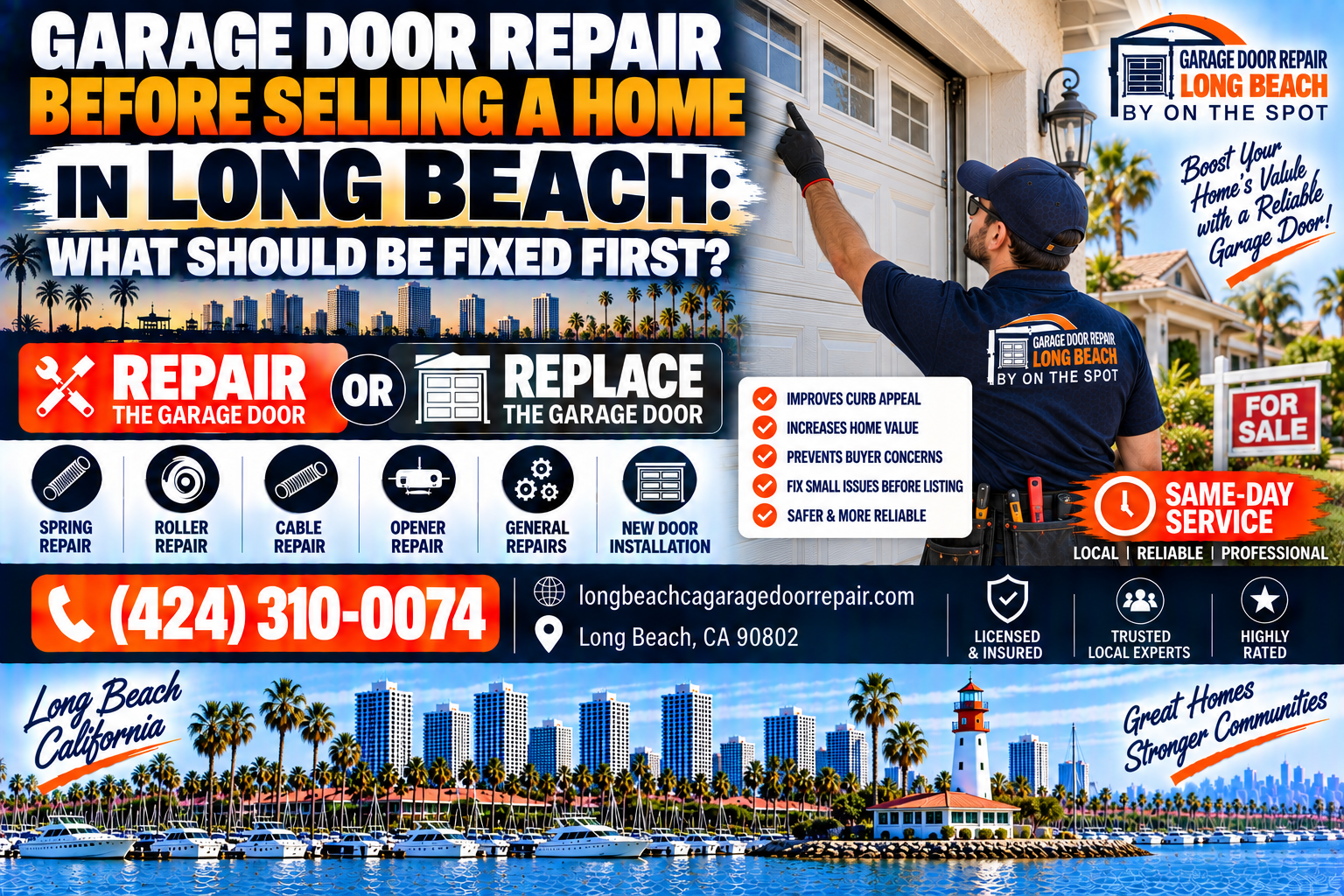
Long Beach Pre-Sale Garage Door Guide
Garage Door Repair Before Selling a Home in Long Beach: What Should Be Fixed First?
What should be fixed first on a garage door before selling a home in Long Beach? Start with safety and auto-reverse, then springs and cables, then opener reliability, then curb-appeal panels and seals. Learn inspection red flags, repair vs replace for listings, high-level disclosure awareness, and why high-tension spring and cable work is never DIY.
Garage Door Repair Long Beach By On The Spot helps homeowners, sellers, landlords, property managers, and agents sequence diagnosis-first repairs so listing photos, open houses, and inspections show a door that operates safely and looks intentional across Long Beach, CA.
Springs & Cables
Opener Reliability
Curb Appeal & Seals
CPSC + DASMA + SCE
Serving Long Beach, CA
Table of Contents
Direct Answer: What Should Be Fixed First Before Selling a Home in Long Beach?
Before selling a Long Beach home, fix garage door safety and auto-reverse first, then address springs and cables that control safe lift, then opener reliability, then curb-appeal items such as panels, paint, and weather seals. That order protects buyers, inspectors, and your listing timeline—because a door that fails a reverse test or hangs on a tired spring can stall escrow faster than a scuffed bottom seal.
In practice, a pre-listing garage door plan for Long Beach looks like this: (1) verify photo eyes, force settings, and auto-reverse on a balanced door; (2) inspect and repair or replace worn torsion or extension springs and lift cables—never as DIY high-tension work; (3) confirm the opener opens, closes, and holds reliably without strain; (4) repair dented or corroded panels, refresh seals, and clean presentation for curb photos; (5) document repairs for disclosure conversations at a high level with your agent. Safety-critical hardware always outranks cosmetic polish.
Long Beach coastal air, fog, and daily cycles often mean springs, cables, bottom brackets, and seals age faster near Belmont Shore, Naples, and Alamitos Beach than on quieter inland blocks. Sellers who only paint the door face and ignore balance or reverse testing risk inspection credits, re-negotiations, or last-minute repair demands. Garage Door Repair Long Beach By On The Spot helps sellers sequence diagnosis-first repairs so listing day shows a door that looks good and operates safely.
This guide is original pre-sale guidance for Long Beach—not a copy of salt-air hardware or rust-order articles. It focuses on listing priorities, inspection red flags, repair-versus-replace for marketability, and high-level disclosure awareness while stressing that spring and cable tension work belongs only to trained technicians.
Why Pre-Sale Garage Door Repair Order Matters in Long Beach
Buyers walking a Long Beach property often open the garage on the first showing. A loud grind, a door that reverses halfway, or a panel that looks salt-pitted next to a freshly staged kitchen creates doubt. Doubt becomes inspection leverage. Inspection leverage becomes credits, price cuts, or delayed close.
The garage door is also a safety system. Automatic residential garage door operators are designed with entrapment protection. If photo eyes are misaligned, dirty, or defeated, or if force is cranked to hide binding springs, the door may pass a casual glance and fail a careful inspector’s checks. Sellers who “make it close somehow” create liability optics no staging vase can fix.
Long Beach adds climate urgency. Marine layer moisture and chlorides accelerate corrosion on springs, cables, hinges, tracks, and fasteners. A door that seemed fine six months ago can show cable stain, spring scale, or seal gaps right when you need clean photos. Pre-sale repair is not vanity—it is risk management timed to your listing calendar.
Ordering work correctly saves money. Replacing an opener before fixing a broken spring wastes budget. Painting panels before replacing a frayed cable invites a second disruption after buyers notice uneven lift. Sequence: safety → lift hardware → opener confirmation → appearance → paperwork notes with your agent.
Finally, timing matters. Same-day or next-day professional service before photography beats emergency calls after a failed inspection. Build a buffer: inspect early, authorize priority repairs, retest reverse and balance, then shoot listing images with the door closed and looking intentional.
Priority One: Safety Systems and Auto-Reverse Before Listing Photos
Start every pre-sale garage door check with safety. Confirm both photo-eye sensors are mounted facing each other near the floor, lenses clean, indicator lights behaving as the manufacturer intends, and the beam path clear of storage clutter. Wave a soft object through the beam while the door closes—proper systems should reverse. Never unplug or bypass sensors so a sticky door will close for a showing.
Auto-reverse and force settings belong on a mechanically honest door. If springs are weak or tracks bind, the opener may need excess force to move the door—an unsafe workaround. Professional balance testing comes before any “just turn up the force” impulse. CPSC guidance on automatic residential garage door operators underscores why entrapment protection must remain intact; link details appear in Authority Sources.
Also check the emergency release cord, wall control placement, and that the door cannot be forced closed against an obstruction without reversing. Look for damaged sensor wires chewed by pests, sun-faded brackets that drifted out of alignment, and coastal grit on lenses—common Long Beach nuisances that are quick fixes with outsized inspection impact.
If the opener lacks modern entrapment features or fails reverse tests after hardware is corrected, plan opener repair or replacement as a safety item—not as a luxury upgrade. Buyers and inspectors notice missing or non-functional safety behavior more than they notice brand logos.
Document what you fixed. A simple note—“photo eyes realigned and reverse verified after spring service on [date]”—helps your agent answer questions without improvising. Keep high-tension details factual; leave legal disclosure strategy to your licensed real-estate professional.
Priority Two: Springs and Cables—The Lift System Buyers Feel Immediately
After safety, springs and cables are the heart of pre-sale garage door repair. A door that feels heavy, lifts unevenly, or bangs then refuses to open signals spring or cable failure. Those symptoms scare buyers and often trigger “repair before close” demands.
Torsion springs above the opening and extension springs along the tracks store dangerous energy. Coastal Long Beach exposure pits spring wire and corrodes cables at drums and bottom brackets. Visible cable whiskers, gaps in torsion spring coils after a bang, or a door that will not stay halfway during a careful professional balance check mean replace—not hope.
Never attempt DIY spring winding, cable clamps, or “temporary” C-clamp tricks before a listing. High-tension failures cause serious injury. Hire trained technicians with proper tools. Pair replacements are common: aged twin springs or twin cables often fail close together, and replacing only one side invites a sequel during escrow.
Bottom brackets where cables attach sit in the splash zone—fog, irrigation, and driveway mist. Section loss there is a stop-work safety item tied to cable service. Sellers who paint over orange brackets without addressing structure create cosmetic cover for a mechanical problem inspectors can still spot.
Budget springs and cables as priority line items even if panels look presentable. A quiet, balanced door photographs better with the opener, stages cleaner for buyers carrying boxes in their minds, and reduces the chance of a mid-escrow emergency when a tired spring finally lets go.
Priority Three: Opener Reliability Without Masking Hardware Problems
Once springs, cables, rollers, and tracks move freely and the door balances, confirm opener reliability. The door should open fully, close fully, stop and reverse appropriately, and respond consistently from the wall button, remotes, and keypad if equipped.
Pre-sale opener issues in Long Beach often include weak remote range, intermittent keypads, noisy gear trains, frayed trolley parts, and logic boards confused by prior force hacks. Separate electrical/opener faults from mechanical drag. If the door was heavy last month and “fine” after someone raised force, inspect springs before buying a new motor.
Smart openers and battery backups can be selling points when they work. They are not substitutes for safe springs. Present them honestly: working Wi-Fi control after safety verification is a plus; an app that reports failures because sensors were defeated is a liability.
Power quality and outages occasionally coincide with odd opener behavior. Southern California Edison outage resources help sellers and buyers separate neighborhood grid events from true equipment failure when timelines are unclear. Still, frayed cables found during an outage week remain a mechanical repair.
If the opener is original to an older door, noisy, and fails safety checks after hardware service, replacement timed before listing can reduce negotiation friction. Choose repair when the unit is sound and symptoms were caused by balance or sensors. Choose replace when gears are spent, safety features are obsolete, or reliability remains poor after mechanical correction.
Priority Four: Curb Appeal—Panels, Paint, Dent Repair, and Weather Seals
After the door operates safely, address what cameras and curb appraisals see. Dent repair or panel replacement, paint or finish refresh, window insert condition, and weather seals at bottom, sides, and top shape first impressions on Belmont Shore alleys and Bixby Knolls driveways alike.
Long Beach coastal doors often show lower-panel corrosion, chalking paint, brittle bottom seals, and daylight gaps that let bugs and marine air in. Replacing a cracked bottom seal and side seals is relatively fast and improves both photos and energy comfort narratives for buyers. Do not stop at the bottom seal if side and top seals are hardened or torn.
Match repairs to the home’s listing story. A mid-century bungalow may need honest paint and hardware cleanup more than a full designer door. A remodeled Naples property may justify a full door replacement if panels are oil-canned, delaminated, or badly rusted through. Repair versus replace guidance appears later in this article.
Avoid last-minute DIY spray paint that peels in fog. Prep and product choice matter near salt air. Coordinate finish work after major mechanical repairs so technicians are not handling wet paint, and so final operation tests do not mar fresh coatings.
Staging tip: clear ladder storage and trash cans from the door’s travel path, clean lenses and handles, and close the door for hero exterior shots unless open-garage lifestyle photos are intentional and the interior is staged. A safely operating, well-sealed door supports both aesthetics and inspection calm.
Inspection Red Flags Inspectors and Buyers Notice on Long Beach Garage Doors
Common red flags include: door reverses inconsistently or not at all; photo eyes taped, twisted, or unplugged; visible frayed lift cables; gaps in torsion springs; extension springs without intact safety cables; bent tracks; rollers flat-spotted or jumping; opener that strains or stops mid-travel; rotten wood jambs holding track lags; heavy rust on bottom brackets; daylight under a brittle seal; and recent paint that hides but does not fix corrosion at structural corners.
Inspectors may also note missing reverse testing evidence, outdated operators without modern entrapment protection, and unsafe DIY modifications—extra holes drilled in tracks, mismatched springs, rope-and-clamp cable “repairs,” and force settings at maximum.
Long Beach-specific flags: salt scale on springs, cable stain near drums, hinge fretting dust, track grit paste from over-greasing, and irrigation-driven rust at lower fasteners. Coastal buyers who already maintain beach homes recognize these patterns quickly.
Repair red flags before the official inspection when possible. A clean inspection report is marketing. A report full of garage door safety notes becomes a negotiation packet. If timing is tight, at least correct safety and spring/cable hazards first; schedule cosmetic follow-ups with transparency rather than hiding inoperative reverse features.
Ask your technician for a brief written summary of findings and completed work. Agents appreciate clear language: safety verified, springs replaced, opener tested, seals renewed. Avoid speculative legal phrasing; stick to operational facts.
Repair vs Replace When You Are Listing a Long Beach Home
Repair makes sense when the door structure is sound, a limited set of parts are worn, and cost plus downtime fit the listing calendar. Typical repair packages before sale: springs and cables, rollers and hinges, photo-eye realignment, opener logic or gear repair, seal kits, and minor dent or panel section swaps.
Replace makes sense when multiple panels are rusted through, the door is chronically binding from warped sections, insulation and appearance are far below neighborhood comps, or cumulative repair quotes approach the cost of a new door with warranty and modern opener pairing. Near the beach, doors with advanced chloride damage across panels and hardware often favor replacement for buyer confidence.
Marketability math is local. In competitive Long Beach micro-markets, a new quiet door can support asking-price psychology. In as-is investment listings, documented safe operation with honest cosmetics may be enough. Align spend with your pricing strategy and days-on-market goals—not with generic national averages alone.
Never replace an opener alone to “solve” a door that is unsafe due to springs. Never install a beautiful new door on rotten jambs without structural prep. System thinking—DASMA-style whole-door safety awareness—beats part-by-part shopping from a big-box aisle without measurement.
On The Spot can help sellers compare repair versus replace on site with the actual door in view, including coastal wear patterns that photos alone understate.
Disclosure Considerations at a High Level (Not Legal Advice)
This section is general information for planning conversations with your licensed real-estate agent and, if needed, your attorney—not legal advice. Disclosure rules depend on California requirements, your transaction type, and what you know about the property’s systems.
From a practical seller perspective, known garage door safety defects, recent spring failures, DIY modifications, and inoperative openers are the kinds of material facts agents often want discussed early. Hiding a door that will not reverse, or that was temporarily “fixed” by defeating sensors, can create larger problems than scheduling a professional repair before listing.
Repairs completed before listing are frequently positioned as maintenance that improves the home. Keep invoices and technician notes. If work occurs during escrow, coordinate communication through your agent so buyers understand scope and safety verification.
Do not invent engineering claims in disclosure forms. Stick to what was repaired, by whom, and when. If you do not know the age of springs, say you do not know rather than guessing. High-level honesty plus professional repairs usually beats silence plus a failed inspection demo.
Again: consult your agent for required forms and wording. This blog focuses on repair priorities and safe operation, not on completing legal paperwork.
Never DIY High-Tension Spring or Cable Work Before a Sale
Listing stress tempts risky shortcuts: YouTube winding bars, rented spring tools, clamping frayed cables, or asking a handy relative to “tighten it.” Those choices are unsafe. Garage door springs and cables operate under high tension. Mistakes cause severe injury and can damage panels, vehicles, and the opening.
Salt-weakened Long Beach hardware is less predictable. Pitted springs and corroded cable ends can fail during amateur handling. Professionals use correct winding bars, locked-down procedures, matched parts, and post-install balance and safety tests.
Safe homeowner actions before a tech arrives: clear the garage floor path, note symptoms (bang, heavy door, uneven travel, reverse failure), photograph visible issues from a safe distance, and stop using the opener if the door is clearly unsafe. Do not cut cables. Do not remove set screws from torsion drums. Do not place ladders under a door held by a single questionable spring.
For light tasks only—cleaning photo-eye lenses with a soft cloth, replacing remote batteries, sweeping debris from the threshold—homeowners can help presentation. Everything involving springs, cables, track bending, or force adjustments belongs to trained service.
Write “never DIY springs/cables” into your personal pre-sale checklist. The hour you save is not worth an ER visit or a mangled door the week photoshoot is booked.
A Practical Pre-Listing Garage Door Checklist for Long Beach Sellers
Week −3 to −2 from photos: Schedule professional inspection. Test auto-reverse and photo eyes. Inspect springs, cables, rollers, hinges, tracks, brackets, seals, panels, and opener function. Ask for a prioritized written list: safety, lift hardware, opener, cosmetics.
Week −2 to −1: Authorize priority repairs. Complete spring/cable work first if needed, then opener corrections, then seals and panel/paint work. Retest reverse and full travel. Confirm remotes and keypad codes you are willing to share or plan to reprogram at close per agent advice.
Photo week: Clean door face, glass, and threshold. Remove hazard clutter from travel path. Close door for exterior hero shots unless open-garage staging is intentional. Verify quiet, smooth operation for video walkthroughs.
Inspection week: Provide repair receipts if asked through your agent. Do not defeat sensors for demos. If something fails, schedule correction quickly rather than arguing physics.
Close week: Discuss remote/keypad handoff and any opener app account transfers with your agent. Leave the door safely operable for the buyer’s first evening in the home.
Coastal add-on: If you are near Belmont Shore, Naples, or Alamitos Beach, assume shorter remaining life on aged springs and seals even if the door “still moves.” Preemptive replacement can be cheaper than escrow drama.
Balance, Travel, and What “Healthy Operation” Looks Like on Showing Day
A healthy sectional door, with opener disengaged by a technician during testing, should lift with controlled effort and hold near mid-travel if springs are properly balanced. Buyers may not perform that test, but technicians and many inspectors understand the concept. An opener that struggles, hesitates, or reverses without obstruction often reveals imbalance or binding.
Travel should be straight without scraping seals to shreds, without rollers climbing out of tracks, and without the door racking diagonally. Uneven cable length, broken spring, or bent track shows up as one side leading. Fix the cause; do not square the door with brute opener force.
Noise expectations: some mechanical sound is normal; grinding, shrieking hinges, popping rollers, and metallic scraping are not “character.” Quiet operation reads as maintained. Coastal fretting and dry springs are common noise sources before sale.
Limits should allow full open for SUV clearance common in Long Beach households and full close with seal compression—not slamming into the slab or stopping short with a gap. After spring work, limits and force should be rechecked.
Showing-day habit: operate the door once before the first tour to confirm nothing changed overnight—especially after windy marine-layer nights that can deposit grit or shift light objects into the sensor beam.
Comparison Table: Pre-Sale Fix Priority for Long Beach Garage Doors
Use this table to sequence spend before listing. Safety and lift hardware outrank paint every time.
| Priority | System | Why it matters to buyers/inspectors | Typical pre-sale action | DIY? |
|---|---|---|---|---|
| 1 | Photo eyes & auto-reverse | Entrapment safety; easy fail on demo | Clean, align, verify reverse; repair wiring | Lens clean OK; no bypass |
| 2 | Springs & lift cables | Heavy/uneven door; injury risk; escrow delays | Inspect; replace worn pairs; rebalance | Never DIY tension work |
| 3 | Tracks, rollers, hinges | Scrape, bind, opener strain | Align, replace worn rollers/hinges | No track bending DIY |
| 4 | Opener reliability | Daily usability; safety features | Repair/replace after mechanical truth | Battery/remote only |
| 5 | Seals & weatherstrip | Bugs, drafts, daylight gaps, photos | Replace brittle bottom/side/top seals | Often homeowner-ok if careful |
| 6 | Panels, paint, dents | Curb appeal and comps | Repair sections or full replace | Paint DIY risky near salt air |
| 7 | Docs & agent notes | Disclosure clarity; trust | Keep invoices; share facts via agent | N/A — use professionals |
Combined failures are common on coastal Long Beach doors. A single service visit can often cover priorities 1–4 together once springs are safe to cycle.
False Fixes Sellers Try Before Listing (That Backfire)
Raising opener force to hide a weak spring: passes a casual push of the remote, fails balance thinking, and risks unsafe operation during showings.
Unplugging or taping photo eyes so the door closes for photos: creates an immediate safety and disclosure problem if discovered.
WD-40 on everything the night before photography: temporary quiet, sticky dust magnet, and no structural repair.
Painting over rusted bottom brackets and cable drums: cosmetic cover on a load path inspectors can still question.
Clamping or knotting a frayed cable: extremely dangerous and obvious to pros.
Replacing only one spring or one cable on an aged pair: invites failure during escrow.
Buying a new opener first while the door remains heavy: spends money on the wrong subsystem.
Heavy grease in tracks to “smooth” scrapes: packs grit and worsens roller wear.
Asking a non-trained handyman to wind torsion springs to save a service call: injury and door damage risk at the worst calendar moment.
Staging over a non-closing door and telling buyers “it usually works”: destroys trust when it fails on inspection day.
Red Flags: Stop DIY and Call for Pre-Sale Garage Door Service Now
Loud bang from the garage and a door that will not open normally.
Visible frayed cable wires (whiskers) or cable off a drum.
Door crooked in the opening or one side hanging lower.
Opener motor hums but door barely moves—or moves then slams.
Photo eyes missing, broken, or deliberately disconnected.
You or a prior occupant “adjusted springs” without professional setup.
Bent track with rollers threatening to come out.
Bottom bracket metal crumbling near a live cable attachment.
Door reverses unpredictably or not at all when tested with a soft obstruction.
Listing photos are days away and the door still fails basic close/open cycles.
If any of these apply, call professional help at (424) 310-0074 and keep people clear of the door’s path until it is rendered safe.
Coastal Long Beach Seller Notes: Belmont Shore, Naples, Alamitos, and Inland
Belmont Shore and alley-loaded properties: expect hinge fretting, cable stain, and seal wear from fog and tight clearances. Clear alley access for technicians before photo week.
Naples and canal-adjacent homes: moisture is persistent. Bottom brackets, lower track fasteners, and seals deserve priority eyes. Soft jamb wood can undermine track geometry—budget structure if lags pull out.
Alamitos Beach and onshore-wind corridors: spring scale and finish chalking appear earlier. A door that looks “tired” next to remodeled neighbors can drag offers; mechanical safety still comes first.
Downtown, Wrigley, West Long Beach: grit and mixed air; still verify reverse and springs. Older openers are common—safety features may need updating.
Bixby Knolls, Los Altos, El Dorado area: longer hardware life is possible, but irrigation splash and deferred maintenance still create pre-sale surprises. Do not skip the garage door on the seller checklist because you are “inland enough.”
Across Long Beach, match intervals and urgency to exposure, not only to ZIP code stereotypes.
Timing Repairs Around Photos, Open Houses, and Escrow
Best case: complete safety and spring/cable work before listing photos. Buyers fall in love with what they see and hear on walkthrough videos.
Acceptable case: list with a scheduled repair date disclosed through your agent if a part is on order—but avoid advertising a door that cannot close safely.
Risky case: wait for the buyer’s inspection to reveal a broken spring you already suspected. Credits and rush fees often exceed planned pre-sale service costs.
During escrow: if a spring fails after acceptance, treat it as urgent safety repair, document completion, and retest reverse. Coordinate messaging through the agent.
Open house weekends: verify sensor beams are not blocked by sandwich boards, plants, or gift tables. A door that will not close because of staging props creates unnecessary panic.
Key transfers: plan keypad code changes and remote handoff. Do not leave master opener accounts tied to the seller’s phone without a transfer plan.
How Buyers Mentally Price a Garage Door on Long Beach Tours
Buyers translate garage door cues into home-care narratives. Smooth, quiet, sealed, and safe suggests maintenance culture. Loud, crooked, and sensor-defeated suggests deferred work elsewhere—even if the kitchen is perfect.
In coastal comps, buyers who already own beach property discount excuses about salt air. They expect sellers to maintain springs and seals like roofs and exterior paint.
Investors may accept cosmetics and still demand safe operation. Owner-occupiers often want both. Know your likely buyer pool for the street you are selling on.
Electric vehicle owners and multi-car households care about reliable opening clearance and smart controls. A failing opener becomes a lifestyle friction point in their offer math.
You cannot control every preference, but you can remove obvious objections: reverse works, lift is balanced, seals keep bugs out, and the face of the door matches the listing quality story.
Deep Dive: Photo Eyes, Reverse Tests, and Showing-Day Safety Demos
Photo eyes create a beam near the floor. When the beam breaks during closing, the operator should reverse. Lenses get dusty, sandy, and salt-filmed in Long Beach. Brackets bend from broom bumps and storage hits. Sunlight at certain hours can confuse some sensors—another reason to test at the time of day you expect showings.
A proper pre-sale service includes cleaning, alignment, wiring integrity checks, and a reverse demonstration. Sellers should be able to show the door reverse on a soft object without fear.
Never elevate sensors to avoid kicking them—or to “solve” nuisance trips caused by a binding door. Height and aim matter for the safety design. Fix the bind; keep sensors in their intended zone.
If wires are cut, chewed, or spliced poorly, repair or replace the harness. Intermittent sensors that work for the photographer but fail for the inspector are classic escrow headaches.
CPSC FAQ material on automatic residential garage door operators is linked under Authority Sources for consumer safety context. Use it as education—not as a substitute for on-site testing.
Deep Dive: Pre-Sale Spring Decisions—Lubricate, Monitor, or Replace
Light surface film on springs with good balance may allow lubrication and monitoring—but selling timelines shorten patience for “monitor.” If listing is weeks away and springs are aged with scale, many sellers choose replacement for predictability through escrow.
Deep pitting, broken tips, gaps after a bang, or failed balance checks mean replace now. Extension springs need intact safety cables; missing safety cables are a pre-sale must-fix.
Cycle history helps but is often unknown. Coastal exposure is a proxy: fog-belt doors with original decade-old springs are prime replacement candidates even if they have not failed yet.
After replacement, expect opener force and limits to be reset. A newly balanced door should not retain maximum force from the heavy-door era.
Price the spring package as insurance against mid-escrow failure. The cost of a rush spring call plus buyer goodwill damage often exceeds planned replacement.
Deep Dive: Cables, Drums, and Bottom Brackets Before You List
Lift cables should show continuous strands without broken wire whiskers. Staining alone is not always replace-now, but staining plus age plus coastal splash warrants close professional judgment—especially before sale.
Uneven lift frequently traces to cable or spring issues. Buyers notice the door “walking” crooked. Fix root causes; do not stage around them.
Bottom brackets are structural corners under tension when cables are attached. Crumbling metal is not a paint project. Bracket and cable service travel together.
Drums and set screws need correct professional handling. DIY loosening is a common path to cable slip accidents.
Paired cable replacement is normal when both are aged. Document the work for your agent’s repair file.
Deep Dive: Opener Repair vs Replace for Maximum Listing Confidence
Repair the opener when gears are serviceable, logic responds, safety systems pass after mechanical correction, and noise is acceptable for the price tier of the home.
Replace when the unit is obsolete on safety features, chronically unreliable, extremely noisy relative to comps, or damaged in ways that cost nearly as much as a new operator.
Pair opener decisions with door condition. A premium opener on a failing door panel set is mismatched spend. A solid door with a failing opener is a clean upgrade story for buyers.
Remotes, keypads, and myQ-style apps: test them, then plan credential handoff. Dead keypad batteries are embarrassing on a twilight tour; replace batteries early.
Rail and trolley condition matter. Bent rails and worn trolleys should be corrected so buyers do not hear chatter that they misdiagnose as “the whole door is bad.”
Deep Dive: Seals, Panels, and the Curb-Appeal Last Mile
Bottom seals crack and flatten under UV and ozone; coastal air accelerates aging. Daylight under the door reads as neglect and invites pests—easy buyer objections.
Side and top seals matter for finished garages and for homes where the garage adjoins living space. Replacing only the bottom seal can leave whistling gaps elsewhere.
Panels: minor dents may be acceptable in as-is listings; multi-panel rust-through near the beach often argues for section replacement or full door replacement.
Windows and inserts: cloudy or cracked inserts are cheap relative to offer psychology on design-forward listings.
Finish: match neighborhood expectations. A freshly detailed door on a polished Belmont Shore listing supports price; a perfectly new door on a heavy fixer may over-improve. Ask your agent where the garage door sits in buyer priorities for your specific comps.
Landlords, HOAs, and Inherited Garage Door Problems at Sale Time
Investment properties often arrive at listing with deferred spring service and tenant-reported “opener issues” that were never diagnosed. Budget a full safety and hardware inspection before MLS photos.
HOA or shared garage contexts may limit which vendor can work or which door styles are approved. Start approval early if replacing the door face.
Document tenant-era DIY attempts. Remove unsafe modifications before showings.
For multi-unit sales, standardize reverse tests and spring evaluations across doors so one bad unit does not poison the entire offering narrative.
Property managers should keep a pre-sale garage door packet: last spring date, cable notes, opener model, and seal condition photos.
Practical Long Beach Pre-Sale Scenarios
Scenario A — Belmont Shore listing in 10 days: Door reverses poorly; springs noisy with scale; paint chalked. Tech realigns photo eyes, replaces torsion springs and cables, resets opener force/limits, replaces bottom seal. Seller defers full repaint, does a professional wash and spot touch-up. Outcome: safe demos, quiet video, minor cosmetic honesty that still photographs clean.
Scenario B — Naples home mid-escrow bang: Extension spring fails after acceptance. Seller does not DIY. Same-day professional springs with safety cables, balance test, reverse verification. Agent shares invoice. Outcome: transaction continues with documented safety repair.
Scenario C — Bixby Knolls seller replaced opener last year, door still heavy: Inspection finds weak original springs. New opener was masking the problem with high force. Springs replaced, force normalized, opener retained. Outcome: safer door, money not wasted on second opener.
Scenario D — Alamitos Beach curb-appeal focus: Panels rusted at bottoms, seals gone, springs OK, reverse OK. Section replacement or full door quote compared; seller chooses full door for comps. Outcome: mechanical safety already good; appearance matches remodel premium.
Scenario E — Investor as-is listing Downtown: Budget only for safety. Springs, cables, sensors corrected; dents left. Outcome: meets safety bar; cosmetics priced into as-is strategy.
Scenario F — HOA with style rules: Seller wants new contemporary door; approval takes three weeks. Meanwhile springs fail inspection. Sequence: emergency spring repair now, HOA door order parallel. Outcome: escrow safety uninterrupted while aesthetics follow process.
Scenario G — Photo eyes taped by prior occupant: Discovered during pre-list check. Wiring repaired, sensors replaced, reverse demo recorded in tech notes. Outcome: avoids catastrophic inspection finding.
Scenario H — Remote range complaints during twilight tours: Batteries and antenna orientation fixed; metal screen door interference explained; opener otherwise sound. Outcome: low-cost reliability win without hardware oversell.
Myths About Fixing the Garage Door Before Selling in Long Beach
Myth: Buyers never care about the garage door. Reality: They operate it, hear it, and mentally score maintenance—especially near the coast.
Myth: Paint alone is enough for listing. Reality: Paint without reverse and spring integrity fails inspection demos.
Myth: Turning up force is a free spring replacement. Reality: It is an unsafe mask.
Myth: If it opens, it is fine to sell. Reality: Opening with frayed cables or defeated sensors is not fine.
Myth: DIY spring YouTube is acceptable for a quick flip. Reality: Injury and deal-killing damage risk.
Myth: New openers fix crooked doors. Reality: Hardware geometry and springs fix crooked doors.
Myth: Inland Long Beach homes can skip garage door checks. Reality: Skip nothing safety-related; intervals may differ, checks should not.
Myth: Seals are purely cosmetic. Reality: Daylight gaps, pests, and drafts affect buyer comfort narratives.
Myth: Disclosure means you should not repair anything. Reality: Many sellers repair to present a safe home and reduce negotiation—coordinate wording with your agent.
Myth: One cable replacement is always enough. Reality: Aged pairs often need paired service.
Questions to Ask a Technician Before Pre-Sale Garage Door Work
Will you test photo eyes and auto-reverse after mechanical repairs?
Do springs or cables need replacement for safe showing and escrow durability?
Are you replacing springs/cables as matched pairs when age warrants it?
What opener force and limit adjustments will you make after balancing?
Which issues are safety-critical versus cosmetic for my listing timeline?
Can you provide a written summary and invoice suitable to share via my agent?
Are tracks, rollers, and hinges contributing to opener strain?
For coastal exposure, what remaining life do you estimate on unrepaired parts?
If we replace the door later, which of today’s repairs still make sense now?
What should we not DIY between now and closing?
Why Garage Door Repair Long Beach By On The Spot for Pre-Sale Repairs
Garage Door Repair Long Beach By On The Spot approaches seller tickets with diagnosis-first sequencing: safety and reverse, springs and cables, then opener confirmation, then seals and appearance support. That order protects people and transactions.
Local coastal familiarity matters. Fog-belt corrosion, alley access constraints, and irrigation splash patterns show up constantly across Long Beach routes from 151 E 5th St.
You get clear maintain-versus-replace conversation without pressure to DIY tensioned parts. High-tension spring and cable work stays with trained technicians.
Sellers, landlords, and agents can call (424) 310-0074 to schedule pre-list inspections or urgent escrow repairs. Learn more at https://longbeachcagaragedoorrepair.com/.
NAP for your records: Garage Door Repair Long Beach By On The Spot | 151 E 5th St, Long Beach, CA 90802 | (424) 310-0074 | Maps https://www.google.com/maps?cid=5381478035707257267.
Areas Served From the Long Beach Location
Pre-sale and general garage door repair coverage includes Belmont Shore, Naples, Alamitos Beach, Downtown Long Beach, Bixby Knolls, Los Altos, El Dorado Park area, Traffic Circle, Rose Park, Wrigley, West Long Beach, and nearby Long Beach communities where sellers need safe, reliable, presentation-ready doors before listing photos and inspections.
If your closing timeline is tight, call early—spring and opener parts availability can shape sequencing even when labor can arrive same day.
Google Map Location
Find Garage Door Repair Long Beach By On The Spot at 151 E 5th St, Long Beach, CA 90802. Use this Google Maps link for directions and business details: https://www.google.com/maps?cid=5381478035707257267.
Phone (424) 310-0074 before visiting if you need pre-sale safety checks, spring and cable service, opener reliability repairs, or seal and panel guidance timed to your listing calendar. Most repair-versus-replace decisions are clearest on site with the door hardware in view.
FAQs About Garage Door Repair Before Selling a Home in Long Beach
What should I fix first on my garage door before selling in Long Beach?
Safety and auto-reverse first, then springs and cables, then opener reliability, then curb-appeal panels and seals. That order protects buyers, inspectors, and your timeline.
Do I need to replace garage door springs before listing?
Replace if balance is poor, springs are pitted/broken, or failure risk is high during escrow—common on aged coastal doors. A technician should decide after inspection; never DIY winding.
Will a bad garage door fail a home inspection?
It can trigger notes or repair requests—especially for non-functional reverse, frayed cables, broken springs, or unsafe modifications. Fixing safety items before inspection reduces surprises.
Is it better to repair or replace the garage door when selling?
Repair when the structure is sound and parts are limited. Replace when panels are widely rusted/warped or repairs approach new-door cost. Match spend to your comps and pricing strategy.
Can I disconnect photo eyes so the door closes for photos?
No. That defeats entrapment protection and creates serious safety and trust problems. Clean, align, and repair sensors; fix mechanical binding instead.
How does Long Beach salt air affect pre-sale garage door repairs?
Chlorides and fog accelerate spring scale, cable corrosion, hinge fretting, and seal aging—especially near Belmont Shore, Naples, and Alamitos Beach. Inspect earlier than inland assumptions suggest.
Should I install a new opener before selling?
Only after the door is balanced and tracks/rollers move freely. New openers do not fix weak springs. Replace openers that fail safety checks or are chronically unreliable after mechanical correction.
What curb-appeal garage door upgrades help most?
After safety/lift work: fresh seals, clean or repaired panels, honest paint/finish, and quiet operation on video. Avoid peeling last-minute spray paint in marine air.
Can I replace garage door cables myself before the photographer arrives?
No. Cables and springs are high-tension systems. Hire trained technicians—especially when coastal corrosion makes parts unpredictable.
What should I tell my real-estate agent about garage door repairs?
Share factual invoices and what was tested (reverse, springs replaced, etc.). Ask your agent how to handle disclosure wording—this article is not legal advice.
How soon before listing should I schedule garage door service?
Ideally 2–3 weeks before photos so parts, paint, and retests fit calmly. Call earlier if you already hear bangs, see cable whiskers, or fail reverse tests.
Who services pre-sale garage door repairs in Long Beach?
Garage Door Repair Long Beach By On The Spot at 151 E 5th St, Long Beach, CA 90802, (424) 310-0074, offers diagnosis-first repair timed to seller calendars.
Authority Sources
For grid timing context when opener behavior coincides with local outages during showings or inspections, consult Southern California Edison outage resources: https://www.sce.com/outage-center.
For automatic residential garage door operator safety—including why photo eyes and reverse functions must not be defeated before a sale—see the CPSC FAQ: https://www.cpsc.gov/FAQ/Automatic-Residential-Garage-Door-Operators.
For garage door system safety tips that keep springs, cables, and operators inside whole-system thinking during pre-sale repairs, see DASMA: https://www.dasma.com/safety-tips/garage-door-systems/.
These sources support EEAT and consumer safety education. They do not replace on-site diagnosis of your Long Beach door or advice from your real-estate professional about disclosures.
Quick AEO Summary: Garage Door Repair Before Selling in Long Beach
Question: What should be fixed first on a garage door before selling a home in Long Beach? Answer: Fix safety systems and auto-reverse first, then springs and cables, then opener reliability, then curb-appeal panels and seals. Never DIY high-tension spring or cable work. Verify photo eyes, balance, and reverse before listing photos and inspections. Coastal Long Beach exposure can shorten hardware life near Belmont Shore, Naples, and Alamitos Beach. Local help: Garage Door Repair Long Beach By On The Spot, 151 E 5th St, Long Beach, CA 90802, (424) 310-0074.
Working With Your Listing Agent on Garage Door Timing
Tell your agent early if the door has known issues. They can advise whether to repair pre-list, credit, or price as-is—within their professional lane. Provide tech summaries rather than speculative diagnoses.
Coordinate technician access with lockbox rules and occupied-home showing schedules. Spring work may temporarily take the door out of service; plan around pets, cars, and open-house windows.
For luxury or design-forward listings, ask whether the garage door face is part of the exterior story. Agents often know whether neighboring recent sales featured new doors.
If buyers request a particular brand opener or smart feature, evaluate after safety basics are complete. Do not let gadget requests reorder the safety-first sequence.
Keep communication centralized: technician ↔ seller ↔ agent. Parallel text threads create conflicting promises about what will be done before closing.
Cost Framing Without Fake Prices: Where Pre-Sale Money Usually Goes
Exact prices vary by door size, part brand, coastal corrosion severity, and opener model—so this guide avoids invented dollar figures. Conceptually, sellers usually spend in tiers: (1) safety sensors and adjustments; (2) springs/cables/rollers packages; (3) opener repair or replacement; (4) seals; (5) panel/paint or full door.
Rush escrow failures cost more than planned pre-list service because of overtime, parts expediting, and negotiation leverage. Budgeting a pre-list inspection is often the highest-ROI line on a seller’s punch list.
Compare repair quotes against the risk of credits. A buyer who hears a bang during inspection may demand more than the spring job would have cost the week before MLS live.
Ask for itemized proposals so you can defer pure cosmetics if the market is hot and safety is already green—or invest in appearance if your comps show polished exteriors winning bidding wars.
On The Spot can walk priorities on site so you fund the failure points that actually threaten closing.
Manual Operation, Lockout Concerns, and Cars Trapped Before Showings
If a spring fails, do not force the opener. Forcing can burn the motor and damage panels. Keep the door secure, move people away, and call for professional spring service.
Sellers sometimes discover failure the morning of an open house with cars inside. Prioritize safe release and spring repair over keeping the schedule sacred. A canceled first hour beats an injury.
Know where the emergency release is, but do not pull it under a heavy unbroken spring situation without understanding risks—improper release handling can allow a door to drop. When unsure, wait for the technician.
Communicate with your agent immediately if access will be limited. Transparency preserves buyer trust better than silent scrambling.
After repair, retest full travel before restaging the garage.
Smart Openers, Keypads, and Access Handoff at Closing
Modern openers tied to apps need deliberate handoff. Plan to transfer or remove seller accounts so buyers are not locked out—and sellers are not leaving digital access behind unintentionally. Follow your agent’s closing checklist norms.
Keypad codes should be changed at appropriate transaction milestones per your agent’s guidance. Temporary showing codes can reduce wear on remotes during a busy listing.
Guest remotes in junk drawers should be gathered and inventoried. Missing remotes become last-week scavenger hunts.
If the opener is ancient and unreliable, replacing it pre-close can simplify handoff with fresh remotes and clear pairing instructions for the buyer.
Smart features never outrank spring safety. A connected door that cannot reverse safely is still the wrong product to celebrate in listing copy.
Field Inspection Flow: From Pre-List Walkthrough to Safe Repair Decision
Step 1 — Observe from outside: panel condition, seal daylight, obvious dents, and whether the door sits square in the opening.
Step 2 — Operate once with everyone clear: listen for grind, scrape, pop, or opener strain. Watch for hesitation, reverse without obstruction, or crooked travel.
Step 3 — Safety devices: inspect photo-eye height, aim, lens cleanliness, wiring, and perform a reverse test with a soft object on a door that is otherwise safe to cycle. If the door is hanging on a broken spring, skip cycling and call for spring service first.
Step 4 — Lift hardware: professional inspection of torsion or extension springs, cables, drums, shafts, brackets, rollers, hinges, and tracks. Note coastal corrosion specifically.
Step 5 — Opener path: rail, trolley, gears, limits, force settings, remotes, keypad, and any smart module. Distinguish mechanical load from electrical fault.
Step 6 — Weather and presentation: bottom/side/top seals, threshold, exterior finish, windows.
Step 7 — Prioritize: safety → springs/cables → binding hardware → opener → seals → cosmetics → documentation for agent.
Step 8 — Retest after repairs: full open/close, reverse, remote consistency, and visual curb check before photographer arrival.
This flow keeps sellers from jumping to paint or opener shopping while a cable whisker waits to become an escrow event.
Tracks, Rollers, and Hinges: The Binding Problems That Spoil Showings
Even with good springs, bent tracks and flat-spotted rollers make doors chatter and scrape—sounds buyers remember. Pre-sale service should include roller condition, hinge fretting, and track alignment, especially on coastal doors where grit paste builds in channels.
Loose lag fasteners into damp jambs allow tracks to drift. Daylight on one side and seal crush on the other is a geometry story, not a “needs more grease” story.
End hinges on wide doors take abuse. Replacing only the noisiest hinge sometimes leaves neighboring hinges ready to squeak during the next open house. Packages can be more efficient.
Do not hammer tracks DIY to “straighten” before photos. Incorrect bends worsen roller climb-out risk.
After track/roller work, confirm seals still meet and the opener does not need compensatory force.
Weather Sealing, Dust, Bugs, and Buyer Comfort Narratives
Long Beach buyers notice garage odors, bug activity, and dusty storage when seals fail. A brittle bottom seal with daylight is an easy objection during a detailed tour.
Side seals and top seals complete the envelope. Coastal air pumping through gaps also feeds corrosion cycles on hardware—another reason seals are more than cosmetics.
If the garage is conditioned or adjacent to living space, seal quality supports comfort claims in listing remarks without overpromising energy numbers you have not measured.
Threshold repairs and slab irregularities sometimes limit seal performance. Technicians may recommend threshold work so new rubber is not shredded in a week.
Schedule seal replacement after major mechanical work so adjustments do not tear new material.
When a Full Door Replacement Is the Cleaner Pre-Sale Story
Consider full replacement when: multiple sections are rusted through; panels are delaminated or badly oil-canned; the door is undersized or style-mismatched for a remodeled facade; insulation and quiet operation are central to buyer expectations on your street; or stacked repair line items approach new-door economics.
Full replacement still requires safe removal of old spring systems by professionals, proper opening prep, and new opener pairing or reuse only when appropriate.
Lead times matter. If a custom door takes weeks, stabilize safety on the existing door for showings, then install the new door at a planned escrow milestone coordinated with your agent—or delay listing photos until the new door is in if appearance is critical.
HOA approvals, color rules, and window styles can gate replacement. Start paperwork early.
A new door is not a license to ignore photo-eye aiming and reverse verification at commissioning. Safety checks remain priority one on day one of the new install.
As-Is Listings vs Repaired Listings: Garage Door Implications
As-is does not mean unsafe to demonstrate. Many as-is sellers still fix springs, cables, and reverse functions to avoid injury and to prevent deals collapsing over basic safety.
Repaired listings aim to remove objections. Garage doors are high-visibility systems; leaving obvious hazards rarely saves money net of credits.
Hybrid approach: repair safety and lift, disclose remaining cosmetics, price accordingly. This often fits Long Beach markets where buyers expect coastal wear honesty but not sensor defeat.
Investor buyers may underwrite repairs themselves—yet still walk if a door looks ready to injure someone during their own inspection.
Choose strategy with your agent; execute safety with a garage door professional.
Video Walkthroughs and Live Showings: How the Door Performs on Camera
Listing videos that include a grinding door undermine music and voiceover. Operate the door during a test recording before the videographer’s final take.
Live Zoom tours amplify opener hum and scrape. Fix noise sources—hinges, rollers, unbalanced springs—before media day.
Camera angles from the driveway should show a clean closed door aligned with the facade. Avoid filming a door stopped halfway with daylight glaring under a failed seal.
If you demonstrate openers on video, also demonstrate reverse when appropriate and safe—some sellers prefer not to, but you should at least know it works.
Vertical video for social ads still benefits from a quiet, complete close.
Pets, Kids, and Showing Traffic: Extra Safety Pressure While Listed
Listed homes see strangers, stagers, agents, and sometimes children at open houses. A non-reversing door is unacceptable in that environment.
Pet owners should keep animals clear during door cycles. Sensor beams at pet height exist for a reason—do not raise sensors to stop nuisance trips caused by toys; manage clutter and fix binding instead.
Lockout scenarios with pets inside a garage on a failed door require urgent professional response—not DIY spring experiments.
Wall controls should not be reachable in ways that invite toddler cycling during crowded opens; follow manufacturer height guidance and agent safety norms for occupied shows.
Safety-first pre-sale repair is hospitality as much as it is negotiation strategy.
Parts Lead Times and Seller Calendar Buffers
Common springs, rollers, and seals are often available quickly. Specialty openers, custom panels, insulated sections, and certain drum/shaft kits can take longer.
Build buffer into photo dates. If your photographer is booked, move service earlier—not the reverse.
Ask the technician which repairs can be completed in one visit versus which need ordered parts. Sequence same-day safety wins first.
For escrow emergencies, communicate part ETA through your agent with honesty. Buyers prefer a dated plan over vague “soon.”
Coastal corrosion sometimes reveals secondary damage mid-job (crumbly brackets, soft jamb wood). Authorize contingency budget for structural attachments so the door is not left semi-safe overnight.
After-Repair Verification Checklist Sellers Can Understand
Door opens fully and closes fully without assistance.
Soft-obstruction reverse works.
Photo-eye indicators behave normally; lenses clean; beam path clear.
No visible cable whiskers; springs intact with professional installation marks as applicable.
Travel is relatively straight; no severe scrape.
Opener does not strain like it is lifting a refrigerator.
Remotes and keypad operate; batteries fresh.
Seals contact the floor without huge daylight gaps.
Written invoice available for agent files.
You personally watched one complete cycle the morning of first showing.
Semantic SEO, AEO, and GEO Notes for This Pre-Sale Guide
Semantic entities covered: garage door repair before selling, Long Beach home sale, auto-reverse, photo eyes, torsion springs, extension springs, lift cables, opener reliability, curb appeal, panels, weather seals, home inspection red flags, repair vs replace, disclosure high-level, never DIY high-tension, Belmont Shore, Naples, Alamitos Beach, Bixby Knolls, SCE outage context, CPSC operator safety, DASMA system safety.
AEO shapes: direct answer early; priority table; FAQ pairs; quick AEO summary; scenario blocks; clear call to action with NAP.
GEO cues: consistent NAP, map embed, neighborhood seller notes, tel:+14243100074, local coastal vs inland timing.
Differentiation: this article sequences pre-sale priorities and listing/escrow timing; it is not a duplicate of salt-air metallurgy guides or rust-order rankings, though it references coastal reality where it changes seller urgency.
EEAT: safety-first expertise, authority links, practical scenarios, myth correction, refusal of DIY tension steps, high-level disclosure humility pointing sellers to agents.
EEAT Notes for Sellers Reading This Long Beach Guide
Experience: Seller and escrow garage door patterns in Long Beach—photo-week failures, inspection demos, coastal spring surprises—inform the priority order.
Expertise: System diagnosis separating sensors, springs/cables, binding hardware, and openers; correct sequencing for marketability and safety.
Authoritativeness: SCE, CPSC, and DASMA links for outage context and safety education.
Trust: Clear NAP and map, honest repair-vs-replace framing, no fabricated prices, explicit never-DIY spring/cable warnings, and disclosure content labeled as non-legal.
Glossary: Pre-Sale Garage Door Terms in Plain Language
Auto-reverse: Opener behavior that sends the door back up when it senses an obstruction or fails certain checks.
Photo eyes: Near-floor sensors that must remain aligned and active for safe closing.
Balance: Spring assistance matching door weight so the opener is not overloaded.
Torsion spring: Twisting spring mounted above the opening.
Extension spring: Stretch spring along horizontal tracks—needs safety cables.
Cable whiskers: Broken outer wires on lift cables—replace signal.
Force settings: Opener effort limits—must not hide broken hardware.
Curb appeal package: Panels, paint, seals, and cleanliness after safety/lift work.
As-is listing: Pricing/strategy choice that still should not ignore basic door safety.
Escrow repair: Work completed after offer acceptance—often costlier under time pressure.
Seller Call Script for Pre-Sale Garage Door Service
You can say: “Hi, I’m selling a home in Long Beach near [neighborhood]. Listing photos / inspection are on [date]. My garage door has [reverse issues / heavy door / noise / frayed cable / seal gaps / opener problems]. I need a safety-first inspection and a prioritized repair plan—springs and cables if needed, no DIY on my part. Can On The Spot help before [date]?”
Add whether the property is occupied, HOA-controlled, or mid-escrow. Leave a callback number. Call (424) 310-0074.
Putting It Together: Your Pre-Sale Garage Door Plan
Fix garage door safety and auto-reverse first, then springs and cables, then opener reliability, then seals and panels for curb appeal. Verify operation before photos and again before major showings. Never DIY high-tension work. Use invoices and factual notes with your agent for high-level disclosure conversations.
Long Beach coastal exposure raises the odds that aged springs, cables, and seals need attention before buyers and inspectors arrive. Plan buffer time. Prefer planned service over escrow emergencies.
Garage Door Repair Long Beach By On The Spot is ready to help sellers translate symptoms into a sequenced, safety-first repair plan.
What to Prepare Before Your Pre-Sale Service Visit
Clear storage from tracks, springs, and sensor paths. Note showing and photo deadlines. Secure pets. List remotes and keypad locations. Photograph issues from a safe distance. Do not loosen torsion hardware. Tell the technician if irrigation hits the door or if prior DIY spring work occurred.
Have agent contact preferences ready if invoices need to be shared quickly during escrow.
Call for Pre-Sale Garage Door Repair Help in Long Beach
If you are selling a Long Beach home and need the garage door safe, reliable, and presentation-ready, schedule diagnosis-first service with Garage Door Repair Long Beach By On The Spot. Prioritize reverse safety, springs and cables, opener confidence, and then curb-appeal finishes—without DIY high-tension risks.
Garage Door Repair Long Beach By On The Spot — 151 E 5th St, Long Beach, CA 90802 — (424) 310-0074 — https://longbeachcagaragedoorrepair.com/ — Google Maps.