
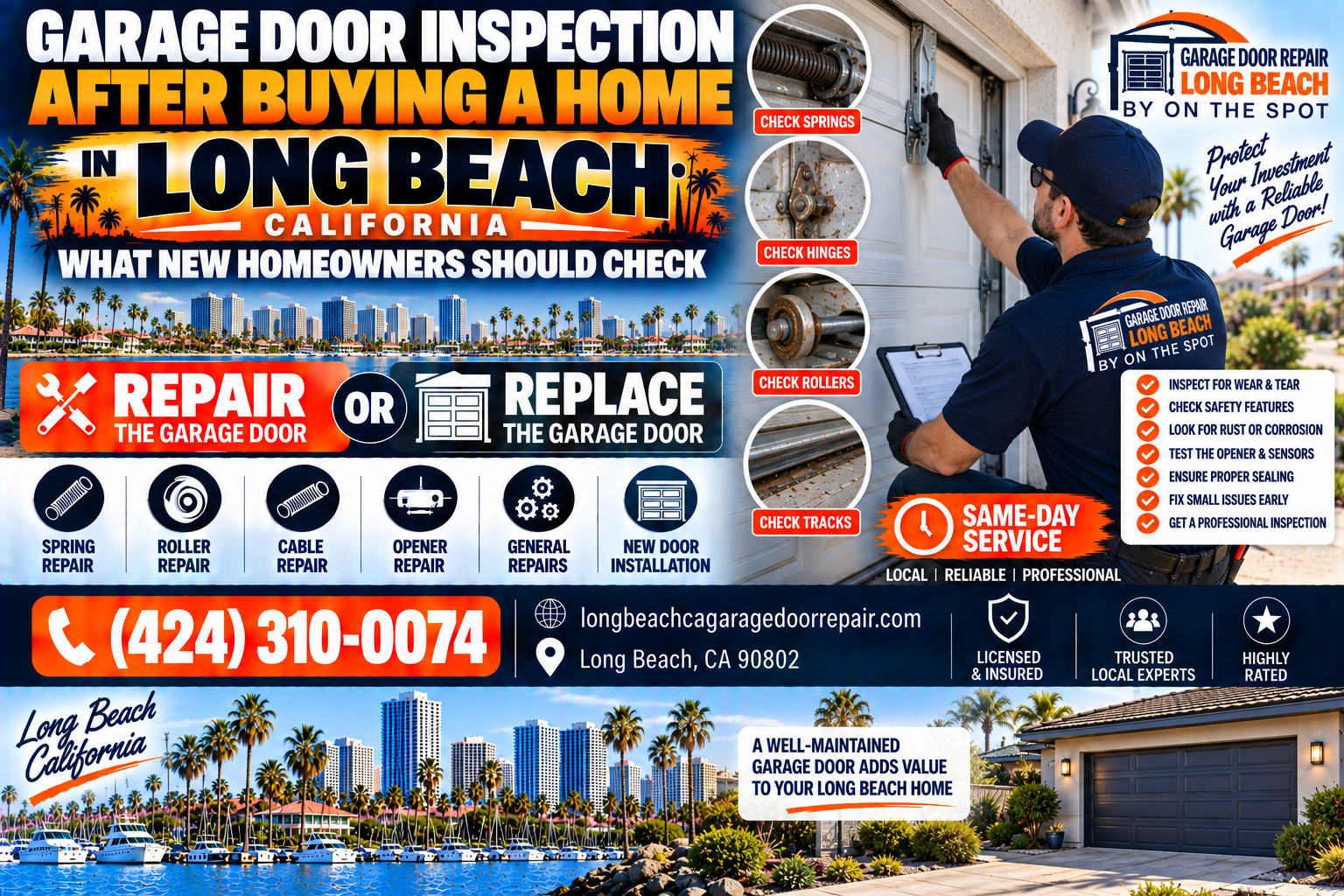
Long Beach New Homeowner Garage Door Guide
Garage Door Inspection After Buying a Home in Long Beach: What New Homeowners Should Check
After buying a home in Long Beach, inspect the garage door for auto-reverse and photo eyes, springs and lift cables, balance, opener reliability, remotes and keypad access, then weather seals and coastal rust. Learn when to schedule a pro visit in the first weeks—and why high-tension spring and cable work is never DIY.
Garage Door Repair Long Beach By On The Spot helps new homeowners, landlords, and property managers turn closing-day uncertainty into a diagnosis-first safety plan across Long Beach, CA.
Springs & Cables
Balance & Opener
Seals & Coastal Rust
CPSC + DASMA + SCE
Serving Long Beach, CA
Table of Contents
Direct Answer: What Should New Homeowners Check on a Long Beach Garage Door?
After buying a home in Long Beach, inspect the garage door for auto-reverse and photo-eye safety first, then springs and lift cables, then mechanical balance, then opener reliability, then remotes and keypad access, then weather seals and coastal rust. Schedule a professional visit in the first weeks if anything fails a safety test, looks frayed or corroded, feels heavy when disconnected from the opener, or was never documented in the seller’s disclosures.
A practical new-homeowner sequence looks like this: (1) verify photo eyes are aligned, clean, and reverse the door on contact or beam interruption; (2) look—without touching high-tension parts—for frayed cables, spring gaps, or heavy rust at bottom brackets; (3) ask a technician to confirm balance if the door feels uneven or the opener strains; (4) test wall control, remotes, and keypad codes you inherited; (5) check bottom, side, and top seals for daylight, brittle rubber, and salt-driven corrosion on panels and hardware; (6) never DIY torsion or extension spring winding, cable clamps, or track realignment under load.
Long Beach coastal air, fog, and chlorides often mean springs, cables, hinges, fasteners, and seals age faster near Belmont Shore, Naples, Alamitos Beach, and other marine-influenced streets than on quieter inland blocks. Closing day does not reset hardware age. What looked “fine” during a busy walkthrough can reveal binding, reverse failures, or cable stain once you use the door daily.
This guide is original post-purchase inspection guidance for Long Beach new homeowners—not a copy of pre-sale repair sequencing or salt-air corrosion chemistry articles. It focuses on first-weeks checks, safety demos you can observe safely, when to call Garage Door Repair Long Beach By On The Spot, and why high-tension work stays with trained technicians.
Why a Garage Door Inspection Matters in the First Weeks After Closing in Long Beach
New ownership changes how you use the door. Sellers may have opened it twice a week; you may cycle it daily with work, school, groceries, and trash. Higher cycle counts expose weak springs, sticky rollers, and intermittent sensors faster than a single open-house demo.
Home inspections catch many issues, but garage doors sit at the intersection of mechanical, electrical, and safety systems. A general inspector may note obvious defects without performing a full professional balance and force evaluation. Your job as a new owner is to treat the garage door as critical daily infrastructure—not as leftover staging.
Long Beach adds climate urgency. Marine layer moisture and salt accelerate corrosion on springs, cables, bottom brackets, hinges, and track fasteners. A door that “worked at closing” can show cable whiskers or seal gaps within weeks of coastal exposure and irrigation splash. Early inspection prevents emergency lockouts when a tired spring fails on a Monday morning.
Access control also changes at closing. Remotes, keypad PINs, and smart-opener accounts may still belong to prior owners, tenants, or contractors. Reprogramming access is part of security hygiene—and a good moment to confirm the opener and safety systems behave correctly.
Finally, warranty and repair budgets are easier to plan early. Catching a failing spring pair or misaligned photo eyes before they strand a car or injure someone is cheaper emotionally and often cheaper financially than after-hours emergencies. On The Spot helps new Long Beach homeowners turn a vague “check the garage” note into a diagnosis-first plan.
Checklist Item 1: Auto-Reverse, Photo Eyes, and Entrapment Protection
Start every new-homeowner garage door check with safety. Confirm both photo-eye sensors face each other near the floor, lenses are clean, indicator lights behave as expected, and storage does not block the beam. With the door closing under supervision, interrupt the beam with a soft object—or use the manufacturer’s recommended reverse test. Proper systems should reverse. Never unplug, tape, or bypass sensors so a sticky door will close.
Auto-reverse and force settings only make sense on a mechanically honest door. If springs are weak or tracks bind, someone may have raised force to “make it work.” That workaround is unsafe. Professional balance testing belongs before any force adjustment. CPSC guidance on automatic residential garage door operators explains why entrapment protection must remain intact; full links appear in Authority Sources.
Also check the emergency release cord (usually red), wall-control placement out of small-child reach when possible, and that the door does not continue closing hard against an obstruction. Look for chewed sensor wires, sun-faded brackets that drifted, and coastal grit on lenses—common Long Beach issues with outsized safety impact.
If the opener lacks modern entrapment features or fails reverse tests after hardware is corrected, treat opener repair or replacement as a safety item, not a luxury upgrade. As a new owner, you inherit liability optics the moment you start daily use—especially with kids, pets, or shared driveway traffic.
Document what you observe: date, reverse test result, sensor light status, and any temporary workarounds you refuse (like propped sensors). Bring those notes to your technician so the visit starts with facts, not guesswork.
Checklist Item 2: Springs, Lift Cables, Drums, and Bottom Brackets
After safety optics, springs and cables are the lift system you feel every day. A door that bangs then feels heavy, lifts unevenly, or will not stay near mid-travel during a careful professional balance check often signals spring or cable trouble. Those symptoms are not “break-in quirks”—they are stop-and-call signs.
Torsion springs above the opening and extension springs along the tracks store dangerous energy. Coastal Long Beach exposure pits spring wire and corrodes cables at drums and bottom brackets. Visible cable whiskers, rust powder under drums, gaps in torsion coils after a bang, or missing safety cables on extension springs mean professional service—not DIY clamps.
Never attempt spring winding, cable replacement, or “temporary” C-clamp tricks. High-tension failures cause serious injury. Hire trained technicians with proper tools and containment. Pair replacements are common: aged twin springs or twin cables often fail close together, and replacing only one side invites a sequel weeks into ownership.
Bottom brackets where cables attach sit in the splash zone—fog, irrigation, and driveway mist. Section loss or severe rust there is a safety item tied to cable service. New owners who paint over orange brackets without addressing structure create cosmetic cover for a mechanical problem that will still fail under load.
Budget springs and cables as early ownership priorities even if panels look presentable. A quiet, balanced door protects the opener, reduces strain on rollers and hinges, and lowers the chance of a mid-week lockout when a tired spring finally lets go.
Checklist Item 3: Balance, Travel Limits, and What Healthy Operation Feels Like
Balance means the door’s weight is correctly counterweighted by springs so the opener is not lifting a dead load. Technicians typically disconnect the opener (via the release) and carefully test whether the door holds near mid-travel. New homeowners should observe—not improvise—this test. A door that rockets up or crashes down is out of balance and unsafe to “force” with the motor.
Travel limits tell the opener where fully open and fully closed are. Incorrect limits can leave a gap under the seal, crush the bottom seal, or stop short while still claiming “closed” on a smart app. After closing, watch for daylight under the door, seal roll-over, and whether the opener hums past the stop point.
Healthy operation in Long Beach daily use looks like: consistent open and close, reverse that works, moderate noise without grinding metal, even panel travel without track rub, and remotes that work from a normal driveway distance. Occasional SCE outages can interrupt power; separate grid events from mechanical faults using outage context when behavior coincides with neighborhood blackouts.
If the prior owner raised force settings to hide binding, the door may “work” while destroying rollers, gears, and cables. New ownership is the moment to reset honesty: fix balance and binding first, then verify force and reverse on a free-moving door.
Ask your technician to explain findings in plain language—balanced or not, travel OK or not, force within safe range or not—so you can track condition over your first year of coastal ownership.
Checklist Item 4: Opener Reliability, Wall Control, and Smart Features
Once springs, cables, rollers, and tracks move freely and the door balances, evaluate the opener. It should open fully, close fully, stop and reverse appropriately, and respond consistently from the wall button. Listen for grinding gear trains, slipping trolleys, and delayed starts that hint at worn mechanics or low voltage issues.
New-homeowner opener issues in Long Beach often include weak remote range, intermittent keypads, noisy gears, frayed trolley parts, logic boards confused by prior force hacks, and smart hubs still linked to the seller’s phone. Separate electrical/opener faults from mechanical drag. If the door feels heavy when released, inspect springs before buying a new motor.
Smart openers and battery backups are useful when they work and when accounts are transferred securely. They are not substitutes for safe springs. Present features honestly to yourself: working Wi-Fi control after safety verification is a plus; an app that reports failures because sensors were defeated is a liability you should not inherit.
Power quality and outages occasionally coincide with odd opener behavior. Southern California Edison outage resources help separate neighborhood grid events from true equipment failure. Still, frayed cables found during an outage week remain a mechanical repair.
If the opener is original to an older door, noisy, and fails safety checks after hardware service, plan repair or replacement early in ownership. Choose repair when the unit is sound and symptoms were caused by balance or sensors. Choose replace when gears are spent, safety features are obsolete, or reliability remains poor after mechanical correction.
Checklist Item 5: Remotes, Keypads, and Access Handoff After Closing
Treat garage access like house keys. Confirm how many remotes you received, whether vehicles have built-in HomeLink-style buttons still programmed to the old house, and whether the outdoor keypad still accepts the seller’s PIN. Change keypad codes promptly. Clear unknown remotes from the opener’s memory when your model supports a secure wipe-and-relearn process—or have a technician do it.
Intermittent keypads near the coast often suffer from weather intrusion, weak batteries, corroded contacts, or wiring faults—not just “wrong codes.” Test in daylight and at night. If the pad works only after rain delays or only when you press hard, schedule diagnosis rather than living with unreliable entry.
Remote range that forces you to stand under the door can mean antenna issues, interference, dying remote batteries, or opener receiver problems. It can also appear when the door is hard to move and the system is struggling. Fix mechanical honesty first, then chase electronics.
Smart locks, cameras, and delivery instructions sometimes depend on reliable garage access. New owners who leave seller PINs active create unnecessary risk. Document your new codes in a secure place—not on a sticky note near the pad.
If you rent the property later, plan a reprogramming ritual between tenants. Access hygiene is part of Long Beach property management as much as it is part of first-week homeownership.
Checklist Item 6: Weather Seals, Daylight Gaps, and Coastal Rust Patterns
After the door operates safely, inspect what coastal air and pests exploit: bottom seals, side seals, top seals, and corrosion at lower panels and hardware. Daylight under the door, brittle cracked rubber, flattened seals, and gaps at the corners invite dust, bugs, and marine moisture into living-adjacent garages.
Long Beach coastal doors often show lower-panel corrosion, chalking paint, cable stain near drums, hinge fretting dust, and irrigation-driven rust at track lags and bottom brackets. You do not need to become a metallurgist—look for orange scale, flaking paint at structural corners, and fasteners that have lost section. Severe rust at cable attachment points is a safety call, not a cosmetic deferral.
Replacing a cracked bottom seal alone may not be enough if side and top seals are hardened or torn. Whole-perimeter sealing improves comfort narratives and reduces grit that abrades rollers and tracks. Coordinate seal work after major mechanical repairs so technicians are not fighting binding hardware while installing rubber.
Avoid last-minute DIY spray paint that peels in fog. Prep and product choice matter near salt air. Never use paint to “hide” compromised bottom brackets or cable drums. Cosmetics after structural safety—always.
Staging for your own daily life: clear storage from the sensor beam path and door travel, keep lenses clean, and note seasonal fog weeks when corrosion and sticky seals worsen. Early seal and rust attention is cheaper than panel replacement later.
When to Schedule a Professional Garage Door Visit in the First Weeks
Schedule a professional visit promptly if any of these apply: reverse test fails; photo eyes are missing, taped, or unplugged; cables are frayed or rusty at drums; springs show gaps or heavy pitting; the door is heavy or crooked; the opener strains or will not close consistently; you cannot change keypad codes; bottom brackets are heavily corroded; or the home inspection flagged garage door safety items you have not verified since closing.
Even without red flags, many Long Beach new homeowners benefit from a baseline professional inspection in the first 30 days—especially near the beach or after years of unknown maintenance. A baseline creates a reference for your ownership years: spring condition, cable health, opener age, seal state, and safety pass/fail.
Timing tips: book before you fill the garage with storage that blocks tracks and sensors; book before school/work routines depend on flawless morning exits; and book before guest PIN sharing begins. If escrow credits mentioned garage door work that was never completed, treat that as priority scheduling, not a footnote.
Same-day or next-day service is often available for safety failures. Non-urgent seal and cosmetic items can follow once reverse, springs, and balance are confirmed. Sequencing prevents paying twice—once for an opener that was masking a spring problem, again for the spring.
Call Garage Door Repair Long Beach By On The Spot at (424) 310-0074 to schedule diagnosis-first service from 151 E 5th St, Long Beach, CA 90802. Bring your closing notes, inspection pages, and a list of remotes and codes you inherited.
Never DIY High-Tension Spring, Cable, or Loaded Track Work
High-tension garage door springs and cables are among the most dangerous DIY projects in a home. Winding bars, cable clamps, and “YouTube temporary fixes” cause serious injuries every year. New ownership excitement is not a reason to experiment.
Safe homeowner actions include: visual observation, photo documentation, cleaning photo-eye lenses gently, testing reverse with manufacturer-appropriate methods, changing remote batteries, updating keypad codes when the system is otherwise healthy, and clearing storage from travel paths. Unsafe actions include: winding torsion springs, stretching extension springs, clamping cables, removing bottom brackets under load, drilling new track holes to “force alignment,” and bypassing sensors.
DASMA safety tips for garage door systems reinforce whole-system thinking—springs, cables, tracks, and operators work together. Links appear in Authority Sources. When in doubt, stop and call a trained technician.
If a spring breaks and the door will not move, do not try to operate it with the opener to “help.” Disconnect power if needed for safety, keep people and pets clear, and schedule professional repair. Forcing a broken-spring door can damage panels, cables, and openers—and can injure you.
Your first weeks of homeownership are exactly when professional habits pay off: document, schedule, verify, and keep high-tension work off your personal to-do list.
A Practical First-Weeks Garage Door Checklist for Long Beach New Homeowners
Use this checklist as a living document in your first month of ownership. Check items you can observe safely; mark professional items for the technician visit.
Safety: photo eyes present, facing each other, lenses clean, beam clear; reverse test performed; emergency release cord visible and intact; no sensor bypasses.
Lift hardware (look only): cables not frayed; springs not obviously broken or gapped; bottom brackets not heavily rusted through; tracks not visibly bent; rollers not jumping out.
Operation: door opens and closes fully; travel seems even; opener does not scream or grind constantly; remotes work from driveway; wall button works; keypad code changed from seller default.
Seals and coastal: bottom seal not cracked flat; side/top seals not torn; limited daylight at corners; note rust scale on lower panels and hardware for the technician.
Admin: remotes inventoried; smart-app ownership transferred; inspection report garage notes reviewed; SCE outage bookmarks saved for odd electrical weeks; On The Spot contact saved: (424) 310-0074.
If more than two safety or lift items fail, stop casual testing and schedule professional service before daily reliance hardens into risk.
Comparison Table: New-Homeowner Garage Door Inspection Priorities in Long Beach
Use this comparison to prioritize your first weeks. Safety and high-tension hardware outrank cosmetics. When two issues compete, fix the one that can injure someone or strand a vehicle first.
Long Beach coastal rows may push rust and seal rows higher sooner than inland blocks—but never above failed reverse tests or frayed cables.
| Inspection Focus | What New Owners Should Notice | Typical First Action | DIY? |
|---|---|---|---|
| Auto-reverse / photo eyes | Fails reverse, dirty/misaligned eyes, taped sensors | Clean/align if simple; professional force/balance check if persistent | Lens clean OK; no bypass |
| Springs | Bang, heavy door, gaps, heavy pitting | Professional replacement (often in pairs) | Never |
| Lift cables / brackets | Whiskers, rust at drums, orange bottom brackets | Professional cable/bracket service | Never under tension |
| Balance / travel | Crooked travel, won’t hold mid-door, seal crush/gap | Professional balance and limit setup | Observe only |
| Opener | Grind, intermittent close, obsolete safety | Repair or replace after mechanical honesty | Limited (batteries, settings per manual) |
| Remotes / keypad | Seller PIN active, weak range, weather flakiness | Reprogram, replace pad/wiring as needed | Codes/batteries OK |
| Seals | Daylight, brittle rubber, bugs/dust | Replace bottom/side/top as a system | Simple seal swaps sometimes; verify fit |
| Coastal rust | Lower panel scale, fastener loss, cable stain | Professional triage: safety vs cosmetic | Cosmetic clean only |
How to Read Your Home Inspection Notes About the Garage Door
Many Long Beach purchase contracts include a general home inspection. Garage door notes may be brief: “opener operates,” “sensors present,” “recommend specialist,” or specific flags like frayed cable or non-functional reverse. Treat specialist recommendations as action items in week one—not as optional niceties after you unpack.
Clarify language. “Operates” does not always mean “balanced, safe, and coastal-ready.” “Deferred maintenance” on springs can mean months or years of remaining life—or imminent failure. When notes are vague, a dedicated garage door technician visit converts ambiguity into a punch list with priorities.
Compare inspection photos (if provided) to what you see now. Moving day can nick seals, bump photo eyes, and shift storage into the beam path. Re-verify safety after furniture delivery trucks leave.
If the seller credited funds for garage door repairs that were never completed, keep the credit paperwork with your service appointment notes. Diagnosis should still be based on current condition, not on what was promised in a hurry at the end of escrow.
Share relevant pages with your technician. Faster triage means fewer return trips and clearer repair-versus-monitor decisions for a new Long Beach owner.
Deep Dive: Photo Eyes, Reverse Tests, and First-Week Safety Demos
Photo eyes create an invisible beam near the floor. When the beam breaks while closing, a properly functioning system should reverse. Sunlight at certain angles, chalky coastal lenses, and brackets loosened by vibration can make eyes intermittent—especially late afternoon on west-facing Long Beach alleys.
Perform safety demos with people and pets clear of the door path. Do not use a hard object that could damage panels. Follow your opener manual’s reverse and obstruction guidance. If the door ignores the beam or reverses only sometimes, stop daily reliance and schedule service.
Force-to-reverse settings are not a substitute for photo eyes. Both matter. Eyes protect against mid-height entrapment scenarios; force/contact reverse is another layer. Defeating either for convenience is unsafe and can conflict with how automatic residential operators are intended to work under CPSC consumer guidance.
Wiring along tracks often suffers from staple pinch, rodent chew, and lawn-equipment nicks. A sensor that “dies at sunset” may be a wiring or alignment issue, not a haunted opener. Technicians trace voltage and alignment systematically; guessing with new sensors alone sometimes fails if the wire is open.
New owners should also refuse any “temporary” showing-era hacks left behind—tape on lenses, sensors twisted toward the wall, or unplugged leads tucked behind a freezer. Reset to safe defaults before the door becomes part of school-run muscle memory.
Deep Dive: Springs After Closing—Monitor, Lubricate Guidance, or Replace
Springs age by cycles and by corrosion. A low-use seller home can still have ancient springs that fail soon after a high-use family moves in. Hear a bang? Stay clear, do not operate the door, and call a professional. A bang with a sudden heavy door is classic torsion spring failure.
Visible oil is not a complete spring health report. Coastal pitting can hide under surface rust color. Technicians evaluate diameter, coil condition, balance, and paired wear. Lubrication—when appropriate with the correct product—may reduce noise on healthy springs; it does not resurrect a cracked or deeply pitted spring.
Extension spring systems need intact safety cables routed correctly. Missing safety cables are a first-weeks correction item. Do not reach into the spring path to “check tension” by hand.
Pair logic: if one torsion spring fails, the mate is often near end of life. Replacing only the broken side can create uneven loads and a near-term second failure. Discuss pairing with your technician based on measurements and age, not just the broken piece on the floor.
For new owners budgeting, spring replacement is frequently the highest-value early repair because it protects the opener, cables, and your schedule. Cosmetics can wait a weekend; a failed spring should not.
Deep Dive: Cables, Drums, and Bottom Brackets New Owners Should Not Ignore
Lift cables carry the door’s weight in concert with springs. Frayed strands—especially near drums or bottom brackets—are a stop-use visual flag. Cable stain on the wall or header can indicate ongoing abrasion or corrosion shedding.
Bottom brackets in Long Beach splash zones rust from the inside out. A bracket that looks merely orange may have lost structural section. Because cables terminate there, bracket failure is a safety event. Professional replacement often accompanies cable service.
Never clamp a cable to “hold until weekend.” Clamps and vise-grips belong in technician-controlled procedures with the door properly supported—not in DIY weekends after closing.
Drum issues—cables off the grooves, unequal wraps, damaged drums—create crooked travel and panel binding. Crooked doors then damage weather seals and strain openers. Early correction prevents cascade failures in your first months.
If you notice one side of the door higher than the other when fully closed or open, photograph it and schedule service. Do not repeatedly run the opener hoping it will self-level.
Deep Dive: Opener Repair vs Replace for New Long Beach Homeowners
Opener decisions should follow mechanical honesty. A strained opener on weak springs is not “an opener problem” first. After balance and binding are corrected, evaluate noise, gear condition, safety logic, remote receivers, and feature needs (battery backup, myQ-style connectivity, quieter belt drives).
Repair makes sense when the chassis is sound, safety features work after setup, and a known wear item (gear, capacitor, trolley pull, logic board within support) failed. Replace makes sense when parts are obsolete, entrapment features are inadequate by modern expectations, the unit repeatedly faults after mechanical fixes, or quiet reliable daily use matters more than salvaging an aged motor.
New owners sometimes inherit openers still registered to sellers. Transfer accounts, update Wi-Fi, and confirm firmware only after physical safety checks pass. An app green checkmark does not override a failed photo-eye demo.
Battery backups help during SCE outages if maintained. Test per manufacturer guidance and replace aging batteries rather than discovering failure during a night outage. Outage center links in Authority Sources help distinguish grid events from equipment faults.
Budget openers as mid-priority after springs/cables/safety unless the opener itself fails reverse or will not run. A new motor on a dangerous door is backwards spending.
Deep Dive: Seals, Dust, Bugs, and Coastal Air After You Move In
Garages in Long Beach often connect to laundry areas, workshops, or living spaces via doors that leak comfort when the big door seals fail. Brittle bottom seals flatten, side seals curl, and top seals drop grit onto cars. Replacing the perimeter as a system is often wiser than a single cheap bottom sweep.
Coastal air carries salt and moisture that condense on cool metal. Seals reduce—but do not eliminate—that load. Pair seal replacement with a rust triage: safety hardware first, then panel cosmetics.
Threshold seals on the floor can help certain slabs, but only if water paths and door travel are understood. Improper thresholds can bind the door or create trip hazards. Ask a technician before adding layers that change closing geometry.
Pest pressure rises when daylight gaps persist. New owners who seal early reduce spider webs on sensors and rodent interest in opener wires—both of which circle back to safety reliability.
After seal service, recheck reverse and travel. A thicker seal can change where the door meets the floor; limits and force may need professional tweak so the opener does not treat a good seal like an obstruction.
False Fixes New Homeowners Should Avoid After Closing
False fix one: raising opener force until the door closes despite binding. You hide a spring or track problem and increase entrapment risk.
False fix two: bypassing or aiming photo eyes away so the door will close for unpacking. Convenient tonight, indefensible tomorrow.
False fix three: WD-40 everything. Wrong lubricants attract grit in coastal dust and can worsen roller and hinge wear. Use products appropriate for garage door hardware—or let a technician lubricate correctly.
False fix four: clamping cables or wiring springs with rope. These are injury patterns, not hacks.
False fix five: painting over rotten bottom brackets and calling it a refresh. Paint is not structural steel.
False fix six: buying a new opener online before a balance check. You may install a louder way to break the same tired springs.
False fix seven: ignoring intermittent keypad failures until someone is locked out at night. Weather and wiring rarely heal alone near the harbor.
Choose diagnosis-first habits. On The Spot exists so new owners do not learn garage doors through emergency scars.
Red Flags: Stop Casual Use and Call for Garage Door Service Now
Stop and call if: the door reverses inconsistently or not at all; sensors are missing or defeated; a spring is broken; cables are frayed; the door is crooked and binding; metal grinding accompanies travel; bottom brackets are critically corroded; the door fell or slammed; or the opener smokes, sparks, or repeatedly resets.
Also call promptly if children or pets share the garage and any safety test fails. New ownership means new traffic patterns—delivery drivers, babysitters, and guests who do not know the door’s quirks.
If the door is stuck closed with a broken spring, do not force the opener. If stuck open, secure the property another way and keep the opening clear of walkways until professionals arrive.
Document with photos from a safe distance. Clear driveway access for the service vehicle when you can. Note any home-inspection flags related to the door.
Call (424) 310-0074 for Garage Door Repair Long Beach By On The Spot. Safety-first scheduling beats hopeful another-week delays.
Coastal Long Beach New-Owner Notes: Belmont Shore, Naples, Alamitos, and Inland
Belmont Shore and Naples homes often see accelerated salt-air effects on springs, cables, fasteners, and lower panels. Fog mornings plus afternoon sun cycle moisture. Expect seal and rust checks sooner in your ownership calendar.
Alamitos Beach and shoreline-adjacent streets share corrosion pressure and sometimes tighter alley clearances that make misaligned tracks more punishing. Keep travel paths clear; small rubs become big panel damage.
Inland Long Beach neighborhoods—Bixby Knolls, Los Altos, El Dorado Park area, and others—may show slower salt corrosion but still suffer irrigation splash rust, sun-baked seals, and high cycle counts from family use. Do not skip the first-weeks safety checklist inland.
Downtown, Wrigley, Rose Park, Traffic Circle, and West Long Beach properties vary by building age and alley vs driveway geometry. Older openers and wood jambs need careful fastener and track evaluation after purchase.
Wherever you closed, the NAP stays the same for help: Garage Door Repair Long Beach By On The Spot, 151 E 5th St, Long Beach, CA 90802, (424) 310-0074.
Practical Long Beach New-Homeowner Garage Door Scenarios
Scenario A: Closing week reverse test fails. You pause heavy garage use, clear the beam path, clean lenses, retest once, then book professional service if still failing—no sensor bypass while unpacking.
Scenario B: Move-in day bang. Possible spring failure. You leave the door alone, keep kids clear, call for spring and cable evaluation, and arrange alternate parking.
Scenario C: Seller PIN still works on the keypad two weeks later. You reprogram immediately, inventory remotes, and ask a technician to clear unknown transmitters if needed.
Scenario D: Door works but daylight and bugs stream under the seal. You schedule seal replacement after confirming balance and reverse are healthy so the opener accepts the new seal height.
Scenario E: Opener strains; home inspector said “operates.” You request a balance-focused visit; springs are weak; replacing springs restores quiet travel without a new motor.
Scenario F: Intermittent close at sunset on a west-facing alley. Eyes are sun-affected and slightly loose. Professional realignment and brackets solve it—no force hacks.
Scenario G: Credit for “garage door tune-up” never performed. You schedule a full baseline inspection and apply the credit toward real safety and lift repairs, not cosmetic spray alone.
These scenarios are illustrative patterns On The Spot sees around Long Beach—not guarantees of your exact hardware.
Myths About Garage Door Inspection After Buying a Long Beach Home
Myth: If it opened during the inspection, it is fine for years. Reality: cycle count and coastal corrosion change after you move in.
Myth: Openers are the main safety system. Reality: springs, cables, balance, photo eyes, and reverse logic all matter together.
Myth: Lubricant fixes dangerous springs. Reality: lube is not a structural repair.
Myth: You should DIY springs to save money as a new owner. Reality: ER visits cost more than professional spring service.
Myth: Only beach houses rust. Reality: irrigation, fog, and dew corrode inland doors too—often at bottom brackets first.
Myth: Smart phone status equals safe door. Reality: apps can look fine while eyes are misaligned or force is excessive.
Myth: Bottom seal replacement alone always stops bugs. Reality: side and top seals and threshold conditions matter.
Myth: Waiting until the first failure is cheaper. Reality: planned first-weeks service prevents cascade damage and lockouts.
Questions to Ask a Technician During Your First Garage Door Visit
Ask: Did the door pass photo-eye and reverse testing after any adjustments?
Ask: Is the door balanced? Should I avoid operating it until springs or cables are corrected?
Ask: Are cables, drums, and bottom brackets safe for continued daily use near coastal air?
Ask: What is the opener’s condition after mechanical honesty is restored—repair, replace, or monitor?
Ask: Which seals should be replaced as a system, not piecemeal?
Ask: Can you clear old remotes and help verify keypad programming after I change the code?
Ask: What maintenance interval makes sense for my neighborhood’s corrosion and cycle pattern?
Ask: What should I watch for in the next 90 days that would trigger a callback?
Write answers down. New ownership is noisy; memory fades; notes keep you safe.
Why Garage Door Repair Long Beach By On The Spot for New-Owner Inspections
Garage Door Repair Long Beach By On The Spot focuses on diagnosis-first service: safety and auto-reverse, springs and cables, balance, opener reliability, access devices, and coastal seal/rust triage sequenced for real households—not one-size upsell scripts.
New homeowners get plain-language explanations. You should leave knowing what passed, what failed, what is optional, and what is unsafe to defer. That clarity matters when you are already juggling utilities, schools, and unpacking.
Local context matters. Coastal blocks near Belmont Shore and Naples differ from inland Bixby Knolls patterns. Technicians who work Long Beach daily recognize cable stain, irrigation rust, and sun-angle sensor complaints without treating them as mysteries.
High-tension work stays professional. You should never be encouraged to wind springs yourself. Our posture matches DASMA-style whole-system safety thinking and CPSC consumer caution around automatic operators.
Call (424) 310-0074, visit longbeachcagaragedoorrepair.com, or find us at 151 E 5th St, Long Beach, CA 90802. Maps: Google Maps CID listing.
Areas Served From the Long Beach Location
New-homeowner inspection and repair coverage includes Belmont Shore, Naples, Alamitos Beach, Downtown Long Beach, Bixby Knolls, Los Altos, El Dorado Park area, Traffic Circle, Rose Park, Wrigley, West Long Beach, and nearby Long Beach communities where recent closings need safe, reliable garage doors in the first weeks of ownership.
If your move-in timeline is tight, call early—spring and opener parts availability can shape sequencing even when labor can arrive same day.
Google Map Location
Find Garage Door Repair Long Beach By On The Spot at 151 E 5th St, Long Beach, CA 90802. Use this Google Maps link for directions and business details: https://www.google.com/maps?cid=5381478035707257267.
Phone (424) 310-0074 before visiting if you need a first-weeks safety check, spring and cable service, opener reliability repairs, remote/keypad help, or seal and rust guidance after buying a Long Beach home. Most repair-versus-monitor decisions are clearest on site with the door hardware in view.
FAQs About Garage Door Inspection After Buying a Home in Long Beach
These FAQs target common new-homeowner questions after closing in Long Beach. They support AEO-style direct answers while pointing back to professional service for high-tension and failed safety tests.
What should new homeowners check first on a Long Beach garage door?
Auto-reverse and photo eyes first, then springs and cables, then balance, then opener reliability, then remotes/keypad, then seals and coastal rust. Schedule a pro visit in the first weeks if anything fails a safety test.
How soon after closing should I inspect the garage door?
Within the first weeks—ideally before daily routines depend on flawless operation. Re-check after move-in trucks may have bumped sensors or seals.
Can I test garage door springs myself?
You can look for obvious damage from a safe distance, but never wind, adjust, or clamp springs or cables. High-tension work is professional-only.
What is an auto-reverse test and why does CPSC guidance matter?
It verifies the door reverses when the beam is interrupted or when appropriate contact/force conditions occur. CPSC consumer FAQ material emphasizes intact entrapment protection on automatic residential operators—do not defeat sensors.
The home inspector said the opener works. Do I still need a specialist?
Often yes for baseline balance, cable/spring condition, and coastal rust triage. “Operates” is not the same as “safe and balanced for daily family use.”
Should I change the garage keypad code after buying?
Yes. Change PINs promptly, inventory remotes, and clear unknown transmitters when supported. Treat access like house keys.
Why do Long Beach garage doors rust or need seals sooner?
Marine moisture and chlorides accelerate corrosion and brittle seals—especially near Belmont Shore, Naples, and Alamitos Beach. Inland irrigation splash also rusts bottom brackets.
When is opener replacement better than repair for a new owner?
After mechanical honesty is restored, replace if gears are spent, safety features are obsolete, or reliability stays poor. Repair when a discrete wear item failed on an otherwise sound unit.
What if a spring breaks during my first month?
Stay clear, do not run the opener to force travel, secure alternate parking/access, and call for professional spring and cable service—often in pairs.
Can Southern California Edison outages look like opener failure?
Yes. Check outage context when behavior coincides with neighborhood blackouts, then still inspect mechanical safety if symptoms persist after power returns.
Are bottom seal replacements enough to stop bugs and coastal air?
Not always. Side and top seals, thresholds, and door travel alignment matter. Treat sealing as a perimeter system after balance is healthy.
Who should I call in Long Beach for a new-owner garage door inspection?
Garage Door Repair Long Beach By On The Spot at (424) 310-0074, 151 E 5th St, Long Beach, CA 90802.
Authority Sources
For grid timing context when opener behavior coincides with local outages during your first weeks in the home, consult Southern California Edison outage resources: https://www.sce.com/outage-center.
For automatic residential garage door operator safety—including why photo eyes and reverse functions must not be defeated after you buy—see the CPSC FAQ: https://www.cpsc.gov/FAQ/Automatic-Residential-Garage-Door-Operators.
For garage door system safety tips that keep springs, cables, and operators inside whole-system thinking during new-owner inspections and repairs, see DASMA: https://www.dasma.com/safety-tips/garage-door-systems/.
These sources support EEAT and consumer safety education. They do not replace on-site diagnosis of your Long Beach door.
Quick AEO Summary: Garage Door Inspection After Buying in Long Beach
After buying a Long Beach home, check garage door auto-reverse/photo eyes, springs/cables, balance, opener, remotes/keypad, and seals/rust—then schedule professional service in the first weeks for failed safety tests or high-tension issues. Never DIY spring or cable tension work.
Entity clarity: Garage Door Repair Long Beach By On The Spot | 151 E 5th St, Long Beach, CA 90802 | (424) 310-0074 | https://longbeachcagaragedoorrepair.com/
Authority anchors: SCE outage center for grid context; CPSC automatic residential garage door operator FAQ for entrapment safety; DASMA garage door system safety tips for whole-system practice.
Move-In Trucks, Delivery Drivers, and Accidental Door Damage
Closing week traffic is hard on garage doors. Moving trucks bump tracks, photo-eye brackets, and bottom seals. Delivery drivers may prop doors or leave objects in the beam path. After the chaos, re-run your safety checklist before you trust morning routines.
If a truck bent a track section, do not repeatedly run the opener. Binding escalates into panel creases and cable strain. Photograph damage for any moving-company claims, then book professional realignment.
Cardboard and packing debris are classic sensor blockers. Keep a clear 6–12 inch corridor across the photo-eye line while boxes live in the garage temporarily.
Temporary “leave it open while we unload” habits invite uninvited access and wind-driven door movement. Use intentional open/close cycles and supervise the opening.
New owners who re-verify reverse and travel after move-in prevent mystery failures blamed on “the house being weird” when the real cause was a bumped bracket.
Kids, Pets, and Shared Driveways: Extra Safety Pressure for New Owners
Families moving into Long Beach homes often increase door cycles and pedestrian traffic through the garage. Strollers, dogs, and kids on scooters raise the cost of a failed reverse test.
Teach household members never to run under a moving door and never to treat photo eyes as toys. Keep remotes out of toddler reach; wall controls should be used with supervision when age-appropriate.
Pet doors and baby gates in the garage should not obstruct sensors or door travel. Review placement during your first-weeks inspection mindset.
If you share an alley or driveway apron, uneven closing or sudden reverses can surprise neighbors. Reliable, quiet, balanced operation is community courtesy as well as safety.
Any safety failure with children or pets in the home is an immediate professional service trigger—not a watch item.
New Investor Owners, Rentals, and Short-Term Stays
If your “new home” is actually a new rental asset in Long Beach, garage door inspection is tenant-safety infrastructure. Document reverse tests, spring condition, and access reprogramming between occupants.
Short-term stays multiply remote and keypad handoffs. Use unique codes per turnover when the hardware supports it, and wipe guest remotes promptly.
HOA alley rules may constrain when noisy spring work can occur. Book earlier in the day and communicate with neighbors when possible.
Deferred spring maintenance on rentals creates emergency callouts that upset guests and reviews. Baseline inspections after acquisition prevent that pattern.
On The Spot can help investor owners standardize a post-acquisition garage door checklist across multiple Long Beach properties.
Tracks, Rollers, and Hinges: Binding Problems New Owners Feel as “Opener Issues”
Binding tracks and flat-spotted rollers often present as opener strain. New owners replace remotes or blame Wi-Fi before noticing track rub marks or roller noise.
Coastal grit plus wrong grease becomes paste that resists travel. Professional cleaning and correct lubrication differ from spraying random oils that attract more sand.
Hinges fatigue with cycles; loose hinge fasteners add slap noise and panel misalignment. Visual checks during your first weeks catch loose hardware before panels crease.
Bent tracks from prior impacts need professional correction. DIY hammering rarely restores safe geometry and can worsen cable angles.
Ask your technician to evaluate the rolling hardware whenever springs are serviced—balance repairs on damaged rollers leave residual noise and wear.
Manual Operation, Emergency Release, and Cars That Must Leave
Know where the emergency release cord is before you need it. In an outage, a balanced door can often be operated manually; an unbalanced or broken-spring door may be unsafe to lift by hand.
If you must leave during a failure, arrange alternate parking rather than fighting a dangerous door. Protect your back and your panels.
Re-engage the trolley correctly after manual use per your opener design. Half-engaged trolleys cause mysterious “opener runs but door does not move” complaints.
Battery backups reduce manual-operation frequency during SCE events if maintained. They do not fix broken springs.
Include a quick emergency-release orientation in your household welcome briefing for partners, older kids, and trusted neighbors who might help during travel.
Field Inspection Flow: From Closing Packet to Safe Daily Use
Step one: gather the home inspection garage notes, seller disclosures mentioning the door, remote inventory, and any smart-opener login info. Step two: perform safe visual and reverse checks listed earlier. Step three: book professional service for anything failed or unclear—especially springs, cables, balance, and reverse. Step four: complete access reprogramming. Step five: retest and file a one-page household summary.
Technicians typically start with safety optics and mechanical freedom, then balance, then opener behavior, then accessories and seals. Expect questions about recent bangs, coastal exposure, irrigation, and whether force settings were previously altered.
After service, operate the door several times with attention—not distraction. Confirm remotes from the street, keypad at night, and reverse once more. Log the date of spring replacement or seal work for future maintenance.
If parts are ordered, ask what is safe meanwhile. Sometimes limited use is OK; sometimes the door should stay closed or disconnected until springs arrive.
This flow turns a vague new-owner anxiety into a sequenced plan that fits Long Beach move-in chaos.
Cost Framing Without Fake Prices: Where First-Weeks Money Usually Goes
Without quoting fake dollar amounts, new-owner spend typically clusters around: safety sensor correction (often modest if wiring is intact), spring and cable sets (commonly the largest early mechanical line), opener repair parts or full replacement (variable), seal kits (moderate), and rust-related bracket or hardware replacements (variable by severity).
Money wasted usually looks like: new opener before springs, paint before bracket safety, or repeated DIY purchases that do not address balance. Money well spent looks like: verified reverse, honest springs, secure access, and seals that match a free-traveling door.
Ask for prioritized options: must-fix now, should-fix soon, monitor. That triad helps households spreading costs across the first quarter of ownership.
Escrow credits, if any, should map to real safety and lift work first. Cosmetic panel work can follow once the door is trustworthy.
On The Spot explains tradeoffs on site so you are not buying fear—or deferring danger.
Smart Openers, Cameras, and Digital Handoff After Closing
Smart ecosystems complicate ownership transfer. Seller phone accounts may still own the garage device. Remove seller access, accept manufacturer transfer flows, and update Wi-Fi credentials that changed when you replaced the router.
Cameras aimed at driveways sometimes alert on every door motion. Tune notifications so real safety events are not ignored as noise. Do not let camera apps replace photo-eye hardware.
Guest PIN features are helpful for cleaners and dog walkers—if you revoke them on schedule. Forgotten guest codes are a top new-owner oversight.
If the prior owner used voice assistants to open the garage, audit linked skills and devices. Digital leftovers are physical access risks.
Technology is a layer on top of springs and sensors—not a substitute. Keep that hierarchy when budgeting gadgets in month one.
Fog Weeks, Heat Spikes, and Seasonal Behavior New Owners Misread
Long Beach fog weeks increase surface moisture on springs, cables, and tracks. Doors can sound different without being on the brink of failure—but new noises still deserve a look if paired with travel changes.
Heat spikes can soften failing weather seals and expand tracks slightly. A door that rubs only on hot afternoons may have clearance and roller issues needing professional adjustment.
Wind events in alley corridors can push lightweight doors or slam partially open sections. Confirm locking/closing behavior and do not leave doors unattended open in gusts.
First-year ownership teaches your door’s seasonal personality. Keep a simple note on your phone: date, symptom, weather. Patterns help technicians.
Seasonal change is never an excuse to bypass sensors “just until summer.”
Jambs, Fasteners, and Structural Clues Beside the Door
Tracks mount to wood or steel jambs. Rotten wood or stripped lags let tracks drift—especially where irrigation wets the exterior trim. New owners should note soft wood, gaps behind track flanges, and fastener rust.
Header conditions above the opening matter for torsion systems. Significant cracks or prior amateur holes deserve professional and sometimes structural attention beyond a typical tune-up.
Earthquake retrofit history in Long Beach varies by property. Do not assume garage bracing hardware interacts safely with door tracks without a look. Keep storage from overloading wall areas that hold track fasteners.
If the door frame shifted after settling or prior foundation work, door symptoms may be geometric, not merely “old springs.” Diagnosis should consider building movement cues.
Flag structural concerns early; spring service alone will not fix a moving jamb.
Panels, Windows, and Curb Appearance After You Own the Home
Once safety and lift are healthy, decide how much curb appearance matters for your pride of ownership—not for a listing. Dents, chalking, and cloudy window inserts are quality-of-life items you can schedule after critical repairs.
Insulated panels and window placement affect noise and temperature in garage workshops. Replacement doors are sometimes cleaner than stacking tiny panel patches on a widely corroded coastal door.
Match finishes to salt exposure expectations. Ask about materials and coatings suited to marine influence rather than inland-only assumptions.
Avoid magnetic “temporary” covers that interfere with sensors or get sucked into travel paths.
Appearance work should never postpone failed reverse tests or frayed cables.
EEAT Notes for New Homeowners Reading This Long Beach Guide
Experience: this guide reflects practical first-weeks inspection patterns seen on Long Beach garage doors—coastal corrosion, move-in sensor bumps, access handoff gaps, and spring failures after cycle counts rise.
Expertise: prioritize auto-reverse and photo eyes, springs and cables, balance, opener reliability, remotes/keypads, and seals/rust, with explicit refusal of DIY high-tension work.
Authoritativeness: cite SCE for outage context, CPSC for automatic residential operator safety FAQs, and DASMA for garage door system safety tips.
Trustworthiness: no fake prices, no encouragement to bypass sensors, clear NAP for Garage Door Repair Long Beach By On The Spot, and separation between educational content and on-site diagnosis.
Originality: this post addresses post-purchase inspection—not seller pre-listing sequencing and not a duplicate of salt-air chemistry articles.
Semantic SEO, AEO, and GEO Notes for This Post-Purchase Guide
Primary intent entities: garage door inspection after buying a home, Long Beach new homeowners, auto-reverse, photo eyes, torsion springs, lift cables, opener, keypad, weather seals, coastal rust, professional service, never DIY springs.
AEO direct answer: check safety reverse first, then springs/cables, balance, opener, access devices, seals/rust; call a pro in the first weeks for failures; never DIY high-tension work.
GEO entities: Long Beach, Belmont Shore, Naples, Alamitos Beach, Bixby Knolls, Los Altos, Downtown Long Beach, 151 E 5th St, CA 90802, On The Spot.
Supporting questions captured in H2/FAQ form: how soon to inspect, what inspectors meant, when to replace openers, how outages confuse diagnosis, how coastal air changes seals and rust timelines.
Internal differentiation: not the pre-sale repair-order article; not the salt-air parts article; this is the after-buying checklist article.
Glossary: Post-Purchase Garage Door Terms in Plain Language
Photo eyes: near-floor sensors that project a beam; breaking the beam while closing should reverse a proper system.
Auto-reverse: the door’s behavior of reversing when it senses an obstruction or beam break per design.
Torsion springs: springs above the opening that counterbalance the door; dangerous to adjust without training.
Extension springs: springs along the sides/tracks; need safety cables.
Lift cables: steel cables that lift the door in sync with springs and drums.
Bottom brackets: hardware at the bottom corners where cables often terminate; rust-critical in coastal splash zones.
Balance: spring counterweight correctness so the opener is not lifting a dead door.
Travel limits: opener settings for full open and full close positions.
Emergency release: cord that disconnects the door from the opener for manual operation.
Weather seal: rubber or vinyl barriers at bottom, sides, and top that block daylight, pests, and air.
New-Owner Call Script for Garage Door Inspection in Long Beach
When you call (424) 310-0074, you can say: “Hi, I just bought a home in Long Beach and need a garage door inspection. The reverse test [passed/failed]. I [do/do not] see frayed cables or spring issues. The keypad [still has the seller code / has been changed]. I’m near [neighborhood]. When can a technician check safety, springs, balance, opener, and seals?”
Add: move-in date, whether the door is currently safe to use, whether a car is trapped, and any home-inspection notes. Clear driveway access helps same-day visits.
Ask for plain-language priorities after diagnosis. Confirm whether temporary limited use is acceptable if parts are required.
Save the NAP: Garage Door Repair Long Beach By On The Spot, 151 E 5th St, Long Beach, CA 90802, https://longbeachcagaragedoorrepair.com/.
A clear call shortens triage and gets your household back to safe routines faster.
A 90-Day Garage Door Plan After Buying in Long Beach
Days 1–7: safety reverse check, visual cable/spring look, remote inventory, keypad code change, clear beam path after movers, book pro visit if anything fails.
Days 8–30: complete professional baseline inspection; repair safety and high-tension items; verify opener after mechanical honesty; replace critical seals if daylight and pests are issues.
Days 31–60: monitor noise and travel; confirm smart-account handoff finished; address secondary cosmetics if desired; note fog-week behavior.
Days 61–90: revisit any “monitor” items; schedule follow-up if coastal rust was borderline; update your household notes with parts replaced and dates.
This plan is flexible. Safety failures collapse the calendar to “now.” Cosmetics expand it. Springs and cables never wait on paint.
What to Prepare Before Your New-Owner Service Visit
Clear storage from tracks, springs, and sensor lines. Provide parking space for the service vehicle when possible. Secure pets. Have remotes and keypad locations ready. Know Wi-Fi passwords only if smart features must transfer that day.
List symptoms with times of day—sunset failures hint at sun on eyes; morning heaviness after fog hints at corrosion drag or seal stick.
Share inspection PDF pages or photos on your phone. Point out irrigation heads that soak bottom brackets.
Decide decision-makers: who can approve spring replacement the same visit if recommended for safety.
Afterward, request a short summary of what passed, what was replaced, and what to watch. Stick it in your home binder.
Putting It Together: Your Post-Purchase Garage Door Plan
Buying a Long Beach home makes the garage door your daily safety system. Inspect auto-reverse and photo eyes, springs and cables, balance, opener reliability, remotes and keypads, and seals plus coastal rust—then schedule professional help in the first weeks for anything unsafe or unclear.
Never DIY high-tension spring or cable work. Use SCE outage context wisely, honor CPSC entrapment-protection guidance, and follow DASMA-style whole-system safety thinking.
Sequence spending: safety → lift hardware → opener confirmation → access hygiene → seals/rust → cosmetics. That order protects people, pets, vehicles, and your sanity during move-in.
Neighborhood climate varies from Naples mist to inland sun, but the checklist spine stays the same. Document, verify, and call early rather than after a stranded-car morning.
Garage Door Repair Long Beach By On The Spot is ready to turn your closing packet uncertainty into a measured, safe operating door.
Call for Garage Door Inspection Help After Buying in Long Beach
If you just closed on a Long Beach home and need a garage door inspection—auto-reverse, springs, cables, balance, opener, remotes, keypad, seals, or coastal rust triage—contact Garage Door Repair Long Beach By On The Spot.
Phone: (424) 310-0074
Address: 151 E 5th St, Long Beach, CA 90802
Web: https://longbeachcagaragedoorrepair.com/
Maps: https://www.google.com/maps?cid=5381478035707257267
Request a diagnosis-first visit in your first weeks of ownership. We will help you separate safe daily use from must-fix hazards—without asking you to DIY high-tension repairs.
Serve your household the same courtesy you expect from a solid inspection: clear findings, prioritized fixes, and a door that reverses, lifts, and seals the way a Long Beach home demands.
Storage Layout After Moving In: Protecting Sensors and Travel Paths
Move-in storage is the silent enemy of photo eyes. Freezers, shelving, and bike racks drift into the beam line. Mark a keep-clear zone across the sensors with tape on the floor for the first month until muscle memory forms.
Vertical storage against tracks risks roller strikes. Keep at least a safe clearance along the full travel of hinges and cables—without touching cables or springs.
Ceiling hoists and overhead racks must not interfere with opener rails or torsion shafts. Measure twice before drilling.
Cardboard piles against the door face create moisture traps that worsen coastal corrosion on lower panels. Leave a drying gap.
A clean travel corridor is free safety insurance between professional visits.
Insurance and Claims Awareness at a High Level (Not Advice)
This section is general awareness, not insurance or legal advice. Some policies distinguish wear-and-tear from sudden spring failure or impact damage. Document condition early with dated photos after closing.
If a moving company damages tracks or panels, photograph immediately and follow your contract’s claim steps. Professional repair estimates help.
Do not operate a door that is structurally unsafe just to “see if insurance will cover it later.” Safety first; paperwork second.
Ask your carrier or agent about coverage questions specific to your policy. Technicians document mechanical findings; they do not interpret policies.
Early professional inspection creates a baseline that clarifies what was pre-existing versus what changed during ownership.
HOA Alleys, Shared Walls, and Neighbor Courtesy During First Repairs
Many Long Beach properties use alleys for garage access. HOA quiet hours may affect when noisy spring work occurs. Book earlier slots when possible.
Shared walls can transmit opener vibration. After repairs, confirm the door is balanced so the opener is not fighting the door and humming into neighboring units.
Parking during service may temporarily block alleys—coordinate with neighbors when feasible and keep access for emergency vehicles in mind.
Cosmetic standards in some associations push panel appearance; still do not let HOA aesthetics outrank failed reverse tests.
Provide technicians gate codes securely and change temporary codes after work if your community requires unique vendor access.
Driveway Slope, Standing Water, and Bottom-Hardware Corrosion
Driveways that drain toward the garage soak bottom seals and brackets. New owners should watch where rain and irrigation water settle after the first storms of ownership.
Standing water accelerates cable-end and bracket corrosion—the same parts that are safety-critical. Redirect sprinklers that mist the door face daily.
Threshold improvements and seal upgrades help only when water paths are understood. Trapping water inside can be worse than a minor gap.
After heavy rain, check for new door-bottom rust staining and swollen wood jambs at track lags.
Mention drainage patterns during your professional visit; coastal corrosion plus poor drainage is a double accelerator.
Noise, Vibration, and Sleep-Adjacent Garages
Garages under living spaces or beside bedrooms make door noise a quality-of-life issue for new owners. Some noise is normal; grinding metal and impact bangs are not.
Balance and roller condition drive much of the perceived racket. A strained opener amplifies everything at 6 a.m. school runs.
Belt-drive openers are often quieter than older chain units when mechanical hardware is healthy—but swapping openers alone will not silence a binding door.
Lubrication helps when done correctly; it is not a cure for flat rollers or failed bearings.
Ask for noise-focused adjustments after safety and balance are confirmed if sleep disruption is part of your move-in complaint list.
Parts Lead Times and Why Early Booking Beats Emergency Weekends
Common springs and seals are often available quickly; specialty openers, custom cables, uncommon drums, or matched panel sections may take longer. Early first-weeks inspections reveal special-order needs before you depend on flawless commuting.
Weekend failures after a month of “it seemed fine” collide with family schedules. Baseline service after closing is calendar risk management.
If parts are ordered, clarify interim safety: leave closed, disconnect opener, alternate parking, etc.
Keep remotes and manual operation knowledge ready during the wait—without forcing unsafe lifts.
Communicating lead times clearly is part of trustworthy service; ask rather than assume same-hour miracles for rare parts.
After-Repair Verification Checklist New Owners Can Understand
After technicians leave, verify: reverse works; door opens and closes fully; travel looks even; remotes operate from typical driveway distance; keypad accepts your new code only; emergency release is re-engaged properly; seals meet the floor without huge daylight corners; no fresh grinding appears on the first ten cycles.
If anything regressed overnight—common when brackets settle or limits need a tweak—call back promptly rather than living with it.
File invoices and part descriptions. Future you will want spring replacement dates when the next decade arrives.
Share operating quirks with all household drivers the same day so nobody “troubleshoots” by raising force.
Verification is the last mile of EEAT in practice: trust comes from confirmed behavior, not promises.
Mindset for New Long Beach Owners: The Garage Door Is Infrastructure
It is easy to treat the garage door as a leftover appliance. Treat it as infrastructure: safety device, access control, weather barrier, and daily mobility tool.
Infrastructure gets baseline inspections, documented repairs, and professional handling for hazardous subsystems. That mindset prevents both injuries and the slow normalization of unsafe hacks.
Long Beach’s coastal setting raises the maintenance tempo. Build a light annual reminder—even if your first weeks were perfect.
When friends ask how the new place is, “we verified the garage door reverse and springs early” is a strangely proud, deeply practical answer.
On The Spot is here when that mindset needs skilled hands at 151 E 5th St or on site at your new address.