
Garage Door Repair Long Beach By On The Spot · Replacement Timing Guide
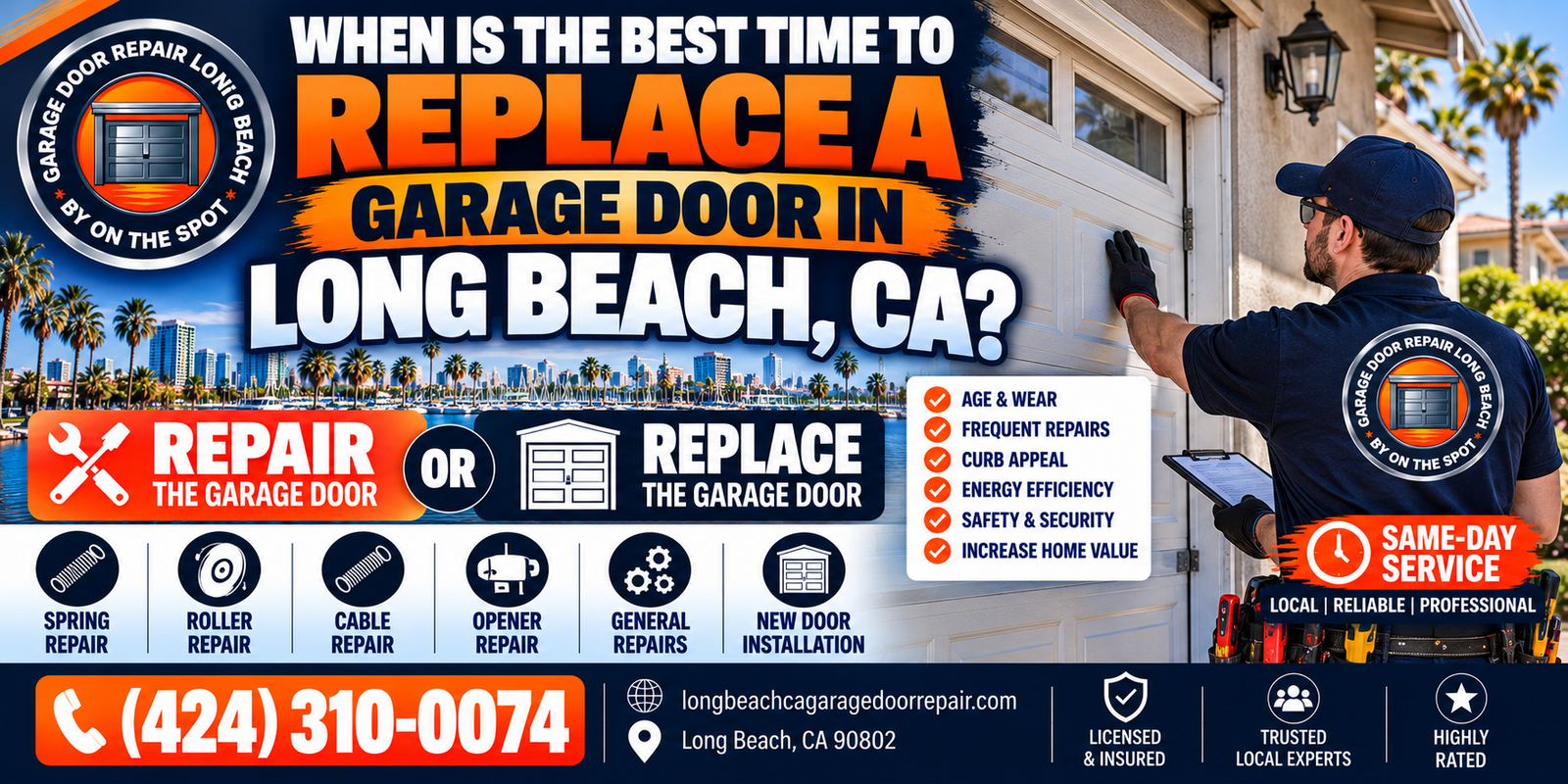
When Is the Best Time to Replace a Garage Door in Long Beach, CA?
Replacing a garage door is not a decision most Long Beach homeowners make often, so it is natural to wonder about timing. Is your door truly at the end of its life, or does it just need a repair? Is there a better season to do it? Should you replace it before selling, after buying, or during a remodel? And how do salt air, the marine layer, and strong coastal sun change the answer? This guide explains the warning signs that point toward replacement, gives you a practical repair-versus-replace framework, walks through Long Beach’s seasons and typical lead times, and shows how to plan a replacement calmly instead of under pressure.
When is the best time to replace a garage door in Long Beach, CA?
The best time to replace a garage door in Long Beach is when the door itself, not just a spring, cable, or opener, is failing, repairs keep recurring, or safety can no longer be assured. Signs include rust that has perforated the panels, cracked or sagging sections, discontinued parts, and repeated repair calls. If the door is still safe, plan replacement during a dry stretch, often late spring or fall, with enough lead time to compare options, handle any HOA approvals, and order the door.
Most problems, including broken springs, frayed cables, worn rollers, misaligned sensors, and failed openers, are repairable and are not by themselves reasons to replace a sound door. Coastal salt air can make homes near Belmont Shore, Naples, and the beach reach the replacement point sooner. If anything is broken right now, make the door safe first and decide on replacement afterward.
Related reading: Garage Door Replacement in Long Beach, CA: Can a New Door Improve Home Value? explains when a new door can help curb appeal and resale, and Garage Door Repair Long Beach, CA: Complete 2026 Guide for Homeowners covers how every part of the system works.
What “The Best Time” Really Means for a Garage Door
When Long Beach homeowners ask when they should replace a garage door, they are usually asking three different questions at once. The first is about condition: has the door reached the point where repairing it no longer makes sense? The second is about season and scheduling: is there a time of year when replacement is easier, faster, or more comfortable? The third is about life events: does it make sense to replace the door before selling, right after buying, during a remodel, or after an accident? The best answer comes from lining up all three, and the condition question always comes first. A door that is unsafe should not wait for a convenient month, and a door that is healthy does not need to be replaced just because it is spring.
This guide walks through each of those timing questions in order. It starts with the warning signs that a door is near the end of its useful life, gives you a practical repair-versus-replace framework, explains how Long Beach’s coastal climate changes the math, and then looks at the calendar: which months tend to work well for installation, how lead times and ordering fit in, and how to plan replacement around a sale, a renovation, or a tight budget. Throughout, the goal is to help you make a calm, informed decision rather than a rushed one.
Condition timing
The door’s structure, springs, panels, hardware, opener, and safety systems tell you whether repair still makes sense. This is the most important of the three timings, and it is the one an on-site inspection answers best.
Seasonal timing
Long Beach has a mild climate, so replacement is possible year-round. Still, dry months, the marine layer, fall wind events, and busy scheduling periods can affect comfort, lead times, and how easily you can plan the day.
Life-event timing
Selling, buying, remodeling, adding an EV charger or a garage conversion, or recovering from vehicle damage can all make replacement the logical next step, even when the old door still technically works.
Why the question matters more in a coastal city
In inland areas, a garage door often ages slowly and evenly. In Long Beach, especially within a mile or two of the shoreline, the aging is uneven. Salt air can attack hardware, bottom brackets, and the lower edges of steel panels long before the rest of the door looks tired, and the marine layer keeps surfaces damp for hours on many mornings. That uneven wear means a door can look fine from the street while its bottom section, fasteners, and springs are quietly deteriorating. It also means a door in Belmont Shore or Naples and an identical door in North Long Beach or Lakewood can reach the replacement point at very different ages. That is why this guide avoids giving a single age at which every door should be replaced.
Signs Your Long Beach Garage Door Is Ready to Be Replaced
No single symptom automatically means replacement. Most garage door problems, including broken springs, frayed cables, noisy rollers, misaligned sensors, and worn seals, are repairable, and a good technician should tell you so. Replacement starts to make sense when several of the signs below show up together, when the structure of the door itself is failing, or when repairs keep coming back. Use the table as a starting point for a conversation with a technician, not as a self-diagnosis.
| Warning sign | What it usually means | Leans toward |
|---|---|---|
| Rust that has perforated or flaked through the bottom panel | Corrosion has moved beyond the surface and weakened the steel skin, often from salt air and standing water at the threshold | Replacement if widespread; section replacement if limited and a match is available |
| Panels that are cracked, split, buckled, or delaminating | Structural damage or material fatigue; common on older wood doors and thin, uninsulated steel | Replacement if more than one section is affected or matching panels are discontinued |
| Door sags between rollers or bows in the middle | Panels have lost stiffness, struts are missing, or the door is too heavy for its reinforcement | Often replacement on older single-layer doors; sometimes struts and hardware correct it |
| Repeated repairs within a short period | Multiple components are wearing out together, so each fix exposes the next weak link | Replacement once cumulative repair cost approaches a meaningful share of a new door |
| Parts are discontinued or hard to source | The door or its hardware line is no longer supported, which lengthens every future repair | Replacement, especially for panels and proprietary hardware |
| No functional auto-reverse or photo-eye safety on the opener | The opener predates modern entrapment protection or its safety system has failed | Opener replacement at minimum; the door itself may be fine |
| Door is drafty, noisy, and hard to balance even after tune-ups | Worn seals, warped sections, and fatigued hardware are compounding each other | Replacement if comfort, noise, or energy matter to you |
| Visible vehicle impact damage across several sections | Bent panels and tracks, possibly with compromised hinges and struts | Depends on extent; insurance and matching often decide |
| Wood door with rot, soft spots, or recurring paint failure | Moisture has entered the wood; the marine layer accelerates this | Replacement if rot is structural; repair and refinishing if localized |
Sign 1: corrosion that has gone structural
Surface rust on a hinge or a spot of rust on a panel edge is normal wear in a coastal city and is usually treatable. What changes the picture is corrosion that has perforated the steel, especially along the bottom panel where salt, sand, and rinse water collect. Once the steel skin has holes or the bottom edge crumbles, the panel loses strength and the bottom seal retainer often corrodes with it. In Belmont Shore, Naples, the Peninsula, Alamitos Beach, and the blocks near Bluff Park, this is one of the most common reasons homeowners start thinking about replacement. A technician can tell you whether the damage is limited to one section that can be swapped or whether the whole door is heading the same way.
Sign 2: the door is structurally tired
A garage door is designed to flex slightly as it moves through the curve of the track, but it is not designed to sag. When you see the middle of the door bowing between the rollers when it is open, or panels that look wavy when closed, the panels have lost stiffness. Some doors can be corrected with added reinforcement struts, but on older single-layer steel doors, the kind many 1950s and 1960s homes in Los Altos, Lakewood, and East Long Beach received as early replacements, the fix is often temporary. A tired door also stresses springs, cables, and the opener, which is why structural fatigue tends to show up alongside other repair calls.
Sign 3: the repair calls keep coming
One spring replacement is routine. A spring, then cables a few months later, then rollers, then a panel, then an opener board is a pattern. When a door starts generating repeat calls, the sensible move is to add up what has been spent over the last few years and what is likely to be needed next, then compare that to replacing the door. A trustworthy technician should help you do this math honestly and should be comfortable telling you when repair is still the better value.
Sign 4: safety features are missing or unreliable
Openers sold in the United States have been required for decades to include automatic reversing, and the CPSC guidance on automatic residential garage door operators explains why entrapment protection matters, particularly for children and pets. If your opener has no photo-eyes, fails the auto-reverse test, or has been bypassed, that is an urgent issue. The good news is that this is usually an opener problem, not a door problem. Replacing the opener alone may be the right call, and it can be a good time to add battery backup, which California has required on newly installed residential openers since 2019.
Sign 5: the door no longer fits how you use the garage
Sometimes the best reason to replace a door has nothing to do with failure. If your garage has become a home gym, a workshop, a home office, or a space for an EV charger, an uninsulated, rattling, drafty door may no longer suit the room behind it. Many Long Beach families also find that a door with windows lets in welcome light, while others want fewer windows for privacy on busy streets and alleys. These are legitimate reasons to plan a replacement, and because the old door still works, you have full control over the timing.
Repair or Replace? A Step-by-Step Decision Framework
The most useful thing a homeowner can do before deciding is to separate the door from the opener and the hardware. A garage door system has three layers: the door itself (panels, struts, windows, seals), the counterbalance and motion hardware (springs, cables, drums, rollers, hinges, tracks, bearings), and the operator (opener, remotes, keypads, sensors). Each layer ages differently. A fifteen-year-old door can be in excellent shape with a failing opener, and a brand-new opener can be attached to a door that is rusting through. Deciding layer by layer prevents both unnecessary replacement and wasted repair spending.
- Make the door safe first. If anything is broken, get it repaired or secured before making a long-term decision. Decisions made with a car trapped inside are rarely the best ones.
- Ask for a whole-system inspection. Have the technician assess panels, springs, cables, rollers, hinges, tracks, seals, opener, and safety features, and ask for plain-language notes on each.
- Sort findings into three groups: safety issues that need action now, wear items that will need attention soon, and cosmetic or comfort issues that are optional.
- Estimate the next few years of repairs. Ask which parts are likely to need replacement and roughly when, recognizing that any estimate is a range, not a promise.
- Get a replacement quote for comparison. An on-site quote for a comparable new door lets you compare real numbers instead of guesses.
- Weigh the non-cost factors: appearance, insulation, noise, security, plans to sell, and how you use the garage.
- Decide layer by layer. You might repair the door and replace the opener, replace the door and keep a newer opener, or replace everything at once if all layers are near the end.
- Plan the timing. If replacement wins and the door is safe, choose a window that gives you time to compare styles and schedule installation without pressure.
A common rule of thumb, used carefully
Many homeowners and contractors use an informal guideline: if a repair would cost a substantial share of a new door, often described as somewhere around half, and the door is already older, replacement deserves a serious look. Treat this as a conversation starter, not a rule. A single expensive repair on an otherwise sound door can still be the better value, and a series of small repairs on a failing door can add up to more than the guideline suggests. The honest answer depends on the door in front of you, which is why an on-site assessment matters.
| Situation | Usually repair | Usually replace |
|---|---|---|
| One broken spring on a solid door | Yes; springs are wear items designed to be replaced | Only if the door has other major problems |
| Cable off drum, door crooked, no panel damage | Yes, after checking tracks and hinges | Rarely |
| One dented panel, matching section available | Section replacement is often practical | If the style is discontinued or several panels are affected |
| Rusted-through bottom section, rest of door sound | Possible if a matching section can be sourced | Often, when rust is starting on other sections too |
| Opener fails, door is healthy | Replace or repair the opener only | No need to replace the door |
| Old single-layer door, sagging, drafty, frequent repairs | Short-term patching only | Yes, usually the better long-term value |
| Wood door with localized rot | Repair and refinish if the damage is limited | If rot is structural or widespread |
| Planning to sell soon, door works but looks worn | Tune-up, paint, new seals may be enough | If the door is a visible weak point in curb appeal |
If you are unsure whether your door problem is a repair or a replacement situation, reading Garage Door Repair Long Beach, CA: Complete 2026 Guide for Homeowners first can help you understand how each component works and fails. And if the question is really about how disruptive the job will be, How Long Does Garage Door Repair Take in Long Beach, CA? covers typical time ranges for repairs and full replacements.
How Long Garage Doors and Their Parts Typically Last
Homeowners often want a simple number, such as “replace every fifteen years,” but garage door life varies too much for that. Material, build quality, how many times a day the door cycles, how well it has been maintained, how close it sits to the ocean, and how much direct sun it takes all matter. What is useful is understanding which parts are designed to be replaced during the life of a door and which parts, when they fail, usually signal the end of it.
| Component | How it ages | Replacement signals |
|---|---|---|
| Torsion or extension springs | Springs are rated by cycles, and many standard residential springs are commonly rated in the range of roughly 10,000 cycles; higher-cycle springs are available. Busy households use cycles faster. | Breakage, visible gaps, door feels heavy or will not stay halfway open. Replace the spring, not the door. |
| Lift cables | Fray, rust, or kink over time, faster near salt air and when the door runs unbalanced | Broken strands, rust, slack on one side. Replace cables; not a door-replacement signal on its own. |
| Rollers | Nylon rollers wear at the tires and bearings; steel rollers can rust near the coast | Noise, wobble, flat spots. Routine repair item. |
| Hinges and brackets | Loosen and corrode, especially at the bottom where moisture collects | Cracks, rust-through, elongated holes. Usually repairable. |
| Weather seals | Rubber and vinyl dry out and crack, faster in strong sun | Daylight or leaves under the door, brittle rubber. Inexpensive to replace. |
| Panels (door body) | Steel can dent and rust; wood can rot and warp; thin single-layer panels fatigue | Perforating rust, cracks, sagging, discontinued style. This is where replacement decisions usually start. |
| Opener | Motors, gears, logic boards, and sensors wear; older units lack modern safety and connectivity features | No auto-reverse, repeated board or gear failures, no battery backup. Replace the opener; door may be fine. |
The practical takeaway: springs, cables, rollers, hinges, and seals are maintenance items. They are expected to be replaced, sometimes more than once, during the life of a good door. The door body and, separately, the opener are the two big-ticket items whose condition drives the replacement decision. When a door body is sound, keeping it running with new hardware is usually good value. When the door body is failing, putting new springs and cables on it may only buy time.
How usage changes the timeline
A household that uses the garage as its main entrance may cycle the door many times a day: leaving for work, coming home, running errands, taking out bins, letting kids in after school. A household that parks in the driveway and opens the garage twice a week puts far less wear on springs and the opener. When you think about timing, count how often your door actually runs. A frequently used door near the water will almost always reach the replacement conversation sooner than a lightly used one inland.
Why maintenance history matters
Doors that receive regular tune-ups, with lubrication of the right parts, balance checks, hardware tightening, and safety testing, tend to last longer and fail more predictably. Doors that have been ignored often fail all at once, which forces a rushed decision. If you are not sure when your door was last serviced, an inspection gives you a baseline and helps you plan a replacement date instead of reacting to a breakdown.
How Long Beach’s Coastal Climate Affects Replacement Timing
Long Beach sits on San Pedro Bay, and a large share of the city lives within a few miles of salt water, whether that is the open beach, Alamitos Bay, the Naples canals, Marine Stadium, or the harbor and port areas to the west. That geography shapes how garage doors age here. Three environmental factors matter most: airborne salt, persistent morning moisture from the marine layer, and strong sun and heat on south- and west-facing garages. Sand and grit carried by onshore breezes add a fourth, especially near the beach.
Salt air
Salt deposits on metal surfaces attract moisture and accelerate corrosion. Hardware, bottom brackets, springs, cables, and the bottom edge of steel panels are usually affected first. Homes closest to the water feel this most.
Marine layer
Many mornings, particularly in late spring and early summer, bring low clouds and damp air. Surfaces can stay wet for hours, feeding rust on steel and swelling or rot on wood.
Sun and heat
Afternoon sun fades finishes, dries out rubber seals, and can interfere with photo-eye sensors at certain angles. Dark doors on sun-facing garages heat up more.
Sand and grit
Fine sand collects in tracks and on rollers and works into seals at the threshold, adding friction and wear on doors near the beach.
What coastal exposure means for your timing decision
If your home is near the water, the replacement conversation often starts with the bottom section and the hardware rather than with the whole door. The upper sections may still be structurally sound while the bottom panel and its fasteners are corroding. That creates a timing choice: replace the bottom section now if a matching section is available, or replace the whole door if rust is starting on other sections too and matching is uncertain. Inland neighborhoods such as North Long Beach, Bixby Knolls, and much of Lakewood usually see slower corrosion, so doors there more often reach replacement because of age, fatigue, or style rather than rust.
Choosing a door that suits the coast
If you do replace, the coastal environment should guide what you buy. Ask about the steel gauge and the paint or coating system on steel doors, whether hardware is galvanized or otherwise corrosion-resistant, whether stainless or coated fasteners are available, and how the bottom seal retainer is made. Aluminum and composite options resist rust but have their own tradeoffs in dent resistance and cost. Wood doors can look beautiful on Craftsman and Spanish-style homes but need a committed finishing schedule in the marine layer. The right choice balances appearance, durability, and how much maintenance you want to do.
| Material | Coastal strengths | Coastal cautions | Good fit for |
|---|---|---|---|
| Insulated steel (multi-layer) | Stiffer panels, better dent resistance, broad style range, quieter operation | Scratches and cut edges can rust if not touched up; bottom edge needs attention near the water | Most Long Beach homes seeking durability and comfort |
| Single-layer steel | Lower upfront cost, lighter weight | Dents easily, flexes, less insulating; corrosion shows sooner | Detached garages, rentals, tight budgets |
| Aluminum and glass | Does not rust like steel; modern look; lots of light | Dents more easily; glass reduces privacy and insulation unless insulated glass is chosen | Mid-century and contemporary homes, Downtown and East Long Beach modern remodels |
| Wood | Classic look on Craftsman, Spanish Revival, and bungalow homes | Needs regular sealing or painting; moisture from the marine layer can cause swelling and rot | Historic-style homes where owners commit to upkeep |
| Wood-look composite or faux-wood steel | Wood appearance with less maintenance; many resist moisture better than real wood | Quality varies by product; ask about warranties and coating | Owners who want a wood look near the coast |
| Fiberglass or vinyl | Resists salt and moisture well; can resist dents | Fewer style options; some finishes may fade in strong sun | Very close-to-water locations |
Whatever material you choose, confirm what the manufacturer’s warranty says about coastal installations. Some warranties include specific conditions or exclusions for homes within a certain distance of salt water. Read the terms before you buy rather than after a problem appears.
The Best Season to Replace a Garage Door in Long Beach
Long Beach’s mild Mediterranean climate means there is no month when garage door replacement is impossible. You will not deal with snow, deep freezes, or extreme humidity that stops installers in their tracks. Still, the seasons do shape the experience. Rain, wind events, marine-layer mornings, summer heat, holiday schedules, and busy periods for contractors can all affect how smoothly a replacement goes. The month-by-month overview below describes typical patterns, not guarantees; weather varies from year to year, and the National Weather Service Los Angeles/Oxnard office is the best source for current forecasts.
| Period | Typical Long Beach conditions | Replacement considerations |
|---|---|---|
| January – March | Cooler, with most of the year’s rain typically falling in the winter months; many clear, mild days between storms | Plan around storm forecasts. A dry day is all an installation needs. Some homeowners find scheduling more flexible after the holidays. |
| April – May | Mild temperatures; marine-layer mornings become more common | Comfortable for installation. Good time to replace before spring and summer home listings or outdoor projects. |
| June – early July | “June Gloom”: frequent overcast mornings, cool and damp near the coast, clearing inland | Installation-friendly. Damp mornings can slow paint or touch-up drying on wood doors. |
| Mid-July – September | Warmest, driest stretch; strong afternoon sun, especially inland | Dry conditions suit installation; hot afternoons in a closed garage can be uncomfortable. Summer is often a busy time for home projects. |
| October – November | Often warm and dry; offshore wind events can occur in fall | A popular window to replace before the rainy months. Seal the door well before winter storms. |
| December | Cooler, with rain possible; holidays compress schedules | Doable, but holiday travel and gatherings can make scheduling harder. Plan ahead if you want a new door before guests arrive. |
Why late spring and fall are often favored
If your door is safe and you have a choice, late spring (roughly April and May) and fall (roughly October and November) often combine the most practical advantages: dry or mostly dry weather, comfortable temperatures for a day of work with the garage open, and time to replace a door before the rainy season or before a spring or summer home sale. These are general tendencies, not rules. A dry week in February works perfectly well, and a well-planned installation in August is just as good as one in October.
Weather and the installation day itself
A typical residential door replacement takes most of a day once the new door is on site, and for much of that time the opening is exposed. Light drizzle is usually manageable, but heavy rain or strong wind can make handling large panels unsafe and can soak the garage interior. If rain is forecast, a professional installer may suggest moving the date. That is a sign of care, not an inconvenience. Wood doors and any painting or staining also need dry conditions and reasonable temperatures to cure properly, so allow extra flexibility if your new door will be painted on site.
Does the time of year change the price?
Pricing is driven mainly by the door you choose, its size, insulation, windows, hardware, the opener, and the complexity of the installation. Seasonal demand can affect how quickly a contractor can schedule you and how long special-order doors take to arrive, and manufacturers occasionally change pricing or run promotions. We do not recommend waiting months for a hypothetical discount if your door is failing. If your door is healthy and replacement is optional, ask during your quote whether timing affects scheduling or lead time, and plan accordingly.
Life Events That Make Replacement the Right Move
Some of the best times to replace a garage door have little to do with the door breaking. Major household changes create natural windows when replacement is easier to justify, easier to schedule, or more valuable. Here are the situations Long Beach homeowners run into most often.
Before selling your home
On many Long Beach homes, particularly the ranch and tract homes of East Long Beach, Los Altos, and Lakewood, the garage door takes up a large share of the front of the house. A dented, faded, or rusty door can drag down first impressions in listing photos and at showings, and a door that fails the auto-reverse test or has a broken spring is the kind of item a buyer’s home inspector is likely to note. If you are planning to list, give yourself enough lead time to compare styles, order the door, and have it installed well before photography. Whether replacement actually adds value depends on the home, the neighborhood, and the condition of the existing door, which is the subject of our companion article, Garage Door Replacement in Long Beach, CA: Can a New Door Improve Home Value?.
Right after buying a home
New owners often inherit a door of unknown age with no maintenance history. The first months are a good time for a full inspection, even if the door seems to work. You will learn whether springs are original, whether safety features function, and whether the door is sound or near the end. If replacement is needed, doing it early means you enjoy the benefits for longer and avoid a breakdown at an inconvenient moment. If it is not needed, you get a baseline and a maintenance plan.
During an exterior remodel or repaint
If you are repainting the house, replacing windows, updating the front entry, or redoing the driveway, a garage door that no longer matches the new look stands out. Coordinating the door with other exterior work lets you choose colors and styles together, and it avoids scuffing a brand-new door during other construction. Many homeowners schedule the garage door near the end of an exterior project so it is the finishing touch rather than a casualty of the work.
When the garage changes purpose
Converting a garage into a gym, workshop, studio, or flexible living area, or adding an EV charger and a second refrigerator, changes what you need from the door. Insulation, quieter operation, better seals, and smart-opener features become more important when people spend time in the garage. Keep in mind that full garage conversions into living space may involve permits and code requirements; check with the City of Long Beach or Lakewood or Signal Hill, as applicable, and with your contractor before planning the door around a conversion.
After vehicle impact or storm damage
Backing into a garage door is more common than most people admit, and wind-driven debris can also dent panels. After impact, the first priority is safety: a bent door can bind, strain the springs and cables, and come off its track. Once the door is secured, a technician can tell you whether a section replacement will do or whether damage across several sections makes a full replacement more practical. If you are filing an insurance claim, ask your insurer about documentation and whether they want an estimate before any work beyond making the door safe.
When an older opener has to be replaced anyway
If your opener has failed and your door is also old, it can make sense to replace both at once. You avoid paying for opener installation twice, you get a system that is balanced and set up together, and you can choose features such as battery backup, a quiet belt drive, and smartphone control in one decision. If the door is healthy, though, there is no reason to replace it just because the opener failed.
Neighborhood Context: How Location Shapes the Decision
Long Beach is a big city with very different housing stock from one neighborhood to the next. The age of the homes, their architectural style, garage layouts, alley access, and distance from the water all influence when replacement makes sense and what kind of door fits. The notes below are general patterns observed across the area, not rules for any particular house.
Belmont Shore and Naples
Close to salt water and canals, with many alley-loaded garages and tight clearances. Corrosion on hardware and bottom panels often drives replacement timing. Low-headroom and narrow-lot garages may need specific hardware.
Belmont Heights and Bluff Park
Many older homes with detached garages, some with original or converted doors. Style matching with Craftsman and Spanish-style homes matters, and older framing can add complexity.
Bixby Knolls and California Heights
Older homes with character, many with detached garages off driveways or alleys. Cal Heights is a designated historic district, so check whether exterior changes need review before choosing a new style.
Los Altos and East Long Beach
Many mid-century ranch homes with prominent attached garages. The door is a large part of curb appeal, and doors from earlier replacement waves are often reaching fatigue.
Downtown and Alamitos Beach
Condos, townhomes, and mixed buildings with shared or HOA-controlled garages. HOA approval, uniform appearance rules, and commercial-grade doors may apply.
North Long Beach
A mix of post-war homes and newer construction farther from the water, where age, fatigue, and security rather than salt tend to drive replacement.
Signal Hill
Hillside streets and views; some homes have sloped driveways and garages that need careful leveling, plus wind exposure on higher lots.
Lakewood
Many post-war tract homes with similar garage sizes. Doors often reach replacement from age and style rather than corrosion, and HOA rules are less common than in condos.
If you live in a condo or townhome community, check your CC&Rs and HOA architectural guidelines before choosing a door. Some associations specify style, color, windows, or even brand, and some handle garage door replacement as a common-area expense. If your home is in one of Long Beach’s historic districts, contact the City of Long Beach about whether exterior changes visible from the street require review. Getting these answers early avoids ordering a door you cannot install.
Should You Replace the Opener at the Same Time?
The door and the opener are separate systems, and they do not need to be replaced together. That said, there are good reasons to consider replacing an older opener when you replace the door, and good reasons to keep a newer opener in service.
| Situation | Recommendation | Why |
|---|---|---|
| Opener is recent, reliable, and has working photo-eyes and auto-reverse | Keep it; have it re-set for the new door | A new door may differ in weight and balance, so force and travel limits must be adjusted and safety features re-tested |
| Opener is old, noisy, or has had repeated repairs | Replace with the door | One installation visit, matched setup, and modern features |
| Opener has no photo-eyes or fails auto-reverse | Replace or repair the safety system urgently, regardless of the door | Entrapment protection is a critical safety feature |
| You want battery backup, quieter operation, or smartphone control | Consider replacing | California has required battery backup on new residential opener installations since July 1, 2019 |
| Door is getting significantly heavier (for example, from single-layer to insulated) | Have the opener’s capacity evaluated | The springs carry the weight, but the opener must still match the door and be set up correctly |
The CPSC guidance on automatic residential garage door operators emphasizes that automatic openers should reverse when they contact an obstruction and that homeowners should test this feature regularly. Any time a new door is installed, the opener’s force and travel settings should be adjusted and both the contact-reverse and photo-eye tests performed before the job is considered complete.
Power outages are not a reason to replace
If your door stopped working during a power outage, that alone is not a sign that the door or opener has failed. Before calling anyone, check the SCE Outage Center to see whether an outage is affecting your area, and look at your breaker panel and the opener’s outlet. If your opener has a backup battery, it may carry a few cycles; if not, the emergency release lets you open the door manually, provided the springs and cables are intact. If you pull the release and the door feels extremely heavy, a spring may be broken, so stop and call a professional instead of lifting it.
When You Should Not Wait for the “Right Time”
Planning is ideal, but some situations call for immediate action. In these cases, the right time is now, and the first call is for a safe repair or securing the door. The replacement decision can follow once the door is stable.
- A torsion or extension spring has broken, often with a loud bang from the garage.
- A lift cable is broken, frayed badly, or has come off its drum and the door hangs crooked.
- The door has come off its tracks or is hanging at an angle.
- The door will not reverse when it contacts an object or when the photo-eye beam is broken.
- The bottom section is so corroded that the bottom bracket or cable attachment is pulling loose.
- The door is stuck open overnight and the home cannot be secured.
- Vehicle impact has bent tracks or panels and the door will not travel smoothly.
Once the door is safe, you are back in control of the timeline. A professional can often restore a failed door to reliable operation with a spring or cable replacement, giving you weeks or months to plan a replacement on your own schedule if the door is near the end of its life.
Planning Timeline: From First Quote to Installed Door
A planned garage door replacement usually unfolds over several weeks, not a single afternoon. The installation day itself is typically the shortest part. Understanding the stages helps you pick a start date that lands the finished door when you actually need it, whether that is before a listing, before the rainy season, or before family visits.
| Stage | What happens | Typical time range (varies) |
|---|---|---|
| 1. Inspection and consultation | Technician assesses the existing door, opening size, headroom, side room, framing, and opener; discusses goals and style | Often a single visit |
| 2. Options and quote | You review materials, insulation, windows, colors, hardware, and opener choices; receive a written quote | A few days, depending on how quickly you decide |
| 3. Approvals (if needed) | HOA architectural approval, historic district review, or permit questions resolved | Can range from days to several weeks; start early |
| 4. Ordering and lead time | Stock doors may be available quickly; custom colors, sizes, windows, and wood doors usually take longer | Days to several weeks; custom orders can take longer |
| 5. Installation | Old door removed, new door, tracks, springs, and hardware installed, opener set up and tested | Most of a day for a typical residential door |
| 6. Final walkthrough | Balance, auto-reverse, photo-eyes, remotes, keypad, and seals checked with you | Usually part of installation day |
The ranges above are general and depend on manufacturer schedules, the options you choose, and the contractor’s calendar. Ask for an estimated lead time in writing with your quote. If you have a hard deadline, such as a listing date, say so up front so the contractor can recommend options that are more likely to arrive in time.
Step-by-step: how to plan your replacement
- Pick your target date and work backward. Add time for decision-making, approvals, ordering, and a buffer for weather or delivery delays.
- Measure nothing critical yourself. Rough measurements are fine for browsing, but the installer should take final measurements of width, height, headroom, side room, and backroom.
- Photograph your house from the street. Many manufacturers offer online visualizers; using a real photo helps you judge color and style.
- Check HOA or historic rules before falling in love with a design.
- Decide on the opener at the same time as the door so everything is ordered together.
- Get a written quote that lists the door model, size, insulation, windows, color, hardware, spring type, opener, removal and disposal of the old door, and warranty terms.
- Verify the contractor’s license with the California Contractors State License Board (CSLB) license lookup.
- Schedule a dry day and plan to have vehicles out of the garage and a clear path to the door.
- Attend the final walkthrough and test the door yourself before the installer leaves.
What Drives the Cost of Replacement (and How Timing Fits In)
We do not publish flat prices in this article because honest pricing depends on your specific opening, the door you choose, and the condition of the framing and existing hardware. What we can do is explain the main factors, so you understand why quotes differ and how to compare them fairly. Always get an on-site quote before making a decision.
| Cost factor | Lower end tends to be | Higher end tends to be |
|---|---|---|
| Size | Standard single-car opening | Double-wide, oversized, or tall openings |
| Construction | Single-layer steel | Multi-layer insulated steel, wood, composite, or custom glass |
| Design | Simple raised-panel or flush design | Carriage-house styling, custom colors, decorative hardware |
| Windows | No windows | Full-view glass or insulated, obscured, or decorative glass |
| Springs and hardware | Standard torsion setup | High-cycle springs, low-headroom kits, corrosion-resistant hardware |
| Opener | Keep existing opener | New belt-drive or wall-mount opener with battery backup and smart features |
| Site conditions | Sound framing and standard clearances | Framing repairs, unusual headroom, sloped floors, or detached garages with older construction |
| Scope | Straight swap | Removal of old tilt-up hardware, jamb replacement, or additional trim work |
As a very general orientation, and not a quote, basic single-car steel doors tend to sit at the lower end of the market, insulated double doors in the middle, and custom wood, full-view glass, or designer carriage-house doors at the upper end, with installation, hardware, and any opener added on top. Prices change with materials and manufacturers, so the only reliable number is an itemized on-site quote for your garage.
How to compare quotes fairly
- Compare the same door construction: layers, steel gauge or material, insulation type, and windows.
- Check whether new tracks, springs, cables, rollers, and weather seals are included or reused.
- Confirm the spring type and cycle rating.
- Ask whether removal and disposal of the old door are included.
- Look for clear warranty terms on the door, springs, hardware, opener, and labor, and ask how coastal exposure affects them.
- Be cautious of quotes that are dramatically lower than others without a clear reason, or of pressure to sign the same day.
Timing interacts with cost in a few practical ways. Replacing a door before it fails can save you from paying for an emergency repair on a door you were going to replace anyway. Combining the door and an aging opener in one visit can reduce total installation labor compared with doing them separately. And planning ahead gives you time to collect more than one quote. Waiting for a better season, on the other hand, rarely saves money on its own.
Choosing the Right Replacement Door for a Long Beach Home
Once you have decided the time is right, the next question is what to install. A new garage door is a long-term decision, so it pays to think about how the door will look, how it will stand up to the coast, and how it will perform day to day.
Style and architecture
Long Beach has an unusually wide range of architecture: Craftsman bungalows and Spanish Colonial Revival homes in Belmont Heights, Bluff Park, Bixby Knolls, and California Heights; mid-century ranch homes in Los Altos, Park Estates, and much of East Long Beach and Lakewood; Cape Cod and traditional homes; and contemporary townhomes and condos Downtown and along the coast. A carriage-house style door with simple hardware often suits Craftsman and Spanish homes, while flush or ribbed panels and aluminum-and-glass doors often suit mid-century and modern designs. Our companion guide on Garage Door Replacement in Long Beach, CA: Can a New Door Improve Home Value? goes deeper into style matching and curb appeal.
Insulation and comfort
Insulated doors are stiffer, quieter, and more comfortable for garages attached to the house or used as living or work space. Insulation is often described with an R-value, but manufacturers calculate these figures in different ways, so compare doors from the same brand or ask how the rating was determined. For a detached garage used only for parking, insulation may matter less than durability and cost.
Windows and light
Windows can soften the look of a large door and bring daylight into the garage. On busy streets or alleys, obscured, frosted, or high-placed windows balance light with privacy. Glass adds cost and can reduce insulation unless insulated glass is chosen.
Hardware and springs
Ask for corrosion-resistant hardware if you live near the water, and consider higher-cycle springs if your household uses the door heavily. Torsion springs are the common modern choice; extension springs may still be used in some low-headroom garages and should always include safety cables. Low-headroom track kits are available for tight garages, which are common in older homes and some coastal alley garages.
Opener features worth considering
- Battery backup, required on new residential opener installations in California since 2019, for operation during outages.
- Belt drive for quieter operation, especially with bedrooms above or beside the garage.
- Wall-mount (jackshaft) openers for garages with high ceilings or limited overhead space.
- Smartphone monitoring and control, with alerts if the door is left open.
- Rolling-code or encrypted remotes and keypads for security.
- Built-in lighting and motion sensing for safer entry at night.
What to Expect on Installation Day
A professional replacement follows a predictable sequence. Knowing it in advance helps you prepare the space and understand why each step matters.
- Arrival and walkthrough. The installer confirms the door, color, windows, and opener details match the order, and reviews the plan with you.
- Securing the old door. Spring tension on the old system is safely released by the technician before anything is removed. This step is dangerous and must be done by trained hands.
- Removal. Old panels, tracks, springs, and, if replacing, the old opener are removed, and the opening is inspected for damaged jambs or header.
- Framing and prep. Minor jamb or trim repairs are made if needed and agreed on; the floor is checked for level at the threshold.
- Installing sections and tracks. The new door is assembled section by section in the opening, with hinges, rollers, and vertical and horizontal tracks.
- Springs and cables. Torsion springs sized for the new door’s weight are mounted and wound, and cables are tensioned evenly.
- Balancing. With the opener disconnected, the door is tested to make sure it stays roughly in place when lifted partway and moves smoothly by hand.
- Opener setup. The opener is installed or reconnected, travel limits and force are set, and photo-eyes are mounted and aligned.
- Safety testing. The contact auto-reverse and photo-eye reverse tests are performed, and remotes and keypads are programmed.
- Seals and cleanup. Bottom and perimeter seals are checked, packaging and the old door are hauled away as agreed, and the installer walks you through operation and care.
For more detail on typical durations, including how corrosion, older framing, and custom doors can add time, see How Long Does Garage Door Repair Take in Long Beach, CA?.
Protecting Your New Door: A Coastal Maintenance Calendar
A new door is an investment, and in Long Beach a little routine care goes a long way toward protecting it. The schedule below is a practical baseline; homes close to the water may benefit from doing some tasks more often.
| When | Homeowner task (safe to DIY) | Professional task |
|---|---|---|
| Monthly | Watch and listen to the door; test photo-eye reverse by passing an object through the beam; test contact reverse carefully | — |
| Every few months (more often near the beach) | Rinse salt and sand from the door face and bottom seal with fresh water; wipe photo-eye lenses; clear debris from tracks without adjusting them | — |
| Twice a year | Inspect weather seals for cracks; check remote and backup batteries; look for rust spots and touch up scratches per the manufacturer’s guidance | — |
| Annually | Note any changes in noise or balance to share with the technician | Tune-up: balance and spring check, cable and hardware inspection, lubrication of appropriate parts, opener force and limit settings, full safety test |
| As needed | Stop using the door if anything looks broken, crooked, or unusually heavy | Spring, cable, track, and bracket repairs |
Follow the manufacturer’s care instructions for cleaning products and lubricants, since some finishes and nylon parts react poorly to harsh chemicals. Never adjust springs, cables, or bottom brackets yourself.
Common Timing Mistakes to Avoid
- Replacing a healthy door because of an opener problem. Diagnose the layer that failed before replacing everything.
- Pouring money into a failing door. Once the door body itself is failing, repeated hardware repairs may only postpone the inevitable.
- Waiting until the week before listing. Custom doors and approvals take time; start early.
- Choosing a door without checking HOA or historic rules. A non-compliant door can mean costly changes later.
- Ignoring coastal exposure when choosing materials. A door that works well inland may not age as well near the water.
- Rushing a decision during an emergency. Get the door made safe first, then decide.
- Skipping the safety test. Any new installation should end with verified auto-reverse and photo-eye function.
- Hiring on price alone. Verify licensing, compare like-for-like quotes, and read warranty terms.
Not Sure If It Is Time to Replace?
Ask Garage Door Repair Long Beach By On The Spot for a whole-system inspection. We will tell you honestly whether repair still makes sense or whether replacement is the better value, and help you plan the timing. Call (424) 310-0074.
A 15-Minute Homeowner Self-Check Before You Call
You do not need tools or technical skill to gather useful information before an inspection. This quick self-check is safe as long as you only look, listen, and use the door normally. Do not touch springs, cables, or brackets, and stop if anything seems broken.
- Look at the door from the street. Note dents, fading, rust spots, peeling paint, and whether the door sits evenly in the opening.
- Look at the bottom section up close. Check for rust bubbling, holes, crumbling edges, or a torn bottom seal. Near the coast, this is where trouble usually starts.
- Watch a full cycle. From inside, with the area clear, open and close the door with the opener. Listen for grinding, popping, or squealing, and watch for shaking or jerky movement.
- Check for sag. With the door open, look along the underside of the panels for bowing between the rollers.
- Look at the springs from a distance. A gap in a torsion spring means it is broken. Do not touch it.
- Look at the cables. Note any fraying, rust, or slack on one side, without touching them.
- Test the photo-eyes. While the door is closing, pass a broom handle or similar object through the beam; the door should stop and reverse.
- Note the opener’s age and features. Look for a label with a model and date, and note whether it has a backup battery.
- Think about history. List repairs from the last few years and roughly what they cost.
- Write down your goals. Are you planning to sell, remodel, convert the garage, or just want reliability?
Bring these notes to your inspection. They help the technician understand the door’s history and your priorities, and they make the repair-or-replace conversation much more productive.
How we approach the replacement conversation
At Garage Door Repair Long Beach By On The Spot, we start with the door you have. If a repair will give you safe, reliable service at a sensible cost, we will say so. If the door body is failing, parts are no longer available, or repairs keep stacking up, we will explain why replacement may be the better value and help you choose a door suited to Long Beach’s coastal conditions and your home’s style. Either way, you get a clear explanation and a written quote before any work begins. You can learn more about our services on our Long Beach garage door repair homepage.
When Is the Best Time to Replace a Garage Door? FAQ
When is the best time to replace a garage door in Long Beach, CA?
The best time is when repairs no longer make sense or safety can no longer be assured, ideally planned during a dry window with enough lead time to compare options. Late spring and fall are often convenient, but Long Beach’s mild climate allows replacement year-round.
How do I know if my garage door needs repair or replacement?
Springs, cables, rollers, seals, sensors, and openers are usually repairable. Replacement becomes more likely when panels are rusted through, cracked, or sagging, parts are discontinued, or repairs keep recurring. An on-site whole-system inspection is the most reliable way to decide.
How long does a garage door typically last?
It varies widely with material, maintenance, usage, sun exposure, and distance from the ocean. Many parts, such as springs and rollers, are designed to be replaced during the door’s life. The condition of the door body is what usually determines when replacement makes sense.
Does salt air near the beach shorten garage door life?
Salt air can accelerate corrosion on steel hardware, springs, cables, bottom brackets, and panel edges, particularly in neighborhoods close to the water such as Belmont Shore and Naples. Corrosion-resistant hardware, regular rinsing, and annual tune-ups help.
Is there a cheaper time of year to replace a garage door?
Price depends mainly on the door, its size and features, and installation complexity. Seasonal demand can affect scheduling and lead times more than price. If your door is failing, waiting for a hypothetical discount is rarely worth the risk.
Can a garage door be replaced in the rain?
Light drizzle is often manageable, but heavy rain or strong wind can make installation unsafe and soak the garage. Installers may reschedule for a dry day, which is usually the best choice for you as well.
How long does garage door replacement take?
The installation itself typically takes most of a day for a standard residential door. Ordering, approvals, and custom options can add days or weeks before installation day. See our guide on how long garage door repair takes in Long Beach for more detail.
Should I replace my garage door before selling my house?
It can make sense when the existing door is damaged, rusty, unsafe, or clearly dated, because the door is a prominent part of many Long Beach facades. Sometimes a tune-up, new seals, and paint are enough. Our companion article on garage door replacement and home value covers this in depth.
Should I replace the opener when I replace the door?
Not necessarily. A recent, reliable opener with working safety features can often be re-set for a new door. An old, noisy, or unsafe opener is often best replaced at the same time to save a second visit.
Is a broken spring a reason to replace the whole door?
Usually not. Springs are wear items designed to be replaced. A broken spring on an otherwise sound door is a repair. Replacement is worth discussing only if the door also has major structural problems.
Can I replace just one damaged panel?
Often, if a matching section is still available in the same style, color, and construction. For older or discontinued doors, matching can be difficult, and full replacement may look and perform better.
Do I need a permit to replace a garage door in Long Beach?
Requirements can change and may depend on the scope of work, especially if framing or the opening size changes. Ask your contractor and check with the City of Long Beach, or with Signal Hill or Lakewood if you live there, before work begins.
Does my HOA have to approve a new garage door?
Many condo and townhome associations regulate garage door style, color, and windows, and some manage replacement themselves. Check your CC&Rs and architectural guidelines and get written approval before ordering.
What garage door material is best near the coast?
Insulated steel with a quality coating and corrosion-resistant hardware is a common, durable choice. Aluminum, fiberglass, and composite options resist rust well, while wood needs committed upkeep in the marine layer. The best choice depends on style, exposure, and maintenance preferences.
My door stopped working during a power outage. Do I need a new one?
Probably not. Check the SCE Outage Center, your breaker, and the outlet first. Use the emergency release to open the door manually only if springs and cables are intact; if the door feels very heavy, stop and call a professional.
Is it safe to remove my old garage door myself?
No. Springs and cables on the old door store high tension, and releasing it incorrectly can cause serious injury. Removal and installation should be done by trained technicians.
How do I check that a garage door contractor is licensed?
Use the California Contractors State License Board online license lookup to verify the contractor’s license status before signing a contract.
What should be included in a garage door replacement quote?
The door model, size, construction, insulation, windows, color, springs and cycle rating, tracks and hardware, opener details if included, removal and disposal of the old door, and written warranty terms for parts and labor.
Do you replace garage doors in Signal Hill and Lakewood?
Yes. Garage Door Repair Long Beach By On The Spot serves Long Beach and nearby communities including Signal Hill, Lakewood, and Seal Beach.
What should I do right now if my door is broken but I am planning to replace it?
Stop using the door, keep people and pets clear, and call for a safe repair or securing service. Once the door is stable, you can plan the replacement without pressure.
Garage Door Repair Long Beach By On The Spot on Google Maps
View Garage Door Repair Long Beach By On The Spot on Google Maps · 151 E 5th St, Long Beach, CA 90802
Ready to Plan Your Long Beach Garage Door Replacement?
Whether your door is rusting through, sagging, or simply no longer fits your home, Garage Door Repair Long Beach By On The Spot can inspect the whole system, tell you honestly whether repair or replacement makes more sense, and help you plan the right timing for your Long Beach home. Call (424) 310-0074 or find us on Google Maps.
Garage Door Repair Long Beach By On The Spot · 151 E 5th St, Long Beach, CA 90802
(424) 310-0074 · office.onthespotgaragedoor@gmail.com · longbeachcagaragedoorrepair.com
One Response