
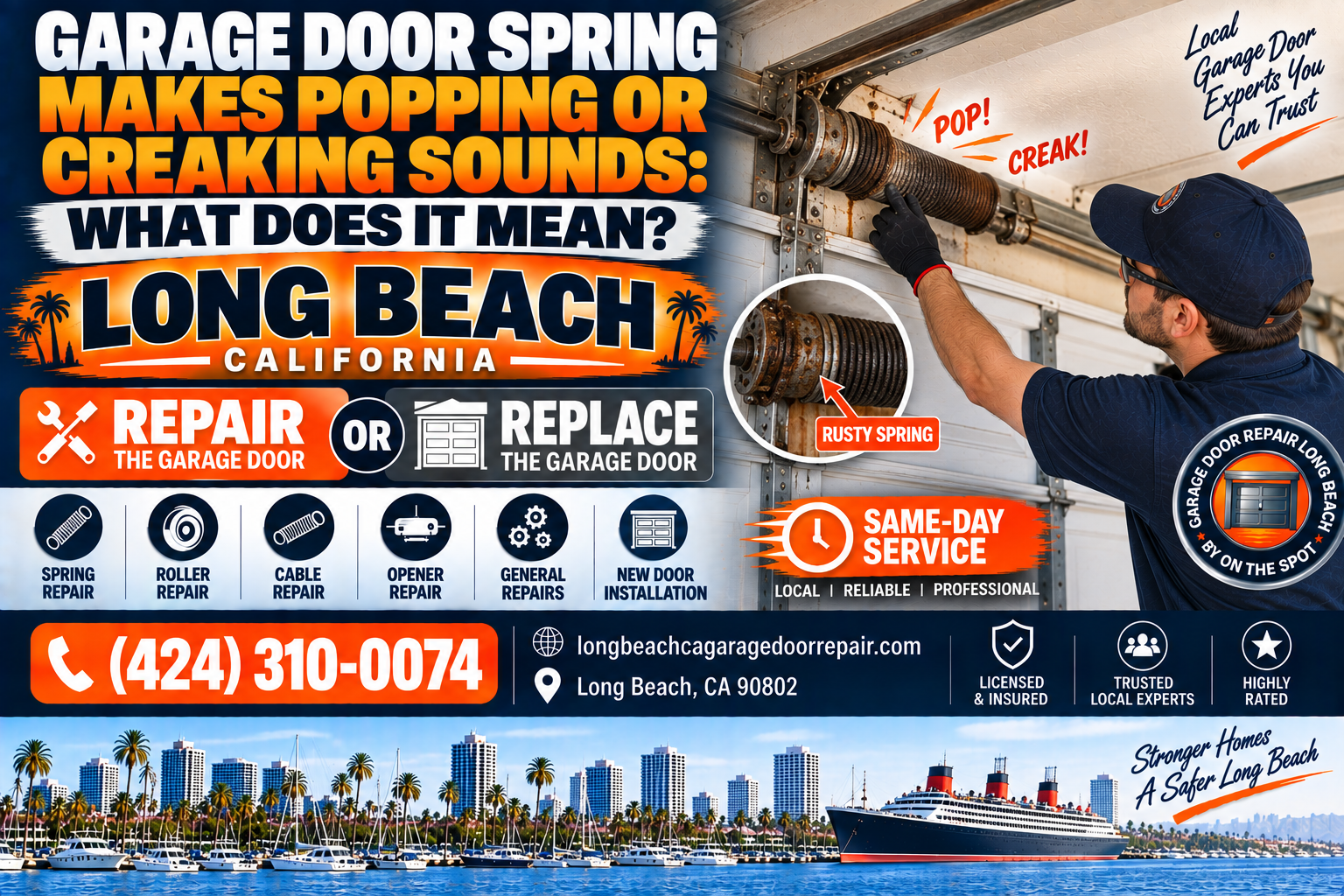
Long Beach Spring Sound Guide
Garage Door Spring Makes Popping or Creaking Sounds: What Does It Mean?
When a garage door spring makes popping or creaking sounds, the cause is often dry bearings, emerging spring fatigue, or cable and drum noise mistaken for the spring—while a sudden loud bang usually means a break. Safe listening diagnosis stays on the floor; never DIY spring winding or wrong-product coil bathing in Long Beach coastal air.
Garage Door Repair Long Beach By On The Spot helps homeowners, renters, landlords, property managers, HOA communities, and small businesses decode spring-area sounds with diagnosis-first service across Long Beach, CA.
Bearings vs Springs
Cable / Drum Mimics
No DIY Winding
CPSC + DASMA + SCE
Serving Long Beach, CA
Table of Contents
Direct Answer: What Does a Popping or Creaking Garage Door Spring Mean?
Direct answer: A garage door spring that makes popping or creaking sounds usually means one of three things: dry or corroded end bearings and hardware rubbing under torsion load; a spring that is fatigued and may be approaching failure; or cable and drum noises that homeowners often mislabel as spring sounds. A single sharp bang followed by a door that will not lift usually means a spring has broken. Safe diagnosis is listening and watching from the floor—never DIY spring winding, never spraying random oils into live coils, and never tightening cones yourself. In Long Beach coastal air, salt and fog accelerate dry-bearing creaks and spring-wire fatigue, so new noises deserve a professional look sooner rather than later.
Garage Door Repair Long Beach By On The Spot diagnoses popping and creaking spring-area sounds with a balance-first, safety-first approach for homeowners, renters, landlords, HOA boards, and small businesses near 151 E 5th St, Long Beach, CA 90802. Call (424) 310-0074 when the soundtrack of your door changes overnight.
This guide separates dry-bearing chatter from imminent break risk, explains how cable and drum noises get blamed on springs, and lays out what you can safely observe versus what DASMA-aligned spring work must leave to trained technicians. It is written for Deep Semantic SEO, EEAT, AEO-style answers, and Long Beach GEO relevance—original to this sheet, not a rewrite of rusty-spring or other sibling posts.
Sound Taxonomy: Pop, Creak, Click, Grind, and Bang
Not every noise above the door is a dying spring. Popping can be a coil settling under load, a bearing cage catching on a dry spot, a cable strand snagging on a drum groove, or a hinge pin that has run dry after months of coastal dust. Creaking often tracks with slow rotation of dry end bearings as the torsion shaft turns through each degree of travel. Clicking may be a loose set screw on a drum or a cable beginning to slip a fraction of an inch. Grinding usually lives in the opener rail, a worn gear set, or a failed roller—not in the spring wire itself. A loud bang that shakes the garage walls is the classic signature of a torsion spring that has broken under stored energy.
Sorting sounds by when they happen matters as much as the pitch you hear. A creak only at the first inch of travel often points to dry bearings waking up under initial torque after the door has been sitting overnight in marine-layer moisture. Intermittent pops mid-travel can be cable-to-drum friction as wrap geometry changes. A bang at rest or during a cycle with sudden loss of lift is spring failure until a professional proves otherwise. Long Beach homes near the water also hear weather-driven morning creaks when overnight temperature and humidity shifts change how metal parts seat against each other before the day warms.
Write down what you hear, when you hear it, and whether the door still feels balanced if—and only if—you already know how to use the emergency release safely and the door is not slamming or free-falling. That listening log helps a technician triage faster and keeps you from guessing yourself into a DIY spring fix that DASMA safety culture strongly discourages for untrained homeowners.
Why do springs get blamed first? Because they sit in the visual center of many torsion systems. When anything above the header makes noise, the eye goes to the coils. That cognitive shortcut is useful for urgency—springs are high-energy parts—but it is a poor standalone diagnostic. End bearings, center bearings, drums, cables, and even the opener trolley can produce spring-adjacent noise. A careful technician listens with the door, watches shaft rotation, and checks balance before declaring the spring the only villain.
Dry Bearings vs Imminent Spring Failure
Dry or corroded end bearings are one of the most common sources of creaking attributed to the spring. The torsion shaft rides in those bearings; when grease has dried out, washed away in fog drip, or been contaminated by coastal grit, metal-on-metal noise appears as soon as the shaft turns. The spring may still have ample cycle life left. Lubricating the wrong place with the wrong product—or soaking live coils in oil—does not fix a dry bearing and can create drips on cars, sticky grit magnets, and false confidence that the system is healthy.
Imminent spring failure sounds different to an experienced ear. Fatigue pops can be sharper and less rhythmic than bearing creaks. You may notice new gaps between coils at rest, a door that feels heavier on one side, cables that look uneven on the drums, or an opener that suddenly strains and runs hotter. Sometimes there is a series of small pops over several days before a final break. Sometimes there is almost no warning beyond a change in balance. Treat progressive popping plus heavier feel as a stop-and-call situation—not a weekend oiling project from a viral video.
Coastal Long Beach accelerates both stories at once. Salt air dries and corrodes bearings faster than many inland valleys, and it also attacks spring wire coatings. A door that creaked for months from dry bearings can later add spring fatigue on top of that soundtrack. That is why saying the door has always made a little noise is not a free pass when the character of the noise changes from soft creak to sharp pop.
Quick Listening Contrasts
- Rhythmic creak with shaft rotation — often bearings or hinge and roller friction
- Sharp mid-cycle pop with no loss of lift — cable or drum friction or coil seating; inspect soon
- Popping plus heavier door or uneven cables — spring fatigue risk; call now
- Single bang and door will not open — broken spring; stop using the door
- Grind from the opener rail — opener or rail issue; do not blame the spring alone
- Morning-only coastal creak that fades — moisture and temperature seating; still worth a pro check if new
Cable and Drum Sounds Mistaken for Springs
Lift cables wrap on drums at the ends of the torsion shaft. When a cable is fraying, dry, misaligned, or jumping a groove, it can pop and tick loudly near the spring assembly. Homeowners standing under the header often swear the spring is cracking. The spring may be mechanically fine while the cable is failing—and a failing cable can dump a door just as dangerously if it separates under load during travel.
Drum noise includes cable slap against worn grooves, groove wear that changes wrap pitch, and set-screw issues that let a drum walk slightly on the shaft. Those sounds travel through the shaft into the spring coils, so vibration feels spring-centered even when the root cause is the drum. Safe diagnosis means watching cable wrap during a slow controlled cycle performed by a technician—not grabbing drums or cables by hand while the system is still tensioned.
If you see fuzzy cable strands, a cable off the drum, or a drum that looks cocked relative to the shaft, treat that as an emergency service call. Do not try to rewind a cable onto a drum yourself. That work sits in the same high-energy family as spring winding and is a leading cause of DIY injury around garage doors nationwide.
Cable equalizer issues on some systems and frayed strands near the bottom brackets can also click during the first or last feet of travel. Those sounds are easy to mis-hear as header spring problems when you are standing in the middle of the garage. Describe the location of the loudest point when you call so the technician stages the right inspection sequence.
When a Loud Bang Means a Spring Break
A sudden loud bang—often compared to a gunshot, a heavy board slamming, or a car hitting a wall—is the classic torsion-spring break. Energy stored in the wound spring releases instantly. The door may drop a few inches if it was open, refuse to lift if it was closed, or hang crooked if one spring of a pair fails while the other remains intact. Extension-spring breaks can also bang and leave a cable or pulley swinging; safety cables, when present, are meant to keep broken extension springs from becoming dangerous projectiles across the garage.
After a bang: keep people and pets clear of the door path. Do not try to force the door open with the opener. Do not insert winding bars, pliers, screwdrivers, or sockets into spring cones. Call for professional spring replacement. If you need temporary egress from the property, ask the technician about safe options—do not invent your own pry or jack method under a live door.
Not every bang is a spring. A panel impact from a vehicle, a falling stored item from above-door shelving, or a ladder tip can bang. But when the bang coincides with a sudden change in door behavior—especially loss of lift—assume spring failure until a professional says otherwise. That assumption keeps households out of the danger zone.
Safety stop: After a suspected spring break, disconnect curiosity. Live springs and cables store enough energy to cause severe injury. DASMA safety tips for garage door systems emphasize leaving spring work to trained professionals. Observe from a safe distance, photograph from the floor if useful, and call (424) 310-0074.
Safe Listening Diagnosis From the Floor
You can gather useful clues without touching high-tension parts. Stand clear of the door path. Operate one open and close cycle if the door still moves normally and nothing is already broken. Note where the sound seems loudest: left end bearing, right end bearing, center bearing area, drums, or opener head. Note whether the sound is continuous, rhythmic with shaft turns, or a one-off pop. Look from the floor for uneven cable wrap, gaps in coils that look new, or a door that sits crooked in the opening.
If the door already struggles, slams, free-falls, or bangs, skip further cycling. Unplug the opener only if you can do so safely without standing under a compromised door. Never put your body under a door that may drop. A listening diagnosis is about information for the technician—not about becoming your own spring technician.
Phone video helps when captured safely. Film the header area from a safe angle during one cycle if the door still operates. Capture the sound. Capture whether both sides move evenly. Do not climb ladders next to live springs for a better camera angle. Floor-level footage is enough for triage.
Balance Clue Without DIY Spring Work
If you already understand how to use the emergency release and the door is not violently unbalanced, a careful hand-lift test can tell a technician whether the spring system is still carrying weight. If the door feels extremely heavy or shoots up, stop and call. If you are unsure about the release cord, skip the test entirely—guessing around a compromised spring is how injuries happen. CPSC guidance on automatic residential garage door operators also reminds households that photo eyes and reverse features protect people; they do not replace a properly balanced spring system.
Never DIY Spring Lubrication With Wrong Products or Winding
Internet advice often says to just spray the springs. That guidance is incomplete and often wrong. Many household oils attract grit, drip onto cars and floors, and do nothing for the bearings that are actually creaking. Some products attack rubber seals or paint finishes on the door. Soaking torsion coils in heavy oil can make a quiet-but-failing spring feel temporarily quieter while fatigue continues unseen inside the wire.
Worse than wrong lubrication is DIY winding. Adjusting spring tension with improvised bars, sockets, or vise-grips is a leading cause of garage-door injuries. Cones can slip; bars can fly out under load. DASMA safety messaging around garage door systems is unambiguous for homeowners: leave spring repair and adjustment to professionals. That includes just a half turn when a door feels heavy after you heard pops.
What you may do as a homeowner, if parts are accessible without climbing into the spring zone: keep photo eyes clean and aligned, keep the floor track free of debris, and schedule professional maintenance. Ask your technician which lubricant they use on bearings, hinges, and rollers—and whether any spring coating care is appropriate for your coastal climate. Do not invent a spray schedule for live coils based on a short social video.
Safe homeowner lane: listen, log, photograph from the floor, keep people clear, call a pro. Dangerous DIY lane: winding bars, cone screws, cable-on-drum rewinds, cutting springs, random aerosol baths on high-tension coils, raising opener force to mask a weak spring.
Long Beach Coastal Effects on Spring and Bearing Noise
Long Beach sits in a marine-influenced climate. Salt aerosols, fog drip, and morning marine layers push moisture onto metal hardware even when it is not raining hard. End bearings lose protective grease. Spring wire coatings oxidize. Cable strands pick up grit from alley dust mixed with salt. The result is a higher baseline of creaks and pops than you might hear in a dry inland garage—and a shorter fuse between annoying noise and real failure.
Neighborhood microclimates matter. Homes closer to Belmont Shore, Naples, Alamitos Beach, and the downtown waterfront often see faster film and dry-bearing onset. Inland pockets like parts of Bixby Knolls or Los Altos still get fog and night cooling that condense on cold steel overnight. Alleys and shared condo garages can trap moisture and road salt brought home from coastal drives.
Coastal noise should change how you schedule maintenance. Annual or semi-annual professional inspections catch dry bearings before they score shafts and catch spring fatigue before the bang. Waiting until the door will not open often means emergency timing plus secondary damage to cables, openers, or panels that planned service would have avoided.
Property managers serving multi-unit buildings near the water should treat new spring-area soundtracks as preventive work orders, not cosmetic tickets. A single bang in a shared alley can block several households and create liability conversations that a dated bearing service would have prevented.
Torsion vs Extension: How Noise Differs by Spring Type
Torsion springs sit on a shaft above the door. Their soundtrack includes bearing creaks, coil pops, and break bangs that radiate from the header. Extension springs run along the horizontal tracks; their failures may bang from the side, and broken ends can whip if safety cables are missing. Extension systems also introduce pulley and stretch noises that get misreported as spring popping even when the coil itself is not the first failing part.
Many Long Beach homes use torsion systems on standard single and double doors. Older or specialty doors may still use extension springs. If you do not know which you have, describe the location of the coils to the dispatcher: above the door on a shaft versus along the sides. That detail shapes parts staging and the safety briefing for the visit.
Never stretch an extension spring by hand to test it. Never cut a painted mark on a torsion spring and assume you can rewind to the same count without proper tools and training. Type-specific DIY tips from forums are not a substitute for on-site professional method matched to your door weight and configuration.
How Openers Mask Weak Springs—and Why Noise Still Matters
Modern openers can drag a poorly balanced door for a while, especially if someone previously raised force settings. That masking delays the obvious door is heavy clue while popping and creaking continue. The opener runs hotter, gears wear, and photo-eye or force reverse events become more common as the system fights physics instead of lifting a properly sprung door.
CPSC consumer FAQ material on automatic residential garage door operators emphasizes entrapment protection—photo eyes and reverse. Those systems are not designed to compensate for broken or severely weakened springs. If your door pops and the opener strains, the fix is spring and balance diagnosis—not another force increase on the opener dial.
Southern California Edison outage tools can help you separate true power events from mechanical noises when an opener behaves oddly during wind or grid events—but a popping spring soundtrack is mechanical first. Use SCE Outage Center to check grid status when lights flicker; do not use outage anxiety as a reason to ignore spring bangs or progressive pops.
Red Flags: Stop Using the Door and Call
- Loud bang then door will not lift or sits crooked
- Visible gap in a torsion spring coil or spring hanging loose
- Cable off the drum, frayed strands, or cable piled unevenly
- Door free-falls, shoots up, or feels drastically heavier
- Popping that worsens every cycle over a day or two
- Opener grinding while trying to lift after new spring noises
- Children or pets near a door that is behaving unpredictably
- Any DIY urge to insert bars into winding cones
When any red flag appears, park cars outside if needed, use another exit, and call Garage Door Repair Long Beach By On The Spot at (424) 310-0074. Do not schedule when I have time next month if the door already bangs or drops. Spring energy does not wait for convenient calendars.
Safe Homeowner Checks vs Dangerous Spring DIY
Safe checks include listening and logging; photographing from the floor; confirming photo eyes are clean and facing each other; noting whether remotes and wall controls behave normally; checking SCE outage status if the opener is completely dead with no sound at all; and clearing toys and storage from the door path so a technician can work safely.
Dangerous DIY includes winding or unwinding springs; replacing springs without training; lubricating by flooding coils with random aerosols; tightening cone set screws; rewinding cables on drums; removing drums; cutting springs; using the opener force dial as a spring substitute; and standing on ladders beside live torsion springs to inspect closely.
If a handyman without spring training offers to adjust it real quick, decline. Spring work is a specialty skill with specialty tools and specialty risk. Hiring the wrong helpers for spring pops is how property damage and injuries enter a story that started as a simple creak.
Professional Repair Path for Popping or Creaking Springs
A diagnosis-first visit typically includes visual inspection of springs, cones, bearings, drums, and cables; balance and hand-lift assessment with the opener handled by the technician; listening during controlled operation; measurement of spring wire and length when replacement is indicated; pairing practice on dual-spring doors; lubrication of appropriate hardware with the right product; opener force and travel review after mechanical balance is restored; and photo-eye verification aligned with CPSC entrapment-protection themes.
If bearings are the creak source and springs still grade well, the technician may service or replace bearings and educate you on coastal recheck timing. If springs show fatigue, rust pitting, or stretch beyond specification, replacement—often as a pair—is the durable path. Cables and drums are inspected whenever springs are replaced because mismatched wear is common after years of shared cycles.
Ask for the cycle rating and wire size being installed. Ask whether both springs are being replaced on a dual system. Ask what maintenance interval fits your distance from the water. Good answers beat the cheapest quote that only oils coils and leaves without measuring balance.
Parts That Matter: Spring, Bearing, Cable, Drum, and Hardware
Springs store lift energy. End and center bearings let the shaft turn quietly. Cables transfer drum rotation into vertical lift. Drums must stay timed and secured on the shaft. Rollers, hinges, and tracks contribute secondary noise that can be mistaken for spring trouble. A popping soundtrack can involve any of these parts in combination, which is why spray-the-coils thinking fails so often.
Coastal Long Beach jobs often bundle bearing service with spring evaluation because both live in the salt-air zone above the door. Replacing a spring while leaving a scored, dry bearing in place can recycle the creak within weeks. Replacing bearings while ignoring a cracked spring coil is equally incomplete. Holistic header inspection is the point of a professional visit.
Hardware quality matters in marine air. Cheap springs with low cycle ratings fail sooner near the coast. Proper cable diameter and drum match keep the soundtrack from returning as cable tick. Your technician should match parts to door weight and configuration—not to whatever leftover coil happens to fit the shaft in a truck bin.
Maintenance After Noise Service in Coastal Long Beach
After bearings are serviced or springs replaced, keep cycles reasonable—do not treat the door like a toy for kids to open and close repeatedly. Avoid hanging storage from the torsion shaft. Keep rollers and hinges on the technician recommended lubrication schedule. Recheck annually, or every six months if you live in heavy marine spray zones. Teach household members not to force a noisy door one more time when the soundtrack changes again.
If popping returns quickly after service, call back. Early warranty-era noises can mean a cable settling issue, a missed dry hinge, or a rare parts defect—professionals would rather hear from you than have you DIY a second guess that undoes careful work.
Document service dates. Property managers in multi-unit Long Beach buildings benefit from a shared log of spring and bearing work so creaks do not get ticketed three times by three different vendors with three different stories and three incomplete fixes.
Repair Now vs Waiting When You Hear Pops or Creaks
Waiting on a mild, long-standing coastal creak that a technician has already graded as dry bearings with a dated recheck can be reasonable. Waiting on new sharp pops, heavier feel, uneven cables, or a bang is not reasonable. The cost curve favors early diagnosis: planned spring replacement rarely damages panels; emergency breaks sometimes do, especially when a door drops or racks in the tracks.
Insurance and landlord disputes also favor documentation. A dated inspection note that bearings creak, springs are okay for now, and recheck by a stated date is clearer than an after-the-bang argument about who ignored warnings from tenants or neighbors.
If you travel frequently or the garage is the only secure entry for a renter, bias toward earlier service. A failed spring while you are away can leave a door stuck down or dangerously unbalanced for whoever arrives next with groceries, medical needs, or work equipment.
Same-Day Help When Spring Noises Turn Urgent
Garage Door Repair Long Beach By On The Spot prioritizes urgent spring-break and cable-off-drum calls because those conditions create immediate safety risk. Popping that escalates in a day, a door that suddenly will not open, or a visible broken coil are same-day candidates. Call (424) 310-0074 with your address, door width if known, torsion versus extension if known, and a short description of the sound and behavior change.
Clear driveway access when possible. Note gate codes for alley garages common in parts of Long Beach. Mentions of HOA rules help if exterior parking will be needed while the door is out of service. Photos from the floor speed parts selection before arrival and reduce second trips for uncommon wire sizes.
Questions to Ask Before Hiring for Spring Noise Service
- Do you diagnose bearings, cables, and drums before condemning the spring?
- Will both springs be replaced on a dual-spring door when one fails?
- What cycle rating and wire size will you install for this door weight?
- Do you follow DASMA-aligned spring safety practices with no homeowner winding?
- Will photo eyes and reverse be verified after balance is restored?
- How does coastal Long Beach exposure change your maintenance advice?
- What warranty covers springs, cables, and labor?
- Will you show me safe versus unsafe zones around the header?
Hiring Red Flags for Garage Door Spring Work
- Offers to teach you to wind springs yourself to save money
- Only sprays oil without inspecting bearings, cables, or balance
- Raises opener force as the primary fix for popping and heavy feel
- Replaces one spring of a pair without explaining imbalance risk
- No mention of safety cables on extension-spring doors
- Cannot explain how they secure winding bars and cones
- Cash-only pressure with no written scope for spring replacement
- Dismisses DASMA or CPSC safety themes as overkill
Why Garage Door Repair Long Beach By On The Spot for Spring Sounds?
We serve Long Beach from 151 E 5th St, Long Beach, CA 90802 with diagnosis-first spring and bearing service—not spray-and-pray visits. Our technicians separate dry-bearing creaks from fatigue pops and cable or drum mimics, explain findings in plain language, and keep homeowners out of the winding-bar danger zone. We respect CPSC entrapment-protection principles after mechanical work and point to DASMA safety culture for springs.
Call (424) 310-0074, visit https://longbeachcagaragedoorrepair.com/, or open our Google Maps listing for directions. Whether your soundtrack is a coastal morning creak or a mid-cycle pop that woke the household, we treat spring-area noise as a safety signal worth decoding correctly the first time.
Symptom Comparison Table: Popping and Creaking Clues
| Observation | Likely Driver | Primary Path | Also Check | Safety Note |
|---|---|---|---|---|
| Rhythmic creak as shaft turns | Dry or corroded end bearings | Pro bearing service and inspect springs | Center bearing, hinges | Do not flood coils with random oil |
| Sharp mid-travel pop; door still lifts | Cable or drum friction or coil seating | Pro inspect cables, drums, springs | Set screws, cable wear | No DIY drum rewind |
| Popping plus heavier door feel | Spring fatigue starting | Plan spring replacement soon | Opener strain, pair mate | Do not raise force as fix |
| Single bang; door will not open | Broken torsion spring | Emergency pro spring replace | Cables, drums, opener | Stop use; clear path; DASMA |
| Side bang; extension hardware loose | Extension spring or pulley failure | Pro replace plus safety cables | Tracks, rollers | Never stretch by hand |
| Morning-only coastal creak | Moisture and temperature plus dry bearings | Inspect; schedule coastal maintenance | Salt film on hardware | Log changes; call if worsens |
| Grind from rail or opener head | Opener or rail wear | Opener diagnosis; still verify balance | Trolley, chain or belt | CPSC reverse still required |
| Clicking near drum | Cable strand or groove issue | Cable and drum service priority | Spring condition | Frayed cable equals urgent |
Areas Served From the Long Beach Location
Service focus includes Long Beach neighborhoods and nearby coastal communities where garage door spring popping and creaking often ties to salt air, dry bearings, and cycle wear: Belmont Shore, Belmont Heights, Naples, Alamitos Beach, Downtown Long Beach, Bixby Knolls, Los Altos, El Dorado Park area, California Heights, Wrigley, West Long Beach, and adjacent areas. Property managers can schedule spring and bearing inspections when new noises appear before fog season turns creaks into breaks.
Google Map Location
Garage Door Repair Long Beach By On The Spot is listed at 151 E 5th St, Long Beach, CA 90802. Call (424) 310-0074 or open the Google Maps CID listing for directions.
FAQs About Garage Door Spring Popping or Creaking Sounds
Is a creaking garage door spring always about to break?
No. Many creaks come from dry or corroded end bearings, hinges, or rollers. Progressive sharp pops plus a heavier door raise break risk. A single bang with loss of lift usually means a break. Have a pro separate bearing noise from spring fatigue—especially in Long Beach salt air.
What does a popping garage door spring sound like before it breaks?
Some doors give a series of sharp pops over days with rising effort; others break with little warning beyond a bang. New popping that coincides with uneven cables or opener strain deserves a prompt inspection, not a DIY oil spray.
Can cable or drum noise sound like a spring problem?
Yes. Fraying cables, groove wear, and drum issues pop and tick near the header and get blamed on springs. A technician watches cable wrap and drum timing during a controlled cycle. Never rewind a cable onto a drum yourself.
Should I lubricate garage door springs myself?
Do not flood live coils with household oils or random aerosols. Wrong products attract grit and can hide fatigue. Ask a technician which hardware should be lubricated and with what. Never combine DIY lube with DIY winding.
Why are garage door spring noises worse near the Long Beach coast?
Salt aerosols and marine-layer moisture dry bearings and attack coatings faster. Morning creaks are common; changing or sharper pops still need professional grading. Semi-annual checks help waterfront and near-water homes.
What should I do after a loud bang from the garage door?
Keep clear of the door path, do not force the opener, do not insert tools into spring cones, and call for professional spring service. Assume a broken spring until proven otherwise. Photograph from the floor if useful.
Is it safe to use the emergency release if the spring is popping?
Only if you already know safe release use and the door is not free-falling or violently unbalanced. If unsure, leave the door alone and call a pro. A compromised spring can make a disconnected door uncontrollable.
Will raising opener force stop spring popping noises?
No. Raising force masks weak springs, wears the opener, and fights CPSC-aligned safety intent. Fix balance and springs; then verify photo eyes and reverse. Force is not a spring substitute.
Do both springs need replacement if only one is popping?
On dual-torsion systems, paired replacement is often best practice because springs share age and cycles. A tech confirms after inspection. Replacing only one can leave uneven lift and repeat noise.
Where can I read official safety guidance about garage door springs and openers?
See DASMA garage door system safety tips for spring cautions, the CPSC FAQ on automatic residential garage door operators for entrapment protection themes, and SCE Outage Center when you need to separate power events from mechanical issues.
Can On The Spot diagnose spring popping the same day in Long Beach?
Urgent break and cable failures are prioritized. Call (424) 310-0074 with your address, sound description, and door behavior. We serve from 151 E 5th St across Long Beach coastal and inland neighborhoods.
Are extension spring pops different from torsion spring pops?
Yes. Extension noise and failures often present along the side tracks and pulleys; torsion events center on the header shaft. Describe where the coils live when you call so the tech stages correctly.
What a Diagnosis-First Spring Sound Visit Looks Like
Arrival and safety briefing come first: clear the path, note who will stay clear of the door, confirm pets are secured. The technician inspects visually from safe positions, then may operate a controlled cycle while listening carefully to the header. Balance testing with the opener properly handled by the technician reveals whether springs still carry design load without motor assistance.
Findings are explained in plain language: bearings versus springs versus cables versus opener. You get a scope—service bearings, replace springs as a pair, renew cables, or schedule a dated monitor if the noise is mild and springs grade well. Parts matching for door weight and coastal exposure is discussed before work starts when replacement is indicated so you are not surprised by pair pricing.
After work, expect a function test, photo-eye check, and guidance on what sounds should be gone versus what normal operation still sounds like. Quiet is relative; a healthy torsion system is not silent like a luxury car door, but it should not pop like popcorn either. Knowing the new baseline helps you notice the next change early.
Rentals, Alleys, Condos, and Tight Long Beach Access
Alley garages and condo podiums complicate spring service: parking for the service vehicle, HOA quiet hours, and shared walls that transmit bangs to neighbors. Tell dispatch about access constraints when popping turns urgent. Landlords should not ask tenants to DIY spring lubrication; provide a work-order path to a qualified company instead.
Renters should document the sound with dated phone video and notify the owner or manager promptly. Stuck or broken-spring doors can strand cars and create liability. Owners should treat spring bangs as habitability-adjacent safety issues, not cosmetic delays that can wait until the next quarterly budget meeting.
Tight spaces still allow professional spring work when staged correctly. What they do not allow is improvisation with winding bars in a crowded alley while bystanders walk past the open garage. Professional staging includes cones, clearances, and controlled energy release methods homeowners should never copy from memory.
Quick AEO Summary: Garage Door Spring Popping or Creaking
What it means: Popping or creaking at the spring area usually means dry bearings, emerging spring fatigue, or cable and drum noise—not automatically a broken spring, but not automatically just oil it either.
When it is urgent: Loud bang with loss of lift, visible broken coil, cable off drum, free-fall, or rapidly worsening pops with heavy feel.
What not to do: DIY winding, random coil spraying, raising opener force, rewinding cables, or standing under a compromised door.
What to do: Listen and log from the floor, photograph safely, call Garage Door Repair Long Beach By On The Spot at (424) 310-0074 for diagnosis-first service in Long Beach, CA.
Authority anchors: DASMA spring safety tips, CPSC operator FAQ, SCE outage center for power-context separation.
Experience Notes: Common Misdiagnoses of Spring Sounds
Misdiagnosis one: the opener is dying when the real issue is a weak spring that the opener has been dragging for months. Misdiagnosis two: springs need oil when bearings are dry and coils are still structurally sound. Misdiagnosis three: it is just coastal weather when a cable is fraying and ticking against a drum. Misdiagnosis four: replacing one spring of a pair and wondering why popping and uneven lift return within a season.
Misdiagnosis five: ignoring morning creaks until a vacation-week bang traps the car inside. Misdiagnosis six: blaming photo eyes for reverse events caused by a door that is too heavy from spring fatigue. Each of these shows up regularly in Long Beach service calls—and each is cheaper to catch early with careful listening plus professional inspection rather than parts roulette.
Decision Path: Listen, Log, Inspect, Repair
Step one: listen without touching springs. Step two: log time of day, weather, cycle position, and behavior changes. Step three: apply the red-flag filter; if any match, stop using the door and call. Step four: if mild and stable, schedule a non-emergency inspection soon rather than waiting a full season of marine air. Step five: accept the scope that matches findings—bearings, springs, cables, or combined work. Step six: verify photo eyes and reverse after mechanical work. Step seven: set a coastal maintenance reminder on your calendar.
This path keeps homeowners in the safe lane and keeps technicians efficient on arrival. Skipping ahead to DIY winding shorts the path straight into injury risk that no blog post can undo after the fact.
Practical Long Beach Scenarios Involving Spring Sounds
Scenario A: Belmont Shore condo, morning creak for months, then a new midday sharp pop. Outcome path: inspect now—bearings plus early spring fatigue are common near the water. Scenario B: Bixby Knolls single-family home, bang at 6 a.m., door will not open. Outcome path: broken torsion spring; emergency pair replacement; check cables and drums in the same visit. Scenario C: Downtown alley garage, clicking near the left drum, cable fuzz visible from the floor. Outcome path: cable and drum priority with springs inspected the same visit so nothing high-energy is left half-done.
Scenario D: West Long Beach light commercial bay, opener strains, staff raised force last year, popping continues. Outcome path: restore spring balance, reset force to safe levels, educate against force-as-fix culture. Scenario E: Los Altos rental, tenant reports creak, owner delays two months, then bang. Outcome path: emergency cost plus tenant inconvenience—earlier inspection would have been cheaper and kinder. Scenario F: Naples home after a marine-layer week, only first-inch creak, balance still good on tech check. Outcome path: bearing service and dated monitor; no panic replacement if springs grade well—but document the date so waiting has a boundary.
Spring Science: Why Metal Pops and Creaks Under Load
Torsion springs store energy by twisting wire coils. Microscopic fatigue cracks can release tiny acoustic events before a full break. Bearing races that have lost grease produce stick-slip creaks as torque overcomes friction each rotation. Cable strands that have broken internally can tick as load transfers to remaining wires. Temperature swings change clearances; coastal moisture changes friction films on steel. Physics explains why the same door can sound different Tuesday morning versus Saturday afternoon without anyone touching the hardware.
Cycle life ratings estimate how many open and close cycles a spring is designed to survive under ideal conditions. Coastal corrosion and poor maintenance shorten real life. A high-cycle spring in marine air still needs inspection—rating is not immortality. When pops appear late in a spring life, treat them as mileage alerts rather than mysteries.
Wire diameter, coil count, and wind direction determine how a spring carries a specific door weight. Mismatched replacements create new noises and unsafe balance even when the old soundtrack was the original complaint. Professional measurement exists for that reason, not for paperwork theater.
Lubrication Science: Right Places, Right Products, Wrong Myths
Bearings, hinges, and steel rollers often benefit from manufacturer-appropriate lubricants applied sparingly by someone who knows what to avoid. Nylon rollers may need different care than steel rollers. Springs sometimes receive a light, specific coating during professional maintenance—but that is not the same as a homeowner bathing coils in solvent sprays that wash out useful films and attract sand from alley approaches.
Wrong myth: oil stops spring breaks. Breaks are fatigue and corrosion events; oil does not reset cycle count. Wrong myth: quieter always means safer. A failing spring can quiet briefly after a drip and still break the next week. Right practice: let a technician choose products that match materials and coastal exposure, and keep DIY sprays away from cones, winding areas, and photo eyes.
Insurance, Documentation, and Spring-Related Door Damage
After a break, panels, openers, or vehicles can be damaged if a door drops suddenly. Dated photos of prior popping complaints, service invoices, and inspection notes help insurance and landlord conversations. They also help you avoid blame narratives that ignore deferred maintenance on high-energy parts.
Document red-flag refusals if a prior vendor only sprayed oil and left. Document that you stopped using the door after a bang. These records support responsible ownership in Long Beach mix of owner-occupied, rental, and HOA properties where accountability questions appear after damage events.
Plain Language Glossary for Spring Sound Talks
Torsion spring: Coil on a shaft above the door that twists to lift weight. Extension spring: Stretch spring along the side track. End bearing: Supports the torsion shaft; common creak source in coastal homes. Drum: Grooved wheel that winds the lift cable. Cone: Fitting on torsion spring ends—never a DIY adjustment point. Cycle: One open and close of the door. Balance: How well springs carry door weight without opener help. Photo eyes: Safety sensors near the floor that support entrapment protection. Force setting: Opener effort limit—not a legitimate spring substitute. Safety cables: Hardware meant to restrain broken extension springs.
Trust Signals This Guide Intentionally Includes
NAP consistency for Garage Door Repair Long Beach By On The Spot at 151 E 5th St, Long Beach, CA 90802, phone (424) 310-0074, website longbeachcagaragedoorrepair.com, and Google Maps CID. Explicit refusal of DIY spring winding. Authority links to SCE, CPSC, and DASMA. Coastal Long Beach GEO specificity with neighborhood examples. Clear separation of safe listening from dangerous work. Comparison table for AEO-style scanning. FAQ coverage for common voice and search queries around garage door spring popping or creaking. Diagnosis-first framing over parts-first selling language.
Commercial and Light-Industrial Bays With Noisy Springs
Light commercial doors in West Long Beach and near port-adjacent corridors cycle harder and often run noisier. Staff sometimes normalize pops until a bang halts shipping for a day. Managers should train teams to report soundtrack changes the same day and to forbid DIY winding by maintenance generalists without spring credentials and tools.
Schedule off-hour spring service when bay downtime matters to customers. Keep a spare-parking plan for days a door must stay closed after a break. Commercial openers that have had force raised repeatedly are a maintenance culture smell—reset the mechanical truth of the springs first, then evaluate opener health honestly.
After-Repair QA: What Healthy Sounds Like
After proper spring and bearing service, expect smoother travel and absence of sharp pops. Mild operational hum from the opener and light roller noise can remain normal. New grinding, new ticks at the drum, or return of header creaks within days should trigger a callback rather than a home experiment with sprays.
Confirm the door stays put when halfway during a technician-supervised balance check. Confirm photo eyes reverse on a test object. Confirm remotes work without requiring a second press every time—intermittent opener behavior after spring work can mean travel limits need a fine pass once the door weight is correct again.
Seasonal Playbook for Long Beach Spring Sounds
Late spring and early fall marine layers often amplify morning creaks. Winter storms add wind-driven salt and occasional power blips—check SCE when openers die silently with no mechanical soundtrack, but treat bangs as mechanical first. Summer heat can thin greases; a previously quiet bearing may start complaining on hot afternoons after months of coastal exposure.
Before holiday travel weeks, if your door has been popping, get the inspection done. Emergency spring service during peak holiday movement is possible but stressful for households that need the car. A planned bearing service in October can prevent a December bang story that strands gifts and guests.
Myths About Garage Door Spring Popping and Creaking
Myth: all spring noise means replace tomorrow. Reality: bearings and cables mimic springs; inspect first. Myth: oil fixes everything. Reality: wrong oil can worsen grit and hide fatigue. Myth: one spring replace is always enough on a dual system. Reality: pairs often share wear and should be discussed as a set. Myth: openers make springs optional. Reality: openers are not designed as primary lift springs. Myth: coastal noise is unavoidable forever. Reality: maintenance changes the failure curve. Myth: YouTube winding is safe if you are careful. Reality: stored energy does not care about confidence or careful feelings.
Homeowner Call Script for Spring Sound Service
Try this script: Hi, my garage door spring area is popping or creaking in Long Beach. The sound happens when described. The door still lifts normally, or feels heavy, or will not open. I did or did not hear a bang. I have not tried to wind or spray the springs. Address is stated, access notes are stated. Please diagnose bearings versus springs versus cables. Call (424) 310-0074.
That script prevents the two worst dispatcher gaps: unknown urgency and unknown DIY damage. Add whether the door is torsion or extension if you know. Add whether kids or elderly household members need guaranteed egress timing so scheduling can reflect real safety needs.
Property Manager Playbook for Spring Noise Tickets
Intake: require tenants to submit a short video and stop using the door if bangs or free-fall occur. Triage: same-day for bangs and cable-off events; forty-eight to seventy-two hour target for new progressive pops; scheduled visits for mild stable coastal creaks already inspected. Vendor rule: spring-qualified only; no general handyman winding. Closeout: store invoice, wire size, pair replacement note, and next inspection date in the unit file.
For HOA boards: communicate that spring bangs can affect shared walls and parked cars in common alleys—fast vendor response protects common elements, not only private units. Quiet-hour policies should not block emergency spring securing after a break.
Pre-Service and Post-Service Checklists You Can Actually Use
Before the Technician Arrives
- Clear the door path and move cars if the door may stay shut
- Secure pets and keep kids away from the garage
- Have gate or alley codes ready
- Save phone video of the sound if safe to capture from the floor
- List prior DIY attempts honestly, even if there were none
- Note when the noise started and whether a bang occurred
After Service
- Confirm what was replaced or lubricated
- Ask for pair-spring and cable findings in writing
- Test photo eyes with the technician present
- Set a coastal recheck reminder
- Store warranty papers digitally
- Teach household members the new normal sound baseline
Deeper Dive: Noisy Springs and Opener Wear
Every cycle against a weak spring is overtime for gears, capacitors, and motors. Popping that you ignore for months can become an opener replacement plus a spring replacement on the same invoice. Sequence matters: restore springs and balance first, then evaluate whether the opener already suffered lasting damage from dragging an unbalanced door.
If the opener smells hot, clicks without moving, or only works on the wall button after spring noises began, tell the technician. Combined repairs are common on deferred Long Beach doors—especially high-cycle downtown units where openers run dozens of times per day.
Materials and Spec Matching in Marine Air
Wire diameter, inside diameter, length, wind direction, and cycle rating must match the door. Coastal buyers sometimes ask for the highest cycle rating available; that can be wise, but only when the geometry fits. Mismatched almost right springs create new noises and unsafe balance. Stainless or specialty coatings may be discussed for harsh exposures—your technician will know what is appropriate versus marketing fluff that does not fit the shaft.
Bearings likewise come in grades. Reusing a noisy, ruined bearing after a premium spring install is false economy. Ask for header hardware to be graded as a system so the soundtrack does not return as the same creak with a new coil beside it.
Sequence of Failure: From First Creak to Bang
Typical coastal sequence: grease film thins, rhythmic creak begins, noise is ignored for months, spring coating oxidizes and fatigue advances, sharper pops appear, opener force is quietly raised by someone, cables wear unevenly, then bang. Interrupting at the creak or first sharp pop stage is the win. Interrupting after the bang is damage control with higher stress and sometimes higher secondary costs.
Not every door follows the full sequence. Some bang with little audible prelude. That is why annual inspections matter even for quiet doors near the water. Silence is not a lifetime warranty in marine air.
Family Safety While Waiting for Spring Service
Park outside if the door is unpredictable. Use house entries instead of garage pedestrian doors if the big door might move without warning. Tell teens not to test the door repeatedly for fun. Never let children operate a popping door as a game. If the door is stuck closed, do not pry panels. If stuck open, stay clear of the opening and wait for professional securing methods.
Photo eyes still matter for other household doors and for post-repair testing, but they will not catch a spring break mid-air. Human habits—clear path, no DIY, fast call—are the waiting-period safety net that protects families between the first pop and the technician arrival.
GEO and EEAT Notes for Long Beach Searchers
This article is written for Long Beach, CA search intent around garage door spring popping or creaking: local NAP, coastal causation, neighborhood examples, and a real service address at 151 E 5th St, Long Beach, CA 90802. Experience notes reflect common misdiagnoses seen in coastal service work. Expertise is framed around safe listening and professional spring practice aligned with DASMA cautions. Authority links out to SCE, CPSC, and DASMA. Trust shows up as clear DIY refusals, paired-spring honesty, and verifiable contact paths including tel:+14243100074 and the Google Maps CID.
Short Answer Snippets for Spring Sound Searches
Why is my garage door spring creaking? Often dry bearings or coastal friction—not always a dying spring—but get it inspected when new or louder.
Why is my garage door spring popping? Possible coil fatigue, cable or drum issues, or hardware stick-slip; progressive pops plus heavy feel need prompt service.
What does a broken garage door spring sound like? Usually a single very loud bang and sudden loss of normal lift.
Can I fix a popping garage door spring myself? No winding or DIY spring replacement—call a trained technician.
Who fixes spring noises in Long Beach? Garage Door Repair Long Beach By On The Spot — (424) 310-0074.
Cost Context: Early Sound Service vs Delayed Break
Exact pricing depends on door size, spring type, pair replacement, cables, and bearings, so this guide avoids fake dollar quotes. The cost shape is consistent: planned bearing service or scheduled spring replacement is usually less disruptive than emergency breakouts that may also need opener or panel attention. Ignoring pops to save money often spends more later in both dollars and downtime.
Ask for a written scope. Compare cycle ratings, not only headline price. A cheap spring that returns popping in eighteen months is not a bargain in marine air where salt shortens weak hardware life.
Photo Tips That Speed Spring Sound Service
From the floor: capture a wide shot of the header, left drum and cable, right drum and cable, and any visible coil gap. Do not climb. Do not touch. Short video with audio of one cycle if the door still moves safely helps dispatch. Snap the opener model label if reachable without a ladder beside springs. These assets help parts planning before wheels roll and reduce return trips for uncommon configurations.
Talking With HOAs and Landlords About Spring Noises
Frame the issue as safety and building protection, not mere annoyance. A bang can damage common-area ceilings, parked cars, and unit access for multiple households. Request approved vendor lists that include spring-qualified technicians. Provide your video evidence. If an HOA delays, document the delay—especially after a bang that already announced urgency.
Landlords should authorize diagnosis without making tenants negotiate DIY tips from strangers online. Clear work-order language helps: inspect spring, bearing, and cable noise; no tenant DIY; restore safe balance; verify photo eyes before closing the ticket.
Emergency Release and Compromised Springs
The emergency release disconnects the door from the opener. With healthy springs, a disconnected door can be moved by hand with manageable weight. With compromised springs, the door may be dangerously heavy or shoot upward when released. If popping already suggests spring trouble, do not casually pull the release to see what happens. Wait for a technician who can control the situation with proper methods.
If a release was already pulled and the door is stuck, keep clear and call. Do not try to reconnect while standing under an unstable door. Reconnection and spring diagnosis belong in the same professional visit when energy storage is in doubt.
What Technicians Recheck After Spring Noise Repairs
Technicians recheck coil gap and winding count using proper procedures, cable evenness on drums, set screws, bearing noise on a test cycle, door balance at mid-travel, opener force within safe response, photo-eye aim and function, limit positions, and homeowner education on the new baseline sound. Coastal homes may get an explicit re-lubrication and re-inspect interval recommendation matched to distance from the water and cycle frequency.
Double-Wide Doors and Spring Sound Sensitivity
Heavier double-wide doors store more energy in springs and put more load on bearings and cables. Pops can be louder; failures can be more dramatic. Paired springs and correct drums are critical for even lift. If one side pops and the door racks, stop immediately—racked double doors amplify track and cable damage when homeowners keep cycling in denial that something serious changed.
Microclimates and Overnight-Looking Noise Changes
A door that was quiet at dinner can creak at 7 a.m. after marine-layer immersion, then quiet again by noon. That pattern often implicates bearings and moisture films more than sudden spring death—but a new sharp pop inside that pattern still deserves a call. Track whether noise intensity ratchets week to week. Ratcheting upward is the story that predicts breaks better than any single morning creak that fades with sunshine.
After-Repair Habits That Protect Quiet Springs
Do not slam the door with the opener by running extra cycles for entertainment. Keep the torsion shaft free of hanging storage. Rinse salt spray from exterior hardware gently when storms dump marine air inland—without spraying water into opener heads or photo eyes. Keep annual professional visits on the calendar. Teach new household members the rule: new pops mean call, not climb.
Garage Door Repair Long Beach By On The Spot remains available at (424) 310-0074 when the soundtrack changes again under Long Beach skies.
Home Listening Lab: How to Describe Sounds Precisely
Dispatchers and technicians move faster when your description is specific. Instead of saying it is loud, say whether the sound is metallic, dull, rhythmic, random, single-shot, or repeating every shaft turn. Instead of saying it is the spring, say the loudest point seemed left, right, center, or near the opener. Instead of saying it happens sometimes, say morning only, first inch only, mid-travel, or every cycle.
Compare the sound to common references carefully: a creaky gate often maps to bearings; popcorn pops map to fatigue or cable ticks; a gunshot maps to a break. Avoid overclaiming. You are providing clues, not a final diagnosis. That humility keeps you from DIY confirmation bias where every sound becomes an excuse to climb a ladder with a spray can.
If two adults hear different loudest points, note both. Shared walls in condos can reflect sound oddly. Alley echoes can make a drum tick sound like a center-spring event. Video with stereo audio from a phone held still at chest height often resolves those disagreements for the technician before arrival.
End Bearings, Center Bearings, and Shaft Noise Pathways
End bearings support the torsion shaft at the flag brackets near each side of the door. Center bearings support the shaft near the spring assembly on many systems. When either dries or corrodes, torque from the springs turns friction into audible energy that homeowners hear as spring noise. The spring is involved as the torque source, but the friction surface may be the bearing race or ball set.
Shaft noise pathways also include keyways, collars, and mounting plates that have loosened over years of cycles. A technician separates those mechanical plays from true coil fatigue by watching and listening while loading and unloading the system safely. Homeowners cannot safely recreate those load tests. Attempting to shake a live shaft by hand is not a diagnostic—it is a hazard.
Coastal grit inside a bearing can score the shaft. Once scoring begins, even fresh grease may not restore quiet. Replacement of the bearing—and sometimes attention to the shaft surface—becomes the durable fix. That is another reason spray-the-spring advice fails: the spray never reaches the worn race where metal is already damaged.
Lift Cables Under Coastal Wear: Ticks, Pops, and Fuzzy Strands
Lift cables are wound and unwound thousands of times. Salt and grit accelerate outer-strand wear. Fuzzy cables are not a cosmetic issue; they are a strength issue. As strands break, remaining wires take more load and can tick or pop under changing tension through the travel arc. Those sounds near drums are classic spring impostors.
Cable stretch and unequal length also create uneven door travel that puts odd loads on springs and tracks. A door that pops and also looks slightly crooked at the top is waving a cable flag. Stop cycling and call. Continuing to operate a frayed cable because the spring looks intact is how sudden drops happen on otherwise ordinary weekday mornings.
After spring replacement, technicians commonly renew cables when wear is visible because leaving old cables on new springs recreates risk and noise. Ask what the cable condition was during any spring-noise visit so you understand the full header health picture.
Opener Soundtrack vs Spring Soundtrack: Separating the Mix
Openers contribute hums, chain or belt sounds, trolley clicks, and rail vibrations. Springs and bearings contribute header creaks and pops. Mixing those soundtracks confuses DIY diagnosis. A simple separation method used by professionals is to evaluate mechanical balance with the opener properly managed, then listen again with motor contribution understood. Homeowners should not disconnect systems casually when springs may be weak.
If noise only happens when the motor runs and vanishes during a careful hand move by a technician, suspicion shifts toward opener or rail. If noise persists whenever the shaft turns regardless of motor, suspicion stays on bearings, springs, drums, or cables. That logic is why diagnosis-first beats parts-first guessing.
Power anomalies still deserve a glance at SCE Outage Center when the opener is dead silent and house lights flicker—but a metallic pop with a moving door is not an outage story.
Why DASMA Guidance Matters Specifically for Spring Sounds
DASMA safety tips for garage door systems exist because springs and related components store dangerous energy. When your symptom is noise rather than a visible break, it can feel less serious—so DIY temptation rises. That is exactly when DASMA-aligned caution matters most. Creaks and pops are invitations to look, not invitations to wind, cut, or clamp. Read the public tips at https://www.dasma.com/safety-tips/garage-door-systems/ and then call a professional rather than improvising tools.
Technicians train around controlled winding, proper bar engagement, secure footing, and correct replacement geometry. Homeowners copying fragments of that process from short videos miss the safety system around the skill. Noise diagnosis does not grant permission to enter the winding procedure. Listening remains the homeowner skill; winding remains the technician skill.
Why CPSC Operator Safety Still Applies After Spring Noise Repairs
The CPSC FAQ on automatic residential garage door operators keeps entrapment protection in focus: photo eyes and reverse behavior protect people near the door. After springs are replaced or bearings serviced, those protections must still work. A beautifully quiet spring system with misaimed photo eyes is not a finished job. Review consumer-facing guidance at https://www.cpsc.gov/FAQ/Automatic-Residential-Garage-Door-Operators and ask your technician to verify sensors before leaving.
Raising force to overcome popping-related heaviness undermines the safety story CPSC guidance supports. Force is a limit, not a lift spring. If the door needs more force to move, the mechanical system needs diagnosis—often springs—before any control tweak.
Call for Help If Your Garage Door Spring Is Popping or Creaking in Long Beach
Popping and creaking are decision signals—not DIY spring projects. Whether you need bearing service, cable repair, or full spring replacement, Garage Door Repair Long Beach By On The Spot provides diagnosis-first help across Long Beach coastal and inland neighborhoods.
Garage Door Repair Long Beach By On The Spot
151 E 5th St, Long Beach, CA 90802
(424) 310-0074
https://longbeachcagaragedoorrepair.com/
Google Maps