
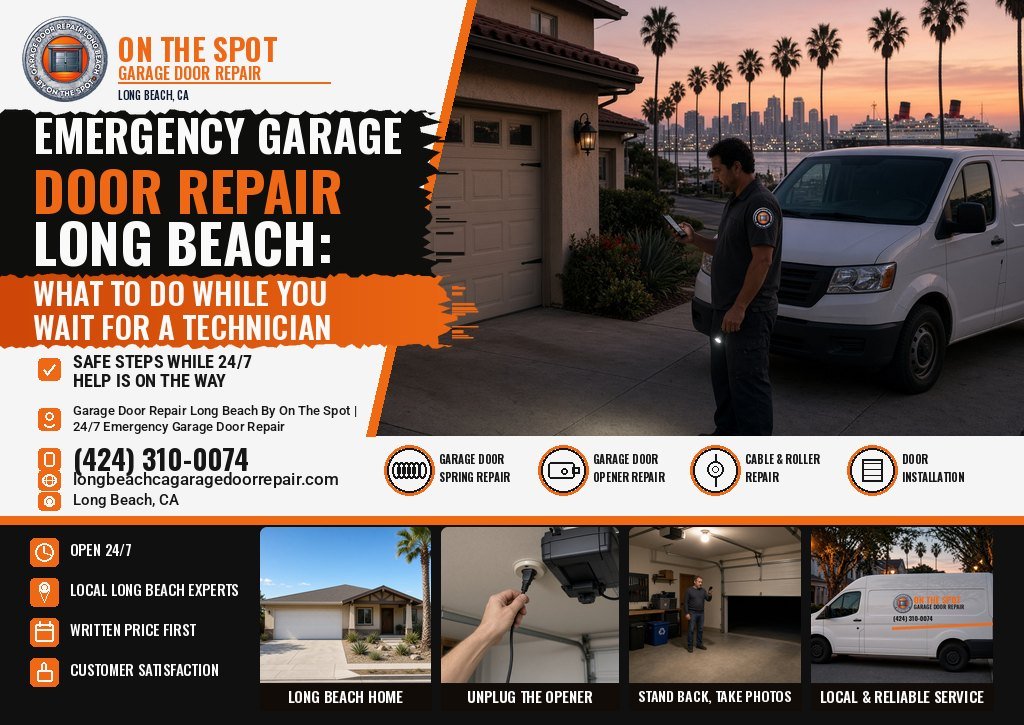
Garage Door Repair Long Beach By On The Spot · 24/7 Emergency Guide
Emergency Garage Door Repair Long Beach: What to Do While You Wait for a Technician
You’ve made the call, and now you’re standing in the garage looking at a door that won’t do what it should. The stretch of time before the technician pulls up is where most avoidable injuries and second repairs happen. This guide covers what to do while waiting for emergency garage door repair in Long Beach, and what to leave alone.
What should you do while you wait for emergency garage door repair in Long Beach?
Leave the door where it stopped, unplug the opener if you can reach it without standing under the door, keep people, pets, and cars clear, lock the door into the house, and take photos from the side. Garage Door Repair Long Beach By On The Spot is open 24/7 for emergency garage door repair in Long Beach at (424) 310-0074.
Below: a plan for each door position, the opener and release-cord rules, what to photograph, what to say on the phone, how to get an alley or shared garage ready, and when the police, not a repair company, should get the first call.
Related reading: 24-hour garage door repair services in Long Beach, Emergency Garage Door Repair in Long Beach, Emergency Garage Door Repair: What to Expect After Hours, How to Open a Garage Door Manually, and Garage Door Repair Long Beach. Safety guidance from the CPSC guidance on automatic residential garage door operators and DASMA garage door system safety tips; outage information from the SCE Outage Center.
What to Do While Waiting for Emergency Garage Door Repair: The First Ten Minutes
The first few minutes after a garage door fails are when people get hurt. Most of the time nobody is hurt by the original break. A spring snaps, a cable jumps off its drum, or a door stops halfway with a grinding noise, and the damage so far is mechanical. The injuries come afterward, when someone presses the button again to see what happens, grabs the bottom panel to help it along, or pulls the red cord on a door that was only being held up by the opener.
For the first ten minutes, forget about diagnosing the door. Stop anything from moving, keep bodies out of the door’s path, and make the house secure. Once that is done, you can take photos and gather the details that help the technician show up with the right parts. Here is the order that makes sense in most Long Beach garages, whether the house is a 1920s bungalow with an alley garage or a newer tract home with a two-car door facing the street.
- Stop operating the door. One press of the wall button or remote is enough to learn that something is wrong. Every press after that asks the opener to fight a door it may not be able to move safely.
- Get people, pets, and cars out from under the door. If the door is partway open or crooked, nobody walks or drives through the opening until it has been secured.
- Take the opener out of play if you can reach its plug or breaker without walking under the door. The next section covers how.
- Leave the door where it stopped. Closed stays closed. Open stays open. Partway stays partway, with everyone clear.
- Secure the house side. Close and lock the door between the garage and the living space. Turn on lights.
- Look, do not touch. From the side of the garage, look at the springs above the door, the cables at the bottom corners, and both tracks. Take photos.
- Call, or call back with details. Tell the dispatcher where the door is resting, what you heard, and whether a car is inside.
That list is deliberately boring. Nothing on it involves a tool, a ladder, or a second person holding the door. Garage doors are heavy, and the system that makes them feel light is a set of springs and cables under constant tension. When part of that system fails, the door’s real weight is suddenly in play. The DASMA garage door system safety tips make the same point in plainer terms: springs, cables, and the brackets they attach to are under high tension and should be adjusted only by trained people. You can read the industry association’s own list in the DASMA garage door system safety tips.
Why waiting well matters more than it sounds
A failed spring is one repair. A failed spring plus a burned-out opener, a bent top section where the opener arm attaches, and a cable that unspooled because someone kept running the motor is three or four repairs. The waiting period is where a single fault turns into a bigger job. It is also where a door that could have been secured in a few minutes ends up hanging crooked in its tracks because someone tried to force it down by hand.
There is a practical upside too. When you call with clear photos and a short description, the technician can bring the right springs, cables, or rollers on the first trip. That matters most late at night, when parts houses are closed and the van’s stock is what there is to work with.
What to Do Depends on Where the Door Stopped
The single most useful fact about a failed garage door is where it is resting. A closed door can’t fall. A fully open door may be held up by the opener and nothing else. A door stuck partway, or hanging lower on one side, is the least predictable of all. Your next moves follow from that one observation, so start there before you do anything else.
| Where the door is | Is it stable? | What to do while you wait | What to leave alone |
|---|---|---|---|
| Fully closed | Usually the most stable position. It has nowhere to fall. | Unplug the opener, use another way in and out of the house, and plan other transport if the car is inside. | Do not lift it by hand or pull the release to get a car out. |
| Fully open | May be held only by the opener trolley if a spring has failed. | Keep everyone and every car out from under it. Lock the interior door. Lights on. Valuables out of sight. | Do not pull the red cord. Do not try to close it with the opener or by hand. |
| Stuck partway | The least predictable position. | Clear the area under and in front of it. Keep kids and pets out of the garage entirely. | Do not duck under it, prop it, or push it up or down. |
| Crooked or hanging on one side | Often a cable or roller problem; the door can shift further. | Stay well back. Photograph both bottom corners from the side. | Do not touch the cables, bottom brackets, or tracks. |
| Came down hard or slammed shut | The springs may no longer be carrying the weight. | Leave it closed. Unplug the opener. Note whether you heard a bang first. | Do not open it to check. A slamming door is a warning sign, not a test result. |
| Off its track | Rollers out of the track can let a section fold or drop. | Clear the area. Photograph where the rollers left the track. | Do not hammer the track or try to push rollers back in. |
If you can’t tell which situation you are in, describe what you see on the call and let the dispatcher decide. A door that looks fully closed may still have a cable off its drum, and a door that looks open and level may have a broken torsion spring you can see only by looking up at the shaft above the opening. Our posts on Torsion vs Extension Springs in Long Beach: How to Tell Which System You Have and Is my garage door spring broken if the door only opens a few inches? explain how those failures look from the floor, without touching anything.
Closed is usually the good news
A broken spring discovered with the door closed is frustrating, especially if the car is inside, but it is the safest starting point. The door is sitting on the floor and the garage is still locked. The main risks are someone trying to lift it by hand to get the car out, or someone running the opener so the motor strains against the full weight. Unplug the opener, tape a note over the wall button if you have kids or roommates, and use the front door until the repair is done. Garage Door Stuck Closed covers the causes behind a door that traps a car.
Open is where the security problem starts
A door stuck open is the case most people call an emergency, and for good reason. There is now a large opening into the house, often onto an alley, and you can’t safely close it if a spring or cable has failed. The work while you wait moves from the door to the house: lock the passage door, light the garage, move bikes, tools, and anything worth stealing out of sight, and lock the cars. Garage Door Stuck Open is our citywide guide to why doors stay open; the security steps are expanded further down this page.
Taking the Opener Out of Play: Plugs, Breakers, Remotes, and Apps
An opener is built to guide a balanced door, not to lift dead weight. When the springs are carrying the door properly, the motor only has to move a few pounds of effort. When a spring has broken, the opener is suddenly asked to lift the whole door. Some will strain, hum, and lift a few inches before the force limit trips. Others will keep pulling until something gives: a gear strips, the rail bends, or the bracket on the top section tears out of the door.
That is why the advice everywhere, from manufacturers to repair companies, is to stop running it. The trick is making sure nobody else runs it either. In a busy household the door can be triggered from the wall button, two or three remotes, a keypad outside, a car’s built-in button, and a phone app. Each of those is a way for someone to press the button out of habit before they remember the door is broken.
Unplugging safely
Most residential openers plug into a ceiling outlet next to the motor unit. If you can reach that plug from a step stool placed to the side of the door’s path, not under the door itself, unplugging is the simplest way to stop the opener. If the outlet is directly above an open or partway door, or you would have to stand under the door to reach it, skip it. The breaker panel is the safer route in that case.
- Find the breaker labeled for the garage or garage ceiling. Older Long Beach homes may have a panel with handwritten or missing labels, so if you are not sure, leave it and rely on the steps below instead.
- Do not switch off breakers at random in the dark. You can lose lights, the refrigerator, or a medical device you did not mean to touch.
- If the opener has a battery backup, unplugging it may not stop it. California has required battery backup on new residential openers sold or installed since July 1, 2019, under California SB 969, so many newer units will keep working on battery for a while after the plug comes out.
Battery backup openers
That last point surprises people. A battery-backed opener can still try to move the door with the power off, which is the point of the law during an outage, but it is unhelpful when a spring has failed. Some units have a battery switch or a removable battery tray; the owner’s manual will show where. If you can’t find it quickly and safely, the next best step is controlling every way the door can be triggered. Our post on Garage Door Backup Battery Not Working covers how those batteries behave in general.
Remotes, keypads, cars, and apps
- Collect the handheld remotes and put them somewhere nobody will grab them by reflex.
- Tell everyone in the house, out loud, that the garage door is broken and nobody presses anything until the technician has looked at it. A note taped over the wall button helps.
- If the opener is connected to a phone app, log in and use any lock or disable option the app offers, or ask family members to stay off it.
- If a car has a built-in garage button, mention it to anyone driving home tonight. A car arriving late and pressing the button is a common way a partway door starts moving again.
Automatic residential openers sold in the United States have to meet a mandatory federal safety standard, 16 CFR Part 1211, which the CPSC guidance on automatic residential garage door operators points to. That standard is about entrapment protection: the door reversing when it meets an obstruction, plus a second safeguard such as photo-eye sensors. Those features protect people from a closing door during normal use. They are not a reason to trust an opener on a door with a failed spring, and they do nothing to stop a door falling after the release cord has been pulled.
When the Red Emergency Release Cord Is Safe, and When It Is Not
The red handle hanging from the opener rail disconnects the door from the opener so the door can be moved by hand. It exists for good reasons: power outages, a failed motor, or a trapped person. It is also the most misused part of a broken garage door, because pulling the cord does not restore the spring’s lift. It only removes the opener from the system. If the opener was the thing holding the door up, the door is now held up by nothing.
| Situation | Release cord? | Why |
|---|---|---|
| Door fully closed, opener dead, springs look intact | Often fine, if a technician agrees | A balanced door on intact springs should lift with moderate effort. If it feels heavy, stop. |
| Door fully closed, spring visibly broken | Leave it alone | The door is far too heavy to lift safely without the spring. Pulling the cord only invites someone to try. |
| Door fully open or partway, any sign of spring or cable failure | Do not pull it | The opener may be the only thing keeping the door from falling. |
| Door crooked, off track, or a cable hanging loose | Do not pull it | The door can twist or drop unevenly as soon as it is disconnected. |
| Power outage, door closed, nothing broken, you need the car | Possibly, carefully | Lift slowly from the side. If the door does not stay put at waist height, lower it and stop. |
If you are unsure whether the springs are intact, treat the cord as off limits. A torsion spring sits on the bar above the door; a break usually shows as a clear gap in the coil. Extension springs run alongside the horizontal tracks on each side; a broken one may hang loose or be stretched out of shape. Even when you can see that a spring looks fine, a slipped cable or a weak spring can still let the door drop. Our guide to Garage Door Emergency Release Cord Problems explains reconnecting the trolley after a normal outage. How to Open a Garage Door Manually covers manual opening when it is genuinely safe. Why Is My Garage Door Too Heavy to Open Manually? explains why a door that feels like it weighs a ton is a spring problem.
If someone already pulled it
If the cord has already been pulled and the door is now sitting disconnected but stable, do not try to reconnect it or move it to the closed position. Leave it where it is, keep people clear, and tell the dispatcher it has been disconnected. If the door dropped when the cord was pulled, check that nobody is hurt, then describe what happened on the call. A door that fell hard can bend the bottom section or knock rollers loose, and those are worth having checked before anything else. Garage Door Slams Shut explains what usually causes a door to come down too fast.
If the Door Is Stuck Open: Securing the House While You Wait
A garage door that will not come down turns the garage into an open room facing the street or the alley. In a lot of Long Beach houses that room connects straight into the kitchen or a hallway through a passage door. It may also hold the most expensive things the household owns that are not bolted down: bikes, tools, a second fridge, the car. The goal while you wait is to make that opening as uninteresting and as hard to use as possible, without going anywhere near the door itself.
- Lock the passage door into the house. If it has a deadbolt, use it. This is the most important step, because it keeps the problem in the garage.
- Turn on the garage lights and any exterior lights. A bright, obviously occupied garage is less inviting than a dark open bay, and the light helps the technician on arrival.
- Move tools, bikes, power equipment, and packages out of sight if you can do it without passing under the door.
- Lock the cars and take the keys and any garage remote out of them.
- Close windows and side doors to the garage and the yard.
- Stay inside the house rather than standing guard in the open garage, especially late at night.
What you should not do is try to close the door anyway. A door with a broken spring may come down far faster than you expect, and holding it with your hands, a rope, or a ladder is how fingers and backs get hurt. Some websites describe closing a spring-broken door manually with two or three adults. It can be done, but that guidance assumes a level door, sound cables, and people who know what a falling door feels like. On a crooked door, at night, with a cable you cannot see clearly, it is a gamble that saves a short wait at the cost of real injury risk. Tell the dispatcher it is a security situation instead. That changes how the visit is prioritized and what gets done first.
Alley garages and street-facing garages
Many older Long Beach neighborhoods, from Belmont Heights and Bluff Park to Cal Heights and parts of Bixby Knolls, have garages that open onto a rear alley. Alleys are quieter at night than the street, which cuts both ways: fewer people pass by to notice a problem, and fewer people pass by to see someone walking into an open garage. If your garage is alley-loaded, mention it on the call, and turn on whatever alley-side light you have. If the opening faces the street, the steps are the same. Our post on Top Causes of Off-Track Garage Doors in Long Beach Alleys explains why tight alley approaches affect doors in the first place.
If you have to leave
Sometimes the door fails as you are heading out for work or a flight. If you have to leave the house before the repair, lock the passage door, take anything worth stealing out of the garage or out of sight, and make sure the dispatcher has a reachable phone number and knows whether someone will be home. Do not try to block the opening by parking a car under or against a door that might fall. Parking a car across the driveway, well clear of the door’s path, is a different thing and may deter casual entry, but it also blocks the technician, so tell them where the keys are.
If Your Car Is Trapped Inside
A car stuck behind a closed, broken door is the other common reason people call at odd hours. It’s stressful because the damage feels small and the consequence feels large: one broken spring and you can’t get to work. The temptation is to lift the door just high enough to back out. With a broken spring, that means two or three people holding the full weight of the door while someone else reverses underneath it. Do not do it. How to Open a Garage Door Manually explains when manual opening is safe; a broken spring is the main exception.
- Leave the car where it is and the door closed.
- Unplug the opener so nobody tries the remote to see whether it can manage.
- Arrange other transport: a ride from a neighbor, a rideshare, Long Beach Transit, or a second car.
- Tell the dispatcher the car is trapped and when you need it, since that affects scheduling.
- Move anything stored near the springs or the inside of the door, if the door is closed and level, so there is room for a ladder.
Do not run the car’s engine inside the closed garage while you wait, even to stay warm or charge a phone. Exhaust in a closed garage can build up carbon monoxide quickly and seep into the house. If you need the car’s battery or heater, wait until the door has been repaired and the car is outside. For the causes behind a door that traps a car, see Garage Door Stuck Closed. For spring-specific questions such as whether both springs get replaced, see Do I need to replace both springs, or just the broken one?.
Electric vehicles and chargers
If you charge an electric car in the garage, you can keep charging while you wait as long as the charger and cable are clear of the door’s path and nobody needs to walk under the door to reach them. If the cable crosses the threshold or the charger is mounted beside a partway door, unplug it from the car, coil the cable away from the door, and leave it until after the repair. A charging cable pinned under a falling door is an expensive fix on top of the door itself.
What to Photograph and Write Down for the Technician
Photos are the most useful thing you can do while you wait. They let the technician confirm what kind of springs you have, whether a cable has come off, and whether the opener is part of the problem. That decides which parts go on the van. Take them from the side of the garage or from inside the house doorway, never from under the door, and never by climbing a ladder near the springs.
| Photo | Where to stand | What it tells the technician |
|---|---|---|
| The whole door, from inside | Inside doorway or the side wall | Whether the door is level, crooked, open, closed, or partway. |
| The spring area above the door | Side wall, looking up | Torsion or extension springs, and whether a coil has a visible gap. |
| Each bottom corner | Side wall, at a distance | Whether the lift cables are attached, slack, or off the drum. |
| Both vertical tracks | Side wall | Rollers out of the track, bends, or loose brackets. |
| The opener label | Only if you can see it without standing under the door | Brand, model, and age, which affect parts and compatibility. |
| The outside of the door | Driveway or alley, standing back | Dents, impact damage, or a section folded outward. |
A short video can help too, if the door has made an unusual noise and you want to describe it. Do not run the door to film it. If you recorded something on your phone when it first went wrong, keep it. Our posts on Garage Door Spring Makes Popping or Creaking Sounds and My garage door cable came loose: does that usually mean the spring is broken too? describe the usual sounds and signs.
A short note to have ready
- What happened right before: you pressed the button, the power flickered, a car touched the door, or it simply stopped.
- What you heard: a bang like a gunshot, a grinding noise, a hum without movement, or nothing.
- Where the door is now and whether it moved after it first stopped.
- Whether the springs have ever been replaced, and roughly how old the door is, if you know.
- Whether a car, a person who needs to leave, or a pet is inside the garage.
- Anything about access: a gate code, an alley entrance, a shared driveway, or a building manager.
You do not need all of that. Even two clear photos and one sentence about the noise help the technician bring the right parts, especially on a call at night when restocking is not an option.
Photos for insurance or a police report
If the door was damaged by a vehicle, a storm, or a break-in attempt, the same photos may be useful for an insurance claim or a police report. Take them before anything is moved. Whether a repair is covered is a question for your insurer and your policy, not something a repair company can promise. A written price and an invoice describing the work usually help that conversation.
What to Tell the Dispatcher on the Call
A good emergency call is short and specific. The dispatcher is trying to answer three questions: is anyone in danger, is the house secure, and what parts are likely to be needed. You can help with all three in under a minute. Here is a simple script that works for most calls to Garage Door Repair Long Beach By On The Spot at (424) 310-0074.
- Where you are: your street address, a cross street, and the neighborhood or city. Long Beach covers a lot of ground, and a Naples canal house, a North Long Beach tract home, and a Downtown condo garage are different approaches.
- Where the door is: closed, fully open, partway, crooked, or off track.
- What happened: the bang, the grinding, the impact, or the outage.
- Who or what is affected: a car inside, a house that can’t be secured, a person who needs to leave, a pet in the garage.
- What you can see: a gap in a spring, a loose cable, rollers out of the track.
- Access: alley or street, gate codes, parking, building rules.
- A callback number that will be answered.
Ask for the current dispatch window rather than an exact arrival minute. Traffic on the 405 and the 710, a job already in progress, and the parts a repair needs all affect timing, and an honest window is more useful than a promise. Ask, too, how pricing works, and ask for a written price before any work begins, so you know what the repair involves before anyone touches the door.
Questions worth asking before the technician arrives
- Is there anything you want me to do, or not do, before you get here?
- Will you call when you are on the way?
- What do you need from me on arrival: access, parking, the breaker panel?
- Will I get a written price before any work starts?
If anyone on the phone pressures you, quotes an oddly low teaser price, or refuses to give a written price before starting, that is worth noticing. Our guide to Garage Door Repair Scams to Avoid covers the common patterns. For a company you are considering for the first time, the California Contractors State License Board (CSLB) license lookup lets you look up a contractor’s license status yourself.
Getting the Garage Ready for the Technician
Once the door is secured and the call is made, there is usually some waiting left. A little preparation in that time makes the visit shorter and safer, as long as none of it involves going near the door. Think of it as clearing a work area and a path to it.
Inside the garage
- If the door is closed and level, move bins, bikes, and boxes back from the door and away from the walls near the springs. The technician may need room for a ladder under the spring shaft and on both sides of the door.
- If the door is open, partway, or crooked, leave everything where it is. Clearing space is not worth walking under the door.
- Keep pets out of the garage and, ideally, in a closed room of the house. Strange tools and noise make calm dogs curious.
- Leave the garage lights on.
- Know where the breaker panel is, in case the opener or outlet needs to be checked.
Outside
- Clear the driveway or alley approach so a van can park close. If street parking is tight, tell the dispatcher; on narrow blocks the van may need to stop in the alley or around the corner.
- Turn on the porch or alley light.
- Unlock any side gate the technician will need, or have the code ready.
- If you are in a gated community or a building with a parking structure, let the manager or security desk know a technician is coming.
Long Beach blocks differ a lot here. A Belmont Shore street with permit parking and cars bumper to bumper, a Los Altos cul-de-sac with a wide driveway, and a Downtown building with a shared garage gate are three different arrivals. Mentioning the setup on the call helps. If you are in a condo or HOA building, our post on Garage Door Repair in Condos and HOA Communities explains who usually owns which part of a shared door.
Kids, guests, and neighbors
Children are fascinated by a broken garage door, especially a partway door with an opening just high enough to duck under. If kids are home, make the garage off limits and tell them why in one sentence. If neighbors come over to help, thank them, and ask them not to lift, push, or adjust anything. The most common well-meant mistake is a neighbor offering to hold the door while someone else does something to it.
What Not to Do While You Wait
Most injuries and second repairs during the wait come from treating a door that has lost part of its counterbalance like a normal door. These are the habits to break.
- Do not keep pressing the button. Repeated tries can strip the opener’s drive gear, bend the rail, or pull the top section apart where the arm attaches.
- Do not lift, push, or pull the door by hand if it feels heavy, crooked, or stuck. A door that fights you has lost its counterweight.
- Do not pull the red release cord on a door that is open or partway, or on any door with a visible spring or cable problem.
- Do not touch springs, cables, bottom brackets, or drums. They hold stored energy even after a failure, and the spring that did not break is still under tension.
- Do not try to unwind or adjust a torsion spring. Winding bars, the right size, and training are not optional on this job.
- Do not prop the door with a ladder, a board, or a car. Props slip, and a falling door does not stop for them.
- Do not walk or drive under a partway or crooked door. Not even quickly.
- Do not hammer a bent track or force rollers back in. That can let a section fold or drop.
- Do not spray lubricant on a broken spring hoping it will help. It won’t, and it makes the parts harder to handle.
- Do not run a car in the closed garage. Carbon monoxide builds up fast.
If you already did one of these before reading this, don’t panic. Stop, step back, and tell the dispatcher exactly what happened, because it changes what the technician checks first. The DASMA guidance and our own posts on Can I replace a garage door spring myself? and Garage Door Closes Too Fast explain the risks in more detail.
Why the spring that did not break still matters
On a door with two torsion springs, one usually fails first. The second is still wound and still pushing against the shaft. On an extension spring door, the spring that did not snap is still stretched, and if there is no safety cable through it, it can whip if something lets go. That is why no part of a broken spring system is safe to touch, even when it looks like the dangerous part already happened. Our guide to Garage Door Spring Repair vs Replacement in Long Beach explains why worn springs are usually replaced, not patched, and What to Expect During a Torsion Spring Replacement in Long Beach walks through a torsion replacement visit step by step.
Long Beach Conditions That Change the Wait
Most of the advice above applies to any garage door anywhere. A few local conditions are worth knowing, because they change what is likely to have failed and what you might see while you wait.
Marine air, fog, and salt
Neighborhoods close to the water, such as Belmont Shore, Naples, the Peninsula, and Alamitos Beach, get regular marine layer and salt air. Over years, that air corrodes springs, cables, and the small hardware that ties a door together. When a spring or cable fails in those areas, it is often because corrosion has been working on it for a long time. You may see rust on the remaining spring or fraying on the other cable. That does not mean you should touch them. It does mean you should mention it, because a technician may recommend replacing more than the part that broke. Our posts on How Salt Air Affects Garage Door Cables, Hinges, Tracks, and Springs and Signs the Marine Layer Is Hurting Your Opener go into the details.
Damp mornings and sticking doors
A door that is slow or reluctant on a damp morning is not always an emergency. Swollen weather seals, corroded rollers, or dew on the photo-eye lenses can all make a door behave badly without anything breaking. If the door simply refuses to close and the opener lights blink, it may be the sensors, and Garage Door Sensor Repair is a better starting point than an emergency call. If you heard a bang, the door is crooked, or a cable looks loose, it is a different situation. Garage Door Gets Stuck in Cold, Damp Weather explains the difference.
Power outages
When a door will not move and the opener shows no lights, check whether the power is out on the block. The SCE Outage Center lists current outages. If it is a general outage and the door is closed, intact, and needed, a careful manual release may be reasonable, as described above. If the door is open and you are not sure whether the springs are sound, leave it, secure the house, and wait. Our guide to Garage Door Will Not Open After a Power Outage covers the common post-outage problems.
Older homes, heavier doors
Long Beach has a lot of older housing stock: Craftsman bungalows in Belmont Heights and Cal Heights, Spanish revival houses in Bixby Knolls and Los Cerritos, and mid-century homes in Los Altos and the Plaza. Some of those garages still have wood doors, retrofitted openers, or extension spring systems. Wood doors are heavy, and an older retrofit may not have the safety cables that keep a snapped extension spring contained. The DASMA garage door system safety tips recommend a safety cable through every extension spring for exactly that reason. If your door is older, assume it is heavier than it looks, and be even more careful about leaving it alone.
When to Call 911 or the Police, Not Only a Repair Company
A broken garage door is a repair problem. Some situations around a broken door are not, and it helps to know the difference quickly.
- Someone is hurt or trapped under or by the door: call 911 first.
- You see or hear someone in the garage who should not be there, or a break-in is in progress: call 911 and stay inside the house.
- The door was damaged in a break-in attempt that has already happened, and nobody is there now: call the Long Beach Police Department’s non-emergency line at (562) 435-6711 to report it, then call for the repair.
- A vehicle hit the door and there are injuries, a fuel leak, or a dispute about what happened: call 911 or the police as appropriate, then call for the repair.
- You smell gas near the garage, or a water heater or gas line in the garage was struck: leave the area and call 911 or the gas utility first.
The Long Beach Police Department contact page lists the department’s phone numbers. In Signal Hill, Lakewood, Seal Beach, and Los Alamitos, use the police or sheriff’s agency that covers your city. Once the immediate danger is handled, a repair company can secure the door. A door damaged in a break-in attempt is a security priority, and that is worth saying on the call.
Smoke, sparks, or a burning smell from the opener
If the opener smells hot or you see sparks, cut power at the breaker if you can reach it safely, keep everyone out of the garage, and call 911 if there is smoke or flame. An opener that was straining against a broken spring can overheat. Do not try to open the motor cover.
Three Situations, Written as Examples
These are examples written to show how the advice above fits together. They are not quotes from customers or descriptions of specific jobs.
A bang at 6 a.m. in Los Altos, door closed, car inside
The door is down, the opener hummed and lifted it two inches before stopping, and there is a visible gap in the torsion spring above the door. This is the stable case. Unplug the opener, leave the door closed, and take a photo of the spring from the side wall. Arrange a ride to work. On the call, say the door is closed, the spring has a gap, and the car is inside. Do not pull the release cord to back the car out, even though the door is closed, because the spring is visibly broken. A typical fix for this pattern is a spring replacement, with the cables and drums checked and the door balance tested before the car comes out. Is my garage door spring broken if the door only opens a few inches? explains this exact pattern.
A door stuck open overnight on an alley garage near Belmont Shore
The door went up, stopped at the top, and will not come down. The opener light is on, and one cable on the left side looks slack. That makes it a cable or spring problem, and the door may be held up only by the opener. Leave it open. Do not pull the cord. Lock the passage door, turn on the garage and alley lights, move the bikes out of sight from the inside doorway, and lock the car. On the call, say the door is open, there is a slack cable on one side, and the garage faces an alley. The Emergency Garage Door Repair in Belmont Shore page covers that neighborhood.
A door hit by a car in North Long Beach, partway open and crooked
Someone clipped the door backing out. It is now stuck about three feet up, lower on one side, with a roller out of the track. Nobody is hurt and there is no fuel leak, so this is a repair call, not a 911 call. Keep everyone clear of the opening, especially kids. Photograph the outside of the door and both tracks from a distance, for the repair and for insurance. Unplug the opener if the plug is reachable from the side. Do not push the door up or down. Tell the dispatcher it is impact damage with the door partway and crooked. Off-Track Garage Door Repair and Garage Door Panel Repair cover the usual repairs, and Emergency Garage Door Repair in North Long Beach covers that part of the city.
What Usually Happens When the Technician Arrives
Knowing what the first part of the visit looks like makes the wait less uncertain. The exact order depends on the door, but an emergency visit usually follows a similar path.
- A quick look at safety. Where the door is, whether anyone is at risk, and whether the opening needs to be secured first.
- Stabilizing the door. On an open or partway door, that may mean clamping the door in its tracks so it can’t move while work happens.
- Finding the actual fault. A spring, a cable, a roller, the opener, or more than one of them.
- A written price. Before work begins, you should know what is being replaced and what it costs.
- The repair. Springs replaced and wound to the door’s weight, cables set evenly, rollers or track sections fixed, and the opener checked.
- Balance and safety tests. The door should stay put when lifted partway by hand, and the opener’s reversing feature and photo-eyes should work.
A repaired door that is badly balanced will wear out the new parts and the opener. A door whose auto-reverse does not work is a hazard; that reversing behavior is what the federal opener standard on the CPSC guidance on automatic residential garage door operators page exists to require. If anything about the test looks wrong to you, say so before the technician leaves. How Long Does Garage Door Repair Take in Long Beach, CA? gives a sense of how long common repairs take, and Emergency Garage Door Repair: What to Expect After Hours explains what a late-night visit is like.
How long the wait itself takes
It depends on the hour, the location, the jobs already in progress, and the parts. Garage Door Repair Long Beach By On The Spot is open 24/7, but no honest dispatcher can promise an exact arrival minute across a city the size of Long Beach. Ask for the current window when you call, and ask to be called when the technician is on the way. Use the time for the steps on this page.
After the Repair: What to Check Before You Go Back to Normal
- Run the door through a full open and close cycle while you watch from the side. It should move smoothly without jerking, scraping, or a loud bang at the top or bottom.
- Lay a 2×4 flat on the floor in the door’s path and close the door. It should reverse when it touches the board. Most opener owner’s manuals describe this reversal test.
- Wave something through the photo-eye beam as the door closes. The door should reverse.
- Plug the opener back in, put the remotes back, and re-enable the app if you disabled it.
- Keep the invoice and photos. They are useful if anything goes wrong later, for insurance, or when you sell the house.
- Ask whether any other parts were close to failing. A second spring of the same age, frayed cables, and worn rollers are common follow-ups.
If the door broke because of slow wear, a regular check can catch the next problem before it becomes another emergency. Garage Door Safety Inspection and Garage Door Tune-Up describe what a routine visit covers.
Waiting for emergency garage door repair in Long Beach: FAQ
Should I unplug my garage door opener while I wait for emergency repair?
Yes, if you can reach the plug or breaker without standing under the door. Unplugging stops anyone from running the opener against a broken spring. Many newer California openers have battery backup, so also collect the remotes, tell everyone in the house, and disable any phone app access until the door is repaired.
Can I close a garage door that is stuck open with a broken spring?
It is safer not to. Without the spring, the door may come down far faster and heavier than you expect, and holding it by hand is how injuries happen. Lock the door into the house, light the garage, move tools and bikes out of sight, and tell the dispatcher it is a security situation instead.
Is it safe to pull the red emergency release cord?
Only when the door is fully closed and nothing looks broken. On a door that is open, partway, or crooked, or one with a visible spring or cable problem, the opener may be the only thing holding the door up. Pulling the cord can let it fall. When in doubt, leave the cord alone.
What should I tell the dispatcher when I call for emergency garage door repair?
Give your address and cross street, where the door is resting, what you heard or saw, and whether a car or person is inside. Mention alley access, gate codes, and parking. Photos of the springs, cables, and tracks taken from the side help the technician bring the right parts on the first trip.
How long will I wait for emergency garage door repair in Long Beach?
It depends on the hour, traffic, the jobs already in progress, and the parts needed, so ask for the current dispatch window when you call. Garage Door Repair Long Beach By On The Spot is open 24/7 at (424) 310-0074. Ask for a written price before any work begins.
When should I call 911 instead of a garage door company?
Call 911 if someone is hurt or trapped by the door, if a break-in is in progress, or if you smell gas or see smoke. For a break-in attempt that is already over, the Long Beach Police non-emergency line is (562) 435-6711. Once everyone is safe, call for the repair.
Garage Door Repair Long Beach By On The Spot on Google Maps
View Garage Door Repair Long Beach By On The Spot on Google Maps · 151 E 5th St, Long Beach, CA 90802
Need 24/7 Emergency Garage Door Repair in Long Beach?
Garage Door Repair Long Beach By On The Spot is open 24/7 for emergency garage door repair in Long Beach and nearby cities. Ask for a written price before any work begins. Call (424) 310-0074, use our contact page, or find us on Google Maps. Our address is 151 E 5th St, Long Beach, CA 90802.
Garage Door Repair Long Beach By On The Spot · 151 E 5th St, Long Beach, CA 90802
(424) 310-0074 · office.onthespotgaragedoor@gmail.com · longbeachcagaragedoorrepair.com