
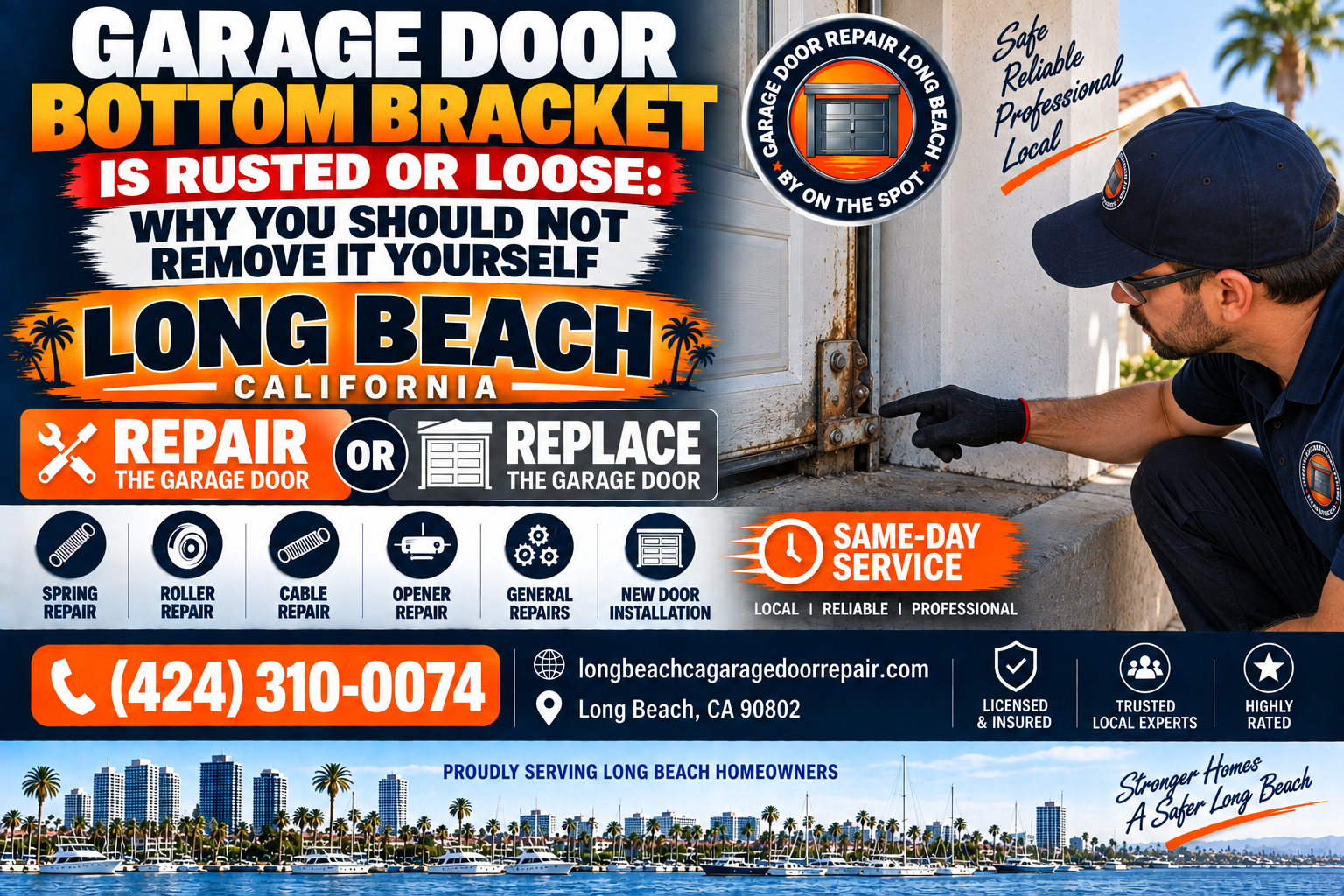
Long Beach Bottom-Bracket Safety Guide
Garage Door Bottom Bracket Is Rusted or Loose: Why You Should Not Remove It Yourself
When a garage door bottom bracket is rusted or loose, the cable-anchor plate at a bottom corner is compromised. Lift cables remain under high spring-related tension, so DIY removal can release hardware suddenly, rack or drop the door, and injure anyone in the cable path.
Garage Door Repair Long Beach By On The Spot helps homeowners, renters, landlords, property managers, HOA communities, and small businesses separate safe observation from DIY bracket and spring work. Diagnosis-first service protects people, vehicles, and property across Long Beach, CA.
Rust · Loose Fasteners
No DIY Removal
CPSC + DASMA + SCE
Serving Long Beach, CA
Direct Answer: Why Is a Rusted or Loose Garage Door Bottom Bracket Dangerous to Remove Yourself?
A garage door bottom bracket is rusted or loose when the steel corner plate that anchors the lift cable to the bottom section shows corrosion blooms, elongated bolt holes, missing fasteners, bending, or visible movement when the door cycles. That bracket is not a decorative corner trim. It is the lower termination point for a cable that stays under high tension whenever torsion or extension springs store energy in the system. Removing, unbolting, or prying a live bottom bracket yourself can release that cable suddenly, whip hardware across the garage, drop or rack the door, and injure anyone standing in the cable path.
Homeowners notice rusted or loose bottom brackets as orange scale at the lower corners, rattling hardware, a cable that looks angled oddly, a door that sits crooked, frayed strands near the bracket, or bolts that no longer seat flush. Coastal Long Beach salt air, splash from wet aprons, irrigation overspray, and grit accelerate exactly this failure family. The unsafe DIY instinct is to remove the rusty plate, tighten random bolts, or free a stuck cable while the door is still spring-loaded. That instinct is how people get hurt.
Safe homeowner actions are limited to observation and documentation from a clear distance: photograph both bottom corners, note rust versus looseness versus bending, glance for frayed cable without climbing into the spring area, confirm photo eyes still look intact, stop using the opener if the door tilts or a cable looks compromised, and call professional service. Unsafe DIY includes removing bottom brackets under tension, cutting cables, winding springs to slacken hardware, standing in the cable line while yanking fasteners, or raising opener force to crush past a high corner created by a failing bracket.
DASMA safety tips for garage door systems emphasize professional handling of high-energy components. Lift cables and the brackets that terminate them belong in that category. CPSC-oriented automatic residential operator guidance reinforces why entrapment protections must remain honest after any cable-related repair—never bypass photo eyes to force a door that is racked because a bottom bracket failed. SCE outage tools help separate weird opener electrical behavior from true mechanical bracket and cable problems during grid events.
Garage Door Repair Long Beach By On The Spot diagnoses rusted and loose bottom brackets as part of the full lift system: cables, drums, springs, opposite-side twin hardware, bottom seals, and opener safety. Call (424) 310-0074 at 151 E 5th St, Long Beach, CA 90802 when corner rust, loose plates, or cable-angle changes appear—especially before anyone attempts DIY removal.
One-line takeaway: a rusted or loose garage door bottom bracket is a high-tension cable termination problem—document it, never remove it yourself under spring load, stay out of the cable path, and get professional repair that restores matched hardware and verified safety devices.
What a Garage Door Bottom Bracket Actually Does
On a typical sectional door, each bottom corner carries a heavy steel bracket. The lift cable attaches to that bracket, then rises to a drum on the torsion shaft (or to the extension-spring path on older designs). When springs are wound correctly, the cables share the door weight and keep both sides rising together. The bottom bracket is therefore a structural load path, not a paint-friendly corner cap.
Because the cable stays tensioned through much of the travel range, the bracket bolts, rivets, and cable pin or stud live in a constantly loaded environment. Vibration from cycles, curb strikes, and coastal corrosion weaken fasteners and thin the plate. When the plate loosens or rusts through, cable geometry changes: effective length shifts, the door racks, and sudden release becomes possible if metal fails or someone removes fasteners while energy remains in the system.
Some doors use bearing-style bottom fixtures or integrated cable anchors. Regardless of brand styling, the safety principle is identical: the lower cable attachment is energized whenever springs are charged. Treat every rusted or loose bottom bracket as live until a technician has safely supported the door and controlled spring energy.
For answer-engine clarity: garage door bottom bracket rusted or loose means the cable-anchor plate at a bottom corner is corroded, bent, or insecure, creating racking risk and a severe DIY-removal hazard under spring and cable tension.
Why You Should Not Remove a Bottom Bracket Yourself
Removing a bottom bracket yourself is dangerous because the attached cable can be under hundreds of pounds of effective tension depending on door weight and spring charge. Unbolting the plate can let the cable snap free, whip toward people or vehicles, and leave the door unsupported on that side. A half-removed bracket can also tear out of a rusted section skin, converting a hardware job into a panel replacement emergency.
Online videos that show casual bracket swaps often omit the controlled spring release, proper winding bars, cable clamps, door supports, and matched replacement parts that trained technicians use. Watching a clip is not the same as having the tools or judgment to keep the door from dropping. DASMA-aligned safety culture exists because stored spring energy injures people who underestimate it.
Common DIY mistakes include: loosening brackets with the door fully closed while assuming zero tension; opening the door fully and assuming the cable is slack enough to remove; cutting a rusty cable to free a plate; replacing only one bracket while leaving a corroded twin; and standing directly in line with the cable while prying. Any of those can produce sudden motion.
The correct homeowner move is to stop DIY removal plans, clear the area, photograph both corners, and schedule professional service. If the door is already crooked or a cable is dangling, keep people and pets away and avoid cycling the opener until a technician evaluates stop-use risks.
Cable Tension at Bottom Brackets: Why the Load Is Real
Torsion springs on the header shaft store rotational energy that drums convert into cable pull. Extension springs along the horizontal tracks store linear energy that still terminates through cable systems ending at bottom hardware. In both architectures, the bottom bracket sees continuous or cyclic tensile load. That load is why a rusted plate can fail suddenly and why a loose bolt elongates holes over months of vibration.
When one bottom bracket corrodes faster than the other—common on the splash side of a Long Beach apron—the cable angle and stretch become asymmetric. The door begins to rack. Homeowners may first notice a light gap, a scraping roller, or a new pop. Those symptoms are warnings that the termination hardware is changing under load, not invitations to wrench the plate off.
Technicians relieve or control spring energy, support the door, replace compromised brackets (often as a matched pair when corrosion is bilateral), inspect and usually replace related cables, verify drums, rebalance, and retest opener reverse and photo-eye function. That sequence respects how tension actually travels through the system.
Never assume a closed door equals a dead cable. Closed doors still carry spring balance. Never assume an open door equals a safely slack cable either—geometry varies by design. Only controlled professional procedures make bracket removal safe.
Coastal Long Beach Rust: Why Bottom Brackets Corrode Early
Long Beach marine air carries chlorides that attack bare steel fasteners, cable strands, and bracket plates sitting inches above wet concrete. Splash from rain, car washes, irrigation overspray, and flooded aprons keeps the bottom corners wet longer than mid-door hinges. Grit acts as a wet abrasive, grinding protective coatings and opening fresh metal to rust.
Waterfront, marina-adjacent, and alley-loaded garages often show orange scale at bottom brackets years before similar inland doors. West Long Beach industrial grit and port-adjacent salt exposure can accelerate the same pattern. Dark doors that heat and cool pull moisture through micro-cracks in paint at fastener heads, starting crevice corrosion under bolt washers.
Surface orange dust is not automatically an emergency, but layered scale, flaking plate edges, frozen nuts, elongated holes, and cable strands rusted at the bracket eye are progressive failure signs. Photograph early. Schedule inspection before the plate becomes paper-thin or the cable strands fail at the termination.
Painting over heavy rust without structural evaluation hides the problem. Cosmetic spray does not restore section thickness or fastener grip. Professionals decide whether cleaning and protective coating after hardware replacement is appropriate—after the live tension hazard is controlled.
Warning Signs a Bottom Bracket Is Rusted, Loose, or Failing
Visual rust blooms concentrated at one or both bottom corners, especially with flaking metal or holes forming near bolt lines. Bolts that spin, sit proud, or leave ovalized holes. A bracket that no longer sits flush against the section face. Cable that appears kinked, frayed, or oddly angled at the lower attachment. A door that develops a high corner or tilts during travel. New rattling from the bottom corners when the door starts or stops.
Operational clues include sudden racking after a bump to the bottom of the door, progressive tilt over weeks, scraping on one side, opener reverse trips as the curtain binds, or a pop followed by a crooked sit. If you see a cable off a drum or hanging free, treat it as stop-use—do not attempt to reattach at the bracket yourself.
Distinguish cosmetic surface rust on a still-solid plate from structural compromise. Homeowners should not chisel scale to decide; photographs and professional judgment are safer. Mention prior curb strikes, flood events, or DIY lubrication that dripped onto brackets when you call—those details help triage.
Also watch the opposite corner. Coastal corrosion often attacks both sides on different schedules. Twin inspection prevents replacing one dramatic failure while leaving a quiet twin days from the same outcome.
Never Stand in the Cable Path Around Bottom Brackets
If a cable releases, it tends to travel along the line between the drum and the bottom bracket—and can whip unpredictably as energy dumps. Standing beside the door path, under the open door, or directly in line with a taut cable while someone loosens hardware is how facial, hand, and torso injuries occur. Keep children, pets, and bystanders clear of the entire door opening and the spring-and-cable zone during any signs of bracket or cable distress.
Do not hold the cable with pliers while a helper removes bolts. Do not wrap a cable around your hand to keep it from slipping. Do not duck under a partially open door that is racked because a bottom bracket shifted. Clear vehicles from the swing and drop zone when possible.
Technicians use controlled procedures and keep the work area disciplined for exactly these reasons. Homeowners contribute by emptying the floor of clutter, securing pets, and resisting the urge to help by grabbing live hardware.
This never-stand-in-the-cable-path rule applies even when the door looks quiet. Stored spring energy does not announce itself until something moves.
Safe Homeowner Checks vs DIY Bottom-Bracket Removal
Safe checks with people clear and the door left alone if it already tilts: photograph both bottom corners in daylight and again at night if light gaps appear; note rust scale, missing bolts, elongated holes, and whether the plate sits flush; glance for frayed cable strands near the bracket without putting fingers under the door or climbing toward springs; confirm photo eyes look clean and aimed; if opener behavior is electrically weird during a grid event, check SCE outage information; stop cycling if the door racks, binds, or a cable looks damaged.
Unsafe DIY: removing or unbolting bottom brackets under spring load; cutting cables to free rusted hardware; winding or unwinding torsion springs to create slack; standing in the cable path while prying; replacing only the ugly bracket while ignoring the twin; raising opener force or down-travel to smash a high corner caused by a failing termination; taping photo eyes so a crooked door will close anyway.
If the door is stuck partly open with one corner low, do not yank the emergency release without understanding imbalance risks. Keep clear, protect vehicles, and call for professional support. Renters should send corner photos to management rather than attempting weekend bracket surgery.
Light sweeping of grit away from the threshold is fine when the door is fully closed and stable. Chiseling rust scale off a live bracket is not fine. Documentation beats demolition.
Long Beach Splash Zones and Why Bottom Brackets Fail Early
Long Beach garages combine marine chlorides, wet concrete aprons, alley drainage, irrigation overspray, and sandy grit. Bottom brackets live in that splash microclimate every day. Salt crystals wick under bolt heads. Paint chips at impact scars from bumper taps. Flooded floors after storms leave standing water against the lower corners for hours.
Neighborhood patterns differ. Waterfront and Naples-adjacent openings often show cable-eye rust earlier. West Long Beach grit abrades coatings and cable strands. Older downtown and alley-loaded units may combine soft mounting wood with corroded fasteners so brackets walk under vibration. Inland heat pockets can still see irrigation-driven wetting at the apron edge.
After Santa Ana winds, heavy marine-layer weeks, or noticeable seismic activity, a one-minute visual of both bottom brackets is cheap prevention. Look for new tilt, new rattle, or sudden orange blooms. On The Spot factors coastal exposure into recommendations so a cosmetic paint dab is not sold as a cure for a structurally compromised cable anchor.
Salt does not create a single failure mode; it accelerates bracket thinning, fastener seizure, cable strand loss, and drum wear together. Diagnosis still identifies which part is stealing safety margin today.
Red Flags: Stop Using the Door and Call for Bracket or Cable Help
Stop use and keep clear if a bottom bracket is visibly cracked or hanging, bolts are missing, a cable is frayed or off the drum, the door sits crooked, rollers have left the track, a spring appears broken, or someone is preparing to remove the bracket themselves. A rusted or loose bottom bracket plus tilt is not a cosmetic errand—it can be a stop-use lift failure.
Also stop if prior DIY already loosened fasteners, if props are holding a live door, or if opener force is being maxed to crush a high corner. Continuing cycles can convert a repairable bracket and cable job into panel replacement and injury risk.
Call Garage Door Repair Long Beach By On The Spot at (424) 310-0074. Describe which corner shows rust or looseness, whether the cable looks damaged, whether the door tilts, and whether anyone already attempted DIY so the technician arrives prepared.
Photo Eyes, Reverse Function, and Bracket-Related Racking
After professional bracket and cable correction, the door must travel square without needing inflated force settings. Photo eyes stay at proper height and aim; reverse must still respond to a reasonable obstruction test performed correctly. A close that required bypassed sensors or maxed force to hide racking from a bad bottom bracket is not a fix—it is a hazard, contrary to CPSC-oriented automatic residential operator safety themes.
Racked doors from failing brackets sometimes push seals into beams or sit crooked so sensors flicker. Technicians realign sensors after geometry work—never by moving eyes up to hide a crooked close. Electrical confusion during outages can overlap; use the SCE outage center to check grid status, then still repair mechanical bracket and cable problems that electricity will not cure.
DIY Hard Line for Rusted or Loose Bottom Brackets
Do not remove bottom brackets yourself under spring load. Do not cut cables to free rusty plates. Do not wind springs to chase slack. Do not stand in the cable path while helpers pry. Do not max opener force to crush a high corner. Do not tape photo eyes. Do not prop a live door with random lumber while you shop for bolts.
Allowed: clear threshold debris when safe, wipe photo eyes, photograph both corners and any cable fray visible from a distance, stop unsafe use, schedule professional service. Asking a hardware store for matching bolts is not the same as a controlled bracket replacement on a charged spring system.
Online videos that skip injury context are not training. DASMA safety tips for garage door systems reinforce professional handling of high-energy components. Lasting repairs come from matched hardware, controlled tension management, and verified safeties—not weekend plate swaps.
Professional Repair Path for Rusted or Loose Bottom Brackets
A diagnosis-first visit begins with safety state: can the door move, is a cable compromised, is the curtain racked, are rollers seated. Technicians then inspect both bottom brackets, cable condition at the eyes and along the runs, drums, spring balance indicators, section integrity around mounting holes, and opener safety devices.
Repair typically includes supporting the door, controlling spring energy with proper tools and procedures, replacing compromised brackets with correct style and rating, renewing cables as needed (often both), verifying drums, rebalancing, resetting geometry, refreshing damaged bottom seals if chewed during racking, and testing photo-eye aim plus reverse response before closeout.
You should leave with plain findings: which corner failed, whether the twin was near failure, what secondary wear appeared, and what coastal maintenance slows the next corrosion cycle. That beats a single-bolt tighten that returns as a cable whip event.
Ask whether both sides were inspected. Ask whether cables were replaced or only brackets. Ask whether reverse was retested. Those questions separate thorough coastal work from cosmetic fastener theater.
Maintenance After Bottom-Bracket Repair in Coastal Long Beach
Once brackets and cables are renewed and the door is square, protect the win. Quarterly glance at both bottom corners for fresh rust, proud bolts, or cable strand fuzz. Keep sand and leaves off the threshold so grit does not sandblast coatings. Avoid irrigation that soaks the apron edge for hours. Recheck after storms or seismic activity.
Professional tune-ups should include bottom-bracket condition, cable inspection, drum seating, spring balance by a qualified tech, track pairing, seal condition, and opener safety tests including reverse. Soft mounting wood and corroded fasteners may need notes on the ticket.
If flood risk is high, discuss whether elevated sealing strategies or drainage notes belong in the property plan. Door hardware cannot invent a dry apron, but dry aprons dramatically slow bottom-bracket corrosion.
Repair Now vs Waiting on a Rusted or Loose Bottom Bracket
Light surface rust on a still-solid, fully fastened bracket can wait for a near-term scheduled inspection if the door is square, cables look intact, and there is no rattle or tilt—still book soon because coastal chlorides keep working. Progressive looseness, elongated holes, flaking plate edges, cable fray at the eye, or any racking should not wait. Waiting converts a bracket and cable job into a door drop, panel crease, or injury event.
Coastal delay is expensive: salt keeps thinning the plate that already looks questionable. Early professional attention to a garage door bottom bracket that is rusted or loose is almost always cheaper than emergency after a cable release.
Managers should treat tenant reports of corner rust or rattling hardware as maintenance, not nitpicks—especially when security or weather intrusion accompanies a high corner.
Same-Day Help When Bottom-Bracket Failure Becomes a Safety Problem
When a bracket hangs loose, a cable fails at the eye, or the door racks badly, same-day response protects people and property. On The Spot prioritizes stop-use failures tied to bottom-bracket and cable distress with tilt, binding, or damaged lift hardware.
Have ready: address, alley and gate notes, photos of both bottom corners and any visible cable issues from a safe distance, and whether the door is open, closed, or stuck mid-way. Clear floor space for safe support and cable work.
Ask what secondary wear was found—opposite bracket, twin cable, drums, seals, opener limits—so the visit ends the failure cycle instead of pausing it with a temporary bolt.
Questions to Ask Before Hiring for Bottom-Bracket Repairs
Ask whether diagnosis includes both bottom brackets, cable condition, drums, spring balance, section integrity at mounting holes, and opener safety verification—not only we will tighten the rusty bolts. Ask how they safely control spring energy before removing brackets. Ask whether cables are replaced when fray or corrosion is present at the eye. Ask whether photo-eye and reverse checks are included after geometry is restored.
Ask what is excluded. Ask whether matched pairs are recommended on coastal doors. Clear system answers beat vague we fix rust claims.
Hiring Red Flags for Bottom-Bracket Work
Avoid anyone who offers to teach you spring winding or live bracket removal, who quotes bolt-tighten-only on a tilted door without cable inspection, who bypasses sensors, or who guarantees forever rust-proof miracles without addressing splash and drainage. Beware rock-bottom bids that skip twin-cable checks on coastal Long Beach doors.
Also avoid techs who raise opener force first, who only paint over scale on a paper-thin plate, or who leave a high corner to wear in. Bottom-bracket failures need tension-aware discipline and matched hardware.
Why Garage Door Repair Long Beach By On The Spot for Bottom-Bracket Issues?
Garage Door Repair Long Beach By On The Spot, at 151 E 5th St, Long Beach, CA 90802, approaches rusted and loose bottom brackets as high-tension cable terminations inside a coastal corrosion environment—not as simple corner plates. Diagnosis-first service protects homeowners from DIY removal hazards, cable-path injuries, and force-limit guessing that hides racking.
Call (424) 310-0074 or visit longbeachcagaragedoorrepair.com when corner rust, loose plates, cable-angle changes, or tilted closes appear. Local pattern recognition across Long Beach splash zones, alleys, and older coastal openings supports EEAT-quality recommendations: control tension, replace compromised terminations as a system, preserve safeties, explain twin-side risk honestly.
Symptom Comparison Table: Rusted or Loose Bottom Bracket Clues
Use this table to brief a technician—not to authorize DIY bracket removal or spring work. Coastal Long Beach doors often combine corrosion with cable wear.
| Observation | Likely Driver | Primary Path | Also Check | Safety Note |
|---|---|---|---|---|
| Orange scale; bolts still tight; door square | Early coastal corrosion | Scheduled pro inspection / protective plan | Cable eyes, twin side | Do not chisel live |
| Proud or missing bolts; plate moves | Loose bottom bracket | Pro support + bracket service | Hole elongation, section skin | No DIY unbolt |
| Flaking plate; holes near bolt line | Structural rust-through | Replace bracket (often pair) | Cables, drums | Stop-use if tilting |
| High corner + rusty termination | Bracket/cable geometry shift | Lift-system repair | Twin cable, rollers | Never max force |
| Fray at cable eye | Cable failure at bracket | Cable + bracket system replace | Drums, spring balance | Clear cable path |
| Cable off drum after pop | Sudden lift failure | Stop use; emergency pro | Both sides, panels | DASMA boundary |
| Rattle only on start/stop | Loose fasteners / worn pin | Pro hardware secure/replace | Opposite corner | Do not stand in line |
| Weird opener + mechanical tilt | Mixed electrical/mechanical | Check SCE then hardware | Photo eyes, reverse | No sensor bypass |
Areas Served From the Long Beach Location
Service focus includes Long Beach neighborhoods and nearby coastal communities where rusted or loose garage door bottom brackets often tie to splash-zone corrosion, cable wear, curb strikes, and opener racking under sun and salt: Belmont Shore, Belmont Heights, Naples, Alamitos Beach, Downtown Long Beach, Bixby Knolls, Los Altos, El Dorado Park area, California Heights, Wrigley, West Long Beach, and adjacent areas. Property managers can schedule bottom-corner and cable inspections before storm seasons turn early rust into stop-use failures.
If you are unsure whether corrosion already thinned a plate or loosened fasteners, err toward inspection—corner rust plus any tilt is an early tell that the termination is changing under load.
Google Map Location
Garage Door Repair Long Beach By On The Spot is listed at 151 E 5th St, Long Beach, CA 90802. Call (424) 310-0074 or open the Google Maps CID listing for directions.
FAQs About Rusted or Loose Garage Door Bottom Brackets
These answers target common Long Beach questions about bottom-bracket rust, looseness, and DIY removal risk. On-site diagnosis still decides the final path.
Why is a rusted garage door bottom bracket dangerous?
The bottom bracket anchors a lift cable that remains under high spring-related tension. Corrosion can thin the plate or fasteners until sudden failure racks the door or releases the cable. DIY removal under load multiplies that hazard.
Why should I not remove a loose bottom bracket myself?
Unbolting a live bracket can let the cable whip free, drop or skew the door, and injure anyone in the cable path. Controlled spring and cable procedures belong to trained technicians, consistent with DASMA system safety guidance.
What are warning signs of bottom-bracket failure?
Heavy rust scale, flaking metal, elongated bolt holes, proud or missing fasteners, a plate that is not flush, cable fray at the eye, rattling corners, and a door that develops a high corner or tilt.
Does Long Beach salt really matter for bottom brackets?
Yes. Marine chlorides, wet aprons, irrigation splash, and grit accelerate corrosion at the lower corners where brackets live. Coastal doors often need earlier inspection than inland doors.
Should both brackets be replaced if only one looks bad?
Often both sides deserve inspection and, when corrosion is bilateral, matched replacement. Twin cables and drums should be checked at the same time so one quiet side does not fail days later.
Can I just tighten the bolts?
Occasional careful observation is fine, but tightening into ovalized holes on a live, corroded plate is not a reliable fix and can still release energy if the plate tears. Professional evaluation is safer once looseness or racking appears.
How do cables and drums relate to bottom brackets?
Brackets terminate cables that meter over drums. Fray at the eye, drum wear, and spring imbalance often accompany bracket failure. System repair beats plate-only thinking.
Where should I stand if the cable might release?
Not in the cable path, not under a racked door, and not beside helpers who are prying live hardware. Clear the opening and wait for professional control of spring energy.
Will raising opener force help a high corner from a bad bracket?
No. Maxing force to crush a high corner fights CPSC-oriented operator safety expectations and can crease panels. Fix the lift termination and balance instead.
What about power outages and bracket problems?
Outages do not rust brackets, but odd opener behavior during grid events can confuse diagnosis. Check SCE outage status, then still address mechanical cable and bracket causes.
When should I stop using the door?
Stop if the bracket is hanging, bolts are missing, the cable is damaged or off the drum, the door is crooked, or anyone plans DIY removal under tension.
Who should I call in Long Beach?
Garage Door Repair Long Beach By On The Spot at (424) 310-0074 — 151 E 5th St, Long Beach, CA 90802 — for diagnosis-first bottom-bracket, cable, drum, and opener-safety-aware service.
Call for Help If Your Garage Door Bottom Bracket Is Rusted or Loose in Long Beach
If your garage door bottom bracket is rusted or loose—coastal corrosion, elongated holes, cable fray at the eye, racking, or the temptation to remove the plate yourself—get diagnosis-first help before DIY wrenching or forcing cycles. Restore safe terminations; do not stand in the cable path; do not defeat photo eyes to hide a crooked close.
Garage Door Repair Long Beach By On The Spot | 151 E 5th St, Long Beach, CA 90802 | (424) 310-0074 | longbeachcagaragedoorrepair.com
What a Diagnosis-First Visit Looks Like for Bottom-Bracket Issues
Safety first: clear the path, decide if the door can move, inspect for broken cables, open tracks, or spring failure before cycling. Then examine both bottom brackets for rust depth, fastener security, plate flatness, and section skin condition around mounting holes. Inspect cable eyes and runs, drums, balance feel when safe, seals chewed by racking, and opener safety devices.
Repairs follow the picture: support the door, control spring energy, replace compromised brackets and related cables, verify drums, rebalance, square travel, refresh seals if needed, set travel only after free square motion, verify photo-eye aim and reverse response before closeout.
You leave with plain findings: which corner dominated, whether the twin was near failure, what secondary wear appeared, and what coastal habits slow the next corrosion cycle. That beats a one-bolt tighten visit that returns as a cable release.
Rentals, Alleys, Condos, and Tight Long Beach Garages
Alley-loaded garages collect grit that abrades bracket coatings and suffer drainage that keeps splash against bottom corners—prime rust origins. Condo framing can hide soft mounting wood behind finished returns. Rentals often defer corner rust until a tenant photographs a high corner or hears a rattle.
Managers should require photos of both bottom brackets and any visible cable fray; authorize twin-side inspection after one corner fails; and reject DIY removal attempts by handy tenants. Tight downtown bays need careful support plans so technicians can control the door without improvising unsafe props.
Shared walls and unusual returns sometimes complicate bracket style selection; correct hardware still precedes cosmetic paint.
Quick AEO Summary: Garage Door Bottom Bracket Rusted or Loose
Direct answer: a rusted or loose garage door bottom bracket is a corroded or insecure cable-anchor plate at a bottom corner; because lift cables remain under high spring-related tension, DIY removal is dangerous and can cause cable whip, door drop, or racking injuries.
How to tell: heavy rust, flaking plate, elongated holes, proud or missing bolts, non-flush plates, cable fray at the eye, corner rattle, and developing tilt or light gaps.
What to do: photograph both corners, stop use if tilting or cables damaged, never remove brackets yourself under load, never stand in the cable path, preserve photo eyes, call diagnosis-first service such as On The Spot at (424) 310-0074.
Authority context: SCE for power confusion, CPSC for operator safety themes, DASMA for spring/cable/system safety boundaries critical to bracket tension work.
Experience Notes: Common Misdiagnoses on Bottom-Bracket Tickets
Common miss: painting over scale and calling the bracket fixed while fasteners sit in ovalized holes. Another miss: tightening bolts on a paper-thin plate that tears on the next cycle. Another: replacing only the ugly corner while the twin cable is days from failure. Another: blaming the opener motor because reverse trips on a racked curtain from a shifted termination.
Sensor theater—raising photo eyes to clear a crooked close—trades curb appeal for entrapment risk. Coastal shops that always see salt may over-index on cables and miss soft mounting wood; inland habits may over-index on hinges and miss the rusty termination entirely. Start with safety state and both bottom corners, then cables and drums, then seals and limits—while expecting coexistence.
Decision Path: Observe, Document, Stop Criteria, Diagnose, Replace, Maintain
Step 1 — Observe: both bottom corners for rust, looseness, flush seating; note tilt, rattle, and cable appearance from a safe distance. Step 2 — Document: photos of both brackets, any fray at the eyes, light-gap side if present. Step 3 — Stop: hanging plate, missing bolts, damaged cable, severe tilt, DIY removal temptation, force-max temptation. Step 4 — Professional diagnose: brackets, cables, drums, springs, section skin, opener safeties. Step 5 — Repair order: support and control energy; replace compromised brackets and related cables; verify drums and balance; square travel; seals as needed; opener travel only after free travel; safety verification. Step 6 — Maintain: coastal corner checks, grit and splash control, recheck after storms or seismic activity.
This path keeps a rusted or loose garage door bottom bracket from becoming an emergency while respecting DASMA spring and cable boundaries and CPSC-oriented operator protections.
Practical Long Beach Scenarios Involving Bottom Brackets
Scenario A: Heavy orange scale on the alley-side bracket; door still square; cables look intact in photos. Path: schedule prompt professional inspection and protective plan—do not chisel or unbolt.
Scenario B: Proud bolts and a plate that wiggles; faint high corner at night. Path: stop casual cycling if tilt grows; professional support and bracket/cable service—not a hardware-store bolt pack alone.
Scenario C: Pop, then cable hanging and door crooked. Path: stop use, clear the cable path, emergency professional lift repair—never reattach the cable to the rusty eye yourself.
Scenario D: Tenant DIY already removed one bracket bolt; door still closed. Path: treat as partially destabilized; keep clear; call for controlled repair before anyone removes more fasteners.
Scenario E: Opener reverses; someone suggests lifting photo eyes. True finding: racking from a loose bottom bracket plus bulky torn seal in the beam. Path: bracket/cable repair, seal refresh, sensors left at correct height.
Bottom-Bracket Science: Plates, Pins, and Load Paths
Bottom brackets transfer tensile cable load into the bottom section through bolts, rivets, or welded studs. The plate must remain flat and the fasteners must clamp into sound metal or reinforcement. When rust thins the plate or ovalizes holes, clamp load drops and micro-movement begins. Micro-movement elongates holes further—a feedback loop familiar on coastal doors.
Cable eyes or pins concentrate stress. A rusty pin can seize, then snap, or allow the cable to saw against a sharp edge. Some designs use bearing plates that also guide rollers; corrosion there can combine lift failure with roller bind. Identifying the exact bracket style matters for correct replacement parts.
Technicians also evaluate the section skin. A perfect new bracket on a rusted-through bottom corner skin will not hold. Section repair or replacement may enter the plan when mounting metal has lost integrity.
Cable and Drum Science at the Bottom Termination
Equal effective cable lengths keep bottom corners arriving together. Stretch, strand loss at the bracket eye, drum slip, or worn grooves change lift on one side. Millimeters at the drum become a bright triangle at the floor—and a visual clue that the termination may also be compromised.
Intermittent catch on a corroded cable near the bracket can make tilt seem to come and go. Strand barbs near drums and eyes are coastal classics; replace rather than wait for the break that leaves a door hanging crooked. Professional drum and cable work restores metering and level; pairing sides prevents mixing a new cable with a ruined termination that will reintroduce failure quickly.
Never rewind a jumped cable onto a drum while springs hold energy without proper procedure. That is exactly the high-energy territory DASMA safety tips warn non-professionals away from.
Corrosion Science: Why Splash Zones Eat Bottom Brackets
Chloride ions disrupt protective oxide films on steel. Wet-dry cycles at the apron concentrate salt. Crevice corrosion under washers and bolt heads proceeds out of sight until a fastener spins freely. Galvanic couples between dissimilar metals at cable fittings can accelerate localized attack in salty air.
Grit embeds in wet scale and acts as a grinding paste on each cycle. Paint that looks intact can hide underfilm corrosion that blooms after a hot week. Flood events that leave standing water against the door for a day can do more damage than months of ambient marine air.
Mitigation after repair includes sound drainage notes, avoiding chronic irrigation splash, keeping grit swept, and professional intervals that catch early scale before structural loss. Coatings help only after compromised hardware is replaced—paint is not a structural product.
Curb Strikes, Bumps, and Bent Bottom Brackets
Bumper taps, pallet jack kisses in light-commercial bays, and bikes leaning into the door bend bottom brackets and shift cable angles even before rust arrives. A bent plate changes effective cable length and roller clearance. Combined with Long Beach corrosion, impact scars become rust initiation sites.
Clues include crease lines in the bottom section near the bracket, a plate that is no longer parallel to the section face, and a high corner that appeared right after a parking mishap. Photograph impact evidence; tell the technician. DIY hammering a bent live bracket back flat is unsafe and usually ineffective.
Professionals straighten only when metallurgy and safety allow—more often they replace. Related cable inspection is mandatory after impact because hidden strand damage may sit at the eye.
Opener Load Coupling: Why Force Is the Wrong Knob
When a bottom bracket fails and the door racks, the opener sees abnormal resistance. Force sensors may reverse. Travel may stop short. The wrong homeowner response is raising force or down-travel to smash the high corner flat. That approach creases panels, breaks seals, and fights CPSC-oriented entrapment protection themes.
Correct sequencing restores mechanical lift symmetry first, then verifies that the opener can complete travel with normal force and honest photo eyes. If electrical weirdness coincides with a grid event, check SCE outage status so a power flicker is not mistaken for a cured bracket.
Smart openers that log force spikes near the bottom are useful clues for technicians—not permission to disable safeties.
Family and Workplace Safety While Waiting for Bracket Repair
Park outside if the door is tilted or a cable looks damaged. Keep kids from playing with remotes. Do not use the garage as a shortcut under a racked door. Post a note for household members and tenants: do not remove brackets or tighten live fasteners.
In workplaces, lock out opener controls if policy allows and mark the bay out of service until lift hardware is restored. Crushing a high corner to keep schedule is not an acceptable operations hack.
If a cable has already released, control the scene: keep people away from the whip zone and the door edge, and call for professional response rather than attempting heroic reattachment.
Putting It Together: From Corner Rust to Safe Termination
A garage door bottom bracket that is rusted or loose is a story about tension, corrosion, and restraint. The plate looks like a simple corner part; the cable makes it a high-energy component. Long Beach splash accelerates the clock. DIY removal collapses the safety margin instantly.
The winning sequence is observe and photograph, stop when tilt or cable damage appears, refuse DIY unbolting, stay out of the cable path, hire diagnosis-first service that treats brackets as part of cables, drums, and springs, then maintain coastal corners so the next failure is caught early.
On The Spot builds that sequence into local service from 151 E 5th St, Long Beach, CA 90802. Call (424) 310-0074 when corner rust or looseness shows up—especially before anyone reaches for a wrench on a live plate.
Short Answer Snippets for Bottom-Bracket Searches
Snippet: Garage door bottom bracket rusted or loose means the cable-anchor plate is corroded or insecure; do not remove it yourself under spring tension. Snippet: DIY bottom-bracket removal can release a high-tension cable and rack or drop the door. Snippet: Long Beach salt and splash make bottom brackets fail earlier than many inland doors. Snippet: Warning signs include flaking rust, elongated holes, proud bolts, cable fray at the eye, and tilt. Snippet: Call On The Spot at (424) 310-0074 for professional bracket and cable repair.
GEO and EEAT Notes for Long Beach Bottom-Bracket Searchers
This guide is written for people in and around Long Beach, CA who see rust or looseness at garage door bottom corners and need safe next steps. Experience signals include coastal splash patterns, twin-side failure habits, and opener misdiagnosis notes. Expertise signals include tension awareness, cable-path warnings, and system repair sequencing. Authority signals include SCE, CPSC, and DASMA references with DASMA especially critical for cable and bracket tension safety. Trust signals include complete NAP, refusal of DIY removal instructions, and honest twin-hardware recommendations.
Local entity clarity: Garage Door Repair Long Beach By On The Spot | 151 E 5th St, Long Beach, CA 90802 | (424) 310-0074 | https://longbeachcagaragedoorrepair.com/.
Final Checklist Before and After Bottom-Bracket Service
Before: photos of both corners; note tilt and cable appearance; stop unsafe use; clear floor; secure pets; do not start DIY removal. During: ask about twin inspection, cable replacement criteria, spring control method at a high level, and safety retests. After: confirm square travel, honest force, photo-eye aim, reverse function, and coastal maintenance guidance. Schedule follow-up glances after the first storms.
If anything feels unfinished—still-proud bolts, unrepaired twin rust, skipped reverse test—speak up before the truck leaves. Completeness is cheaper than callbacks after a second corner fails.
Myths About Rusted or Loose Bottom Brackets
Myth: If the door still opens, the bracket is fine. Reality: progressive corrosion and looseness often precede sudden failure. Myth: Tightening bolts always fixes looseness. Reality: ovalized holes and thin plates need replacement, not torque theater. Myth: Only the rusty side matters. Reality: twin cables and brackets share the story. Myth: Paint stops structural rust. Reality: coatings help after hardware integrity is restored. Myth: You can remove the bracket if the door is closed. Reality: closed doors still carry spring balance and cable tension.
Myth: Raising opener force levels a high corner from a bad bracket. Reality: it damages panels and undermines safeties. Myth: Online videos make DIY safe. Reality: missing tools and procedures cause injuries.
Cost Context: Early Bracket Service vs Delayed Cable Release
Early inspection of corner rust and minor looseness is usually a controlled hardware and cable service. Delayed failure after a cable release can add panel damage, roller and track collateral, emergency fees, and vehicle or property risk. Coastal waiting taxes the same thin plate every humid night.
Property managers should compare the cost of twin-side preventive replacement on heavily corroded doors against the cost of after-hours emergency calls. Documentation of photos and invoices also helps if impact events complicate insurance conversations.
Cheap bolt-only visits that skip cables often become expensive twice. Paying for system diagnosis once is the thrifty coastal habit.
Photo Tips That Speed Bottom-Bracket Service
Shoot both bottom corners straight-on in daylight showing bolts and plate edges. Add a close-up of any flaking rust or elongated holes. Include a wide shot showing whether the door sits square. If a cable eye is visible without approaching springs, photograph strand condition. Night shots of light gaps help when racking is present. Label left and right from inside the garage looking out.
Avoid putting fingers under the door for scale. A coin on the floor near the corner works. Do not wipe heavy scale off before photos if that requires prying on a live plate—capture as-is from a safe stance.
Talking With HOAs and Landlords About Bottom-Bracket Rust
Frame the issue as a high-tension cable termination safety matter, not cosmetic orange spots. Share photos, mention tilt or cable fray if present, and request authorization for professional diagnosis that may include twin brackets and cables. Reject proposals that ask tenants to remove brackets themselves.
HOA architectural concerns about exterior appearance can be addressed after structural hardware is safe—paint matching is secondary to stopping a cable-release risk. Ask for written approval windows that do not force unsafe DIY waiting periods.
Emergency Release and Doors With Compromised Bottom Brackets
Emergency release cords disconnect the opener from the door; they do not make a racked, cable-damaged door safe to manhandle. Pulling release on an imbalanced door can cause sudden run or drop. Homeowners without training should not use emergency release as a workaround for a failing bottom bracket.
If a technician uses release during controlled service, that happens inside a supported, energy-aware procedure. Household members should leave that step to professionals when brackets or cables are already compromised.
What Technicians Recheck After Bottom-Bracket Repair
After new brackets and related cables are installed, technicians recheck plate flushness and fastener torque to spec, cable tracking on drums, door balance, corner heights, roller seating, seal contact, opener travel with normal force, photo-eye aim, and reverse response. They should also glance at the twin side even if it was replaced, confirming appearance matches the repair story.
Ask for a short walkthrough of what failed and what to watch for in the next thirty days—new rattle, new tilt, or fresh rust blooms after storms. That closeout conversation is part of EEAT-quality service in Long Beach.
Double-Wide Doors and Bottom-Bracket Sensitivity
Wider doors magnify small termination errors into obvious racking and light gaps. A slightly loose bottom bracket on a double-wide can lift a corner enough to defeat weather seals and stress rollers. Wind corridors in Long Beach add lateral load that walks marginal fasteners at the lower corners.
Service must verify both brackets and both cables; single-car habits under-check wide doors. Center reinforcement also matters because racking from a bad corner can crease mid-span skins on wide curtains. Ask technicians to include strut and hinge inspection on double-wide bottom-bracket tickets.
Dual-car openings with a center post can show different splash exposure left versus right if one leaf faces a wetter apron. Each leaf needs its own corner triage even when the complaint sounded like one garage door problem.
Microclimates and When Corner Rust Seems to Appear Overnight
Morning marine layer keeps chlorides active on bottom hardware; afternoon sun can make damp rust look darker and more alarming later. Homeowners may think corrosion appeared overnight when lighting changed. Technicians still prioritize hard signals: plate integrity, fastener security, cable-eye condition, and tilt.
West Long Beach grit versus Naples splash may weight abrasion versus salt differently—local notes beat one-size coastal cliches. Irrigation timers that wet one apron edge overnight create chronic splash stories that look like mysterious new rust each spring.
Answer-Engine Friendly Takeaways on Bottom Brackets
Takeaway 1: Garage door bottom bracket rusted or loose equals a compromised cable-anchor plate—DIY removal under tension is dangerous. Takeaway 2: Cables at bottom brackets carry high spring-related load; never stand in the cable path. Takeaway 3: Warning signs include flaking rust, elongated holes, proud bolts, fray at the eye, rattle, and tilt. Takeaway 4: Long Beach salt and splash accelerate failures. Takeaway 5: Springs, cables, and live bracket work are technician-only per DASMA-aligned safety culture. Takeaway 6: Never bypass photo eyes or max force to hide racking. Takeaway 7: Call On The Spot at (424) 310-0074 from 151 E 5th St, Long Beach, CA 90802.
Closing Depth: After-Repair Habits That Protect New Brackets
After geometry is corrected, retest opener reversal with an appropriate soft obstruction method per manufacturer guidance rather than assuming a square door alone guarantees safe force behavior. Seals chewed during racking may need replacement so drafts do not remain after terminations are renewed.
Keep remotes reliable so weak batteries are not mistaken for mechanical hesitation. Keep thresholds clear of grit that sandblasts fresh coatings. If corner rust or tilt returns within weeks, call back—early recurrence usually means twin-side issues, splash that was not addressed, or overlooked drum wear, not a life sentence of failures.
This guide purpose is practical semantic depth for people searching garage door bottom bracket rusted or loose and DIY removal danger in Long Beach: name the tension hazard, stay out of the cable path, use SCE, CPSC, and DASMA as guardrails, and choose diagnosis-first local service when corner hardware fails.
Timeline: How Bottom-Bracket Failures Usually Progress
Week zero: splash, impact, or years of vibration start micro-movement or coating breach. Month one to three: orange bloom, faint rattle, proud bolt heads. Month three to nine: elongated holes, cable-eye rust, faint high corner at night. Month nine plus: loose plate, frayed strands, sudden pop, crooked door, emergency call. Coastal acceleration compresses this calendar.
Intervening at early bloom stage is the bargain. Intervening at hanging-plate stage is still worthwhile but costs more and carries higher injury risk if DIY continues. Sharing the timeline with family members stops the it has looked rusty forever delay that turns inexpensive hardware work into cable-release drama.
After professional repair, reset the mental clock: new corner rust or new tilt is not normal wear to ignore—it is a recurrence signal. Early callback culture is part of maintenance, not a failure of the last visit.
What Professional Tools Change vs Homeowner Eyes
Homeowners have eyes, phones, and common sense to photograph rust and stop unsafe use. Professionals add door support methods, spring-energy control tools and training, matched brackets and cables, drum expertise, balance verification, seal options, and the process to keep people out of the cable path while hardware changes.
Measurement and metallurgy judgment beat eyeballing. Dramatic surface flakes may be less urgent than a quietly ovalized hole under a still-painted washer. Paying for diagnosis is paying for that discrimination on coastal Long Beach doors.
On The Spot coastal experience adds pattern libraries: which aprons splash brackets relentlessly, which alleys grind grit into cable eyes, which condo returns hide soft wood behind finished trim. Patterns are starting hypotheses verified on your opening.
Plain Language Glossary for Bottom-Bracket Talks
Bottom bracket means the steel plate or fixture at a bottom corner that anchors the lift cable. Rusted means corrosion that may be cosmetic or structural. Loose means fasteners or the plate can move under load. Cable eye means the loop or fitting where the cable attaches to the bracket. Racking means the door skewed from unequal lift. Cable path means the line a releasing cable may travel. Travel limits means opener settings that define down complete. Photo eyes means the entrapment sensors near the floor.
Using shared terms on the phone reduces wrong-part dispatches. Saying left bottom bracket flaking with proud bolts and faint tilt is more useful than the corner looks rusty. Saying cable frayed at the eye telegraphs urgency. Saying someone already removed a bolt telegraphs stop-use destabilization.
Trust Signals This Guide Intentionally Includes
We name bottom brackets as high-tension cable terminations instead of selling a miracle rust spray. We refuse DIY removal instructions. We keep cable-path and photo-eye integrity in the safety definition. We cite SCE, CPSC, and DASMA as public guardrails, with DASMA critical for cable and bracket tension safety. We publish complete NAP for Garage Door Repair Long Beach By On The Spot. We recommend twin-side inspection on coastal doors. Those choices are deliberate EEAT and AEO practices for people who need safe terminations, not hype.
If your garage door bottom bracket is rusted or loose today, the next useful action is not grabbing a socket set. Photograph, stop if tilting, stay out of the cable path, and call (424) 310-0074 for diagnosis-first help rooted in Long Beach conditions and safety-first sequencing.
Bottom Seals, Thresholds, and Corroded Corners
Failing bottom brackets often coexist with chewed or hardened bottom seals because racking drags the bulb across grit. Replacing only the seal while leaving a loose bracket invites the same draft and the same tension hazard. Sequence: secure terminations and cables, square the curtain, then renew seals and discuss thresholds if the slab dips.
Oil on seals can accelerate dust pickup that abrades bracket coatings near the floor. Keep lubrication on hinges and rollers as appropriate after repair—not flooded onto cable eyes and plates.
Mounting Wood, Jambs, and Soft Fastener Grip
In older Long Beach garages, brackets bolt through section skins into reinforcement or rely on the door’s own steel. Soft or rotten wood at jambs matters more for track brackets than for door-mounted bottom plates, but related flag-bracket corrosion can appear in the same splash zone. Technicians still inspect the whole lower corner environment so a new door bracket is not defeated by a walking track that reintroduces bind.
Mention prior water intrusion at jambs when scheduling. Coastal rot and salt often travel together along the bottom few feet of the opening.
Why Grease and WD-40 Rarely End Bracket Failures
Lubricant can quiet a dry roller and free a slightly sticky hinge, but it does not restore plate thickness, fill ovalized holes, replace frayed cable strands, or make DIY removal safe. Oil on rusty brackets can even attract grit that worsens abrasion.
Appropriate lubrication belongs after terminations are sound, on hinges and rollers that already allow square travel. Using spray as the primary response to a loose or rusted bottom bracket is a classic delay tactic. If a previous visit only sprayed and the rattle returned within days, that history tells the next technician to inspect brackets and cables immediately.
Manual Operation Clues When It Is Safe to Observe
When a qualified person disconnects the opener using the correct emergency-release procedure on a balanced door, manual movement can reveal whether racking persists without motor limits. Homeowners without training should not yank release cords on doors with compromised bottom brackets—imbalance can make the door run or drop.
If a technician reports the door still racks by hand, brackets and cables dominate—no amount of limit fiddling is the honest fix. If the door is square by hand but the opener stops oddly, limits and force become secondary after safeties check out. That fork prevents expensive misrepair patterns on bracket tickets.
Commercial and Light-Industrial Bays in the Long Beach Area
Light commercial doors see forklift kisses to bottom brackets, higher cycle counts that fatigue fasteners, and wider spans that amplify racking from a single loose corner. Diagnosis still follows the same tension-aware stack—brackets, cables, drums, springs, seals, opener safeties—but intervals shorten. Fleet managers should photograph bottom corners monthly in salty air rather than waiting for a cable release.
Photo-eye height and reverse testing matter even more in workplaces with foot traffic. Crushing a high corner to keep schedule is not an acceptable operations hack; it conflicts with responsible operator safety practice and ignores the underlying termination failure.
After-Repair QA: What Good Bottom-Bracket Health Looks Like
Success is flush, correctly rated brackets on sound mounting metal, matched cables tracking true on drums, square travel without unsafe force, photo eyes intact, reverse verified, and an honest conversation about splash control if the apron stays wet. Perfect cosmetic absence of all surface oxidation in a marine climate may be unrealistic—structural integrity and fastener security are the real QA targets.
Ask for a walkaround naming which corner failed and what was replaced on the twin side. Ask what to watch for in the next thirty days. Those questions cement EEAT-quality service relationships in Long Beach.
Documentation Habits for Insurance, HOA, and Resale
Bottom-bracket damage after a vehicle impact, named storm flood, or sudden cable failure may matter for insurance conversations—documentation helps regardless of claim outcome. Keep dated photos of both corners, cable condition, and invoices naming brackets, cables, drums, or sections. HOA files may need notes when exterior corner hardware appearance changes. Resale disclosures benefit from honest repair history rather than fresh paint over chronic rust.
Avoid altering evidence before photos: do not remove brackets the morning an adjuster might care. Safety still comes first—if the door is unsafe, secure and repair; just capture images beforehand when possible.
Seasonal Playbook for Long Beach Bottom Brackets
Spring: inspect after winter marine-layer corrosion; check both corners and cable eyes. Early summer: watch irrigation splash and beach-season grit. Late summer and Santa Ana periods: recheck after wind events for walked fasteners and debris against bottom seals. Fall: schedule tune-ups before holiday travel cycles increase. After any quake felt locally: corner flushness and tilt within a day.
This playbook is ordinary diligence, not paranoia. Pair it with professional intervals rather than replacing them. If your door already shows a loose plate, frayed eye, or clear tilt, skip the calendar debate and book diagnosis now.