
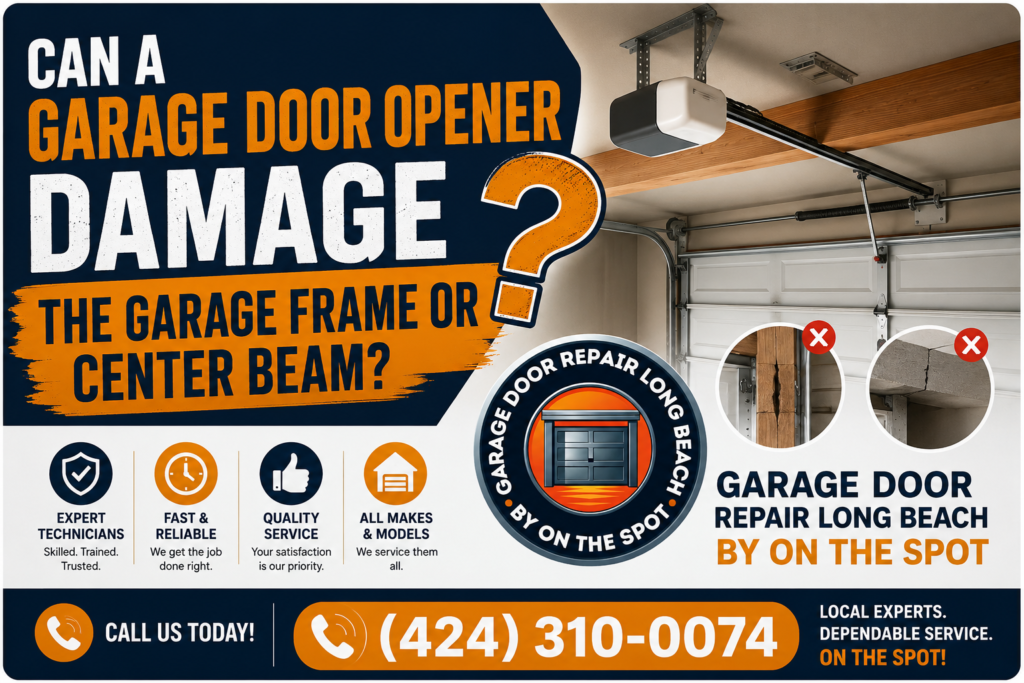
A garage door opener should make daily use easier, quieter, and safer. It should not pull your garage apart, bend the top section of the door, crack the header area, or make the center support look like it is under stress. When a Long Beach homeowner notices the opener rail shaking, the door jerking, the top panel flexing, or the garage frame moving, the first question is simple: can the opener actually damage the garage frame or center beam?
The short answer is yes, a garage door opener can contribute to damage around the garage frame, header, center beam area, opener bracket, or top panel. However, the opener is often not the only cause. In many cases, the opener is exposing a deeper problem with the garage door system. The door may be too heavy, the springs may be weak, the tracks may be binding, the opener force may be set too high, the top panel may not be reinforced, or the opener hardware may have been installed into weak framing.
This guide from Garage Door Repair Long Beach By On The Spot explains what usually causes this type of damage, how to recognize the warning signs, when to stop using the door, and why a full garage door inspection matters before replacing the opener or repairing the frame.
Quick Answer: Can a Garage Door Opener Damage the Garage Frame or Center Beam?
Yes, a garage door opener can damage or stress the garage frame, center support, header bracket area, or top garage door panel when the door is not operating correctly. A properly balanced garage door should move smoothly with minimal effort. The opener is designed to guide and move the door, not force a heavy, stuck, damaged, or unbalanced door to open.
If the garage door opener is pulling against a door with weak springs, bent tracks, worn rollers, loose hinges, a damaged top panel, or poor reinforcement, the force can transfer into the opener arm, the opener rail, the header bracket, the top section of the door, and the surrounding framing. This can lead to cracking sounds, visible movement, bracket separation, bent panels, or damage around the garage header.
For homeowners looking for garage door repair Long Beach CA, the best first step is not guessing whether the opener or the frame is the only issue. The safer approach is to inspect the complete system: opener, springs, door balance, tracks, rollers, hinges, cables, top panel reinforcement, header bracket, and mounting points.
Why This Question Matters for Long Beach Homeowners
Garage doors in Long Beach are used in many different types of homes, from older detached garages near historic neighborhoods to modern sectional doors in newer residential areas. Some homes still have older wood-framed garage openings, older heavy doors, older flip-up style systems, or garage doors that were later converted to work with automatic openers. When the opener was added after the door was originally installed, the door may not always have the reinforcement needed for long-term automatic operation.
Many garage door problems start small. The opener shakes a little. The top section bends slightly. The door makes a popping sound. The opener bracket looks a little loose. The door still opens, so the homeowner keeps using it. Over time, that repeated movement can make the issue worse. What starts as a loose opener bracket can become a bent top panel. What starts as weak spring tension can become opener strain. What starts as a small crack near the header can become a larger concern that needs both garage door repair and structural review.
This is why a full inspection matters. A garage door is a connected system. The opener does not work alone. Springs carry most of the door weight. Tracks guide the door. Rollers allow movement. Cables help lift and lower the door. Hinges allow the sections to bend around the track. The opener arm connects the motor system to the door. The header bracket secures the opener rail above the door opening. If one part fails or is installed incorrectly, the stress can show up somewhere else.
Garage Door Repair Long Beach By On The Spot helps homeowners understand whether the opener is the direct issue, whether the door itself is creating resistance, or whether the opener bracket and frame connection need repair. That distinction is important because replacing the opener alone may not solve the problem if the door is still heavy, unbalanced, or binding.
How a Garage Door Opener Can Stress the Frame, Header, or Center Beam
A garage door opener creates pulling and pushing force through the opener rail and arm. When everything is installed correctly and the door is balanced, that force is controlled. The opener moves the door along its tracks while the springs do the heavy lifting. But when the door resists movement, the opener may continue pulling. That force has to go somewhere.
The stress can transfer into several areas. It can pull on the top section of the garage door. It can shake the opener rail. It can loosen the header bracket. It can cause fasteners to move. It can make the wood around the header creak. It can create flexing in the frame area. If the opener attachment point is weak, the top panel can bend or crack. If the header bracket is loose or mounted into weak material, it may begin pulling away from the wall.
The Opener Is Pulling a Door That Is Too Heavy
One of the most common causes of opener strain is a heavy door. This does not always mean the door itself is unusually large. A normal garage door can become “too heavy” for the opener when the springs are weak, broken, or poorly adjusted. The opener may still lift the door, but it has to work much harder than it should.
A balanced garage door should be possible to lift manually with controlled effort when disconnected from the opener. If the door feels extremely heavy, slams down, will not stay halfway open, or only moves with the help of the motor, the opener may be doing work the springs should be doing. This can strain the motor, trolley, rail, arm, top panel, bracket, and frame connection.
The Top Section Was Not Reinforced for an Opener
The opener arm usually connects to the upper section of a sectional garage door. That area receives repeated pulling and pushing force every time the opener runs. If the top section is thin, aging, cracked, or not reinforced, it may flex or bend inward. Over time, the opener bracket may tear away from the panel or cause the panel to buckle.
This is especially common on lightweight steel doors, older doors, doors with previous damage, and doors where an opener was added without the right reinforcement bracket. A proper opener reinforcement bracket helps spread the opener force across more of the top section instead of concentrating stress on one small spot.
The Header Bracket Is Loose or Not Anchored Properly
The header bracket is the hardware mounted above the garage door opening where the opener rail attaches. It needs to be secured into solid framing, not just weak trim, drywall, or damaged wood. If the bracket is loose, the rail may move every time the door opens. This movement can make the homeowner think the whole frame or center beam is failing.
A loose header bracket is not something to ignore. If the bracket pulls away further, the opener rail can lose alignment. The opener may shake more, the door may bind, and the force can become uneven. A technician should check whether the bracket is secure, whether the wood behind it is sound, and whether the opener is pulling against resistance from the door.
The Garage Door Is Binding in the Tracks
Bent tracks, damaged rollers, loose hinges, or poor track alignment can make the door bind. When this happens, the opener may continue pulling even though the door is not moving smoothly. That creates stress in the opener arm, rail, and bracket connection. It may also cause the door to jerk or shift.
Binding can be subtle. The door may still open and close, but not evenly. You may hear rubbing, scraping, popping, or grinding. You may see one side move slightly before the other. You may notice the opener slows down at a certain point. These signs suggest the opener is fighting resistance instead of moving a properly aligned door.
The Opener Force Setting May Be Too High
Many garage door openers have force settings that control how much push or pull the opener uses. If the force is set too high, the opener may continue pushing or pulling when the door hits resistance. That can stress the door and hardware. It can also hide the real issue because the opener may overpower a problem that should have stopped the door.
Force settings should not be used as a shortcut to make a bad door move. If the door needs extra force to operate, the real cause should be found. The issue may be springs, tracks, rollers, hinges, cables, alignment, or door damage.
Warning Signs Your Garage Door Opener May Be Damaging Something
If you are searching for garage door repair Long Beach CA because your opener looks like it is pulling on the garage frame, watch for these warning signs. One sign alone does not always mean major damage, but several signs together should be taken seriously.
- The opener rail shakes heavily when the door starts moving.
- The header bracket above the door appears loose or is pulling away.
- The top garage door panel bends inward when opening.
- You hear popping, cracking, grinding, or snapping sounds.
- The garage frame, header, or center support visibly moves.
- The door jerks instead of moving smoothly.
- The door reverses unexpectedly.
- The opener motor sounds strained or labored.
- The garage door looks crooked in the opening.
- The door stops at the same spot during travel.
- The opener arm angle looks unusual or too steep.
- The bracket on the top panel is loose, cracked, or pulling out.
- The center stile on the door is cracked or separating.
- The door is hard to lift manually when disconnected.
- The frame around the opening has new cracks or gaps.
Safety Note
If the garage door frame, header bracket, opener rail, or top panel is moving noticeably, stop using the automatic opener until the system is inspected. Do not try to adjust torsion springs or extension springs yourself. Garage door springs are under high tension and can be dangerous without the correct tools and training.
Is the Opener the Problem, or Is the Garage Door the Problem?
Many homeowners assume the opener is bad because the opener is the part making noise. But the loudest part is not always the root cause. A garage door opener may shake, strain, or pull hard because the door itself is not moving correctly. Before replacing the opener, the whole system should be tested.
When the Garage Door Opener May Be the Main Problem
The opener may be the main issue if it was installed incorrectly, if the rail is loose, if the opener arm is connected at the wrong angle, if the force setting is too high, if the motor is failing, or if the trolley, chain, belt, gear, or carriage is worn. An opener can also be mismatched to the size or weight of the door.
An opener that is too weak may struggle and shake. An opener that is too forceful may pull too hard when the door resists movement. A poorly installed opener can transfer force at a bad angle, which can stress the top panel and bracket. The solution may involve opener adjustment, opener repair, bracket correction, rail alignment, or opener replacement.
When the Garage Door System Is the Real Problem
The door system may be the real problem if the springs are weak, the cables are worn, the tracks are bent, the rollers are damaged, the hinges are loose, the top section is cracked, or the door is not balanced. In this situation, the opener may be doing its best to move a door that needs repair.
This is why Garage Door Repair Long Beach By On The Spot checks the door balance, spring condition, track alignment, opener bracket, and panel condition before recommending a final repair. If the opener is replaced but the springs are still weak, the new opener may face the same stress. If the top panel is reinforced but the tracks are still binding, the door may continue jerking. Accurate diagnosis prevents repeat problems.
Can a Garage Door Opener Crack the Garage Center Beam?
A properly installed opener operating a properly balanced door should not normally crack a center beam or structural support. When homeowners describe a “center beam,” they may be talking about different parts of the garage. It may be the wood framing above the door, the header, a center support near the opener rail, or the vertical reinforcement on the garage door itself. Each one has a different repair approach.
If a beam or header area is cracked, the opener may be part of the problem, but the structure itself should also be considered. Wood can be affected by age, moisture, previous repairs, poor fasteners, old movement, termites, rot, or improper installation. If the opener bracket is attached to weak wood, the opener can make the weakness more visible by pulling on it during every cycle.
In some cases, what looks like a center beam problem is actually a garage door top-section problem. The top panel may be bending, the center stile may be cracking, or the opener bracket may be pulling out of the door. That is a garage door repair issue. In other cases, the actual structural header or framing may be damaged. That may require a contractor or structural professional in addition to a garage door technician.
Important Terms Homeowners Should Know
- Garage door opener: The motorized system that moves the door open and closed.
- Opener rail: The long rail that connects the motor unit to the trolley and arm.
- Opener arm: The metal arm connecting the trolley to the garage door.
- Header bracket: The bracket mounted above the garage door opening that supports the opener rail.
- Garage header: The structural framing above the garage door opening.
- Center stile: The vertical reinforcement on a garage door panel where hardware may attach.
- Top panel: The upper section of a sectional garage door, often where the opener arm connects.
- Reinforcement bracket: Hardware used to strengthen the top section where the opener attaches.
Why the Top Garage Door Panel Bends When the Opener Runs
A bending top panel is one of the clearest signs that the opener connection needs attention. The opener pulls from a specific point. If that point is weak, the force can bend the metal, crack the wood, or pull the bracket loose. This is common when an opener is attached directly to a thin panel without proper reinforcement.
Some homeowners notice the top panel bending only at the beginning of the opening cycle. That is because the first movement is often the hardest. The door must break from the closed position and begin moving upward. If the springs are weak or the door is stuck, the opener pulls harder. That extra force can bend the top section inward.
A reinforcement bracket can help distribute force across a wider area of the top section. However, reinforcement should not be used to hide other problems. If the springs are weak, the tracks are misaligned, or the opener force is too high, the cause still needs correction. Otherwise, the reinforced section may hold up better, but the opener and frame may still be under stress.
Common Causes of Top Panel Bending
- No opener reinforcement bracket installed.
- Weak or broken garage door springs.
- Door is too heavy for the opener to move properly.
- Opener arm is attached at a poor angle.
- Top section is already cracked, rusted, or weakened.
- Tracks are bent or rollers are binding.
- Opener force setting is too high.
- Wrong opener setup for the door type.
How Weak Springs Can Lead to Opener and Frame Damage
Garage door springs are one of the most important parts of the entire system. Torsion springs or extension springs help counterbalance the weight of the door. When the springs are working correctly, the door should not feel extremely heavy. When the springs are weak, stretched, broken, or incorrectly adjusted, the opener has to compensate.
This is where damage can begin. The opener pulls harder. The rail shakes. The bracket moves. The top panel flexes. The motor strains. The door may lift unevenly. Cables may loosen or jump. Rollers may drag. The entire system becomes less smooth.
Homeowners sometimes replace the opener because it sounds weak, but the real problem is the spring system. A new opener may temporarily move the door, but if the springs are not repaired, the same stress can continue. For this reason, garage door spring repair Long Beach CA is often closely connected to opener repair and frame-stress problems.
Signs the Springs May Be Causing Opener Strain
- The door feels very heavy when lifted manually.
- The door falls quickly when disconnected from the opener.
- The door will not stay open halfway.
- The opener hums but struggles to lift the door.
- The top panel bends at the start of opening.
- The opener rail shakes more than usual.
- You see a visible gap in a torsion spring.
- The door opens a few inches and stops.
Should You Keep Using the Garage Door?
If you see movement in the garage frame, header bracket, top panel, opener rail, or center support area, it is better to stop using the automatic opener until the problem is inspected. Continued use can make the issue worse. It can also turn a small repair into a larger repair.
If the door is fully closed, you may be able to leave it closed and avoid using the opener. Do not disconnect the opener if the door is open or partially open unless you know the door is secure and balanced. A heavy door can come down unexpectedly. If the door is stuck open, crooked, off track, or supported by damaged hardware, call a professional.
What to Do Right Away
- Stop using the automatic opener if the frame or bracket is moving.
- Look at the top panel, opener arm, and header bracket from a safe distance.
- Do not pull, force, or kick the door to make it move.
- Do not loosen spring hardware or cable hardware.
- Call a garage door repair technician to inspect the full system.
When Garage Door Repair Long Beach By On The Spot inspects this type of issue, the goal is to find out whether the opener is overworking, whether the springs are weak, whether the top section needs reinforcement, whether the door is binding, and whether the frame connection is safe enough for normal opener operation.
Garage Door Opener Repair Long Beach CA: What a Technician Should Check
A good inspection should not focus only on the opener motor. The motor may be only one part of the problem. A complete opener and door inspection should include the full path of movement and the full load-bearing system.
1. Door Balance Test
The technician should test whether the door is balanced. This helps reveal whether the springs are carrying the door weight correctly. A door that is too heavy can overload the opener and create stress at the top panel and header bracket.
2. Spring System Inspection
Torsion springs and extension springs should be checked for wear, breaks, tension problems, and correct sizing. Incorrect spring size can make the door too heavy or too aggressive during travel.
3. Track and Roller Inspection
Bent tracks, loose track brackets, worn rollers, and poor alignment can make the door bind. If the door binds, the opener may pull harder and create stress in the opener arm and frame connection.
4. Cable and Drum Inspection
Cables and drums help lift the door evenly. If one cable is loose, frayed, or out of position, the door may move crooked. A crooked door can create uneven resistance and opener strain.
5. Top Panel and Reinforcement Inspection
The technician should check whether the opener is attached to a reinforced part of the top section. If the panel is bending, cracked, or separating, reinforcement or panel repair may be needed.
6. Header Bracket and Mounting Inspection
The bracket above the door should be secure. The mounting surface should be solid. If the bracket is loose, missing fasteners, or attached to weak material, it may need correction.
7. Opener Arm Angle and Rail Alignment
The opener arm should move in a controlled path. A poor angle can create extra pulling force on the top panel. The rail should be aligned properly with the door.
8. Opener Force and Travel Settings
Force and travel settings should match the door’s movement. Settings that are too aggressive can hide resistance and increase stress. Settings that are too weak may stop the door before it completes travel.
Garage Door Frame Damage vs. Garage Door Hardware Damage
Not every visible crack or movement means the structural frame is damaged. Sometimes the issue is with garage door hardware attached near the frame. Other times, the door itself is damaged. Understanding the difference helps homeowners know who to call and what type of repair may be needed.
Garage Door Hardware Damage
Hardware damage may involve the opener bracket, top panel bracket, hinges, rollers, tracks, cables, drums, or spring system. These are garage door repair issues. If the top panel is bending, the opener bracket is pulling out, or the door is binding, a garage door technician is usually the right first call.
Frame or Header Damage
Frame or header damage may involve the wood or structural material around the garage opening. If there is cracking, rot, movement, or separation in the structural framing, a contractor may need to evaluate it. A garage door technician can often identify whether garage door operation is contributing to the stress, but structural repairs may require a separate professional.
Both Problems Can Happen Together
In many real homes, the issue is not one or the other. A weak door can strain the opener. The opener can loosen a bracket. The bracket can stress weak wood. The frame movement can affect the opener alignment. That is why the best repair plan may include both garage door correction and framing review.
Long Beach Local Factors That Can Make This Problem More Common
Long Beach has a wide mix of garage types and home ages. Some garages are newer and use modern sectional doors. Others have older framing, older one-piece doors, aging wood doors, or opener systems added years after the original garage was built. These local conditions can affect how the opener and frame work together.
Older Detached Garages
Older detached garages may have aging wood, older headers, previous modifications, or older door hardware. If an automatic opener was added to a garage that was originally designed for manual operation, the door may not have been reinforced correctly.
Coastal Moisture and Hardware Wear
Long Beach homes can be exposed to coastal air and moisture. Over time, metal hardware can rust and wood can weaken if it is not maintained. Rusty rollers, hinges, tracks, or brackets can increase resistance and make the opener work harder.
Heavy Older Garage Doors
Older wood doors or older insulated doors may be heavy. If the springs are not properly matched to the door weight, the opener can be overloaded. A heavy door can create strain at the opener arm and header bracket.
DIY or Previous Improper Installations
Some opener problems come from previous installation shortcuts. The opener may be attached to weak framing, the top section may not have a reinforcement bracket, the opener arm may be at the wrong angle, or the force settings may have been adjusted to overpower a door that really needed repair.
Garage Door Repair Long Beach CA: Neighborhoods Served
Garage Door Repair Long Beach By On The Spot provides garage door repair support for homeowners throughout Long Beach and nearby areas. Local service matters because a technician familiar with Long Beach garage types can better recognize common issues with older detached garages, coastal hardware wear, older wood doors, and opener systems attached to aging framing.
- Belmont Shore
- Bixby Knolls
- Naples
- El Dorado Park
- Wrigley
- Alamitos Beach
- Rose Park
- Los Altos
- Downtown Long Beach
- East Long Beach
- California Heights
- Lakewood Village
- Signal Hill nearby
- Lakewood nearby
Do You Need a Permit for Garage Frame or Header Repair in Long Beach?
Basic garage door hardware repairs are different from structural repairs. Replacing rollers, adjusting tracks, repairing an opener, replacing springs, or reinforcing a top garage door panel is typically a garage door service issue. However, if the repair involves structural framing, header repair, major alteration, or changes to the building structure, homeowners should check with the City of Long Beach or a qualified contractor about permit requirements.
Long Beach building guidance explains that many dwelling alterations, replacements, and repair activities may require permits and inspections. That does not mean every garage door service visit requires a permit. It means homeowners should be careful when the issue goes beyond the garage door system and involves actual structural framing.
A garage door technician can help identify whether the issue appears to be opener hardware, door balance, top panel reinforcement, or the surrounding frame. If the problem appears structural, the homeowner may need a licensed contractor or structural professional to evaluate the framing.
Common Repair Options
The right repair depends on the cause. A homeowner should avoid assuming the opener needs replacement without checking the rest of the system. Below are common repair paths for this type of issue.
Opener Bracket Repair
If the bracket on the top panel is loose or pulling out, it may need to be reattached correctly or replaced. If the top panel is weak, reinforcement may be needed before the opener is used again.
Top Panel Reinforcement
If the opener arm is attached to a weak top section, a reinforcement bracket may help distribute the force. This is common when the top panel bends inward during the opening cycle.
Spring Repair or Spring Replacement
If the door is too heavy, the springs may need service. Weak or broken springs can make the opener work too hard. Correct spring repair can reduce strain on the opener and frame connection.
Track Alignment and Roller Repair
If the door is binding, the tracks and rollers should be checked. Smooth movement reduces opener strain and helps prevent jerking or uneven force.
Opener Adjustment
If the opener force, travel limits, arm angle, or rail alignment is wrong, adjustment may solve the problem. However, opener settings should only be adjusted after the door itself is confirmed to be safe and balanced.
Opener Replacement
If the opener is worn, undersized, damaged, or unsafe, replacement may be recommended. A new opener should be installed with the correct bracket setup and a properly balanced door.
Frame or Header Repair
If the actual framing is cracked, rotted, or moving, a contractor may need to repair or reinforce the structure. The garage door system should also be corrected so the same stress does not return.
AEO: Direct Answers to Common Homeowner Questions
Can a garage door opener damage the garage frame?
Yes. A garage door opener can contribute to garage frame or header area damage if the door is unbalanced, stuck, too heavy, poorly reinforced, or installed with a loose bracket. The opener may not be the only cause, but it can transfer stress into the frame when the door resists movement.
Can a garage door opener crack the center beam?
It is possible for opener force to contribute to cracking or movement if the opener is pulling against a problem door or if the opener bracket is mounted into weak framing. A properly installed opener on a balanced door should not normally crack a structural beam.
Why is my garage door opener pulling on the wall?
The opener may be pulling on the wall because the header bracket is loose, the door is too heavy, the springs are weak, the tracks are binding, or the opener rail is misaligned. The wall movement should be inspected before continued opener use.
Why does my garage door bend at the top when opening?
The top section may be weak or missing an opener reinforcement bracket. The problem can also happen when the springs are weak, the door is too heavy, or the opener arm is pulling at a poor angle.
Can weak springs damage a garage door opener?
Yes. Weak springs make the opener lift more weight than it should. This can strain the motor, rail, trolley, opener arm, top panel, and mounting brackets.
Should I replace the opener if the frame is cracked?
Not automatically. The opener, springs, tracks, door balance, top panel, and frame connection should be inspected first. If the frame is structurally damaged, a contractor may also be needed.
Is it safe to use a garage door with frame damage?
It is safer to stop using the automatic opener until the issue is inspected. Continued operation can worsen damage and create a safety risk.
Who repairs opener-related garage door problems in Long Beach CA?
Garage Door Repair Long Beach By On The Spot can inspect opener strain, door balance, spring condition, track alignment, opener brackets, and top panel reinforcement for Long Beach homeowners.
GEO: Why This Page Matters for Garage Door Repair in Long Beach CA
A homeowner searching for garage door repair Long Beach CA may not always know the correct name for the problem. They may search for “opener pulling wall,” “garage frame cracked,” “garage door center beam damage,” “top garage door panel bending,” or “garage door opener shaking.” These searches all point to the same concern: something in the garage door system is under stress.
This page is built to answer that concern clearly for Long Beach homeowners. It explains the relationship between the opener, springs, door balance, brackets, tracks, rollers, and frame connection. It also helps homeowners understand when the issue is a normal garage door repair and when structural framing may need additional review.
Long Beach homes can vary widely by age, garage style, door type, and previous repair history. A technician may see an older wood door in one neighborhood, a lightweight steel sectional door in another, and a newer insulated door in another. The repair recommendation should fit the actual door, not just the opener brand.
Related Garage Door Services in Long Beach CA
If your garage door opener appears to be stressing the frame, the solution may involve one or more related services. Garage Door Repair Long Beach By On The Spot can inspect the full door system and recommend the repair that matches the cause.
- Garage door opener repair Long Beach CA: For opener motors, rails, trolleys, arms, travel limits, force settings, and bracket problems.
- Garage door spring repair Long Beach CA: For weak, broken, stretched, or incorrect springs that make the door too heavy.
- Garage door track repair Long Beach CA: For bent, loose, or misaligned tracks that cause door binding.
- Garage door cable repair Long Beach CA: For loose, frayed, or off-drum cables that make the door move unevenly.
- Garage door roller replacement Long Beach CA: For worn rollers that make the door noisy, rough, or resistant.
- Garage door panel repair Long Beach CA: For bent top sections, cracked panels, or opener bracket damage.
- Garage door tune-up Long Beach CA: For preventive inspection, lubrication, balance testing, and safety checks.
- Emergency garage door repair Long Beach CA: For doors that are stuck, crooked, off track, unsafe, or unable to close.
What Not to Do When You See Frame or Opener Damage
When a garage door still opens, it can be tempting to keep using it until it completely fails. That is risky. Opener and frame stress problems often get worse with each cycle. The door may continue to move for a while, but the damage may spread to the top panel, rail, bracket, springs, cables, or frame.
- Do not increase the opener force setting to overpower the problem.
- Do not keep using the opener if the bracket is pulling away.
- Do not attach the opener arm to a weak or cracked panel without reinforcement.
- Do not try to adjust torsion springs without training.
- Do not ignore a door that feels unusually heavy.
- Do not replace the opener without checking the door balance first.
- Do not assume a cracked header is only a garage door issue.
A safe repair starts with diagnosis. The goal is not only to make the opener run again. The goal is to make sure the door moves smoothly, the opener is not overloaded, the brackets are secure, and the frame connection is not being stressed.
How Garage Door Repair Long Beach By On The Spot Approaches This Problem
When a homeowner calls about an opener that may be damaging the frame or center beam, the repair should begin with listening to the symptoms. Did the problem start after an opener installation? Did the door recently become heavy? Did the top panel begin bending? Is there a new crack near the header? Does the opener only shake at the beginning of travel? Did the door hit something? Did a spring break recently?
After that, the technician can inspect the door system. The door balance is checked. Springs are reviewed. Rollers and tracks are inspected. The top section is checked for reinforcement. The opener bracket and header bracket are examined. The opener arm angle is reviewed. The opener rail is checked for alignment. The opener settings are reviewed only after the door itself is confirmed to be moving correctly.
This process helps avoid unnecessary repairs. If the door only needs bracket correction and reinforcement, the opener may not need replacement. If the springs are weak, opener replacement alone will not fix the real problem. If the header area is structurally damaged, a contractor may need to be involved. The right repair depends on the full picture.
Recommended Blog Images and Alt Text
Images can help this article rank better and make the topic easier for homeowners to understand. Use original photos or realistic service images when possible.
Image 1: Main Hero Image
A residential garage door in Long Beach with an automatic opener rail visible from inside the garage.
Alt text: Garage door repair Long Beach CA opener connected to residential garage door
Image 2: Opener Bracket Close-Up
Close-up of the opener arm connected to the top section of the garage door.
Alt text: Garage door opener bracket stressing top panel in Long Beach CA
Image 3: Technician Inspection
Technician inspecting the opener bracket, rail, and top panel reinforcement.
Alt text: Garage Door Repair Long Beach By On The Spot inspecting opener and garage frame
Image 4: Spring and Balance Check
Garage door technician checking torsion springs and door balance.
Alt text: Garage door spring repair Long Beach CA balance inspection
Internal Linking Suggestions
To strengthen topical authority, link this article to related service pages. Use natural anchor text instead of repeating the same phrase every time.
Final Answer: Can a Garage Door Opener Damage the Garage Frame or Center Beam?
Yes, a garage door opener can contribute to damage around the garage frame, header, center beam area, or top garage door panel, but it usually happens because the door system has another problem. The opener may be pulling against weak springs, a heavy door, bent tracks, worn rollers, poor alignment, a loose header bracket, or an unreinforced top section.
The opener should not be treated as a machine that forces the door open no matter what. It should work with a balanced, properly aligned, properly reinforced garage door. When the opener has to fight the door, stress can transfer into the weakest point. That weak point may be the top panel, the opener bracket, the header bracket, the opener rail, or the surrounding frame.
If you notice shaking, cracking, bending, bracket movement, or frame movement, stop using the automatic opener and schedule an inspection. A professional can determine whether the issue is the opener, the springs, the tracks, the top panel, the bracket, or the frame connection.
For local help with garage door repair Long Beach CA, Garage Door Repair Long Beach By On The Spot can inspect the full system and help Long Beach homeowners find the cause before the damage gets worse.
Need Garage Door Repair in Long Beach CA?
If your garage door opener is shaking, pulling on the frame, bending the top panel, or making the door move unevenly, do not ignore it. The problem may involve the opener, springs, tracks, rollers, brackets, or door balance.
Garage Door Repair Long Beach By On The Spot can inspect your garage door opener, frame connection, header bracket, top panel, spring system, tracks, cables, and rollers to help identify the real issue and recommend the right repair.
Get help with garage door opener repair, spring repair, cable repair, track repair, panel repair, tune-ups, and emergency garage door repair in Long Beach CA.