
Long Beach Opener Power Guide
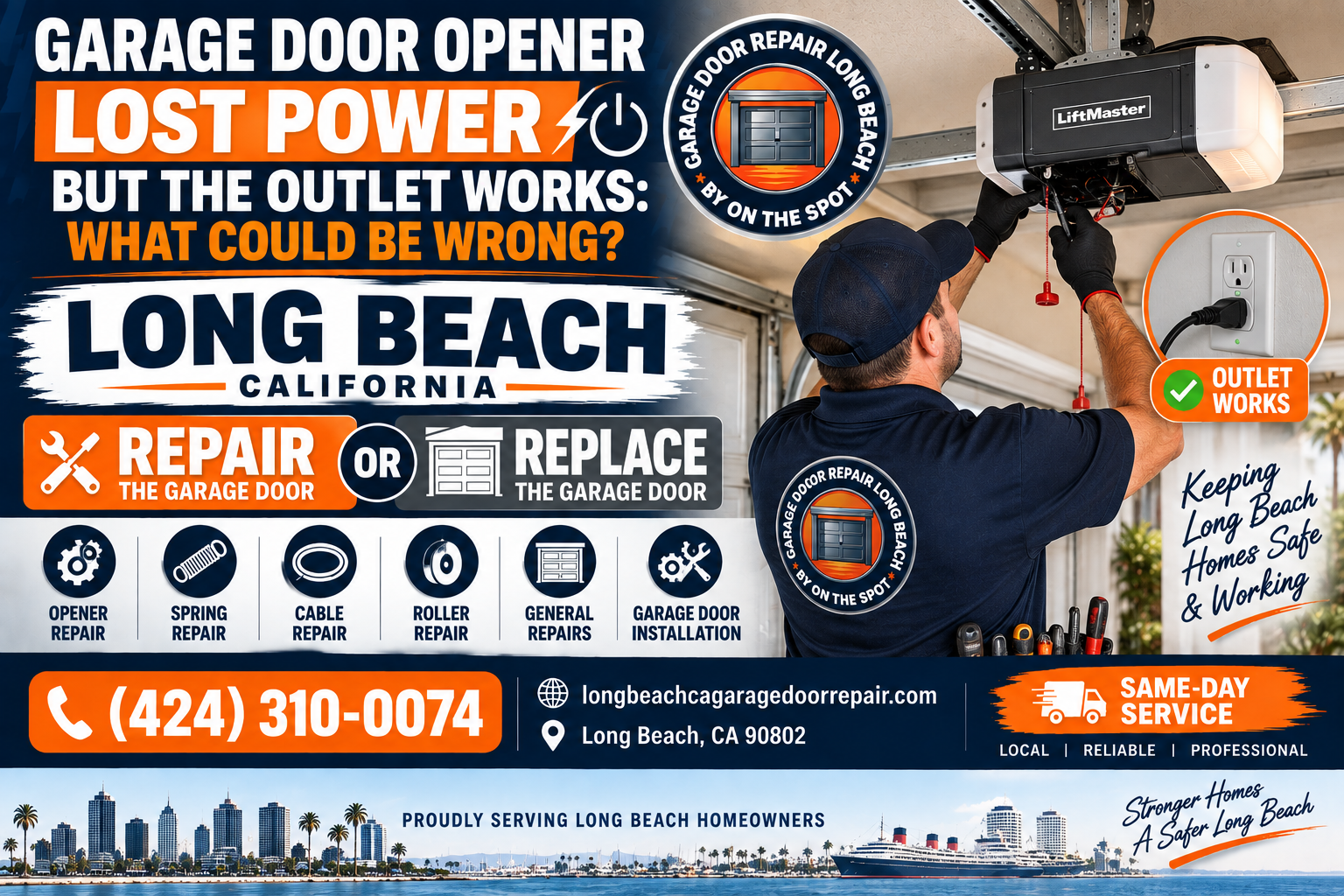
Garage Door Opener Lost Power but the Outlet Works: What Could Be Wrong?
If your garage door opener is completely silent—no lights, no click, no motor hum—but a lamp or charger proves the wall outlet still has power, the problem is usually between that outlet and the opener’s internal electronics, not a whole-house blackout. GFCI confusion, a loose or corroded plug, surge-damaged logic boards, opener fuses or transformers, vacation lock, damaged wiring, backup-battery quirks after SCE events, and spring-weight misreads all create this exact complaint in Long Beach garages.
Garage Door Repair Long Beach By On The Spot helps homeowners, renters, landlords, property managers, HOA communities, and small businesses diagnose opener power loss with outlet presence confirmed, separate electrical lookalikes from true board or motor failure, and restore safe automatic operation in Long Beach, CA.
GFCI & Breaker Clarity
Surge & Logic Board
Safe Do-Nots
Serving Long Beach, CA
Direct Answer: Why Did the Garage Door Opener Lose Power When the Outlet Still Works?
If the garage door opener is completely dead—no lights, no click, no motor hum—but a lamp or phone charger proves the wall outlet still has power, the failure is usually between the outlet and the opener’s internal electronics, not a whole-house blackout. Common Long Beach causes include a tripped GFCI protecting the garage circuit, a half-dead receptacle where only one slot works, a loose or partially unplugged opener cord, a blown internal fuse or failed low-voltage transformer on the opener, surge damage to the logic board after an SCE storm or voltage spike, a vacation lock or lock button freezing wall-control commands, or damaged wiring between the outlet and the opener head.
Separately, people often misread battery-backup behavior, photo-eye sensor symptoms, and spring-weight problems as “no power.” A motor that will not lift a heavy door can sound dead even when electronics are alive. Sensors can stop travel without killing lights. A dead outlet is a different problem from a live outlet feeding a dead opener—and that distinction drives every safe next step.
Garage Door Repair Long Beach By On The Spot diagnoses opener power loss with outlet presence confirmed, confirms whether the issue is GFCI, cord, fuse, board, lock mode, or mechanical load, and restores safe automatic operation for homes and small businesses across Long Beach, CA.
Why an Opener That Lost Power While the Outlet Works Matters in Long Beach
Long Beach garages sit on Southern California Edison service. Brief SCE interruptions, neighborhood switching, and coastal voltage quirks are part of normal life here. After power returns, homeowners often plug a lamp into the garage outlet, see it light up, and conclude the opener must be “broken beyond repair.” Sometimes that is true. Often it is not. The opener may be on a protected GFCI branch that tripped while an unprotected duplex half still feeds the lamp. The cord may have vibrated loose on an aging ceiling receptacle. A surge may have sacrificed the opener’s fuse or logic board while leaving the wall receptacle alive.
That distinction matters for security, schedule, and cost. A dead opener with a live outlet can strand a vehicle overnight, block alley access, or leave a rental unit without a workable entry path. Jumping straight to a full opener replacement without checking GFCI reset, cord seating, lock mode, and fuse condition wastes money. Ignoring a scorched board or melted plug while “just resetting things” creates fire risk. Coastal humidity around Belmont Shore, Alamitos Beach, and Naples accelerates corrosion on plugs, receptacles, and low-voltage terminals—so a power-loss complaint here is not always the same failure mode you would see in a dry inland garage.
This guide is written for Long Beach homeowners, renters, landlords, property managers, HOA communities, and small businesses who need a clear, depth-first explanation of why an opener can go dark while the outlet still works—and what to do safely next.
Security & Access
A silent opener with a live outlet still blocks cars, bikes, and alley egress until you diagnose power path versus mechanical bind.
Cost Clarity
GFCI resets, cord reseating, and fuse or lock-mode fixes are not the same price class as logic-board or full opener replacement.
Coastal Reality
Salt air, heat, and SCE events shape how Long Beach outlets, plugs, and opener electronics fail over time.
How Garage Door Opener Power Actually Works—Outlet to Motor
Understanding the power path prevents the most expensive misunderstanding: assuming “outlet works” equals “opener received clean power.” Residential openers typically hang from the ceiling and plug into a dedicated or shared 120-volt receptacle. From that plug, line voltage feeds an internal transformer or switching supply that creates low-voltage rails for the logic board, wall-control circuit, radio receiver, and often the lamp circuit. The motor then draws heavier current when commanded to open or close.
Between the wall and the board sit several failure points. The receptacle itself may be GFCI-protected upstream. The plug may be polarized and only partially seated. Some openers include a user-accessible fuse or thermal protection. Many include a vacation lock that disables remote and sometimes wall commands without killing standby lights—or, on other brands, lock mode can look almost identical to a dead unit if you only try remotes. Battery-backup models add another layer: a depleted or failed battery can change behavior during and after SCE outages without meaning the wall outlet is dead.
Photo-eye sensors and safety reverse systems do not usually remove all power from the opener head. They interrupt travel logic. That is why sensor faults and true power-loss faults feel different once you know what to look for: lights and clicks versus total silence. Spring balance problems are mechanical, not electrical—but a motor that struggles against a broken spring can trip protectors or appear lifeless after repeated failed attempts.
For Long Beach readers, the practical takeaway is simple: prove power at the receptacle, then prove power at the opener’s input, then decide whether the silence is fuse, board, lock, wiring, or a mechanical load masquerading as electrical failure.
Outlet Presence Versus Opener Presence
A neon tester or lamp in the wall outlet only proves that receptacle (or that half of a duplex) is energized. It does not prove the opener cord is intact, the plug blades are making contact, the opener’s inlet fuse is good, or the logic board’s power supply survived the last surge. Treat “outlet works” as step one, not the whole diagnosis.
Why GFCI Confusion Is So Common
Many Long Beach garages share GFCI protection with bathroom, outdoor, or laundry circuits, or have a GFCI receptacle that feeds downstream outlets. A tripped GFCI can kill the opener while a different, unprotected outlet in the same garage still lights a lamp. Homeowners naturally test the convenient outlet near the workbench, see life, and assume the opener circuit is fine. Always identify whether the opener’s own receptacle is GFCI-protected and whether that device needs a reset.
Detailed Causes: Opener Dead, Outlet Still Live
Below are the failure modes we see most often when Long Beach customers report a silent opener and a working outlet. Rankings vary by garage age, coastal exposure, and whether an SCE outage or surge recently hit the neighborhood—but the checklist order below is a useful mental model.
1. Tripped GFCI or Confused Breaker Mapping
A GFCI receptacle or GFCI breaker can trip from moisture, a deteriorating opener cord, a damp outdoor circuit sharing the trip device, or a ground-fault event elsewhere on the protected chain. After the trip, an unprotected outlet elsewhere in the garage still works. Resetting the correct GFCI often restores the opener immediately. If it trips again at once, stop resetting repeatedly—that pattern can indicate a real ground fault in the cord, opener, or wiring that needs professional attention.
Breaker confusion is related. Multi-wire branches, mislabeled panels, and shared garage/laundry circuits mean the breaker you think feeds the opener may not be the one that does. A partially tripped breaker can also leave odd receptacle behavior. Confirm labeling carefully and never force a breaker that will not reset cleanly.
2. Loose, Partially Seated, or Corroded Plug
Ceiling receptacles loosen over years of motor vibration. Coastal humidity and salt air around Belmont Shore and Alamitos Beach corrode brass contacts. A plug that looks “in” can still be making intermittent contact—enough for a lamp test at the wall when you wiggle nothing, but not enough for the opener’s intermittent high draw. Look for discoloration, warmth, melted plastic, or a plug that falls out with light pressure. Those are not DIY “push it harder” situations if heat damage is visible.
3. Surge Damage to Logic Board or Power Supply
SCE restoration spikes, nearby lightning-influenced surges, and aging surge protectors can kill the opener’s logic board or switching supply while leaving the wall outlet intact. Classic signs include a completely dark head after a storm or outage restoration, a burnt electronics smell, or visible scorch near the board cover. Sometimes only the radio dies; sometimes everything dies. Board replacement versus full opener replacement depends on age, parts availability, and rail/motor condition.
4. Internal Fuse, Thermal Protector, or Transformer Failure
Some openers include a replaceable fuse; others use non-user-serviceable protection. Thermal protectors can open after a motor struggles against a binding door or weak springs, then appear as a “dead” unit until cool-down—or fail open permanently. The low-voltage transformer that feeds controls can fail while line voltage still arrives at the inlet. These failures sit downstream of your working outlet test, which is why outlet presence alone never clears the opener.
5. Vacation Lock, Lock Button, or Wall-Control Wiring Fault
Vacation lock and lock buttons are designed to disable remotes (and sometimes the wall button behavior). Depending on brand and how you test, lock mode can look like total power loss if you only try remotes and never inspect the wall control LEDs or lock icon. Separately, damaged bell wire between the wall button and opener can prevent commands even when the head has standby power. Always visually check the wall control for a lock indicator and inspect low-voltage wire for staples, pinches, or rodent damage before condemning the motor.
6. Damaged Cord or Wiring Between Outlet and Opener
The short power cord from receptacle to opener head is a known wear item. Heat, abrasion against the rail, improper stapling, and age create open conductors or intermittent faults. In multi-unit Long Beach buildings, prior handyman work sometimes leaves openers on extension cords—which is both a code concern and a failure source. If the cord is warm, cracked, or repaired with tape, treat it as a hazard, not a temporary fix.
7. Battery Backup Confusion After SCE Events
Battery-backup openers can behave strangely when the battery is depleted, swollen, or past service life. During an outage the unit may have run on battery until empty; after utility power returns, some units need a reboot cycle, battery replacement, or board attention before normal wall-power behavior resumes. Homeowners see a live outlet and a silent or oddly limited opener and assume the motor failed. Often the backup subsystem is the real story.
8. Sensor Symptoms Mistaken for Power Loss
Misaligned or sun-blinded photo eyes typically leave the opener powered: lights may work, the motor may click, and the wall button may attempt a close that reverses. That is not the same as a dark, silent head. Still, stressed owners describe both as “it won’t work / no power.” Clarify whether any lights, clicks, or LED patterns remain before choosing a power-path diagnosis.
9. Spring Weight and Binding Pretending to Be Electrical Failure
Broken springs, binding rollers, or a door that is far too heavy for the opener can cause the motor to hum briefly, trip protection, or refuse to start in a way people summarize as “dead.” If the opener lamps still light and remotes still chirp the radio, you are not in true no-power territory. Manual lift feel (with proper release procedure and extreme caution) often reveals an unsafe door that needs spring service—not a new logic board.
GFCI and Breaker Confusion When the Garage Outlet “Still Works”
GFCI protection saves lives in garages where concrete floors, outdoor leakage paths, and damp coastal air raise shock risk. It also creates the single most common false conclusion in opener power complaints: “the outlet works, so it cannot be electrical.” Which outlet? Protected by what device? Reset where?
Start by identifying the exact receptacle the opener uses. If it is a GFCI receptacle, press reset firmly after confirming the area is dry and no cords feel hot. If the opener receptacle is a standard duplex, hunt for an upstream GFCI—often on a garage wall, in a bathroom that feeds the garage, or at a GFCI breaker in the panel. Long Beach remodeled homes frequently hide upstream protection in unexpected places.
Document what happens after reset. Immediate re-trip suggests a persistent ground fault. Delayed trip under motor load suggests leakage under current. No change after a confirmed reset of the correct device moves you downstream to cord, fuse, board, or lock mode.
For breakers: a breaker that feels soft, will not stay on, or shows heat at the panel is an electrician problem, not an opener-parts problem. Opener technicians and electricians often collaborate when the fault sits in building wiring rather than the operator head. Do not keep resetting a breaker that trips under no load.
Safe Checks You Can Do Before Calling for Opener Power Help
These checks are for homeowners who want to gather useful information without opening high-voltage compartments or fighting a heavy door. Stop at the first sign of burning smell, melted plastic, sparking, or a door that feels dangerously heavy.
Confirm What “Dead” Means
Stand at the opener and try the wall button once. Note whether any lamp lights, LEDs flash, relays click, or the motor hums. Try a remote only after checking for vacation lock. A completely dark, silent unit points more toward inlet power, fuse, or board. Lights without motion point more toward sensors, travel limits, lock mode, or mechanical bind.
Prove the Opener Receptacle—Not a Neighbor Outlet
Plug a simple lamp or phone charger into the same receptacle the opener uses (unplug the opener first if needed to access the slots). If that receptacle is dead while another garage outlet lives, you have a circuit or GFCI issue, not an opener failure. If that receptacle is live, reseat the opener plug firmly and listen for restoration.
Inspect the Plug and Cord Visually
Look for discoloration, warping, buzzing, or a loose fit. Do not ignore heat. A warm plug after brief operation is a warning. Coastal corrosion may look like green or white crust on blades or screws.
Check Vacation Lock and Wall-Control Indicators
Many wall controls show a lock icon or disable remotes when vacation mode is on. Toggle lock off per your brand’s label. Inspect low-voltage wire for obvious damage. Do not splice low-voltage wire casually if you are unsure of polarity and routing.
Check SCE Outage Status Even When One Outlet Works
Partial outages and restoration waves happen. Before deep opener work, glance at the Southern California Edison outage center for neighborhood status. A live lamp on one circuit does not always mean stable utility conditions across the property.
Note Recent Surges, Work, or Water Events
Tell a technician if you recently had an SCE outage, panel work, a wet garage floor, a replaced outlet, or a door that started binding. Those details shorten diagnosis dramatically.
What Not to Do When the Opener Lost Power but the Outlet Works
Good intentions create the worst callouts. Avoid these moves.
Symptom Comparison Table: Dead Opener vs Live Outlet Scenarios
Use this table to match what you see with the most likely zone of failure. It is a triage aid, not a substitute for on-site testing with proper meters and door-balance evaluation.
| What You Observe | Outlet Lamp Test | Likely Zone | Typical Next Step |
|---|---|---|---|
| Opener dark; other garage outlet live | Opener receptacle dead | GFCI / breaker / branch wiring | Reset correct GFCI; verify breaker; call electrician if re-trips |
| Opener dark; same receptacle live | Live | Plug, cord, fuse, transformer, board | Inspect plug; professional inlet and board diagnosis |
| Lights on; remotes dead | Live | Vacation lock / radio / wall wiring | Clear lock; test wall button; inspect bell wire |
| Lights on; closes then reverses | Live | Photo eyes / travel / obstruction | Align sensors; clear path; not a power-loss case |
| Hum or brief try; door too heavy | Live | Springs / binding / thermal trip | Stop forcing; spring and balance service |
| Dead after SCE restoration | Live | Surge board / backup battery / fuse | Board and backup evaluation; surge history notes |
| Intermittent life when cord wiggled | Live | Loose plug / worn receptacle | Replace damaged cord/receptacle; stop using if hot |
| Works on wall button only | Live | Remote programming / lock / radio | Not total power loss; reprogram or clear lock |
If your row says “not a power-loss case,” shifting into fuse and board replacement talk will waste time. If your row points at GFCI or plug heat, treat electrical safety as the priority over convenience.
Repair the Power Path, Repair the Board, or Replace the Opener?
Decision quality improves when you separate building-side power problems from opener-side electronics and from mechanical door problems. A live outlet with a dead opener still leaves several honest forks.
Repair the Circuit, GFCI, Cord, or Receptacle
When the opener receptacle is dead, or the plug and receptacle show heat damage, the right first repair is electrical integrity—not a new motor. Long Beach coastal moisture makes receptacle replacement and proper GFCI protection especially relevant. Extension-cord “solutions” are not repairs.
Repair Fuse, Transformer, Lock Wiring, or Logic Board
If inlet power is confirmed and the head is still dark or unstable, internal power supply, fuse, or board work may restore the existing rail and motor. Age matters. An opener already near end of life with worn gearing may not deserve a premium board if a modern, safer unit is comparable in total cost.
Replace the Opener
Replacement makes sense when the board is unavailable, the motor and gear train are noisy or worn, safety features are outdated, or repeated surge damage suggests the unit will not be reliable. Battery-backup upgrades are popular in Long Beach because SCE interruptions still occur and alley access cannot wait for daylight every time.
Fix Springs First When Weight Is the Real Problem
Never “upgrade the opener” to overpower broken springs. That path destroys openers and endangers people. If the door is heavy or uneven, spring and hardware service comes before motor decisions.
Circuit / GFCI / Cord
Best when the receptacle is dead, trips repeat, or the plug shows heat or corrosion.
Board / Fuse / Lock Path
Best when inlet power is good but the head stays dark or lock/wiring logic fails.
Full Opener Replacement
Best when age, worn mechanics, obsolete safety, or repeated board failure stack up.
Springs & Balance First
Mandatory when the door’s weight or binding is causing protector trips or false “dead” reports.
Same-Day and Emergency Help When the Opener Has No Power
A silent opener with a live outlet still creates real-world urgency: work schedules, medical appointments, alley parking rules, and rental turnover do not wait for leisurely parts shopping. Garage Door Repair Long Beach By On The Spot prioritizes clear phone triage—GFCI questions, outlet confirmation, lock-mode checks, and safety screening—so the technician arrives with a realistic plan.
Emergency framing is appropriate when the door is stuck closed with a vehicle trapped, when burning smells follow a surge, when a GFCI will not reset, or when a door is unsafe to operate manually. Non-emergency but still same-day framing fits intermittent plug issues, vacation-lock confusion after a guest visit, or a backup battery that failed overnight but left the door usable with caution.
Call (424) 310-0074 with notes: Did any lights or clicks remain? Did you test the opener’s own receptacle? Any recent SCE outage? Any heat at the plug? Is the door unusually heavy? Those answers reduce guesswork on site.
Long Beach Local Conditions That Affect Opener Power Reliability
Long Beach is not a generic climate for garage electrics. Marine layer moisture, salt aerosol near the coast, summer heat spikes in inland neighborhoods, and SCE grid events all leave fingerprints on opener power complaints.
Coastal Humidity and Corrosion
Belmont Shore, Naples, Alamitos Beach, and nearby coastal strips see faster corrosion on receptacle contacts, plug blades, low-voltage terminals, and exterior GFCI devices. A plug that worked last winter can become intermittent after a damp spring. White or green crust, powdery screw heads, and brittle cord jackets are local warning signs.
Heat and Attic-Adjacent Garages
Detached and attic-adjacent garages in Bixby Knolls, California Heights, and similar areas can run hot. Heat ages capacitors, boards, and backup batteries. An opener that fails on the first hot afternoon after an SCE flicker may be revealing thermal weakness, not a random coincidence.
SCE Outages and Restoration Surges
Even short outages matter. Restoration can include voltage instability that stresses opener power supplies. Checking SCE’s outage center helps separate neighborhood utility events from isolated opener failure—especially when neighbors also report odd electronics behavior.
Older Housing Stock and Shared Circuits
Long Beach’s mix of pre-war, mid-century, and remodeled homes means garage circuits are often shared, relabeled poorly, or partially updated. GFCI may protect some receptacles and not others. Handyman outlets and openers on undersized cords show up more often than people expect. Diagnosis must include the building story, not only the opener brand.
Alleys, Condos, and Multi-Unit Panels
Downtown and multi-unit properties may place breaker access behind locked rooms or share subpanels. An opener “power loss” can be a building breaker event that left a convenience outlet on another circuit alive. Property managers should document panel locations before the next after-hours failure.
Questions to Ask Before Hiring Help for an Opener That Lost Power
Hiring clarity prevents paying for a replacement you did not need—or waiting on a parts-only visit when the fault was a tripped GFCI all along.
Red Flags When Hiring Garage Door Repair for Opener Power Problems
Why Consider Garage Door Repair Long Beach By On The Spot?
Garage Door Repair Long Beach By On The Spot focuses on diagnosis-first service for Long Beach garages—including the classic complaint that the opener died while an outlet still works. That complaint is a process problem as much as a parts problem: prove power, prove inlet integrity, prove whether silence is lock mode, fuse, board, or mechanical load, then recommend the least wasteful safe repair.
From 151 E 5th St, Long Beach, CA 90802, the team serves homeowners, renters, landlords, property managers, HOAs, and small businesses who need straight answers after SCE events, coastal corrosion surprises, and mid-week access failures. Call (424) 310-0074 or visit longbeachcagaragedoorrepair.com. Map listing: Google Maps CID.
Diagnosis First
Outlet, GFCI, plug, lock mode, board, and door balance are separated before replacement talk.
Local Context
SCE outages, coastal humidity, alley access, and multi-unit panels are treated as real variables.
Clear Communication
You get plain-language options for repair versus replace—and safety do-nots up front.
Areas Served From the Long Beach Location
Garage Door Repair Long Beach By On The Spot serves customers in Long Beach and nearby communities from its Long Beach location. Service availability may vary by schedule, door type, property type, and repair scope. Opener power-loss calls—especially when a wall outlet still works—are common across these areas whenever SCE interruptions, coastal humidity, or aging garage circuits create confusing symptoms.
If you are just outside these neighborhoods, call (424) 310-0074 to confirm routing. Bring notes about which outlet you tested and whether any opener lights remain—those details travel well over the phone.
Google Map Location
View the Long Beach garage door repair location on Google Maps. Use this listing to confirm the business identity before scheduling opener power-loss or GFCI-related service:
Direct map link: Garage Door Repair Long Beach By On The Spot on Google Maps. NAP: Garage Door Repair Long Beach By On The Spot | 151 E 5th St, Long Beach, CA 90802 | (424) 310-0074 | https://longbeachcagaragedoorrepair.com/.
FAQs About Garage Door Opener Power Loss When the Outlet Works in Long Beach
Why is my garage door opener dead but the outlet still works?
Because outlet works only proves that receptacle (or one half of it) is energized. The opener can still fail from a loose plug, blown fuse, dead logic board, failed transformer, vacation lock confusion, damaged cord, or a different GFCI-protected feed than the outlet you tested. Confirm you tested the opener own receptacle, then move downstream.
Could a GFCI trip kill the opener while another garage outlet stays live?
Yes. That is one of the most common Long Beach scenarios. Upstream GFCI receptacles or GFCI breakers can protect the opener circuit while a separate unprotected outlet still powers a lamp. Reset the correct device once after a cool, dry check. Immediate re-trips need professional diagnosis, not endless resetting.
How do I know if the logic board failed after a power surge?
Clues include a completely dark opener head after SCE restoration, burnt electronics odor, visible scorch, and confirmed live power at the receptacle and plug. Boards can also fail partially (radio dead, lamps weird). A technician verifies inlet power and supply rails before condemning the board. Age and parts availability then decide repair versus replace.
Is vacation lock the same as no power?
No. Vacation lock usually disables remotes and sometimes changes wall-control behavior while the opener still has standby power. If lamps or LEDs still show life, check lock mode before assuming fuse or board failure. If the head is totally dark, lock mode is unlikely to be the whole story.
Can photo-eye sensors make the opener look like it lost power?
Sensors typically do not create a fully dark, silent opener. More often you get lights, clicks, or a close attempt that reverses. People still describe sensor faults as no power in frustration. Separating silence from reverse-on-close prevents wrong parts purchases.
When should I suspect the backup battery instead of the motor?
After an SCE outage, if the unit ran on battery until empty, or if behavior is limited or odd while the wall outlet tests live. Swollen, old, or disconnected backup batteries change post-outage startup. Battery service is not the same as motor replacement and should be evaluated before you scrap an otherwise sound operator.
Why does a heavy door get mistaken for opener power failure?
Broken springs or binding hardware can make the motor hum briefly, trip thermal protection, or refuse to start. Owners summarize that as dead. If any lights or radio responses remain, think mechanical load. Do not force the door; spring systems are dangerous when unloaded incorrectly.
Is it safe to keep resetting the breaker if the opener will not stay powered?
No. Repeated resets without finding the fault can indicate a short or ground fault. Stop, unplug the opener, and seek diagnosis. Soft, hot, or non-latching breakers are electrician territory.
Can coastal humidity in Long Beach really cause opener power problems?
Yes. Corrosion on plugs, receptacles, GFCI devices, and terminals creates intermittent contact and leakage paths that trip protection. Coastal neighborhoods see this faster. Visual corrosion plus intermittent life when the cord is moved is a classic pattern.
Should I replace the opener if the outlet works and the head is dead?
Not automatically. Sequence matters: verify the correct receptacle and GFCI, inspect the plug and cord, clear lock mode, then diagnose fuse, board, and transformer. Replace when age, worn mechanics, obsolete safety features, or unavailable boards make repair a poor value—not merely because the first outlet lamp lit.
What information should I give when I call (424) 310-0074?
Say whether the opener own receptacle was tested, whether any lights or clicks remain, whether a GFCI was reset, whether an SCE outage or surge happened, whether the plug feels hot, and whether the door feels unusually heavy. Those details speed triage for Garage Door Repair Long Beach By On The Spot.
Where can I check if my neighborhood has an SCE outage?
Use Southern California Edison outage center at sce.com/outage-center. A live lamp on one circuit does not always mean the broader neighborhood event is over, and restoration spikes are relevant history for board failures.
Call for Help If Your Garage Door Opener Lost Power but the Outlet Works in Long Beach
If your opener is silent while a lamp still lights in the garage, you do not have to guess between GFCI, surge damage, lock mode, and spring weight alone. Garage Door Repair Long Beach By On The Spot can verify the power path, protect you from unsafe do-nots, and present clear repair-versus-replace options.
Garage Door Repair Long Beach By On The Spot | 151 E 5th St, Long Beach, CA 90802 | (424) 310-0074 | longbeachcagaragedoorrepair.com
Maintenance Habits That Prevent Surprise Opener Power Loss
Prevention will not stop every surge, but it sharply reduces the avoidable failures: loose plugs, corroded GFCIs, ignored lock modes, and batteries that die quietly between SCE events.
Every few months, look at the opener plug and receptacle with a flashlight. You are checking for discoloration, looseness, brittle cord jacket, and white or green crust that coastal air loves to leave behind. If the plug feels warm after normal use, schedule service—do not wait for a total silence morning.
Test GFCI devices on the garage circuit using their test and reset buttons on a schedule the manufacturer suggests, and after any wet-floor event. A GFCI that will not reset is information, not an annoyance to bypass with an extension cord.
If your opener has a backup battery, note the install date and replace on the manufacturer’s interval—or sooner after repeated deep discharges during outages. A battery that enabled a few cycles during an SCE interruption may still leave you stranded if it never recovered.
Keep wall-control lock mode in the family vocabulary. Guests and vacation settings create false “dead opener” calls more often than people admit. Label the wall control if the lock icon is easy to miss in a dark garage.
Finally, maintain the door’s balance and rollers so the motor is not fighting a mechanical problem that later looks electrical after a thermal trip. Balanced doors protect openers; neglected doors punish electronics and gearing alike.
What a Diagnosis-First Service Visit Looks Like for Opener Power Problems
A useful visit is structured, not theatrical. The technician confirms your report: total silence versus lights-without-motion versus intermittent life. They identify the opener’s receptacle and test it under a simple load. They look for upstream GFCI devices and breaker behavior without performing unsafe panel heroics outside their scope.
Next comes inlet integrity: plug condition, cord condition, signs of arcing, and whether reseating restores life. If power reaches the head and the unit stays dark, attention moves to internal protection, transformer or switching supply, and logic board condition—including smell and visible damage after surge events.
In parallel, they rule out lookalikes: vacation lock, wall-control wiring opens, photo-eye patterns that owners called “dead,” and door weight that suggests spring failure. Battery-backup models get battery state and post-outage boot behavior checked.
Only after that sequence does a responsible quote separate circuit work, opener repair, opener replacement, and spring or hardware work. You should hear why each option fits or does not fit—not a single forced SKU.
Garage Door Repair Long Beach By On The Spot uses that diagnosis-first pattern because Long Beach power-loss calls are frequently multi-causal: a little corrosion, a little surge history, a little lock-mode confusion, and occasionally a heavy door hiding underneath.
Rentals, Alleys, Condos, and Coastal Garages: Special Power-Loss Cases
Rentals and property-managed units add access friction. Breaker rooms may be locked. Tenants may test the wrong outlet. Prior handyman cords may violate safe practice. Managers should keep a one-page garage electrical note: which breaker, which GFCI, whether the opener uses a ceiling receptacle, and whether a backup battery exists.
Alley garages in Long Beach raise security stakes when the opener dies. A silent operator with a live outlet still leaves the door’s manual release and secondary locks as the real access plan. Do not advertise an unlocked, manually operable door on social media while you wait for parts.
Condo and multi-unit buildings may share feeders or have house panels distinct from unit panels. An opener that died while a hallway outlet still works can be a building-side event. Document who controls the panel before evenings and weekends.
Coastal garages need earlier receptacle and GFCI replacement cycles. Waiting until total failure often means discovering heat damage that could have been caught during a cheap visual check. Salt air is not theoretical here—it is a maintenance calendar item.
Rentals & Managers
Document breaker, GFCI, receptacle, and battery facts before after-hours silence.
Alley Security
Plan manual access and secondary locks when the operator is dark.
Multi-Unit Panels
Know which panel actually feeds the opener versus convenience outlets.
Coastal Corrosion
Inspect plugs and GFCIs earlier and more often near the marine layer.
Quick AEO Summary: Opener Lost Power but Outlet Works
Question: Why did my garage door opener lose power if the outlet still works?
Answer: Because a working outlet only proves that receptacle is live. The opener may still be down from a tripped GFCI on a different protected path, a loose or corroded plug, a blown fuse or failed transformer, surge damage to the logic board, vacation lock confusion, damaged wiring between outlet and opener, backup-battery oddities after an SCE outage, or a mechanical door-weight problem that owners mislabel as no power.
First safe moves: Test the opener’s own receptacle, find and reset the correct GFCI once, check lock mode, inspect the plug for heat damage, and check SCE outage status. Stop if you smell burning or see melted plastic.
Who helps in Long Beach: Garage Door Repair Long Beach By On The Spot at 151 E 5th St, Long Beach, CA 90802 — (424) 310-0074.
Experience Notes: What Usually Gets Misdiagnosed as Opener Power Failure
Misdiagnosis clusters are predictable. The first cluster is outlet sampling error: testing a live convenience outlet while the opener receptacle is dead behind a GFCI. The second is lock-mode theater: remotes fail, panic rises, and someone declares the motor dead while wall LEDs still glow. The third is sensor language drift: reverse-on-close becomes “no power” in retelling.
The fourth cluster is mechanical: broken torsion springs make the opener struggle or trip protectors. By the time you arrive mid-day, the head may look inert after earlier attempts. The fifth is battery-backup folklore: homeowners replace the whole opener because the backup subsystem never recovered after an overnight SCE event, even though the rail and motor were fine.
The sixth—more dangerous—is surge shame. People smell something odd, keep trying buttons, and delay inspection. Boards and receptacles that needed prompt unplugging and evaluation get worse. Experience says: believe your nose, unplug if safe, and call.
Sorting these clusters is why strip-tag word depth matters in a guide like this. Surface tips that only say “check the breaker” leave Long Beach households stranded in the middle paths where most real failures live.
Step-by-Step Decision Path: Reset, Repair Power Path, Fix Board, or Replace
Use this path as a calm sequence. It is not a dare to perform electrical work beyond your comfort; it is a decision map.
Step 1 — Characterize the silence
Any lights, LEDs, clicks, or hums? Total dark changes the tree versus lights-without-motion.
Step 2 — Prove the opener receptacle
Lamp or charger in the same receptacle. Dead receptacle shifts you to GFCI/breaker/wiring. Live receptacle shifts you to plug, cord, and opener internals.
Step 3 — GFCI and breaker sanity
Reset the correct protective device once. Re-trip ends DIY resets. Soft or hot breakers end DIY entirely.
Step 4 — Plug, cord, lock mode
Visual heat check, firm reseat if cool, clear vacation lock, glance at wall-control indicators.
Step 5 — Utility context
Note SCE outage or restoration timing via the outage center. Surge timing informs board likelihood.
Step 6 — Professional fork
Live inlet + dark head suggests fuse/transformer/board diagnosis. Live head + no move suggests sensors, limits, or mechanical load. Heavy door suggests springs first. Aged noisy units with dead boards often tip to replacement.
Step 7 — Quote clarity
Demand a written separation of electrical, opener, and door-hardware scopes so you are not paying opener prices for a GFCI or spring prices for a cord.
Practical Scenarios: How Long Beach Homeowners Typically Meet This Problem
Scenario A — Morning silence after a night flicker
You heard a brief SCE blink at 2 a.m. At 7 a.m. the opener is dark. A workbench outlet still charges a phone. Likely paths: upstream GFCI trip, surge-damaged board, or backup battery confusion. Check outage center history, test the opener receptacle, inspect for odor, then call if still dark.
Scenario B — Coastal intermittent life
In Belmont Shore the opener works if you wiggle the plug. That is not a personality quirk—it is contact failure. Plan receptacle and cord correction before heat damage writes a harder story.
Scenario C — Guests and vacation lock
Relatives stayed for a weekend. Remotes suddenly “dead,” wall button still works or shows a lock icon. This is education, not replacement. Clear lock mode and show everyone the icon.
Scenario D — Door heavy, opener blamed
The motor used to strain. Now it seems dead after several tries. Lights may still work. Springs and balance deserve priority. Replacing the opener to lift an unsafe door is the wrong ending.
Scenario E — Condo panel mystery
Your unit outlets work; the garage opener does not. The garage may sit on a house panel or shared branch. Coordinate with management early rather than guessing at drywall.
Scenario F — Rental turnover Tuesday
A tenant reports a dead opener; maintenance lights a lamp on the wrong wall. Documented GFCI location would have saved a day. Build that note into the property file.
Opener Brand Notes, Status Lights, and Power Practicalities
Brand families differ in how they present lock mode, battery status, and diagnostic blinks. Some wall controls scream “locked” with an icon; others are subtle. Some battery-backup units chirp or flash when the battery is missing; others quietly limit functionality after an outage. Always read the label on your specific head and wall control rather than assuming internet generic steps match your board revision.
Status lights are your friend when the complaint is ambiguous. A head that still lamps is not the same failure as a head with zero LED life. Photograph blink patterns before unplugging when safe—those patterns help technicians even if you cannot interpret them.
Parts reality also differs. Older logic boards may be scarce. If your opener is already noisy, uses obsolete safety assumptions, or lacks modern battery options, a surge-killed board can be the economic tipping point toward a modern operator—not because diagnosis failed, but because value failed.
Regardless of brand, CPSC and DASMA safety guidance still applies: automatic doors need working safety systems, and homeowners should not bypass safety devices to “get power working.” Power restoration without safety integrity is not success.
Security and Access While the Opener Has No Power
A dark opener changes household security posture even when an outlet still works. If you must use the emergency release to move the door, understand that you have shifted into manual mode with different risks. Reconnect procedures vary by brand; forcing a crooked or heavy door is unsafe.
Secondary locks, interior bolts, and alley awareness matter more while automatic closing is unavailable. Do not leave a manually operable door unattended in a way that invites intrusion. If the door must stay closed and locked manually, plan vehicle parking accordingly rather than defeating locks for convenience.
For households with mobility constraints, a dead opener is an accessibility incident, not merely an annoyance. Say so when you call for scheduling—same-day framing may be appropriate even if the electrical fault is “only” a GFCI, because access consequences are not only technical.
Putting It All Together for Long Beach Homeowners
When a garage door opener loses power but the outlet works, the story is rarely one sentence. Long Beach adds SCE restoration quirks, coastal corrosion, shared older circuits, alley security pressure, and the eternal temptation to misname sensor or spring problems as electrical death.
Your best personal process is narrow and humble: prove the correct receptacle, respect GFCI re-trips, inspect for heat, clear lock mode, note utility context, and stop before invasive DIY on boards and springs. Your best professional process is diagnosis-first: separate building power, opener electronics, backup subsystems, and door mechanics before anyone sells you a single default repair.
Authority references help you stay oriented while you wait for service. Southern California Edison’s outage center contextualizes neighborhood power. The CPSC operator FAQ keeps safety expectations honest for automatic doors. DASMA safety tips reinforce system-level caution—not just motor-centric thinking.
Garage Door Repair Long Beach By On The Spot stands on that same sequence at 151 E 5th St, Long Beach, CA 90802. Call (424) 310-0074 when the opener is silent, the lamp still lights, and you want a clear path from confusion to a safe working door.
Keep this page as a checklist for the next flicker, the next humid week, or the next guest who discovers vacation lock the hard way. Power-path literacy is cheaper than panic replacement—and safer than repeated resets into a fault you have not identified.
Wiring Between the Outlet and the Opener: What Fails in Real Garages
The short flexible cord from ceiling receptacle to opener head is easy to ignore because it looks trivial. In practice it is a flexing, vibrating, heat-exposed component. Staples driven too tight nick insulation. Rails and torsion hardware can abrade jackets. Prior owners sometimes coil excess cord against lamps or metal, creating hot spots.
Hardwired openers exist but are less common in typical Long Beach residential installs than plug-in heads. Where hardwiring is present, junction box work belongs to qualified electrical practice. Do not convert a failed plug-in cord into a DIY hardwire experiment to save a service call.
Low-voltage bell wire is a separate path. It does not carry line voltage to the motor, but open or shorted wall-control wiring can prevent commands and contribute to “it has no power” language when remotes are also missing or locked. Rodents in detached garages occasionally chew both low-voltage and, more rarely, damage near power cords. Visual inspection along the wire run is fair game; random splicing without labels is not.
If a previous worker left the opener on an extension cord draped across the ceiling, treat that as a defect to correct, not a baseline. Voltage drop, trip hazards, and heat risk accumulate. A live outlet at the wall does not redeem a noncompliant cord run to the head.
Surge Damage, SCE Restoration, and Opener Electronics
Surges are not only lightning mythology. Utility switching, nearby faults, and restoration after an outage can impose brief voltage irregularities. Opener logic boards and switch-mode supplies are more delicate than a simple lamp filament. That is why a lamp can prove the outlet while the opener remains dark.
Whole-home surge protection and point-of-use devices can reduce risk but are not magic. After a known event, watch for opener oddities: lost remotes, flickering lamps on the head, intermittent resets, or sudden silence. Early inspection beats living with intermittent faults that eventually become permanent board death.
When a board is condemned, ask about the rest of the system. Is the gearing already worn? Are photo eyes failing? Is the door balance acceptable? Bundling a modern opener with battery backup can be rational after surge loss in Long Beach—not as upselling theater, but as resilience planning for the next SCE interruption.
Document the event time if you can. Technicians use that timeline. Pair it with a quick look at the SCE outage center so everyone shares the same neighborhood context.
Battery Backup vs Motor Failure vs Spring Weight: Separating the Three
These three impostors create the loudest arguments at the service van.
Battery backup issues show up around outages. The outlet is live afterward, yet the unit behaves limited, confused, or silent until the battery subsystem is addressed or the head is power-cycled per manufacturer guidance. Look for battery age, swelling, corrosion on battery terminals, and chirps or LED codes.
Motor or electronics failure shows up as true inability to energize or drive despite confirmed inlet power and cleared lock mode. Gear train ruin often announces itself earlier with grinding; sudden dark silence after surge leans board/supply.
Spring weight problems show up as strain, uneven travel, heavy manual feel, and protectors that open after fights with an unbalanced door. Lights may still work. Replacing motors to lift broken springs is unsafe and ineffective.
Say the three labels out loud when you describe symptoms on the phone. Forcing the vocabulary—“I think it is battery versus board versus springs”—helps the dispatcher and reduces wrong-part trips.
Battery Backup
Outage-linked oddities with live outlet; check age, swelling, terminals, codes.
Motor / Board
Confirmed inlet power, lock cleared, still dark or inert drive—electronics focus.
Spring Weight
Heavy door, strain history, lights may work—mechanical service first.
EEAT and Local Trust Signals for This Power Topic
Experience on this topic means recognizing GFCI sampling errors and coastal plug corrosion before guessing boards. Expertise means sequencing electrical, electronic, and mechanical tests without skipping safety. Authority means pointing to SCE, CPSC, and DASMA rather than invented rules. Trust means publishing a real NAP, a real map CID, and a real phone line that answers Long Beach service questions.
Garage Door Repair Long Beach By On The Spot publishes this depth because thin content creates thin decisions: people replace openers when a reset was enough, or they ignore melted plugs when a board swap was never the risk. Full-depth guidance is a safety tool as much as an SEO artifact.
If you found this page because you searched for a garage door opener that lost power while the outlet works, you are already asking a better question than “why is my garage door broken.” Keep that precision when you call (424) 310-0074.
One Response