
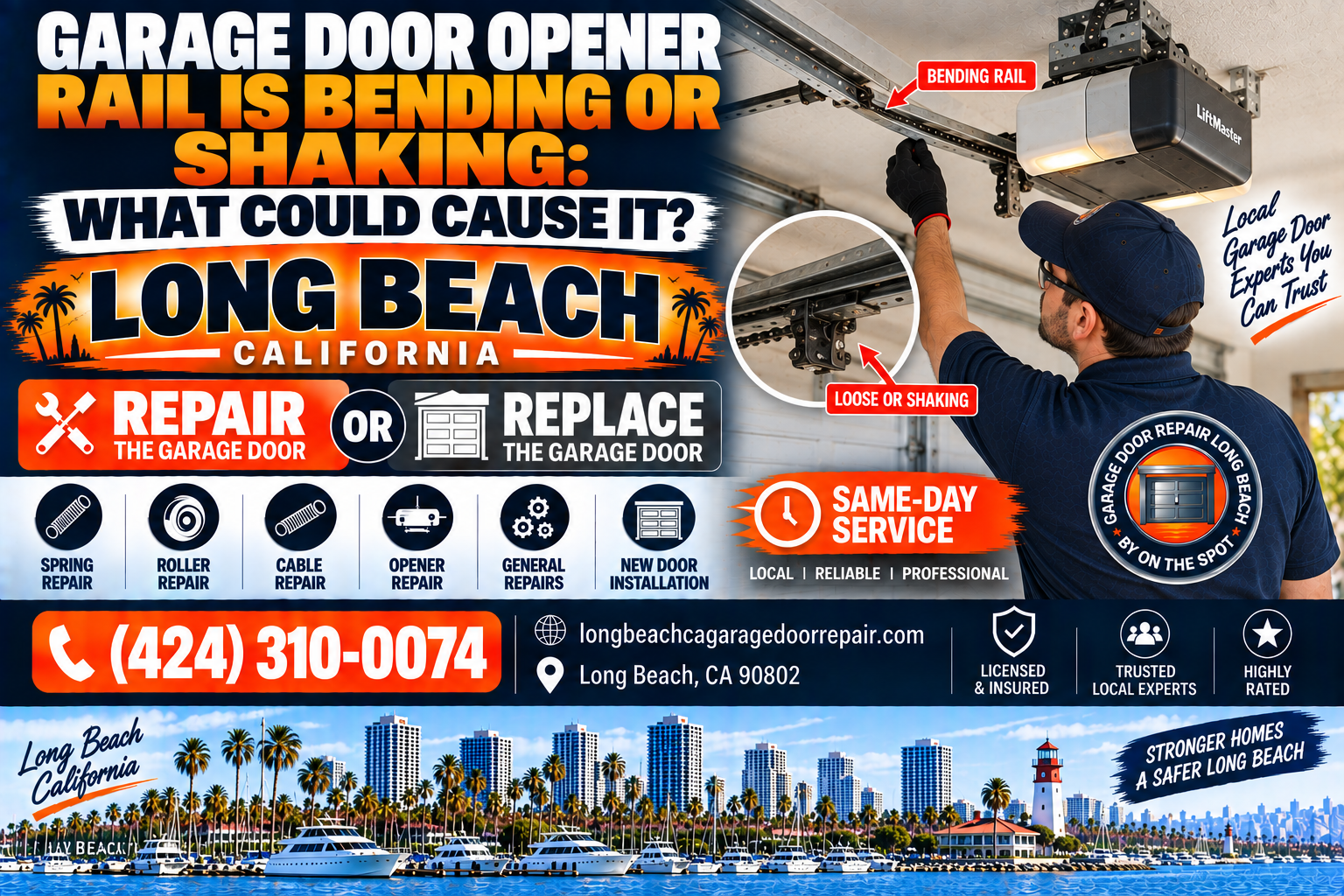
Long Beach Opener Rail Guide
Garage Door Opener Rail Is Bending or Shaking: What Could Cause It?
When a garage door opener rail is bending or shaking, loose header brackets, an opener fighting a heavy unbalanced door, trolley binding, damaged rail sections, worn-gear vibration, or springs that force the operator to work too hard are usually involved. Learn safe observation, Long Beach install quirks, and when to call for systems-first repair.
Garage Door Repair Long Beach By On The Spot helps homeowners, renters, landlords, property managers, HOA communities, and small businesses diagnose bending and shaking opener rails with coastal-aware service across Long Beach, CA.
Unbalanced Door Overload
Trolley Bind
Rail Damage + Gear Wear
CPSC + DASMA + SCE
Serving Long Beach, CA
Table of Contents
Direct Answer: What Causes a Garage Door Opener Rail to Bend or Shake?
Direct answer: A garage door opener rail that bends or shakes usually means the rail and header bracket are absorbing forces they were never meant to carry alone. Common causes include a loose or under-anchored header bracket, an opener fighting a heavy unbalanced door because springs are weak or broken, trolley binding that jerks the rail on every cycle, damaged or kinked rail sections, vibration from a worn drive gear inside the opener head, misaligned hangers that let the rail whip, and installation quirks common in Long Beach alley and coastal garages. Safe homeowner observation is visual and auditory only—do not try to straighten a live rail, retension springs, or force the trolley through a bind. Call for diagnosis-first service when shaking worsens, the rail visibly bows, the door feels heavy, or gear dust appears under the head.
In short: the rail is a guide, not a structural substitute for balanced springs. When the door fights the opener, the rail and brackets become the shock absorbers—and they show it as bend, rattle, and shake.
What the Opener Rail Does and Why Bend or Shake Matters
The opener rail (sometimes called the track or boom on chain, belt, and screw-drive units) is the straight path that carries the trolley from the motor head toward the garage door. It bolts to a header bracket above the door opening and hangs from ceiling joists or struts with hanger straps. Its job is geometry and guidance—not lifting the door’s weight. Springs (torsion or extension) should carry most of the door’s mass so the opener only nudges an already balanced door.
When homeowners notice the rail bending mid-cycle or shaking hard enough to rattle dust from the ceiling, that is a systems signal. Something upstream—springs, cables, rollers, brackets, gear wear, or trolley friction—is converting normal travel into intermittent shock loads. Those loads travel into the rail web, joints, and header fasteners. Over weeks or months, soft fasteners walk out, thin rail walls fatigue, and the shake becomes a permanent bend.
Ignoring rail motion is not a cosmetic choice. A bowed rail can bind the trolley, trip force reverse incorrectly, leave the door partially open after a power event, or accelerate gear stripping inside the opener head. In Long Beach’s mix of coastal moisture and inland heat, vibration also speeds corrosion at joints and hanger hardware.
Understanding the rail as a messenger of door balance and hardware health is the first EEAT step: experienced technicians diagnose the message before they replace the messenger.
Loose Header Brackets: The Most Common Shake Starter
The header bracket is the metal plate or angle that anchors the rail’s door-end to the wall structure above the opening. If lag bolts miss solid framing, if the bracket was mounted only into drywall or a thin ledger, or if years of vibration have ovaled the bolt holes, the rail’s door end can rock with every open and close. That rock looks and feels like the whole rail is shaking—even when the mid-rail hangers are still tight.
Homeowners often hear a sharp clack at the start of travel or see the rail tip nod when the trolley begins to pull. Paint cracks around the bracket, daylight gaps behind the plate, or a bracket that can be wiggled by hand (with the opener unplugged and the door secured) are classic clues. In older Long Beach cottages and converted carriage houses, headers are sometimes patched lumber rather than continuous framing—another reason brackets loosen faster than expected.
Safe observation: stand clear of the door path, watch one cycle from the side, and note whether motion is largest at the header. Do not re-lag into unknown framing without confirming what is behind the finish. Hitting wire, plumbing, or empty cavity with long lags creates new hazards. Pros locate solid backing, use correct lag length and washers, and may add a plywood or steel backing plate when the original header is compromised.
Loose header brackets also amplify every other problem. An unbalanced door that would only hum quietly on a solid mount can slap a loose bracket hard enough to bend the first rail section. Fixing balance without fixing the bracket leaves the next gear kit or trolley at risk.
Overloaded Rails: When Heavy Unbalanced Doors Make the Opener Fight
Springs that have lost tension, broken coils, or uneven cable wrap turn a garage door into dead weight. The opener then tries to lift hundreds of pounds that the springs should have neutralized. That fight transmits as rail flex, trolley chatter, and head vibration. Many “rail is bending” calls are really “springs are tired and the rail is complaining.”
Safe balance check (door closed, opener disconnected via emergency release only when the door is fully down and stable): try to lift the door by hand at the handle. A properly balanced residential door should feel manageable and stay roughly in place around mid-travel. If it feels like dead steel plate, drops hard, or rockets up, stop. Do not attempt spring adjustments. High-tension springs are a documented injury risk; DASMA guidance treats spring and cable work as professional territory for good reason.
Overloaded rails also show secondary symptoms: opener force settings cranked higher than factory intent, thermal trips after a few cycles, scorched smells at the head, and chain or belt slap. Increasing opener force to “push through” an unbalanced door is a temporary mask that accelerates gear wear and rail fatigue. Long Beach homes with insulated double doors, window panels, or added cladding are especially prone—owners upgrade the door skin without upgrading spring rating.
Professional path: measure spring condition and cable integrity first, verify track and roller freedom, then reassess whether the rail bend is residual plastic deformation or only dynamic flex under overload. Sometimes a rail looks permanently bent under load but returns once springs are restored—other times fatigue has already set a permanent bow that needs rail replacement or reinforcement.
Trolley Binding That Jerks and Shakes the Rail
The trolley (carriage) slides or rolls along the rail while connected to the door arm. Binding happens when the trolley plastic wears oval, when rail joints are stepped, when debris packs the channel, when the emergency-release latch is half-engaged, or when the arm geometry pushes the trolley sideways. Each bind creates a sudden stop-start that ripples the rail like a diving board.
Symptoms: a rhythmic bump at the same travel point every cycle, intermittent reverse without photo-eye obstruction, shiny wear marks on one rail flange, or a trolley that looks cocked relative to the rail centerline. Screw-drive carriages can pack grease and grit into the thread and chatter; chain systems can have a sticky master link; belt systems can have a tooth that climbs and drops.
Homeowners can clear obvious soft debris (leaves, paper, wasp nests) only with the opener unplugged and the door secured—never reach into pinch points while powered. Do not grind, hammer, or “true” a trolley with tools. Lubricant choice matters: heavy grease on a chain rail that was designed for dry or light oil treatment can attract grit and worsen binding in dusty Long Beach alley garages.
Pros diagnose binding with travel listening, clearance gauges, and replacement of worn trolley assemblies rather than endless lubricant. If binding coincided with a recent door panel repair or track realignment, the door path—not only the opener rail—may be pushing lateral load into the trolley.
Damaged Rail Sections: Kinks, Cracks, Rust-Through, and Joint Failures
Rails are usually multi-piece assemblies: door-end section, mid sections, and head-end section bolted or riveted at joints. Impact from a ladder, a truck rack, a falling storage box, or a door that jumped track can kink a section. Coastal salt air thins steel at joints. Over-tightened hangers can crush a rail web. Once geometry is gone, the trolley chatters and the rail shakes even if springs and gears are healthy.
Visual cues include a visible dog-leg at a joint, flaking rust at bolt lines, elongated holes, cracked powder coat with brown staining, and a rail that no longer sights straight when viewed from the head toward the door (opener unplugged, careful side angle only). Some aluminum or hybrid rails show crease lines after overload events.
Replacement strategy depends on brand and profile. Mixing incompatible rail generations, shortening rails incorrectly, or using hardware-store bolts of the wrong grade recreates vibration. Long Beach installs sometimes show DIY splice plates that were meant as temporary fixes after vehicle impact—those plates can themselves become shake sources if they add mass off-center.
Never attempt to cold-straighten a rail while it is still supporting an energized opener and a live door. A “mostly straight” DIY bend can leave micro-cracks that fail later under shock. Pros support the system, replace compromised sections, re-square hangers, and verify trolley travel end-to-end before re-energizing.
Vibration From a Worn Drive Gear Inside the Opener Head
Many chain- and belt-drive openers use a polymer (often nylon) worm gear that meshes with a steel worm on the motor. As teeth wear, the gear develops backlash. Backlash becomes a rhythmic thump that travels down the rail, especially at start of travel and near limits. Homeowners describe it as the rail “shaking itself apart” even when the rail steel is still straight.
Clues: fine plastic dust or curly shavings under or inside the head cover, a grinding hum that used to be a smooth whir, intermittent travel with sprocket hesitation, and shaking that is strongest near the motor end of the rail rather than the header. Gear wear is often the result of years of fighting an unbalanced door—so rail shake and gear dust frequently arrive together.
Replacing only the gear without correcting balance and rail geometry is a short-cycle repair. Experienced Long Beach techs treat gear kits as part of a system refresh: springs if needed, rail fasteners, trolley condition, and limit/force verification after reassembly. CPSC consumer guidance on automatic operators underscores that opener work should preserve reverse and entrapment performance—not just restore motion.
Do not run the opener repeatedly “to see if the dust stops.” Each cycle on a stripped gear can shear more teeth and leave the door stranded mid-travel.
When Springs Make the Opener Fight the Door—and the Rail Pays
Spring problems do not always look like a dramatic broken coil on the floor. Progressive fatigue, wrong wire size after a prior repair, oil-tempered springs in a corrosive coastal garage, and extension springs with worn pulleys all create a door that is almost liftable—but not quite. The opener’s force curve then peaks harshly at the same degrees of travel every day. Those peaks flex the rail.
Another pattern: one cable off the drum a half wrap, or a cable that has stretched, so the door lifts crooked. Lateral racking loads twist the trolley arm and push the rail sideways in the hangers. The symptom reported is “rail shaking,” but the root is door path asymmetry.
Alignment with DASMA safety tips means treating springs and cables as high-energy components. Homeowners should not insert winding bars, cut cables, or clamp spring cones. Observation only: listen for scraped cable sounds, watch whether both ends of the door rise together, and note if the rail shakes more when lifting than when closing (or vice versa).
After professional spring service, rail shake often drops dramatically. If it does not, the residual cause is usually hardware: header brackets, hangers, damaged rail, or gear backlash that developed during the overloaded months.
Safe Observation: What Homeowners Can Check Without Creating Hazards
Safe checks are eyes, ears, and photos—not tools on springs or live rails.
- Power context: If shaking began after a neighborhood outage, confirm power quality and whether the emergency release was used. Check SCE’s outage center for recent events before assuming only mechanical failure.
- Visual rail survey: From outside the door path, sight along the rail. Note bows, joint steps, and hanger angles.
- Header inspection: Look for gaps, cracked paint, and loose-looking lags—do not yank on the bracket.
- Gear dust: With the unit unplugged, a quick look under the head for plastic dust is informative; reassemble covers before restoring power.
- Door balance feel: Only with the door fully closed and after proper release procedure if you know how—otherwise skip and call.
- Photo-eyes and reverse: Do not disable safety devices to “stop the shaking.” Shaking is not fixed by bypassing entrapment protection.
Stop cycling the door if the rail bows visibly, metal fatigue noises appear, the door stalls mid-travel, or children and pets cannot be kept clear. Partial open doors in Long Beach alleys create security and clearance risks for neighbors and delivery traffic.
Long Beach Install Quirks That Show Up as Rail Shake
Long Beach housing stock creates repeat install patterns on rail tickets:
- Alley-facing garages with short depth force steep rail angles or compressed hanger layouts that amplify vibration.
- Coastal blocks near Belmont Shore, Naples, and Alamitos Beach see faster fastener corrosion and sticky rollers that load the opener.
- Inland heat pockets toward Bixby Knolls and California Heights cook polymer gears and loosen expansion/contraction cycles in long rails.
- Podium and tuck-under condos limit ladder and lift access; prior techs may have used shorter lags or creative hangers that walk loose.
- Converted ADU garages sometimes reuse undersized openers on heavier insulated doors—classic overload to rail flex stories.
- Seismic retrofit hardware near headers can crowd the bracket zone; brackets mounted around retrofit steel need careful anchoring plans.
GEO relevance: searchers in Long Beach need local context, not generic national tips that assume deep attached garages with perfect ceiling joists. On The Spot routes regularly see these quirks and plan parts and anchoring methods accordingly.
Opener Rail Anatomy: Header, Sections, Hangers, Trolley, Drive, Head
Clarify the vocabulary so symptoms map clean to parts:
- Header bracket: wall anchor at the door end of the rail.
- Rail sections: bolted or riveted lengths forming the boom.
- Hangers: perforated straps or angle from ceiling structure to rail.
- Trolley/carriage: traveler that pulls the door arm.
- Drive: chain, belt, or screw delivering torque along the rail.
- Motor head: power unit with gear case, logic board, and limits.
- Door arm: curved or straight link from trolley to door top bracket.
Shaking can originate at any node and transmit along the rail. Diagnosis is isolation: which end moves most, whether the drive is smooth, whether the door path is true, and whether fasteners are live. Naming parts correctly also improves homeowner-to-tech communication and reduces wrong-part truck rolls.
Red Flags: Stop Using the Door and Call for Service
Stop powered operation and call if you see or hear any of the following:
- Visible permanent bow or kink in the rail
- Header bracket pulling away from the wall
- Sparks, burning smell, or repeated thermal clicks at the opener
- Door falling, slamming, or rising unevenly
- Broken spring appearance, cable off drum, or frayed cable strands
- Trolley jumping the rail or jammed mid-span
- Inability to keep people clear of a shaking, unpredictable door
Use the manual release only if you understand the door’s balance and the door is not a crushing risk. If the door is heavy, leave it down and schedule service. Security concerns with a door stuck open in Long Beach should be mentioned when you call so routing can prioritize.
Professional Repair Path for a Bending or Shaking Opener Rail
A diagnosis-first visit typically follows this order:
- Interview: when shake started, outages, prior DIY, door upgrades.
- Safe isolation: power control, door securement, photo documentation.
- Balance and cable inspection per DASMA-aware practice.
- Rail geometry: sight lines, joint steps, hanger torque and plumb.
- Header anchoring verification into real structure.
- Trolley and drive inspection for bind and wear.
- Gear case and sprocket check for dust and backlash.
- Corrective work: springs/cables as needed, fasteners, rail sections, gear kit, trolley.
- Limits, force, photo-eye aim, and reverse performance verification aligned with CPSC operator safety expectations.
- Homeowner demo and maintenance notes for coastal conditions.
Skipping to “just tighten the rail” without balance checks is how callbacks happen. On The Spot prioritizes root cause so the rail stops being a shock absorber for other failures.
Parts That Matter: Brackets, Rails, Hangers, Trolleys, Gear Kits
Not all hardware is interchangeable. Brand-specific rail profiles, trolley shapes, and gear tooth counts matter. Using a universal bracket that does not match hole patterns can leave play that recreates shake. Ceiling hangers need correct gauge steel and locking fasteners; soft sheet-metal screws into thin drywall channels will not hold a vibrating rail.
Gear kits should match model and shaft design. Rail replacement may be sectional or full-length depending on damage. Header reinforcement plates help when framing is marginal—common in remodeled Long Beach structures. After parts install, torque patterns and threadlocker on select fasteners reduce coastal vibration walk-out.
Cheap temporary bolts without nylon lock or proper length are a frequent reason a “fixed” rail starts shaking again within weeks of marine-layer nights and hot afternoons.
Maintenance After Rail Service in Coastal Long Beach
Post-repair habits extend rail life:
- Quarterly visual check of header gaps and hanger fasteners
- Keep rollers and hinges lubricated with appropriate products—avoid over-greasing chain rails unless manufacturer specifies
- Rinse salt haze from exterior hardware on coastal blocks; dry afterward
- Do not hang storage from the opener rail or use it as a chin-up bar
- After any SCE outage and manual operation, confirm the trolley re-engaged before trusting remote travel
- Retest photo-eyes and reverse monthly with a soft obstruction test as advised in operator manuals and CPSC consumer materials
Schedule professional tune-ups if the door is older, insulated, or on a high-cycle rental. Catching spring fatigue early protects rails and gears.
Repair Now vs Waiting When the Rail Bends or Shakes
Waiting rarely saves money on rail shake. Dynamic flex becomes permanent set; polymer gears finish stripping; loose headers oval holes until a larger repair plate is required. A door that still “works” while shaking is accumulating damage on every cycle.
Reasonable short wait: mild new rattle after confirming lock mode and obvious debris, with a same-week appointment booked. Unsafe wait: visible bow, heavy door feel, gear dust storms, bracket pull-away, or inability to secure the opening.
Insurance and landlord contexts: document dates and photos. Property managers in Long Beach should treat shaking rails as priority tickets because stranded mid-open doors block alleys and create liability.
Same-Day Help When Rail Shake Turns Urgent
Urgent patterns include doors stuck mid-travel after a loud crack, brackets hanging on one lag, burning smell at the head, or security exposure with an open bay. Call (424) 310-0074 with gate codes, parking constraints, and whether the door is open into an alley easement.
Have photos of the rail bow, header, underside of the opener head, and overall door ready. Mention if shaking started after an outage, a spring pop, or a vehicle bump. That triage speeds the correct truck stock—gear kits, rail sections, springs, or reinforcement plates.
Questions to Ask Before Hiring for Rail or Opener Service
- Will you check spring balance before replacing rail parts?
- How will you verify header framing before re-lagging?
- Do you stock my opener’s rail and gear kit on the truck?
- Will reverse and photo-eye performance be demonstrated before you leave?
- What coastal fastener practices do you use in Long Beach?
- If the rail is permanently bent, section or full replacement—and why?
- Written findings for landlords or HOAs?
Answers that skip balance and safety testing are red flags even if the price is low.
Hiring Red Flags for Rail and Opener Work
- Quotes that only say “tighten rail” with no inspection time
- Willingness to disable photo-eyes or crank force to hide imbalance
- Spring work offered casually without winding tools or safety talk
- No model-specific parts—only vague universal claims
- Pressure to replace the entire opener without explaining gear vs rail vs spring findings
- Cash-only opacity with no written scope
Choose diagnosis transparency over the cheapest line item.
Why Garage Door Repair Long Beach By On The Spot for Rail Issues?
Garage Door Repair Long Beach By On The Spot at 151 E 5th St, Long Beach, CA 90802 focuses on systems diagnosis for opener rails that bend or shake. Coastal corrosion, alley geometry, and unbalanced upgraded doors are everyday locals—not edge cases. Service aligns with public safety framing from CPSC operator FAQs, DASMA system safety tips, and practical SCE outage context when manual operation preceded the symptom.
Call (424) 310-0074, visit https://longbeachcagaragedoorrepair.com/, or use Maps https://www.google.com/maps?cid=5381478035707257267. Bring clear photos and a short timeline of when the shake started. You get root-cause clarity—not only a temporary clamp on a vibrating rail.
Symptom Comparison Table: Bend vs Shake Causes
| What you notice | Likely cause layer | Homeowner next step | Pro focus |
|---|---|---|---|
| Rail nods most at door end; paint cracks at bracket | Loose header bracket | Stop yanking bracket; photo gaps; call | Framing verification + proper lags/plate |
| Door feels heavy; opener strains; rail flexes mid-span | Weak/broken springs (overload) | Do not wind springs; limit cycles | Spring/cable balance first |
| Bump at same travel point; trolley cocked | Trolley binding / joint step | Unplug; clear soft debris only | Trolley, joints, arm geometry |
| Visible kink or dog-leg; rust at joints | Damaged rail section | Do not cold-bend; photo sight line | Section or full rail replace |
| Shake strongest at motor; plastic dust | Worn drive gear backlash | Stop repeated test cycles | Gear kit + balance + limits |
| Door rises crooked; rail twists in hangers | Cable/drum asymmetry | Keep clear; photo both ends | Cables, drums, tracks |
| Shake after outage + manual use | Release half-engaged or limits confused | Confirm engagement if safe; check SCE | Re-engage, limits, travel teach |
| Hangers angled; ceiling dust rains on cycles | Loose/mis-set hangers | Do not overtighten blind | Hanger plumb + structure |
Use the table as a triage aid, not a final diagnosis. Multiple layers often coexist—especially overload plus gear wear plus loose hardware after months of vibration.
Areas Served From the Long Beach Location
Garage Door Repair Long Beach By On The Spot serves Long Beach neighborhoods and nearby communities from 151 E 5th St, Long Beach, CA 90802, including downtown Long Beach, Belmont Shore, Belmont Heights, Naples, Alamitos Beach, Bixby Knolls, California Heights, Wrigley, Traffic Circle, El Dorado Park area, Lakewood borders, Signal Hill, and adjacent Los Angeles County pockets along regular routes. Alley garages, podium structures, and HOA shared bays appear often on rail-shake tickets.
Call (424) 310-0074 with gate codes, parking notes, and whether a bowed rail has left the door stuck open into an alley. Coastal blocks and inland heat pockets both produce rail and gear failures—describe afternoon-only shake if that is your pattern.
Website: https://longbeachcagaragedoorrepair.com/. Maps: https://www.google.com/maps?cid=5381478035707257267.
Google Map Location
Find Garage Door Repair Long Beach By On The Spot at 151 E 5th St, Long Beach, CA 90802. Use this Google Maps link for directions and business details: https://www.google.com/maps?cid=5381478035707257267.
Phone (424) 310-0074 before visiting if you need to discuss a stranded door. Most bending or shaking rail problems are diagnosed at your garage rather than at a counter drop-off.
FAQs About Garage Door Opener Rails That Bend or Shake
Why is my garage door opener rail shaking when the door moves?
Shaking usually means the rail is absorbing shock from a loose header bracket, unbalanced springs, trolley binding, damaged rail geometry, worn gear backlash, or loose hangers. The rail is reporting a systems problem—not acting up for no reason.
Can a bent garage door opener rail be straightened?
Light dynamic flex may disappear after balance and fastener repairs. Permanent kinks, cracks, or fatigued bows typically need section or full rail replacement. Cold-bending a live rail is unsafe and can hide micro-cracks.
Does a shaking rail mean my springs are bad?
Often springs or cables are part of the story because overload flexes the rail, but brackets, hangers, gears, and trolley bind can shake a rail even with healthy springs. Pros check balance first without assuming a single cause.
Is it safe to keep using a door when the opener rail bends?
If bend is visible, worsening, or paired with heavy door feel, burning smells, or unpredictable travel, stop powered use and call. Continuing cycles can strip gears, pull brackets from framing, or strand the door mid-open.
What does plastic dust under the opener mean if the rail also shakes?
Plastic dust often points to a worn polymer drive gear. Backlash from that wear vibrates the rail, especially near the motor head. Replace the gear as part of a system fix that also addresses why the gear wore early.
How do Long Beach coastal conditions affect opener rails?
Salt air corrodes fasteners and joints; marine-layer moisture sticky rollers add load; inland heat ages polymer gears. Vibration walk-out of lags is common when coastal corrosion meets unbalanced doors.
Can I tighten the header bracket myself?
Only if you can confirm solid framing and use correct fasteners—and even then many homeowners should leave it to pros. Guessing lag length into unknown cavities risks electrical, plumbing, and weak anchors that fail again.
Why does the rail shake more when opening than closing?
Opening against weak springs loads the opener harder. Closing with extension-spring or cable issues can also differ. Note the direction for your technician; it narrows overload versus bind versus gear patterns.
Do photo-eyes cause rail shaking?
Photo-eyes do not mechanically shake rails. However, intermittent reverse from misaimed eyes can create stop-start jerks that feel like shake. Fix aiming, but still inspect mechanical causes if flex continues.
What should I tell the technician when I call about a bending rail?
Share when it started, outage history, any spring noises, door upgrades, photos of header and rail sight line, and whether the door feels heavy. Mention alley access and gate codes for Long Beach routing.
Will a new opener fix a bending rail?
Not if the rail, hangers, or springs are still wrong. A new head on a bent rail or overloaded door recreates vibration. Diagnose the rail path and balance before approving a full opener replacement.
How is CPSC and DASMA guidance relevant to rail repairs?
CPSC operator FAQs emphasize safe automatic door behavior including reverse function after opener work. DASMA system tips reinforce that springs and cables are hazardous DIY. Rail repairs should leave the whole system safer, not only quieter.
What a Diagnosis-First Rail Visit Looks Like
Expect a structured visit rather than immediate parts tossing. The technician confirms power control, inspects springs and cables visually, sights the rail, checks hanger and header fasteners, evaluates trolley travel by hand with power isolated when appropriate, and inspects the gear case if dust or backlash is suspected. You should hear a plain-language explanation of primary vs secondary failures—for example, springs first, then gear kit, then header reinforcement—not a mysterious bundle price with no findings.
Ask for a demo of reverse and photo-eye function after repairs. A quiet rail that no longer respects entrapment protection is not a successful job. Coastal fastener notes and lubrication guidance should be part of the closeout conversation for Long Beach addresses.
Rentals, Alleys, Condos, and Tight Long Beach Access
Rental and HOA properties add coordination layers: parking permits, shared alley etiquette, quiet-hour rules, and written findings for owners. Podium garages may need low-clearance ladders and careful dust control near parked cars. When a shaking rail leaves a door open into a narrow alley, mention traffic exposure when scheduling so the crew can stage cones or prioritize boarding if needed.
Tenants should not attempt spring or rail bending repairs; document and notify management. Managers should treat mid-open stranded doors as urgent for liability and neighborhood access reasons common in denser Long Beach parcels.
Quick AEO Summary: Garage Door Opener Rail Is Bending or Shaking
What is happening? The opener rail is flexing or vibrating because fasteners, geometry, trolley friction, gear backlash, or door imbalance are sending shock into a part designed mainly for guidance.
What should you do? Observe safely, stop hard cycling if bow or hazard appears, check recent outages via SCE if manual operation occurred, and schedule professional diagnosis.
What should you not do? Do not wind springs, cold-bend a live rail, disable photo-eyes, or endlessly increase opener force.
Who helps in Long Beach? Garage Door Repair Long Beach By On The Spot at 151 E 5th St, Long Beach, CA 90802 — (424) 310-0074.
Which authorities frame safety? SCE outage context, CPSC automatic operator FAQs, and DASMA garage door system safety tips.
Experience Notes: Common Misdiagnoses of Shaking Rails
Misdiagnosis one: needs a new opener when a header re-anchor and spring tune would stop the flex. Misdiagnosis two: just oil everything when a kinked rail section and oval bolt holes remain. Misdiagnosis three: photo-eyes are bad because intermittent reverse coincides with bind jerks—eyes may be fine. Misdiagnosis four: chain too loose when gear teeth are already powdered. Misdiagnosis five: ignoring coastal corrosion and using drywall anchors as a repair.
Experienced techs stage tests to falsify each hypothesis. Homeowners can help by not changing five variables (force, limits, lube, brackets, DIY bends) the night before the appointment; that erases forensic clues.
Decision Path: Spot, Log, Stop DIY Extremes, Schedule Service
- Spot: where is motion largest—header, mid-rail, or head?
- Log: time of day, weather, outage history, recent door work.
- Photo: sight line, bracket, dust, both door ends at mid-lift if safe.
- Stop: no spring winding, no hammer straightening, no safety bypass.
- Schedule: call with access notes and urgency if door is insecure.
- Verify: after service, watch a full cycle and confirm reverse demo.
This path keeps EEAT integrity: real observation, bounded DIY, professional correction, and safety proof—not vibes-based part swapping.
Practical Long Beach Scenarios Involving Bending or Shaking Rails
Belmont Shore coastal condo: Afternoon shake after marine-layer mornings. Sticky rollers plus marginal springs overload a slightly loose header. Fix: rollers, spring service, corrosion-aware fasteners.
Wrigley alley garage: Truck rack clipped the rail months ago; joint dog-leg now chatters the trolley. Fix: rail section, hanger re-square, travel verify.
Bixby Knolls heat: Polymer gear dust and head-end vibration on a double insulated door with original springs. Fix: springs to match door weight, gear kit, force/limits refresh.
Downtown podium: Short hangers and creative bracket around seismic hardware. Fix: engineered anchoring plan, reinforcement plate, HOA documentation.
Post-SCE outage: Manual release left soft-latched; trolley jerks and rail rattles. Fix: proper re-engagement teaching, inspect for wear from the event.
Rail Physics: Why Guidance Hardware Becomes a Shock Absorber
In a balanced system, peak dynamic loads on the rail are modest. Imbalance multiplies peak tension in the drive and peak bending moment at hangers and the header. Fatigue life of thin rail webs drops nonlinearly as stress amplitude rises—so a door that almost feels fine can still kill a rail over a season of high cycles. Vibration also reduces effective clamp load on fasteners (a known fretting and walk-out pattern), which is why coastal corrosion plus vibration is a brutal combination.
Understanding this physics reframes the homeowner instinct to hammer the rail straight. Straightening without lowering stress amplitude just resets the fatigue clock with possible crack starters. Lower the stress (balance, free trolley, solid anchors), then repair geometry.
Think of the rail as a lightly loaded beam that suddenly becomes a diving board when door mass is no longer spring-supported. Beam deflection scales with load and with the cube of unsupported span between hangers—another reason missing or widely spaced hangers magnify visible shake even when the steel itself is undamaged.
Limits, Force, and Safety After Any Rail Work
Any time hangers move, rails replace, or gears change, travel limits and force settings need verification. Too much force masks remaining binds and defeats the protective intent of obstruction sensing. Too little force causes nuisance reverses that tempt unsafe bypasses. Photo-eye alignment must be confirmed so the system meets the spirit of CPSC consumer guidance on automatic residential operators.
Ask for a reverse test demonstration. A rail that no longer shakes but fails to reverse on a safe obstruction test is not done. Document that demo for landlords and HOAs so the ticket closes on safety, not only quiet metal.
After-Repair QA: What a Healthy Rail Cycle Looks Like
Healthy signs: rail stays visually stable, fasteners do not walk during a multi-cycle test, trolley travels without bumping the same joint, opener sound is smooth without grinding bursts, door ends rise evenly, and reverse works. Ceiling dust should not rain from violent vibration. The header remains tight to framing. Homeowners should still perform periodic visual checks—coastal Long Beach is not a set-and-forget environment.
If mild residual rattle remains only at one joint after service, ask whether that joint was flagged for watch-and-recheck versus immediate section replacement. Honest QA includes residual-risk talk, not absolute silence promises when older rails stay in place by agreement.
Seasonal Playbook for Long Beach Opener Rails
Spring: Inspect after winter storm debris; check hangers.
Summer: Heat-soak days stress polymer gears—listen for new grind.
Marine-layer stretches: Watch for sticky rollers that load the opener.
Dry wind periods: Dust intrusion into open rail channels.
Holiday high-cycle weeks: Rentals and multi-car families add cycles that reveal marginal springs.
Seasonal awareness is GEO practicality: the same rail problem presents differently in Naples humidity than in inland heat. Pair seasonal checks with SCE outage awareness during wind and heat events when manual release use spikes.
Myths About Garage Door Opener Rails That Bend or Shake
- Myth: More lubricant always fixes shake. Fact: Wrong lube can pack grit and hide kinked geometry.
- Myth: Stronger opener force is a repair. Fact: It accelerates gear and rail damage.
- Myth: If the door opens, the rail can wait. Fact: Fatigue is cumulative and sudden failure modes exist.
- Myth: Any universal rail fits. Fact: Profiles and trolley interfaces differ by brand and generation.
- Myth: Springs are unrelated to opener rails. Fact: Springs dominate whether the rail lives a quiet life or a hard one.
- Myth: Shaking means the house framing is collapsing. Fact: Usually opener hardware and door balance—though header framing quality still matters for anchors.
Homeowner Call Script for Rail Bending or Shaking Service
Try this when you call (424) 310-0074:
Hi, my garage door opener rail is bending or shaking during travel. The motion seems worst at the header, mid-rail, or motor end. I do or do not see plastic dust under the head. The door feels normal, heavy, or uneven. This started around a recent date, possibly after an outage, impact, or spring noise. My address is in a named neighborhood; access notes are gate and parking. Photos are ready. Please diagnose balance, brackets, rail geometry, trolley, and gears—not only tighten hardware.
Clear scripts shorten mis-dispatch and get the right parts on the truck.
Property Manager Playbook for Rail and Opener Tickets
Create a ticket taxonomy: noise-only, visible bend, stranded open, stranded closed, post-outage. Require photos before vendor dispatch when residents can safely take them. Ban resident spring DIY in lease rules. For HOAs, keep preferred vendor notes that include reverse-test requirements. Track repeat units—chronic shake on the same opener model may indicate door weight upgrades without spring changes across a building.
Close tickets only after written confirmation of balance check and safety demo, not merely rail tightened. Store model numbers so gear kits and rail sections can be pre-staged on the next unit with similar symptoms.
Pre-Service and Post-Service Checklists You Can Actually Use
Pre-service: clear clutter near the door path, note codes, secure pets, charge phone for photos, list prior repairs, check SCE outage history if relevant, do not adjust springs.
Post-service: watch full open/close, confirm reverse demo, ask which parts changed, schedule follow-up visual check in 30 to 60 days for coastal fasteners, store invoice with model numbers for future gear kits.
Weekly light check: listen once from outside the path; glance at header paint cracks; confirm the release cord hangs normally and is not a play toy for kids.
Sequence of Failure: From First Rattle to Permanent Rail Bend
Typical sequence: (1) springs weaken or rollers stick; (2) opener force rises and cycles sound strained; (3) gear backlash and fastener micro-movement begin; (4) rail dynamic flex becomes noticeable shake; (5) header holes oval and hangers lean; (6) permanent bow or joint step appears; (7) trolley bind and nuisance reverses escalate; (8) stranded door or stripped gear ends powered travel. Interrupting at steps 1 to 3 is cheaper; at 6 to 8 is multi-part and urgent.
Homeowners who act at first persistent shake protect both the opener investment and the wall framing around the header. Waiting for a dramatic failure is how alley doors get stuck open overnight.
Family Safety While Waiting for Rail Service
Keep kids and pets away from the door path. Do not use the door as a play feature. If the door must stay closed for security, unplug the opener to prevent remote activation during unstable rail conditions—only if you can still exit the house by another door. If the door is stuck open, avoid parking under it and consider temporary security measures. Never stand under a door that is held only by a struggling opener.
Manual operation is for adults who understand balance risks. When in doubt, leave the door in the safest stable position and wait for the technician. Teach teens not to test a shaking rail repeatedly for videos.
Photo Tips That Speed Rail Diagnosis
- Wide shot of the full rail from the side
- Close-up of header bracket and lags
- Each rail joint and hanger at the ceiling
- Underside of opener head for dust
- Door top brackets, arm, and both bottom corners
- Any visible spring or cable anomaly from a safe distance
Daylight photos beat dim flash. A short video of one cycle with the filmer outside the path helps more than ten adjectives. Avoid filming while standing under the door.
What Technicians Recheck After Rail, Gear, or Bracket Work
Recheck list: header tightness under load, hanger plumb, rail sight straightness, trolley freedom, drive tension per spec, gear mesh quietness, limit accuracy, force margins, photo-eye aim, reverse function, and door balance sample. Coastal jobs add fastener material notes and sometimes threadlocker on vibration-prone points. Documentation for warranty and landlords should list parts and critical steps when applicable.
Double-Wide Doors and Extra Rail Sensitivity
Double-wide doors carry more mass and higher spring energy. Small imbalance creates larger peak loads into a single centered opener rail. Some installations use reinforced rails or specific hanger spacing; skipping those on a heavy door is a shake prediction. Window inserts and decorative hardware add weight that older spring cards did not anticipate. Long Beach remodels that swap in modern insulated doubles on original openers are frequent rail-flex candidates.
Some double doors benefit from torsion upgrades and carefully verified center-lift brackets so the arm does not rack the trolley sideways into the rail flanges.
After-Repair Habits That Protect Rail Geometry
Do not hang bikes from the rail. Do not use the rail to brace storage racks. Keep the emergency release cord accessible but not a toy. After any hard impact near the garage from moving vans or ladder slips, re-inspect sight lines. Seasonal fastener glances take one minute and prevent oval-hole disasters. If shake returns, call early because recurrence means a root cause remains.
Hanger Geometry Mistakes That Mimic a Bad Rail
Hangers set too far apart allow mid-span trampoline flex. Hangers set crooked pre-load the rail into a twist. Soft wire or plastic ties used as temporary hangers after hurried DIY guarantee vibration. Ceiling attachments into light gauge metal without proper anchors will walk. Pros calculate spacing from manufacturer guidance and actual rail length, then verify under motion, not only with a static level bubble.
On cathedral or unusual ceilings common in some Long Beach remodeled spaces, custom hanger angles need more than a one-size strap kit. Ask how the tech will triangulate support so the rail cannot sway side to side.
Header Framing Realities in Remodeled Long Beach Garages
Remodels hide surprises: sistered studs, false headers, foam, and electrical chases. A bracket that held for five years can fail after insulation work or EV charger conduits changed what was behind the drywall. Careful exploratory methods beat random long lags. Reinforcement plates spread load when lumber is marginal. This is why a bracket tightened last month that is loose again is a framing story as often as a bolt story.
Pros may recommend relocating the bracket slightly to hit solid stock, adding a continuous ledger, or combining interior plates with correct lag length. Homeowners should not keep hunting for wood with ever-longer lags through unknown cavities.
How Worn Gears and Rail Shake Feed Each Other
Backlash hammers the drive, which hammers the rail, which loosens fasteners, which increases shock into the gear. That feedback loop is why rail-only or gear-only thinking fails. Breaking the loop requires restoring mesh with a correct gear kit and removing the overload or bind that destroyed the old gear. Otherwise the new polymer teeth powder out again in a few months of Long Beach heat and alley dust.
Why DASMA Guidance Matters When a Rail Bends or Shakes
DASMA garage door system safety tips remind consumers that doors are integrated systems. Springs, cables, tracks, and operators interact. A shaking rail is often the visible complaint; the hazardous energy may sit in the spring set. Following DASMA-aligned caution keeps rail troubleshooting from becoming an injury event. Read the tips at the authority link in this article and treat them as boundaries, not optional color commentary.
Why CPSC Operator Safety Still Applies After Rail Service
The CPSC FAQ on automatic residential garage door operators centers consumer safety expectations: doors should reverse appropriately and not be fixed in ways that defeat protection. After rail, gear, or bracket work, verifying those behaviors is mandatory professionalism. Aesthetics of a still rail never outrank entrapment protection. Keep the CPSC resource bookmarked when evaluating any opener-related repair proposal.
Why SCE Outage Context Belongs in Rail Troubleshooting
Southern California Edison outages push homeowners to pull emergency releases. Re-engagement mistakes and post-outage force tussling show up as new rail rattles. Before assuming mechanical catastrophe, check the SCE outage center for recent neighborhood events and tell your technician if manual operation happened. Power quality blips can also coincide with hard starts that stress gears. Context matters for accurate diagnosis.
EEAT and GEO Notes for Long Beach Searchers
Experience: coastal and alley rail failures are routine on local routes. Expertise: systems diagnosis across springs, rails, gears, and anchors. Authoritativeness: alignment with SCE, CPSC, and DASMA public references. Trust: clear NAP, map embed, safety-first DIY limits, and diagnosis before parts pressure. GEO: neighborhood microclimates and housing stock quirks are named so Long Beach searchers see their actual garage types reflected, not generic Midwest detached-garage advice.
Deeper Coastal Heat and Moisture Mechanics on Rails and Gears
Daily thermal cycling expands and contracts metal rails and fasteners. Polymer gears soften in heat-soak mounts when opener heads sit under dark roofs. Moisture films increase roller drag in the morning; afternoon heat then runs the opener against still-marginal springs. That daily two-act play is uniquely hard on Long Beach hardware compared with stable inland deserts or cool northern climates. Maintenance calendars should reflect it: visual checks after heat waves and after long marine-layer streaks.
Balance Physics Recap for Opener and Rail Health
Ideal balance means the opener supplies modest push and pull, not primary lift. Measured in practical terms: a human-liftable door with manageable mid-travel behavior when properly disconnected. Deviation converts the opener into a hoist and the rail into a crane boom, roles they are bad at. Every rail shake investigation that skips balance wastes money. Every balance repair that ignores a damaged rail leaves a bent guide waiting to bind the next trolley.
Expanded DIY Boundary Examples With Clear No Lists
Yes (generally): photo documentation, debris clearing with power off, visual fastener observation, SCE outage lookup, lock-mode review on wall controls, keeping people clear.
No: winding bars on torsion springs, cutting cables, hammering rails straight under load, removing photo-eyes, drilling random header holes, substituting improvised hangers, defeating reverse, running endless diagnostic cycles on a grinding gear.
When a video step conflicts with DASMA or CPSC safety framing, stop and call a pro. Viral confidence is not engineering control.
Screw-Drive Openers: Rail Shake Without a Chain or Belt
Screw-drive units use a rotating screw inside a rail-like housing; the trolley rides the thread. Shake can come from packed grit on the screw, worn carriage inserts, bent tube sections, or mounts that loosened under vibration. Lubrication must follow manufacturer chemistry—wrong grease becomes grinding paste in sandy alley air. Diagnosis still starts with door balance; a screw drive fighting a heavy door will shout through the rail tube just like a chain system.
Listening Map: Where Rail Shake Sound Originates
Stand outside the path and map sound: sharp clack at start often header; rhythmic mid-travel bump often joint or trolley; grinding wash at the head often gear; metallic ringing after impact often kinked section. Pair listening with visual sighting. Two-person diagnosis with one watcher at header and one at head helps on long rails, but keep both people clear of the door sweep area.
Documentation for Landlords, Insurers, and HOAs
Keep dated photos of the bend, invoices listing springs, rails, and gears, and notes that reverse testing was performed. If a vehicle impact caused the kink, document separately from wear claims. HOA architectural committees sometimes question exterior header plates; interior reinforcement is often preferable when aesthetics matter—discuss before install day.
Preventive Upgrades When Replacing Rails or Openers
Consider reinforced rail kits on heavy doors, corrosion-resistant fasteners on coastal blocks, soft-start openers that reduce shock loading, and spring upgrades matched to current door weight—not the weight from a decade-old sticker if panels changed. Backup battery systems help avoid panicked manual releases during outages that later show up as rail symptoms. Pair batteries with SCE awareness, not as a substitute for mechanical health.
When budgeting, ask which upgrades prevent the feedback loop of imbalance, gear wear, and fastener walk-out rather than which upgrade merely looks newest on an app screen.
Small Business and Shared Bay Considerations
Shared commercial bays in Long Beach may have higher cycles and mixed users who misuse emergency releases. Post simple signage: report shake early, do not prop doors with objects that rack tracks, and keep release cords standard. Fleet vans hitting rails is a recurring damage mode—add protection bollards where layout allows.
Facility managers should log cycle estimates and schedule preventive spring and roller service before opener rails become the loudest complaint in the building.
Rail Materials, Coatings, and Corrosion Patterns
Steel rails with damaged coatings rust at joints first. Some aluminum extrusions resist rust but still fatigue or crease. Fastener bi-metallic couples can accelerate corrosion in salt air. Inspect for white aluminum oxides versus red steel rust—they tell different material stories. Replacement should consider environment, not only price.
Touch-up of coatings after hanger moves is a small step that slows coastal creep of rust at new scratch lines.
Honest Limits of Self-Diagnosis for Rail Problems
You can often identify which end shakes most and whether dust looks like plastic gear wear. You cannot safely quantify spring torque, certify header framing, or guarantee reverse performance after DIY fastener work. Paid diagnosis is cheaper than framing repair after a bracket tears out. Use self-diagnosis to communicate, not to replace professional risk controls.
Glossary: Rail Bend and Shake Terms in Plain Language
- Header bracket: wall mount at the door end of the opener rail.
- Hanger: ceiling strap supporting the rail.
- Trolley: traveler that pulls the door arm.
- Backlash: slop in worn gears that thumps under load.
- Force setting: opener push strength; not a substitute for balance.
- Sight line: visual check that the rail is straight.
- Dynamic flex: temporary bend under load that may recover.
- Permanent set: bend that remains when unloaded.
More Long Beach Micro-Scenarios for AEO Depth
Naples finger canals: salt and moisture; expect fastener corrosion timelines shorter than inland suburbs.
California Heights craftsman: older lumber headers; reinforcement plates more common.
Signal Hill border: hillside approaches and tight driveways complicate truck staging—mention when booking.
El Dorado Park area: larger lots, longer rails on deep garages—hanger spacing errors show as mid-span trampoline shake.
Traffic Circle multifamily: shared access hours and resident education needed to stop release-cord misuse.
After a Vehicle or Ladder Impact to the Opener Rail
Even a light bump can start a fatigue crack that only shows as shake weeks later. If you know about an impact, say so. Pros may simply replace questionable sections rather than gamble. Do not cycle repeatedly to see if it is fine—that is how partial cracks propagate.
Smart Openers, Alerts, and Rail Vibration
App alerts for obstruction or motor overheating can coincide with rail bind events. Do not silence alerts without inspection. Camera snapshots of a bowed rail help remote triage but do not replace on-site geometry checks. Wi-Fi openers still obey the same physics: balance and hardware first, app settings second.
What Diagnosis-First Means in Technician Training Terms
Techs learn to separate door path faults from operator faults before opening a gear case. Rail shake tickets punish shortcut habits. Mentoring includes coastal fastener practice, alley etiquette, and how to explain DASMA and CPSC boundaries to anxious homeowners without fearmongering. That culture is part of why systems-first shops produce fewer callbacks than parts-first vans.
How to Think About Cost Without Guessing Online Prices
Online averages mislead because a rail repair can mean a lag kit, a full rail, springs, and a gear kit in different combinations. Ask for line-item findings. Paying for accurate diagnosis protects you from buying a whole opener when a bracket and springs were the real bill. Conversely, do not demand the cheapest line if inspection shows cascading damage—partial fixes return as repeat labor.
Putting It Together: Rail Shake as a System Story
Opener rail bending or shaking is rarely a single broken stick of metal with a single SKU fix. It is a story about anchors, balance, trolley friction, gear health, hanger geometry, and Long Beach environment. Read the story in the right order, respect energy hazards in springs, preserve operator safety functions, and use authority resources for context. Then the rail returns to what it should be: a quiet guide, not a vibrating warning flag.
Call for Help If Your Garage Door Opener Rail Is Bending or Shaking in Long Beach
If your garage door opener rail is bending or shaking—loose header, overloaded unbalanced door, trolley binding, damaged rail sections, worn-gear vibration, or springs forcing the opener to fight—get diagnosis-first help from Garage Door Repair Long Beach By On The Spot. Mild new rattles still deserve a scheduled inspection; visible bows, heavy doors, and gear dust should not wait.
Call (424) 310-0074, visit https://longbeachcagaragedoorrepair.com/, or find us at 151 E 5th St, Long Beach, CA 90802. Maps: https://www.google.com/maps?cid=5381478035707257267.
Bring photos of the rail sight line, header bracket, opener head underside, and door ends. Ask for balance-before-rail-parts clarity, coastal fastener practices, and a reverse plus photo-eye demonstration before the truck leaves.
Authority-aligned service keeps SCE outage context, CPSC operator safety, and DASMA spring boundaries in view, so rail repairs solve rail problems and spring or power problems get named honestly when they are the real cause.