
Long Beach Opener Trolley Guide
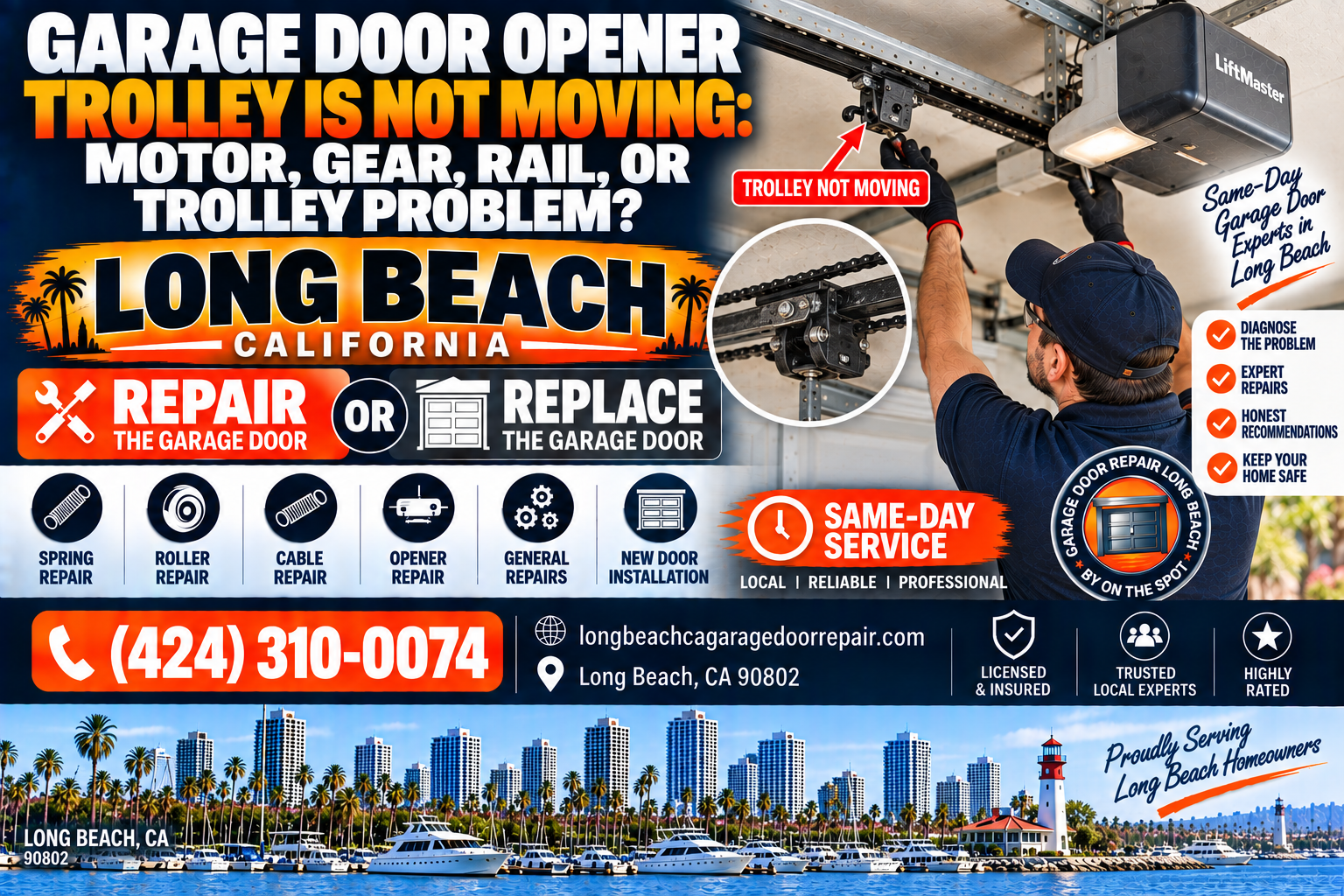
Garage Door Opener Trolley Is Not Moving: Motor, Gear, Rail, or Trolley Problem?
When a garage door opener trolley is not moving, the motor may still hum while a stripped gear, broken trolley, rail bind, chain or belt disconnect, disengaged emergency release, or vacation lock blocks travel. Learn how to tell motor vs gear vs trolley vs rail, run safe checks, and get Long Beach coastal-aware service.
Garage Door Repair Long Beach By On The Spot helps homeowners, renters, landlords, property managers, HOA communities, and small businesses diagnose frozen trolleys with systems-first service across Long Beach, CA.
Stripped Gear Clues
Trolley vs Rail
Release + Vacation Lock
CPSC + DASMA + SCE
Serving Long Beach, CA
Table of Contents
Direct Answer: Motor, Gear, Rail, or Trolley When the Opener Runs but Nothing Moves?
Direct answer: When a garage door opener trolley is not moving, the motor may still hum or the head may sound busy while the trolley stays put. The usual culprits are a stripped drive gear inside the opener head, a broken or disengaged trolley, rail binding or bent rail geometry, a chain or belt disconnect, an emergency-release left disengaged, or a vacation lock / lock mode that blocks travel. Tell them apart by listening at the head, watching the drive (chain/belt) for motion, checking trolley-to-arm coupling, confirming the release is re-engaged, and ruling out lock mode before assuming the motor is dead. Safe DIY is visual checks, release re-engagement when the door is secure, and lock-mode review; gear cases, spring work, force changes, and rail bending are pro territory. Long Beach heat, coastal corrosion, and attic-bake openers accelerate gear wear and sticky trolley slides.
Garage Door Repair Long Beach By On The Spot diagnoses trolley-not-moving failures with a systems approach for homeowners, renters, landlords, HOA boards, and small businesses near 151 E 5th St, Long Beach, CA 90802. Call (424) 310-0074 when the motor hums, the rail drive moves but the door does not, or the trolley sits frozen mid-rail.
This A109 guide is original to the trolley-not-moving question. It does not rewrite loose-belt or sagging-chain siblings. It centers on motor-versus-gear-versus-trolley-versus-rail differentiation, emergency-release and vacation-lock traps, safe checks, Long Beach coastal conditions, and authority framing from SCE, CPSC, and DASMA.
What the Opener Trolley Does and Why Motion Stops
The trolley (also called the carriage) rides the opener rail and connects the drive—chain, belt, or screw—to the door arm. When you press the remote or wall button, the motor turns a gear or pulley, the drive advances, the trolley travels, and the arm lifts or lowers the door. If the trolley is not moving, that kinetic chain is broken somewhere between electricity at the outlet and the door panel.
Not moving is different from moving slowly, moving then reversing, or moving with noise. A frozen trolley means zero useful travel along the rail even though something upstream may still be energizing. Households often fixate on the motor sound and miss whether the chain or belt is actually circulating, whether the trolley is mechanically free of the drive, or whether a lock feature is simply ignoring commands.
Trolleys include engagement features: a release lever that decouples the carriage for manual operation, and on many models a re-engage mechanism that must click back into the drive path. Leave the release pulled and the motor can run its heart out while the trolley stays parked. That single oversight creates many false “dead opener” tickets in Long Beach alley and townhome garages.
Understanding the trolley as a coupler—not as the motor—keeps diagnosis honest. Replace the head only after you confirm the gear, drive, rail, release, and lock story. Call (424) 310-0074 if you need eyes on a humming head that moves nothing.
Trolley Snapshot Checklist
- Motor hums, clicks, or runs while trolley stays put
- Chain or belt moves (or does not) relative to the trolley
- Emergency-release cord hanging or lever in open position
- Vacation lock or lock LED active on the wall console
- Visible plastic gear dust under the opener head
- Rail rust, bend, or debris blocking the trolley path
When the Motor Hums but the Trolley Stays Put
A humming motor with a frozen trolley is one of the most common garage-door opener complaints. Hum means windings are energized; it does not prove the gear train is intact or that the trolley is coupled. Classic stripped-gear syndrome: the motor spins a ruined nylon or polymer drive gear, you hear a whir or grind from the head, and the sprocket or pulley never advances the drive.
Contrast that with a silent head that does nothing: that path leans toward power, logic-board, capacitor start issues, lock mode, or remote/wall-control problems—not necessarily trolley mechanics. Contrast again with a head that runs and the chain moves while the door stays shut: that often means the trolley is disengaged from the drive or the arm is detached.
Do not keep hammering the remote to “help” a humming, non-traveling opener. Repeated stalled starts heat the motor and can finish off a partial gear. Unplug if you smell hot plastic or electrical odor, keep people clear of the door path, and schedule diagnosis.
Long Beach attic-mounted openers bake in summer. Heat softens aging gear teeth and expands tolerances. A gear that barely held in cool marine-layer mornings can strip suddenly on a hot afternoon cycle. Note time-of-day in your service call notes.
Stripped Drive Gear: The Classic Hum-and-No-Travel Failure
Inside many residential opener heads, a steel worm drives a large polymer or nylon gear that turns the chain sprocket or belt pulley. Those polymer teeth are wear items. Age, heat, unbalanced doors, and years of starts chew them into powder. When teeth are gone, the motor worm spins freely: audible hum or grind, zero sprocket motion, trolley motionless.
Homeowner clues without opening the gear case: fine white, gray, or beige plastic dust under or around the head; a sudden change from normal operation to hum-only; history of a heavy door or prior spring issues. Opening the gear case yourself voids warranties, risks capacitor shock, and scatters parts. Gear kits are technician work with correct mesh, grease, and reassembly torque.
A stripped gear is not a trolley problem, but it presents as a trolley that will not move. Correct naming matters for parts and quotes. Ask the technician whether the sprocket advanced during the failed cycle and whether gear dust is present. That single observation separates gear failure from a free-floating trolley.
After gear replacement, honest shops recheck door balance. Installing a new gear on a door the opener must lift as dead weight recreates the failure. Garage Door Repair Long Beach By On The Spot sequences springs and balance before calling a gear job “done.” Call (424) 310-0074 for hum-plus-dust symptoms.
Safety stop: Do not pry open the gear housing, probe capacitors, or force the trolley while the motor is humming under load. Unplug the opener if it overheats, keep the door path clear, and use the emergency release only if you understand manual door control and the door is balanced enough to handle safely.
Broken, Cracked, or Worn Trolley Assemblies
Trolleys crack at the release pocket, wear their slide pads, lose internal engagement dogs, or break the pin that links to the door arm. A cracked trolley may still sit on the rail but no longer grab the chain or belt. From the floor it looks like “the opener runs but nothing happens,” even though the drive may be circulating past a dead carriage.
Wear pads and slides matter in coastal Long Beach. Salt air and grit polish slides until the trolley binds, chatters, or sits cockeyed. Binding can trip force sensors or look like a dead trolley when the opener times out against friction. Lubrication that attracts grit can worsen binding; follow manufacturer guidance rather than spraying random oil on the entire rail.
Arm-pin and bracket failures disconnect the door from a healthy trolley. The trolley may travel while the door stays put—or the arm hangs and the trolley cannot complete its path. Photograph the arm connection before the tech arrives so triage includes arm hardware, not only the head.
Replacement trolleys must match rail type and drive style. Universal guesses fail on engagement geometry. After install, limits, force, and reverse must be verified so the new carriage does not create entrapment risk.
Rail Issues: Bend, Rust, Debris, and Misaligned Hangers
The rail is the road the trolley travels. A bent section, crushed seam, disconnected rail joint, or shifted hanger can trap the carriage. Symptoms include a trolley that stops at the same rail mark every time, grinding at one spot, or a carriage that will not pass a joint after a bump from a tall vehicle or ladder strike.
Rust and coastal corrosion roughen the rail path. Long Beach marine air plus roof leaks above the garage create flaky rails that eat slides. Debris—packaging cardboard, bird nests in open-beam garages, holiday-storage overflow—can wedge the trolley. Clear visible clutter from a stable stance with the opener unplugged; do not climb on the door.
Hanger lag bolts into ceiling joists can loosen after seismic jiggle or decades of vibration. A drooping rail changes trolley geometry and can bind mid-travel. Rail straightening and hanger reset are pro adjustments; improvising with random lumber braces often misaligns the path further.
Screw-drive rails have different failure modes (dry screw, debris in the thread) but the trolley still needs a true path. Confirm drive type before searching chain-only advice. Call (424) 310-0074 when the trolley always dies at one rail location.
Chain or Belt Disconnect: Drive Moves Past a Dead Trolley
On chain and belt openers, the trolley grabs a master link, bolt, or molded tooth section of the drive. If that connection fails—broken master link, sheared bolt, belt tooth section torn out—the drive can circulate while the trolley sits. You may see the chain whip or the belt run with a loose flap while the carriage never advances.
Disconnect is distinct from simple looseness. A loose belt or sagging chain may still move the trolley inconsistently. A true disconnect moves the drive with zero trolley take-up. Visual confirmation from a safe floor position: watch one painted chain link or a belt mark and see whether the trolley follows.
Reconnecting is not always a five-minute DIY. Correct link orientation, tension, trolley engagement, and limit verification all matter. A belt with a torn tooth section usually needs belt replacement, not a zip-tie fantasy. A chain with a failed master link needs the right link and tension procedure.
Never stand on a ladder under a live, whipping chain. Unplug first. If the door is partially open and unsupported by a balanced spring system, do not pull the release without a plan to control the door. When in doubt, leave it and call for service.
Emergency Release Left Disengaged: The Silent Trolley Killer
The red emergency-release cord disconnects the trolley from the drive so you can move the door by hand during power loss or opener failure. After manual use, many models require you to pull the cord toward the door or run the opener so the trolley re-engages with a click. Skip that step and the next remote press runs the motor and drive while the trolley stays free—classic “trolley not moving with the door” confusion, or trolley moving without driving the door depending on what you watch.
Households forget the release after storms, SCE outage events, or weekend hand-operation. Kids and guests also pull the red cord out of curiosity. Check the lever position and cord hang before condemning the opener. Re-engagement procedures vary by brand; consult the wall chart or manual rather than yanking randomly while the door is mid-travel.
If the door feels heavy, crooked, or wants to free-fall when disconnected, stop. That is a spring or cable problem, not a re-engage tutorial. DASMA safety guidance treats high-energy spring systems as non-DIY. Secure the area and call (424) 310-0074.
Safe check: With the door fully closed and secure, confirm whether the release lever is in the engaged position and whether the trolley is coupled to the chain or belt. Unsafe: wrestling a heavy, spring-compromised door to “test” re-engage, or standing in the door path during attempts.
Vacation Lock and Wall-Console Lock Mode
Many wall controls include a lock or vacation mode that disables wireless remotes (and sometimes other controls) so the door will not open while you are away. Homeowners return, mash remotes, hear nothing useful from the trolley, and assume the opener died. The wall button may still work—or may also be restricted depending on model. Check for a lock LED, a slide switch, or a lock icon before scheduling a full mechanical diagnosis.
Lock mode does not strip gears. It is a logic lockout. Clearing it restores travel if the mechanical path is healthy. If lock is off and the trolley still will not move while the motor hums, return to gear, rail, and coupling checks.
Property managers should document lock-mode status in tenant tickets. “Opener broken” notes that omit lock state waste truck rolls. Teach residents the difference between lockout and mechanical failure.
After any outage, also check whether a power blip left the logic board in a fault state. SCE outage center updates help explain neighborhood blackouts, but local outlet and opener resets still need on-site verification. Authority link context: SCE Outage Center.
How to Tell Motor vs Gear vs Trolley vs Rail Problems
Use a structured listen-and-look sequence. Do not open housings. Do not adjust force. Observe one careful command cycle only if the door path is clear and previous cycles were not overheating the head.
- Power and lock: Confirm outlet power, opener is plugged in, and vacation lock is off.
- Release: Confirm emergency release is engaged so the trolley can couple to the drive.
- Listen at the head: Hum/grind with no sprocket motion → gear-side suspicion. Silence → power/logic/capacitor/control path. Healthy motor tone with visible drive motion → look at trolley coupling and rail.
- Watch the drive: Chain/belt/screw advancing past a still trolley → disconnect or broken trolley engagement. Drive and trolley both still → gear, clutch (on some models), or motor not delivering torque.
- Watch the rail: Trolley starts then dies at one spot → rail bend, debris, or joint issue.
- Watch the door arm: Trolley moves, door does not → arm pin, bracket, or door binding separate from trolley drive.
This matrix keeps quotes accurate. Replacing a trolley when the gear is powdered wastes money; replacing a head when the release is open wastes trust. Garage Door Repair Long Beach By On The Spot walks this matrix on site so parts match symptoms. Call (424) 310-0074 with your listen-and-look notes.
AEO summary: Motor hum + no drive motion often means stripped gear. Drive motion + still trolley often means disconnect or broken trolley. Still everything + lock LED means lock mode. Still trolley after release pull means re-engage needed. Trolley dies at one rail mark means rail path. Door heavy by hand means springs first—not more opener force.
Safe Homeowner Checks Before You Call
Safe observational checks speed service without creating new hazards. Unplug the opener before touching the rail area. Keep children and pets out of the garage. Never put your body under a partially open door that is not mechanically secured.
- Verify the outlet has power (lamp or phone charger test) and the opener is firmly plugged in
- Confirm vacation/lock mode is off on the wall console
- Visually confirm emergency-release lever position with the door fully closed
- From the floor, look for plastic gear dust under the head
- Note whether the chain/belt moves when someone else presses the wall button (stand clear of the door path)
- Photograph the trolley, arm pin, and any rail deformity
- Write morning versus afternoon behavior and any recent outage or spring work
Unsafe checks: opening the gear case, climbing the door, adjusting limit and force pots to “help” a frozen trolley, cutting the chain, and testing a slamming door by hand. CPSC operator safety FAQs emphasize entrapment protection and proper reverse function—settings you should not casually rewrite while chasing a trolley symptom. Review CPSC Automatic Residential Garage Door Operators FAQ for consumer-facing safety context.
When checks point past lock mode and release engagement, call (424) 310-0074. Bring your photo set; diagnosis starts faster.
Long Beach Conditions That Freeze Trolleys and Strip Gears
Coastal Long Beach stacks heat, salt, fog, and vibration on opener systems. Attic-adjacent and second-story rooms above garages turn into ovens by late afternoon. Polymer gears and trolley plastics age faster under that bake. Marine-layer mornings followed by hot afternoons cycle expansion and contraction on rails and hangers, loosening fasteners that later misalign the trolley path.
Salt air corrodes rail seams, trolley slides, and chain links. Corrosion plus grit from alley dust creates sticky travel that looks like a dead trolley when the opener times out against friction. Condensation in fog-prone blocks leaves overnight moisture that briefly changes friction—another reason morning and afternoon symptoms diverge.
Seismic micro-movement and decades of truck traffic near industrial corridors can shift rail hangers. A rail that was true at install can develop a subtle kink that only stops the trolley at one height. Homeowners describe “it always dies halfway,” which is a rail geometry clue, not a random electronics ghost.
Property near the Port, Alamitos Bay, and beach-adjacent streets should treat opener gear and trolley service as coastal maintenance, not optional noise work. Garage Door Repair Long Beach By On The Spot accounts for coastal wear patterns when quoting gear kits, trolley slides, and rail service. Call (424) 310-0074 when heat-of-day failures appear.
Opener Anatomy: Motor, Gear, Drive, Rail, Trolley, Arm
Think of the system as a stacked stack of parts. The motor converts electricity to rotation. The gear set multiplies torque and turns the drive sprocket, pulley, or screw. The drive (chain, belt, or screw) carries motion along the rail. The trolley rides that motion. The curved or straight arm connects trolley to door. Limits and force logic decide when to stop or reverse. Photo eyes watch the doorway for obstructions on the close cycle.
Failure at any layer can present as “trolley not moving” from a casual glance. Precise language—“motor hums, sprocket still,” “chain runs, trolley free,” “trolley hits rail kink”—cuts diagnostic time. Photos of each layer help remote triage before the truck rolls.
Screw-drive systems replace chain/belt with a threaded rod; the trolley still travels and still can bind, crack, or disengage via release. Do not force chain advice onto a screw rail. Confirm drive type by looking up at the rail path.
Logic boards and capacitors sit in the head. Capacitor weakness can cause weak starts that sound like a hum without travel, overlapping gear symptoms. Technicians separate capacitor and gear failures with tools homeowners should not improvise.
Red Flags: Stop Using the Door and Call
Stop daily cycling and call immediately if any of these apply:
- Hot plastic or electrical smell from the opener head
- Motor humming repeatedly with no travel and rising heat
- Door crooked, heavy, free-falling, or cable off a drum
- Trolley jammed with the door partially open over a driveway or sidewalk
- Visible large cracks in the trolley or rail separation
- Children, pets, or vehicles at risk from unpredictable motion
Partial-open stranded doors are especially dangerous. Do not park under them. Do not try to “help” the trolley with a pry bar. If you must clear a car and the door is balanced and you understand the emergency release, move carefully with a spotter—otherwise wait for a technician.
Call (424) 310-0074 for same-day triage language: humming head, gear dust, release state, lock LED, and whether the door is stuck open.
Safety stop: Never stand under a door held only by an opener trolley. Springs and cables carry the load; if they have failed, the opener is not a jack stand. Clear the area and get professional help.
Professional Repair Path for a Trolley That Will Not Move
A diagnosis-first visit usually follows this order: safety scan (springs, cables, door posture), power and lock verification, release/engagement check, listen-and-look of motor versus drive versus trolley, rail path inspection, then parts decision (gear kit, trolley, rail repair, drive reconnect, or opener replacement when the head is beyond economic repair).
Balance testing belongs early. A heavy door that strip-geared the opener must not receive a new gear alone without spring correction. DASMA safety tips for garage door systems reinforce treating the full door system—not just the opener gadget—as the safety unit. See DASMA garage door system safety tips.
Closeout includes travel limits, force settings within safe norms, photo-eye alignment, and a documented reverse test. CPSC consumer guidance expects operators to reverse on obstruction; a trolley repair that skips reverse verification is incomplete.
Garage Door Repair Long Beach By On The Spot explains adjust-versus-replace options in plain language on site near 151 E 5th St, Long Beach, CA 90802. Call (424) 310-0074 to schedule.
Parts That Matter: Gear Kits, Trolleys, Rails, Drives, Arms
Gear kits must match brand and generation. Tooth count, worm geometry, and sprocket interfaces are not interchangeable across all “1/2 HP” labels. Trolley assemblies must match rail profile and release style. Rails may be repaired at a joint or replaced as a section depending on damage. Chains need correct pitch and master links; belts need correct length and tooth pitch; screw drives need clean thread and matching carriage.
Arm hardware and door brackets transfer load. Bent arms and worn pins recreate “trolley moves, door does not” tickets. Ceiling hangers and perforated angle are structural; rusty or undersized hangers allow rail droop that binds trolleys.
Opener replacement enters when the logic board, motor windings, and gear case are collectively tired, parts are discontinued, or noise/safety features of a modern unit are the better investment. Replacement still requires balance and photo-eye closeout—new heads do not forgive weak springs.
Ask for part numbers on the invoice for future coastal maintenance cycles. Gear dust return within a year after a heavy-door gear-only fix is a known pattern; documentation helps the next tech.
Maintenance After Trolley or Gear Service in Coastal Long Beach
After service, keep the rail path clear, follow manufacturer lubrication notes (often specific trolley slides—not greasy entire rails), test photo eyes monthly, and listen for new hum-without-travel early. Schedule spring inspections on aging doors so the opener is not re-tasked as a hoist.
Coastal property: rinse salt mist from exterior door hardware when washing the car area (avoid spraying opener heads and photo eyes directly with pressure washers). Interior rail wipe-downs with a dry cloth remove grit that destroys slides.
Log any SCE outage that forced manual release use, then verify re-engagement the same day power returns. Outage habits prevent the next “trolley not moving” false alarm.
Call (424) 310-0074 if post-repair travel shortens, new gear dust appears, or afternoon binding returns.
Repair Now vs Waiting When the Trolley Will Not Move
Waiting is rarely free. A humming stripped gear that you keep energizing can overheat the motor. A half-engaged trolley can grab unpredictably. A rail-bound carriage can scar the rail into a permanent kink. A door stuck partly open invites weather, animals, and security loss in Long Beach neighborhoods.
The narrow wait window is lock-mode confusion or a clearly disengaged release you can safely re-engage with the door fully closed and balanced. Even then, if re-engage fails or the door is heavy, stop waiting and schedule service.
Intermittent trolley motion—works in the morning, fails after work—often means heat-related gear or binding. That pattern will not self-heal over a vacation week; it will strand someone in the driveway.
Cost control favors early diagnosis: a gear kit and balance correction beats a cooked motor plus door panel damage from a slam event.
Same-Day Help When Trolley Failure Turns Urgent
Urgent categories: door stuck open over the sidewalk or alley, vehicle trapped for work or medical needs, hot-smelling opener, crooked door with cable issues, or overnight security gap. Say those words when you call so dispatch prioritizes correctly.
Have ready: opener brand if known, whether the motor hums, whether gear dust is visible, lock LED state, release cord state, door position (open/closed/partial), and safe access notes for alley or HOA garages.
Garage Door Repair Long Beach By On The Spot serves Long Beach from 151 E 5th St, Long Beach, CA 90802. Call (424) 310-0074 or visit https://longbeachcagaragedoorrepair.com/. Maps: https://www.google.com/maps?cid=5381478035707257267.
Questions to Ask Before Hiring for Trolley or Opener Service
Ask whether the visit includes spring balance testing before gear or trolley parts are sold. Ask how they confirm release engagement and lock mode before quoting a new opener. Ask whether gear kits include correct grease and worm inspection. Ask for reverse and photo-eye demonstration before the truck leaves. Ask whether rail hanger torque is checked when the trolley binds at one spot.
Ask for a plain-language verdict: motor, gear, rail, trolley, drive disconnect, or controls. Vague “opener bad” quotes without that matrix deserve a second opinion.
For rentals and HOAs, ask for photo documentation of gear dust, trolley cracks, and rail kinks for the maintenance file.
Hiring Red Flags for Trolley and Opener Work
Walk away from anyone who raises force first to “make it move,” refuses to check springs, opens gear cases with the unit still plugged in, or quotes a full opener replacement without listening for gear-versus-trolley clues. Be wary of cash-only pressure, unmarked vans without local identity, and parts that “fit everything.”
Be wary of technicians who dismiss CPSC reverse testing as optional or who leave photo eyes taped over “temporarily.” Entrapment protection is not a nicety after trolley service.
Local accountability matters. Prefer shops that publish a Long Beach NAP, answer the phone, and warranty gear and trolley work with clear terms.
Why Garage Door Repair Long Beach By On The Spot for Trolley Issues?
Garage Door Repair Long Beach By On The Spot focuses on diagnosis-first opener and door system repair for Long Beach homes, rentals, and light commercial bays. We separate lock mode, release engagement, stripped gears, broken trolleys, rail binds, and drive disconnects so you do not buy the wrong part. Coastal heat and salt patterns are familiar on our routes from 151 E 5th St, Long Beach, CA 90802.
We close with balance checks, limit and force verification, and photo-eye reverse demonstration. Authority-aligned habits reference SCE outage context when power events precede symptoms, CPSC operator safety expectations, and DASMA system safety boundaries around springs.
Call (424) 310-0074, visit https://longbeachcagaragedoorrepair.com/, or find us on Maps: https://www.google.com/maps?cid=5381478035707257267.
Symptom Comparison Table: Motor, Gear, Rail, or Trolley
| What you notice | Likely layer | Homeowner next step | Pro focus |
|---|---|---|---|
| Hum/grind, sprocket still, possible plastic dust | Stripped gear (or weak capacitor overlap) | Stop cycling; photo dust; call | Gear kit + balance |
| Drive runs, trolley stays, release open | Emergency release disengaged | Re-engage if door closed and safe | Confirm coupling and limits |
| Drive runs, trolley free, release engaged | Broken trolley or drive disconnect | Unplug; photo trolley and links | Trolley or master link/belt section |
| Trolley dies at same rail mark | Rail bend, joint, debris, hanger droop | Clear debris only if safe; photo kink | Rail/hanger geometry |
| Silent head, lock LED on | Vacation/lock mode | Clear lock; retry wall button | Controls education |
| Trolley moves, door does not | Arm pin/bracket or door bind | Photo arm; do not force | Arm hardware / door path |
| Door heavy or crooked | Springs/cables (not trolley first) | Stop; clear path; call | Spring/cable safety repair |
| Works morning, fails afternoon heat | Heat-aged gear or sticky slides | Log pattern; schedule warm-hour visit | Gear/slides + coastal maintenance |
Use the table as a conversation starter, not as a DIY repair license. When layers overlap—heavy door plus gear dust—professionals sequence springs first.
Areas Served From the Long Beach Location
Garage Door Repair Long Beach By On The Spot serves Long Beach neighborhoods and nearby communities from 151 E 5th St, Long Beach, CA 90802, including downtown Long Beach, Belmont Shore, Belmont Heights, Naples, Alamitos Beach, Bixby Knolls, California Heights, Wrigley, Traffic Circle, El Dorado Park area, Lakewood borders, Signal Hill, and adjacent Los Angeles County pockets along our regular routes. Alley garages, podium structures, and HOA shared bays are common on trolley and opener tickets.
Call (424) 310-0074 with gate codes, parking notes, and whether the door is stuck open into an alley easement. Coastal blocks and inland heat pockets both see gear and trolley failures—describe your microclimate if afternoon failures dominate.
Website: https://longbeachcagaragedoorrepair.com/. Maps: https://www.google.com/maps?cid=5381478035707257267.
Google Map Location
Find Garage Door Repair Long Beach By On The Spot at 151 E 5th St, Long Beach, CA 90802. Use this Google Maps link for directions and business details: https://www.google.com/maps?cid=5381478035707257267.
Phone (424) 310-0074 before visiting if you need to drop parts or discuss a stranded door. Many trolley failures are diagnosed on site at your garage rather than at the shop counter.
FAQs About Garage Door Opener Trolleys That Are Not Moving
Why does my garage door opener motor hum but the trolley does not move?
Most often a stripped polymer drive gear spins under the worm while the sprocket stays still. Other causes include a disengaged emergency release, drive disconnect, broken trolley engagement, rail bind, or (less often) capacitor/start weakness. Confirm lock mode is off, then listen for sprocket motion and look for gear dust. Call a pro for gear-case work.
Can a vacation lock stop the trolley from moving?
Vacation or lock mode typically blocks remotes and can make it seem like the opener is dead. Clear the lock LED or switch and try the wall button. If the motor then hums without travel, move on to mechanical diagnosis.
How do I know if the emergency release is disengaged?
Look at the trolley lever and red cord. Many models show an open lever when disconnected. With the door fully closed and secure, follow the brand’s re-engage steps until you hear or feel the carriage couple to the chain or belt. If the door is heavy or unsafe, do not force manual movement—call for service.
Is plastic dust under the opener a bad sign?
Fine nylon or polymer dust under the head strongly suggests gear wear or failure. Stop repeated cycling, photograph the dust, and schedule gear diagnosis with balance testing so a new gear is not destroyed by a heavy door.
What if the chain moves but the door stays shut?
The trolley may be disconnected from the drive or the arm pin may have failed. Watch whether the trolley itself travels. Drive motion with a still trolley points to coupling; trolley motion with a still door points to the arm or door bind.
Can a bent rail keep the trolley from moving?
Yes. A kink, crushed seam, bad joint, debris, or drooping hanger can stop the carriage at one spot. Note the rail mark where travel dies. Clear only loose debris with the opener unplugged; leave rail straightening to professionals.
Should I replace the whole opener if the trolley is stuck?
Not automatically. Many stuck-trolley tickets are gear kits, trolley replacements, release re-engagement, or rail fixes. Full replacement makes sense when the head is aged, parts are obsolete, or multiple systems have failed. Demand a layer-by-layer diagnosis first.
Are weak springs related to trolley-not-moving problems?
Weak springs overload openers and accelerate gear stripping, which then presents as a trolley that will not move. Springs can also make manual operation unsafe when the release is pulled. DASMA treats springs as high-energy components—observe, do not wind.
What Long Beach conditions make this failure more common?
Attic heat ages polymer gears; coastal salt and grit sticky trolley slides and rails; fog-to-heat cycles shift hangers; outages lead to forgotten release re-engagement. Afternoon failures with morning success are a classic heat clue.
Is it safe to keep pressing the remote when nothing moves?
No. Repeated stalled starts heat the motor and can finish a partial gear failure. Unplug if you smell heat, keep the doorway clear, and call for diagnosis.
Do photo eyes stop the trolley from opening?
Photo eyes primarily affect closing/reverse behavior. A door that will not open at all with a humming motor is rarely a photo-eye-only story. Still keep eyes clean and aligned for overall safety after any repair.
Who should I call in Long Beach for this symptom?
Garage Door Repair Long Beach By On The Spot at (424) 310-0074, 151 E 5th St, Long Beach, CA 90802. Bring notes on hum, dust, lock LED, release state, and door position.
Still stuck after reading FAQs? Call (424) 310-0074 with your symptom matrix notes.
What a Diagnosis-First Trolley Visit Looks Like
Expect arrival confirmation, doorway clearance, and a safety scan of springs, cables, and door posture before anyone cycles the opener repeatedly. Next comes power, lock, and release verification—the fast wins. Then listen-and-look: head sound, sprocket motion, drive motion, trolley response, rail path, arm connection.
If gear dust and worm spin are confirmed, the tech discusses gear kit versus opener replacement based on head age and collateral wear. If the trolley is cracked, matching carriage parts are sourced. If the rail is bent, geometry repair or section replacement is scoped. Balance correction is added whenever the door is heavy.
Closeout: limits, force, photo eyes, reverse demo, and a plain-language summary for your records. Ask for photos of gear teeth and trolley cracks for HOA or landlord files.
Book with (424) 310-0074 and mention A109 trolley-not-moving symptoms.
Rentals, Alleys, Condos, and Tight Long Beach Access
Alley garages limit ladder angles and truck staging. Podium and condo shared bays add HOA rules, fire-lane constraints, and multi-door opener banks where one trolley failure gets blamed on the wrong head. Bring gate codes, parking instructions, and which door number is affected.
Renters should notify landlords early when a trolley freezes; forcing a heavy door by hand can injure and can worsen spring failures. Landlords should authorize diagnosis-first visits rather than “just replace the opener” texts that skip gear-versus-trolley truth.
Garage Door Repair Long Beach By On The Spot regularly works tight Long Beach access from 151 E 5th St, Long Beach, CA 90802. Call (424) 310-0074 with access notes up front.
Quick AEO Summary: Garage Door Opener Trolley Is Not Moving
In one breath: If the garage door opener trolley is not moving, decide which layer failed. Motor hum with no sprocket motion and plastic dust points to a stripped gear. Drive motion with a free trolley points to disconnect or broken carriage. An open emergency release or vacation lock can freeze useful travel without any broken part. Rail kinks stop the trolley at one mark. Heavy doors mean springs first. Safe DIY is visual checks and careful re-engage; gear cases and spring work are professional. Long Beach heat and salt accelerate these failures. Call Garage Door Repair Long Beach By On The Spot at (424) 310-0074.
Featured entities for search clarity: garage door opener trolley, stripped gear, emergency release, vacation lock, opener rail, chain drive, belt drive, Long Beach CA, CPSC operator safety, DASMA system safety, SCE outages.
Experience Notes: Common Misdiagnoses of Frozen Trolleys
Common miss one: replacing remotes and logic boards because the head hummed once and someone assumed “electronics.” Gear dust was on the floor the whole time. Common miss two: installing a new opener without fixing weak springs, then blaming the new trolley when gears strip again. Common miss three: ignoring vacation lock for an entire weekend. Common miss four: forcing trolley movement with pliers and cracking a still-usable carriage. Common miss five: oiling the entire rail into a grit magnet that binds slides worse than before.
Field pattern in Long Beach townhomes: after a brief SCE blip, residents pull the release, operate manually, restore power, and forget re-engage. Monday morning “dead opener” is a lever position. Always check release before condemning hardware.
Another pattern: afternoon-only failures blamed on “bad remotes” when heat-softened gear teeth finally jump. Warm-hour diagnostics catch what cool morning visits miss.
Decision Path: Spot, Log, Stop DIY Extremes, Schedule Service
- Spot: hum, silence, drive motion, trolley motion, lock LED, release lever, gear dust, rail mark.
- Log: time of day, outage history, recent spring work, photos.
- Stop: no gear-case opening, no force-pot spinning, no pry bars on trolleys, no cycling a hot motor.
- Safe fixes only: clear lock mode; re-engage release if door is closed and balanced; clear obvious floor-level debris with power off.
- Schedule: call (424) 310-0074 with the matrix for motor vs gear vs trolley vs rail.
This path protects people and parts while getting the right repair the first visit.
Practical Long Beach Scenarios Involving Frozen Trolleys
Belmont Heights attic bake: Summer afternoon hum-only opener; morning worked. Gear teeth glazed and stripped; springs were weak. Fix: springs then gear kit; education on heat aging.
Downtown alley garage: Chain whipping, door shut, trolley still. Master link failed after corrosion. Fix: link, tension, trolley inspection, coastal maintenance notes.
Condo podium: Remotes dead, wall button dead-feeling—actually vacation lock left on after travel. Fix: education; no parts.
Wrigley rental: Release left open after outage; tenant forced door and bent arm pin. Fix: arm hardware, re-engage training, landlord photo set.
Near-port salt exposure: Trolley slides grit-bound at mid-rail every evening. Fix: slide service, rail clean per spec, hanger check, no random grease bath.
Drive Science: Why Torque Never Reaches the Trolley
Torque must cross the gear mesh into the sprocket or pulley. When polymer teeth shear, the worm spins in a polished pocket and torque falls to near zero at the drive. Capacitors that cannot deliver start torque create a related hum without rotation—different part, similar soundscape. Clutch mechanisms on some models slip when overloaded, protecting gears but presenting as no trolley travel under a heavy door.
Even with perfect head torque, a disconnected trolley cannot pull the arm. Engagement dogs, release cams, and chain bolts are small parts with outsized failure impact. Rail friction can exceed available force settings, triggering stop logic that looks like a dead trolley mid-path.
Understanding energy flow—electrical to motor to gear to drive to trolley to arm to door—keeps each repair honest. Skipping a layer invites comebacks.
Limits, Force, and Safety After Any Trolley Work
After gear, trolley, or rail service, travel limits must match real door positions. Force settings must allow reverse on obstruction without being so high they override binding or crush risk. Photo eyes must align and stay unobstructed. These closeouts are how professional work honors the safety intent reflected in the CPSC operator FAQ.
Homeowners should refuse “we will set force later” exits. Ask for a broom-roll or manufacturer-approved reverse demonstration on the close cycle before signing off—without trapping anyone under the door.
If a technician proposes force increases to drag a sticky trolley instead of freeing the rail, decline and call (424) 310-0074 for a second opinion.
After-Repair QA: What Healthy Trolley Travel Looks Like
Healthy travel is quiet enough for the drive type, continuous from limit to limit, without mid-rail stalls, without sprocket-free humming, and with a trolley that stays coupled through the full stroke. The arm should track without binding. The door should seal at the floor without reverse chatter. Photo eyes should interrupt close as designed.
QA listening: no grinding gear scream, no chain whip from a loose reconnect, no belt slap from wrong tension after a trolley job. QA looking: no new plastic dust after a week of normal cycles, no rail shiny flat spots from a cocked carriage, no hanging release lever.
Document a short video of one open and one close after service for your records. If afternoon heat returns a stall within days, call back with that timestamped clip rather than waiting months.
Seasonal Playbook for Long Beach Opener Trolleys
Late spring: Inspect for winter grit, confirm hangers tight, listen for new gear noise before summer attic peaks. Summer: Expect heat-related gear and slide issues; schedule warm-hour service for intermittent faults. Fog season: Watch overnight moisture and morning stick that eases later—still treat mid-rail binds seriously. Fire-weather / wind events: Doors under wind load stress openers; do not raise force to fight wind bind. Holiday storage: Keep boxes off rails and hangers; a single cardboard wedge has stranded more trolleys than homeowners admit.
After any season’s first outage, practice the re-engage checklist so trolley-not-moving tickets stay rare.
Myths About Garage Door Opener Trolleys That Will Not Move
Myth: If the motor makes noise, the trolley must be fine. Fact: Noise can be a stripped gear spinning uselessly.
Myth: More force always frees a stuck trolley. Fact: Force masking hides rail binds and destroys safety margins.
Myth: All stuck trolleys need a new opener. Fact: Lock mode, release, gear kits, and trolley parts fix many cases.
Myth: Grease everywhere fixes sticky travel. Fact: Wrong lubricants attract grit and glaze slides.
Myth: Springs are unrelated to opener trolley problems. Fact: Heavy doors strip gears that then look like trolley failures.
Myth: You should test fifty remote clicks to “clear the fault.” Fact: Repeated stalls cook motors.
Homeowner Call Script for Trolley-Not-Moving Service
Try this script when you call (424) 310-0074:
“Hi, this is [name] in Long Beach near [neighborhood]. My garage door opener trolley is not moving. The motor [hums / is silent / clicks]. I [do / do not] see plastic dust under the head. Vacation lock is [on / off / unsure]. The emergency release looks [engaged / open / unsure]. The chain or belt [moves / does not move / unsure]. The door is currently [closed / open / partial]. I [have / have not] had a recent outage or spring repair. Photos are ready. Gate code is [if any].”
That script maps directly to motor vs gear vs trolley vs rail triage and shortens time on site.
Property Manager Playbook for Trolley and Opener Tickets
Standardize tenant intake with the same matrix fields: hum, dust, lock, release, drive motion, door position, access. Ban DIY gear-case openings in leases’ emergency addenda. Require photo uploads before after-hours opener-replacement approvals when symptoms sound like lock mode or release.
Track repeat gear failures on the same unit as a balance red flag. Budget coastal slide and rail maintenance for older alley inventories. Keep Garage Door Repair Long Beach By On The Spot at (424) 310-0074 in the vendor list with notes that diagnosis-first is preferred over parts-first.
For HOA boards: educate on vacation lock and release re-engage in newsletters—those two bullets prevent many tickets.
Pre-Service and Post-Service Checklists You Can Actually Use
Pre-service
- Clear vehicles from the door path
- Unlock vacation mode if you know how
- Note release lever state; do not yank if door is unsafe
- Photograph head underside, trolley, rail, arm pin, wall console LEDs
- Write time-of-day pattern and outage history
- Secure pets; provide gate codes
Post-service
- Watch full open and close
- Confirm reverse demonstration completed
- Ask whether springs were tested
- Get part names (gear kit, trolley SKU, rail work)
- Verify release is engaged before the tech leaves
- Save invoice photos for warranty
- Call (424) 310-0074 promptly if hum-without-travel returns
Deeper Dive: How Frozen Trolleys and Premature Opener Wear Connect
Every stalled start dumps heat into windings and stress into remaining gear teeth. A trolley that binds mid-rail teaches the logic board ugly force profiles. Households that keep “trying one more time” convert a gear kit into a motor-and-board conversation. Conversely, a broken trolley that lets the drive freewheel can seem gentle on the motor while leaving the door unsecured—different wear, same need to stop casual cycling.
Unbalanced doors are the silent accelerator. The opener was never the lifting spring. When it tries to be, polymer gears are the fuse. Replacing the fuse without fixing the overload is how Long Beach coastal homes repeat the same ticket every eighteen months.
Quiet belt drives can hide early gear wear until failure is sudden. Chain drives may announce distress earlier with metal sound. Neither soundtrack replaces a scheduled balance inspection on a ten-year-old door.
Sequence of Failure: From First Hesitation to Fully Frozen Trolley
Stage one: occasional afternoon hesitation or a new tick from the head. Stage two: intermittent hum with delayed travel. Stage three: visible dust, skip sounds, or trolley stalls at a familiar rail mark. Stage four: complete no-travel with motor noise or complete silence after the board protects itself. Stage five: collateral damage—hot motor smell, cracked trolley from DIY prying, or door left partial-open.
Intervening at stage one or two is cheaper and safer. Waiting for stage four with daily remote mashing is how emergencies happen on workday mornings.
Release-and-lock failures often skip stages and present as stage four suddenly—because nothing mechanical broke until someone assumed the worst and forced parts. Always run the lock/release checklist first.
Family Safety While Waiting for Trolley Service
Keep kids from playing with remotes and the red cord. Park outside if the door is unreliable. Do not use the garage as a walk-under zone if the door is partial-open and held only by questionable hardware. If you must leave the door open for ventilation after a failure, secure the property another way and do not assume the trolley will hold against wind.
Teach teens that vacation lock is not a toy and that a humming opener is not a challenge to overcome with more button presses. Post (424) 310-0074 on the fridge for housemates.
If a person or pet is ever struck or trapped, prioritize emergency medical help first; opener repair comes after human safety.
Photo Tips That Speed Trolley Diagnosis
Shoot: (1) wide shot of the opener head and full rail, (2) underside of the head for dust, (3) trolley close-up including release lever, (4) chain/belt connection at the trolley, (5) arm pin and door bracket, (6) any rail kink with a finger pointing to the spot (power off, stable stance), (7) wall console showing LEDs, (8) a short video of one button press from a safe angle away from the door path.
Avoid flash glare on glossy belts; use daylight when possible. Do not climb onto the door or stand under a partial opening for a hero shot.
Label photos with morning vs afternoon if behavior changes. Heat-linked gear failures show differently across a day.
Emergency Release, Stuck Trolleys, and Manual Operation Limits
The release is for emergencies and power loss—not a daily bypass around a broken gear. If the trolley is mechanically jammed on a bent rail, pulling the release may free the drive coupling but the carriage might still not slide by hand. Forcing a jammed trolley can crack it. Leave jammed carriages to technicians with rail tools.
Manual door operation requires a door that is reasonably balanced. Review DASMA safety tips before treating the door like a gym weight. If the door shoots up or drops, stop and call (424) 310-0074.
After any manual use, re-engage before assuming the opener failed again. Outage-linked habits save weekends.
What Technicians Recheck After Trolley, Gear, or Rail Work
Recheck list: gear mesh and grease where applicable, sprocket retention, drive tension, trolley engagement through a full stroke, arm geometry, rail hanger torque, limit positions, force within safe norms, photo-eye alignment, reverse demonstration, wall and remote control function, lock mode education, and a final listen for residual grind.
On coastal jobs, recheck slide friction after a clean, and advise owners not to pressure-wash the rail. On heat jobs, advise attic ventilation improvements when relevant—not as a substitute for parts, but as life extension.
Ask the tech to show you the re-engage motion once so the next outage does not recreate the ticket.
Double-Wide Doors and Trolley Sensitivity
Double-wide doors amplify balance and opener load. Gear stripping and trolley stress appear earlier when springs are tired. Center-lift openers on wide doors need true rail alignment; a slight hangar droop binds more dramatically than on a single-car door. Two-opener jackshaft or dual systems have different architectures—confirm your setup before applying trolley-rail advice meant for a single belt or chain rail.
Wide-door households should treat afternoon hesitation as an early warning, not a personality quirk of a big door.
After-Repair Habits That Protect Trolley Travel
Keep storage off the rail. Test photo eyes monthly. Listen monthly for new head noise. After every outage, verify re-engage. Schedule spring inspections on aging doors. Avoid force fiddling. Keep the wall console lock intentional, not accidental. Call early at (424) 310-0074 when hum-without-travel flickers once—do not wait for a total freeze on a work morning.
Rail Geometry and Hanger Issues Mistaken for Dead Trolleys
A rail can look straight from the floor and still pinch at a joint. Hanger droop creates a subtle valley where the trolley bottoms out and stops. Ceiling unfinished lumber shifts as moisture cycles—common in older Long Beach craftsman garages. Ladder strikes and SUV roof racks bang rails into local dents.
Technicians use straightedges, sight lines, and travel tests to find the pinch. Homeowner DIY “brace with scrap wood” often introduces a new twist. Document the exact stop mark with a piece of tape on the rail (power off) before service so the tech reproduces the fault quickly.
Trolley Engagement Mechanics When the Drive Still Runs
Engagement dogs, cams, and chain bolts are the handshake between drive and carriage. Wear rounds the dogs so they climb out under load. A bent cam from a yanked release cord never seats. A stretched belt tooth section no longer matches the trolley catch. From the floor, you see motion in the drive and stillness at the arm—proof the handshake failed.
Re-seating without inspecting dog wear is a temporary click. Technicians examine engagement surfaces whenever a “runs but does not move the door” complaint appears. Replacement trolleys include fresh engagement geometry for a reason.
Screw-drive carriages use different engagement but the same diagnostic idea: is torque reaching the carriage, and is the carriage reaching the arm?
Gear Dust Patterns and What Color and Volume Suggest
Fresh fine powder under the head after a sudden failure often means recent tooth shear. Older packed dust in the housing corners (visible only to techs) means long-term wear that finally let go. Gray-white nylon is common; some gears shed beige or blackened dust when grease mixed with particles cooks.
Dust on the car roof below an attic opener is a clue households notice while loading groceries. Do not vacuum inside an open gear case yourself. Photograph external dust and leave internals to the tech.
Absence of dust does not fully clear gears—some failures shed into the case only—but presence of dust strongly upgrades gear probability versus lock-mode stories.
Why DASMA Guidance Matters When a Trolley Seems Stuck
A frozen trolley tempts people to yank doors, climb ladders, and improvise around high-energy springs and cables. DASMA garage door system safety tips frame the door as a system: springs, cables, tracks, and openers interact. Treating only the trolley while ignoring a broken spring is how injuries happen.
Use DASMA-aligned thinking: if the door is heavy, crooked, or the cable looks off, stop trolley DIY and call professionals. Opener work after unsafe spring conditions is incomplete and hazardous.
Garage Door Repair Long Beach By On The Spot keeps spring safety in the same visit as trolley diagnosis because the matrix demands it.
Why CPSC Operator Safety Still Applies After Trolley Service
Repairing a trolley or gear restores motion—which is exactly when entrapment protection must be verified again. The CPSC Automatic Residential Garage Door Operators FAQ exists because moving doors can injure. Force and reverse are not optional footnotes after you get the trolley rolling again.
Homeowners should expect photo-eye checks and reverse demonstrations. Taping eyes or maxing force to “make sure it closes” fights the safety purpose of the operator standards consumers rely on.
If a prior DIY raised force to overcome a sticky trolley, ask the tech to reset force properly after freeing the rail—not to leave the unsafe setting in place.
Why SCE Outage Context Belongs in Opener Troubleshooting
Power blips send households to the red cord. Power returns, remotes work at the board, but the trolley stays disengaged—or lock mode was toggled during troubleshooting chaos. Checking the SCE Outage Center explains neighborhood events that precede “sudden” trolley failures that are really procedural misses.
Outage context also matters when outlets and surge history enter the story for silent heads. Still, a humming head with dust is mechanical until proven otherwise—do not let an outage narrative distract from gear teeth on the floor.
After any SCE event: verify power at the outlet, clear lock mode, re-engage the trolley, then evaluate residual mechanical faults.
EEAT and GEO Notes for Long Beach Searchers
Experience: coastal heat and salt patterns on gears and slides are routine on Long Beach routes. Expertise: layer-by-layer motor/gear/trolley/rail diagnosis beats parts roulette. Authoritativeness: aligning advice with SCE, CPSC, and DASMA public references. Trust: clear NAP, phone, and map identity for Garage Door Repair Long Beach By On The Spot at 151 E 5th St, Long Beach, CA 90802, (424) 310-0074, https://longbeachcagaragedoorrepair.com/, https://www.google.com/maps?cid=5381478035707257267.
GEO relevance: alley garages, podium HOAs, marine-layer mornings, attic-bake afternoons, and port-adjacent corrosion are local modifiers that generic national opener articles skip. This A109 page is written for those Long Beach realities without copying sibling belt or chain guides.
Deeper Coastal Heat Mechanics on Gears, Rails, and Trolleys
Polymer gears soften as garage temperatures climb under dark roofs. Tooth deflection under start torque rises; fatigue cracks grow; eventual shear leaves the worm spinning. Metal rails expand; hanger brackets that were snug in winter allow a hair more droop in summer, enough to pinch a trolley shoe. Grease thins and can migrate, leaving dry mesh that shrieks before it fails.
Night cooling after a hot day can temporarily improve mesh or friction, explaining “it worked at 6 a.m.” stories. Honest diagnostics try to reproduce heat-of-day conditions when intermittent faults dominate.
Ventilation, radiant barriers, and not storing heat-soaking cardboard against the opener help but do not replace worn gears. Treat environmental fixes as companions to correct mechanical repair.
Balance Physics Recap for Opener and Trolley Health
Springs counter door weight so the opener moves a near-neutral load. When springs weaken, every start is a dead lift. Gears and trolleys see peak loads they were not sized to sustain daily. Cables and drums that mis-wind add friction and crooked travel that bind trolleys at predictable heights.
Safe homeowner clue: only if you already understand the emergency release and the door is not slamming, a careful hand move can reveal heavy versus neutral feel. If unsure, skip the test. Align with DASMA boundaries: do not wind springs.
Professionals place balance before declaring a trolley or gear job complete. That sequencing is the difference between a one-visit fix and a revolving failure.
Expanded DIY Boundary Examples With Clear No Lists
Yes lists: verify outlet power with a lamp; clear vacation lock; photograph dust and trolley; note drive motion from a safe stance; re-engage release only with door fully closed and known-safe balance; clear floor-level debris with opener unplugged; call (424) 310-0074 with the matrix.
No lists: open gear cases; pry trolleys; cut chains; max force pots; tape photo eyes; wind springs; stand under partial doors; hammer rails; “universal” belt guesses after disconnect; fifty stalled remote retries.
Crossing from Yes to No is how minor tickets become injuries and full opener replacements.
Capacitor and Start Problems That Mimic Stripped Gears
A weak start capacitor can leave a motor humming without breaking away, sounding like a stripped gear. Distinguishing clues: gear failures often leave dust and show a worm spinning freely when inspected by a tech; capacitor issues may show no dust and may improve briefly in cooler conditions or after a rest. Homeowners should not discharge or replace capacitors DIY—shock hazard and incorrect microfarad ratings cause further damage.
Technicians test and replace capacitors as a standard head diagnosis step when gear teeth still look intact. Mention both possibilities when you describe hum-without-travel so triage brings the right parts density on the truck.
Screw-Drive Openers: Trolley Stalls Without a Chain or Belt
Screw-drive systems use a threaded rod; the trolley rides the screw. Stalls come from dry or dirty threads, bent screws, carriage wear, release disengagement, lock mode, or motor/gear issues inside the head. Do not apply chain-tension advice. Keep the screw clean per manufacturer notes—wrong grease attracts grit that packs the thread and freezes the carriage.
Listen for the screw turning. If the screw turns and the trolley stays, carriage engagement or thread packing is suspect. If the screw never turns during a hum, think head-side failures again.
Call for Help If Your Garage Door Opener Trolley Is Not Moving in Long Beach
If your garage door opener trolley is not moving—motor humming, drive running free, release left open, vacation lock on, rail binding, or gear dust under the head—get diagnosis-first help from Garage Door Repair Long Beach By On The Spot. Mild lock-mode or release confusion can clear quickly; humming stalled motors, heavy doors, and jammed partial openings should not wait.
Call (424) 310-0074, visit https://longbeachcagaragedoorrepair.com/, or find us at 151 E 5th St, Long Beach, CA 90802. Maps: https://www.google.com/maps?cid=5381478035707257267.
Bring photos of the trolley, head underside, rail stop mark, and wall console. Ask for motor-versus-gear-versus-trolley-versus-rail clarity, spring balance checks before gear-only fixes, and a reverse plus photo-eye demonstration before the truck leaves.
Authority-aligned service keeps SCE outage context, CPSC operator safety, and DASMA spring boundaries in view, so trolley repairs solve trolley problems and spring or power problems get named honestly when they are the real cause.
One Response