
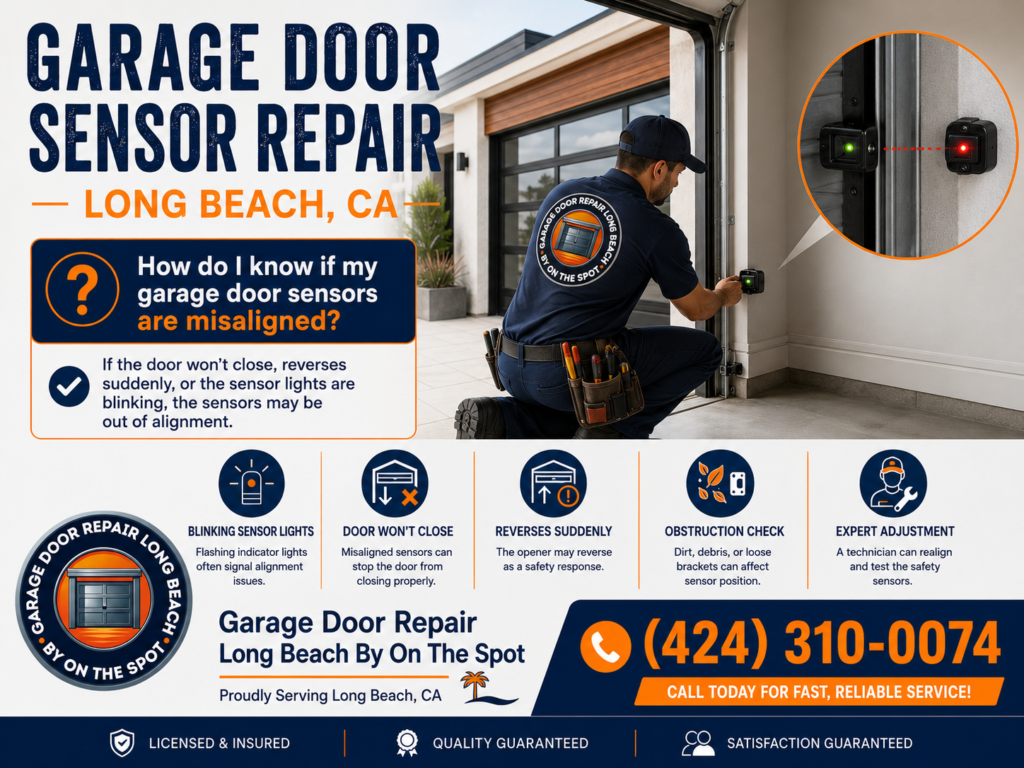
When a garage door will not close, starts to come down and then reverses, flashes the opener lights, or only closes when the wall button is held down, many homeowners immediately think the opener is broken. In many cases, the real issue is much smaller but still important: the garage door safety sensors may be misaligned, dirty, blocked, loose, affected by sunlight, or connected to damaged wiring. That is why homeowners search for garage door sensor repair Long Beach CA and ask, “How do I know if my garage door sensors are misaligned?”
Garage door sensors are designed to help stop the door from closing when something is in the doorway. They sit low on both sides of the garage door opening and send an invisible beam across the opening. If the beam is blocked, broken, or not received correctly, the opener may stop the closing cycle and reverse the door. This safety function is helpful, but it can also be frustrating when the door refuses to close even though nothing obvious is in the way.
This full guide from Garage Door Repair Long Beach By On The Spot explains the signs of misaligned garage door sensors, what sensor lights may mean, how to check for common problems, when sensor alignment may be enough, when repair or replacement may be needed, and why Long Beach homeowners should not bypass garage door safety sensors.
URL Structure
garage door sensor repair Long Beach CA: How Do I Know If My Garage Door Sensors Are Misaligned?
/garage-door-sensor-repair-long-beach-ca-how-do-i-know-if-my-garage-door-sensors-are-misaligned/
SEO Title
Garage Door Sensor Repair Long Beach CA: How Do I Know If My Garage Door Sensors Are Misaligned?
Meta Description
Need garage door sensor repair in Long Beach CA? Learn how to tell if your garage door sensors are misaligned, why the door reverses, what sensor lights mean, and when to call Garage Door Repair Long Beach By On The Spot.
Quick Answer: How Do I Know If My Garage Door Sensors Are Misaligned?
You may have misaligned garage door sensors if the garage door starts to close and then reverses, the opener lights flash, one sensor light is blinking or off, the door only closes when you hold the wall button, or the two sensor lenses are not facing each other directly. Misalignment can happen after a sensor is bumped by a trash can, bike, storage box, broom, car tire, pet item, or even vibration from repeated door use.
The most common sensor-related symptoms are simple to notice. The garage door may move down a few inches and then go back up. The opener may click but refuse to complete the closing cycle. The opener lights may flash as a warning. The sensor lights may flicker, blink, dim, or turn off. The door may close only when constant pressure is kept on the wall button. These are all signs that the safety sensor circuit needs attention.
For homeowners in Long Beach CA, Garage Door Repair Long Beach By On The Spot can inspect the garage door sensors, sensor brackets, sensor wiring, opener diagnostic signals, wall button behavior, sunlight interference, dirty lenses, and door operation before recommending alignment, repair, or replacement.
What Garage Door Safety Sensors Do
Garage door safety sensors are small devices mounted near the bottom of the garage door tracks. They are often called photo eyes, safety reversing sensors, opener sensors, or garage door eye sensors. Their job is to help detect whether something is in the path of the closing door. If the sensor beam is interrupted, the opener should stop the close cycle and reverse the door.
This is why sensor problems can make a garage door act like something is blocking it even when the doorway looks clear. The opener is not actually “seeing” the full garage opening the way a person does. It is relying on the sensor beam. If the beam is blocked, dirty, misaligned, interrupted by sunlight, or affected by wiring trouble, the opener may react as if there is an obstruction.
They Stop the Door From Closing on Obstructions
The main purpose of garage door sensors is safety. The sensors help prevent the garage door from closing on vehicles, bikes, toys, tools, pets, children, storage bins, or anything else in the door opening. The sensors are installed low because many objects that can be hit by a garage door sit near the floor.
When the door is closing and the sensor beam is broken, the opener should stop or reverse the door. If the sensors are not working correctly, the door may refuse to close. While this can be annoying, it is better than ignoring a safety system that is designed to prevent damage or injury.
They Must Face Each Other Correctly
Garage door sensors must face each other across the garage door opening. One side sends the beam, and the other side receives it. If one sensor is tilted upward, downward, inward, or outward, the receiving sensor may not detect the beam. Even a small angle change can make the opener think the door path is blocked.
The sensor brackets are usually close to the floor, which makes them easy to bump. A trash can, toolbox, bicycle wheel, garden tool, laundry basket, or vehicle tire can knock a sensor out of place. In many Long Beach garages where storage space is limited, sensor brackets are often close to daily traffic inside the garage.
Sensor Problems Can Look Like Opener Problems
A sensor issue can look like an opener issue because the opener motor may still run but the door will not close normally. The opener may start the door, reverse it, flash lights, or require the wall button to be held. Homeowners sometimes replace remotes, batteries, or opener parts before realizing the sensors were dirty, loose, or misaligned.
This is why garage door sensor repair Long Beach CA should include more than a quick look at the sensors. A proper inspection checks the sensors, wiring, wall button behavior, opener lights, opener logic, brackets, lens condition, and the door’s actual movement.
Signs Your Garage Door Sensors Are Misaligned
Misaligned garage door sensors create repeatable symptoms. The door often starts to close and then reverses. The opener lights may flash. One sensor light may blink or turn off. Sometimes the problem happens all day, and sometimes it only happens at certain times because sunlight, vibration, or intermittent wiring affects the sensor signal.
The Garage Door Starts to Close, Then Reverses
This is one of the strongest signs of a sensor issue. If the door begins moving down and then reverses back up, the opener may believe something is in the doorway. This can happen when the sensor beam is actually blocked by an object, but it can also happen when the sensors are pointed slightly away from each other.
Before assuming the opener motor is failing, look near the bottom of the door opening. Check whether anything is between the sensors. Look for small objects, leaves, spider webs, boxes, tools, or a garage door bottom seal that may be crossing the beam. If the opening is clear and the door still reverses, alignment or wiring may be the cause.
The Opener Lights Flash
Many opener systems flash the main opener lights when the door will not close because of a safety sensor issue. This flashing is a signal that the opener is trying to tell the homeowner something is wrong. It may be sensor alignment, obstruction, wiring, sunlight, or sensor failure.
Flashing lights are easy to overlook during the day, especially in a bright garage. At night, they are more obvious. If the opener lights flash after the door reverses, the safety sensor circuit should be checked before replacing the opener.
One Sensor Light Is Blinking or Off
A blinking, flickering, dim, or off sensor light can point to a misalignment or wiring issue. Many sensor systems have small LED lights on each sensor. When the sensors are correctly powered and lined up, the lights are often steady. When one sensor is not receiving the beam, its light may blink or go out.
Sensor light colors vary by manufacturer, so do not rely only on whether the light is green, yellow, amber, red, or orange. The important question is whether the light is steady and whether both sensors are facing each other clearly.
Both Sensor Lights Are Off
If both sensor lights are off, the issue may be more than simple alignment. The sensors may not be connected, the wires may be damaged, the opener may not be supplying power to the sensors, or the sensors may have failed. Both lights off can also happen after wiring damage, loose terminal connections, or a sensor installation problem.
In this situation, cleaning or gently moving the sensors may not solve the issue. A technician may need to trace wiring from the sensors back to the opener, check wire staples, inspect wire insulation, and test whether power is reaching the sensor pair.
The Door Only Closes When You Hold the Wall Button
If the garage door only closes when you hold the wall button down, the safety sensor system may not be working normally. Some opener systems allow the door to close with constant pressure from the wall control, but this should not be treated as a permanent fix. It is a warning sign that the opener does not trust the sensor signal during normal closing.
A door that only closes this way may have misaligned sensors, blocked sensors, dirty lenses, loose wires, broken wires, faulty sensors, sunlight interference, or an opener control issue. Continuing to use the door this way may leave the safety system unresolved.
The Sensor Brackets Look Bent or Loose
Sensor brackets are often made to hold the sensors low and close to the track. Because they sit near the floor, they are easy to bend, bump, or loosen. A bracket does not need to be severely damaged to cause a problem. A slight twist may be enough to move the sensor beam out of alignment.
If the sensors look crooked or one side points upward while the other points straight, the alignment should be corrected. If the bracket is bent or loose, it may need adjustment or replacement so the sensor stays aligned after the repair.
The Sensor Lenses Are Dirty or Covered
Dust, spider webs, mud, leaves, moisture, paint overspray, or garage debris can block the sensor lens. This can make the opener think something is in the way. A dirty lens can also cause intermittent issues where the door works sometimes but reverses at other times.
Cleaning the lenses with a soft cloth may help if the sensors are otherwise aligned and working. However, if the lights continue blinking or the door still reverses, the issue may involve alignment, wiring, sunlight, or sensor failure.
What Do Garage Door Sensor Lights Mean?
Garage door sensor lights are helpful, but they can be confusing. Different opener brands may use different colors and different light behavior. Some systems have a sending sensor and receiving sensor with different LED colors. Other systems use similar colors on both sides. Because of this, homeowners should focus less on memorizing one color rule and more on the behavior of the lights.
Solid Lights Usually Mean Better Alignment
On many systems, solid sensor lights are a good sign. They usually mean the sensors have power and can see each other. If both sensor lights are solid and the door closes normally, the alignment is likely good. If one light is off or flickering, the receiving sensor may not be reading the beam consistently.
Solid lights do not guarantee that every opener issue is solved, but they are an important first clue. If both lights are solid and the door still will not close, the issue may involve the opener board, wall button wiring, force setting, track binding, door balance, or another opener-related problem.
Blinking, Flickering, or Off Lights Need Troubleshooting
Blinking or flickering sensor lights often point to a sensor issue. The beam may be partially blocked. The sensors may be slightly out of alignment. The lens may be dirty. The bracket may be loose. The wiring may be damaged. The sensor may be failing.
Off lights can point to power or wiring problems. If one sensor is off, check that the sensor is connected and that its wire is not cut, pinched, chewed, corroded, or pulled loose. If both sensors are off, the issue may be at the opener terminals, wire run, or sensor set.
Sensor Light Colors Can Vary by Brand
Some homeowners ask why one garage door sensor light is green and the other is yellow or orange. In many systems, that is normal. One side may be the sending eye, while the other is the receiving eye. The colors may be different even when the sensors are working properly.
The better question is whether the lights are steady and whether the door closes normally. A steady green and steady amber light may be normal on one opener brand. A blinking green light may mean the receiving sensor is not seeing the beam. Since color meanings vary, a technician can identify the opener model and read the sensor behavior correctly.
How to Check If Garage Door Sensors Are Misaligned
Homeowners can check some basic sensor issues from a safe distance. These steps are for simple observation and light cleaning only. Do not bypass the sensors, cut wires, remove opener covers, or attempt electrical repairs if you are not trained. If the door is stuck, damaged, crooked, or unsafe, call a technician.
Step 1: Look for Anything Blocking the Beam
Start with the simplest cause. Look across the bottom of the garage door opening where the sensors face each other. Remove anything that could be breaking the beam. This may include bikes, boxes, trash cans, tools, leaves, spider webs, toys, pet bowls, storage bins, or a rolled-up extension cord.
Also check the garage door bottom seal. Sometimes a loose or curled weather seal can hang low enough to interrupt the sensor beam as the door starts to close. If the door reverses at the same point every time, look carefully for anything moving into the beam during the close cycle.
Step 2: Check the Sensor Lights
Look at both sensors and note whether the lights are solid, blinking, flickering, dim, or off. Do not stare into any light source at close range. You only need to see whether the LEDs are steady. If one sensor light changes when you gently touch the bracket, the bracket may be loose or the wire may be intermittent.
If the lights are solid and the door closes properly after removing an obstruction, the issue may have been simple blockage. If the lights are not steady, continue checking alignment, lens condition, and wires.
Step 3: Clean the Sensor Lenses
Use a soft, dry cloth to gently wipe each sensor lens. Dust, dirt, cobwebs, and moisture can affect the beam. Avoid using harsh cleaners or soaking the sensor. The goal is to clean the lens without moving the bracket out of position.
After cleaning, try closing the door again from the wall button or remote. If the door closes smoothly, dirty lenses may have been the problem. If the door still reverses, check alignment and wiring.
Step 4: Make Sure the Sensors Face Each Other
Stand safely to the side and look at both sensors. They should point directly across the garage door opening at each other. If one sensor points away, downward, or upward, the beam may not connect. A small adjustment may restore alignment.
Some brackets can be gently adjusted by hand. Others may require loosening a fastener. If the sensor or bracket is damaged, do not force it. A technician can reset the bracket, secure the sensor, and test the close cycle properly.
Step 5: Check for Loose or Damaged Wires
Sensor wires are usually thin low-voltage wires running from each sensor to the opener or to wire connections near the track. Look for visible damage, loose connections, staples through the wire, cracked insulation, corrosion, chew marks, or wires pulled away from the sensor.
If the wire looks damaged, the sensor may not receive power or signal correctly. Wiring repair is different from simple alignment. If the wire is broken, shorted, or corroded, call a garage door repair technician.
Step 6: Test the Door Safely
After checking for blockage, cleaning the lenses, and confirming the sensors face each other, test the door. Use the wall button or remote while standing clear of the door path. If the door closes normally, the issue may be resolved. If it still reverses, flashes the opener lights, or only closes while holding the wall button, the sensor system needs professional inspection.
Can Sunlight Cause Garage Door Sensor Problems?
Yes, sunlight can cause garage door sensor problems. Bright sunlight can shine directly into the receiving sensor and interfere with the infrared beam. When this happens, the opener may act as if something is blocking the door, even though the doorway is clear.
Sunlight problems are often intermittent. The door may close fine in the morning but fail in the afternoon. It may work on cloudy days but reverse on bright days. It may happen during certain seasons when the sun angle lines up with the sensor.
Why Sunlight Blocks the Receiving Sensor
The receiving sensor is trying to detect the beam from the sending sensor. When direct sunlight hits the receiving lens, it can interfere with that signal. The opener then behaves as if the beam is blocked. This can create a confusing problem because nothing appears to be physically in the way.
Long Beach Garage Orientation and Afternoon Sun
In Long Beach, many garages receive strong afternoon sunlight depending on the direction the garage faces. West-facing or south-facing garage openings may experience more direct light at certain times of day. Homes near open streets, driveways, or reflective surfaces may also have more glare around the sensor area.
If your garage door sensor problem happens only at certain times, mention that to the technician. Time-of-day clues can help identify sunlight interference faster.
When a Sun Shield or Sensor Adjustment May Help
A technician may recommend a sensor shield, sensor position adjustment, bracket correction, wiring check, or sensor replacement depending on the cause. The goal is to keep the receiving sensor from being overwhelmed by direct light while still allowing the sensors to face each other properly.
Do You Need Sensor Alignment, Repair, or Replacement?
Not every garage door sensor issue requires new sensors. Many problems are caused by simple misalignment, dirty lenses, loose brackets, blocked beams, or sunlight. Other problems involve wiring, damaged sensors, water exposure, corrosion, or opener electronics. A proper diagnosis prevents unnecessary parts and helps restore safe closing.
When Alignment May Be Enough
Sensor alignment may be enough if the sensors were bumped, the brackets are loose, one light is blinking, the lenses are pointed slightly away, and the door works again after the sensors are reset. In this case, the repair may focus on securing the brackets and confirming both sensor lights remain steady.
When Sensor Repair May Be Needed
Sensor repair may be needed when the problem involves loose wiring, damaged insulation, corroded connections, bracket damage, intermittent power, vibration, or sunlight interference. In some cases, the sensors themselves are fine, but the wiring or mounting position is causing inconsistent operation.
When Sensor Replacement May Be Better
Sensor replacement may be the better option if a sensor is cracked, water-damaged, physically broken, will not light up, fails after wiring is checked, or continues to cause close-cycle failures after proper alignment. Replacement may also be recommended when an older opener has sensor parts that are unreliable or no longer respond consistently.
When the Opener May Be the Real Problem
Sometimes the sensors are not the only issue. A garage door opener circuit board, wiring terminal, wall button wiring, or close-limit issue can mimic sensor failure. If both sensor lights are steady but the opener still will not close correctly, the opener should be diagnosed. This is why a full garage door opener sensor repair visit should include opener testing, not just sensor cleaning.
Is It Safe to Bypass Garage Door Sensors?
No, garage door safety sensors should not be permanently bypassed. They are designed to help prevent the door from closing on people, pets, vehicles, tools, bikes, boxes, and other objects. If the door only closes when holding the wall button, that is a warning sign that the safety sensor system needs repair.
Bypassing the sensors may make the door close, but it removes an important safety function. That can create risk for children, pets, vehicles, stored items, and anyone walking through the garage opening. A sensor problem should be fixed rather than ignored.
Why Bypassing Sensors Is Risky
- The door may close without detecting an obstruction.
- Children or pets may be in the door path.
- Vehicles, bikes, or stored items may be hit by the door.
- The opener may operate without a key safety function.
- The real problem may get worse over time.
- Wiring or opener issues may remain hidden.
The safer option is to have the sensors aligned, repaired, rewired, shielded from sunlight, or replaced as needed. Garage Door Repair Long Beach By On The Spot can inspect the safety sensor system and restore normal closing behavior.
How Much Does Garage Door Sensor Repair Cost in Long Beach CA?
Garage door sensor repair cost in Long Beach CA depends on the cause of the problem. A simple alignment or lens cleaning issue may be less involved than sensor replacement, wiring repair, opener diagnostics, or sunlight interference correction. The most accurate estimate comes after inspecting the sensors and opener together.
Pricing Factors
- Whether the sensors only need alignment.
- Whether the sensor brackets are bent or loose.
- Whether the sensor lenses are dirty or blocked.
- Whether the sensor wiring is damaged.
- Whether the sensors need replacement.
- Whether sunlight interference needs correction.
- Whether the opener circuit board needs diagnosis.
- Whether the wall button or remote symptoms need testing.
- Whether the repair is same-day or emergency service.
- Whether other garage door parts also need inspection.
Why Diagnosis Matters Before Replacement
Not every sensor issue needs new sensors. Dirty lenses, loose brackets, small obstructions, or minor misalignment can create the same symptoms as failed sensors. At the same time, replacing sensors may not solve the problem if the real issue is a broken wire, sunlight interference, loose opener terminal, or opener board problem.
A careful diagnosis helps avoid unnecessary replacement and helps restore safe door operation. The technician should confirm the cause, explain the repair, test the door after service, and make sure the opener closes the door normally without bypassing the safety system.
Why Choose Garage Door Repair Long Beach By On The Spot?
Garage Door Repair Long Beach By On The Spot helps Long Beach homeowners with garage door sensors that are misaligned, blinking, dirty, blocked, sun-affected, loose, damaged, or causing the garage door to reverse. Sensor repair is not only about getting the door closed. It is about restoring the safety system so the opener can operate normally.
Local Garage Door Sensor Repair in Long Beach CA
A local technician can inspect the garage environment, sensor position, bracket stability, sunlight direction, wiring condition, opener behavior, and door operation. This matters because garage door sensor problems can have different causes from one home to another.
Full Opener and Safety Sensor Inspection
A proper sensor repair visit may include checking the photo eyes, sensor lenses, sensor brackets, low-voltage wires, opener terminals, opener lights, wall button behavior, close cycle, safety reversal, remote operation, and door travel. The technician should also confirm that the door is not binding in the tracks or reversing for a non-sensor reason.
- Garage door sensor alignment
- Garage door sensor repair
- Garage door sensor replacement
- Safety reversing sensor inspection
- Sensor wiring repair
- Opener diagnostic check
- Wall button issue check
- Remote and opener testing
- Track and bracket inspection
- Garage door opener repair
- Emergency garage door repair
Clear Repair Recommendations
The goal is to identify whether the issue is alignment, wiring, sunlight, sensor failure, opener diagnostics, or another door problem. If alignment is enough, replacement should not be pushed unnecessarily. If replacement is needed, the technician should explain why the existing sensors are no longer reliable.
Garage Door Sensor Repair in Long Beach CA
Long Beach homes have many different garage setups. Some garages are older detached structures. Some have narrow storage space around the tracks. Some have west-facing or south-facing openings that receive bright sunlight. Some use older openers, while others use newer opener systems with diagnostic lights and smart features. Because of this variety, garage door sensor repair should be based on the actual symptoms and setup at the home.
Serving Long Beach Neighborhoods
Garage Door Repair Long Beach By On The Spot provides garage door sensor repair support across Long Beach and nearby communities, including:
- Belmont Shore
- Naples
- Bixby Knolls
- El Dorado Park
- Wrigley
- Alamitos Beach
- Rose Park
- Los Altos
- Downtown Long Beach
- East Long Beach
- California Heights
- Lakewood Village
- Signal Hill nearby
- Lakewood nearby
Why Long Beach Homes May Have Sensor Problems
Garage door sensors in Long Beach can be affected by coastal moisture, garage dust, storage items, sunlight, older wiring, loose brackets, and frequent daily door use. In many homes, the garage is used as a main entrance, which means the sensors and opener may cycle several times a day. More movement can increase the chance of vibration, bracket loosening, or intermittent alignment issues.
Local garages may also have limited interior space, making it easier for bikes, trash cans, tools, and storage bins to bump the sensors. A small bump may be enough to create a sensor alignment issue that stops the door from closing.
Local Search Phrases This Page Supports
This page is built around real homeowner search language, including garage door sensor repair Long Beach CA, garage door sensor alignment Long Beach, garage door safety sensor repair Long Beach CA, garage door won’t close Long Beach CA, garage door opener sensor repair Long Beach, garage door sensor replacement Long Beach CA, and garage door repair Long Beach CA.
Do Garage Door Sensor Repairs Require a Permit in Long Beach?
Basic garage door sensor alignment, sensor cleaning, or sensor replacement is usually a garage door service repair, not a structural building alteration. However, homeowners should understand the difference between a simple sensor repair and work that changes electrical wiring, building structure, framing, or major opener installation conditions.
If a garage door issue involves structural framing, major electrical changes, building alterations, or other work beyond normal garage door service, homeowners should check with the City of Long Beach or a qualified professional. The sensor repair itself may be simple, but related structural or electrical work should be handled correctly.
Related Garage Door Services in Long Beach CA
A sensor problem can be connected to other garage door or opener issues. Use related service pages to build a stronger local garage door repair content cluster.
- Garage door sensor repair Long Beach CA: For misaligned, blinking, dirty, damaged, or failing sensors.
- Garage door opener repair Long Beach CA: For opener diagnostics, close-cycle problems, and opener light flashing.
- Garage door safety sensor alignment Long Beach: For sensors that need realignment and bracket adjustment.
- Garage door sensor replacement Long Beach CA: For cracked, water-damaged, or failed photo eyes.
- Garage door track repair Long Beach CA: For doors that reverse because of track binding or uneven movement.
- Emergency garage door repair Long Beach CA: For garage doors that are stuck open, stuck closed, or unsafe to use.
Recommended Internal Links
Add these internal links if the site has matching service pages:
Recommended Blog Images and Alt Text
Use clear, realistic images that show the sensor problem and repair process. This helps users understand the issue and improves image SEO relevance.
Image 1: Misaligned Garage Door Sensors
Show two garage door sensors near the floor, with one slightly tilted out of line.
Alt text: Misaligned garage door sensors for garage door sensor repair Long Beach CA
Image 2: Blinking Garage Door Sensor Light
Show a close-up of a garage door sensor with a blinking or dim light.
Alt text: Garage door sensor light blinking in Long Beach CA
Image 3: Technician Inspecting Safety Sensors
Show a technician checking the sensor bracket and wiring near the bottom of the garage door track.
Alt text: Garage Door Repair Long Beach By On The Spot inspecting garage door safety sensors
Image 4: Garage Door Won’t Close
Show a residential garage door partially open with focus on the lower sensor area.
Alt text: Garage door will not close due to sensor misalignment Long Beach CA
FAQs About Garage Door Sensor Repair Long Beach CA
How do I know if my garage door sensors are misaligned?
Your sensors may be misaligned if the garage door starts to close and then reverses, the opener lights flash, one sensor light blinks or turns off, or the door only closes when you hold the wall button. Misalignment can also be visible if the sensors are not facing each other directly.
Why won’t my garage door close even though nothing is blocking it?
The sensors may be dirty, misaligned, blocked by a small object, affected by sunlight, disconnected, damaged, or connected to faulty wiring. The opener may think the beam is blocked even when the garage opening looks clear.
Why does my garage door only close when I hold the wall button?
This often points to a safety sensor issue. The sensors may be misaligned, blocked, disconnected, damaged, or affected by wiring problems. The safety sensor system should be inspected before normal use continues.
What do garage door sensor lights mean?
Sensor light meanings vary by brand, but solid lights usually mean the sensors are powered and aligned. Blinking, flickering, dim, or off lights may point to obstruction, misalignment, dirty lenses, wiring trouble, sunlight interference, or sensor failure.
Can sunlight affect garage door sensors?
Yes. Direct sunlight can interfere with the receiving sensor on some systems. This can make the opener act as if the sensor beam is blocked, especially at certain times of day.
Do I need new garage door sensors or just alignment?
You may only need alignment if the sensors are loose, bumped, dirty, or slightly pointed away from each other. Replacement may be needed if the sensors are cracked, water-damaged, will not light up, or keep failing after proper alignment and wiring checks.
Is it safe to bypass garage door sensors?
No. Garage door safety sensors should not be permanently bypassed. They help prevent the door from closing on people, pets, vehicles, and objects. If the door only closes by holding the wall button, the sensor system should be repaired.
Who repairs garage door sensors in Long Beach CA?
Garage Door Repair Long Beach By On The Spot helps Long Beach homeowners with garage door sensor alignment, safety sensor repair, sensor replacement, opener diagnostics, wiring checks, and garage doors that will not close properly.
Final Answer: How Do I Know If My Garage Door Sensors Are Misaligned?
You can often tell your garage door sensors are misaligned when the door starts to close and then reverses, the opener lights flash, one sensor light blinks or turns off, or the door only closes when you hold the wall button. The sensors may also look crooked, loose, dirty, or no longer pointed directly at each other.
Sensor misalignment is common because the sensors sit low near the garage floor where they can be bumped by storage items, trash cans, bikes, tools, pets, or vehicles. However, not every sensor problem is simple alignment. Dirty lenses, sunlight, loose wires, broken wires, faulty sensors, damaged brackets, or opener electronics can create similar symptoms.
If you are searching for garage door sensor repair Long Beach CA, do not permanently bypass the sensors or keep forcing the door closed. The safety sensor system should be inspected and repaired so the garage door can close safely and normally.
Garage Door Repair Long Beach By On The Spot can inspect the sensor alignment, sensor lights, sensor wiring, opener diagnostics, brackets, lenses, and door operation to determine whether your garage door needs sensor alignment, repair, or replacement.
Need Garage Door Sensor Repair in Long Beach CA?
If your garage door will not close, reverses for no reason, flashes the opener lights, or only closes when you hold the wall button, the sensors may be misaligned or failing.
Garage Door Repair Long Beach By On The Spot helps Long Beach homeowners with garage door sensor repair, sensor alignment, safety sensor replacement, opener diagnostics, wiring checks, and emergency garage door repair.
Call (424) 310-0074 to schedule garage door sensor repair in Long Beach CA and restore safe garage door closing.