
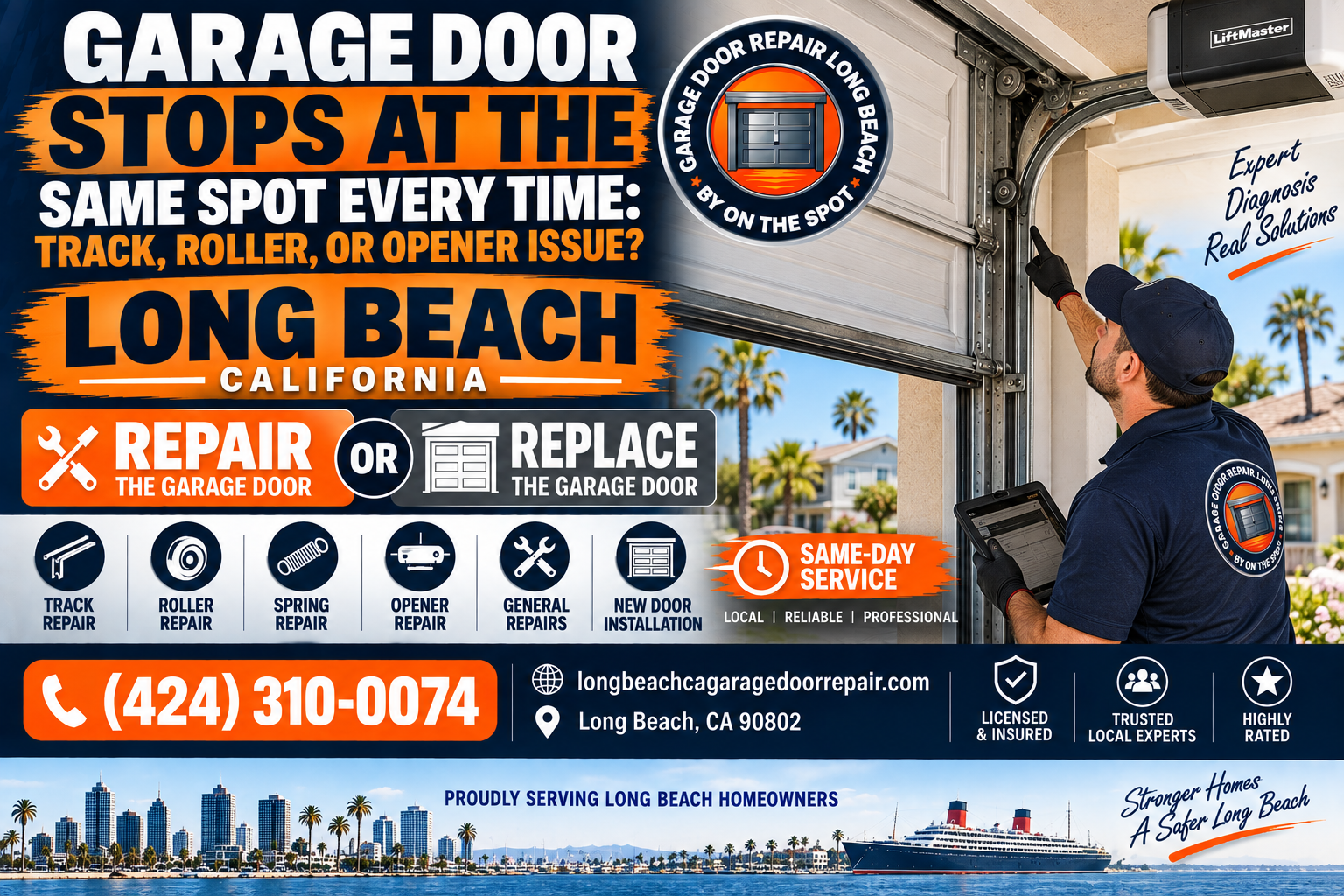
Long Beach Same-Spot Stop Diagnosis Guide
Garage Door Stops at the Same Spot Every Time: Track, Roller, or Opener Issue?
When a garage door stops at the same spot every time, the pattern itself is the clue. A dented or misaligned track, a worn or seized roller, travel-limit settings on the opener, a fixed-height obstruction, cable or drum catches, and Long Beach heat or coastal humidity on marginal clearances all create repeatable pauses—not random electronics moods.
Garage Door Repair Long Beach By On The Spot helps homeowners, renters, landlords, property managers, HOA communities, and small businesses separate track vs roller vs opener limits before anyone maxes force or hammers a live rail. Diagnosis-first repair restores free travel, then commissions limits and entrapment protection across Long Beach, CA.
Track vs Roller vs Limits
Safe Checks & Do-Nots
CPSC + DASMA + SCE
Serving Long Beach, CA
Direct Answer: Why Does a Garage Door Stop at the Same Spot Every Time?
When a garage door stops at the same spot every time—mid-travel, just before fully open, or a few inches from the floor—you are looking at a repeatable mechanical or limit-setting problem, not a random glitch. The most common Long Beach causes are a dented or misaligned track, a worn or seized roller that binds at a fixed height, travel-limit settings on the opener that tell the motor to stop early, a physical obstruction at a fixed height (shelf, hose reel, framing, debris), cable or drum issues that create a hard stop on one side, and weather-related track expansion or panel swell that only shows up in heat or coastal humidity. The key diagnostic clue is sameness: if the door always freezes at the same inch of travel, something geometric or programmed is repeating.
Track and roller problems feel mechanical—scraping, grinding, or a hard bind you can almost point to on the rail. Opener travel-limit problems feel electrical or programmed—the motor stops cleanly, sometimes with a soft click, and the door may reverse or refuse to finish travel without obvious metal-on-metal drama. Obstructions at a fixed height mimic both: the door hits the same shelf, bike handle, or warped jamb every cycle. Cable and drum issues often add a crooked or one-sided feel before the stop. Long Beach coastal humidity and summer heat amplify seized rollers, sticky nylon bushings, and aluminum or steel track that expands enough to change clearance at one height band.
Garage Door Repair Long Beach By On The Spot diagnoses same-spot stops by separating track vs roller vs opener limits vs obstruction vs cable/drum before anyone touches high-tension springs or reprograms force settings. Safe homeowner checks include looking (from outside the door path) for dents, debris, and obvious hang-ups; checking SCE outage or power-quality context if limits “forgot” after a blackout; and stopping automatic cycling if the door binds hard. Do-nots include hammering rollers back into bent track under power, cranking force limits to “push through” a bind, standing under a crooked door, and DIY cable or spring work. Call (424) 310-0074 for professional diagnosis in Long Beach, CA.
Why a Same-Spot Stop Matters More Than a One-Off Pause
A garage door that hesitates once after a windy night can be debris or a temporary bind. A garage door that stops at the same spot every time is teaching you a lesson: the system has a fixed geometric conflict or a fixed programmed stop. Ignoring that lesson while cranking force settings, yanking the emergency release, or “helping” the door by hand is how Long Beach homeowners turn a repairable track dent or roller seizure into a bent panel, jumped cable, or crushed object in the path.
Repeatability is also an EEAT signal for technicians. When a homeowner can say “it always stops about four feet up on the left track” or “it always stops two inches from the header,” dispatch and on-site diagnosis go faster. That precision protects the door. Opener motors are not designed to grind against a seized roller for fifty cycles. Travel limits are not meant to be maxed out to smash past a shelf. Photo-eyes protect the threshold, but they do not prevent mid-travel metal binds higher on the rail.
From a safety angle, same-spot stops matter because they often precede worse failures. A roller that binds at the same height can eventually jump the track. A cable that catches on a drum every cycle can fray until it snaps. A track dent that “almost” clears can become a full derailment when coastal heat expands the rail another millimeter. Treating the pattern early is cheaper and safer than waiting for a crooked hang or a slam.
Locally, Long Beach adds coastal corrosion and temperature swings that make “always the same spot” especially informative. Salt air seizes bearings; afternoon heat expands tracks; morning marine layer moisture swells wood trim near the opening. Those factors do not create random stops—they create stops that cluster at the height where clearance is already tightest.
How Normal Travel Works: Tracks, Rollers, Cables, and Opener Limits
A residential sectional garage door rides on rollers inside vertical and horizontal tracks. Lift cables wind on drums near the torsion shaft (or stretch with extension-spring systems). The opener contributes pull via the trolley and arm, but springs do most of the heavy lifting when the door is balanced. Travel-limit settings on the opener tell the logic board where “fully open” and “fully closed” should be. Force settings tell the motor how hard to push before reversing. Photo-eyes watch the threshold for entrapment. All of these layers must agree.
When everything is healthy, rollers glide, tracks stay parallel and undented, cables wind evenly, drums stay seated, and the opener stops because the door reached a programmed limit—not because metal seized. When something is unhealthy at a fixed height, one of those layers wins the argument every cycle. A dented track wins with a hard mechanical stop. A seized roller wins with grinding that always starts at the same panel joint. Mis-set travel limits win with a clean motor stop that ignores how close the door is to the floor or header. A fixed obstruction wins with a bump you can see.
Understanding that stack helps you avoid the most common misrepair: treating a track bind as an opener problem, or treating a limit problem as a spring problem. Springs that are broken usually make the door heavy everywhere, not only at one height. Same-spot stops are more often guidance, obstruction, or programming—though cable drum problems can create height-specific catches.
CPSC consumer guidance on automatic residential garage door operators emphasizes reverse and photo-eye safety for normal operation. DASMA safety tips emphasize that spring systems store dangerous energy. SCE outage tools help separate power events from mechanical binds. Together, those authorities frame a homeowner’s role: observe safely, protect people, call pros for high-tension and structural fixes, and verify operator safety after repairs—not invent force settings that hide a metal-on-metal stop.
Dented or Misaligned Track: The Classic Fixed-Height Bind
A dented track is one of the cleanest explanations for a garage door that stops at the same spot every time. Impact from a vehicle mirror, a ladder, a bike handlebar, or a prior DIY “adjustment” can crease the rail. Misalignment from loose flag brackets, shifted jamb anchors, or settlement can pinch the roller path at one elevation even when the rest of the rail looks fine. Because rollers follow a fixed path, the pinch shows up at the same inch of travel on every open and close.
Symptoms that point toward track geometry include visible creases, scrape marks at one height, paint transfer, a roller that looks cocked in the channel, and a stop that happens whether you use the wall button or the remote. Sometimes the door will reverse after the bind if force settings are sensitive; sometimes the opener stalls and clicks. Helping the door by hand at that exact height may “prove” the bind—but forcing past it risks jumping a roller out of the track.
Long Beach alley garages and tight driveway parks see track dents often. Compact clearances mean bumpers and mirrors meet rails. Coastal corrosion can also freeze adjustment bolts so that a once-correct alignment drifts and stays wrong. Heat can widen a dent’s effective interference as metal expands.
Professional repair may include reforming minor dents when safe, replacing a damaged track section, re-squaring verticals, tightening brackets to manufacturer geometry, and verifying roller clearances through full travel. Do not hammer a live track while the opener is connected and the door is under spring tension. Do not loosen every bracket “to see what happens.” Geometry is a system; random loosening creates new same-spot stops higher or lower on the rail.
Worn, Flat-Spotted, or Seized Rollers: Binding at the Same Panel Height
Rollers wear. Nylon tires flat-spot. Steel rollers rust and seize at the bearing. Stems bend. When a roller goes bad, the bad behavior often concentrates at the height where that roller transitions from vertical to horizontal track, or where a panel hinge loads that roller hardest. The result feels like a garage door that stops at the same spot every time—even when the track itself is undented.
Listen for grinding that starts at a predictable moment. Watch for a roller that skids instead of spins. Look for black dust, metal filings, or melted nylon near one hinge line. Seized rollers in Long Beach coastal humidity are common: salt air attacks bearings; infrequent use lets corrosion lock them; then the first summer heat cycle cooks residual lubricant dry.
A seized roller is not a lubrication-only problem forever. Grease can quiet a dying bearing for a week and then mask the failure until the stem snaps or the roller jumps. Technicians replace worn rollers in matched sets when wear is systemic, check hinges and stems, and confirm that tracks are still true after roller replacement. Homeowners should not spray random solvents into bearings while the door cycles under power, and should not remove rollers from a door that is still spring-loaded without understanding counterbalance risks.
How do you tell roller trouble from track dent? Track dents are usually visible creases or pinches on the rail. Roller issues often show rotating failure at the wheel even on a smooth rail. Both can coexist: a rough roller can bruise a track, and a dented track can destroy the next roller that hits it. Same-spot diagnosis should inspect both before anyone reprograms travel limits.
Opener Travel-Limit Settings: When the Motor Stops on Purpose at the Wrong Place
Modern openers store open and close travel limits in logic boards or adjuster screws, depending on age and brand. If those limits are wrong, the door will stop at the same programmed position every time—even if tracks and rollers are perfect. Classic signs include a door that stops a few inches from the floor and leaves a gap, a door that stops short of the header and blocks the car roof clearance, or a door that reverses at the same point because close limits and force settings disagree with the floor.
Limits can drift after battery backups, power outages, logic-board replacements, DIY “learning” attempts, or mechanical changes (new weatherseal thickness, new floor height, new opener rail). In Long Beach, SCE outages and restorations sometimes coincide with homeowners noticing odd limit behavior. Checking SCE’s outage center helps establish whether a power event happened—but a power event does not excuse ignoring a mechanical bind. If the door also scrapes metal, fix geometry first; do not only re-learn limits.
Safe professional commissioning sets limits on a balanced door with healthy rollers and tracks, then verifies photo-eye reverse and force sensitivity with a non-body object per CPSC-aligned operator safety expectations. Unsafe DIY patterns include maxing force to smash the door closed, setting close limits so aggressive that the door crushes the weatherseal daily, or “fixing” limits while someone stands under the door.
If your same-spot stop is silent, clean, and identical with no scrape marks, travel limits rise on the suspect list. If the stop is noisy, sparking, or accompanied by visible rail damage, limits are probably reacting to a bind—not creating it.
Obstruction at a Fixed Height: Shelves, Hoses, Framing, and Debris
Not every same-spot stop is a broken part. Garages accumulate stuff. A hose reel mounted too close to the track, a paddleboard on wall hooks, a fridge that crept an inch, a new shelf bracket, a child’s scooter handle, or a warped piece of trim can sit at a height the door meets on every cycle. Because the object does not move, the stop is perfectly repeatable—exactly the pattern that makes homeowners think “the opener is broken.”
Obstruction diagnosis is visual and boring on purpose. Stand outside the door’s travel path. Watch one full cycle with a spotter ready to hit the wall button. Look for contact points. Check both sides of the opening, the header area, and anything hanging from ceiling storage near the horizontal tracks. In Long Beach coastal homes, outdoor gear often migrates into the garage; salt-water toys and kayaks create new clearance problems overnight.
Photo-eyes only watch the bottom threshold band. They will not stop a door that hits a shelf at chest height. Force reverse may eventually trip, but relying on force reverse as a bumper against storage is how panels crease. Clear the obstruction first. If the door still stops at the same spot after the garage is truly clear, move on to track, roller, limit, and cable checks.
Property managers should treat fixed-height obstructions in shared garages as recurring ticket items: label no-storage zones near tracks, and inspect after resident move-ins. Renters should photograph the obstruction and notify landlords before anyone “adjusts the opener” to push harder.
Cable and Drum Issues That Create a Same-Spot Catch
Lift cables and drums usually announce themselves with crooked travel, fray, or sudden slack—not a polite mid-height pause. Still, certain drum and cable faults create a catch at a repeatable height: a cable riding wrong in a drum groove, a flattened cable section that snags once per revolution geometry, a drum set screw that slipped just enough to change wrap timing, or a cable that rubs a fixed bracket at the same elevation every cycle.
Warning signs include chirps or scrapes timed to drum rotation, visible fray near the bottom bracket or drum, a door that is slightly higher on one side before it stops, and black cable dust. Coastal Long Beach humidity accelerates cable corrosion; once strands rust, they snag more easily. Heat cycles stretch and relax cables, sometimes making a intermittent snag become a daily same-spot stop in late afternoon.
Cable and drum work is high-risk DIY territory. Springs and cables store and redirect dangerous energy. DASMA safety messaging exists because consumer spring and cable work causes serious injuries. If you suspect cable involvement—especially with crooked posture—stop automatic operation, keep people clear, and call professional service. Do not cut cables, clamp them with hardware-store fittings, or wind drums by hand.
Technicians will secure the door, evaluate spring balance, replace damaged cables in appropriate pairs, reseat or replace drums, and verify even travel before restoring opener automation. Same-spot cable catches that were ignored often progress to full cable failure and crooked hang—the emergency cousin of today’s “it always stops here” complaint.
Weather, Coastal Humidity, and Heat Expansion in Long Beach
Long Beach does not need Midwest freeze-thaw to create seasonal garage-door drama. Marine layer moisture, coastal salt air, and hot inland-afternoon pattern days expand metal, soften nylon, swell wood jambs, and change clearances by millimeters that matter inside a roller channel. A door that travels fine at 8 a.m. can stop at the same spot at 3 p.m. when the track has expanded into a pre-existing near-interference.
Humidity seizes roller bearings that were already marginal. Salt air corrodes stems and hinges. Heat softens old nylon rollers so flat spots form faster. Wood trim near the opening can swell enough to kiss a panel edge at one height. These are not excuses to ignore mechanical repair; they are local amplifiers that make same-spot patterns show up earlier than the same wear would inland.
Practical homeowner response: note the time of day and weather when the stop happens, keep tracks free of sand and salt crust with manufacturer-appropriate cleaning (not flood greasing), and schedule professional inspection rather than waiting for winter “when it might get better.” Coastal corrosion does not reverse itself because the calendar changed.
After storms or heavy marine fog weeks, do a visual check for debris at fixed heights and for new scrape marks on rails. If SCE power blips coincided with odd opener behavior, check outage history—then still inspect for mechanical binds before assuming limits alone are guilty.
How to Tell Track vs Roller vs Opener Limits vs Obstruction
Use this differentiation framework as a conversation guide for dispatch—not as permission to dismantle the door.
- Track dent / misalignment: Visible crease or pinch; scrape paint at one height; stop feels hard and metallic; often same whether remote or wall control.
- Worn / seized roller: Grinding or skidding sound; roller not spinning; dust or melted nylon; bind may track with a specific hinge line.
- Travel limits: Clean motor stop; little or no scrape evidence; door stops short of floor or header consistently; sometimes began after power event, opener replacement, or DIY learn mode.
- Fixed obstruction: You can see or photograph the object in the path; clearing it changes or eliminates the stop.
- Cable / drum: Timing with drum rotation; fray; slight crookedness; chirps from cable path; coastal corrosion clues.
- Weather expansion: Same geometric spot, but more frequent in heat or humidity; clearance was already marginal.
Many Long Beach doors combine two causes—for example, a slightly dented track plus a nearly seized roller, or soft limits plus a shelf that only contacts when heat expands the rail. Professional diagnosis tests the stack in order: clear path, inspect guidance hardware, verify balance, then commission limits and force on a healthy door.
If the door is crooked, heavy on one side, or shows spring gap / cable slack, abandon fine distinctions and treat the situation as a safety stop: clear the threshold, do not keep cycling, call urgent repair.
Safe Observation Checks You Can Do Without Touching High-Tension Parts
Safe checks are eyes, ears, and notes—not tools on springs.
- Clear people, pets, and cars from the door path.
- Confirm there is no obvious storage object at the stop height.
- From a safe side angle, watch one cycle and mark the approximate height of the stop on a note (not on the moving door).
- Look for track dents, scrape marks, roller dust, cable fray, and crooked posture.
- Listen for grind vs clean motor stop.
- Note whether the problem started after an SCE outage, a DIY “fix,” a parking bump, or a heat wave.
- Test the wall button once; if the bind is hard, stop. Do not repeat twenty times.
- Check that photo-eyes are aligned and unblocked at the threshold—even though they may not explain a mid-height stop, they matter for overall safety.
These observations help Garage Door Repair Long Beach By On The Spot arrive with the right parts mindset: rollers, track section, limit commissioning, cable set, or obstruction coaching. They also protect you from “helping” in ways that jump rollers or snap cables.
What Never to Do When the Door Stops at the Same Spot
- Do not max out opener force to push through a bind.
- Do not hammer rollers back into a bent track while the opener is live.
- Do not stand under the door to lift it past the sticky spot.
- Do not remove rollers or cables as a DIY experiment.
- Do not cut or clamp lift cables.
- Do not wind torsion springs or stretch extension springs.
- Do not defeat photo-eyes or tape over sensors to finish a close.
- Do not keep cycling a crooked door.
- Do not assume “it’s only the limits” when you can see metal damage.
- Do not ignore coastal corrosion clues until a cable fails completely.
CPSC-aligned operator safety expects functional reverse systems on automatic doors. DASMA-aligned spring safety expects professionals on high-tension components. Same-spot stops sit at the intersection: sometimes programming, often hardware, always worth disciplined response instead of brute force.
Symptom Comparison Table: Track, Roller, Limits, Obstruction, Cable/Drum
Use this table when describing the problem to a dispatcher. It is a triage aid, not a DIY repair chart.
| What you notice | Likely primary suspects | Immediate action | DIY? |
|---|---|---|---|
| Hard metallic stop at one height; visible track crease | Dented or pinched track; bracket shift | Stop cycling; clear path; call for track repair | No hammering under power |
| Grinding that always starts at same panel; roller not spinning | Seized or flat-spotted roller; worn stem | Limit cycles; schedule roller/hardware service | No roller removal on live spring door |
| Clean motor stop short of floor or header; little scrape evidence | Travel-limit settings; possible post-outage drift | Note SCE/power context; professional limit set after hardware check | Avoid maxing force DIY |
| Stop disappears after moving shelf/hose/bike | Fixed-height obstruction | Keep zone clear; retest once | Yes — clearing storage is fine |
| Chirp timed to drum; fray; slight crookedness before stop | Cable/drum catch; corrosion | Stop automatic use; call urgent service | No cable DIY |
| Same spot worse on hot afternoons or humid mornings | Expansion on marginal clearance; sticky rollers | Document pattern; professional geometry/roller check | No “wait it out” if binding hard |
| Door heavy everywhere, not only one height | Spring weakness/break (different problem class) | Treat as balance emergency; clear threshold | No spring DIY |
| Stops then reverses with click near same point | Force sensitivity hitting bind or wrong limits | Do not raise force blindly; diagnose bind first | No sensor defeat |
Red Flags That Mean Stop Using the Door and Call Now
Same-spot stops are often repairable without emergency drama—until they are not. Call promptly, and treat as urgent, if you see crooked hang, cable fray with strand failure, rollers outside the track, a door that fell hard after a bind, spring gap, or a door so heavy the opener strains loudly. Those signs mean guidance or counterbalance is failing, not merely pausing.
Also call urgently if anyone could be trapped by a door that stops mid-travel in a tight alley garage, if a vehicle is stuck halfway under a partially open door, or if children have been using the door as a play object during the malfunction. Clear the area, disconnect casual remote use if needed by securing remotes, and use the wall control only if a technician asks for a supervised demonstration.
For non-urgent but still important cases—clean short travel, mild scrape, obvious shelf hit—same-day scheduling still beats weeks of forcing the door. Every forced cycle can convert a dent into a derailment.
Repair vs Adjust vs Replace: Tracks, Rollers, Limits, Opener, or Cables?
Not every same-spot stop needs a new opener. Many need track correction, roller replacement, obstruction removal, or professional limit commissioning. Some need cable and drum service. A minority need opener logic repair when the board will not hold limits—but that diagnosis comes after hardware is proven healthy.
Track: reform minor damage when safe, replace sections when creased beyond safe roller travel, re-anchor brackets to restore parallel geometry.
Rollers: replace seized or flat-spotted rollers; inspect hinges and stems; consider stainless or better-sealed rollers in harsh coastal exposure when appropriate for the door design.
Limits: set open/close limits and verify force only on a balanced, free-traveling door; re-check photo-eye reverse.
Cables/drums: replace damaged cables, correct drum seating, verify even wrap; address springs if balance contributed.
Opener replacement enters the conversation when motors overheat from chronic binds, gears are already destroyed, logic will not retain settings, or the unit lacks modern entrapment features expected for safe residential use. Replacing an opener while leaving a dented track untouched simply installs a stronger motor to fight the same dent—until something worse breaks.
Long Beach Coastal Humidity, Heat, and How They Create Same-Spot Stops
Garage Door Repair Long Beach By On The Spot sees same-spot patterns cluster in coastal corridors where salt air and temperature swings stack on high cycle counts. Belmont Shore and Naples homes with ocean-near air see roller seizure sooner. Downtown and alley garages see track dents from tight parking. Bixby Knolls and Los Altos heat spikes expand marginal clearances. Shared multi-unit garages accumulate resident storage that creates fixed-height hits.
Humidity does not invent a dent, but it will seize the roller that has to pass that dent. Heat does not invent bad limits, but it will make a door that stops a half-inch short feel like a bigger gap when weatherseal softens. Local service means reading those amplifiers instead of applying a generic inland checklist.
Maintenance habits that help: keep tracks reasonably clean of sand and salt crust, avoid flooding nylon rollers with heavy grease that traps grit, maintain clear zones along vertical tracks, and schedule inspection when a same-spot pause first appears—not after the third weekend of forcing it.
Same-Day Help When the Door Always Stops Mid-Travel in Long Beach
When you cannot park, cannot secure the home, or risk derailment by another forced cycle, same-day service matters. Call (424) 310-0074 with your best description: exact height of the stop, scrape vs clean motor stop, heat/humidity pattern, any recent bump or outage, and whether the door is level. That information helps the technician arrive ready to inspect tracks, rollers, limits, and cables efficiently.
From 151 E 5th St, Long Beach, CA 90802, Garage Door Repair Long Beach By On The Spot serves Long Beach neighborhoods and nearby communities with diagnosis-first repair. We would rather find a shelf bracket than sell you an opener—and we would rather replace rollers than let a seized bearing jump a track on a school-morning rush.
Questions to Ask Before Hiring Help for a Same-Spot Stop
- Will you inspect tracks and rollers before changing force or travel limits?
- Do you repair or replace dented track sections when needed?
- How do you handle seized rollers in coastal corrosion conditions?
- Will cable and drum condition be checked if travel is uneven?
- How will photo-eye reverse be verified after adjustments?
- What warranty covers parts and workmanship on the repair?
- Can you document findings for a landlord or HOA?
Good answers sound like a sequence: path clear, guidance true, balance confirmed, limits commissioned, safety tested. Vague answers that jump straight to “we’ll turn up the force” are a hiring red flag.
Hiring Red Flags for Same-Spot Garage Door Repairs
Be cautious of any pitch that skips inspection and goes straight to opener replacement, any technician who maxes force settings in the first five minutes, anyone willing to cut cables in your driveway without securing the door, and quotes that refuse to explain whether the stop is track, roller, limit, or obstruction related. Also be wary of “lifetime guarantees” that vanish when you ask what is excluded, and of pressure to approve spring replacement when your symptom is a clean mid-height stop with healthy balance.
Ask for findings in plain language. A trustworthy visit names the geometric or programmed cause, shows you the dent or seized roller when safe to view, and explains why limits are adjusted only after free travel is restored. For rentals and HOAs, request photos before and after.
Why Consider Garage Door Repair Long Beach By On The Spot?
Same-spot stop calls reward diagnosis discipline. Garage Door Repair Long Beach By On The Spot builds the visit around separating track geometry, roller condition, opener travel limits, fixed obstructions, and cable/drum catches before anyone treats the opener like a bulldozer. We work on residential sectional doors across Long Beach with coastal corrosion and heat-expansion patterns in mind, and we commission limits and entrapment protection only after the door travels freely.
Local familiarity matters: alley clearances, marine-layer mornings, SCE outage confusion, and storage creep in shared garages show up weekly. We explain findings to homeowners, renters, landlords, and property managers so the repair matches the actual fault—not the loudest guess. Call (424) 310-0074 or visit longbeachcagaragedoorrepair.com.
Areas Served From the Long Beach Location
From 151 E 5th St, Long Beach, CA 90802, Garage Door Repair Long Beach By On The Spot helps households and properties across Long Beach neighborhoods and nearby communities with same-spot stops, track and roller binds, travel-limit commissioning, cable concerns, and related garage door repair. Service context commonly includes Belmont Shore, Belmont Heights, Naples, Alamitos Beach, Downtown Long Beach, Bixby Knolls, Los Altos, Lakewood-adjacent edges, Signal Hill-adjacent corridors, and other local areas where coastal air, heat, and tight parking stress tracks and rollers.
Property managers and HOA communities with shared garages should treat a repeating mid-travel stop as a building maintenance ticket before someone raises force settings or wedges storage against the rails. Renters should notify landlords quickly with height notes and photos. Small businesses using roll-up or sectional doors for bay access should not ignore a fixed-height bind during delivery hours—derailments cost more than a prompt inspection.
Google Map Location
Garage Door Repair Long Beach By On The Spot is listed at 151 E 5th St, Long Beach, CA 90802. Call (424) 310-0074 or open the Google Maps CID listing for directions.
FAQs About Garage Doors That Stop at the Same Spot Every Time
Why does my garage door stop at the same spot every time?
Repeatable stops usually mean a fixed cause: dented or misaligned track, worn or seized roller, opener travel-limit settings, a physical obstruction at that height, cable/drum catch, or weather-related expansion on a marginal clearance. Same spot equals same geometry or same program—not random electronics mood.
How can I tell if it is the track or the opener limits?
Track problems often scrape, show visible dents, and feel like a hard mechanical bind. Limit problems often stop cleanly with little metal noise and leave the door short of the floor or header. When unsure, have a technician inspect hardware before rewriting limits.
Can a bad roller cause a stop at only one height?
Yes. A seized or flat-spotted roller can bind at the height where load or the vertical-to-horizontal transition stresses that roller, creating a very repeatable pause or stop.
Should I increase the opener force to push past the spot?
No. Raising force to smash through a bind risks bent panels, jumped rollers, cable damage, and defeat of safety margins. Fix the bind or correct limits properly instead.
Could storage in the garage be the whole problem?
Absolutely. Shelves, hose reels, bikes, and ceiling hangings at a fixed height create perfect same-spot stops. Clear the path and retest once before assuming the opener failed.
Do Long Beach humidity and heat make this worse?
They often amplify it. Coastal humidity seizes rollers; heat expands tracks and can turn a near-miss clearance into a daily bind at the same elevation.
The door started stopping short after a power outage. Is that limits?
Possibly. Check SCE outage context, then have limits professionally verified—after confirming tracks and rollers are free. Do not ignore scrape marks just because an outage happened.
Is cable work something I can DIY if it stops mid-travel?
No. Cable and spring systems store dangerous energy. If fray, crooked travel, or drum issues are suspected, call trained technicians. Follow DASMA-aligned safety expectations: leave high-tension work to pros.
Will photo-eyes fix a mid-height stop?
Photo-eyes protect the threshold band for entrapment. They generally will not detect a shelf hit at chest height. They still must work correctly after any repair, per CPSC-aligned operator safety themes.
When is a same-spot stop an emergency?
Treat it as urgent if the door is crooked, cables are fraying, rollers left the track, the door fell hard, or the opener is straining against a severe bind. Clear people and call for service.
Can you service rental and HOA garages in Long Beach?
Yes. Documented findings help landlords and managers. Shared garages benefit from clear no-storage zones near tracks and prompt hardware repair before residents keep forcing doors.
Who should I call in Long Beach?
Garage Door Repair Long Beach By On The Spot at 151 E 5th St, Long Beach, CA 90802, (424) 310-0074.
Call for Help If Your Garage Door Stops at the Same Spot in Long Beach
If your garage door stops at the same spot every time—whether from track damage, seized rollers, travel limits, a fixed obstruction, or cable/drum catch—stop forcing it and get a diagnosis-first repair. Clear people from the path, note the height and sounds, and call for professional service.
Garage Door Repair Long Beach By On The Spot
151 E 5th St, Long Beach, CA 90802
(424) 310-0074
longbeachcagaragedoorrepair.com
Google Maps
Maintenance Habits That Reduce Surprise Same-Spot Binds
Monthly visual checks beat yearly panic. Walk the exterior path of the door (while it is closed and safe) and look for track dents, loose brackets, roller dust, and storage creep. Quarterly, watch one open/close cycle from a safe angle and listen for new grind points. After any parking bump against a rail, inspect immediately. After heat waves or heavy marine fog weeks, re-check marginal clearances you already knew about.
Keep a clear zone along vertical tracks—no hose reels, no shelf brackets in the roller envelope. Avoid flooding nylon rollers with thick grease that traps beach sand. If you notice a soft pause becoming a hard stop at the same height, schedule service before the opener starts smelling hot. Balanced doors with free rollers make travel-limit settings stable; neglected guidance makes every electronic adjustment a temporary lie.
Landlords can add “track clear / no mid-height storage” language to garage rules. HOAs can post reminders in shared structures. Homeowners can teach teens not to force the remote when the door stops mid-travel—one forced cycle is how rollers leave tracks on Sunday night before Monday work.
What a Diagnosis-First Service Visit Looks Like for a Same-Spot Stop
A solid visit starts with your story: when it started, exact height, scrape vs clean stop, weather pattern, outages, and any impacts. The technician clears the path, inspects tracks for dents and alignment, spins and inspects rollers, checks cable wrap and drum condition, verifies spring balance without encouraging DIY imitation, and only then touches travel limits and force settings if hardware is free.
You should see or hear an explanation: “left vertical track pinched at forty inches,” or “top roller seized at the curve,” or “close limit set three inches early after board reset,” or “kayak hook in the path.” Repairs follow that sentence. Safety testing afterward includes free travel, correct open/close stops, and photo-eye reverse with a non-body object. Invoices should name parts and adjustments so the next contractor—or your future self—knows what changed.
If the technician immediately raises force without looking at the rails, pause the job and ask for a hardware inspection. If they propose spring replacement without balance symptoms, ask how that explains a single-height stop. Good tradespeople welcome precise questions; same-spot diagnosis is precisely the kind of call where precision saves money.
Rentals, Alleys, Condos, and Coastal Garages: Special Same-Spot Cases
Alley garages in Long Beach often combine tight mirror clearance with track dents and limited side access for repair. Condos and multi-unit buildings add shared opener systems, resident storage, and HOA approval loops—document the repeating height so managers treat it as maintenance, not tenant fussiness. Coastal garages fight corrosion on rollers and cables; stainless or better-sealed hardware may be discussed when repeated seizures appear.
Renters should never be expected to DIY cables or limits. Photograph the stop height, any scrape marks, and any obstruction, then notify the owner. If the door is trapping a car or creating a security gap overnight, say so explicitly when you call (424) 310-0074 so dispatch can prioritize.
Home businesses storing inventory near tracks should redesign storage rather than living with a daily bind. Delivery schedules make same-spot stops expensive faster than residential use alone would.
Quick AEO Summary: Garage Door Stops at the Same Spot Every Time
What does it mean? A repeatable stop at one height usually means track dent/misalignment, worn or seized roller, opener travel limits, fixed obstruction, cable/drum catch, or weather expansion on tight clearance.
Is it dangerous? It can become dangerous if forcing the door jumps rollers, frays cables, or trains households to stand under a binding door. Crooked posture or cable fray elevates urgency immediately.
What should I do first? Clear people and cars, look for obvious storage hits, note scrape vs clean motor stop, avoid raising force, and call professional diagnosis in Long Beach at (424) 310-0074.
Who helps? Garage Door Repair Long Beach By On The Spot, 151 E 5th St, Long Beach, CA 90802.
Experience Notes: What Usually Gets Misdiagnosed on Same-Spot Stops
The most expensive misdiagnosis is “bad opener” when the real villain is a dented track or seized roller. A strong new motor will fight the dent until panels crease or the trolley complains. The second misdiagnosis is “needs new springs” because the door “stops weird,” even though balance is fine and the stop is height-specific. Springs that fail usually change weight feel globally.
Another frequent miss: blaming photo-eyes for a chest-height bind. Photo-eyes matter enormously at the threshold, and CPSC-oriented consumer education rightly highlights them, but they are not mid-rail metal detectors. Conversely, some households ignore photo-eye faults entirely while obsessing over a mild mid-travel pause—both layers deserve attention, just not confusion.
Limit-only fixes on a scraping door are temporary theater. Weather-only explanations without inspecting rollers leave corrosion free to seize bearings. Obstruction-only clearing without noticing the crease left by last month’s bike hit invites the stop to return. The durable approach stacks causes: clear, inspect, repair guidance, then program.
On The Spot technicians in Long Beach also see DIY “track widening” with pliers that creates a new pinch an inch away—same-spot stops that simply move. Geometry wants measured correction, not improvisation.
Step-by-Step Decision Path: Observe, Clear, Call, Repair Guidance, Then Limits
- Observe one cycle from a safe position; mark the stop height in notes.
- Clear fixed storage and debris; retest once.
- If scrape, dent, grind, crookedness, or fray exists, stop forcing and call repair.
- If the stop is clean and short of floor/header after a power event, still call for professional limit commissioning—mention SCE context.
- Allow hardware inspection before any force increases.
- Approve track/roller/cable repairs as indicated.
- Have limits and reverse safety verified on the free-traveling door.
- Keep maintenance habits that protect coastal hardware.
This path keeps electronic adjustments in their proper place: after physics cooperates. It also keeps high-tension components in professional hands, aligned with DASMA safety culture.
Practical Scenarios: How Long Beach Homeowners Meet Same-Spot Problems
Scenario A — Mirror kiss in an alley: A side mirror taps the left vertical track. Weeks later the door always stops about shoulder height with a scrape. Cause: dented track. Fix: professional track repair/replacement and roller check—not a new opener.
Scenario B — Kayak hook: New wall hooks for coastal gear sit in the roller envelope. The door stops at the same spot until the kayak is moved. Cause: obstruction. Fix: relocate storage; verify no latent track bruise.
Scenario C — Post-outage short close: After an SCE outage night, the door stops three inches above the floor with a quiet motor halt. Tracks look fine. Cause: travel limits. Fix: professional limit set and safety reverse test.
Scenario D — Summer afternoon bind: Fine in the morning, sticky at 3 p.m. at the curve to horizontal. Cause: heat expansion plus nearly seized roller. Fix: roller replacement and clearance verification.
Scenario E — Chirping drum height: Soft stop plus cable chirp and slight high-on-one-side posture. Cause: cable/drum catch with corrosion. Fix: stop use; professional cable/drum service; inspect springs.
Scenario F — Force maxed by prior tech: Previous visit “fixed” a bind by raising force. Now panels show stress marks and the stop is harsher. Cause: hidden track/roller fault plus unsafe force. Fix: correct hardware, then re-commission force to safe values.
Opener Travel Limits and Force Settings: Deep Dive Without DIY Temptation
Travel limits define the intended end points of motion. Force settings define how hard the motor may push before it assumes an obstruction and reverses or stops. On a healthy door, limits land the door fully open and fully closed with weatherseal compressed appropriately, and force is sensitive enough to reverse on a reasonable obstruction test without being so weak that normal weatherseal friction falsely trips reverse.
When a same-spot stop is actually a limit problem, the motor is obeying instructions. Rewriting those instructions on a scraping door teaches the opener to ignore danger. That is why diagnosis order matters. CPSC FAQ themes around automatic operators exist to protect people from entrapment; they assume a door that can travel and reverse properly—not a door fighting a bent rail.
Some openers use screw adjusters; others use button-led learn modes. Regardless of interface, commissioning belongs after balance and free travel checks. If a logic board will not retain limits, replacement may be warranted—but prove retention failure after hardware is clear. Battery backup transitions and brownouts can confuse households into thinking limits “broke” when a mechanical bind started the same week; SCE outage history helps timeline the story without becoming the whole story.
Never ask a child to stand under a door during limit setting. Never use a body part as an obstruction test. Use an appropriate non-body object for reverse verification as technicians do in professional commissioning.
Track Geometry Deep Dive: Parallel Rails, Flag Brackets, and Pinch Points
Vertical tracks must be plumb enough and spaced correctly for roller stems and door width. Flag brackets and jamb brackets hold that geometry. A single loose fastener can let a rail creep inward until rollers bind at one elevation—often near a panel joint or near the curve. Horizontal tracks need proper back-hang support so they do not sag into the door’s path at the same “spot” every time the top section arrives.
Pinch points also appear where vertical meets horizontal: the transition curve is unforgiving of roller wear and slight mis-spacing. Long Beach heat can expand a rail that was already a millimeter tight. Salt crust can effectively thicken interference. Professional correction uses measurement and manufacturer geometry—not a random bend with channel locks.
After any track work, rollers should be inspected because they may have been damaged by the pinch. Limits should be confirmed because travel feel changes when friction disappears. Homeowners should expect a short post-repair cycle test and a clear explanation of what was bent, moved, or replaced.
Roller and Hinge Deep Dive: Seizure Stages and Coastal Wear
Rollers fail in stages. First comes noise: a periodic tick or grind at the same travel moment. Next comes visible skidding— the tire no longer rotates freely. Then comes heat and dust: nylon powders, steel squeals, stems discolor. Finally comes structural failure: bent stems, cracked hinges, or rollers that climb out of the track when they hit the familiar bind height. Same-spot symptoms often live in the middle stages, which is exactly when replacement is still straightforward.
Coastal Long Beach accelerates the early stages. Salt air attacks bearings. Infrequent use during travel weeks lets corrosion set. Then a heat wave cooks residual lubricant. Households hear a new sound at the same spot for days and hope it self-heals. It will not. Grease may quiet the symptom briefly while grit packs into the bearing.
Hinges share the load. A hinge that is cracked or missing fasteners shifts roller alignment and can create a height-specific rock. Technicians inspect hinge lines when rollers seize repeatedly at one panel. Replacing only the loudest roller on a door with five tired rollers can be a temporary economy that returns you to the same spot next month; matched replacement is often the wiser coastal strategy when wear is systemic.
Do not remove rollers from a door under spring tension without professional methods. The door’s balance and the remaining rollers’ load change when one is pulled. That is a technician task.
Cable and Drum Deep Dive: Repeatable Catches Before Catastrophic Snap
Before a cable snaps, it often telegraphs. Strands porcupine outward. Dust collects on the drum. The door rides a little high on one side at a familiar height. A chirp repeats every cycle as a damaged section passes a fixed point. That repetition is your same-spot warning dressed in cable clothing.
Drum groove problems create similar timing. If a cable climbs a flange or seats wrong after a prior shock, it may catch once per wrap geometry. Homeowners sometimes describe it as “the door always stutters right there.” If posture is even slightly crooked, treat it as urgent. Crooked plus catch is how bottom brackets tear and panels rack.
DASMA safety culture is unambiguous about high-tension systems: springs and related hardware are not casual DIY. Cables connect that energy path to the door. Cutting, clamping, or “shortening” cables in a driveway is how serious injuries happen. Professional service secures the door, replaces cables appropriately, reseats drums, and verifies balance before reconnecting automation.
Coastal corrosion means cables may look dusty-brown before they fail. If you see fray, stop cycling. A same-spot cable catch ignored for convenience becomes the slam/drop emergency covered in other guides.
Family and Workplace Safety Routines While Waiting for Repair
Until the door travels freely again, treat remotes as controlled tools—not toys. Tell kids and teens not to “help” by lifting under a binding door. Park outside if needed rather than inching a car under a door that stops mid-travel. If the door stops partially open overnight, discuss security with your household and consider professional priority scheduling.
For home workplaces, post a simple note near the wall control: height of stop, do not force, call status. Shared garages should alert neighbors if a door could block an alley. Keep pets away from the threshold during any test cycle.
If you must leave the door closed for security and it will not open past the spot, do not yank the emergency release without understanding balance. A release on a poorly balanced or cable-compromised door can drop or become immovable. When in doubt, wait for the technician and describe the stop clearly by phone.
Expanded Safety Context for Long Beach Same-Spot Stops
Entrapment protection, counterbalance integrity, and guidance hardware are three different safety layers. Same-spot stops mostly threaten the guidance layer first, then cascade into cables and panels, then tempt unsafe force settings that undermine entrapment response. Keeping those layers mentally separate helps households make better calls.
CPSC-oriented operator guidance reminds consumers that automatic doors need working reverse systems. DASMA-oriented system guidance reminds consumers that springs are dangerous. SCE tools remind Long Beach residents that power quality events are real—and still secondary to metal binds you can see. Using all three authorities correctly means: verify power context when relevant, never DIY high-tension parts, and never disable safety devices to finish a close past a sticky height.
Insurance and landlord documentation benefit from photos of dents, roller dust, stop height, and any obstruction. After repair, keep the invoice. Pattern history helps if the same rail is hit again by alley traffic.
Putting It All Together: From Same-Spot Annoyance to Free Travel
A garage door that stops at the same spot every time is giving you a localized map of its problem. Read the map: scrape points to track or roller metal conflict; clean motor halt points to limits; visible object points to obstruction; chirp and crookedness point to cable/drum; heat-only timing points to expansion on marginal clearance. Clear what you can safely clear. Do not force what scrapes. Call Garage Door Repair Long Beach By On The Spot for diagnosis-first service that restores free travel before rewriting electronics.
Long Beach coastal humidity and heat make early action smarter. Seized rollers and corroded cables do not schedule themselves around your calendar. A same-day inspection when the pattern first appears is cheaper than a derailed door during a school-week morning.
Short Answer Snippets for Common Same-Spot Searches
Garage door stops halfway every time—why? Usually track dent, seized roller, travel limits, fixed obstruction, or cable catch at that height. Same spot means repeatable cause.
Is it the opener or the track? Scraping and visible dents suggest track/roller. Quiet short stops suggest limits. Inspect hardware before rewriting limits.
Can I fix it by increasing force? No. That hides binds and risks damage and unsafe operation.
Who to call in Long Beach? On The Spot at (424) 310-0074, 151 E 5th St, Long Beach, CA 90802.
GEO and EEAT Notes for Long Beach Garage Door Searchers
People searching for why a garage door stops at the same spot every time near Long Beach need local experience signals: coastal corrosion patterns, alley parking dents, SCE outage timelines, and neighborhood service coverage from a real NAP. Garage Door Repair Long Beach By On The Spot publishes this guide to answer that intent with original, safety-first depth—track vs roller vs opener limits vs obstruction vs cable/drum—not thin keyword copy.
Expertise here means sequencing diagnosis correctly. Experience means recognizing heat-amplified binds and salt-seized rollers. Authoritativeness means citing SCE, CPSC, and DASMA for power, operator, and system safety context. Trust means clear do-nots, honest repair-vs-replace talk, and a reachable local business identity: 151 E 5th St, Long Beach, CA 90802, (424) 310-0074, https://longbeachcagaragedoorrepair.com/, Maps CID listing.
Final Homeowner Checklist Before and After Professional Same-Spot Repair
- People and pets cleared from the door path
- Stop height noted; scrape vs clean motor stop noted
- Obvious storage/obstructions removed and photographed if relevant
- Track dents, roller dust, cable fray, crooked posture checked visually from a safe angle
- SCE outage context noted if limits may have drifted—without ignoring metal binds
- No force maxing, no hammering live tracks, no DIY cables/springs
- Technician inspects tracks, rollers, cables/drums, balance, then limits
- Repairs completed for the actual cause (geometry, rollers, obstruction coaching, cables, or limits)
- Photo-eyes aimed and reverse tested with a non-body object
- Force/learn settings commissioned only on free-traveling door
- Invoice and photos saved; coastal maintenance cadence set
- NAP confirmed: Garage Door Repair Long Beach By On The Spot | 151 E 5th St, Long Beach, CA 90802 | (424) 310-0074
Use this checklist when the door’s stubborn sameness is frustrating. A repeating stop is information. Treated calmly, it becomes a clean repair instead of a bent panel, jumped roller, or unsafe force setting. For help in Long Beach, call (424) 310-0074.