
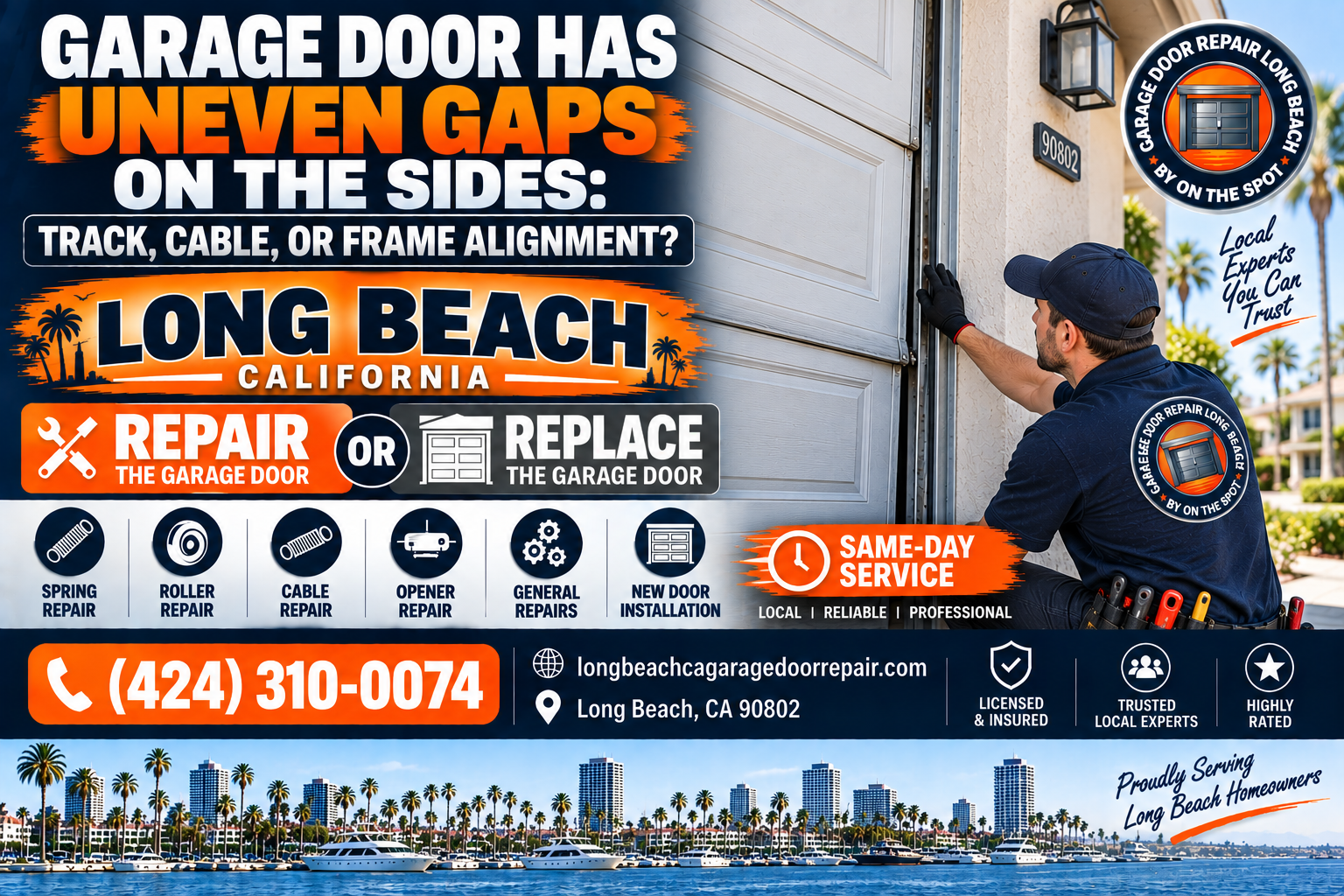
Long Beach Uneven Side-Gap Garage Door Guide
Garage Door Has Uneven Gaps on the Sides: Track, Cable, or Frame Alignment?
When a garage door shows uneven gaps on the sides—more light or space along one jamb than the other, or a gap that changes from top to bottom—the usual drivers are track misalignment, cable stretch or failure on one side, drum issues, roller wear, or building and frame settlement that shifts the opening itself.
Garage Door Repair Long Beach By On The Spot helps homeowners, renters, landlords, property managers, HOA communities, and small businesses tell track problems from cable and frame problems before anyone forces the opener or attempts DIY spring and cable work. Diagnosis-first service protects people, vehicles, and property across Long Beach, CA.
Track · Cable · Frame
Drum · Roller Wear
CPSC + DASMA + SCE
Serving Long Beach, CA
Direct Answer: Are Uneven Gaps on the Sides a Track, Cable, or Frame Problem?
When a garage door has uneven gaps on the sides, the right first question is not which part to buy—it is which family of problems you are seeing. Track misalignment usually means the vertical or horizontal rails no longer sit plumb, parallel, and equally spaced from the door edges, so one side shows a wider reveal against the jamb while rollers bind or scrape. Cable stretch, fray, or break on one side—often paired with drum problems—tilts the door so one edge rides higher or lower, changing side gaps as the curtain racks. Building or frame settlement moves the opening itself: jambs twist, headers sag, and the door can still be “square to itself” while looking wrong against warped trim. Roller wear and loose brackets amplify any of the above by letting the door wander in the track.
A useful homeowner filter: if the door is level left-to-right at the bottom but one side still shows a fat gap along the vertical jamb, lean toward track spacing, roller float, or frame/jamb shift. If one entire side of the door sits higher than the other, lean toward cable, drum, or spring asymmetry before you touch track bolts. If gaps change after an earthquake, excavation, foundation work, or years of coastal moisture cycling in Long Beach, include frame and opening geometry in the diagnosis—not only “adjust the tracks.”
Safe observation beats DIY cable and spring work every time. High-tension torsion springs and lift cables store energy that can cause serious injury. You can photograph gaps with the door closed, note whether daylight is uniform, listen for scraping, and stop using the door if it binds, jumps, or sits visibly crooked. Professional diagnosis then separates track, cable/drum, roller, and frame causes—often more than one at once in salt-air Long Beach garages—and restores safe travel without defeating photo eyes or raising opener force to smash through a bind.
If you only remember one line: uneven side gaps are a geometry and balance problem—measure the reveal, compare left and right height, treat cables and springs as technician-only, and do not force a crooked door with the opener.
What Uneven Side Gaps Mean on a Sectional Garage Door
A sectional garage door travels between two vertical tracks that must stay parallel and correctly spaced so rollers stay centered in the channel. Weather seals and jamb trim create a visual “reveal”—the gap you see between door edge and frame. When that reveal is even and modest, the door looks finished and seals well enough for coastal dust, pests, and wind-driven rain. When one side opens into a wide strip of light while the other nearly kisses the trim—or when the gap is tight at the top and wide at the bottom on the same jamb—you are looking at uneven side gaps.
Those gaps are not only cosmetic. A door that is racked loads one cable more than the other, steals roller life on the tight side, and teaches the opener to fight a bind. Photo-eye alignment can look fine while the curtain still scrapes a jamb. Bottom seals may seal on one corner and leave a triangular daylight triangle on the other. In Long Beach, salt and UV already stress hardware; adding side-gap geometry problems accelerates frayed cables, flattened rollers, and bent track brackets.
Homeowners describe the same geometry with different words: door looks crooked, light on one side, gap at the hinge side, door rubbing the frame, door won’t seal on the left, or tracks look bent. Mapping those phrases to track versus cable versus frame keeps the repair plan honest. Track work without fixing a stretched cable leaves the door tilted again within cycles. Cable work without correcting kicked-out track leaves rollers chewing the rail. Frame settlement without acknowledging the opening has moved leads to endless “adjustments” that never look right.
For answer-engine clarity: uneven gaps on the sides means the left and right reveals between door and jamb are unequal or inconsistent top-to-bottom. That symptom set points to track alignment, one-sided cable or drum issues, roller wear, and/or building frame movement—diagnosed with eyes and measurements before tools touch high-tension parts.
Track Misalignment: When Rails Create Uneven Side Gaps
Vertical tracks should be plumb, parallel to each other, and spaced so rollers sit without crushing seals or floating with excess play. Horizontal tracks need consistent pitch and secure hanging so the door does not drift sideways as it enters the curve. When a bracket loosens, a lag bolt pulls from a soft jamb, someone bumps a track with a vehicle, or a prior DIY “tighten” session over-torques one side, the rail can kick in or out. The door edge then shows a fat gap on the wide side and rubs trim on the narrow side.
Classic track-driven clues: scraping sounds localized to one rail; paint wear on the door edge; rollers that look pinched or, conversely, nearly falling out of a flared track; brackets with elongated holes showing past movement; and gaps that stay relatively consistent whether the door is fully closed or cracked open a few inches—because the rail geometry, not lift height, is wrong. Flag hinges and end stiles may look fine while the track throat is simply in the wrong place.
Long Beach coastal conditions matter here. Moisture and salt corrode track brackets and fasteners. Soft or previously patched wood jambs let lag screws creep. Thermal cycling expands and contracts metal rails. A track that was “close enough” after installation can wander over years until the side gap becomes obvious. Technicians re-establish plumb and spacing with proper shims and fasteners rather than bending track by hand into a temporary compromise.
Track correction often pairs with roller inspection. Forcing a door through a kicked track flattens nylon rollers or scores steel rollers, which then amplify wobble and recreate uneven reveals. On The Spot checks track geometry, bracket security, flag hinge condition, and roller fit as one system—because uneven side gaps from track misalignment are rarely a single bent stick of steel in isolation.
Do not loosen every track bolt and “eyeball” a fix while the door hangs on cables and springs. Unsupported track work can drop a door or release stored energy unpredictably. Safe process uses proper support, incremental adjustment, and verification that cables remain correctly wound on drums before anyone cycles the opener.
Cable Stretch, Fray, or Break on One Side: The Tilt That Changes Side Gaps
Lift cables (and the drums they wind on) keep both sides of the door rising and falling together. If one cable stretches, slips off a drum, frays, or breaks, that side of the door drops or lags. The curtain racks into a parallelogram: one bottom corner sits low, the opposite high, and the vertical reveals against the jambs become uneven—often dramatically so. Homeowners may first notice a triangular gap under the bottom seal or a door that “opens from one side.”
Cable-driven uneven gaps usually come with height asymmetry. Measure or sight the bottom corners: if one side is clearly higher, treat cable/drum/spring balance as primary suspects before major track rebuilds. Frayed cable strands, a cable sitting incorrectly in a drum groove, a drum that has walked on the torsion tube, or a broken spring that unloaded one side all belong in this family. Salt air in Long Beach accelerates cable corrosion; sandy grit from alley and beach environments adds abrasion.
Safety hard line: garage door cables and torsion springs are not DIY projects for homeowners. Sudden cable failure can slam a door; spring energy can cause catastrophic injury. If you see a broken cable, a door sitting crooked, or a cable off the drum, stop using the opener, keep people and pets clear, and call for professional service. Do not try to “rewound it a little” with pliers while the spring is still under tension.
Repair typically means matching cable type and length, verifying drum integrity, resetting cable turns with correct spring tension procedure, checking the opposite cable for twin wear, and confirming the door sits level before track fine-tuning. Skipping the twin-cable inspection is how one-sided failures become repeat visits. After cable service, side gaps should equalize if the opening and tracks are still true—if not, diagnosis continues into frame and track geometry.
Cable issues also masquerade as opener problems. An opener that strains, reverses, or seems to lift one side first may be fighting a cable that already failed to keep the door square. Raising force settings to compensate is unsafe and fails CPSC-oriented operator safety expectations. Fix the lift system; do not bully the door through a tilt.
Drum Issues: How Cable Drums Create Uneven Side Gaps
Cable drums—usually mounted on the torsion tube—meter cable as the door rises and lowers. A cracked drum, a drum that slipped on the tube, grooves worn egg-shaped, or a set screw that no longer holds can let one side of the door lose lift height relative to the other. The visual result is the same family of uneven side gaps and racked travel that homeowners blame on “the tracks,” even when the rails are still fairly true.
Clues that drums deserve attention: cable nesting incorrectly in grooves, visible drum cracks, set screws with witness marks showing rotation, aluminum powder or metal dust near the drum, and a door that was level last month but suddenly sits a half-panel low on one side after a loud pop or grinding noise. Drums and cables are a matched subsystem; replacing a cable onto a damaged drum invites rapid re-failure.
In Long Beach, corrosion and vibration from daily cycles plus marine air can loosen set screws and pit drum surfaces. Older drums on high-cycle doors simply wear out. Professional service replaces damaged drums in pairs when wear is shared, resets cable winding with proper spring procedure, and verifies left-right level before calling the job done. Side-gap appearance after drum repair is a quick quality check: equal reveals mean the curtain is square again relative to a true opening.
Never hammer a drum back into place or tighten set screws on a spring system under unknown tension without training. Drum work sits inside the high-energy zone of the torsion assembly. Observation and photos are fine; intervention is for technicians with the right winding tools and safety process.
Building and Frame Settlement: When the Opening—Not the Door—Creates Uneven Gaps
Sometimes the garage door and tracks are reasonably square to each other, yet the side gaps still look wrong because the building moved. Long Beach includes older coastal housing, fill soils in places, seismic history, and decades of moisture cycling that can twist jambs, drop headers, and rack door openings. Stucco cracks above the garage, doors that stick seasonally, and trim that is no longer plumb are soft signals that the frame—not only the hardware—belongs in the conversation.
Frame-driven uneven gaps often show as a reveal that follows the jamb’s warp: tight high on one side and open low, or a consistent lean that matches the trim line rather than the door edge. If a technician levels the door and still sees daylight patterned to a crooked jamb, shimming tracks alone may improve roller travel without ever making the aesthetic gap “perfect.” Honest service explains that tradeoff: safe, square door travel comes first; cosmetic reveal matching a settled opening may need carpentry, not endless track bends.
Settlement also changes how weather seals meet the floor and jambs. A door that used to seal can leave side drafts after the opening racks, inviting salt air and pests. Property managers should document opening measurements when leasing coastal units so successive “gap complaints” can be compared against prior geometry rather than blamed solely on the last cable job.
DIY temptation here is to force tracks to chase a moving house. Over-bending rails to hide frame problems creates binding, roller failure, and opener strain. The better path is measure the opening, measure the door, separate frame issues from lift-system issues, and plan repairs that keep the door safe even if the trim still shows age.
Earthquake aftershocks, nearby construction vibration, and vehicle impacts against jambs can create sudden frame or track shifts that look like overnight uneven gaps. Photograph before and after when possible; those photos speed technician triage between bent track, slipped cable, and true opening movement.
Roller Wear: How Loose or Flattened Rollers Widen Side Gaps
Rollers guide the door in the track. Nylon or steel rollers with worn bearings, flat spots, bent stems, or missing stems let the door edge wander toward or away from the jamb. The result can look like uneven side gaps even when cables are equal and tracks are mostly true—especially on the side with the worst rollers. Coastal grit and lack of maintenance accelerate that wear in Long Beach alleys and beach-adjacent streets.
Clues: rumbling travel, rollers that squeal or grind, visible flat spots, stems that look bent relative to hinges, and a door edge that “flops” slightly when carefully observed at rest (without putting body parts in the path of a falling door). Replacing rollers without checking track spacing can leave residual gap asymmetry; replacing tracks without fresh rollers leaves new rails chewing on old flats.
Roller service is often paired with hinge inspection. End hinges that hold roller stems can elongate holes or crack, letting the door edge float. Flag hinges and bottom brackets deserve a look whenever side gaps appear after years of quiet service. Salt corrosion on stems and bearings is a Long Beach specialty—hardware that looks intact from afar may seize or grind up close.
Homeowners can note noise and photograph rollers from a safe distance with the door fully closed and the opener disconnected only if they understand emergency-release risks; otherwise leave inspection to the visit. Do not spray random lubricants as a substitute for replacing failed rollers—grease can attract sand and worsen abrasion near the coast.
How to Tell Track vs Cable vs Frame: A Practical Comparison Method
Use a simple triage that does not require tools on springs. First, with the door fully closed and everyone clear, look at the bottom corners. Are they at the same height relative to the floor? If one corner is clearly higher, prioritize cable, drum, and spring balance before major track redesign. If corners are even but one vertical reveal is much wider, prioritize track spacing, roller float, and jamb geometry.
Second, look top-to-bottom on each jamb. A gap that is wide at the bottom and tight at the top on the same side often signals racking (cable/drum) or a twisted jamb. A gap that is uniformly wide along one entire side more often signals track kicked out or rollers undersized in a flared rail. A gap that matches a visibly bowed or out-of-plumb trim line suggests frame settlement contributing to the look.
Third, listen during a short, supervised travel only if the door is not already badly crooked or binding. Scraping on one rail points to track/roller interference. A sudden pop or cable slap points to lift-system failure—stop immediately. If the door will not move freely by hand when a technician safely disconnects the opener, do not force it.
Fourth, check recent history: new impact from a car, DIY bracket work, broken spring symptoms, construction next door, or seismic events. History plus geometry usually names the primary family—track, cable/drum, or frame—before parts are ordered. On The Spot uses that triage so Long Beach customers are not sold a track-only fix for a cable tilt or a cable-only fix for a settled opening.
Fifth, remember coexistence. Coastal corrosion can fray a cable and loosen track brackets in the same garage. The comparison method finds the dominant tilt driver first, then verifies secondary contributors so the side gaps stay even after service.
Safe Homeowner Observation vs DIY Cable and Spring Work
Safe observation includes: photographing closed-door side gaps in daylight; noting left-right bottom corner height; listening from clear of the door path; checking whether photo eyes are clean and aligned; and verifying on SCE’s outage tools whether a power event coincides with odd opener behavior—without using outage status as an excuse to force a crooked door. You can also note whether gaps appeared suddenly or crept in over months.
Unsafe DIY includes: winding or unwinding torsion springs; attempting to reattach cables under tension; removing drums; cutting cables; loosening track systems while the door is unsupported; bypassing photo eyes; and cranking opener force to push through a bind. DASMA safety guidance for garage door systems and CPSC consumer material on automatic operators both reinforce professional service for high-energy components and intact entrapment protection.
If the door is stuck partway, visibly tilted, or a cable is hanging free, keep the garage clear, do not park under the door, and call for help. Temporary workarounds like propping the door with lumber are hazardous if the door can still move. Professional crews bring spring winding bars, matching cables and drums, track gauges, and the process to re-level the door safely.
Renters should notify property management promptly with photos of uneven side gaps—especially if the door binds—rather than attempting weekend adjustments. Landlords benefit from authorizing diagnosis-first visits that document track, cable, and frame findings for maintenance records.
Long Beach Coastal Conditions and Uneven Side Gaps
Marine air carries chlorides that attack cables, drums, fasteners, and roller bearings. UV and heat cycle seals and plastic roller components. Fine grit from beach and alley environments abrades tracks. Together, these conditions make Long Beach a place where uneven side gaps appear earlier than in dry inland garages—especially on doors that see daily opener cycles and occasional storm wind loads.
Neighborhood microclimates matter. Units closer to the waterfront and marina corridors often show cable corrosion and bracket rust sooner; inland Long Beach pockets may see more heat-driven fastener creep and seal shrinkage that changes how gaps look without a true tilt. Alleys with poor drainage add splash corrosion at bottom brackets—exactly where cable ends and rollers live.
Coastal maintenance habits that reduce uneven-gap surprises: keep tracks free of sand buildup, schedule professional inspections before peak heat and wind seasons, replace noisy rollers early, and treat any sudden crooked travel as a stop-use event. After Santa Ana wind periods or significant seismic activity, a quick visual check of side reveals and bottom corner height is cheap insurance.
On The Spot factors coastal exposure into parts choices—appropriate cables, hardware coatings, and roller materials—so a side-gap repair is not undone by the next season of salt air. Diagnosis still comes first: salt does not invent a single failure mode; it accelerates several that must be sorted with measurements.
Red Flags: Stop Using the Door and Call Now
Stop using the garage door and keep clear if you see a broken or dangling cable, a door sitting heavily tilted, a cable off the drum, a cracked drum, a broken spring, track that has pulled away from the wall, or rollers that have come out of the rail. Uneven side gaps paired with binding, grinding, or a door that drops suddenly are not “adjust later” problems—they are stop-use conditions.
Also stop if the opener struggles, the door reverses repeatedly while crooked, or anyone has been tempted to disconnect safety sensors to make it close. CPSC-oriented guidance on automatic residential operators exists because entrapment and force misuse cause injuries. A crooked door that needs force to seal is a mechanical problem, not a sensor problem.
If you already used emergency release and the door will not stay, do not leave it unsecured overhead. Call Garage Door Repair Long Beach By On The Spot at (424) 310-0074 for diagnosis-first help. Mention uneven side gaps, tilt, and any cable or spring sounds so the technician arrives prepared.
Photo Eyes, Reverse Settings, and Why Uneven-Gap Repairs Must Preserve Operator Safety
After track, cable, or frame-related service, the door must travel square enough that the opener does not need inflated force settings. Photo eyes must remain unobstructed and correctly aimed. Reversal function must still respond to a reasonable obstruction test performed per manufacturer instructions by someone who knows the system. Uneven side gaps that were “fixed” by cranking force leave a dangerous door that can injure people or damage vehicles while looking closed.
Side-gap geometry can also push seals into photo-eye beams or shift the door edge so sensors see intermittent blockage. Technicians verify sensor alignment after re-leveling. Homeowners should never relocate photo eyes upward to clear a crooked door—that defeats their purpose near the floor.
Electrical confusion sometimes overlaps mechanical tilt. If lights flicker or the opener behaves oddly during a known grid event, check SCE outage information to separate power issues from hardware. Power restoration does not straighten a racked door; it only restores electricity to an opener that may still be fighting bad geometry.
DIY Hard Line: What Not to Attempt on Uneven Side Gaps
Do not wind torsion springs. Do not remove or reinstall lift cables under tension. Do not replace drums as a weekend project. Do not unbolt both vertical tracks with the door suspended. Do not use a come-along or rope to “level” a door against live springs. Do not hammer tracks until the gap looks even without measuring plumb and spacing. Do not bypass photo eyes or tape sensors.
Limited homeowner actions that stay safer: clear debris from the threshold, wipe photo eyes, photograph symptoms, and schedule service. Lubrication of hinges and rollers with appropriate products can be fine on a door that already travels square—but lubrication will not fix a stretched cable or a kicked track that already created uneven side gaps.
YouTube shortcuts that show spring winding without naming the injury risk are not a training program. DASMA safety tips for garage door systems exist because stored energy is unforgiving. Long Beach homeowners who want lasting equal side gaps get there faster—and safer—with professional cable, drum, track, and balance work.
Maintenance Habits After Side-Gap Repair in Long Beach
After tracks are aligned, cables matched, drums secured, and rollers refreshed, keep the win by reducing coastal wear. Quarterly visual checks of side reveals and bottom corner height catch creep early. Listen for new scrapes. Keep sand and leaves out of track channels. Avoid bumping tracks with vehicles or storage racks.
Schedule professional tune-ups that include cable inspection, drum set-screw checks, track bracket tightness, roller condition, spring balance, and opener safety tests. After storms, seismic activity, or nearby construction, repeat the closed-door gap photo habit. Small changes are easier to fix before a cable fails completely.
If your opening has known settlement, accept that cosmetic reveals may need occasional carpentry attention while mechanical travel stays the priority. Document measurements so future techs do not chase frame issues with endless cable adjustments.
Repair Now vs Waiting Until Uneven Side Gaps Get Worse
Mild, stable, even-travel doors with a slight cosmetic reveal difference can sometimes wait for a scheduled visit—if there is no tilt, no scrape, and no cable abnormality. Progressive tilt, growing daylight triangles, new noise, or binding should not wait. Waiting turns a cable replacement into track damage, roller destruction, opener clutch wear, and seal failure.
Coastal delay is especially costly: a fraying cable exposed to salt does not heal. A loose bracket works more elongated holes into the jamb. A door that rubs paint off the edge will eventually crease skins or tear weatherstrip. Early diagnosis of garage door uneven gaps on the sides is almost always cheaper than emergency after a break.
Property managers should treat tenant reports of light on one side as actionable maintenance, not aesthetic nitpicking—especially when paired with difficulty closing or opener reverse trips.
Same-Day Help When Uneven Side Gaps Escalate in Long Beach
When a cable snaps, a door jams crooked in the opening, or rollers leave the track, same-day professional response protects the household and the building. On The Spot prioritizes stop-use failures: broken cables, severe tilt, doors off track, and unsafe opener behavior tied to geometry problems.
Have ready: address, gate/alley access notes, photos of both side gaps and bottom corners, and whether the door is stuck open, closed, or mid-travel. Mention coastal exposure and any recent impacts. Clear the floor inside the garage so technicians can support the door and work on drums and tracks safely.
After emergency leveling and cable/track service, ask what secondary wear was found—opposite cable, rollers, brackets, or frame notes—so the repair is complete rather than a temporary re-hang.
Questions to Ask Before Hiring Help for Uneven Side Gaps
Ask whether the visit includes diagnosis of track alignment, cable and drum condition, roller wear, spring balance, and opening/frame plumb—not only “we’ll bend the track.” Ask how they verify left-right level after cable work. Ask whether photo-eye and reverse function are rechecked. Ask how coastal corrosion factors into parts recommendations.
Ask what is excluded: carpentry for settled jambs may be separate from door hardware. Ask for before/after notes on side reveals. Ask whether both cables are inspected when one fails. Clear answers signal a diagnosis-first shop; vague “we fix gaps” answers often mean parts roulette.
Hiring Red Flags for Track, Cable, and Frame Side-Gap Work
Walk away from anyone who offers to show you how to wind springs yourself, who wants to bypass safety sensors, who quotes a track-only price without looking at cables on a tilted door, or who guarantees perfect cosmetic gaps on a visibly twisted building without measuring the opening. Be wary of extreme low bids that omit drum and cable inspection on coastal doors.
Also be wary of techs who immediately raise opener force, who lubricate instead of replacing flattened rollers, or who leave the door still racked “to settle.” Uneven side gaps deserve measured geometry and safe lift-system work—not theater.
Why Consider Garage Door Repair Long Beach By On The Spot?
Garage Door Repair Long Beach By On The Spot works from 151 E 5th St, Long Beach, CA 90802, with diagnosis-first service for uneven side gaps that may involve track misalignment, one-sided cable or drum problems, roller wear, and building frame settlement. Coastal experience matters: salt-accelerated cable fray and bracket corrosion show up differently than inland dry wear, and treating every gap as a track bend wastes time and money.
The shop’s approach emphasizes safe observation for homeowners, professional handling of springs and cables, preservation of photo-eye and reverse function, and clear communication when an opening itself has moved. Call (424) 310-0074 or visit longbeachcagaragedoorrepair.com to request help when garage door uneven gaps on the sides appear—especially with tilt, scrape, or binding.
Local familiarity with Long Beach neighborhoods, alley garages, condos, and older coastal openings helps technicians anticipate mixed failure modes rather than single-part guesses. That EEAT-style experience—hands-on pattern recognition plus safety discipline—is what turns a vague “gap on the side” complaint into a durable repair plan.
Symptom Comparison Table: Track vs Cable vs Frame Side Gaps
Use this table as a conversation starter with a technician—not as a license to service springs or cables yourself. Observations overlap in coastal Long Beach garages, so final calls come from on-site measurements.
| Observation | Likely Driver | Primary Path | Also Check | Safety Note |
|---|---|---|---|---|
| One bottom corner higher | Cable / drum / spring asymmetry | Pro cable and balance service | Opposite cable, drums | Stop DIY spring work |
| Even corners, one wide vertical reveal | Track spacing or kicked rail | Track realign and secure | Rollers, brackets | Support door properly |
| Gap follows crooked trim | Frame / jamb settlement | Measure opening; limited track chase | Carpentry needs | Do not over-bend rails |
| Scraping one rail, paint wear | Track/roller interference | Track and roller service | Hinges, flag brackets | Do not force opener |
| Cable fray or off drum | Lift cable failure | Cable/drum replacement | Spring condition | Stop use immediately |
| Rumbling, flat rollers | Roller wear float | Roller and stem service | Track throat wear | Avoid sandy grease mess |
| Sudden tilt after pop | Cable, drum, or spring event | Emergency pro diagnosis | Track damage from racking | Clear people and cars |
| Gaps worse after quake/construction | Opening or bracket shift | Full geometry check | Header/jamb plumb | Photo document first |
Areas Served From the Long Beach Location
Service focus includes Long Beach neighborhoods and nearby coastal communities where garage door uneven gaps on the sides often tie to track misalignment, cable and drum wear, roller failure, and frame settlement under sun and salt: Belmont Shore, Belmont Heights, Naples, Alamitos Beach, Downtown Long Beach, Bixby Knolls, Los Altos, El Dorado Park area, California Heights, Wrigley, West Long Beach, and adjacent areas. Property managers with multi-site portfolios can coordinate cable and track inspections before wind and heat seasons turn mild reveals into binding doors.
If you are unsure whether your exposure is coastal enough for salt to matter at cables and brackets, err on the side of inspection—chlorides and grit travel farther than many residents expect, and side-gap geometry reveals lift-system fatigue early.
Google Map Location
Garage Door Repair Long Beach By On The Spot is listed at 151 E 5th St, Long Beach, CA 90802. Call (424) 310-0074 or open the Google Maps CID listing for directions.
FAQs About Garage Door Uneven Gaps on the Sides
These answers target common Long Beach search questions about garage door uneven gaps on the sides. They support quick understanding; on-site diagnosis still decides the final repair path.
What causes uneven gaps on the sides of a garage door?
Common causes include track misalignment, cable stretch or failure on one side, drum problems, roller wear that lets the door wander, and building or frame settlement that shifts the jambs. Long Beach salt air and grit accelerate cable and hardware wear that shows up as uneven reveals.
How do I tell track problems from cable problems?
If one bottom corner sits higher than the other, suspect cable, drum, or spring asymmetry first. If corners are even but one vertical reveal is much wider, suspect track spacing, kicked rails, or roller float. Gaps that follow crooked trim suggest frame contribution.
Can I fix uneven side gaps myself?
You can safely photograph gaps, note tilt, and stop using a binding door. Do not DIY torsion springs, cable reattachment under tension, or unsupported track removal. Those steps risk serious injury—use professional service.
Are uneven side gaps dangerous?
They can be. Racking overloads cables, damages rollers and tracks, strains openers, and tempts unsafe force increases or sensor bypasses. Stop use if the door is badly tilted, a cable is damaged, or the door binds.
Why are side gaps common near the coast in Long Beach?
Chlorides corrode cables, drums, and fasteners; grit abrades rollers and tracks; UV and heat cycle seals and plastics. Those factors combine to create geometry and balance problems that appear as uneven side gaps sooner than in dry inland areas.
Will adjusting the tracks always fix the gap?
No. If the door is tilted from a cable or drum issue, bending tracks to hide the reveal leaves the lift system unsafe. If the building settled, tracks can improve travel without perfect cosmetic matching to warped trim.
What should I do if a cable breaks and the door sits crooked?
Keep clear, do not operate the opener, and call for professional repair. Do not try to rewind the cable onto the drum while springs are tensioned.
Do rollers really change side gaps?
Yes. Worn or flattened rollers and bent stems let the door edge float in the track, widening or tightening reveals even when cables are equal. Coastal grit makes roller wear a frequent contributor.
Should photo eyes be moved if the door rubs when closing?
No. Fix the geometry and travel. Moving photo eyes higher or bypassing them increases entrapment risk and conflicts with safe automatic operator practice highlighted in CPSC consumer FAQ material.
Can foundation or jamb settlement cause uneven garage door gaps?
Yes. When jambs twist or headers drop, the opening no longer matches a square door. Technicians separate frame geometry from track and cable issues so repairs stay honest and safe.
Does power outage cause uneven side gaps?
Outages do not bend doors, but opener oddities during grid events can be confused with mechanical problems. Check SCE outage status to separate electrical issues, then still address any real tilt or track bind with mechanical diagnosis.
Who should I call in Long Beach for uneven side gaps?
Garage Door Repair Long Beach By On The Spot at (424) 310-0074 — 151 E 5th St, Long Beach, CA 90802 — for diagnosis-first track, cable, drum, roller, and frame-aware service.
Call for Help If Your Garage Door Has Uneven Gaps on the Sides in Long Beach
If your garage door has uneven gaps on the sides—whether from track misalignment, cable stretch or break on one side, drum issues, roller wear, building frame settlement, or Long Beach coastal corrosion—get diagnosis-first help before forcing cycles or attempting DIY spring and cable work. Equalize geometry safely; do not defeat photo eyes to hide a bind.
Garage Door Repair Long Beach By On The Spot | 151 E 5th St, Long Beach, CA 90802 | (424) 310-0074 | longbeachcagaragedoorrepair.com
What a Diagnosis-First Service Visit Looks Like for Uneven Side Gaps
A thorough visit starts with safety: clear the path, assess whether the door is safe to move, and inspect for broken cables, open tracks, or spring failure before cycling. Technicians then measure or sight bottom corner heights, vertical reveals on both jambs, track plumb and spacing, roller condition, drum and cable seating, and spring balance indicators. Frame and jamb plumb get noted when trim tells a settlement story.
Only after that picture do parts and adjustments begin—cable and drum work with proper spring procedure when tilt demands it; track realignment and bracket securing when rails kicked; roller and hinge service when float widens gaps; honest conversation about carpentry when the opening moved. Opener force is checked last, never first, and photo-eye function is verified before closing the ticket.
Customers receive plain-language findings: which family dominated, what secondary wear was found, and what coastal maintenance will slow the next round of uneven gaps. That transparency is the opposite of a one-bolt “looks better” visit that returns in weeks.
Rentals, Alleys, Condos, and Coastal Garages: Special Side-Gap Cases
Alley-loaded Long Beach garages collect grit that packs into tracks and chews rollers, producing side-gap wander. Condo and HOA sites may share opener brands but have unique opening framing; settlement in one unit does not mean the next door needs the same track bend. Rental units often accumulate deferred cable corrosion until a tenant reports light on one side or a door that will not close evenly.
Property managers should require photos of both jambs and bottom corners with every ticket, authorize twin-cable inspection after any single-side failure, and avoid vendors who bypass sensors to force HOA aesthetic closes. Coastal HOA boards benefit from seasonal cable and roller inspection programs before peak tourist and wind months.
Tight downtown and multifamily spaces also limit track bracket access; technicians plan accordingly rather than under-fastening rails in cramped corners where vibration loosens hardware faster.
Quick AEO Summary: Garage Door Uneven Gaps on the Sides
Direct answer: uneven gaps on the sides of a garage door usually come from track misalignment, one-sided cable or drum problems, roller wear, and/or building frame settlement—often accelerated by Long Beach coastal salt and grit.
How to tell: bottom-corner height difference points to cable/drum/spring asymmetry; even corners with one fat vertical reveal point to track or roller issues; gaps that follow crooked trim point to frame contribution.
What to do: photograph, stop use if tilted or binding, do not DIY springs or cables, preserve photo eyes, and call professional diagnosis-first service such as On The Spot at (424) 310-0074.
Authority context: use SCE outage tools for power confusion, CPSC operator FAQ themes for reverse/photo-eye safety, and DASMA system safety tips for spring/cable boundaries.
Experience Notes: What Usually Gets Misdiagnosed on Uneven Side Gaps
Common miss: bending tracks to hide a cable tilt. The reveal looks better for a day, then the door racks again and rollers die. Another miss: replacing only the visible frayed cable while leaving a cracked drum or a twin cable one season from failure. Another: blaming weather seals alone when the curtain is not square. Another: calling every gap “foundation” without measuring whether cables still lift evenly.
Opener-centric misdiagnosis is frequent too—new logic boards ordered because the door reverses while crooked, when geometry was the real load. Sensor “fixes” that raise photo eyes to clear a rubbing door trade a cosmetic close for an entrapment hazard. Coastal shops that always see salt sometimes over-index on cables and miss a vehicle-bent track; inland-trained habits sometimes over-index on tracks and miss corroded cables.
Pattern recognition from Long Beach service calls says start with height symmetry and safety state, then track spacing, then rollers, then frame—while remembering coexistence. That order prevents the most expensive wrong turns.
Step-by-Step Decision Path: Observe, Document, Diagnose, Align or Rebalance, Maintain
Step 1 — Observe safely: with the door closed, note left and right side gaps top-to-bottom and compare bottom corner heights. Do not stand under a partially open door.
Step 2 — Document: take photos of both jambs, both bottom corners, cables if visible without climbing into the spring area, and any scraped paint. Note sudden versus gradual change.
Step 3 — Stop criteria: broken cable, severe tilt, door off track, grinding bind, or failed spring symptoms mean stop use and call now.
Step 4 — Professional diagnose: track plumb/spacing, cable/drum condition, rollers/hinges, spring balance, opening plumb. Separate mechanical tilt from frame cosmetics.
Step 5 — Repair in order: secure lift symmetry first if tilted; then track and roller geometry; then seal and opener safety verification; discuss carpentry if the building moved.
Step 6 — Maintain: coastal inspections, grit control, no sensor bypasses, recheck reveals after storms or seismic activity.
This path keeps garage door uneven gaps on the sides from becoming emergency failures while respecting DASMA spring-safety boundaries and CPSC-oriented operator protections.
Practical Scenarios: How Long Beach Homeowners Meet Uneven Side Gaps
Scenario A: After parallel parking in a tight alley, a bumper kisses the track. Weeks later one side gap widens and the door scrapes. Primary path: track bracket and rail realignment plus roller check—not a spring job unless racking also slipped a cable.
Scenario B: A morning pop, then the door sits low on the left with a huge right-side reveal. Primary path: cable/drum/spring diagnosis, stop use, professional rebalance. Tracks may need secondary repair after the tilt stressed brackets.
Scenario C: An older bungalow shows stucco cracks and a garage jamb that leans. The door is level but the reveal looks ugly on one side. Primary path: confirm lift symmetry, optimize safe travel, explain frame limits, optionally involve carpentry—do not destroy tracks chasing perfection.
Scenario D: Condo unit with sandy floors and noisy travel; gaps fluctuate. Primary path: roller replacement, track cleaning, cable inspection for grit abrasion, maintenance plan for HOA records.
Scenario E: Opener reverses at the floor; someone suggests lifting photo eyes. True finding: door edge rubs because of kicked track after settlement. Primary path: geometry repair and sensor realignment at proper height—never defeat entrapment protection.
Track Alignment Science: Plumb, Parallel, and Throat Clearance
Vertical tracks form a constrained channel. If the left and right rails are not parallel, the door is forced into a trapezoid as it rises, changing side gaps dynamically. If rails are parallel but both shifted toward one jamb, the whole curtain sits off-center with a fat reveal on one side and rub on the other. If only the bottom flares, gaps look triangular. Understanding those geometries stops random bolt loosening.
Flag brackets and lag fasteners into wood jambs must resist opener vibration and door weight reactions. Soft Long Beach jamb wood, prior oversized holes, and corroded lags let rails creep. Technicians use proper fasteners, sometimes relocating into sound wood or using reinforcements, rather than endlessly retightening a stripped hole. Horizontal track hangers that sag pull the door sideways through the curve, which homeowners perceive as side-gap change even when verticals look fine at rest.
Throat clearance—the space that accepts roller thickness—matters. Crushed or pinched track from impact reduces clearance and scrapes; flared track from prior abuse lets rollers chatter and wander. Measuring clearance and roller diameter together explains some “mystery” uneven gaps after roller swaps with mismatched sizes.
Thermal expansion along long horizontal runs is modest but real in sun-facing Long Beach garages; fasteners that allow controlled movement without letting hangers walk prevent seasonal bind. Track science is therefore fasteners, geometry, and roller match—not just “make it look even.”
Cable and Drum Science: Why One Side Failure Racks the Curtain
Cables convert torsion-spring torque at the drums into vertical lift at bottom brackets. Equal effective cable lengths and matched drum winding keep the door level. Stretch, broken strands, slip on the drum, or a drum that rotates on the tube changes effective lift on one side by millimeters that become visible degrees of rack across a wide door. That rack opens one side gap and closes the other.
Friction and corrosion change cable behavior before complete break. A cable that catches intermittently can produce side gaps that seem to come and go—frustrating for homeowners and dangerous if someone assumes the problem “fixed itself.” Strand barbing near drums is a classic coastal finding; once barbs appear, replacement beats waiting for the break.
Drum groove geometry meters cable lay. Worn grooves allow pile-up or mis-tracking so the effective radius changes mid-travel, tilting the door as it moves. Set screws that mark the tube with deep divots may still be loose under load. Professional drum replacement restores a known metering surface; pairing drums and cables prevents mixing worn and new metering on opposite sides.
Bottom brackets anchor cables to the door. Corroded or bent bottom brackets alter cable angle and effective length. Side-gap diagnosis that ignores bottom brackets misses a frequent Long Beach corrosion point near splash and grit zones.
Frame and Opening Science: When Architecture Sets the Reveal
A garage opening is a rough rectangle that ages into a non-rectangle. Differential settlement, header deflection, seismic racking, and moisture-swollen jambs all change the reference lines against which homeowners judge door gaps. A perfectly level, square door in a rhombus opening will show uneven side gaps by definition.
Technicians measure opening width at top, middle, and bottom, check jamb plumb, and compare to door width plus desired reveal. If the opening itself varies by large amounts, hardware-only perfection is a myth. The ethical repair keeps rollers safe in tracks, keeps lift balanced, and explains residual cosmetic asymmetry. Carpentry or trim work can improve appearance; bending tracks into unsafe curves cannot honestly “fix the house.”
Seismic retrofit plates, new drywall returns, and aftermarket trim kits sometimes change reveal expectations without moving structural jambs. Homeowners may perceive new uneven gaps after cosmetic remodeling even when the door hardware did not fail. Documentation before remodel helps separate cause.
Roller and Hinge Science: Float, Flattening, and Edge Wander
Rollers are bearings on stems. When bearings fail, flat spots form, or stems bend, the door edge gains degrees of freedom inside the track throat. That float shows up as uneven gaps that may change when the door is bumped or when wind loads push the curtain. End hinges that elongate under coastal cycling amplify stem wobble.
Stem length and hinge selection must match track stand-off. Mixing hinge numbers or using worn hinges on one side only can bias the door toward one jamb. After roller replacement, technicians verify that both sides sit similarly in their rails; mismatched installs recreate the complaint that brought the call.
Nylon rollers quiet travel but can oval under heat and load; steel rollers endure differently but transmit more noise. Coastal grit is hostile to both if tracks stay dirty. Science-based maintenance cleans channels and replaces rollers on interval rather than waiting for visible side-gap drama.
Opener Load Coupling: Why Force Is the Wrong Knob for Side Gaps
An opener expects a balanced door that needs only light assistance. A racked door raises friction on one rail and unloads the other, so the opener sees intermittent high force—exactly the condition that triggers reverse or burns gearing. Increasing force settings masks the symptom while raising injury and property-damage risk, contrary to safe automatic operator practice emphasized in CPSC consumer FAQ themes.
Arm geometry on sectional doors also assumes a curtain that is not twisted. A tilted door can bind at the top section near the operator bracket, creating new scrape marks that look like track problems but originate in lift asymmetry. Diagnosis order—balance and square before opener tweaks—prevents parts churn on motors and logic boards.
Smart openers that log force curves can help technicians prove a bind, but logs without a geometry inspection still mislead. Pair data with track gauges and cable inspection for side-gap cases.
Corrosion and Grit Depth Notes for Long Beach Side-Gap Hardware
Chloride-driven corrosion prefers cable strands, drum set screws, bottom brackets, track lags, and roller stems—the exact parts that keep side gaps even. Grit acts as grinding compound in tracks. Together they shorten service life and make “sudden” uneven gaps feel surprising when wear was actually progressive.
Mitigations: choose appropriate hardware coatings where suitable, keep tracks clean, inspect cables on a schedule, replace noisy rollers early, and re-torque accessible non-spring fasteners during tune-ups without disturbing spring winds. After beach storms, rinse grit from thresholds carefully without spraying water into bearings recklessly.
Do not confuse surface rust on a track exterior with structural failure; prioritize functional corrosion at fasteners and cables. Photos with a technician help decide clean-and-treat versus replace.
Family and Workplace Safety Routines While Waiting for Side-Gap Repair
If the door is unsafe to use, park outside if needed, use the house entry, and keep children from treating the garage door as a play object—especially when gaps and tilt look “interesting.” Post a note on the opener remotes if multiple drivers share the home. Businesses with warehouse-style doors should lock out openers until service arrives.
Pets should be kept from darting under partially open crooked doors. Never prop a tilted door with a car bumper or random lumber that can kick out. If overnight security is a concern with a door stuck open, discuss temporary securing options with the technician rather than improvising against spring tension.
Teach household members the stop-use red flags: dangling cable, severe tilt, grinding bind, and any request to tape photo eyes. Shared understanding prevents one person from “just closing it once” and causing a break.
Putting It All Together: From Uneven Side Gaps to Safe, Square Travel
Uneven gaps on the sides are a visible language for hidden geometry and balance problems. Track misalignment speaks through scrapes and uniform one-sided reveals. Cable and drum problems speak through tilted bottom corners and sudden racking. Frame settlement speaks through reveals that mirror crooked trim. Roller wear speaks through rumble and wander. Long Beach coastal conditions amplify all four languages with salt and grit.
Your job as a homeowner or manager is to observe, document, and stop when red flags appear—not to wind springs or chase tracks unsupported. The technician’s job is to measure, separate families of causes, repair in a safe order, preserve opener entrapment protections, and tell you honestly when the building—not only the door—sets the cosmetic limit.
Authority sources keep the guardrails visible: SCE for power-context confusion, CPSC for operator safety themes, DASMA for system and spring safety tips. Together with local service from Garage Door Repair Long Beach By On The Spot, those references support decisions that favor people and property over forced closes.
Short Answer Snippets for Common Uneven Side-Gap Searches
“Garage door uneven gaps on the sides” — usually track, cable/drum, rollers, or frame settlement; compare bottom corner heights to triage.
“Garage door gap bigger on one side” — if that side’s bottom corner is also high or low, think cable; if corners even, think track/rollers/frame.
“Garage door rubbing on one side” — track kicked in, roller failure, or tilt from lift asymmetry; do not raise opener force.
“Garage door cable broken crooked” — stop use, clear the area, professional cable and spring service only.
“Garage door gaps after earthquake” — check for track bracket shift, cable slip, and opening rack; photograph and call if tilted or binding.
“Long Beach garage door salt air gaps” — coastal corrosion and grit accelerate cable and roller wear that show as uneven side reveals.
GEO and EEAT Notes for Long Beach Garage Door Searchers
Geographic relevance for this topic includes marine-air corrosion patterns, alley grit, older coastal framing, and seismic history specific to the Long Beach area—not generic national advice alone. Experience signals include naming coexistence of track and cable failures, warning against sensor bypasses, and separating frame cosmetics from lift safety. Expertise shows in triage by bottom-corner height versus vertical reveal shape. Authority is reinforced by citing SCE, CPSC, and DASMA without pretending those pages replace on-site diagnosis. Trust builds by refusing DIY spring instructions and by publishing clear NAP: Garage Door Repair Long Beach By On The Spot, 151 E 5th St, Long Beach, CA 90802, (424) 310-0074, https://longbeachcagaragedoorrepair.com/.
Answer engines and local pack users benefit when content states the decision rule plainly: height asymmetry → cable/drum/spring family; even height with unequal reveals → track/roller/frame family; always preserve safeties; always respect spring energy.
Final Homeowner Checklist Before and After Professional Side-Gap Service
Before: photos of both side gaps and bottom corners; note noises; confirm whether door is safe to leave closed; check SCE if opener electrical behavior is weird; clear garage floor; list access codes; do not attempt spring winding.
During: ask for findings across track, cable/drum, rollers, balance, and frame; ask whether both cables were inspected; ask for photo-eye and reverse verification.
After: operate through a few supervised cycles; recheck reveals visually; listen for scrape; keep sensors clear; schedule coastal follow-up; call promptly if tilt returns.
Redial (424) 310-0074 if anything feels wrong after service—early callbacks beat ignored new frays.
Myths About Garage Doors With Uneven Side Gaps
Myth: “It’s only weatherstripping.” Seals can wear, but unequal left-right daylight often means the curtain or opening geometry changed. Myth: “Tighten every track bolt equally.” Random torque without plumb reference can worsen bind. Myth: “One new cable is enough.” Twin wear and drum condition usually matter. Myth: “Raise the force.” Unsafe and the wrong knob. Myth: “All gaps mean foundation failure.” Sometimes yes, often cables or tracks. Myth: “Lubricant fixes crooked.” It may quiet noise briefly without restoring level.
Replacing myths with triage and professional lift-system care is how Long Beach homeowners get lasting equal side gaps without injuries.
Cost Context: Early Geometry Fixes vs Delayed Cable and Track Damage
Catching a kicked track or noisy rollers early is typically less costly than waiting until a cable fails, a door racks hard, openers strain, and panels scrape. Coastal delay multiplies parts: twin cables, drums, rollers, brackets, and sometimes spring service after shock loads. Emergency after a break also risks vehicle or doorway damage.
Frame-related cosmetics may add carpentry cost separate from door hardware; budgeting honestly beats paying repeatedly for track bends that cannot square a twisted opening. Ask for prioritized findings—safety items first, cosmetic frame items second—so money lands where risk lives.
Photo and Video Documentation Tips for Faster Side-Gap Service
Stand back and shoot both sides of the closed door in daylight. Shoot a centered shot of the bottom seal showing both corners. If safe, a short video of travel helps—stop filming and clear away at the first bind. Capture close-ups of frayed cable only if visible without climbing near springs. Include the opener and photo eyes in one wide shot so technicians anticipate sensor clearance issues.
Timestamped photos after storms or seismic activity create a timeline. Property managers can attach them to work orders to reduce repeat visits and disputes about whether a gap is new.
Talking With Neighbors, HOAs, and Landlords About Uneven Side Gaps
Describe observations, not diagnoses: “Left bottom corner sits higher; right jamb shows a wide gap; door scrapes when closing.” Offer photos. Request diagnosis-first service that includes cables and tracks. Push back politely on instructions to tape sensors or “just force it.” For HOAs, cite safety—not only curb appeal—as the reason for timely repair.
Landlords should treat uneven side gaps with binding as habitability and safety maintenance, especially when tenants cannot secure the garage. Documentation protects both parties.
Emergency Release Cords and Doors With Uneven Side Gaps
Emergency release is for outages and certain service procedures—not for routinely yanking a tilted door into place. If you pull the release on a racked door, it may be heavy, unbalanced, or prone to slam. Without training, leaving a released door unsecured overhead is dangerous. Prefer professional handling when side gaps come with tilt or cable damage.
If a power outage coincides with a crooked door, use SCE resources to understand grid status, use house entry if needed, and still schedule mechanical repair—electricity returning will not level a racked curtain.
What Technicians Recheck After Uneven Side-Gap Repairs
Level at the bottom, even travel through the curve, cable seating on both drums, set-screw security, track spacing and fastener torque, roller spin and stem straightness, spring balance feel on a proper disconnect test, opener force within sane range, photo-eye aim, and reverse response. Side reveals are a final visual QA—not the only metric—especially on settled openings.
Coastal notes go on the ticket: corrosion found, twin-cable status, grit conditions, and recommended inspection interval. That recheck culture is how equal gaps stay equal.
Additional Depth: Double-Wide Openings and Side-Gap Sensitivity
Wider doors magnify small lift asymmetries into obvious uneven side gaps. A few millimeters of cable difference that might be subtle on a narrow single becomes a clear rack on a double-wide. Struts and hinges matter for face flatness, but side-gap tilt still traces to lift and track geometry. Double-wides in Long Beach wind corridors also see more lateral load, which can walk brackets if fasteners are marginal.
Service on wide doors should always verify both cables and both verticals; one-sided habits from single-car work leave wide doors under-checked.
Additional Depth: Microclimates Across Long Beach and Gap Timing
Morning fog and marine layer keep chlorides active near the shore; afternoon sun inland heats tracks and seals so gaps look different later in the day as plastics and rubber respond. Homeowners sometimes report “the gap moved” between morning and evening without a true hardware change. Technicians account for temperature when comparing reveals and still prioritize hard signals like corner height and scrape marks.
West Long Beach industrial-adjacent grit differs from Naples salt splash; both create side-gap wear, but cable corrosion versus track abrasion may dominate differently. Local notes beat one-size coastal clichés.
Additional Depth: Answer-Engine Friendly Takeaways
Takeaway 1: Garage door uneven gaps on the sides are a triage problem—track, cable/drum, rollers, or frame—not a single part name. Takeaway 2: Bottom corner height is the fastest homeowner clue for cable-family tilt. Takeaway 3: Springs and cables are technician-only. Takeaway 4: Never bypass photo eyes to close a crooked door. Takeaway 5: Long Beach salt and grit accelerate the wear that creates these gaps. Takeaway 6: Call On The Spot at (424) 310-0074 for diagnosis-first help from 151 E 5th St, Long Beach, CA 90802.
Additional Long Beach Side-Gap Depth Notes: Soft Obstruction Awareness After Repairs
After tracks and cables are corrected, retest opener reversal with a soft obstruction on the ground per manufacturer guidance rather than assuming geometry fixes alone guarantee safe force behavior. Side seals that were crushed during the crooked period may need replacement so the door does not appear to “still gap” for seal reasons after the curtain is square again.
Keep remote batteries fresh so weak remotes are not mistaken for mechanical hesitation. Keep the threshold clear of new grit. If uneven gaps return within weeks, call back promptly—early recurrence usually means a secondary loose bracket, twin cable issue, or frame movement that needs another look, not resignation to living with a crooked door.
This guide’s purpose is practical semantic depth for people searching garage door uneven gaps on the sides in Long Beach: name the systems, stay safe, use authority sources as guardrails, and choose diagnosis-first local service when the reveal goes wrong.