
Long Beach Sunlight Sensor Guide
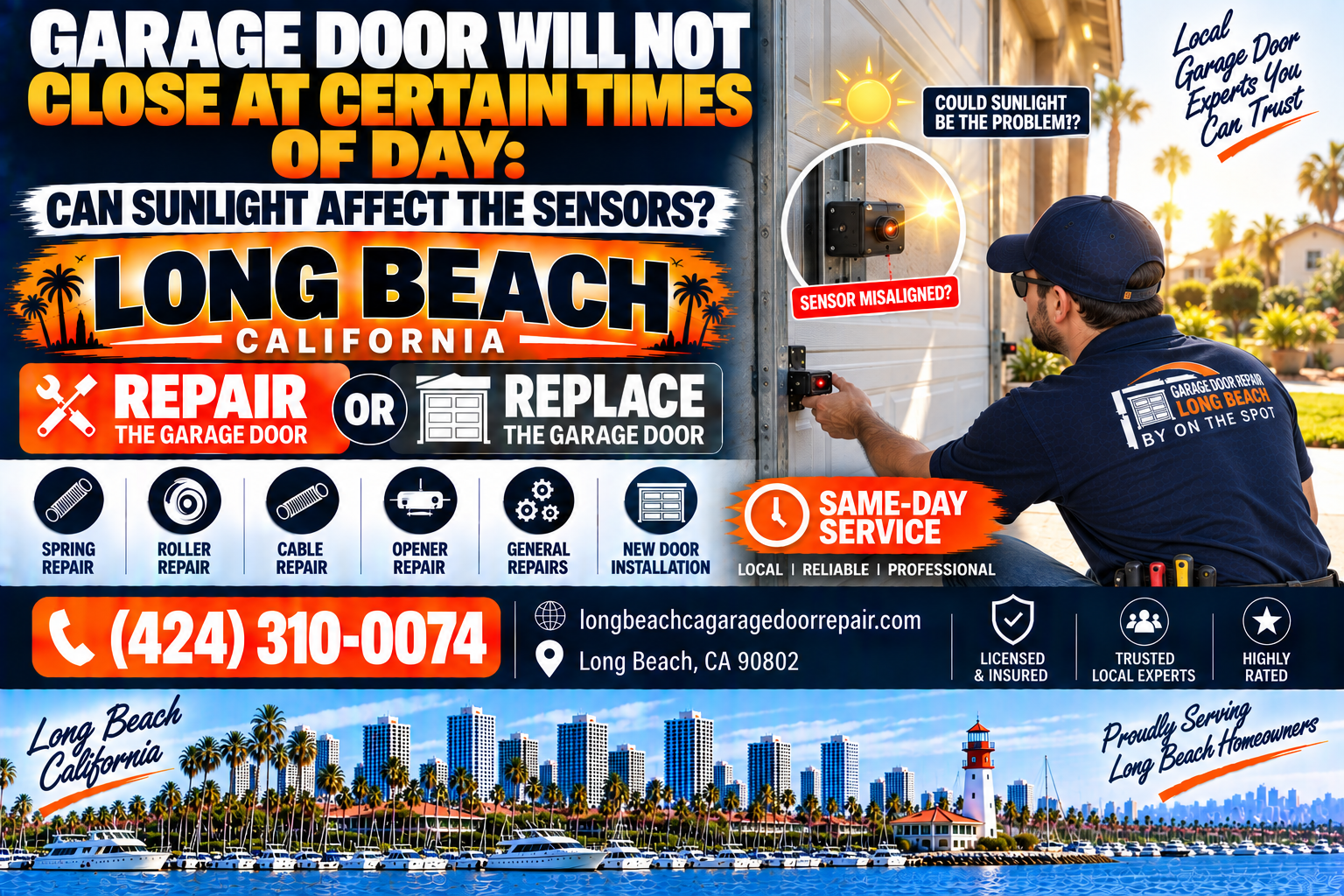
Garage Door Will Not Close at Certain Times of Day: Can Sunlight Affect the Sensors?
When a garage door will not close at certain times of day, sunlight flooding photo eyes is a leading cause—especially on west-facing Long Beach garages. Learn glare versus true obstruction, seasonal sun-angle patterns, sensor hoods and shields, alignment under bright ambient light, and why you must never bypass safety sensors.
Garage Door Repair Long Beach By On The Spot helps homeowners, renters, landlords, property managers, HOA communities, and small businesses restore safe closing with coastal-aware service across Long Beach, CA.
West-Facing Glare
Hoods + Alignment
Never Bypass Sensors
CPSC + DASMA + SCE
Serving Long Beach, CA
Table of Contents
Direct Answer: Can Sunlight Affect Garage Door Sensors So the Door Will Not Close?
Direct answer: Yes—sunlight can affect garage door safety sensors (photo eyes) so the door will not close at certain times of day. Bright low-angle sun, especially on west-facing Long Beach garages in late afternoon and early evening, can flood the receiver, create glare on the lens, or mimic a broken beam. The opener then refuses to complete a close cycle even though nothing physical is blocking the doorway. The fix is never to bypass the sensors. Correct responses include shade hoods or shields, careful realignment, cleaning lenses, reducing reflective bounce from driveways and walls, and—when needed—sensor replacement with better ambient-light rejection. Confirm with time-of-day notes, LED behavior in sun versus shade, and a professional reverse/entrapment check after any work.
Safe homeowner steps: log the exact failure window, photograph sensor LEDs during the fail time, note garage orientation (especially west-facing), check for true debris in the beam path, and call a pro before defeating photo eyes. Garage Door Repair Long Beach By On The Spot at 151 E 5th St, Long Beach, CA 90802 — (424) 310-0074.
What “Will Not Close at Certain Times of Day” Really Means
When homeowners say the garage door will not close at certain times of day, they usually mean a clock-tied pattern: reverses or refusals between mid-afternoon and sunset on clear days, with normal operation after dusk, under marine-layer overcast, or on foggy mornings.
That signature is common in Southern California coastal cities like Long Beach, where bright late-day light meets photo-eye receivers near the floor.
Other time-of-day patterns exist—SCE power events, thermal track expansion after hot afternoons—but photo-eye glare leads when LEDs flicker or go dark only while the sun sits in a specific sky position, and when careful hand-shading of the receiver restores a solid beam indication.
Document date, clock time, sky condition, whether the door is fully open when light pours in, and whether parked cars, wet concrete, or white stucco make it worse.
Technicians who only arrive at 10 a.m. may see healthy LEDs and miss the story; late-day appointments or fail-window videos close that gap.
This guide focuses on sunlight interacting with photo eyes while also covering alignment, dirt, damaged wire, and true obstructions that can stack with glare.
Garage Door Repair Long Beach By On The Spot hears west- and southwest-facing versions of this complaint year-round across coastal and alley properties.
That detail matters for Long Beach homeowners who only notice the problem after work on clear days.
Technicians treat the clock pattern as primary evidence rather than a superstition.
Keep people and pets clear of the doorway while you observe LEDs or wait for service.
How Photo-Eye Sensors See a Beam—and Why Light Can Fool Them
Residential photo eyes are a matched pair: an emitter sending an infrared beam across the opening and a receiver that must detect that beam continuously while the door closes.
Eyes usually sit a few inches above the floor on opposite jambs; if the beam is broken—or the receiver thinks it is—the operator stops or reverses to reduce entrapment risk.
The receiver is not a camera; it looks for a specific infrared signal. Sunlight contains infrared energy and intense visible light that can saturate optics, bounce into the lens, or raise ambient levels beyond what older or dirtier sensors reject cleanly.
When ambient rejection fails, the logic board treats the channel as unsafe and blocks closing—even with an empty doorway.
LED indicators show power and beam status on many brands. Solid “good” patterns under current lighting usually mean alignment and power are healthy; flashing, dim, or dark patterns only in bright sun point toward glare or flooding.
Two expensive mistakes follow misunderstanding: replacing a good opener motor because it “won’t close in the afternoon,” and defeating sensors so the door closes without protection.
CPSC consumer guidance on automatic residential garage door operators exists because closing convenience must never erase entrapment protection.
Photo eyes are one safety layer alongside contact reverse and proper door balance; fixing glare does not excuse skipping a reverse test after service.
Long Beach homes mix opener generations; older photo-eye designs may tolerate less ambient light, so a sensor that worked for years can start failing seasonally as sun angles shift or lenses haze.
That detail matters for Long Beach homeowners who only notice the problem after work on clear days.
Technicians treat the clock pattern as primary evidence rather than a superstition.
Keep people and pets clear of the doorway while you observe LEDs or wait for service.
Sunlight Flooding Photo Eyes: Glare, Ambient Light, and False Beams
Sunlight flooding means enough ambient light reaches the receiver that it can no longer distinguish the intended infrared beam from noise.
Flooding can be direct—rays hitting the lens head-on—or indirect from bounce off concrete, glossy vehicles, white walls, or a wet driveway.
Glare feels like a bright wash across the lens that correlates with reverse-on-close; both flooding and glare are sunlight effects, not the same as a cardboard box in the path, though the opener response looks identical.
Why certain times of day? Solar azimuth and elevation change continuously. For a west-facing Long Beach garage, late-day sun may aim down the beam corridor for twenty to forty minutes; outside that window the door closes normally.
Dirty lenses amplify flooding. Dust, coastal salt, spider silk, or grit scatters light into the receiver. Cleaning helps but may not fix a bare west-facing receiver that stares into the sun.
Failures only on cloudless days—or only after the marine layer burns off—mislead people into thinking the opener healed itself overnight on gray mornings.
If you carefully shade the receiver with a card during a fail window (door stopped, people clear) and the LED snaps good, sunlight influence is strongly implicated.
Do not leave floppy cardboard as a permanent repair without secure mounting that cannot fall into the doorway.
That detail matters for Long Beach homeowners who only notice the problem after work on clear days.
Technicians treat the clock pattern as primary evidence rather than a superstition.
Keep people and pets clear of the doorway while you observe LEDs or wait for service.
West-Facing Long Beach Garages: Afternoon and Evening Failure Windows
West-facing Long Beach garages are disproportionately represented in sunlight-sensor tickets because afternoon and early-evening light arrives low and bright after marine-layer lift.
Alleys opening westward, street-facing west elevations, and corner lots with unobstructed solar exposure create long glare windows.
Southwest orientations pick up late-day and seasonal shifts; a door fine in June may struggle in October when lower, more southerly sun slides under eaves.
East-facing doors more often see morning issues; north-facing doors are relatively protected; south-facing doors can have midday winter problems when the sun is low.
Belmont Shore and Naples may catch reflective bounce from light walls and water-adjacent brightness; downtown and Alamitos podium garages see angled courtyard light; Wrigley alleys can funnel sunset light like a tunnel.
Removing a tree, adding a white privacy wall, or parking a glossy SUV in a new spot can introduce a mirror sensors never had before.
Local service from On The Spot asks orientation and failure clock time first because west-facing afternoon patterns are a known Long Beach signature.
If your door faces west and fails near golden hour, lead with that sentence when you call—it shortens diagnosis more than listing every opener sticker.
That detail matters for Long Beach homeowners who only notice the problem after work on clear days.
Technicians treat the clock pattern as primary evidence rather than a superstition.
Keep people and pets clear of the doorway while you observe LEDs or wait for service.
Glare vs True Obstruction: How to Tell the Difference
Glare and true obstruction produce the same safety response: the door will not complete a close. Distinguishing them prevents useless part swaps and ignored hazards.
True obstruction clues include visible objects in the beam line, LEDs that stay bad after sunset, or failures at every hour regardless of sky.
Glare clues include failures clustered in a sun window, LEDs that recover when shaded, a clean doorway, and perfect night operation.
Mixed cases exist: slightly misaligned sensors may work in shade and fail in sun; dirt plus sun stacks; damaged wire can fail when you close after work—so not every after-work failure is sunlight.
Safe sequence with the door stopped and path clear: look for objects; note LEDs; carefully shade the receiver in the fail window; retry only while standing clear; log results.
Never test by defeating sensors or propping the door while eyes are unplugged.
When unsure, photograph doorway and LEDs during failure and after dusk, then call (424) 310-0074.
That detail matters for Long Beach homeowners who only notice the problem after work on clear days.
Technicians treat the clock pattern as primary evidence rather than a superstition.
Keep people and pets clear of the doorway while you observe LEDs or wait for service.
Seasonal Sun-Angle Patterns: Why Winter and Summer Fail Differently
Seasonal sun-angle patterns explain why a door that closed all summer suddenly refuses late-day closes in autumn—or why a winter problem vanishes by May.
Earth’s tilt changes solar elevation and azimuth. Low winter sun undercuts eaves and short hoods. High summer sun may miss the lens but create harsh driveway bounce.
Around equinoxes, many Long Beach homeowners notice new or returning time-of-day failures that are geometry, not sudden sensor death.
Daylight saving shifts schedules relative to the sun so you attempt closes at solar angles you previously missed on weekdays.
Marine layer seasonality hides glare vulnerability until the first clear hot afternoon after weeks of gray.
Professional advice often includes verifying hoods before fall clear skies, cleaning lenses before summer dust peaks, and rechecking alignment after jamb work.
If your failure window drifts by twenty minutes across months, that drift supports solar-geometry diagnosis; broken gears do not track sunset.
That detail matters for Long Beach homeowners who only notice the problem after work on clear days.
Technicians treat the clock pattern as primary evidence rather than a superstition.
Keep people and pets clear of the doorway while you observe LEDs or wait for service.
Sensor Alignment Plus Sun Interaction: Why a “Good Aim” Still Fails
Sensor alignment and sunlight interact. A beam barely making the receiver in ideal light can drop out when ambient infrared rises.
Brackets that look aimed but sit at tolerance edge are fine at night and fragile at 5 p.m.
Loose brackets from vibration, soft wood jambs, or bumps make problems intermittent across days as well as hours; sunlight becomes the stress test.
Height mismatch, twisted brackets, and paint overspray reduce margin; coastal salt film reduces it faster.
Alignment without addressing sun exposure can yield temporary improvement that returns on the next clear evening.
Best practice: align for strong stable LED indication, verify under fail-time lighting when possible, and always finish with a beam-break reverse check.
Homeowners should not aggressively bend brackets or stand under a moving door to watch LEDs.
If the bracket wiggles by hand, secure mounting comes before another micro-adjustment; if aim was perfect last year and only season changed, hoods may matter more.
That detail matters for Long Beach homeowners who only notice the problem after work on clear days.
Technicians treat the clock pattern as primary evidence rather than a superstition.
Keep people and pets clear of the doorway while you observe LEDs or wait for service.
Sensor Hoods, Shields, and Sun Screens: What Helps and What Does Not
Sensor hoods and shields are physical shades that reduce direct sun and some bounce into the receiver—among the most effective mitigations for west-facing Long Beach garages.
What helps: rigid hoods sized for the sensor body, oriented to block the known solar angle without blocking the infrared path, secured against wind and vibration, paired with clean lenses and solid brackets.
What does not help long-term: taped cardboard, floppy foil, melting plastic, tint films that also kill the IR beam, or hoods that force misalignment.
DIY shades that fall into the doorway become new obstructions.
Some kits include integrated sun shields; others need aftermarket or technician-fabricated hoods compatible with the brand.
Wrong polarity swaps or cheap mismatched eyes create new problems—parts choice matters.
Hoods are not a license to ignore damaged wire, cracked housings, or defeated sensors; they address ambient light only.
Ask your technician to demonstrate LED stability with the hood installed and explain whether both sides need protection.
That detail matters for Long Beach homeowners who only notice the problem after work on clear days.
Technicians treat the clock pattern as primary evidence rather than a superstition.
Keep people and pets clear of the doorway while you observe LEDs or wait for service.
LED Behavior During Sun Glare: Reading the Lights Without Guesswork
Learning LED behavior during sun glare turns mysterious afternoon failures into readable data.
Many photo eyes use steady lights for power/alignment OK and blink patterns for misalignment or beam loss; brand specifics differ—photograph sensors and manuals when available.
During a fail window, watch whether the receiver LED drops only when sun hits, recovers when shaded, or stays dead regardless.
A permanently dead LED suggests power, wire, or sensor failure rather than pure glare.
Flicker synchronized with cloud movement or a reflective car driving past is a glare/bounce clue; flicker when you flex the cable is a wire clue.
Do not stare into emitters or trust random forum color myths; treat LEDs as relative clues for a pro when brand logic is unknown.
A twenty-second video at 4:45 p.m. showing LED change as a cloud passes can confirm sunlight influence better than a morning-only visit.
After repair, LEDs should look stable in the previously bad window—or hooding and alignment should make that true.
That detail matters for Long Beach homeowners who only notice the problem after work on clear days.
Technicians treat the clock pattern as primary evidence rather than a superstition.
Never Bypass Garage Door Sensors Because of Sunlight
Never bypass garage door sensors because of sunlight. Unplugging photo eyes, jumping terminals, taping magnets to levers, or using close-anyway hacks removes a primary entrapment protection layer.
The door may close through afternoon sun—and through a child, pet, or bicycle you did not see.
CPSC guidance on automatic residential garage door operators emphasizes working entrapment protection. DASMA system safety tips reinforce treating garage door systems as complete safety assemblies.
Frustration with a 4 p.m. reverse is real; defeating sensors is still the wrong answer.
If you inherited a bypass from a previous occupant or rushed handyman, treat it as an emergency restore item and call for proper repair and verification.
Temporary safe options while waiting: park outside if needed, use the door when sensors read healthy (often after dusk for sun cases), keep kids and pets clear, and avoid forcing cycles against a reversing door.
On The Spot will not endorse bypass methods. Our job is to restore honest photo-eye function with hoods, alignment, cleaning, wiring, or replacement as indicated.
If someone online suggests unplugging sensors until winter, ignore that advice—seasonal sun is solvable without creating a year-round hazard.
That detail matters for Long Beach homeowners who only notice the problem after work on clear days.
Technicians treat the clock pattern as primary evidence rather than a superstition.
Keep people and pets clear of the doorway while you observe LEDs or wait for service.
Long Beach Coastal Light, Reflective Driveways, and Neighbor Glare
Long Beach coastal light is bright, often under clean air after winds, and frequently paired with reflective surfaces: light concrete, stucco, trailers, and water-adjacent brightness in some shoreline-adjacent pockets.
Salt haze on lenses scatters light. Morning fog may hide the issue; afternoon clarity reveals it—hence questions about marine-layer burn-off timing.
Neighbor glare from a white wall, reflective film, or new construction bounce path aims light into your receiver; diplomacy plus hooding usually beats arguing with the sun.
Driveway sealers and glossy coatings increase bounce; after a driveway redo, sudden afternoon close failures deserve a bounce and hood check before opener replacement.
Garage Door Repair Long Beach By On The Spot factors coastal brightness into sunlight-sensor service along routes from 151 E 5th St.
Bring photos of the approach path looking toward the sensors at fail time; that driver’s-eye view often shows the glare corridor instantly.
That detail matters for Long Beach homeowners who only notice the problem after work on clear days.
Technicians treat the clock pattern as primary evidence rather than a superstition.
Keep people and pets clear of the doorway while you observe LEDs or wait for service.
Field Diagnostic Flow: Time-of-Day Close Failure to Root Cause
Use this field flow when the garage door will not close at certain times of day and sunlight may be involved. Stay clear of the door path; never defeat sensors.
- Log the window: clock times, sky condition, garage facing direction, and whether night closes work.
- Clear the path: remove toys, bins, tools, and vehicles from the beam line.
- Read LEDs: photograph both sensors during failure and after dusk.
- Shade test (careful): if safe, briefly shade the receiver with a non-metallic card; note LED and close behavior. Do not stand under a moving door.
- Lens check: look for dirt, salt film, webs, paint, or cracked housings—clean gently if you know how, without twisting brackets.
- Wire flex clue: if gentle cable movement at any hour kills LEDs, suspect wire damage, not only sun.
- SCE context: if failures coincide with neighborhood power events, check the SCE Outage Center—then still evaluate sensors.
- Call a pro: share your log, orientation, and videos. Ask for hooding, alignment, and reverse verification rather than bypass.
This flow separates glare from obstruction, wire faults, and power coincidences so the repair matches the cause.
Symptom Comparison Table: Sun Glare vs Obstruction vs Misalignment vs Power
Use this table when your garage door will not close at certain times of day. Match clues before buying random openers or defeating sensors.
| Clue | Likely Layer | Homeowner Safe Step | Pro Step |
|---|---|---|---|
| Fails late afternoon; fine after dark | Sun glare / flooding | Log times; photo LEDs; shade test carefully | Hoods; align; verify reverse |
| West-facing garage; golden-hour reverse | Orientation + low sun | Note facing direction | Shield receiver; site-specific aim |
| Hand shade restores LED instantly | Ambient light flood | Do not leave cardboard permanently | Proper hood/shield install |
| Fails every hour; object in path | True obstruction | Clear doorway | Confirm path + sensor health |
| LED dies when cable flexed any time | Damaged sensor wire | Photo damage; no bypass | Splice/rewire; protect loom |
| LED bad even at night; no sun | Misalignment / dead eye / power | Photo both eyes | Electrical + alignment diagnosis |
| Worse after driveway sealer or white wall | Reflective bounce | Note property change | Hood + aim; reduce bounce path |
| Seasonal return each fall evenings | Sun-angle pattern | Keep seasonal log | Pre-season hood/align tune |
| Fails during SCE flicker week too | Power co-factor possible | Check SCE outage center | Opener + sensor full check |
| Sensors unplugged so it “closes” | Unsafe bypass present | Stop using defeated setup | Restore photo eyes now |
Brief technicians with your matching rows. Keep CPSC and DASMA safety boundaries visible while you chase afternoon convenience.
False Fixes That Waste Time When Sunlight Blocks Closing
False fixes waste money and sometimes create danger. Replacing the entire opener because of afternoon reverses is a classic overspend when hoods and alignment would solve glare.
Buying random no-name sensors without matching protocols can leave worse ambient rejection than the originals.
Taping cardboard as a permanent hood looks clever until it falls, blocks the beam, or becomes clutter in the path.
Foil wraps that cook in sun can melt onto housings.
Cranking force settings harder so the door pushes through does not fix optical beam loss and can worsen impact risk.
Bypassing sensors is the most dangerous false fix—it trades a reversible afternoon annoyance for missing entrapment protection at every hour.
Endless lens wiping without addressing west sun geometry yields temporary hope and recurring 5 p.m. calls.
Smart-home app spam—pressing close repeatedly—does not train the sun; it only stresses the operator and your patience.
That detail matters for Long Beach homeowners who only notice the problem after work on clear days.
Technicians treat the clock pattern as primary evidence rather than a superstition.
Red Flags: Stop DIY and Schedule Sunlight-Sensor Service
Stop DIY and schedule service when sensors have been defeated; brackets are broken or hanging; wires are chewed or bare; the door is off-track; springs are broken; the door drops hard; LEDs never recover even at night; or anyone is tempted to unplug the eyes until sunset.
Also stop if shade tests require standing under a moving door, if you must climb unstable objects to reach sensors, or if electrical smell appears at the opener.
Rental and HOA units should not leave bypasses for the next occupant—document the sun issue and request professional restore.
Call (424) 310-0074 for Garage Door Repair Long Beach By On The Spot when red flags appear.
Afternoon glare is common; unsafe improvisation is not acceptable.
If a child or pet was nearly struck during a confused close attempt, treat the system as out of service until photo eyes and reverse are verified.
Red flags override wait-until-weekend thinking—especially when bypass is already present.
That detail matters for Long Beach homeowners who only notice the problem after work on clear days.
Technicians treat the clock pattern as primary evidence rather than a superstition.
Keep people and pets clear of the doorway while you observe LEDs or wait for service.
Professional Repair Path for Sun-Affected Garage Door Sensors
A professional path typically includes interview for time-of-day and orientation; visual inspection of eyes, brackets, lenses, and wire; LED evaluation; alignment; hoods/shields discussion; cleaning; bounce-path review; optional sensor upgrade when optics are weak; and mandatory reverse/entrapment verification after work.
Technicians may schedule into the failure window when logistics allow, or use west-facing Long Beach experience to anticipate hood needs.
Wiring integrity is checked so sun is not blamed for a chewed conductor that fails after work when the door is used most.
You should receive plain-language findings: glare, obstruction, misalignment, wire, opener logic, or mixed.
Ask for before/after LED expectations at the problem hour.
Authority-aware shops keep CPSC photo-eye expectations and DASMA system framing in mind—and may note SCE outage coincidence without stopping at the utility website.
On The Spot’s path is diagnosis-first, safety-intact, and coastal-aware—not parts roulette.
That detail matters for Long Beach homeowners who only notice the problem after work on clear days.
Technicians treat the clock pattern as primary evidence rather than a superstition.
Keep people and pets clear of the doorway while you observe LEDs or wait for service.
Parts That Matter: Hoods, Brackets, Sensors, Wire, and Mount Height
Parts that matter for sunlight cases include compatible photo-eye pairs with solid ambient rejection, mounting brackets that hold aim, sun hoods/shields that fit the housing, clean lenses, healthy low-voltage wire and connectors, and brand-specific optical details.
Mount height must remain within safety norms—eyes too high miss small objects; too low catch debris and splash. Hooding must not force unsafe repositioning.
Cheap mismatched emitters and receivers can refuse to talk to the opener or reject sunlight poorly. Brand protocol compatibility beats bargain bins.
Opener logic boards are rarely the first part to replace for pure afternoon glare—rule out optics and geometry first.
Ask what warranty covers hoods and alignment callbacks if seasonal sun shifts.
Keep old defeated jumpers out of the garage; do not leave bypass hardware just in case.
That detail matters for Long Beach homeowners who only notice the problem after work on clear days.
Technicians treat the clock pattern as primary evidence rather than a superstition.
Keep people and pets clear of the doorway while you observe LEDs or wait for service.
Maintenance Habits That Reduce Sun-Related Close Failures
Clean lenses on a seasonal schedule; keep spider webs cleared; verify brackets are snug; watch for new reflective surfaces; trim plantings that drop debris on eyes; recheck after jamb painting; and log the first afternoon reverse of each clear season as a cue for a tune visit.
Do not spray harsh chemicals that haze plastic optics. Soft cloth and appropriate cleaners beat abrasive pads.
Test reverse monthly with a soft roll under the door path per common safety guidance—never with a person as the test object. After sun-mitigation work, retest.
If you wash the driveway and notice bounce glare, dry times and sun angles may temporarily worsen flooding—another log clue.
Battery backup openers still need working photo eyes. Power resilience does not equal optical resilience.
Small habits prevent the every-clear-Saturday-at-5-p.m. frustration cycle.
That detail matters for Long Beach homeowners who only notice the problem after work on clear days.
Technicians treat the clock pattern as primary evidence rather than a superstition.
Keep people and pets clear of the doorway while you observe LEDs or wait for service.
Repair Now vs Waiting When the Door Still Closes at Night
Waiting is tempting when the door closes fine at night. The risk is that someone will eventually bypass sensors for daytime convenience, or that marginal alignment will degrade further.
Waiting also strands daytime deliveries, caregivers, and anyone who must secure the home before sunset.
Repair now when the pattern is clear, when west sun is predictable, or when household members already argue about just unplugging it.
Waiting is more reasonable only when a same-week appointment is booked and interim use stays within safe LED-confirmed windows—without bypass.
If last October was bad, schedule hooding before this October’s clear evenings.
Property sale and rental turnovers should not transfer a known afternoon reverse problem undocumented.
Cost of a proper hood/align visit is usually far below opener replacement or liability from a defeated system.
That detail matters for Long Beach homeowners who only notice the problem after work on clear days.
Technicians treat the clock pattern as primary evidence rather than a superstition.
Keep people and pets clear of the doorway while you observe LEDs or wait for service.
Same-Day Help When Afternoon Sun Strands Your Close Cycle
Same-day help matters when afternoon sun strands you unable to secure the garage, when a bypass already exists, when LEDs failed permanently, or when travel plans require a reliable close before evening.
Call (424) 310-0074 and mention sunlight/time-of-day so dispatch can plan parts like hoods and compatible sensors.
Share facing direction, fail clock times, and whether night operation works. Videos help.
If the door is off-track or springs are broken, say so—those override a pure sensor glare ticket for safety sequencing.
Garage Door Repair Long Beach By On The Spot routes from 151 E 5th St, Long Beach, CA 90802 across Long Beach neighborhoods and nearby communities.
Do not create a DIY bypass just for today. Park outside and wait for honest sensors if needed.
Ask the arriving tech to verify reverse after sun mitigation—same-day speed should not skip safety checks.
That detail matters for Long Beach homeowners who only notice the problem after work on clear days.
Technicians treat the clock pattern as primary evidence rather than a superstition.
Keep people and pets clear of the doorway while you observe LEDs or wait for service.
Questions to Ask Before Hiring for Sunlight Sensor Issues
- Will you evaluate sunlight/glare given my west-facing (or other) orientation and fail times?
- Do you install proper sensor hoods/shields, not cardboard temporary hacks?
- Will alignment be verified and reverse/entrapment protection tested after work?
- How do you distinguish sun glare from damaged wire or true obstruction?
- Are replacement sensors protocol-compatible with my opener brand?
- What should I expect at the next seasonal sun-angle shift?
- Do you refuse bypass requests and restore defeated sensors?
- Can you review SCE outage coincidence without ignoring optical causes?
- What maintenance should I do between visits for lenses and brackets?
- How should I document symptoms for warranty or landlord/HOA records?
Good answers sound specific. Vague we-will-look-at-the-motor replies without mentioning photo eyes and sun are a yellow flag for this symptom pattern.
Why Garage Door Repair Long Beach By On The Spot for Sunlight Sensor Problems?
Garage Door Repair Long Beach By On The Spot treats time-of-day close failures as an optical-geometry problem first: sunlight, bounce, alignment margin, lenses, and hoods—while still checking wire, obstruction, and opener health. We serve homeowners, renters (with permission), landlords, property managers, HOAs, and small businesses from 151 E 5th St, Long Beach, CA 90802.
We keep safety non-negotiable. CPSC and DASMA-aligned practice means we restore sensors rather than defeat them for afternoon convenience. SCE outage context is used when timing suggests power co-factors, without ignoring a west-facing glare corridor in plain sight.
Coastal experience matters: marine-layer burn-off, reflective stucco, alley golden-hour tunnels, and seasonal low-sun shifts show up on our Long Beach routes constantly.
Call (424) 310-0074, visit https://longbeachcagaragedoorrepair.com/, or map us at Google Maps.
Diagnosis First
Clock patterns, orientation, LEDs, and shade clues before random opener swaps.
Safety Intact
No bypass. Photo eyes and reverse verified on site.
Local Coastal Fit
West-facing Long Beach sun, bounce, and marine-layer timing built into the visit.
Areas Served From the Long Beach Location
Garage Door Repair Long Beach By On The Spot serves Long Beach neighborhoods and nearby communities from 151 E 5th St, Long Beach, CA 90802, including downtown Long Beach, Belmont Shore, Belmont Heights, Naples, Alamitos Beach, Bixby Knolls, California Heights, Wrigley, Traffic Circle, El Dorado Park area, Lakewood borders, Signal Hill, and adjacent Los Angeles County pockets along regular routes. Sunlight sensor tickets appear often on west- and southwest-facing doors, alley golden-hour approaches, and reflective driveway remodels.
Call (424) 310-0074 with gate codes, facing direction, fail-time videos, and whether night closes work. Website: https://longbeachcagaragedoorrepair.com/. Maps: https://www.google.com/maps?cid=5381478035707257267.
Provide reserved stall notes and whether a prior technician defeated sensors. Condo P-levels may need escort. Rental turnovers should include a photo-eye LED check at a sunny late hour when possible and a reverse demonstration before new occupants arrive.
Google Map Location
Find Garage Door Repair Long Beach By On The Spot at 151 E 5th St, Long Beach, CA 90802. Use this Google Maps link for directions and business details: https://www.google.com/maps?cid=5381478035707257267.
Phone (424) 310-0074 before visiting if you need to discuss a stranded afternoon close caused by sunlight on the sensors. Most glare, hood, and alignment decisions are diagnosed at your garage rather than at a counter drop-off.
Bring opener brand photos, LED clips from the fail window, facing-direction notes, and any prior cardboard-hood attempts to any conversation—phone, web contact, or on-site.
FAQs About Garage Door Will Not Close Due to Sunlight Sensors
These answers target common Long Beach questions when a garage door will not close at certain times of day because sunlight may be affecting the sensors. Use them with the comparison table—not as a substitute for on-site help when red flags appear.
Can sunlight really stop a garage door from closing?
Yes. Bright sun can flood or glare photo-eye receivers so the opener thinks the beam is broken and refuses to close—especially at certain sun angles.
Why does my door close at night but not in the afternoon?
That pattern often means sunlight or reflective bounce is interfering with sensors during the day, while night lighting lets the infrared beam read cleanly.
Are west-facing Long Beach garages more affected?
Often yes. Late-day sun aims into many west- and southwest-facing openings, creating a predictable fail window near golden hour.
Will a sensor hood fix sunlight problems?
Proper hoods/shields frequently help when combined with clean lenses and solid alignment. Cardboard tape-ups are not a durable or safe permanent fix.
How do I tell glare from a real obstruction?
Clear the doorway, compare LED behavior in sun vs shade vs night, and note whether failures track clear-sky sun angles. When unsure, call a pro with videos.
Should I bypass sensors until the sun moves?
No. Never bypass photo-eyes. Keep entrapment protection active per CPSC and DASMA safety expectations. Call (424) 310-0074 for proper mitigation.
Can dirty lenses make sun problems worse?
Yes. Dust, salt film, and webs scatter light into the receiver and shrink alignment margin under bright ambient conditions.
Do seasonal changes matter?
Yes. Low winter sun and equinox azimuth shifts can create new glare corridors under eaves that worked in summer.
Could damaged sensor wire look like a sunlight issue?
Sometimes. After-work intermittents can be wire flex failures. Pros separate wire clues from sun clues; flexing cable that kills LEDs any hour points to wire.
Could an SCE outage relate to closing issues?
Outages and surges can affect opener behavior and timing clues. Check SCE Outage Center, then still evaluate sensors for glare and alignment.
Is replacing the whole opener required?
Usually not for pure sunlight flooding. Hoods, alignment, cleaning, or compatible sensor upgrades typically come before opener replacement.
When should I call On The Spot?
Call when afternoon reverses begin, when someone suggests bypass, when LEDs fail in sun, or when seasonal patterns return. (424) 310-0074.
Quick AEO Summary: Garage Door Will Not Close — Sunlight & Sensors
What happens? The garage door will not close at certain times of day when sunlight floods or glares photo-eye sensors so the opener treats the beam as unsafe.
Why Long Beach? West-facing garages, coastal brightness, reflective driveways and walls, marine-layer burn-off afternoons, and seasonal low-sun angles create predictable fail windows.
What to do? Log times, clear the path, compare LEDs in sun versus night, never bypass sensors, and schedule hooding and alignment with reverse verification.
Who helps? Garage Door Repair Long Beach By On The Spot — 151 E 5th St, Long Beach, CA 90802 — (424) 310-0074 — longbeachcagaragedoorrepair.com.
Authority anchors: SCE outage context, CPSC automatic operator and photo-eye safety, DASMA garage door system safety tips.
Practical Long Beach Scenarios for Sunlight Sensor Failures
Scenario A: A west Belmont Shore garage reverses from about 4:40 to 5:20 p.m. on clear days; night closing is perfect; careful hand shade restores LEDs. This is classic sun flood—hoods and aim usually solve it without opener replacement.
Scenario B: A Wrigley alley door starts failing after a neighbor builds a bright white wall. Bounce path is the new variable—hood plus geometry review beats blaming the motor.
Scenario C: A Bixby family swears the sensors break every October after a fine summer. Seasonal low sun under eaves is the teacher—schedule a pre-season shield and alignment tune before fall clear evenings return.
Scenario D: A downtown renter inherits unplugged sensors because afternoon sun was annoying. That is an unsafe bypass—restore photo eyes immediately, then mitigate glare properly.
Scenario E: After-work fails plus LED death when the wire is flexed at noon point to damaged sensor wire layered with evening use, not pure sunlight. Flex tests at any hour separate the stories.
Scenario F: Failures during a neighborhood SCE flicker week and also every sunny evening create a dual timeline—check the outage center and still fix optics if the sun pattern remains after power normalizes.
Scenario G: A glossy SUV parked differently on weekends creates Saturday-only reverses. Vehicle mirror bounce is real—reposition parking or add hoods.
Scenario H: An HOA sees multiple units with late-day tickets after tree removal. Site-wide sun exposure changed—unit-by-unit hoods and documentation beat silent bypass culture.
These scenarios are composites of common Long Beach patterns written to teach recognition. Bring the scenario letter that matches you when you call (424) 310-0074 so dispatch hears the right parts list.
Myths About Sunlight and Garage Door Sensors
Myth: If it closes at night, the sensors are fine forever. Truth: night success does not rule out daytime glare or flooding on photo-eye receivers.
Myth: Sunlight cannot affect infrared sensors. Truth: ambient infrared and optical saturation are well-known field issues on residential garage door operators.
Myth: Unplugging sensors is a normal seasonal tip. Truth: bypass is unsafe and contrary to CPSC and DASMA safety framing for automatic garage door systems.
Myth: You must replace the opener for afternoon reverses. Truth: optics, hoods, cleaning, and alignment usually come first for pure time-of-day glare.
Myth: Any shade material is fine. Truth: improper shades can block the beam, melt, or fall into the doorway as new obstructions.
Myth: Force up the close power to beat the sun. Truth: force settings do not restore a lost optical beam and can increase impact risk.
Myth: Only dirty lenses matter. Truth: clean lenses still fail when low sun stares into a bare west-facing receiver.
Myth: Marine layer means you have no sun problem. Truth: burn-off afternoons are exactly when many Long Beach tickets appear.
Myth: Cardboard taped above the eye is a professional fix. Truth: durable hoods and verified reverse tests are the professional path.
Myth: Smartphone apps can train the door to ignore afternoon sun. Truth: repeated close commands do not change solar geometry or ambient rejection physics.
Homeowner Call Script for Sunlight Sensor Service
Use this script when calling (424) 310-0074 so the visit starts with the right diagnosis frame:
Hi, my garage door will not close at certain times of day—usually late afternoon on clear days—and I suspect sunlight is affecting the sensors. The door faces [west/southwest/other]. Night closing usually works. LEDs [describe solid, blinking, or dark]. I have from the fail window. Sensors have [not] been bypassed. Address is in [neighborhood]. Gate code is [if any]. Please help with diagnosis, hoods or alignment if needed, and a reverse check—not a bypass.
Add whether pets or kids use the doorway heavily, whether a recent driveway sealer or white wall appeared, and whether the sensor wire shows chew, pinch, or abrasion marks.
Ask for arrival windows that overlap the fail time if scheduling allows. If only morning slots exist, promise videos and orientation notes so hood decisions can still be made intelligently.
Keep the SCE note ready if outages coincided: you already checked https://www.sce.com/outage-center and still see sun-tied LED behavior afterward.
Clear, concise facts get faster correct parts on the truck—hoods, compatible sensors, brackets—and reduce the chance of a second trip.
Glossary: Sunlight Sensor Terms in Plain Language
Photo eyes / safety sensors: The optical pair near the floor that watches a beam across the door opening for entrapment protection during close cycles.
Emitter / transmitter: The side that sends the infrared beam across the opening toward the receiver.
Receiver: The side that must detect the beam; often the most vulnerable to sun flood and glare on west-facing Long Beach garages.
Ambient rejection: The sensor’s ability to ignore sunlight and other ambient light while still seeing the intended infrared beam.
Glare / flooding: Excess light interfering with reliable beam detection so the opener refuses to close even with a clear doorway.
Sun hood / shield: Shade hardware that reduces direct sun and some bounce into the sensor optics without blocking the beam path.
Fail window: The clock period when closing fails due to solar geometry—often late afternoon for west doors on clear days.
Beam-break reverse: A safety check where breaking the beam during close should make the door reverse; never test with a person or pet.
Bypass: Unsafe defeat of sensors by unplugging, jumping, or other hacks—never recommended, especially for sunlight convenience.
Bounce path: A reflected light route from concrete, walls, vehicles, or wet surfaces into the lens that can mimic direct sun flood.
Marine layer burn-off: Local coastal weather pattern where morning gray clears into bright afternoon sun—timing that often reveals glare problems.
Alignment margin: How solidly the beam couples into the receiver; thin margin may pass at night and fail under high ambient light.
Photo-Eye Anatomy: Emitter, Receiver, Beam Path, and Ambient Rejection
Photo-eye anatomy for sunlight diagnosis includes housings with lenses, an internal infrared LED emitter, a photodetector receiver circuit, status LEDs, brackets with slotted aiming holes, low-voltage cable to the opener, and sometimes integrated sun shields from the manufacturer.
The beam path is a narrow corridor a few inches above the floor. Anything that raises ambient light at the receiver—direct sun, specular bounce, scattering dirt, spider silk—competes with the intended signal and can push marginal systems into reverse-or-refuse behavior.
Ambient rejection designs vary by opener generation. Older eyes may need hoods sooner on west Long Beach exposures. Newer eyes still benefit from shade when geometry is harsh, especially in alley tunnels that aim golden-hour light at sensor height.
Polarity and brand pairing matter when replacing sensors. Mixing unmatched sets can cause chronic beam faults that get blamed wrongly on bad openers or mysterious afternoon ghosts.
Mounting wood that is soft, cracked, or stripped lets vibration walk the aim until sunlight becomes the deciding stressor that reveals the weakness each clear evening.
Understanding anatomy keeps conversations precise with your technician: hood the receiver, clean the lens, secure the bracket, verify the beam, prove reverse—not hit the motor with a hammer or max the force settings.
Wire integrity remains part of anatomy. A sun story that also shows LED dropout when the cable flexes at noon is a combined ticket; do not let glare language hide chewed copper.
After any anatomy-level repair—new eyes, new brackets, new hoods—finish with LED checks in the problem lighting when possible and a beam-break reverse demonstration with the path clear.
Deep Dive: West-Facing Alleys, Golden Hour, and Beam Flood
West-facing alleys in Long Beach often act like solar tunnels in the hour before sunset. Buildings on both sides block high sky but admit a horizontal blast of light that lands near sensor height, exactly where photo eyes live.
Golden-hour intensity can overwhelm marginal receivers even though the infrared beam is still present. Discrimination collapses under ambient flood, and the opener treats the channel as blocked.
Technicians who walk an alley at noon may underestimate the evening corridor. Homeowner photos and videos from the fail minute are diagnostic gold and should be part of every west-alley dispatch note.
Parking patterns change alley reflectance overnight. A row of white vans or a newly washed glossy SUV can turn a tolerable evening into a fail window without any sensor part actually dying.
Hood depth and orientation should match the actual azimuth of failure, not a generic tip to stick something on top. Side wings often matter as much as top shade when light arrives sideways down an alley.
A door that is fully open maximizes the aperture for light. Partially closed panels sometimes shade the eyes and create false it-works-now moments that confuse households mid-diagnosis.
Coastal west light after clean-air wind events is especially crisp. Expect more tickets on those calendar days, then fewer when marine layer returns—another reason logs beat memory.
Professional alley work may include bracket relocation within safe height norms when hoods alone cannot beat a laser-like sun path. Any relocation still ends with reverse retesting and LED confirmation.
HOA alley rules may limit improvised lumber shades; neat compatible hood kits usually travel better through architectural review than DIY cardboard architecture.
If both emitter and receiver see sun, shield priorities still usually start with the receiver, then confirm empirically during the next clear fail window.
Deep Dive: Equinox Shifts, Winter Low Sun, and Summer High Glare
Equinox periods shift solar azimuth quickly week to week. A hood aimed for August sun may underperform in late September even though no part failed and no one bumped the bracket.
Winter low sun undercuts short eaves. South and southwest openings join west doors on the problem list, which is why December tickets sometimes surprise homeowners who only watched summer evenings.
Summer high sun may create driveway hotspots that bounce upward into lenses even when direct rays miss the housing. Bounce season and direct-flood season can feel like two different diseases with one doorway.
Keep a simple calendar: first clear evening reverse each month. Patterns beat memory and help landlords see that geometry—not tenant misuse—is often the actor.
Daylight saving transitions move civil time against solar time. The fail clock on the kitchen wall may jump by an hour while solar geometry is continuous, which confuses family debates about whether it got worse.
Pre-season service in early fall prevents stacks of emergency calls the first heat-clear week when everyone tries to close at golden hour after work.
Technicians should explain seasonal expectations so homeowners do not assume parts failed when geometry shifted. That education is part of EEAT-quality local service.
If you travel and return to a new problem, check whether you simply arrived into a different solar season before replacing hardware blindly.
Photo logs across seasons support rental files and HOA work orders when multiple units share a newly sunny approach after tree work.
Do not wait for perfect astronomical prediction—if afternoons fail, mitigate; refine hoods as seasons teach the next angle.
Deep Dive: Hood Geometry, Lens Tint Myths, and Proper Shield Fit
Hood geometry includes depth, width, side wings, and how far the shade extends beyond the lens plane without clipping the infrared path to the opposite eye. Getting that balance right is the craft of sunlight sensor service.
Too-shallow hoods fail at low sun. Too-aggressive hoods create self-obstruction or collect spider habitats that become true beam blocks on otherwise sunny-problem doors.
Lens tint myths circulate online. Heavy tint films can kill IR throughput and create a permanent beam fault. Use designs meant for photo eyes, not random window tint scraps from a leftover remodel kit.
Material choice matters in Long Beach UV. Prefer UV-stable plastics or metals that do not melt onto housings; avoid craft foam and cheap tape sculptures that cook by August.
Fitment should leave status LEDs inspectable or include a known inspection method for future service so the next technician is not flying blind.
Vibration-proof fasteners matter on busy doors. A hood that rotates with cycles becomes a seasonal misalignment machine that recreates the afternoon reverse after a few weeks.
Some brands sell OEM sun shields—prefer compatibility. Universal hoods can work when carefully aimed and verified after install with LED and reverse checks.
Matte dark hood interiors often reduce scatter into the lens compared with shiny interiors that bounce light around inside the shade cup.
Never screw through live sensor wires when mounting. Map cable paths first, especially on older jambs with stapled loom hidden under paint.
After install, perform sun-window verification when possible, or a bright ambient challenge plus standard beam-break reverse, and teach homeowners not to remove hoods for a cleaner look.
Deep Dive: Alignment Tolerances When the Sun Is in the Beam Corridor
Alignment tolerances shrink under high ambient light. A beam that is only marginally coupled may read OK at night and fail at 5 p.m. when sunlight floods the receiver.
Use manufacturer LED logic when known. Aim for stable indication with gentle tap tests on brackets showing no dropout, then lock hardware and recheck because tightening can shift aim.
Height match between eyes reduces diagonal beam paths that clip weather seals, uneven thresholds, or storage edges near the jamb.
Twisted brackets create off-axis coupling issues on some designs and should be corrected rather than compensated with endless force tweaks.
Soft jambs may need backing or different fasteners so vibration does not undo alignment by the following week—especially on older Long Beach alley structures.
Sun interaction means final acceptance testing should consider ambient conditions whenever logistics allow. Morning-only green LEDs are incomplete acceptance for a known evening fail window.
If alignment cannot hold, inspect for bent track, loose opener rail, or door balance problems transmitting shake into the sensor brackets.
Record bracket condition with photos for rental files. Crushed stamped metal after years of bin bumps is common and may require bracket replacement, not only a screwdriver nudge.
Homeowners should avoid aggressive screwdriver adventures that strip soft screws. Observation, photos, and a scheduled visit are safer than DIY micro-aiming under a moving door.
Pros carry replacement brackets and compatible eyes because sunlight tickets often reveal hardware that was already at the edge of tolerance before the season changed.
Deep Dive: Reflective Concrete, White Walls, and Parked Vehicles as Mirrors
Reflective concrete sealers, white stucco, glossy vehicles, boat hulls, and glass doors can mirror sunlight into photo-eye receivers even when the sun is not aimed directly at the lens face.
Wet concrete after washing is a temporary mirror. Failures right after driveway chores are a bounce clue, not proof the opener logic board failed during the rinse.
Parked vehicle changes create weekend mysteries: Saturday reverse, Monday fine, because the car moved. Ask household members where vehicles sat during each failure before buying parts.
Mitigations include proper hoods, slight aim changes within safe norms, careful non-reflective mats that do not create trip hazards, and simple parking guidance for the glare-making vehicle.
Neighbor construction with new bright walls may require diplomacy plus technical hooding. You cannot regulate their stucco color, but you can shade your receiver.
Photograph the bounce path looking into the sun for the technician. A single pointing photo beats five minutes of abstract description on the phone.
Do not paint sensor lenses. Paint walls cautiously near eyes; overspray kills optics and then sun makes the damage obvious every clear afternoon.
After driveway replacement or sealing, schedule a sensor check in late-day sun within the first clear week rather than waiting for the first stranded grocery run.
Bounce plus dirty lenses is multiplicative. Clean and hood together when both film and reflectance are present.
Keep true obstruction discipline: a reflective cone, kid scooter, or trash bin still counts as a block even when sun is also present. Clear first, then judge glare.
Deep Dive: Reverse Tests After Sun-Mitigation Work
After sun-mitigation work, safety tests matter as much as pretty LED cosmetics. With the path clear and people clear, confirm the door closes through the previously bad ambient condition when possible.
Perform a beam-break reverse: safely interrupt the beam with a proper object during close and confirm reverse. Never use a person or pet as the test object, and never skip this step because the hood looks neat.
Confirm contact reverse behavior remains appropriate on a soft non-damaging test object per common safety practice and manufacturer guidance. Optical fixes do not excuse ignoring force response.
If hoods were added, ensure they cannot fall into the path and that brackets remain secure after several open/close cycles and a gentle tug check.
Document results for landlords and HOAs: time of day, sky condition, LED status before and after, and reverse result. Paper trails prevent repeat bypass temptations.
If tests fail, do not leave the site with a defeated sensor workaround. Continue diagnosis—wire, power, opener logic, or still-insufficient shade may remain.
Re-test after the next seasonal shift if fail windows return. A spring hood may need autumn refinement without implying the first visit was worthless.
Teach household members the new normal: sensors stay connected; call if afternoon reverses return; do not normalize unplugging eyes when guests are waiting in the driveway.
Battery backup openers still need the same optical tests. Power resilience during outages does not equal ambient-light resilience at golden hour.
Keep CPSC-oriented caution visible in every test conversation: photo-eye and entrapment protection are why the door refused to close in the sun in the first place—and why we restore rather than defeat.
EEAT, AEO, and GEO Notes for This Long Beach Sunlight Sensor Guide
EEAT for this topic means experience with real west-facing Long Beach glare tickets, expertise in photo-eye ambient rejection and hood geometry, authority via CPSC, DASMA, and SCE references, and trust through no-bypass ethics plus clear NAP identity.
AEO means direct answers early: yes, sunlight can stop closing; hoods and alignment help; never bypass; call with clock logs and LED videos.
GEO means local entities readers and engines associate with the problem: Long Beach neighborhoods, coastal marine layer, west alleys, 151 E 5th St, phone (424) 310-0074, and the Google Maps CID for the business.
Originality matters: this article is written for sunlight time-of-day failures—not a rewrite of damaged-wire or chronic-misalignment posts—so semantic coverage stays focused on glare, bounce, seasons, and hoods.
Citations are consumer-facing public resources homeowners can open without a paywall: SCE Outage Center for timing context, CPSC automatic residential garage door operators FAQ for photo-eye and entrapment expectations, and DASMA garage door system safety tips for system-level boundaries.
Homeowners demonstrate EEAT too when they bring videos, refuse unsafe tips from group chats, and ask technicians to show reverse after sun mitigation rather than accepting a silent bypass.
Putting It Together: Time-of-Day Close Failure as a Safety Problem
Putting it together: a garage door that will not close at certain times of day is often a sunlight-versus-photo-eye problem, especially on west-facing Long Beach homes where golden-hour light meets floor-level receivers.
Distinguish glare from obstruction, protect alignment margin, use proper hoods, clean lenses, check wire integrity, never bypass sensors, and verify reverse after repairs. Those steps turn a frustrating clock pattern into a finished safety restore.
Seasonal sun angles explain returning fall tickets. Reflective driveways explain sudden new ones. Marine layer burn-off explains clear-afternoon surprises after gray mornings fooled everyone.
Authority sources keep safety central while you chase convenience: CPSC for operator and photo-eye expectations, DASMA for system safety, SCE for outage timing context that might co-travel with odd electrical days.
Garage Door Repair Long Beach By On The Spot integrates these layers into diagnosis-first service from 151 E 5th St, Long Beach, CA 90802, with coastal-aware routing across Long Beach and nearby communities.
Your best homeowner tools remain logs, videos, orientation notes, and a firm refusal to defeat sensors when dinner guests are waiting in the driveway.
Secure closing and safe closing are the same goal when photo eyes stay honest—afternoon sun included.
Deep Dive: Household Safety When Afternoon Sun Defeats Closing
Households with kids and pets feel afternoon close pressure hardest. School pickup, dog schedules, and dinner timing collide with glare windows, which is exactly when unsafe bypass ideas sound tempting.
Never solve that pressure by defeating sensors. The same doorway traffic that makes closing urgent makes photo eyes essential for entrapment protection.
Interim strategy while waiting for service: close after dusk when LEDs are healthy, supervise the doorway, park outside if needed, and book help quickly at (424) 310-0074.
Teach older kids not to help by holding sensors, sticking tape on lenses, or standing in the path to see if the door reverses. Observation from a clear distance is enough.
Pets chewing wires create layered failures. Sun plus damaged wire is a known double ticket—inspect loom when after-work intermittents do not match a clean sun-only pattern.
Strollers and toys left in the beam are true obstructions that can coincide with sun windows. Clear first, then judge glare, so you do not hood a doorway that still has a scooter in the corridor.
After repair, re-walk household safety rules: wait for full open and close, stay clear of tracks and springs, never play near moving doors, and keep sensors connected year-round.
If a near-miss occurred during a confused close attempt, take the door out of service until photo eyes and reverse are verified by a professional.
Caregivers and sitters should know the fail window so they do not assume the opener is randomly broken and invent a bypass before you get home.
Post the On The Spot number near the opener and keep the fridge playbook with facing direction and video links so every adult responds the same way.
Call for Help If Sunlight Stops Your Garage Door From Closing in Long Beach
If your garage door will not close at certain times of day—especially late afternoon on clear days when sunlight floods west-facing photo eyes, glares into receivers, or bounces off Long Beach driveways and walls—get diagnosis-first help from Garage Door Repair Long Beach By On The Spot. Proper hoods, alignment, cleaning, and compatible sensor work keep photo eyes honest; bypasses, broken springs, off-track doors, and defeated safety loops should not wait.
Call (424) 310-0074, visit https://longbeachcagaragedoorrepair.com/, or find us at 151 E 5th St, Long Beach, CA 90802. Maps: https://www.google.com/maps?cid=5381478035707257267.
Bring videos of LED behavior during the fail window, facing-direction notes, opener label photos, and any prior cardboard-hood or bypass attempts. Ask for glare-versus-obstruction clarity, a demonstrated close cycle, a beam-break reverse check, and durable sun mitigation so the failure does not return with the next equinox.
Authority-aligned service keeps SCE outage context, CPSC operator safety (including photo-eye/entrapment expectations—critical when afternoon sun tempts bypass), and DASMA system boundaries in view—so optical repairs solve optical problems and larger door problems get named when they are the real cause.
Whether you are in a Belmont Shore west garage catching golden hour, a Wrigley alley funneling sunset light, a Bixby home with after-work close needs, or a rental where someone unplugged the eyes until the sun moves, sunlight sensor issues are solvable when the clock pattern is named first and safety stays intact.
Garage Door Repair Long Beach By On The Spot — 151 E 5th St, Long Beach, CA 90802 — (424) 310-0074 — https://longbeachcagaragedoorrepair.com/ — Google Maps.