
 Long Beach Power Outage Garage Door Guide
Garage Door Won’t Open After a Power Outage in Long Beach: What Should You Check First?
When the lights come back on in Long Beach but your garage door still will not open, the problem is often not “the door is broken.” It may be a tripped breaker, a GFCI outlet that reset itself into the off position, a dead opener backup battery, a trolley that stayed locked after the emergency release was pulled, a safety sensor that lost alignment, or a mechanical issue that only became obvious after Southern California Edison (SCE) restored power.
Garage Door Repair Long Beach By On The Spot helps homeowners, renters, landlords, property managers, HOA communities, and small businesses diagnose garage doors that will not open after an outage—and separates simple power-path checks from spring, cable, trolley, and opener failures that need professional repair.
Direct Answer: What Should You Check First If Your Garage Door Won’t Open After a Power Outage in Long Beach?
If your garage door won’t open after a power outage in Long Beach, check the utility and power path first—not the springs. Confirm whether Southern California Edison has restored power to your block using the SCE Outage Center, then verify that other garage circuits work, the garage breaker is on, the opener is plugged in firmly, and any GFCI outlet protecting the opener has not tripped.
Next, look at the opener itself. Note whether the opener lights turn on, whether the logic board responds to the wall button, whether a backup battery is present and charged, and whether the emergency release cord was pulled during the outage. A door that was manually disconnected from the trolley often will not reopen with the motor until the trolley is re-engaged correctly.
Only after those electrical and release checks should you evaluate mechanical warning signs: a door that feels extremely heavy, sits crooked, shows a visible spring gap, has a frayed or slack cable, or resists movement at the track or rollers. Those symptoms point past a simple outage reset and toward spring, cable, trolley, track, or opener drive problems.
Homeowners can safely check outage status, breakers, plugs, GFCI reset buttons, wall-button response, remote batteries, visible sensor blockage, and whether the release cord is hanging free. They should not force the door, climb a ladder to tension springs, rewind cables, pry the trolley, or keep cycling a motor against a jammed or unbalanced door. When the power path looks fine but the door still will not open, call (424) 310-0074 for diagnosis-first garage door repair in Long Beach.
Why a Garage Door That Won’t Open After a Power Outage Matters in Long Beach
A power outage changes how people use a garage door. During SCE interruptions, many Long Beach homeowners pull the emergency release cord so they can get a car out for work, school, medical appointments, or to move a vehicle before an alley or driveway becomes blocked. When power returns, the door may no longer be connected to the opener the way it was before the outage. That single habit explains a large share of “the door still will not open” calls that arrive after the lights are back on.
Long Beach also has a high mix of property types that raise the stakes when a door stays shut. Coastal homes near Belmont Shore and Alamitos Beach often store vehicles in alley-access garages. Rentals in Wrigley, Rose Park, and Downtown may leave tenants dependent on a single garage bay. Condos and HOA communities can share openers, keypads, or common electrical panels. Small businesses and workshops may treat the garage door as the only loading entrance. In all of those settings, a door that will not open after an outage is not a minor inconvenience—it can trap a car, block deliveries, create lockout problems, or leave a property looking unsecured if someone later forces the door open incorrectly.
Outages also expose weak points that were already developing. A backup battery that had not been replaced in years may fail the first time it is asked to run the opener. A GFCI outlet that was marginal may trip during the surge of restoration. An opener logic board that had intermittent faults may reboot into a non-responsive state. A door with weak springs may have been “mostly working” on motor power until someone tried to lift it by hand and discovered how heavy it really was. The outage did not invent every failure, but it often reveals them.
That is why the right first move is a structured check order: utility status, breaker, outlet, GFCI, opener response, backup battery, emergency release and trolley engagement, then mechanical warnings. Jumping straight to opener replacement wastes money when the real issue is a tripped GFCI. Ignoring mechanical warnings wastes time when the real issue is a broken spring or cable. A diagnosis-first approach protects both your schedule and the door system.
Local service from Garage Door Repair Long Beach By On The Spot is useful when you need someone who understands both the electrical recovery sequence and the mechanical garage door system. The company serves homeowners, landlords, property managers, HOA communities, apartment buildings, and small businesses from its Long Beach location at 151 E 5th St, Long Beach, CA 90802.
Step-by-Step Check Order After a Long Beach Power Outage
Use this sequence in order. Each step either solves the problem or narrows the cause. Skipping ahead is how people replace remotes for a tripped GFCI, or force a door that was only disconnected from the trolley.
Step 1 — Confirm the outage status and neighborhood restoration. Open the SCE Outage Center and verify whether your address or nearby circuits are still listed as out. If neighbors still have no power, the garage opener will not recover yet. If power is restored on the street but your garage is dark, the issue is likely local: a breaker, GFCI, subpanel, or outlet.
Step 2 — Check other loads in the garage. Test a light, outlet, or appliance on the same side of the garage. If everything in the garage is dead while the house has power, look at the garage breaker or a dedicated subpanel. If the garage has power but the opener does not, move to the opener circuit specifically.
Step 3 — Inspect the breaker panel. Look for a breaker labeled garage, opener, or exterior that is fully off or sitting in a middle trip position. Move a tripped breaker fully to OFF, then firmly back to ON. Do not repeatedly flip breakers that trip again immediately; that can indicate a short or overloaded circuit that needs an electrician.
Step 4 — Confirm the opener is plugged in. Outages and restoration surges sometimes coincide with plugs that were loose, outlet covers that shifted, or extension cords that should never have been used for an opener. Seat the plug firmly in a grounded outlet. Avoid temporary adapters as a permanent fix.
Step 5 — Reset any GFCI protecting the opener. Many Long Beach garages place the opener on a GFCI outlet or on a circuit protected by a GFCI breaker. Press RESET firmly and listen for the click. Test again with the wall button.
Step 6 — Observe opener response. Press the hard-wired wall button—not only the remote. Note lights, clicks, hums, or silence. A silent opener with no lights often still has a power-path problem. Lights with no travel often point to travel limits, force settings, sensors, or mechanical bind. A hum without door movement can mean a stripped gear, locked trolley, or a door the motor cannot lift.
Step 7 — Evaluate the backup battery. If your opener has a battery backup, check status lights or the battery compartment for corrosion, swelling, or a battery that never recharged after prior outages. Battery backup is designed for temporary operation during an outage; it is not a substitute for a healthy spring system when the door is unbalanced.
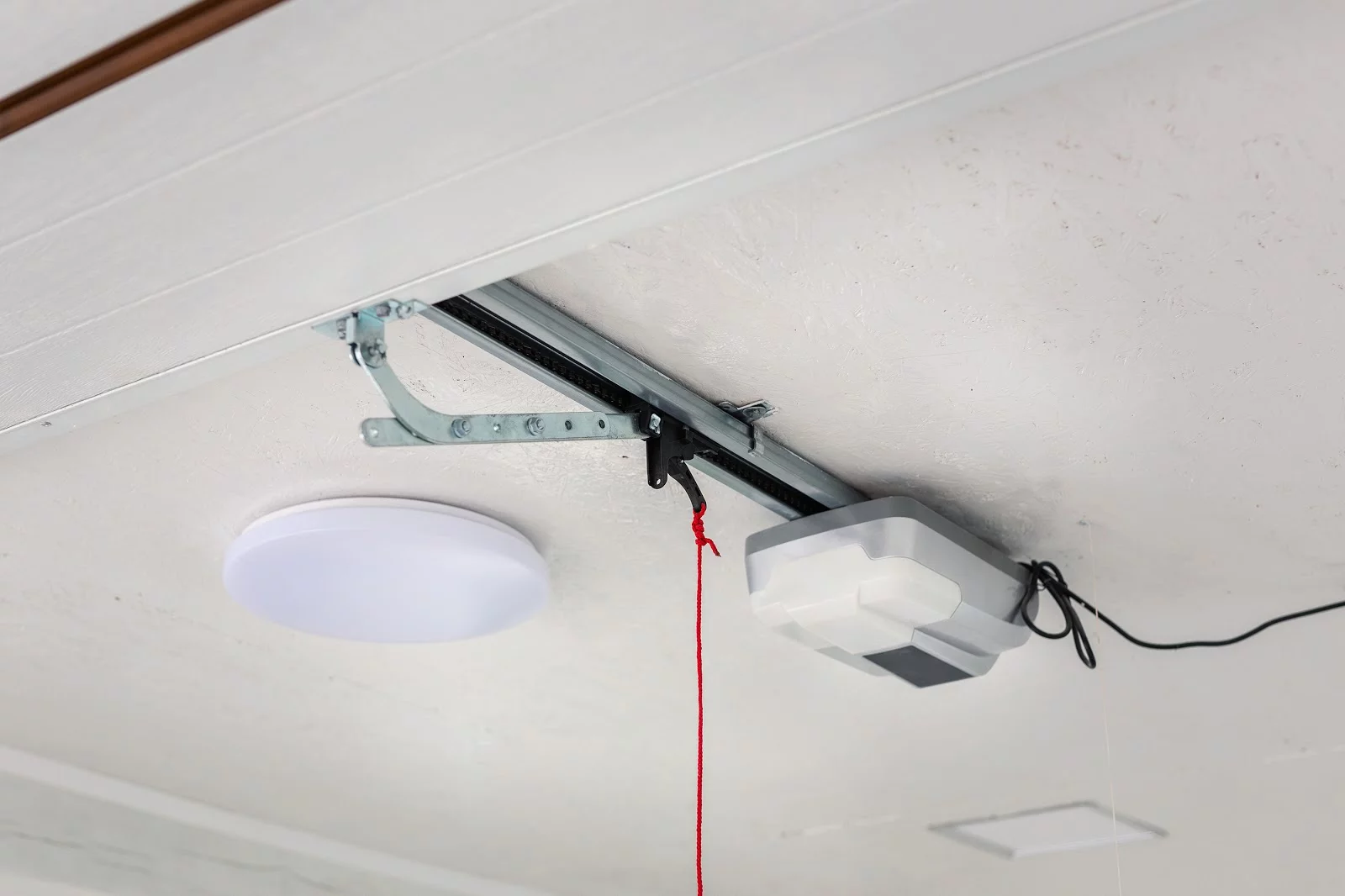
Step 8 — Check the emergency release cord and trolley. If the red cord was pulled so the door could be opened by hand, the opener may run while the door stays put, or the door may feel free but refuse automatic operation until the trolley is reconnected according to the opener design.
Step 9 — Look for mechanical warnings from a safe distance. A crooked door, visible spring gap, cable off a drum, frayed cable strands, bent track, or a door that feels far too heavy are stop signs. Those conditions need professional repair before any further motor cycling.
Step 10 — Decide between safe DIY recovery and a service call. If power, GFCI, and release re-engagement restore normal travel, monitor the door for unusual noise or uneven movement. If the power path is good and the door still will not open—or any mechanical warning is present—call for diagnosis rather than forcing parts.
Power Path Problems: SCE Outage Status, Breakers, and the Opener Outlet
The most common reason a Long Beach garage door “still will not open after the outage” is that the opener never regained clean power—even though living-room lights are back. Utility restoration is not always uniform across every branch circuit. A house can have kitchen power while a garage branch remains tripped, a GFCI can sit open after a surge, and an older outlet can fail to hold a tight connection after vibration or heat cycling.
Start with the utility view, not the door hardware. The SCE Outage Center is the primary place to confirm whether your neighborhood is still affected, whether an estimated restoration time is posted, and whether multiple customers on your circuit are reporting the same interruption. If SCE still shows an active outage for your area, no amount of remote clicking will restore automatic door travel. Use the emergency release only if you understand how to operate the door safely by hand and only if the door is balanced enough to lift without extreme force.
When SCE shows restored service but your garage feels different from the rest of the home, treat the garage as its own electrical zone. Many Long Beach properties—especially older bungalows, converted alley garages, ADU setups, and multi-unit buildings—feed the garage through a dedicated breaker, a subpanel in the garage, or a circuit shared with exterior outlets and landscape lighting. A tripped garage breaker can leave the opener dead while the refrigerator and interior lights behave normally.
At the panel, identify the garage or opener breaker. A breaker that looks “almost on” may actually be tripped into a center position. Reset procedure matters: push it firmly to OFF first, then back to ON. If it trips again instantly, stop. Repeated resets of a shorted circuit can create heat and further damage. At that point you may need an electrician for the branch circuit and a garage door technician for any opener damage caused by the electrical event.
Then inspect the outlet itself. Look for a plug that pulled partially out, a cracked faceplate, scorch marks, a loose receptacle, or an extension cord that was never intended as a permanent opener supply. Openers should use a properly grounded receptacle. Temporary “workarounds” after an outage often become permanent hazards. If the outlet feels warm, smells burnt, or arcs when you seat the plug, leave it alone and call for professional electrical and door evaluation.
Power-path diagnosis also protects your decision-making later. If the opener never received stable power, you do not yet know whether the logic board, travel system, sensors, or springs are healthy. Confirm power first so later observations—lights, clicks, humming, incomplete travel—mean something.
GFCI Outlets and Garage Door Openers After an Outage
Ground-fault circuit interrupter (GFCI) protection is common in garages, and it is one of the highest-yield checks after a Long Beach power interruption. GFCI devices are designed to open quickly when they detect current imbalance. Power restoration, moisture near coastal properties, damp alley garages, and aging outlets can all contribute to trips that leave the opener completely dark.
Find the GFCI that protects the opener. Sometimes it is the receptacle the opener plugs into. Sometimes it is another outlet in the garage, laundry area, exterior wall, or bathroom that feeds downstream receptacles. Sometimes protection is at a GFCI breaker in the panel. Press RESET firmly. If the device will not reset, or resets and trips again when the opener is plugged in, do not keep forcing it. That pattern can mean a defective GFCI, moisture intrusion, a damaged opener cord, or a genuine ground fault.
Coastal Long Beach conditions make GFCI behavior especially relevant. Properties in Belmont Shore, Naples, Alamitos Beach, Bluff Park, and near the Port often see more humidity, salt air, and temperature swings. Condensation on metal boxes, corroded contacts, and outdoor receptacles tied into the same circuit can increase nuisance trips after storms or outages. A door that “dies every time the power blips” may need outlet replacement, circuit diagnosis, or a cleaner power path—not a brand-new opener.
After a successful GFCI reset, test with the wall control. If the opener wakes up and the door travels normally, monitor for repeat trips over the next few days. Recurring GFCI trips after every restoration are a maintenance signal. If the opener stays dead after a confirmed reset and a live outlet, move on to opener-response and battery checks rather than assuming the GFCI is still the villain.
This step also matters for renters and landlords. In multi-unit buildings around Downtown, Poly High, and Cambodia Town, tenants may not know which GFCI feeds the garage. Property managers should document which receptacle or breaker protects common garage openers so outage recovery does not turn into a guessing game after dark.
Opener Response, Lights, Wall Button, Remotes, and Safety Sensors
Once power reaches the outlet, the opener’s behavior becomes diagnostic. Press the hard-wired wall button first. Remotes and wireless keypads introduce extra variables—dead batteries, radio interference, and unprogrammed controls—that can confuse an outage recovery. The wall button is the cleanest test of whether the opener’s control circuit is alive.
Interpret what you hear and see. No lights and no sound usually means power is still not reaching the unit, the logic board is dead, or a fuse/internal protection has opened. Lights that turn on with a click but no movement can indicate travel-limit confusion after a reboot, a safety-sensor fault, a locked trolley, or a door the opener refuses to move because force thresholds are being hit. A continuous hum with a door that does not travel often points to a mechanical bind, stripped gearing, or a door that is too heavy because of spring failure.
Safety sensors deserve a deliberate look after outages. Photo-eye sensors at the bottom of the tracks can be bumped when people move cars by flashlight, when storage shifts in a crowded Long Beach garage, or when someone manually walks the door. Misaligned sensors commonly prevent closing and can also interrupt normal open/close logic depending on the opener model and fault state. Check that lenses are clean, wiring is seated, and both sensors show their normal indicator state. Do not bend brackets aggressively; small alignment changes are enough.
Remote and keypad issues are secondary. Replace remote batteries if the wall button works and the handheld does not. Reprogramming may be needed after some power events, but only after you confirm the opener itself travels with the wall control. Otherwise you will chase wireless settings on a machine that never had power or never re-engaged the trolley.
Consumer safety guidance for automatic residential garage door operators emphasizes proper operation, safety features, and avoiding unsafe bypass habits. The U.S. Consumer Product Safety Commission maintains publicly available guidance on automatic residential garage door operators at CPSC: Automatic Residential Garage Door Operators. Use that as background for safe opener behavior—not as a substitute for diagnosing a door that is mechanically unsafe.
If the opener lights and responds but the door will not open, resist the urge to hold the button down repeatedly. Repeated stalled motor runs heat the unit and can destroy gearing that was still salvageable. Document the symptom—lights only, hum only, short travel, reverse, or full silence—and pair it with the mechanical visual checks described later.
Backup Battery Behavior During and After an SCE Outage
Many modern openers include a backup battery so the door can operate for a limited time during a utility interruption. In Long Beach, that feature is useful during SCE outages—especially if you need to leave for work while the neighborhood is still dark. But battery backup is widely misunderstood. It is temporary. It is not a guarantee that the door will open if springs are broken. It will not overcome a door that is off track. And a neglected battery may be dead exactly when you need it.
During an outage, a healthy backup system may allow a few cycles. After restoration, the opener should recharge the battery. If your door operated on battery during the blackout and then failed once grid power returned, the problem may be elsewhere: GFCI, breaker, outlet, trolley, or a logic board that did not reboot cleanly. If the door never operated during the outage despite having a labeled battery backup, the battery may be depleted, disconnected, swollen, or aged out.
Inspect status indicators if your model provides them. Some units flash codes for charging, battery fault, or low capacity. Look for corrosion on terminals, a battery hot to the touch, or a pack that has clearly ballooned. Do not puncture or crush a damaged battery. Replacement is a maintenance item for openers that are otherwise healthy; it is not a cure for a door that feels extremely heavy or sits crooked.
Battery backup also changes how people behave during outages. Homeowners who trust the battery may never practice manual release operation. Then, when the battery is dead, they pull the release cord for the first time in years—sometimes incorrectly—and create a trolley engagement problem after power returns. Learning how your specific opener’s release and reconnect process works before the next outage is a practical preparedness step for Long Beach households.
From a repair-planning standpoint, a failed backup battery is usually inexpensive relative to full opener replacement. Replace the battery when diagnosis shows the opener and door are otherwise sound. Replace the opener when the logic board, gear train, rail drive, or repeated electrical failures make further battery investment a poor value. That decision belongs after inspection, not during the anxiety of an outage evening.
Emergency Release Cord, Manual Operation, and Trolley Re-Engagement
The emergency release cord is the red handle hanging from the opener trolley. It exists so you can disconnect the door from the motor and operate the door manually during a power failure. In Long Beach outages, this cord is used constantly—and it is also one of the top reasons doors “will not open automatically” after SCE restores power.
If someone pulled the release to get a car out, the opener may later run along the rail while the door stays closed, or the door may feel free but refuse to reconnect. Different opener designs re-engage differently. Some reconnect when you align the trolley and run the opener; others require you to pull the cord toward the door or rail at a certain angle, then seat the carriage until it clicks. Forcing the door up while the trolley is in the wrong position can bend arms, stress brackets, or leave the system half-connected.
Manual operation is only safe when the door is reasonably balanced. A door with healthy springs should lift with steady, manageable force. If the door feels like dead weight, stops unevenly, or wants to slam, stop. That is a spring or cable problem, not an outage-reset problem. Continuing to muscle a heavy door is how people injure themselves and how cables leave drums.
After reconnecting, test with the wall button through a full open and close cycle. Watch for hesitation at the start of travel, scraping at the tracks, and whether the door stops short of fully open. Incomplete travel after a manual episode can mean the trolley reconnect worked but travel limits need professional adjustment—or that the door’s balance changed.
For alley-access homes in Belmont Heights, Bluff Heights, and parts of East Long Beach, practice matters. Alley garages are often tight, poorly lit during outages, and shared with trash cans or neighboring parking. Knowing where the release cord is, how to secure the door after manual opening, and how to reconnect later reduces the chance of a midnight improvisation that damages the system.
Industry safety resources such as DASMA garage door system safety tips reinforce a core message that fits this section well: garage doors are large moving systems, and unsafe improvisation around springs, cables, and forced operation creates preventable injuries. Use the release cord as designed; do not turn an outage workaround into a hardware project.
Mechanical Warnings the Outage May Reveal: Springs, Cables, Tracks, and Trolley Strain
Not every post-outage failure is electrical. Sometimes the outage simply forced a manual lift that revealed a door which was already failing. Springs that were close to breaking can snap during a heavy lift attempt. Cables that were fraying can leave a drum when the door is walked up unevenly. A trolley that was worn can refuse to re-engage cleanly. Tracks that were slightly bent can jam when the door is moved by hand instead of by the opener’s steadier pull.
Spring warning signs include a visible gap in a torsion spring, a door that feels dramatically heavier than usual, a door that will not stay halfway open when disconnected, or a loud prior bang that neighbors heard during the outage period. Extension spring issues may show as a stretched or dangling spring, but any spring work is professional territory. Springs store dangerous energy. Looking is fine; adjusting is not a DIY step.
Cable warning signs include slack cable, cable off the drum, frayed strands near the bottom bracket, or a door sitting crooked in the opening. A crooked door after manual operation is a stop-work signal. Do not use the opener to “pull it straight.” That can bend the track, tear the cable, or damage panels. Cable and drum problems need controlled professional repair, especially on older Long Beach doors with worn hardware.
Track and roller issues show up as grinding, popping, visible bends, rollers climbing out of the track, or doors that stick at the same height every time. Crowded garages in North Long Beach, Wrigley, and multi-unit properties often take side hits from vehicles, bins, and storage. An outage is not the root cause, but flashlight driving and hurried manual operation can finish the job.
Trolley and opener-arm strain appears when the motor runs, the rail carriage moves, and the door barely twitches—or when reconnect attempts feel rough and incomplete. Sometimes the opener is fine and the door is too heavy. Sometimes the gearing is stripped from prior stalling. Diagnosis separates those cases so you do not replace an opener while a broken spring continues to destroy the next unit.
If any mechanical warning is present, shift from DIY recovery to professional inspection. The goal after an outage is restored safe access, not a temporary forced opening that creates a bigger repair tomorrow.
Broken or Weak Springs
After manual lifting, a weak spring system may make the door feel immovable. The opener may hum without raising the door. Spring repair or replacement must be done by a trained technician.
Cable and Drum Issues
Slack, frayed, or unseated cables can leave the door crooked. Do not run the opener to correct a cable that left the drum during manual operation.
Track, Roller, and Bind Points
Bent track sections and worn rollers create the same “won’t open” symptom as a dead outlet. Visual inspection from the ground helps separate bind from power loss.
Safe Checks You Can Do Before Calling for Garage Door Repair
Safe checks are visual and low-force actions. They exist to restore simple power-path problems and to collect better symptom information for a technician. They are not a license to dismantle the door.
Check SCE status for your Long Beach address or neighborhood on the Outage Center. Confirm whether nearby homes have power. Test a garage light or receptacle. Reset a tripped garage breaker once using the OFF-then-ON method. Reseat the opener plug. Reset GFCI devices that protect the garage circuit. Try the hard-wired wall button. Replace remote batteries only after the wall button test. Look at photo-eye sensors for obvious blockage or knocked brackets. Observe whether the emergency release cord was pulled and whether the trolley looks disconnected. From the ground, look for a spring gap, slack cable, crooked door position, or bent track.
If the door is disconnected and feels balanced, you may carefully lift it to about mid-height to see whether it holds. If it will not hold, treat that as a spring-balance failure and leave further movement alone. If it holds and travels smoothly, reconnect according to your opener’s design and run one full powered cycle while watching for unusual noise.
Write down what you observed: outage duration if known, whether GFCI was tripped, whether the opener has lights, whether it hums, whether the door is crooked, whether the release was used, and whether the door is unusually heavy. That notes list shortens diagnosis when you call (424) 310-0074.
- Confirm SCE restoration status for your block
- Check garage breaker and dedicated opener circuit
- Reseat the opener plug in a grounded outlet
- Reset GFCI outlets or GFCI breakers once
- Test the hard-wired wall button before remotes
- Note opener lights, clicks, hums, or silence
- Inspect backup battery status lights if equipped
- Check whether the emergency release was pulled
- Look for sensor blockage without forcing brackets
- From the ground, look for spring gaps or slack cables
- Stop if the door is crooked, heavy, or binding
- Document symptoms before approving any repair
What Not to Do When the Garage Door Won’t Open After an Outage
Post-outage frustration leads to predictable mistakes. Avoid them and you avoid converting a reset problem into a multi-part repair.
Do not keep hammering the remote or wall button when the door does not move. A stalled opener can overheat and damage gears. Do not stand under a door that is partially open and unsupported. Do not wedge lumber under a half-open door as a long-term “solution.” Do not climb a ladder to put wrenches on torsion springs, drums, or cables. Do not lubricate a problem you have not identified just to feel proactive. Do not cut and splice opener cords with makeshift connectors. Do not bypass safety sensors with tape or fake “fixes” so the door will move.
Do not assume the opener is bad because it is silent—silence often means no power. Do not assume the opener is fine because it hums—humming can mean the motor is fighting a broken spring. Do not pay for a same-day opener replacement before anyone checks GFCI, trolley engagement, and door balance. Do not let a technician start invasive work without explaining the failed component in plain language.
CPSC and DASMA safety materials both support a cautious approach around automatic operators and garage door systems. When in doubt, stop using the system and get a professional inspection rather than inventing a workaround that disables safety features.
- Repeatedly stalling the opener motor against a stuck door
- Adjusting or winding torsion or extension springs yourself
- Forcing a crooked door with the opener “to straighten it”
- Bypassing photo-eye sensors so the door will travel
- Using damaged extension cords as a permanent power source
- Ignoring a door that feels extremely heavy by hand
- Approving opener replacement before balance is verified
- Leaving a partially open door unsecured overnight
Post-Outage Garage Door Symptom Comparison Table
Use this table to match what you are seeing with the most likely first checks. It is a diagnostic aid, not a final verdict. Long Beach homes vary by opener brand, door weight, spring type, and electrical layout.
| What you notice | Likely first cause | Safe first check | Call for repair if… | Risk if ignored |
|---|---|---|---|---|
| Whole garage still dark after neighbors have power | Garage breaker, subpanel, or local wiring issue | Panel reset once; test other garage outlets | Breaker retrips immediately or outlet shows damage | Electrical hazard; repeated trip heat |
| Garage has power; opener totally dead | Unplugged unit, GFCI trip, dead outlet | Reseat plug; reset GFCI; verify outlet with a lamp | Outlet arcs, GFCI will not reset, or board stays dead | Missed simple reset; unnecessary opener replacement |
| Opener lights work; door never moves | Disconnected trolley, sensor fault, travel/force issue | Check release cord; inspect sensors; use wall button | Trolley will not re-engage or door binds | Stripped gears from stalled cycles |
| Opener hums; door stays closed | Broken spring, locked trolley, stripped gearing | Stop cycling; check door weight by careful hand lift if safe | Door is extremely heavy or crooked | Motor burnout; cable damage |
| Door worked on battery during outage; fails after restore | GFCI/breaker after restoration; reboot fault | Recheck power path and wall button | Power is confirmed and opener still fails | Intermittent no-access after every outage |
| Battery backup never ran during blackout | Depleted/failed backup battery | Inspect battery status lights and age | Battery swollen/corroded or opener still dead on grid power | No manual-cycle option in future outages |
| Release cord was pulled; opener runs alone | Door disconnected from trolley | Re-engage trolley per opener design | Carriage will not lock or door feels unsafe | Bent arm; incomplete reconnect |
| Door sits crooked after manual opening | Cable off drum, spring failure, track issue | Do not use opener; photograph from safe distance | Any crooked position or slack cable | Panel damage; cable snap; injury risk |
| Door opens a few inches then stops | Bind, force setting, weak spring, track debris | Look for obstruction; stop repeated attempts | Symptom repeats after clearing debris | Opener strain; roller failure |
| Remote dead; wall button works | Remote battery or programming | Replace remote battery; retest | Wall button also fails later | Access inconvenience only—until wall control fails too |
| Door closes then immediately reverses | Sensor misalignment or obstruction | Clean lenses; check alignment indicators | Sensors damaged or wiring cut | Security gap if door will not stay closed |
| Burning smell from opener after restore | Electrical damage or motor overheating | Unplug opener; stop use | Any smell, smoke, or heat at the unit | Fire risk; total unit failure |
Repair vs Replace the Opener After a Power Outage
An outage is a stressful moment to decide on opener replacement. Sales pressure thrives when people are locked out of a car or trapped at home. A better frame is: restore safe function with the smallest durable repair, then evaluate age and reliability.
Repair tends to make sense when the door is balanced, tracks are sound, the trolley re-engages, and the failure is a GFCI event, backup battery, sensor alignment, limit adjustment, or a discrete opener part on a relatively young unit. Repair also makes sense when the “dead opener” was never powered in the first place.
Replacement tends to make sense when the logic board is dead after confirmed power, gears are stripped, the rail drive is worn, parts are discontinued, the unit repeatedly fails after electrical events, or the opener lacks modern safety and battery features that you actually need for Long Beach outage patterns. Replacement should still wait until door balance is verified. Installing a new opener on broken springs is a fast way to destroy the new motor.
Ask for a clear explanation of what failed. “Your opener is old” is not a diagnosis. “The GFCI was tripped and the trolley was disconnected” is a diagnosis. “The worm gear is stripped and the door balance is good, so replacement is more practical than gear-kit repair on this model” is a diagnosis plus a reasoned recommendation.
Cost planning should include related parts only when they are actually needed: battery, sensors, remote reprogramming, or spring work discovered during inspection. Be wary of bundled “while we are here” replacements that were not tied to a failed component. A trustworthy Long Beach technician can separate must-fix items from optional upgrades.
Same-Day and Emergency Help When You Cannot Wait for Access
Same-day garage door repair matters when a vehicle is trapped, a medical appointment depends on leaving, a rental tenant is locked out of parking, a small business cannot receive deliveries, or a door is stuck in an unsafe partially open position. Emergency priority is even higher when a door is stuck open and the property is exposed, or when cables and springs have clearly failed.
Not every post-outage no-open situation is an emergency. A tripped GFCI at 2 p.m. with a car already outside may be a quick self-check. A broken spring at 11 p.m. with the only vehicle trapped inside is a different category. When you call, describe whether the door is fully closed, partially open, crooked, heavy, humming, silent, or manually disconnected. That information helps the dispatcher prioritize.
Garage Door Repair Long Beach By On The Spot can discuss current same-day or emergency availability at (424) 310-0074. Availability varies by schedule, parts needs, and how many outage-related calls arrive after a widespread SCE event. After major neighborhood outages, call volume rises quickly because many households discover trolley and GFCI issues at the same time.
While you wait for service, keep people and pets clear of the door path. If the door is open and will not close, secure the property another way if possible and avoid improvised props that can kick out. If the door is closed and will not open, do not attempt spring work while waiting.
Long Beach Local Conditions That Affect Garage Doors After Power Outages
Long Beach is not a generic suburb with identical garages. Coastal air, alley access, older housing stock, multi-unit living, and SCE circuit patterns all change how outage-related door failures show up. Understanding local conditions helps you ask better questions and avoid generic advice that ignores how this city actually parks, stores, and powers its garage doors.
Downtown Long Beach and the urban core. Dense housing, podium garages, older converted spaces, and mixed-use buildings mean tenants may not control the breaker that feeds an opener. After an outage, building staff or property managers may need to reset common panels. Communication matters: a tenant clicking a remote in a dark garage may not know a house panel one floor away tripped.
Belmont Shore, Naples, and Belmont Heights. Coastal moisture accelerates hardware corrosion on rollers, hinges, fasteners, and outdoor keypads. GFCI nuisance trips can be more common around damp conditions. Alley-loaded garages leave little room to maneuver a car by flashlight, which increases hurried emergency-release use during blackouts.
Alamitos Beach, Bluff Park, and Bluff Heights. Compact lots and older door systems are common. A door that was already noisy or uneven before the outage may fail completely once someone lifts it manually. Homeowners here should treat pre-outage maintenance—spring condition, cable inspection, roller wear—as preparedness, not cosmetics.
Bixby Knolls and California Heights. Many properties combine residential openers with detached garages that have their own electrical quirks. Detached garages may sit on older feeders or separate subpanels. After SCE restoration, the house may light up while the detached garage remains dark until a local breaker is reset.
Los Altos, El Dorado Park, and East Long Beach. Larger residential doors and two-car openings are common. Heavier doors punish weak springs during manual operation. Families who rely on battery backup for school-morning departures should test backup function before storm season rather than during the first multi-hour outage.
Wrigley, Rose Park, Zaferia, and Cambodia Town. Rental density is higher in several of these areas. Landlords and tenants often share responsibility confusion after outages: who resets the GFCI, who pays for a failed battery, who authorizes spring repair if manual lifting revealed a failure. Clear property protocols prevent doors from sitting broken for days.
North Long Beach and West Long Beach. Mixed residential and light commercial uses mean some “garage doors” are business access points. An outage that leaves a door closed can stop a contractor from loading tools or block a warehouse bay. Same-day diagnosis has operational value beyond household convenience.
Signal Hill, Lakewood, Seal Beach, Los Alamitos, and Rossmoor. Nearby communities share similar SCE outage patterns and coastal-adjacent wear. Commuters who park work vehicles in these areas often discover post-outage door problems at dawn. Having a local repair contact saved in your phone is practical preparedness.
Cerritos, Bellflower, Paramount, Carson, San Pedro, and Wilmington. These surrounding cities appear frequently in regional service patterns. San Pedro and Wilmington add stronger coastal corrosion pressure. Carson and industrial-adjacent areas may include heavier doors that are especially unsafe to force by hand after spring failure.
Across all of these neighborhoods, the GEO pattern is consistent: confirm SCE status, reset local protection devices, re-engage the trolley if the release was used, then treat mechanical warnings as professional work. Local context changes the frequency of each failure mode, not the safety rules.
Questions to Ask Before Hiring Help for a Post-Outage Garage Door Problem
Good questions protect you from both under-diagnosis and overselling. Ask them before authorizing major parts replacement.
- Did you confirm the outlet, breaker, and GFCI are delivering power to the opener?
- Was the emergency release disconnected, and is the trolley fully re-engaged?
- Is the door balanced, or are springs contributing to the no-open condition?
- What exact part failed, and how did you verify it?
- Are you recommending repair or replacement, and why is that the better value?
- Will the door be safe to operate manually if another SCE outage happens tonight?
- Does the estimate include only failed components, or optional upgrades too?
- If sensors or limits need adjustment after reconnect, is that included?
- What warranty covers parts and labor on the recommended repair?
- Can you show me the broken gear, battery, cable, or spring condition?
Also ask how the technician will leave the system after service. You want a full open/close test, a confirmation of sensor function, and a brief explanation of how to use the emergency release correctly before the next outage. For rental properties, ask for notes you can share with tenants so the same GFCI or release confusion does not repeat.
Red Flags When Hiring Garage Door Repair After a Power Outage
Outages create urgency, and urgency attracts weak sales tactics. Watch for these warning signs.
- Anyone who refuses to check power, GFCI, or trolley engagement before quoting a full opener replacement
- A quote that changes dramatically after “opening the unit” with no explanation of findings
- Pressure to decide immediately because “this price expires when I leave the driveway”
- Recommendations to bypass sensors permanently so the door will move
- Spring or cable work quoted without showing you the unsafe condition
- No business identity, no local phone number, and no clear service address
- Demands for large cash-only payment before diagnosis
- Dismissing a crooked door as “normal after an outage”
A trustworthy process is calm and specific. It names the failed system, separates electrical recovery from mechanical repair, and gives you a clear choice when repair and replacement are both technically possible. You can review the local business presence of Garage Door Repair Long Beach By On The Spot on Google Maps, call (424) 310-0074, or visit the website for contact options.
Why Consider Garage Door Repair Long Beach By On The Spot?
Garage Door Repair Long Beach By On The Spot is a local Long Beach garage door repair company serving homeowners, landlords, renters, property managers, real estate investors, HOA communities, apartment buildings, small businesses, warehouses, storefronts, and local commercial properties.
For post-outage problems, the valuable approach is diagnosis first: confirm whether the issue is SCE-side, breaker-side, GFCI-side, outlet-side, backup-battery-side, emergency-release-side, sensor-side, spring-side, cable-side, track-side, or opener-drive-side. That sequence prevents the two most expensive mistakes—replacing an opener that never had power, and powering an opener that is fighting a broken spring.
The company can help with garage door repair, same-day garage door repair, emergency garage door repair, opener repair, opener replacement planning, backup battery evaluation, torsion and extension spring repair, cable repair, off-track doors, roller and track issues, sensor problems, noisy door concerns, tune-ups, and maintenance conversations that reduce the chance the next outage turns into a lockout.
NAP for local trust signals: Garage Door Repair Long Beach By On The Spot, 151 E 5th St, Long Beach, CA 90802, (424) 310-0074, longbeachcagaragedoorrepair.com, with map listing at Google Maps CID 5381478035707257267.
No company should invent guarantees it cannot keep. Service timing depends on schedule and parts. What you should expect is clear communication about findings, safer recommendations than forced DIY, and repair options explained in plain language.
Areas Served From the Long Beach Location
Garage Door Repair Long Beach By On The Spot serves customers in Long Beach and nearby communities from its Long Beach location. Service availability may vary by schedule, door type, property type, and repair scope. Post-outage garage door problems—GFCI trips, backup battery failures, emergency-release reconnects, spring discoveries after manual lifting, and opener no-responses—are common across these areas whenever SCE interruptions hit.
Google Map Location
View the Long Beach garage door repair location on Google Maps. Use this listing to confirm the business identity before scheduling post-outage service:
Direct map link: Garage Door Repair Long Beach By On The Spot on Google Maps.
FAQs About Garage Doors That Won’t Open After a Power Outage in Long Beach
Why won’t my garage door open after the power comes back on in Long Beach?
The most common reasons are a tripped garage breaker, a GFCI outlet still open, an unplugged or dead opener outlet, a depleted backup battery paired with another fault, an emergency release that left the trolley disconnected, misaligned sensors, or a mechanical problem such as a broken spring or cable that became obvious during manual operation. Start with SCE status and the power path before assuming the opener failed.
Should I check SCE first or the garage door springs first?
Check SCE and local power first. Springs matter enormously for safety, but many post-outage “no open” calls are electrical or release-related. Use the SCE Outage Center to confirm restoration, then inspect breakers, outlets, and GFCI devices. Evaluate springs if the door is heavy, crooked, or will not balance.
What does a GFCI have to do with my garage door opener?
Many garage receptacles are GFCI-protected. During outages and restoration surges—especially in coastal or damp Long Beach garages—those devices can trip and leave the opener completely dark even when house lights work. Resetting the correct GFCI is often the fastest fix.
My opener lights turn on but the door will not move. What now?
Power is likely reaching the unit. Check whether the emergency release disconnected the trolley, whether sensors are blocked or misaligned, and whether the door binds or feels extremely heavy. Do not repeatedly stall the motor. If the door is crooked or heavy, stop and call for repair.
Is it safe to use the emergency release during every SCE outage?
It is the designed method for manual operation when the door is balanced and tracks are sound. It is not safe to force a door that feels like dead weight or sits unevenly. Learn your opener’s reconnect process before the next outage so restoration does not leave you stuck.
Can a backup battery open a door with broken springs?
Do not count on it. Battery backup powers the opener; springs carry the door’s weight. A broken spring can leave even a powered opener unable to lift the door safely. If the door is unusually heavy, treat it as a spring problem.
Should I replace the opener after one power outage?
Not automatically. Many openers recover fully after GFCI resets, trolley reconnects, battery replacement, or sensor alignment. Replace when diagnosis shows a failed logic board, stripped gearing, repeated electrical failures, or an aged unit where repair is not practical—and only after confirming door balance.
The door is crooked after we opened it by hand. Can we run the opener to straighten it?
No. A crooked door often means a cable, spring, or track problem. Running the opener can worsen damage. Keep clear, photograph from a safe distance if useful, and schedule professional cable/spring/track repair.
What if I am a renter and the garage door will not open after an outage?
Notify the landlord or property manager quickly, especially in multi-unit buildings where common panels or shared GFCI devices may be involved. Share what you already checked: neighborhood power, wall button response, and whether the release cord was pulled. Do not attempt spring or cable repairs as a tenant DIY project.
When is a post-outage garage door problem an emergency?
Treat it as urgent if a vehicle is trapped and needed, if the door is stuck open and the property is exposed, if cables or springs have failed, if the door is partially open and unsafe, or if there is burning smell/heat at the opener. Call (424) 310-0074 to ask about current emergency or same-day availability.
Do photo-eye sensors fail because of power outages?
Sensors can reboot into a fault state, lose alignment if bumped during flashlight parking, or reveal wiring problems after restoration. Clean lenses and verify indicator lights. Do not bypass sensors to force travel.
Where can I read official safety guidance about garage door operators and systems?
See the CPSC FAQ on automatic residential garage door operators and DASMA safety tips for garage door systems, linked in the Authority Sources section below. For utility status in Long Beach, use the SCE Outage Center.
Call for Help If Your Garage Door Won’t Open After a Power Outage in Long Beach
If you have checked SCE status, breakers, outlets, GFCI devices, wall-button response, backup battery indicators, and emergency-release engagement—and the door still will not open—or if you see spring, cable, or crooked-door warnings—stop forcing the system and get a diagnosis.
Garage Door Repair Long Beach By On The Spot | 151 E 5th St, Long Beach, CA 90802 | (424) 310-0074 | longbeachcagaragedoorrepair.com
How Long Beach Homeowners Can Prepare Before the Next SCE Outage
The best time to solve post-outage garage door chaos is before the next interruption. A short preparedness routine reduces lockouts and unsafe improvisation.
Label the garage/opener breaker in your panel so you are not guessing by flashlight. Locate every GFCI that might feed the garage and test/reset them during daylight once or twice a year. Know where the emergency release cord is and read the reconnect method for your opener brand. Replace opener backup batteries on a maintenance schedule rather than after failure. Keep a charged flashlight in the car and another in the house. Photograph your spring type and opener model label for faster parts conversations.
Schedule maintenance if the door is already noisy, uneven, slow, or heavy. Outages turn marginal doors into no-access doors. Rollers, hinges, cables, and balance should be inspected before storm season and before periods when SCE warns about higher outage risk. Coastal properties should pay extra attention to rusted fasteners and sticky hardware that make manual operation harder.
For landlords and HOA boards, create a one-page outage protocol: who resets common GFCI devices, who tenants call first, what not to touch, and how to request after-hours service. That document alone can prevent unsafe tenant DIY around springs and cables.
Preparedness is an E-E-A-T practicality signal as much as an SEO topic cluster: experience shows that households with a labeled breaker and a known release process recover faster, with fewer damaged trolleys and fewer emergency spring calls that could have been maintenance calls.
What a Diagnosis-First Service Visit Looks Like After an Outage
A credible service visit after a power outage should feel methodical. The technician typically confirms whether power is present at the receptacle, whether protective devices have tripped, whether the opener powers on, whether the trolley is engaged, whether sensors are aligned, and whether the door is balanced before recommending major parts.
Expect questions about when SCE power returned, whether anyone pulled the release cord, whether the door was operated manually, whether you heard a bang, and whether the opener hummed or stayed silent. Those details are not small talk; they route the diagnosis.
If spring or cable work is required, the technician should explain why the door is unsafe to operate and what hardware will be replaced. If the opener needs replacement, you should hear why repair is not practical on that unit and whether door balance was verified first. You should also get a post-repair demonstration of open/close travel and release operation.
This process-centered approach is how homeowners can evaluate expertise and trustworthiness without relying on hype. It also creates clearer outcomes for AI-overview style answers: power path first, release second, mechanical warnings third, repair-versus-replace last.
Rentals, Alleys, and Coastal Garages: Special Post-Outage Cases in Long Beach
Rental properties create split incentives. Tenants need immediate access; owners need durable repairs and documentation. After an outage, tenants should report symptoms quickly and avoid spring work. Owners should authorize diagnosis that checks electrical recovery and mechanical safety, not just a remote replacement. Security deposits and lease language rarely answer what to do at 6 a.m. when a car is trapped—having a preferred Long Beach repair contact does.
Alley garages deserve special caution. Limited lighting, tight turn radii, and shared alley traffic make manual door operation riskier. If you must open manually during an outage, clear the path first, use adequate light, and secure the door fully open so it cannot drop while a vehicle exits. After power returns, reconnect carefully and test travel before leaving the property.
Coastal garages add corrosion and moisture into the electrical story. Outdoor GFCI devices, weathered receptacle covers, and salt-air hardware wear can make “random” post-outage failures look mysterious when they are actually environmental maintenance issues. If your opener dies after every marine-layer week plus every outage, ask for an inspection of the outlet environment and door hardware condition together.
Condo and HOA shared garages add another layer: common equipment rules, vendor approval lists, and access codes. If your community restricts which contractors may work on common doors, know that process before an outage. Individual deeded garages still benefit from the same check order described in this guide.
Quick AEO Summary: First Checks When a Long Beach Garage Door Won’t Open After an Outage
For cite-ready clarity: (1) verify SCE restoration via the Outage Center; (2) confirm garage power at lights/outlets; (3) reset the garage breaker if tripped; (4) reseat the opener plug; (5) reset GFCI protection; (6) test the wall button and note lights/sounds; (7) check backup battery status; (8) re-engage the emergency-release trolley if disconnected; (9) stop for professional help if the door is heavy, crooked, off-track, or the opener smells hot; (10) choose repair versus opener replacement only after door balance and power path are confirmed.
Primary entity focus for this page remains garage door won’t open after power outage in Long Beach, with related entities including opener, backup battery, emergency release, GFCI, breaker, springs, cables, trolley, and SCE outage status. Local modifiers include Long Beach neighborhoods, coastal alleys, rentals, HOAs, and same-day access needs.
If you need hands-on help now, call Garage Door Repair Long Beach By On The Spot at (424) 310-0074.
2 Responses