
Long Beach Coastal Corrosion Guide
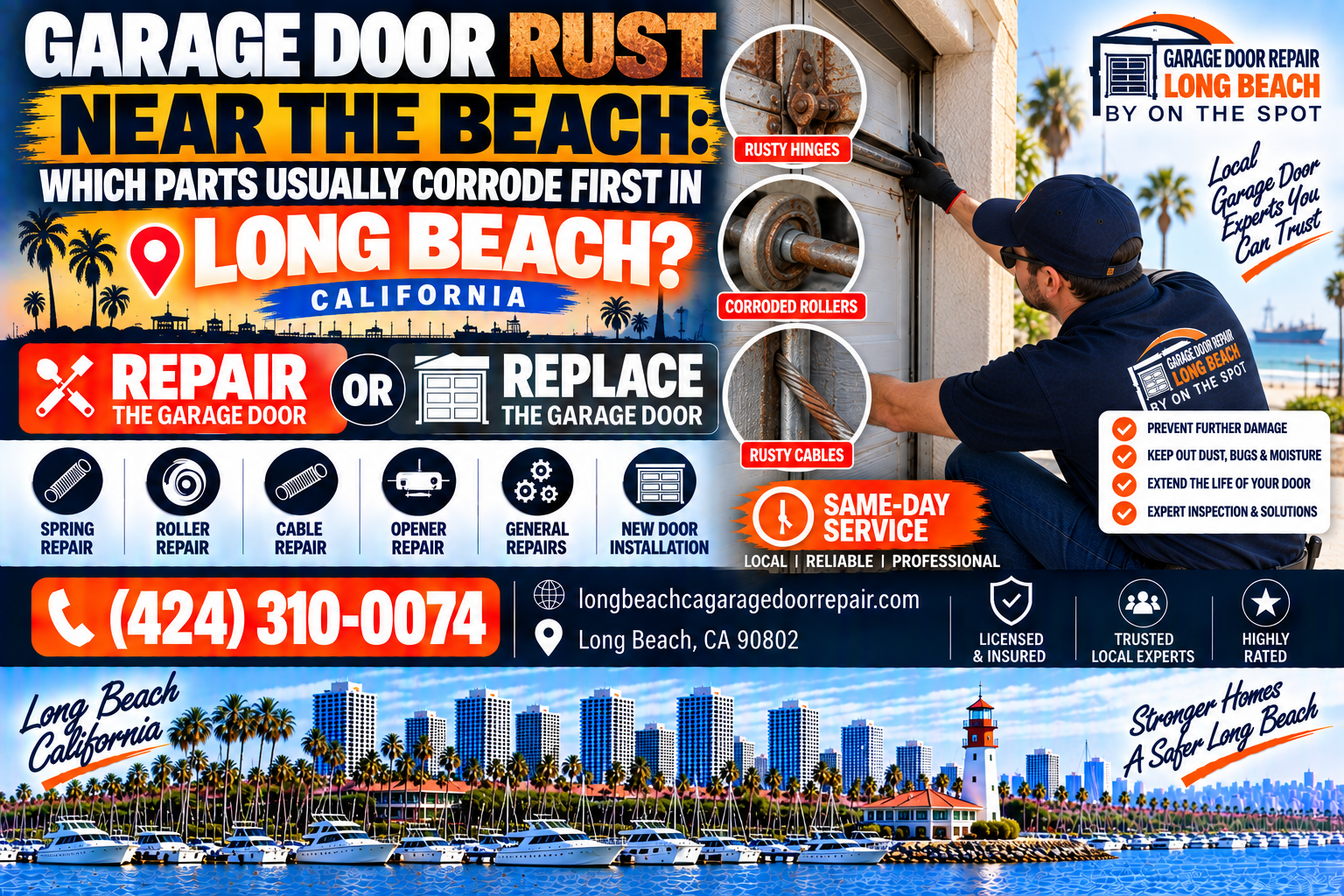
Garage Door Rust Near the Beach: Which Parts Usually Corrode First in Long Beach?
Near Long Beach beaches, which garage door parts usually corrode first? Learn the coastal order—springs, cables, hinges, rollers, tracks, bottom brackets, and fasteners—plus Belmont Shore, Naples, and Alamitos salt-air patterns, prevention versus replace, and why high-tension spring and cable work is never DIY.
Garage Door Repair Long Beach By On The Spot helps homeowners, renters, landlords, property managers, HOA communities, and small businesses stop salt-air hardware failure with diagnosis-first corrosion service across Long Beach, CA.
Hinges / Rollers / Tracks
Bottom Brackets
Belmont Shore / Naples / Alamitos
CPSC + DASMA + SCE
Serving Long Beach, CA
Table of Contents
Direct Answer: Which Garage Door Parts Usually Corrode First Near the Beach in Long Beach?
Near the beach in Long Beach, garage door parts that usually corrode first are the ones that combine steel exposure, thin protective coatings, constant salt-film wetting-and-drying cycles, and mechanical stress: torsion or extension springs, lift cables, hinges and hinge pins, rollers and roller stems, track channels and track brackets, bottom brackets and cable anchors, and fasteners (lag bolts, carriage bolts, track screws, and end-bearing plate hardware). Panel skins and decorative hardware can rust too, but the first safety-critical failures almost always appear in the high-tension and high-cycle metal stack—not in the paint.
A practical Long Beach order of concern for west-facing and marine-layer neighborhoods (Belmont Shore, Naples, Alamitos Beach, and many Alamitos Bay–adjacent streets) is: spring wire surface rust and pitting → cable strand rust and fray → hinge and roller binding with orange dust → track scale and fastener creep → bottom-bracket and cable-anchor corrosion → visible panel edge rust. That order is a field pattern, not a guarantee on every door. A shaded north-facing alley door inland may keep springs looking fine while bottom brackets and fasteners go first because splash, irrigation overspray, and floor moisture dominate.
If you see orange dust under the door, hear grinding that was not there last season, notice a spring with dry orange scale, or find a cable with broken outer strands, treat it as a hardware integrity problem—not a cosmetics problem. High-tension spring and cable work is never a DIY project. Call Garage Door Repair Long Beach By On The Spot at (424) 310-0074 for diagnosis-first coastal corrosion service from 151 E 5th St, Long Beach, CA 90802.
Direct answer in one line: salt air hits springs, cables, hinges, rollers, tracks, bottom brackets, and fasteners first; prevention (rinse, dry, correct lubricant, inspection) slows the clock; replacement restores safe balance; DIY on charged springs or cables is unsafe.
What Beach-Zone Garage Door Rust Really Means in Long Beach
Beach-zone garage door rust in Long Beach is not the same as inland surface oxidation after a few wet winters. Marine air carries chloride ions that stay active on cool metal overnight, then concentrate as dew evaporates in the morning sun. That wetting–drying cycle is aggressive on any carbon steel that is not continuously protected by intact zinc, paint, grease, or stainless alloys. Garage doors cycle daily, so fresh metal is constantly exposed at hinge knuckles, roller stems, cable wraps on drums, and spring coils that flex.
Homeowners often first notice orange dust on the floor under the door, rusty streaks on the inside face of a steel panel, or a spring that looks dusty and dry. Those clues matter because they map to different parts of the system. Floor orange dust under the vertical track or near the bottom corners often means rollers, hinges, or bottom brackets are shedding oxide. Dust under the center of a torsion system can mean spring scale falling from the tube. Streaks on panels may be cosmetic—or may mark fastener weep paths that are loosening lag bolts into the framing.
Rust also changes friction. A door that used to balance and float can start to feel heavy, chatter in the tracks, or reverse on the opener because photo-eye or force settings are fighting sticky rollers and rough hinges. That is why coastal corrosion is an opener-safety topic as well as a hardware topic. Keep operator safety expectations aligned with the CPSC automatic garage door operator FAQs, and keep whole-system repair thinking aligned with DASMA garage door system safety tips—especially when corrosion increases drag and tempts unsafe force adjustments.
In Long Beach, marine layer mornings, Santa Ana wind weeks that push grit into tracks, and west exposures that get afternoon UV all stack together. Salt film plus grit acts like grinding paste. Lubrication that worked inland can wash off or emulsify with salt faster near Belmont Shore and Naples. Understanding that environment is the first step before deciding whether to clean and protect or replace.
Typical Corrosion Order: Springs, Cables, Hinges, Rollers, Tracks, Bottom Brackets, Fasteners
Field tickets across Long Beach coastal streets tend to show a recurring corrosion order, even though every door age, brand, and exposure differs. Think of it as a priority queue for inspection rather than a rigid law of physics.
1) Springs. Torsion spring wire and extension spring coils live under enormous stored energy. Any pitting reduces cross-section. Surface rust is common; deep pits and coil binding are urgent. Springs also sit high where salt aerosol reaches them and where grease thins over time.
2) Cables. Lift cables are multi-strand steel. Outer strands rust and fray first at drum wraps, bottom-bracket anchors, and any place a cable rubs. A single broken strand is a service ticket—not a wait-and-see cosmetic note.
3) Hinges and rollers. Hinge leaves and pins collect salt; nylon rollers can still have steel stems and bearings that seize; steel rollers can pit and flat-spot. Binding here creates noise, panel stress, and opener strain.
4) Tracks and track brackets. Vertical and horizontal tracks hold salt grit in the channel. Brackets and punched holes rust at fasteners. Scale in the channel increases drag even when rollers look fine.
5) Bottom brackets and cable anchors. These live in the wettest, saltiest microclimate near the slab, splash, and coastal fog. Corrosion here threatens cable retention—the catastrophic end of the lift path.
6) Fasteners throughout. Lag bolts into header and jambs, track screws, and end-bearing plate bolts can lose section and grip. Loose hardware amplifies every other symptom.
Panel skins, decorative handles, and exterior hinges on carriage-style doors may look worst photographically, but safety priority still follows tension hardware first. A pretty door with a pitted spring is still a high-risk door.
Torsion and Extension Springs: Why High-Tension Hardware Corrodes Early
Torsion springs (the common tube-mounted pair above the door opening) and extension springs (along the horizontal tracks) are usually among the first parts to show meaningful corrosion near Long Beach beaches because they are bare or thinly coated steel under continuous stress. Salt film finds every coil gap. Morning condensation turns that film into an electrolyte. When the door cycles, coils rub and crack dry oxide, exposing fresh metal.
What homeowners see: orange scale on coils, dry powder under the spring tube, a spring that looks darker and rougher than last year, or—more dangerously—a door that suddenly feels much heavier because one spring has lost effectiveness or has already failed. Extension springs may show rust at hooks, safety cables (if present), and pulley interfaces.
Why first matters: springs store the energy that makes a door liftable. Pitting reduces strength. A corroded spring can fail with less warning than a healthy spring that simply reaches cycle life. Near Belmont Shore and Naples, cycle life and corrosion life can arrive together—especially on older doors that already have high open/close counts.
Never attempt to unwind, cut, clamp, or oil heavily and hope on a charged spring. Spring replacement is a trained, tool-specific job. Garage Door Repair Long Beach By On The Spot replaces springs as a matched, balanced system and inspects cables, drums, bearings, and fasteners in the same visit because coastal corrosion rarely stops at one part. Call (424) 310-0074.
Prevention that helps springs: keep the garage drier when possible, rinse salt film from accessible non-tension areas carefully without blasting water into bearings, use manufacturer-appropriate lubricant sparingly on torsion spring surfaces when recommended (never as a substitute for replacement of pitted wire), and schedule seasonal inspections if you live within a few blocks of the sand or Alamitos Bay.
A spring that looks only lightly orange can still hide pits in the wire valleys. Pros look for pitting depth, coil binding, stretch gaps when the door is in a position that allows safe visual assessment, and mismatched spring wear on paired systems. Coastal honesty means replacing on pits rather than polishing for photos.
Lift Cables: Fraying, Rust Staining, and Why Cable Work Is Never DIY
Lift cables usually corrode early in beach neighborhoods because they are flexible steel rope with huge surface area, constant flex at the drum, and an anchor at the bottom bracket where moisture and salt concentrate. Outer strands rust first. Once outer strands break, remaining strands take more load and the cable can fail suddenly.
Visual clues: rusty cable color instead of bright steel, broken whisker strands near the drum or bottom bracket, uneven cable wrap on the drum, one cable looser than the other, or rust stains running down from the drum area. Operational clues: door tilts while opening, opener strains, or the door drops a corner when someone tries to lift manually after disconnect.
Cable work is never DIY—not near the beach, not inland, not just to tighten. Cables are part of the high-tension system. Incorrect cable length or drum seating can cause the door to fall or the spring system to unload violently. Frayed cables should be replaced in pairs with proper drum and bottom-bracket inspection.
Coastal pattern note: doors that sit closed for long periods still accumulate salt on cables. Doors that cycle many times per day wear the rusted strands faster. Either way, fray equals replace. Lubricating a frayed cable does not restore strength; it only hides the problem under a greasy film.
If you see broken strands, stop using the door if it is unsafe, keep people and vehicles clear of the opening path, and call (424) 310-0074. Mention cable fray and beach proximity so the technician brings the right cable diameter and drum hardware.
Drum grooves can pack with rust dust that changes how cables seat. After coastal years, drums and cables often renew together. Skipping drum inspection during a cable job is how uneven travel returns within months on Belmont Shore and Naples doors.
Hinges and Rollers: Salt Film, Binding, and Early Noise Warnings
Hinges and rollers are mid-stack corrosion targets that homeowners hear before they fully see. Salt film on hinge pins creates binding. Roller stems and bearings seize. Nylon rollers can still fail when the steel axle corrodes. Steel rollers pit and leave orange trails in the track.
Early noise warnings: squeaks at specific panel lines, grinding on open, chattering near the vertical-to-horizontal transition, or a rhythmic scrape that tracks with roller count. Visual warnings: orange dust under hinges, white-gray salt crust on hinge leaves, rollers that do not spin freely during a professional inspection, and hinge knuckles that look swollen with oxide.
Why they corrode early relative to thick track steel: hinges and roller axles are smaller cross-sections with moving contact. Motion plus salt equals fretting corrosion. Grit from marine wind locks into grease and turns lubricant into abrasive paste.
Replacement strategy near the beach often upgrades rollers to sealed or better-bearing designs and renews hinges in worn stations rather than only oiling. Oil on a seized roller is a temporary quieting trick that does not fix pitted stems. Track alignment should be checked when rollers are replaced because corroded hardware can hide prior impact bends.
DIY-friendly adjacent tasks (not hinge pin surgery under load): wipe accessible track faces, keep the slab clear of wet leaves that hold moisture against the bottom panel, and photograph hinge rust for the service call. Leave hinge pin punches, roller removal under tension, and cable-connected bottom fixtures to professionals.
Count the noisy hinge lines. If three or more stations scream after a fog week, plan a roller and hinge package rather than another can of spray lube. Coastal grit paste returns quickly when the metal underneath is already pitted.
Tracks, Bottom Brackets, and Fasteners: Where Salt Settles and Hardware Loosens
Tracks, bottom brackets, and fasteners complete the early-corrosion set because they are either grit reservoirs (tracks) or wet-zone anchors (bottom brackets and fasteners near the slab and jamb).
Tracks: salt and sand settle in the channel. Oxide scale roughens the rolling surface. Punched holes and bracket interfaces rust and can elongate, allowing track movement. A track that looks only a little rusty can still add enough drag to make an opener reverse or a spring feel underpowered.
Bottom brackets: these connect cables to the bottom corners of the door. They live where fog drip, wash-down water, and coastal humidity linger. Severe corrosion here is a red flag because cable pull can rip a weakened bracket. Never hammer, drill, or weld on a bottom bracket that still has a cable under tension.
Fasteners: lag bolts into wood framing, concrete anchors, and machine bolts at end bearing plates all suffer chloride attack. A loose end bearing plate or flag bracket changes spring tube alignment and accelerates cable and spring wear. Fastener rust is easy to dismiss as cosmetic until the door starts to rack.
Long Beach coastal tip: after Santa Ana or strong marine wind events, grit in tracks spikes. A careful vacuum of accessible track channels (door fully closed, no DIY near spring hardware) and a pro lubrication and inspection visit after stormy weeks can prevent a season of accelerated wear.
Garage Door Repair Long Beach By On The Spot inspects tracks for scale and bend, replaces critically corroded bottom brackets with the cable system as needed, and retightens or renews fasteners into sound structure—not just into crumbly oxide. Call (424) 310-0074.
Fastener weep stains down a painted panel are useful clues. Follow the stain upward to the lag or bolt. If the head is wasted or the wood crumbs out, renewal into sound framing is part of corrosion repair—not an optional add-on.
Salt Air Patterns in Belmont Shore, Naples, and Alamitos Beach
Belmont Shore, Naples, and Alamitos Beach see some of Long Beach’s most consistent salt-aerosol exposure on residential garage doors. West- and southwest-facing openings catch afternoon marine push. Narrow lots and alley garages can trap humidity. Boat and bay activity around Naples adds another chloride source on some blocks.
Patterns techs see: faster spring surface rust on doors that face the ocean breeze; cable fray appearing sooner on high-cycle family homes; hinge and roller noise returning weeks after a light oiling because salt film rebuilds; bottom bracket corrosion on doors whose slabs stay damp from fog and irrigation overspray; fasteners showing white chloride crust even when panels still look painted.
Naples islands and Belmont Shore streets with frequent onshore flow often need shorter inspection intervals than inland Bixby Knolls doors—sometimes seasonal rather than annual if the door is already older steel hardware. Alamitos Beach and nearby Alamitos Avenue corridors share similar west exposure with mixed building ages.
Prevention that matches these neighborhoods: rinse salt from exterior panel faces and accessible non-tension hardware with fresh water on a cool morning, dry what you can, avoid leaving the door partially open overnight in heavy marine layer if it invites indoor condensation on springs, and book a professional hardware inspection before summer peak cycling if last winter left visible orange scale.
For Belmont Shore, Naples, and Alamitos Beach rust tickets, call (424) 310-0074 and mention street exposure (ocean-facing, alley, bay-adjacent). That context helps prioritize spring and cable safety checks versus cosmetic panel talk.
HOA alleys in these zones sometimes cluster tickets: one pressure-washed door can splash neighbors’ bottom brackets. Coordinate rinse habits and ask for professional advice before blasting hardware with high-pressure tips.
West-Facing Coastal Doors vs Inland Long Beach: Different Rust Timelines
Not every Long Beach ZIP code rusts at the same rate. West-facing coastal doors in Belmont Shore, Naples, and Alamitos typically outpace inland doors in Bixby Knolls, California Heights, or eastside pockets—unless those inland doors have irrigation spray, car-wash runoff, or a chronically damp slab.
Coastal timeline traits: earlier spring scale, earlier cable strand fretting, grease that turns dirty faster, and fasteners that weep rust stains down panels. Inland timeline traits: more UV fade and seal aging relative to metal pitting, unless water management is poor.
That difference matters for prevention versus replace advice. A light orange film on an inland spring after one wet month may clean and lubricate successfully. The same look on a Belmont Shore spring that has been cycling for twelve years may mean pitting has already started and replacement is the honest recommendation.
GEO note for searchers: queries like garage door rust near the beach Long Beach map to Belmont Shore, Naples, and Alamitos exposures, while garage door rusty hinges Long Beach may also include alley moisture inland. This guide focuses on marine chloride patterns first, then generalizes to citywide hardware safety.
Wherever you are in Long Beach, the safety rule does not change: springs and cables are not DIY, and corroded bottom brackets under tension are not DIY.
Microclimates still surprise: a courtyard door two streets from the sand can outlast an open west alley door half a mile inland that catches wind-driven mist and sprinkler overspray. Inspection beats assumptions.
Prevention vs Replace: When Lubrication and Coatings Buy Time—and When Parts Must Go
Prevention buys time when corrosion is still surface-level: intact spring wire without deep pits, cables without broken strands, hinges that move after cleaning, rollers that spin, tracks with light scale, fasteners that still torque into sound wood or masonry, and bottom brackets without section loss.
Prevention toolkit: fresh-water rinse of panel exteriors and accessible track faces; drying; removing grit; manufacturer-appropriate lubricant on rollers and hinges (not greasy sludge that traps sand); keeping irrigation from spraying the door; fixing slab drainage that ponds at the threshold; and seasonal professional inspection near the beach.
Replacement is the right path when there is pitting on spring wire, any cable strand break, seized rollers that score the track, hinges with frozen pins, bottom brackets with heavy scale or cracked bodies, tracks bent or heavily scaled beyond cleanup, or fasteners that spin without gripping. Painting over a pitted spring is not prevention—it is camouflage.
Coastal honesty: near Belmont Shore and Naples, prevent forever is unrealistic for original carbon-steel hardware on an aging door. Prevention extends safe service life; it does not repeal chloride chemistry. Budgeting for staged hardware renewal (springs and cables first, then rollers and hinges, then tracks and brackets as needed) is smarter than waiting for a sudden failure on a school-morning commute.
Garage Door Repair Long Beach By On The Spot will tell you which side of the line you are on after eyes-on inspection—not after a phone guess. Call (424) 310-0074.
A useful homeowner rule: if lubrication quiets noise for months, you bought time. If lubrication quiets noise for days, the metal underneath is likely ready for replacement, especially after repeated coastal fog cycles.
Never DIY High-Tension Spring or Cable Work Near the Beach (or Anywhere)
Never DIY high-tension spring or cable work—near the beach or anywhere. Torsion springs are wound under extreme torque. Extension springs store dangerous energy along the tracks. Cables are load paths that can drop a door if mishandled. Bottom brackets are cable anchors under tension. Online videos that show easy spring replacement skip the injury statistics and the specialized winding bars, locking tools, and balance procedures trained techs use.
Coastal corrosion makes DIY even more dangerous: rusty set screws can strip; corroded cones can behave unpredictably; frayed cables can snap while being adjusted; pitted bottom brackets can tear. Salt-weakened fasteners may release suddenly when torque is applied.
Safe homeowner actions: visual photos from a distance, note when noise started, test opener function only if the door is tracking normally, check SCE outage context if electric symptoms confuse the picture, and call a pro. Unsafe homeowner actions: winding bars from the hardware aisle, C-clamps on springs, cutting cables, removing bottom brackets, bypassing photo eyes because a rusty door is heavy, and cranking opener force to overcome corrosion drag.
Authority alignment: CPSC guidance on automatic residential garage door operators exists to reduce entrapment and unsafe operation—not to encourage defeating safety devices when rust makes a door hard to move. DASMA system safety tips reinforce whole-door thinking. If corrosion has made the door unsafe, stop cycling it and schedule service.
For Long Beach beach-zone spring and cable corrosion, call Garage Door Repair Long Beach By On The Spot at (424) 310-0074. Do not wait for a loud bang and a door you cannot open.
If a neighbor offers to help wind springs because they have done it before, decline politely. Coastal pitting changes how hardware behaves under torque. Professional tools and procedures exist for a reason.
Field Inspection Flow: From Orange Dust to Safe Repair Decision
A practical field inspection flow for coastal rust tickets moves from safety to sequence.
Step 1 — Scene safety: Is the door off-track, leaning, or partially down with broken hardware? Keep clear. Disconnect opener only if trained and safe. Otherwise wait for the tech.
Step 2 — Tension hardware survey: Spring scale, pits, gaps between coils when door position allows visual check from a safe distance; cable whiskers; drum wrap evenness; end bearing plate security.
Step 3 — Moving hardware: Hinge rust, roller condition, track channel grit and scale, unusual noise mapping to panel lines.
Step 4 — Wet-zone anchors: Bottom brackets, cable loops, fasteners near slab, threshold moisture notes.
Step 5 — Opener interaction: Does the opener strain, reverse, or rely on elevated force? Photo eyes must still work; force is not a substitute for free-rolling hardware. Review CPSC operator safety expectations mentally before any force-fix temptation.
Step 6 — Decision: clean, lubricate, and protect versus replace springs, cables, rollers, hinges, brackets, or tracks; pair replacements where symmetry matters; verify balance after hardware work.
Step 7 — Coastal aftercare plan: rinse habits, inspection interval, materials notes for Belmont Shore, Naples, and Alamitos exposures.
Homeowners can prepare photos and symptom timing; professionals complete the live tension-system diagnosis. Call (424) 310-0074 to start that flow.
Write down the date orange dust first appeared and whether it followed a fog week, a Santa Ana grit event, or an irrigation change. Timeline clues sharpen the repair decision.
Comparison Table: Which Part Corrodes First and What Homeowners Notice
| Part | Why it corrodes early near the beach | What you notice | Prevention vs replace | DIY? |
|---|---|---|---|---|
| Torsion / extension springs | Bare stressed steel + salt film + coil flex | Orange scale, heavy door, loud bang on failure | Light film may lubricate; pits = replace | Never DIY |
| Lift cables | Multi-strand surface area + drum flex + wet anchors | Whisker strands, tilt, rust color | Fray = replace (usually pairs) | Never DIY |
| Hinges / pins | Moving contact + fretting + trapped grit | Squeaks, orange dust, stiff panels | Clean/lube if free; seize = replace | Wipe only; pro removes under load rules |
| Rollers / stems | Axles and bearings in salty grit paste | Grind, chatter, flat spots | Seized or pitted = replace | Pro recommended |
| Tracks / brackets | Grit reservoir + fastener rust | Drag, scrape, loose track | Clean scale; bend/heavy scale = repair/replace | Vacuum grit carefully; no track bending DIY |
| Bottom brackets | Slab splash + fog + cable tension | Heavy rust at corners, cable stain | Section loss = replace with cable service | Never under tension |
| Fasteners | Chlorides attack bolts and lags | Stains, looseness, shifting plates | Retorque or renew into sound structure | Minor visible only; structural = pro |
| Panel skins | Paint chips + salt | Cosmetic orange blooms | Touch-up vs panel/door decision | Cosmetic DIY possible |
Use this table as a triage aid. Safety-critical rows (springs, cables, bottom brackets) always outrank cosmetic panel rust when you decide what to fund first on a Long Beach beach-zone door.
False Fixes That Waste Time on Coastal Garage Door Rust
False fix 1: More opener force. Corrosion drag is a hardware problem. Raising force can hide binding until a cable or spring fails—and can defeat the spirit of safe entrapment protection. Check CPSC operator safety FAQs before treating force as a cure.
False fix 2: Thick grease everywhere. Grease traps salt and sand. The door gets quieter for a week, then worse. Use correct lubricants thinly on the right parts.
False fix 3: Paint over a pitted spring. Paint does not restore wire cross-section. It hides inspection cues.
False fix 4: Replace only one cable or one spring when the pair is aged and coastal-corroded. Mismatched systems fail unevenly.
False fix 5: WD-style spray as a permanent roller fix. It can displace moisture briefly and then leave hinges dry or attract grit.
False fix 6: Ignoring bottom-bracket rust because the door still opens. Cable anchors fail late and suddenly.
False fix 7: Unplugging photo eyes because a sticky door reverses. That creates a life-safety hazard. Fix the hardware drag instead.
False fix 8: Assuming inland advice applies unchanged to Belmont Shore. Inspection intervals and replacement thresholds are tighter near salt air.
False fix 9: Hammering a track to quiet a grind without checking rollers. You can bend geometry and create a worse alignment problem on top of corrosion.
False fix 10: Waiting for a holiday week because the noise is only morning fog related. Coastal pitting does not pause for calendars.
Red Flags: Stop DIY and Schedule Corrosion Service Now
Stop DIY and schedule service now if you see: broken cable strands; spring with deep pits or a visible gap suggesting failure; door crooked in the opening; bottom bracket heavily scaled or cracked; track off the rollers; door that fell or slammed; opener that only works by forcing through grind; fasteners missing at end bearing plates; or a loud bang from the spring area.
Also stop cycling the door if children or pets use the garage as a play path and hardware integrity is unknown after visible coastal corrosion. A failing cable or spring does not schedule itself around your calendar.
Call (424) 310-0074 for Garage Door Repair Long Beach By On The Spot. Say you are near the beach and describe springs, cables, or bottom corners specifically so the dispatch notes match the risk.
If the door is down and you cannot safely open it, say stuck unsafe in the first sentence. Crews stage differently for trapped vehicles versus noisy-but-usable doors.
Professional Path: Diagnosing and Replacing Corroded Hardware Safely
A professional coastal rust path usually includes: interview (exposure, noise timeline, prior lube), visual tension-system inspection, safe test of balance and travel, identification of replace versus preserve parts, parts staging (matched springs, cable sets, roller counts, brackets), controlled replacement, lubrication of renewed moving parts, fastener security into sound structure, opener safety reversal and photo-eye verification, and homeowner guidance for rinse and inspection intervals.
DASMA-aligned thinking treats the door as a system: changing springs without checking cables and bearings is incomplete; changing rollers without checking track scale is incomplete; quieting noise without restoring balance is incomplete.
SCE outage context still matters when electric symptoms overlap: if the opener is dead during a grid event, do not confuse that with mechanical corrosion failure. Check the SCE Outage Center when power mysteries cluster with local outages, then return to mechanical diagnosis when power is stable.
Garage Door Repair Long Beach By On The Spot runs this path from 151 E 5th St, Long Beach, CA 90802 across Long Beach coastal and inland routes. Call (424) 310-0074.
Expect the tech to refuse unsafe shortcuts such as welding near charged cables, single-spring gambles on aged pairs, or leaving force settings cranked to hide residual drag. Those refusals are a trust signal, not upselling theater.
Materials and Coatings That Survive Long Beach Marine Air Better
Materials that survive Long Beach marine air better include: stainless or better-coated fasteners where appropriate; quality rollers with sealed bearings; hinges with better pin protection; springs specified correctly for door weight (not whatever is cheaper underspringing that overworks cables); and, on some projects, upgraded hardware packages when the rest of the door still has life.
Coatings and lubricants help only when reapplied as part of a maintenance plan. They are not magic near Belmont Shore. Panel upgrades or full door replacement enter the conversation when skins are perforated, insulation is compromised, or repeated hardware renewal costs approach door replacement value—especially on older non-insulated steel doors with widespread fastener failure.
Ask your tech what is available for your exact door model. Not every coastal upgrade fits every track geometry. Honest fit beats catalog wish lists.
Powder-coated track brackets look sharp until fasteners underneath are wasted. Judge materials by the load path, not only by the finish brochure.
Maintenance Habits That Slow Rust After Coastal Exposure
Maintenance habits that slow rust after coastal exposure: monthly visual checks for cable whiskers and spring scale; quarterly fresh-water rinse of exterior panels and accessible track faces on cool mornings; dry wipe where safe; keep plants and irrigation off the door plane; remove sand and leaf piles at the threshold; avoid storing wet beach gear against the inside bottom panel; schedule professional lubrication and inspection seasonally if you are blocks from the sand; and reassess after major wind or fog events.
Do not spray water directly into open electrical opener housings or photo eyes. Do not hose springs at high pressure. Gentle rinse and wipe discipline beats heroic soaking.
Document with phone photos every few months. Coastal rust progression is easier to prove—and budget—when you can see last spring versus this spring.
After rinsing, leave the door closed until surfaces dry when practical. Prolonged dampness on bottom returns and brackets undoes some of the rinse benefit in Naples and Belmont Shore alleys.
Fix Now vs Waiting When Rust Looks Mild
Mild surface film on non-critical painted brackets with free-moving rollers and intact cables may wait a short time if you schedule inspection soon—especially inland. Waiting is unwise when cables show strands, springs show pits, the door is heavy, noise is grinding, bottom brackets are scaly, or the opener is compensating with force.
Beach-zone bias: prefer earlier intervention. Chloride damage accelerates nonlinearly once pitting starts. A wait until holidays plan can become a failed spring on the first cool marine-layer week of fall.
When unsure, send photos to the conversation you start at (424) 310-0074 and ask for triage guidance—without requesting DIY spring instructions.
Mild cosmetic panel bloom can wait behind a scheduled tension inspection. Do not let pretty-panel anxiety reorder the safety queue.
Same-Day Help When Rust Affects Safe Door Operation
Same-day help matters when rust has moved from cosmetic to operational: door stuck, cable frayed, spring broken, unsafe balance, or opener reverse loops from drag. Garage Door Repair Long Beach By On The Spot prioritizes unsafe tension failures and off-track conditions. Call (424) 310-0074, note beach proximity, and describe whether the door is usable.
Clear the garage apron, secure pets, and have gate codes ready. If the door is down and unsafe to open, say so clearly so the crew stages lifting and temporary securement properly.
Same-day is not a license to keep cycling a frayed cable until the truck arrives. Park outside if needed and keep the opening clear of kids and pets.
Questions to Ask Before Hiring for Coastal Rust Repair in Long Beach
Ask: Which parts are safety-critical on my door given this rust? Are springs and cables within safe service condition? Do you replace cables in pairs? Will rollers and hinges be renewed where seized? How will you verify balance and photo-eye reversal after repair? What maintenance interval do you recommend for Belmont Shore, Naples, or Alamitos exposure? Are fasteners being renewed into sound structure? What warranty applies to springs and hardware?
Ask what not to do: confirm they will not recommend DIY winding or force hacks. Ask how DASMA system safety and CPSC operator safety factor into their checklist.
Garage Door Repair Long Beach By On The Spot welcomes those questions at (424) 310-0074.
Also ask whether stocked cable diameters and spring wire sizes cover your door on the first visit. Coastal emergencies go smoother when parts staging is honest.
Why Garage Door Repair Long Beach By On The Spot for Beach-Zone Rust?
Garage Door Repair Long Beach By On The Spot focuses on diagnosis-first garage door repair for Long Beach homeowners, renters, landlords, property managers, HOA communities, and small businesses. Beach-zone rust tickets get tension-system priority: springs, cables, hinges, rollers, tracks, bottom brackets, and fasteners—without pretending paint alone solves chloride damage.
NAP identity: Garage Door Repair Long Beach By On The Spot | 151 E 5th St, Long Beach, CA 90802 | (424) 310-0074 | https://longbeachcagaragedoorrepair.com/ | Maps https://www.google.com/maps?cid=5381478035707257267.
You get local routing knowledge for Belmont Shore, Naples, Alamitos Beach, downtown, Bixby Knolls, and adjacent communities; safety-first handling of high-tension parts; and clear prevention-versus-replace recommendations matched to marine exposure—not generic inland scripts.
You also get straight talk when a door shell is not worth another hardware cycle. Coastal ownership sometimes needs a full-door conversation, and that honesty saves money over serial patch jobs.
Areas Served From the Long Beach Location
Garage Door Repair Long Beach By On The Spot serves Long Beach neighborhoods and nearby communities from 151 E 5th St, Long Beach, CA 90802, including downtown Long Beach, Belmont Shore, Belmont Heights, Naples, Alamitos Beach, Bixby Knolls, California Heights, Wrigley, Traffic Circle, El Dorado Park area, Lakewood borders, Signal Hill, and adjacent Los Angeles County pockets along regular routes. Beach-zone rust tickets cluster on west- and southwest-facing doors, alley slabs with damp corners, and high-cycle family garages a few blocks from the sand or bay.
Call (424) 310-0074 with photos of springs, cables, and bottom corners, plus notes on ocean versus alley exposure. Website: https://longbeachcagaragedoorrepair.com/. Maps: https://www.google.com/maps?cid=5381478035707257267.
Google Map Location
Find Garage Door Repair Long Beach By On The Spot at 151 E 5th St, Long Beach, CA 90802. Use this Google Maps link for directions and business details: https://www.google.com/maps?cid=5381478035707257267.
Phone (424) 310-0074 before visiting if you need to discuss garage door rust near the beach, spring or cable concerns, or bottom-bracket corrosion. Most prevention-versus-replace decisions are diagnosed on site with the door hardware in view.
FAQs About Garage Door Rust Near the Beach in Long Beach
1. Which garage door parts usually rust first near Long Beach beaches?
Springs, cables, hinges, rollers, tracks, bottom brackets, and fasteners typically show meaningful corrosion before panel skins become a safety issue. Exact order varies by exposure and door age.
2. Does Belmont Shore really rust hardware faster than inland Long Beach?
Often yes. West-facing marine aerosol and daily wetting–drying cycles accelerate chloride attack on carbon-steel hardware compared with many inland streets—unless inland doors have irrigation or chronic damp slabs.
3. Can I lubricate a rusty torsion spring myself?
Light surface film is sometimes addressed during professional service with appropriate products. Homeowners should not wind, cut, clamp, or treat pitted springs as a DIY project. Pitting means replace, not polish.
4. Is a frayed garage door cable an emergency?
Treat broken strands as urgent. Cables can fail suddenly. Stop relying on the door if it is unsafe and call for professional cable replacement—never DIY.
5. Will painting stop garage door rust near the ocean?
Paint can slow cosmetic panel rust if metal is prepared correctly. It does not restore spring wire section or cable strand strength. Safety hardware still needs inspection and possible replacement.
6. Why does my opener reverse after rusty hinges started squeaking?
Corrosion drag increases closing resistance. The opener may reverse on force sensitivity. Fix hardware; do not defeat photo eyes or blindly raise force. Review CPSC operator safety guidance.
7. Are bottom brackets really a salt-air weak point?
Yes. They sit in splash and fog zones and anchor cables under tension. Heavy scale or cracking is a red-flag replacement item with proper cable service.
8. How often should beach-neighborhood doors be inspected?
Many Belmont Shore, Naples, and Alamitos Beach doors benefit from seasonal professional checks if hardware is aging, versus a looser annual inland rhythm—your tech will tailor that after seeing the door.
9. What should I rinse after a foggy week?
Cool-morning fresh-water rinse of exterior panels and accessible track faces, then dry what you can. Avoid high-pressure spraying into springs, bearings, and opener electronics.
10. Do stainless fasteners solve everything?
Better fasteners help at attachment points, but springs, cables, and rollers still need their own corrosion strategy. Fasteners are one row of the system, not the whole system.
11. Can Santa Ana winds make rust worse?
Winds drive grit into tracks and hinge grease, creating abrasive paste that accelerates wear on already salt-filmed parts. Post-wind grit cleanup and inspection help.
12. Who do I call for garage door rust near the beach in Long Beach?
Garage Door Repair Long Beach By On The Spot at (424) 310-0074, 151 E 5th St, Long Beach, CA 90802. Bring photos of springs, cables, and bottom corners.
Authority Sources
For grid timing context when opener behavior coincides with local outages, consult Southern California Edison outage resources: https://www.sce.com/outage-center.
For automatic residential garage door operator safety—including entrapment protection and why photo eyes must not be defeated when corrosion increases door drag—see the CPSC FAQ: https://www.cpsc.gov/FAQ/Automatic-Residential-Garage-Door-Operators.
For garage door system safety tips that keep springs, cables, and hardware inside whole-system thinking, see DASMA: https://www.dasma.com/safety-tips/garage-door-systems/.
These sources support EEAT without replacing on-site diagnosis. Local chloride exposure and hardware condition still need eyes on your actual Long Beach door.
Quick AEO Summary: Garage Door Rust Near the Beach in Long Beach
Question: Garage door rust near the beach—which parts usually corrode first in Long Beach?
Answer: Springs, cables, hinges, rollers, tracks, bottom brackets, and fasteners usually corrode first under salt air—especially in Belmont Shore, Naples, and Alamitos Beach. Prevention (rinse, dry, correct lube, inspection) slows damage; pitting, fray, and section loss require replacement. Never DIY high-tension spring or cable work.
Local help: Garage Door Repair Long Beach By On The Spot, 151 E 5th St, Long Beach, CA 90802, (424) 310-0074, https://longbeachcagaragedoorrepair.com/.
Practical Long Beach Scenarios for Beach-Zone Garage Door Corrosion
Scenario A — Belmont Shore west garage: spring scale visible each marine-layer week; cables still intact; rollers noisy. Path: professional spring evaluation, roller and hinge service, coastal maintenance plan.
Scenario B — Naples alley door: bottom brackets scaly, cable stain, kids use side yard. Path: urgent bracket and cable inspection, stop DIY, secure opening until serviced.
Scenario C — Alamitos Beach rental: tenant raises opener force because door grinds. Path: restore free hardware motion, reset force to safe norms, educate against eye bypass; cite CPSC safety expectations.
Scenario D — Bixby inland door with irrigation spray: fasteners weep rust, springs look fine. Path: water management plus fastener renewal; different root cause than beach aerosol but same safety seriousness if hardware loosens.
Scenario E — After Santa Ana winds: grit-filled tracks on a previously lubed coastal door. Path: clean grit, inspect for abrasive wear, re-lubricate correctly, check cable fretting.
Scenario F — Loud bang at dawn: one torsion spring failed on a salt-pitted pair. Path: replace springs as a system, inspect cables, drums, and bearings, do not try to open with opener alone if balance is gone.
Scenario G — Dual-car family near Alamitos: one door cycled constantly shows cable whiskers; the other looks fine. Path: service the high-cycle door now and still inspect the quiet door—salt does not skip addresses.
Scenario H — Fresh paint over old hardware: panels look new, springs still scaled. Path: tension inspection before celebrating the paint job; cosmetics do not reset cycle or chloride clocks.
Myths About Garage Door Rust, Salt Air, and Coastal Hardware
Myth: If it opens, rust is only cosmetic. Reality: cables and brackets can look serviceable until the day they are not.
Myth: Ocean air only hurts the outside paint. Reality: inside hardware sees fog and salt film too—especially on leaky or frequently opened doors.
Myth: Any oil fixes rusty hinges. Reality: seized, pitted hardware needs replacement; wrong lube traps grit.
Myth: I can replace one spring myself from a video. Reality: high-tension injuries are real; coastal corrosion increases unpredictability.
Myth: Stainless screws mean I can ignore springs. Reality: springs and cables remain carbon-steel wear items on most residential doors.
Myth: Opener force is a corrosion cure. Reality: force masks drag and can create unsafe closing behavior.
Myth: Inland Long Beach never rusts. Reality: slower often, not never—especially with water spray and damp slabs.
Myth: Marine-layer weeks are too short to matter. Reality: daily wetting–drying concentrates chlorides even without rainstorms.
Myth: Grease forever protects rollers near the beach. Reality: grit turns grease into grinding paste unless cleaned and renewed correctly.
Deep Dive: Spring Metallurgy, Salt Creep, and Failure Modes
Torsion spring wire is high-carbon steel designed for fatigue life measured in cycles. Chloride pitting creates stress concentrators. Once a pit forms, each open/close cycle works that notch. Near Long Beach beaches, the environmental clock and the cycle clock often finish together. That is why a door that always worked can fail spring-wise after a few more marine-layer seasons without dramatic prior drama—only subtle scale and a gradually heavier feel.
Extension springs add hook and pulley corrosion points. Safety cables (where installed) must remain intact; corroded safety cables are not optional décor. Pulley bearings seize in salt grit and change extension spring geometry, increasing failure risk.
Professional spring work includes measuring wire size, inside diameter, length, and wind direction; matching door weight; using proper winding bars; setting correct turns; tightening set screws on healthy cones; and verifying balance so the door floats with minimal opener effort. Coastal jobs add explicit inspection for pitting versus mere surface bloom.
Homeowner takeaway: photograph springs from a safe distance seasonally. If scale thickens or the door gains weight, schedule service before failure day. Do not tap springs with tools, do not spray unknown chemicals into cones, and do not attempt to equalize uneven doors with DIY cable tugs.
Salt creep under old grease is common. What looks like dirty lubricant can mask early pits. Pros wipe and look; homeowners should not scrape coils with screwdrivers while the spring is charged.
When one spring in a pair fails, replace both on aged coastal systems. The survivor has lived the same chloride life and is statistically near the same cliff.
Deep Dive: Cable Strand Corrosion and Drum Interface Risks
Garage door lift cables are typically aircraft-style wire rope sized to the door. Each strand is a thin steel element. Salt attacks the outer wires first. Vibration and drum wrapping frets those wires at contact points. Once outer wires break, sharp whiskers appear—an unmistakable replace signal.
Drum interface risks: uneven wrap from stretching or prior mishandling; rust packing in drum grooves; set screws and keys suffering chloride attack; cable slip that suddenly drops a corner. Bottom-bracket interfaces add bend radii where wires fatigue and rust simultaneously.
Replacement best practice: replace cables in pairs; inspect drums and bottom brackets; verify equal length and seating; confirm spring condition because weak springs overload cables; lubricate only as specified after hardware is sound—not to hide fray.
Never clamp a cable with vise-grips to shorten it. Never knot a cable. Never reuse a frayed cable because it mostly looks fine. Coastal fray progresses quickly once started.
Cable diameter must match drums and door weight. Mixing leftovers from a prior DIY attempt is a common Long Beach alley mistake that creates unequal lift and accelerated wear.
After cable renewal on a coastal door, ask the tech to demonstrate even drum wraps through a full open cycle before they leave. Uneven wraps are easier to catch immediately than after grit returns.
Deep Dive: Hinge Pins, Roller Stems, and Track Channel Scale
Hinge pins see oscillating motion with every cycle. Salt film plus micro-movement equals fretting corrosion—oxide that forms and is scraped, again and again. Roller stems rotate under load in track channels filled with salty grit. Nylon roller tires may look white and clean while the steel axle is seizing.
Track channel scale increases the effective roughness the roller must climb. That roughness transmits shock into hinges and panel skins, sometimes cracking hinge flanges or elongating holes. Coastal doors that were slightly out of alignment inland-tolerable become noisy and destructive once grit arrives.
Service pattern: renew rollers in full sets when multiple are bad; renew hinges at high-wear stations; clean tracks; check flag brackets and alignment; lubricate lightly with appropriate product; re-check opener force and photo eyes so safety remains within expected behavior per CPSC-oriented practice.
Center hinges on heavier doors take more abuse. If only end hinges look bad, still check centers—load paths surprise coastal owners who only photographed the loud corner.
When track scale is severe, cleaning alone may not restore a smooth channel. Pros decide between cleanup, section repair, or track replacement based on bend and roughness—not based on how much spray lube is left in the truck.
Deep Dive: Bottom Brackets, Cable Anchors, and Fastener Chemistry
Bottom brackets are among the most consequential wet-zone parts. They carry cable tension into the door structure. Chloride-driven section loss here is not a paint issue. A failed bottom bracket can release a cable and drop a corner—or worse.
Cable anchors and clevis-style connections need clean inspection. Fastener chemistry matters: mixed metals can accelerate galvanic effects in salt electrolyte; heavily rusted lags may no longer grip header wood; concrete anchors can spall the slab edge.
Professionals replace critically corroded bottom brackets as part of a cable job, verify panel integrity around mounting holes, and refuse unsafe shortcuts like welding near charged cables. Homeowners should never drill out a bottom bracket that still has tension on the cable.
Look for deformation: elongated holes, bent ears, cracked welds on fabricated brackets, and cable thimbles that have rusted into a sharp edge. Those are replace cues even if the door still cycles.
Header lags that secure the spring’s end bearing plates deserve equal respect. A plate that shifts under load changes cable tracking and spring tube alignment, feeding more wear into an already salty system.
Deep Dive: Panel Skins, Embossing, and Cosmetic vs Structural Rust
Panel skin rust is what neighbors notice first: orange blooms at embossing, scratch lines, and bottom-edge returns. Cosmetic rust can be stabilized with prep and paint if the metal is not perforated. Structural concern rises when rust-through reaches hinge pads, bottom returns that hold weather seal retainers, or stiles that mount hardware.
Insulated doors can hide internal corrosion until blistering appears. Coastal fog that enters through failed seals raises interior humidity and can rust inside faces even when outside paint looks acceptable—linking this rust guide to seal-maintenance topics without copying them.
Decision framework: cosmetic touch-up versus panel section replacement versus full door replacement when hardware renewal would be spent on a shell that is failing. A tech can help you avoid funding premium springs on a door whose panels will not survive another coastal summer.
Bottom returns that hold astragal retainers often rust from the inside out near the beach. If seals keep falling out, ask whether the return metal is still sound before buying another vinyl kit.
Embossed decorative patterns trap salt longer than flat skins. Rinse habits matter more on ornate coastal doors, but rinse still does not replace tension hardware inspection.
Deep Dive: Opener Load, Safety Reversals, and Corroded Hardware Drag
Corroded hardware increases the force required to move the door. Openers respond by working harder, heating, or reversing on obstruction sensing. Homeowners sometimes raise force settings or disconnect safety devices—both unsafe paths. The correct path is restoring free mechanical motion, then verifying opener settings and photo-eye function.
CPSC automatic residential garage door operator FAQs emphasize entrapment protection. A rusty, heavy door is exactly when those protections matter most. DASMA system tips remind us the opener is not a substitute for balanced springs and sound cables.
If electric behavior coincides with neighborhood outages, check the SCE Outage Center before assuming the opener failed from corrosion. Dual failures happen—power event plus sticky door—but sequence the diagnosis: power first if the unit is dark, then mechanical drag if it runs but struggles.
Hot motor smell after weeks of coastal grind is a stop-using-now signal. Motors die chasing seized rollers while homeowners blame the opener brand.
After hardware renewal, insist on a beam-break reverse demonstration and a balance check with the opener disconnected if the tech deems it safe to show. Those demos rebuild trust that force was not left artificially high.
Deep Dive: Semantic SEO, AEO, and GEO Notes for This Coastal Rust Guide
This guide targets semantic intent around garage door rust near the beach in Long Beach: which parts corrode first, salt-air patterns in Belmont Shore, Naples, and Alamitos, prevention versus replace, and never-DIY tension work. Entity coverage includes springs, cables, hinges, rollers, tracks, bottom brackets, fasteners, marine layer, chloride film, opener safety, and NAP local business signals.
AEO: direct-answer block and FAQ phrasing mirror voice and AI-overview style questions. GEO: neighborhood entities and map NAP support local pack relevance without keyword stuffing. EEAT: first-hand coastal service logic, clear safety limits, and outbound authority links to SCE, CPSC, and DASMA.
Originality note: this article is written for Sheet A131 corrosion hardware focus and does not copy seal-perimeter articles A127 or A129; overlapping coastal climate language is reframed around metal integrity rather than dust and bug seal planes.
Secondary entities worth natural coverage: Santa Ana grit, irrigation overspray, alley slabs, photo eyes, torsion tubes, drum wraps, and end bearing plates. Each appears in the repair story without forced keyword density.
EEAT, AEO, and GEO Notes for This Long Beach Beach-Zone Rust Guide
Experience: coastal Long Beach service patterns on west-facing and bay-adjacent doors inform the corrosion order and neighborhood notes. Expertise: tension-system safety boundaries are stated plainly. Authoritativeness: SCE, CPSC, and DASMA links provide third-party safety and grid context. Trustworthiness: NAP address, phone, and maps are consistent; DIY limits are not softened for engagement.
Readers should leave knowing what to look for, what to stop doing, and whom to call—not how to wind a spring in a driveway.
Local business trust signals repeat with purpose: Garage Door Repair Long Beach By On The Spot at 151 E 5th St, Long Beach, CA 90802, phone (424) 310-0074, site https://longbeachcagaragedoorrepair.com/, and the Google Maps CID link for verification.
Glossary: Corrosion and Hardware Terms in Plain Language
- Chloride film
- Invisible-to-crusty salt layer left by marine air that drives steel corrosion.
- Pitting
- Localized deep corrosion that weakens spring wire and fasteners beyond surface bloom.
- Cable whiskers
- Broken outer wire strands sticking out from a lift cable—replace signal.
- Bottom bracket
- Corner hardware anchoring the lift cable to the door—wet-zone critical part.
- Torsion spring
- High-tension spring on a tube above the door opening.
- Extension spring
- High-tension springs running along horizontal tracks on some doors.
- Fretting corrosion
- Wear-plus-oxidation at tiny moving contacts like hinge pins.
- Track scale
- Rusty roughness inside track channels that increases roller drag.
- Balance
- Door weight offset by springs so the door is controllable and opener-friendly.
- Photo eyes
- Safety sensors that must remain active—never bypass because rust made the door heavy.
- End bearing plate
- Plate supporting the torsion tube—fastener security matters in salt air.
- Marine layer
- Coastal fog and low cloud pattern that wets metal overnight in Long Beach.
Use these terms when you call so dispatch and technicians share the same picture of beach-zone rust risk.
Homeowner Call Script for Beach-Zone Garage Door Rust Service
Try this when you call (424) 310-0074:
Hi, this is for Garage Door Repair Long Beach By On The Spot. My garage is near the beach in Long Beach—Belmont Shore, Naples, Alamitos, or other. I am seeing orange dust, spring scale, cable whiskers, noisy hinges, or bottom-corner rust. The door currently opens normally, feels heavy, tilts, or is stuck. I have photos of springs, cables, and brackets. I need a safety inspection and prevention-versus-replace guidance. I will not DIY springs or cables. Address is in the 151 E 5th St, Long Beach, CA 90802 service area.
Add gate codes, best arrival windows, and whether pets or HOA rules affect alley access.
If this is after a bang or a dropped corner, lead with emergency unsafe hardware so dispatch prioritizes correctly.
Putting It Together: A Coastal Corrosion Plan for Long Beach Doors
A coastal corrosion plan for Long Beach doors: (1) know the early parts—springs, cables, hinges, rollers, tracks, bottom brackets, fasteners; (2) inspect more often in Belmont Shore, Naples, and Alamitos Beach; (3) rinse and dry panels and accessible tracks; (4) lubricate correctly, not heavily; (5) replace on pits, fray, and section loss; (6) never DIY tension hardware; (7) keep opener safety intact; (8) use SCE, CPSC, and DASMA as context, not as substitutes for local eyes-on service.
Fund safety-critical metal before cosmetic paint. A balanced, free-rolling door with sound cables beats a shiny panel on weak springs every time.
Revisit the plan each season. Coastal conditions change with fog intensity, wind grit, and household cycle counts. A plan written once and ignored becomes a failed spring story.
What to Prepare Before Your Coastal Rust Service Visit
Before the tech arrives: clear space around springs and tracks; unlock gates; leash pets; note recent noises and dates; gather prior invoice if springs were replaced before; photograph cables and bottom corners in daylight; list irrigation or leak issues; and decide who can authorize paired cable or spring replacement if recommended on site.
If the door is unsafe, leave it closed or in the safest stable position recommended when you called—do not force cycles for convenience.
Have payment and HOA access instructions ready so the visit can complete hardware renewal without a second trip solely for paperwork or gate codes.
Deep Dive: A Seasonal Coastal Maintenance Calendar for Long Beach Garage Doors
Winter marine-layer weeks: expect heavier morning condensation on metal. Walk the garage weekly for orange dust under hinges and spring tubes. Rinse exterior panels after persistent fog episodes. Book a professional inspection if cables show color change.
Spring: cycle counts rise as weather improves. Listen for new grind. Recheck rollers and track grit after windy weeks. Confirm photo eyes are clean and aligned before summer travel schedules increase opener use.
Summer: UV plus salt film on west faces. Check weather seals so hot coastal air exchange does not pump more chloride indoors onto hardware. Avoid leaving wet beach equipment stacked on the bottom panel.
Fall: Santa Ana and early marine returns. Grit cleanup in tracks matters. Reassess spring weight feel before holiday travel. If the door gained heaviness since spring, schedule service rather than waiting for a break.
Year-round rule: any cable whisker or spring pit ends the calendar debate—call for replacement service immediately.
Neighborhood modifiers: Belmont Shore and Naples may compress this calendar into tighter loops; inland Bixby may stretch intervals if water spray is controlled. Always customize after a tech sees your actual hardware, not only your ZIP code.
Deep Dive: Neighborhood Playbook for Belmont Shore, Naples, Alamitos, and Inland Contrasts
Belmont Shore playbook: assume west-face acceleration; inspect springs and cables seasonally on older doors; rinse panels after thick fog weeks; treat hinge noise as early binding, not ambiance; prioritize sealed rollers when renewing; keep irrigation off the plane; photograph bottom brackets twice a year.
Naples playbook: bay-adjacent humidity plus narrow access can delay service if gates are locked—have codes ready; watch alley slab splash; bottom brackets and fasteners often lead; confirm safety cables on extension-spring doors; do not store damp beach gear against the door interior.
Alamitos Beach playbook: similar west exposure with mixed building stock; rentals need clear tenant rules against raising opener force; landlords should schedule annual coastal hardware checks between tenancies; document repairs for the next resident.
Downtown and shoreline-edge playbook: fog plus traffic grit; fasteners and track scale appear early; confirm end bearing plate security; combine corrosion checks with seal checks when drafts pump marine air inside.
Belmont Heights playbook: elevation does not cancel marine layer; still inspect tension hardware on schedule; wind can be stronger on hills—grit paste risk remains.
Bixby Knolls and California Heights playbook: slower chloride rate typically; watch irrigation and car-wash runoff; do not ignore rusty lags into wood; springs may outlast coastal twins but still hit cycle life.
Wrigley and Traffic Circle playbook: alley moisture and mixed alignment; corrosion plus bend issues can co-exist; fix alignment when renewing rollers so new parts do not inherit old geometry stress.
Signal Hill and Lakewood-edge playbook: hardware aging plus possible settlement; verify track plumb when fasteners are renewed; coastal aerosol is weaker but not zero on windy days.
Deep Dive: Opener Limits, Manual Operation, and When to Stop Using a Rusted Door
If corroded hardware makes manual lift unsafe or crooked, stop using the door until it is serviced. Forcing cycles can finish a frayed cable. If the opener struggles, humming without movement, or reversing repeatedly, disconnect only if you know the emergency release procedure and the door is stable—many homeowners should simply leave the door and wait for the technician.
Manual operation on a badly unbalanced coastal door is a common injury pattern. Springs that look intact can still be weak from pitting. Do not invite neighbors to help lift a heavy door with unknown cable status.
When a spring has already broken, the opener must not be used to lift the door. The opener is not rated as a hoist for an unbalanced slab. Professional temporary support and spring replacement are required.
Teach household members the red flags: new grind, orange dust bursts, visible whiskers, sudden heaviness, crooked travel. Shared language prevents someone from just trying one more time before the tech arrives.
Power outages add confusion. Check SCE outage resources if the opener is dark, but still treat mechanical rust symptoms as mechanical. A door can have both a power issue and a corrosion issue on the same week.
Call for Help If Garage Door Rust Near the Beach Is Showing Up in Long Beach
Garage door rust near the beach in Long Beach is a predictable chloride problem with a clear parts hierarchy: springs, cables, hinges, rollers, tracks, bottom brackets, and fasteners usually corrode first. Belmont Shore, Naples, and Alamitos Beach see faster timelines. Prevention slows the clock; replacement restores safety; high-tension DIY remains off-limits.
Call (424) 310-0074, visit https://longbeachcagaragedoorrepair.com/, or find us at 151 E 5th St, Long Beach, CA 90802. Maps: https://www.google.com/maps?cid=5381478035707257267.
Bring photos of springs, cables, and bottom corners, plus notes on ocean-facing versus alley exposure. Ask for tension-system priority, paired replacements where needed, balance verification, photo-eye reversal checks, and a coastal maintenance interval so salt air does not silently rewrite your hardware life.
Authority-aligned service keeps SCE outage context, CPSC operator safety—including photo-eye and entrapment expectations when rust drag tempts unsafe force or bypass—and DASMA system boundaries in view, so corrosion repairs solve metal problems and larger door problems get named when they are the real cause.
Whether you are in a Belmont Shore west garage with spring scale, a Naples alley with scaly bottom brackets, an Alamitos Beach rental where someone raised opener force to hide grinding rollers, or an inland home with irrigation-driven fastener rust, beach-zone and water-driven corrosion is solvable when safety-critical parts are inspected in order and high-tension work stays with trained technicians.
Garage Door Repair Long Beach By On The Spot — 151 E 5th St, Long Beach, CA 90802 — (424) 310-0074 — https://longbeachcagaragedoorrepair.com/ — Google Maps.
One Response