
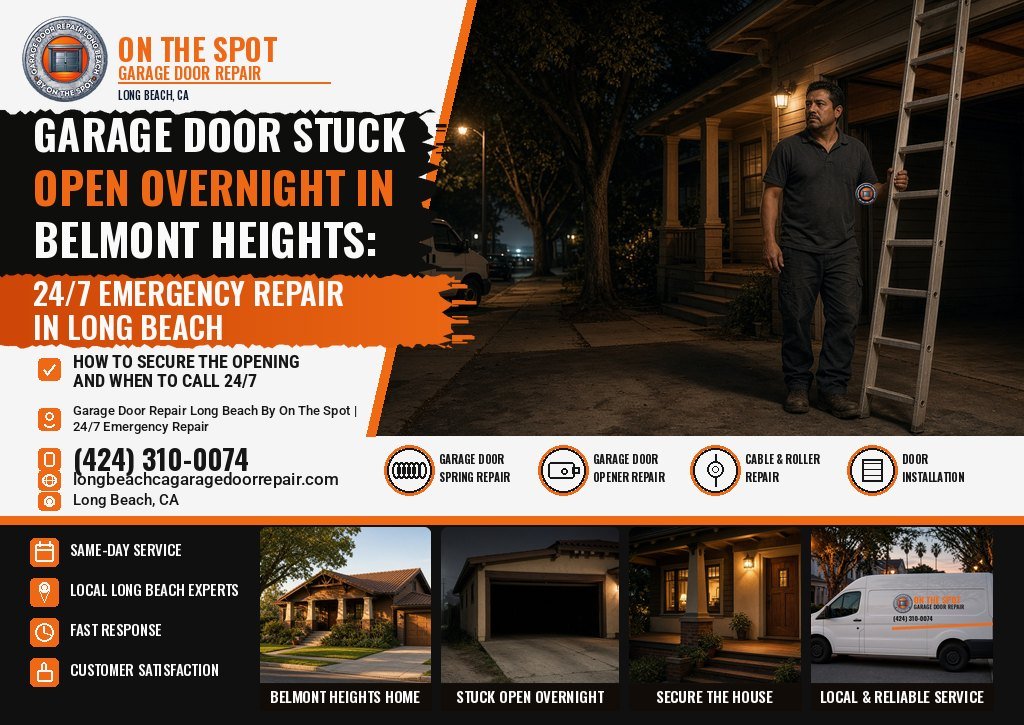
Garage Door Repair Long Beach By On The Spot · 24/7 Emergency Guide
Garage Door Stuck Open Overnight in Belmont Heights: 24/7 Emergency Repair in Long Beach
A garage door stuck open overnight in Belmont Heights is a security and safety problem, not a repair you should leave until morning if you can help it. The opening faces a street or a rear alley, coastal air and fog move through the garage, and a door that will not come down may also be unsafe to stand under. Garage Door Repair Long Beach By On The Spot is open 24/7 for emergency garage door repair in Long Beach, including Belmont Heights. This guide covers how to tell Belmont Heights from Belmont Shore, what you can safely do while you wait, what to leave alone, and what a night visit usually involves. It is not a do-it-yourself repair manual.
What should you do if a garage door is stuck open overnight in Belmont Heights?
Treat it as a 24/7 emergency. Keep people and pets out from under the door, close and lock the door between the house and the garage if you have one, turn on lights, and photograph the opening from a safe angle. Do not force the door down, and do not pull the emergency release if you think a spring or cable has failed. Then call for emergency garage door repair in Long Beach.
Belmont Heights is not the same neighborhood as Belmont Shore. The Shore has its own emergency page at Emergency Garage Door Repair in Belmont Shore. This guide is for Heights homes, often Craftsman and Spanish bungalows along and above the bluff, many with alley-facing garages.
Related reading: Garage Door Stuck Open, Emergency Garage Door Repair in Long Beach, When Should I Call a 24 Hour Garage Door Repair Service in Long Beach?, 24 Hour Garage Door Repair Services, Emergency Garage Door Repair: What to Expect After Hours, Garage Door Repair in Belmont Shore: Common Problems in Older Coastal Homes, and Garage Door Repair Long Beach. Safety guidance from the CPSC guidance on automatic residential garage door operators and DASMA garage door system safety tips; outage information from the SCE Outage Center.
Belmont Heights Is Not Belmont Shore
People mix the two names up, and it is easy to see why. They sit next to each other on the southeast side of Long Beach, they share a ‘Belmont’ label, and a short walk can take you from one into the other. For a night repair call, the distinction matters. The house, the alley or street the garage faces, and the door itself are in Belmont Heights. The Shore is a different neighborhood with its own emergency page.
Belmont Heights is a district in the southeast part of the city, next to Bluff Park, Bluff Heights, Recreation Park, Belmont Park, Belmont Shore, and the ocean. Common descriptions of its edges put City of Long Beach streets in the picture: Ocean Boulevard and Livingston Drive to the south, Redondo Avenue on the west, 7th Street to the north, and Nieto Avenue to the east. A business strip runs along Broadway east of Redondo. The Belmont Heights Community Association is the local neighborhood group. None of that is a substitute for standing in front of your own garage, but it is enough to keep a Heights call from being written up as a Shore call.
The Shore already has a live emergency page, Emergency Garage Door Repair in Belmont Shore, and a post on older coastal homes, Garage Door Repair in Belmont Shore: Common Problems in Older Coastal Homes. Naples has Emergency Garage Door Repair in Naples, Long Beach. This article does not replace those pages. It is for a Heights house whose door will not come down overnight, and for the practical questions that come with that situation: how to secure the opening, when 24/7 help is the right call, and what the visit is likely to involve.
A short historic note helps explain the housing, not the repair price. Belmont Heights was incorporated as its own city in 1908 and was annexed to Long Beach in 1909. A historic district inside the neighborhood covers many homes between 7th Street, 4th Street, Newport Avenue, and Roswell Avenue. Survey work there has pointed to Craftsman bungalows as the most common contributing style, with Victorian, Mediterranean and Spanish Colonial Revival, Tudor Revival, and later houses mixed in. Construction in that district is often dated from 1905 into the 1930s, with a peak in the early 1920s. Plenty of Heights houses sit outside that formal district. If you are not sure whether your block is designated, the Long Beach Heritage’s historic districts list list is a better starting point than a guess, and a garage change on a designated property may need a closer look than a like-for-like repair on a later house.
Belmont Heights
Southeast Long Beach, inland of the bluff and the Shore, with many 1905-1930s bungalows and a Broadway business strip.
Belmont Shore
The neighborhood closer to the sand and 2nd Street, with its own emergency page. Do not treat a Heights address as a Shore address.
Why the mix-up happens
Shared “Belmont” names, shared ZIP conversations, and short distances between the two.
What to say on the call
The street, a cross street, whether the garage faces an alley or the street, and that you are in Belmont Heights, not Belmont Shore.
What this page is for
A door stuck open overnight on a Heights home, and the safety and security steps that come first.
What this page is not
A second Shore emergency page, a general “stuck open” diagnosis post, or a do-it-yourself closing method.
Why a Door Stuck Open Overnight Is an Emergency
A door that will not close is inconvenient in daylight. Overnight it is a hole in the house. If the garage shares a wall and a passage door with the living space, that hole is closer than it looks. If the garage stands alone off an alley, the opening still leaves tools, bikes, a freezer, or a parked car visible and reachable. Either way, leaving it until morning is a security decision, not only a repair decision.
There is a safety side as well. A door that is stuck open may be hanging on a weak cable, a twisted track, or an opener that has reached the end of its travel and cannot come back. Standing under it to ‘just pull it down’ is how people get hurt. Children and pets treat an open garage as a play space. A car in the driveway, or a neighbor backing down the alley, has a dark opening to misjudge. The repair can wait a few minutes while you get everyone clear. The opening itself should not sit unattended if you can get help.
Weather adds a third reason that is easy to forget on a mild Long Beach night. Fog, marine layer, and salt air move through an open garage and settle on tools, a washer, stored boxes, and bare metal. A sprinkler-or-storm oddity is less common here than in some cities, but a heavy marine layer is not rare, and an open door lets that air work on the same springs, cables, and hinges that may already be the reason the door failed. You do not need a storm warning to treat an overnight opening as urgent.
This is a different question from ‘is the door merely stuck, and what part failed?’ That diagnostic walk-through already lives on Garage Door Stuck Open, which is written as a citywide guide to what to check before you call. The page you are reading assumes you have already seen that the door will not come down, that it is late, and that the house is in Belmont Heights. The job now is to protect the opening and get 24/7 help, not to become the technician.
- An open garage is an open side of the house, especially when a passage door leads inside.
- A door that will not close may also be unsafe to stand under or to pull on.
- Overnight coastal air and fog reach stored items and already-stressed hardware.
- Neighbors, alleys, and street parking change how exposed the opening feels, but they do not make it safe to ignore.
What “Stuck Open” Can Mean on the Door
Stuck open is a position, not a single failure. The door is up, and it will not come down on command. The reason might be electrical, mechanical, or a mix. You do not have to name the part correctly before you call. You do have to avoid treating every open door as a simple opener glitch you can fix with a button mash.
On many Heights bungalows the opener is a later add-on, bolted to a ceiling that was not designed around it, running a door whose springs and rollers are older than the motor. If the remote and the wall button both do nothing, the first fork is power: a tripped breaker, a loose outlet, or a wider outage. SCE Outage Center posts outage information, and Garage Door Will Not Open After a Power Outage walks through what to check after the power drops. If the lights in the garage still work and the opener does not, that points more toward the opener, its logic board, or a travel setting than toward the whole block losing power.
If the opener runs and the door will not follow, or it starts down and climbs back up, the problem may be the safety sensors, sunlight or a dirty lens at night (less common than at sunset, but a misaligned sensor stays misaligned), a tight or off-track roller, or a door that is out of balance. Garage Door Sensor Repair, Garage Door Will Not Close at Certain Times: Sunlight and Sensors, Off-Track Garage Door Repair, and Garage Door Will Not Close cover those paths in more depth. A door that reversed in daylight and then sat open after the last try is still an overnight security problem. The sensor explanation does not make it safe to leave.
Mechanical failures can also leave a door up. A cable that has slipped or broken on one side can freeze a door in a crooked open position. A track that has taken a hit from a bumper or a tight alley turn can pinch a roller so the door will not travel. A broken spring usually makes a door hard or impossible to lift, so it is a less common cause of a door that is already fully open and will not come down, but it is not impossible: a door that was opened before the spring failed, or a door held by the opener trolley after a spring let go, can be up and unsafe. If you heard a bang earlier in the day and the door is still open, do not pull the release and do not get under it.
A quick way to sort what you are seeing
From inside the house, or from the side of the opening, look. Do not stand in the path of the door. Note whether the door is level, whether one side is higher, whether a roller is out of the track, and whether the opener rail is still attached to the trolley. Those observations help the technician and keep you from guessing with a wrench.
Opener silent, house power on
The motor, its outlet, or its logic may be the issue. Try the wall button once. Do not keep cycling it.
Opener runs, door stays up
Look, from the side, for sensors, a pinched roller, or a door that starts and reverses.
Door crooked in the opening
Think cable, track, or a roller that has left the rail. Leave it. A crooked open door can shift.
Bang earlier, door still up
Treat springs and cables as failed until a technician says otherwise. Do not pull the release.
After an outage
See Garage Door Will Not Open After a Power Outage and the SCE Outage Center. A backup battery, if present, is a separate check, not a reason to force the door.
You cannot tell
That is fine. Secure the house and call. Naming the part is the technician’s job.
Older one-piece tilt-up doors, which still turn up on some early Heights garages, do not behave like a sectional door. They pivot as a slab. If one of those is stuck open, the hazard zone is different and often larger. Do not improvise a prop or a rope. Mention a one-piece door on the call so the technician is not expecting a sectional track.
What You Can Safely Do While You Wait
The useful work you can do is about the house, not the hardware. You are trying to shrink the risk of the open bay until someone who can close or secure the door arrives. None of these steps require touching springs, cables, or the opener rail.
- Get people and pets out of the garage and out from under the door. Treat the bay as a no-stand zone.
- If there is a passage door between the house and the garage, close it, lock it if you can, and make sure it actually latches. That is the main interior barrier.
- Turn on the porch light, the alley light if you have one, and a garage light that already works. Light is a deterrent and it helps you see the opening from inside the house.
- From a side angle, take two or three photos: the full opening, the tracks if they are visible, and any obviously loose cable or roller. Do not walk under the door to get a better shot.
- Move trash bins, bikes, or a second car away from the opening if you can do it without passing under the door. Do not climb over anything in the bay.
- If you have a second way to park or to leave, use it. Do not start a car that is sitting under a stuck door.
- Call. Give the street, a cross street, Belmont Heights (not Belmont Shore), whether the garage faces an alley, and whether anyone is at the house.
A temporary barrier that does not touch the door can make sense on a short, exposed alley: a folding screen or a parked car across a driveway, used only if it does not block the technician and does not sit under the door. It is not a substitute for a working door, and it is a poor idea if it creates a new trip or traffic problem. Do not nail a board to the door, the tracks, or the jambs. Do not ratchet-strap the door down. Those shortcuts hide the failure and can make the next movement of the door worse.
If you already read Garage Door Stuck Open or Garage Door Will Not Open earlier in the day and tried the obvious button and sensor checks, do not keep repeating them at midnight. Repeated open and close commands can heat an opener and confuse travel limits. One careful try of the wall button is enough once you have confirmed the door is stuck.
What You Should Not Do
Forcing a stubborn door is the other common mistake. People pull on the handle, hang on a section, or have a second person yank a cable they can see. If the door is off track, that force can finish the derailment. If a cable is already thin or slipped, it can let go. If the opener is the only thing holding the door up, fighting the motor or kicking the trolley can drop the door. Strength is not a diagnostic tool here.
- Do not stand or sit under the door to ‘just ease it down.’
- Do not clamp, strap, or weight the door in the closed or open position.
- Do not remove rollers, hinges, or brackets, even if one looks loose.
- Do not cut a zip tie, a sensor wire, or a photo-eye ‘to bypass it for the night.’
- Do not keep hitting the remote from the street in hopes it will catch.
- Do not assume that a door which opened fine this morning is safe to pull down by hand tonight.
The emergency release cord deserves its own warning. The red handle hanging from the opener rail disconnects the door from the motor so you can move a balanced door by hand, which is the point of How to Open a Garage Door Manually and Garage Door Emergency Release Cord Problems when the power is out and the springs are sound. On a door that is already open, pulling that cord can be the moment the door drops if the springs are weak or broken, or if a cable is gone. If you are not sure the door is balanced, leave the cord alone. A technician can close or secure an open door without asking you to become the counterweight.
A related ‘too heavy’ feeling is its own warning. If you already tried to help the door and it felt like a dead weight, stop. Why Is My Garage Door Too Heavy to Open Manually? explains why that usually points to the springs, not to a lazy opener. An open door that feels heavy is not a door you should be muscling downward at night.
When 24/7 Emergency Garage Door Repair in Long Beach Is the Right Call
Garage Door Repair Long Beach By On The Spot is open 24/7, so the old question of ‘do they even answer at night?’ is settled for this company. The useful question is whether your situation should be a night dispatch or a first-thing-in-the-morning visit. A door stuck open overnight in Belmont Heights usually belongs in the first group.
When Should I Call a 24 Hour Garage Door Repair Service in Long Beach? and Emergency Garage Door Repair in Long Beach walk through the broader ‘what should not wait’ list: a broken spring, a snapped cable, a door off track, a door that will not close and leaves the house open, or a door that will not open and traps a car you need. Emergency Garage Door Repair: What to Expect After Hours covers what the after-hours visit itself feels like. This Heights guide is narrower. If the bay is open and it is dark, that is enough reason to call tonight.
Night dispatch makes sense when
- The door is up and will not come down, and the garage is attached or holds a lot of what you would not leave on the sidewalk.
- The door is crooked, off track, or was preceded by a bang, so it may not be stable in the open position.
- You need a car that is in the garage, or you cannot securely close off the house from the garage.
- You are leaving the house empty overnight, or you are arriving late and cannot stay to watch the opening.
- Weather, fog, or a known alley-facing garage makes the opening more exposed than a quiet interior stall would be.
Waiting until morning can be reasonable when
Almost never, if the door is fully open and you cannot close a solid barrier between the house and the garage. The rare exceptions are narrow. If the door is only a few inches from closed and is stable, if you can lock a solid passage door and you have already reduced the exposure, and if a technician has already scheduled a first-light visit, you might hold. That is a judgment call you should make on the phone, not a rule you should invent to avoid a night visit. A door that is fully open, crooked, or after a bang should not be in the ‘wait’ column.
Cost is a fair question and not one this page will invent. Night work can be priced differently from a midday appointment at many companies. Ask for a written price before work begins, including any after-hours difference, and do not approve a vague ‘we will see when we get into it’ number. Garage Door Repair Scams to Avoid is worth a look if a caller is pushing you to decide in the dark without a written figure. Open 24/7 does not mean ‘priced however we want.’ It means someone can come, inspect, and write the figure down.
Same-day service, which Same-Day Garage Door Repair discusses, is a related but different promise. A 24/7 emergency call is about a problem that should not sit overnight. A same-day slot can also be the right fit when you call in the morning and the door is already closed, or when the failure is real but the house is secure. Do not downgrade a stuck-open night problem to ‘I will try to get a same-day slot tomorrow’ if the bay is still open.
How Belmont Heights Housing Affects a Night Call
The housing stock is the reason a Heights night call often looks different from a call on a wide suburban lot. Many of the contributing houses in the historic district are Craftsman bungalows, with Spanish and Mediterranean houses mixed in, built when cars were smaller and garages were an afterthought. A single-car garage tucked at the rear, reached from an alley, is common. Some later houses added a side driveway and a two-car door on a narrow lot. The opener, the springs, and the tracks were often added or replaced in pieces over decades. A technician arriving at 1 a.m. is not only closing a door. They are working in a tight opening with a mix of hardware.
Low headroom is a regular feature. A bungalow garage may have a low ceiling, a storage shelf just above the opening, or a later opener squeezed in at a shallow angle. That does not change the first goal, which is to close or secure the door safely. It does change how the door comes down and what hardware will actually fit if a part has to be replaced at night. A temporary close, a short-term brace that a technician installs, or a like-for-like part may be the night plan, with a return visit if a low-headroom conversion or a different opener is the lasting fix. That plan should be explained before you approve it.
Original or early wooden doors still exist on some Heights garages. They are heavier than a modern insulated steel door of the same size, and they do not always take a later opener well. If a wooden door is stuck open, the risk of a sudden drop is not abstract: the weight is real. Mention a wooden or one-piece door on the call. Do not try to ‘help’ it with a 2×4 in the track.
If the house sits in the historic district, a like-for-like repair of a working door is usually a different conversation from a visible replacement of a distinctive garage door. This page is about an emergency close. Cosmetic or historic questions can wait until the opening is secure. If a later replacement is on the table, Long Beach Heritage’s historic districts list and the city are the references for whether your block has extra review, not a guess made at the curb. Refurbishing vs Replacing Historic Garage Doors discusses older doors in a non-emergency setting.
Alley Garages, Tight Side Yards, and Street Frontage
A lot of Heights garages open onto a rear alley rather than the street. That is convenient in daylight and less comfortable at night. Alleys can be darker, less watched, and tighter to turn in. An open bay facing an alley is a visible invitation in a way a street-facing door under a porch light is not. Light what you can, close the passage door, and say ‘alley garage’ on the call so the technician knows where to pull in.
Tight alleys also explain some of the mechanical failures. A bumper catches a track. A tight turn racks a wooden door. A roller walks out of a slightly bent rail, and the door stops in the open position because it cannot come back through the pinch. Off-Track Garage Door Repair and the alley-focused post Top Causes of Off-Track Garage Doors in Long Beach Alleys (if you have an alley door) are the deeper mechanical guides. For tonight, the point is simpler: a door that stopped because it is off track is not a door you should force back into the rails.
Street-facing Heights garages have a different exposure. Broadway and the nearby residential streets have more foot traffic at some hours and more eyes at others. A stuck-open door under a porch light is still an opening. It may also be more visible to a technician looking for the house number. Have the number lit if you can, and mention any parking restriction or driveway blockage so the van can actually stop.
Side yards on these lots are often narrow. That limits where a ladder can go and where a second person can stand. It is one more reason you should not be the person on a ladder at midnight, and one more detail worth mentioning: ‘there is only about a foot on the hinge side.’ A technician who knows that before arriving brings the right approach, not a surprise.
Coastal Air, Fog, and Hardware That Sticks
Belmont Heights sits close enough to the water for salt air and a regular marine layer to matter. That does not mean every stuck door is ‘the rust door.’ It does mean hinges, rollers, a bottom bracket, and a sensor bracket that would have slid easily in a dry inland garage can be sticky or pitted here. How Salt Air Affects Garage Door Cables, Hinges, Tracks, and Springs and Garage Door Rust Near the Beach: Which Parts Corrode First explain which parts tend to go first on coastal Long Beach houses. Overnight fog moving through an already open garage does those parts no favors.
A door that ran roughly for weeks and then refused to close after dark may be telling you the hardware is past a simple lube job. A night visit can close or secure the door and flag obviously failed parts. A full roller, hinge, and spring inspection may still be the next appointment, in better light, with the door safely down. Ask the technician to write down what was safe to do tonight and what should be scheduled, so the night close does not get treated as the complete repair if it was only the first step.
Coastal air also shows up in older extension-spring systems, which still appear on some early Heights garages. A missing safety cable is a reason to mention it, not a reason to crawl up and add one yourself. Torsion vs Extension Springs in Long Beach: How to Tell Which System You Have helps you tell which system you have from the floor, with the door closed. If the door is stuck open, do not get under it to identify the springs. Describe what you can see from the side, and leave the identification to the visit.
What a 24/7 Visit Looks Like
The shape of an after-hours visit is already described in Emergency Garage Door Repair: What to Expect After Hours. In Belmont Heights the sequence is usually: confirm the address and whether the garage is alley or street, look at the door from a safe angle, test or disconnect the opener only if that is safe, secure or close the door, and write a price before any repair beyond that temporary safe state. You should be asked to approve the work, not presented with a finished bill for parts you never agreed to.
Closing the door may be straightforward: a sensor cleaned and aligned, a travel limit reset, a roller guided back with the door supported, or an opener setting corrected. It may also be a slower job: a cable that has to be replaced before the door can come down evenly, a track that has to be straightened enough to travel, or springs that will not let the door move safely until they are replaced. If the lasting repair needs daylight, a part that is not on the truck, or a second set of hands, the technician should say so and should leave the opening secure. ‘Secure’ means the door is down and can be kept down, or that a temporary protective measure the technician installs is actually adequate, not that a broom is leaning against the opening.
You can stay inside the house. You do not need to hold the door or ‘catch’ anything. If the alley is tight, you may need to move a bin or unlock a gate. If a car is under the door, say so immediately; that changes the safe approach. If children are asleep on the other side of a passage door, say that too, so the work is quieter and the passage door stays shut.
The end of a proper visit includes a safety-reverse check if the opener is still in use, along the lines of the habits in DASMA garage door system safety tips and the CPSC guidance on automatic residential garage door operators opener guidance, and the checklist thinking in DASMA Technical Data Sheet 167, the residential door and operator checklist. If the opener was disconnected so the door could be closed by hand, you should be told how the door is being left (locked down, opener still disconnected, or reconnected and tested) so you are not surprised at 6 a.m. when a remote does nothing.
- A written price before work, including any after-hours difference, should be in your hands before parts come off.
- A night close can be the full repair, or it can be a secure state plus a scheduled follow-up. Ask which one you are approving.
- The safety-reverse test belongs at the end if the opener will be used again.
- You should leave the visit knowing whether the opener is connected and whether you can use the door in the morning.
After the Door Is Closed: What Should Be Inspected
Once the bay is no longer open, the urgency drops and the inspection should not. A door that would not close once can refuse again the next night if the cause was only patched. Ask for a look at the parts that commonly sit behind a stuck-open failure, even if the obvious fix was a sensor or a travel limit.
- Springs: rust, gaps in the coils, or a door that is heavy in the technician’s hands after the opener is disconnected.
- Cables and drums or pulleys: fraying, slack on one side, or a cable that has left the drum.
- Tracks and rollers: bends, missing fasteners, worn or seized rollers, especially on an alley door.
- Sensors and wiring: alignment, dirty lenses, staples through a wire, or a bracket that has been kicked.
- Opener: gear wear, travel and force settings, and whether the rail is still solid on a low bungalow ceiling.
- Weather seals and the bottom edge: not the cause of a stuck-open door, but an open overnight bay is a good reminder to look.
Garage Door Tune-Up and Garage Door Safety Inspection describe a fuller inspection in ordinary hours. Garage Door Maintenance and How Salt Air Affects Garage Door Cables, Hinges, Tracks, and Springs are the coastal-maintenance companions. If springs need replacement, Garage Door Spring Replacement, Garage Door Spring Replacement Service, What to Expect During a Torsion Spring Replacement in Long Beach, and Garage Door Spring Repair vs Replacement in Long Beach are the follow-on guides. None of those pages is a reason to delay tonight’s close. They are the reading for the morning after.
If the door is an older wooden or one-piece door, the after-visit conversation may include whether repeated opener repairs are still a good idea. That is a repair-or-replace question for daylight, with measurements and a written figure, not a decision forced at 2 a.m. unless the door itself is failing in a way that cannot be secured. Garage Door Replacement in Long Beach and Garage Door Panel Repair can wait until the opening is no longer the emergency.
Photos That Help on the Phone
A short set of photos can speed the dispatch and keep you off a ladder. Take them from the side or from inside the house, not from under the door.
- The full opening, so the technician can see whether the door is level and how high it is sitting.
- The left and right tracks, if they are visible without stepping into the bay.
- Any cable that is obviously slack, off a drum, or hanging.
- The opener rail and trolley, if you can see them from the passage door or the side.
- The alley or driveway approach, so parking and access are not a surprise.
Do not send a close-up of a spring you photographed by standing on a storage box under an open door. That photo is not worth the risk. A slightly muddy side shot is more useful than a perfect shot taken from a bad place.
Questions to Ask Before Work Begins
- What do you think is holding the door open, and is it safe to close tonight?
- What is the written price to close or secure the door, and what is included?
- Is there a separate after-hours amount, and is it on the same written price?
- If a lasting repair needs a return visit, how will the door be left tonight?
- Will the opener be connected and tested before you leave?
- Is this a one-piece or wooden door issue, and does that change the plan?
- What should I not do with the door in the morning until the follow-up, if there is one?
If any answer is vague, pause. Garage Door Repair Scams to Avoid lists patterns that show up in stressed, after-hours calls: pressure to approve a large extra repair on the spot, a price that changes after the door is already apart, or a claim that you must decide this minute or the door cannot be left safe. A real 24/7 visit can still be careful and written down.
Example Situations (Composite, Not a Quote)
These are composite sketches, not testimonials and not a promise that your door will match them. They are here to make the decision points concrete.
The alley bungalow at 11 p.m.
A single-car wooden door on a rear alley has sat open since early evening. The wall button clicks and the opener hums, then stops. From the passage door the homeowner can see that the door is slightly higher on the left. They close and lock the passage door, turn on the alley light, take a side photo, and call. They do not crawl into the bay to look at the left cable. The technician finds a cable off the drum and a roller starting to leave the track, closes and secures the door after replacing the cable set, and writes a follow-up to replace worn rollers in daylight. The night decision was to treat the crooked open door as unstable, which it was.
The street-facing door after a power blink
A later two-car door on a street-facing Heights house is open when the homeowner gets home after a brief outage. The garage lights work. The opener does not. They check SCE Outage Center, see that the neighborhood is restored, try the wall button once, and leave the red release alone because they are not sure about the springs. The visit finds a dead outlet on a circuit that tripped in a way that was easy to miss, plus an opener that needs a reset. The door is closed, the opener is tested, and the safety reverse is checked. The useful move was not pulling the release on an open door in the dark.
The door that reversed at dusk and never came back down
Sensors that were barely aligned had been kicking the door back up at sunset for a week. Tonight the door stopped fully open. The homeowner had already read Garage Door Will Not Close at Certain Times: Sunlight and Sensors and was tempted to twist the brackets themselves. They did not. A 24/7 visit realigned and tightened the brackets, cleaned the lenses, and closed the door, then flagged a bent sensor bracket for replacement. The opening was not left unattended until morning ‘because it is only sensors.’
The bang in the afternoon, still open at night
A loud bang in the afternoon, a door that opened and then would not close, and a family that had to leave for the evening. They put a light on, locked the passage door, and called rather than having a neighbor try to pull the door down. The spring had failed and the opener had been holding the door. Pulling the release would have dropped it. The night work was a spring replacement, with the pair handled as Do I need to replace both springs, or just the broken one? and Garage Door Spring Repair vs Replacement in Long Beach describe, and a safety-reverse test at the end. The car in the garage was not moved until the door was supported.
If the Opener Has No Power
A dark opener is not automatically a broken door. Walk through Garage Door Will Not Open After a Power Outage first if the rest of the house or the block is dark, and use the SCE Outage Center outage map rather than guessing. If the house has power and the opener does not, look at the outlet and the breaker without taking the cover off the motor. A backup battery, if the opener has one, is worth mentioning on the call; Garage Door Backup Battery Not Working covers batteries that should have run and did not. California’s battery-backup rule for many residential openers is described in California SB 969. None of that is a reason to pull the release on an open door when you cannot see the springs clearly.
If power is out on the whole block and the door is open, the security problem is the same. A technician can still help close or secure a door when it is safe to move, but they cannot restore the utility. Be clear on the phone that the block is dark, so the dispatch is not a surprise. If the door is balanced and the springs are sound, a manual close after a careful inspection may be possible. If they are not, it is a mechanical job that happens to be happening during an outage.
Stuck-open overnight garage doors in Belmont Heights: FAQ
Is a garage door stuck open overnight in Belmont Heights a 24/7 emergency?
Yes. An open bay is a security and safety problem, especially on an alley garage or a house with a passage door into the living space. Garage Door Repair Long Beach By On The Spot is open 24/7 for emergency garage door repair in Long Beach, including Belmont Heights.
How is Belmont Heights different from Belmont Shore?
They are neighboring districts, not the same place. Heights sits inland of the Shore and the bluff, with many early-20th-century bungalows and a Broadway business strip. Shore has its own emergency page, Emergency Garage Door Repair in Belmont Shore. Give your street and say Heights, not Shore, on the call.
Can I pull the emergency release and close the door myself?
Only if a technician has already judged the door balanced and the springs sound, which you often cannot tell on an open door at night. Pulling the release on an open door with a weak or broken spring can drop the door. See How to Open a Garage Door Manually and Garage Door Emergency Release Cord Problems, and when in doubt leave the cord alone.
What should I do while I wait?
Clear people and pets from the bay, close and lock the passage door to the house, turn on lights, take side photos, and call. Do not stand under the door, strap it, or force it down.
Why would a door stay open instead of closing?
The opener may have no power, the sensors may be reversing it, a roller or track may be pinched, a cable may have slipped, or, less often, a spring problem is leaving the door up and held by the trolley. Garage Door Stuck Open is the citywide diagnostic. Tonight’s job is to secure the opening.
Is this only a problem on alley garages?
Alley garages are more exposed and tighter to work in, but a street-facing door stuck open is still an opening in the house. The advice to call 24/7 applies to both.
Will you come at 2 a.m.?
Garage Door Repair Long Beach By On The Spot is open 24/7. Call (424) 310-0074 and describe the opening, the neighborhood, and whether the garage faces an alley. Ask for a written price before work begins.
What if the power is out?
Check the SCE Outage Center outage information and Garage Door Will Not Open After a Power Outage. A dark opener during a real outage is not automatically a broken door, but an open bay is still a security problem. Do not pull the release unless you know the door is balanced.
Can I wait until morning if I lock the door into the house?
A locked passage door helps, and you should do it either way. It does not close the garage or make a crooked, off-track, or post-bang door stable. If the bay is fully open, call tonight and make the wait-or-dispatch decision on the phone.
Do I need to be home?
Someone who can unlock a gate, confirm the address, and approve a written price should be available. You do not need to help lift the door. If you cannot be there, say so up front.
Will a night repair cost more?
This page does not list prices. Ask for any after-hours difference to be included in the written price before work begins. Open 24/7 is about availability, not a blank check.
Where are you located?
Garage Door Repair Long Beach By On The Spot is at 151 E 5th St, Long Beach, CA 90802. Call (424) 310-0074, use our contact page, or find us on Google Maps.
Garage Door Repair Long Beach By On The Spot on Google Maps
View Garage Door Repair Long Beach By On The Spot on Google Maps · 151 E 5th St, Long Beach, CA 90802
Need 24/7 Help With a Door Stuck Open in Belmont Heights?
Garage Door Repair Long Beach By On The Spot is open 24/7 for emergency garage door repair in Long Beach, including Belmont Heights. Ask for a written price before any work begins. Call (424) 310-0074, use our contact page, or find us on Google Maps. Our address is 151 E 5th St, Long Beach, CA 90802.
Garage Door Repair Long Beach By On The Spot · 151 E 5th St, Long Beach, CA 90802
(424) 310-0074 · office.onthespotgaragedoor@gmail.com · longbeachcagaragedoorrepair.com