
Garage Door Repair Long Beach By On The Spot · 24/7 Emergency Guide
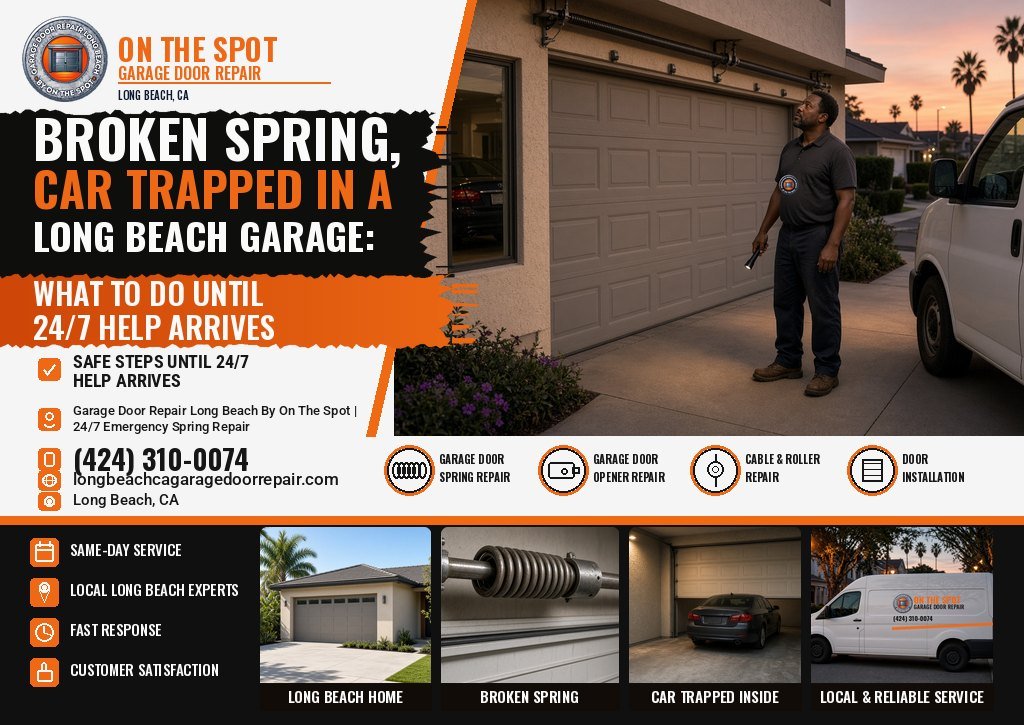
Broken Garage Door Spring With Your Car Trapped in a Long Beach Garage: What to Do Until 24/7 Help Arrives
A bang, a door that will not lift, and a car sitting on the other side of that door is one of the most common 24/7 emergencies on a Long Beach garage. In most of those calls the spring has failed, the door is now far too heavy, and the opener is not a workaround. Garage Door Repair Long Beach By On The Spot is open 24/7 for emergency garage door repair in Long Beach, including broken-spring calls that have a car trapped inside. This guide covers how to recognize that failure, what you can safely do while you wait, why the emergency release is often the wrong move, and what the visit is for. It is not a do-it-yourself spring replacement.
What should you do if a broken spring has trapped your car in a Long Beach garage?
Leave the door and the spring alone, and call for 24/7 help. A broken spring takes away the balance that lets a person or an opener lift the door. Forcing the door, winding the spring, or pulling the emergency release so you can ‘just lift it’ is how people get hurt and how openers get torn up. If you have another way out of the house or another car, use that. Then call for emergency garage door repair in Long Beach.
A door that will not open is not always a broken spring, and a car that is stuck is not always a reason to disconnect the opener. Garage Door Will Not Open, Garage Door Stuck Closed, and How to Open a Garage Door Manually already cover diagnosis and a careful manual open when the springs are sound. This page is for the narrower case: the spring has likely failed, the car is inside, and it is not safe to muscle the door out of the way.
Related reading: Garage Door Stuck Closed, How to Open a Garage Door Manually, Garage Door Spring Replacement, Do I need to replace both springs, or just the broken one?, Garage Door Spring Repair vs Replacement in Long Beach, What to Expect During a Torsion Spring Replacement in Long Beach, Emergency Garage Door Repair in Long Beach, and When Should I Call a 24 Hour Garage Door Repair Service in Long Beach?. Safety guidance from the CPSC guidance on automatic residential garage door operators and DASMA garage door system safety tips, including DASMA Technical Data Sheet 167, the residential door and operator checklist and DASMA Technical Data Sheet 190 on torsion spring life; outage information from the SCE Outage Center.
How to Tell a Broken Spring From Other Failures
You do not need a perfect diagnosis to justify a 24/7 call. You do need a rough sense of whether this is a spring failure, because the unsafe moves are different. A door that will not open because of a dead opener, a locked deadbolt, or a morning of coastal fog in the tracks is a different problem from a door whose counterbalance has just disappeared.
The classic spring failure announces itself. You hear a bang from the garage, sometimes loud enough that people think a car was hit or a shelf came down. The door that opened normally yesterday now feels dead heavy, moves a few inches and stops, or will not leave the floor. The opener may hum, click, or try to lift and then give up. Looking from a safe distance, a torsion spring on the shaft above the door may show a visible gap in the coils. An extension spring along the track may be hanging or obviously separated. You can see those things from the floor, with the door closed, without touching anything.
Garage Door Spring Replacement and Is my garage door spring broken if the door only opens a few inches? describe the same warning signs in a non-emergency setting. Garage Door Spring Makes Popping or Creaking Sounds and Garage Door Spring Is Rusty but Not Broken: Should It Be Replaced Yet? cover the noises and rust that sometimes come first. This page starts later in the story: the spring has likely already failed, and the car is on the wrong side of the door. If you never heard a bang, the spring can still be the cause. Some springs unwind or break with less drama, especially if they were already badly rusted. The heavy door and the failed lift still tell the story.
Other failures can mimic a trapped car. A snapped cable can leave the door crooked and jammed. A door off track can refuse to move. An opener with no power can sit silent while the door is actually still balanced. Garage Door Cable Repair, Off-Track Garage Door Repair, Garage Door Will Not Open, and Garage Door Will Not Open After a Power Outage are the right guides for those forks. If the door is crooked, or you can see a cable off a drum, treat it with the same caution as a broken spring: do not force it, and do not pull the release to muscle the car out.
Bang, then a heavy door
Treat it as a broken spring until a technician says otherwise. Do not lift, wind, or disconnect.
Door rises a few inches and stops
Often a spring or a cable. The opener is trying to lift a load it was not built to carry.
Door is crooked in the opening
Think cable or track, not only a spring. Still a no-force situation.
No bang, opener silent, lights out
Check power and Garage Door Will Not Open After a Power Outage first. A balanced door during an outage is a different case than a broken spring.
You cannot see the spring
That is fine. Describe the sound, the weight, and that a car is inside. Identification can wait for the visit.
The door slammed or dropped recently
See Garage Door Slams Shut. A door that has already dropped once should not be tested by hand.
Why the Car Is Trapped, and Why the Opener Will Not Solve It
Most of the door’s weight is supposed to be carried by the springs, not by the motor and not by you. That is true on a torsion system and on an extension system. When a spring breaks, the door that felt easy yesterday becomes a slab. The opener is sized to move a balanced door, plus a little reserve. It is not a hoist. If you keep hitting the remote, the motor can overheat, the gear can strip, and the door still will not rise enough to roll a car out.
That is why ‘just run the opener harder’ is not a plan, and why Why Is My Garage Door Too Heavy to Open Manually? is worth reading if you already tried to lift the door and felt the weight. A car inside makes the temptation worse. You have somewhere to be, or you need the car for work in the morning, or you are standing in the house at 11 p.m. looking at a closed door and a set of keys. The spring does not care about the calendar. Forcing the door to free the car is how a second failure, a second injury, or a ruined opener gets added to the first problem.
If the car is sitting close to the door, say so on the call. A technician needs to know how much room is in front of the bumper before they support or move the door. Do not start the car in a closed garage to ‘nudge’ the door, and do not idle while you wait. If you can walk out through a passage door or a side door, do that. The trapped object is the car, not you, in most attached-garage houses. If the only walk-out is the garage door itself, say that immediately. That is a different urgency.
What You Should Not Do While the Car Is Inside
- Do not put a winding bar, screwdriver, or other tool in a torsion cone.
- Do not unhook, cut, or stretch an extension spring, and do not try to thread a safety cable now.
- Do not keep running the opener against a door that will not lift.
- Do not pry the bottom section with a 2×4, a jack, or a bumper.
- Do not crawl under a door that is partly open and not secured.
- Do not ask a group of neighbors to lift the door so you can drive out.
- Do not start the car in a closed garage to push the door.
The jack idea shows up often enough to mention it by name. People have tried a floor jack or a scissor jack under a door section to make a gap for the car. The door is not a lift point, the section can buckle, and a jack that kicks out leaves the door in a worse, less stable place, sometimes on the car. If a technician uses support, it is specific to the door and is not something to improvise with auto tools.
Cables and bottom brackets belong on the same do-not list. A loose or broken cable is sometimes part of the same failure, and the bottom bracket on a torsion system is under load. Garage Door Cable Repair and My garage door cable came loose: does that usually mean the spring is broken too? explain the connection. Do not loosen a bracket to ‘free’ a cable with the car a few feet away. You can make the door move in a way you cannot control.
What You Can Safely Do Until 24/7 Help Arrives
Garage Door Repair Long Beach By On The Spot is open 24/7, so the wait is the time until a technician can get to you, not the rest of the night by default. What you do in that window is about safety and information, not about freeing the car yourself.
- Confirm that people and pets are out of the garage and not standing in the door’s path. If anyone was in the garage when the bang happened, make sure they are unhurt.
- Use a house door or a side door if you have one. You should not be climbing out under a partly open garage door.
- If you have a second car on the driveway or the street, use that, or arrange another ride. The trapped car can wait for the door to be repaired.
- From the passage door or from the side, take photos of the shaft area or the tracks, the bottom of the door, and any obvious gap in a torsion spring. Do not climb on the car or on a ladder under the door.
- Leave the opener alone after one careful try of the wall button, if you have not already ruled the door out as too heavy.
- Turn off the opener at the motor or the outlet if the motor is still trying to lift and getting nowhere, so it cannot keep heating.
- Call. Say that you think a spring broke, that a car is inside, how close the car is to the door, and whether you have another way out of the house.
If it is late, you do not have to sit in the garage with a flashlight. Wait in the house. Light the number if you can. Unlock a side gate if the technician will need it. If you are in a condo or a shared garage, tell the dispatcher that as well, because access and permission may take a minute longer; Garage Door Repair in Condos and HOA Communities is the longer guide for those buildings, but tonight the need is still a safe door and a written plan.
There is not much useful you can do for the car itself. Do not pop the bumper up against the door. Do not try to deflate the ‘situation’ by rearranging storage in the dark around a door that might move. Leave a path for the technician from the passage door or the side to the springs and the opener.
The Emergency Release Is Often the Wrong Move Here
The red handle on the opener rail is there so you can disconnect the door from the motor and move a balanced door by hand. That is the right tool after a power outage, if the springs are doing their job. How to Open a Garage Door Manually is written for that case, including the ‘car trapped in the garage’ framing, and Garage Door Emergency Release Cord Problems covers what happens when the cord will not reconnect later. Neither page is a green light to pull the release after a bang, or after the door has already told you it is too heavy.
On a broken spring, the opener may be the only thing keeping a partly raised door from falling. Disconnecting it can drop the door onto the car, onto the floor, or onto a person. Even a door that is fully down can be a problem: once the trolley is free, there is nothing to stop a badly unbalanced door from behaving unpredictably if someone then tries to lift a corner. The release is not a shortcut around a spring replacement. It is a disconnect for a door that is already safe to lift.
If you already pulled the cord before you read this, do not try to reconnect it by guessing, and do not test-lift the door to ‘see how bad it is.’ Stay out from under it, keep the car off, and say on the call that the opener is already disconnected. A technician can support the door and reconnect or leave it disconnected as part of the repair. The mistake is understandable. Continuing to experiment is not.
A related temptation is to pull the release and have several people lift, then have someone drive out while the others hold the door. That turns a spring job into a strain-and-drop job. Why Is My Garage Door Too Heavy to Open Manually? exists because the weight of an unbalanced door surprises people. Let the car wait.
Torsion Versus Extension: What Changes When a Spring Breaks
Long Beach houses use both systems, and Torsion vs Extension Springs in Long Beach: How to Tell Which System You Have is the identification guide: a shaft and spring above the opening is torsion; long springs above the horizontal tracks are extension. You can usually tell from the floor with the door closed. If the door is closed and you can see the hardware without crawling into a bad position, mention which system you think you have. If you cannot tell, skip it.
When a torsion spring breaks, the remaining spring on a two-spring shaft, if there is one, is now doing work it was not sized to do alone, and the door is still badly out of balance. A single-spring torsion door loses its counterbalance in one failure. The broken spring can have a visible gap. The shaft, drums, and cables may still be in place, or a sudden break can have stressed a cable. Do not poke the gap to confirm it.
When an extension spring breaks, the loose spring can travel if it was not contained by a safety cable through its center. That is why DASMA garage door system safety tips guidance, including the checklist thinking in DASMA Technical Data Sheet 167, the residential door and operator checklist, treats containment cables as part of a proper extension system. If you see a spring off the track or a cable that looks wrong, stay back. A missing safety cable is useful information for the technician. It is not a weekend project to add one now, with a car in the garage.
Conversion from extension to torsion is a separate decision and not an emergency requirement. Should You Convert Extension Springs to Torsion Springs? covers when that change is a real option. Tonight’s job is to restore a safe, working counterbalance, usually by replacing the failed springs in the system you already have, then getting the car out and testing the door.
Why Worn Springs Are Usually Replaced as a Pair
Homeowners often hope to replace only the spring that broke. Do I need to replace both springs, or just the broken one? and Garage Door Spring Repair vs Replacement in Long Beach explain why that is usually a poor bargain. Springs on the same door have been cycling together, in the same coastal air, for the same years. The unbroken one is not new. Leave it in place and it is the likely next failure, sometimes soon, sometimes at another inconvenient hour, sometimes with the car inside again.
What to Expect During a Torsion Spring Replacement in Long Beach walks through a torsion replacement visit in ordinary language: inspection, the right springs for the door’s weight and height, winding by a technician, cables and drums checked, opener force left in a sensible range, and a safety-reverse test. A 24/7 emergency visit follows the same safety logic. The difference is the hour and the trapped car, not a free pass to skip the matching spring, the cable check, or the final test.
DASMA Technical Data Sheet 190 on torsion spring life discusses torsion spring life in terms of cycles, not a promise of a certain number of years on a Long Beach door. Daily use, a heavy wooden door, and rust all spend that life faster. None of those documents is a DIY manual, and this page will not invent a year count for your particular door. The practical point is that a spring that has just broken was at the end of its useful life, and its partner is usually nearby.
If a technician recommends replacing only one spring, ask why this door is the exception, and have the reason on the written price. There are odd cases, such as a later mismatched spring that was already the wrong part, but ‘it is cheaper tonight’ is not a complete reason. You should also ask whether the cables, drums or pulleys, and fasteners are part of the same ticket or a later visit.
When 24/7 Emergency Garage Door Repair in Long Beach Is the Right Call
A broken spring with a car trapped in the garage is a 24/7 emergency. Garage Door Repair Long Beach By On The Spot is open 24/7 for emergency garage door repair in Long Beach. When Should I Call a 24 Hour Garage Door Repair Service in Long Beach?, Emergency Garage Door Repair in Long Beach, and 24 Hour Garage Door Repair Services cover the broader list of problems that should not wait: off-track doors, snapped cables, a door stuck open, a door that will not close, and spring failures. This page is the trapped-car, broken-spring slice of that list.
Call tonight if you need the car, if you cannot securely leave the house with the door as it is, if the door is partly up and unstable, or if you simply do not want an unbalanced door sitting until morning. A spring that has already failed will not ‘settle’ overnight into a safer state. The door is already at its most awkward.
Waiting until morning is only reasonable in a narrow set of conditions you should confirm on the phone: the door is fully down and stable, you do not need that car before the first morning slot, you have another way in and out, and no one will try the opener again in the meantime. If the door is partly open, if it dropped, or if you need the car, do not invent a reason to wait.
Ask for a written price before work begins, including any after-hours difference. This page does not list prices and does not invent a night surcharge. Open 24/7 means the phone is answered and a technician can be dispatched. It does not mean you should approve an open-ended figure in the driveway. Garage Door Repair Scams to Avoid is worth reading if you are being hurried past a written price, or if a second, much larger repair appears only after the door is already apart.
What a 24/7 Broken-Spring Visit Involves
The visit has a simple order: make the door safe, confirm the failure, write a price, replace the springs (usually as a pair) with the door properly supported, check cables and related hardware, reconnect the opener if it is still sound, and test the safety reverse. What to Expect During a Torsion Spring Replacement in Long Beach is the step-by-step companion for a torsion job. Emergency Garage Door Repair: What to Expect After Hours describes the feel of a night call. You can stay in the house. You should not be asked to hold the door or to ‘just lift a little’ so the technician can set a part.
If the car is close to the door, the first move may be to support the door and create a safe working position, not to start the car. Do not hover in the garage with the keys in your hand unless the technician asks you to move the car after the door is secured in an open position. If the opener was already strained, it may need a closer look before anyone treats it as healthy. A stripped gear discovered after the springs are replaced is a separate item and should be written down, not slipped into the bill silently.
A night job can still be a complete spring replacement. It can also be a secure-the-door visit plus a return if the right springs are not on the truck, if a header or cable drum problem is larger than a standard replacement, or if a second technician is needed on an awkward door. Ask which visit you are approving. If the car must stay in until a morning return, you should leave knowing that, and the door should be left in a stated, safe condition: down and stable, or secured open only if that is actually safe, which is uncommon after a spring break.
The safety-reverse test at the end is not a formality. If the opener’s force was turned up at some point to ‘help’ a dying spring, those settings should be brought back into a sensible range so the door does not become a new hazard. The CPSC guidance on automatic residential garage door operators opener guidance, DASMA garage door system safety tips, and DASMA Technical Data Sheet 167, the residential door and operator checklist are the references. California’s battery-backup requirement for many residential openers, California SB 969, is a separate issue; mention a battery only if the opener has one and it failed during the same episode, which is more of an outage story than a spring story.
- A written price should cover the springs, the labor, and any cables or drums that will be replaced now, plus any after-hours difference.
- You should be told whether the opener is still usable and whether a follow-up is recommended.
- The car should be moved only after the door is supported or repaired enough to make that safe.
- A safety-reverse test belongs at the end if the opener will be used again.
Coastal Long Beach: Rust, Cycles, and Springs That Fail Without Much Warning
Salt air does not invent a new kind of spring failure, but it shortens the path to one. Springs, cables, fasteners, and bottom brackets rust sooner near the beach than they do inland. How Salt Air Affects Garage Door Cables, Hinges, Tracks, and Springs and Garage Door Rust Near the Beach: Which Parts Corrode First go through the parts that usually corrode first. DASMA Technical Data Sheet 190 on torsion spring life‘s cycle language still applies; rust and pitting can use up that life faster than a clean inland spring of the same rating. A Long Beach door that ‘was fine last week’ can still be a rust-and-cycles failure, not a mystery.
Some springs pop and creak for a while first; Garage Door Spring Makes Popping or Creaking Sounds covers that. Others, especially if rust is already deep, break with little warning beyond a bang. A rusty spring that has not broken yet is a planning problem, which Garage Door Spring Is Rusty but Not Broken: Should It Be Replaced Yet? addresses. Once it has broken, and a car is inside, it is a 24/7 problem. Do not use a can of lubricant as a substitute for replacement, and do not wrap a rusted spring in tape.
Older wooden doors, which still show up on bungalows and early houses around Long Beach, are heavier than a later steel door of the same width. Heavy doors spend spring life faster and are even worse to lift by hand after a break. Mention a wooden door and an approximate width on the call. The technician still has to weigh or measure to get the right springs; your description just reduces surprises.
After the Car Is Out: What Else Should Be Checked
Once the car is out and the door is running, the urgency drops. The inspection should not. A spring break is a good moment to look at the hardware that failed in the same years and the same air as the spring.
- The second spring, if it was not already replaced as part of the pair.
- Lift cables, drums or pulleys, and the fasteners at the bottom corners.
- Rollers, hinges, and tracks, especially if the opener had been dragging a heavy door.
- The opener gear, rail, and force settings, after they have been asked to lift an unbalanced door.
- Weather seals and the bottom edge, which are unrelated to the bang but easy to miss if the visit is only about the spring.
Garage Door Tune-Up, Garage Door Safety Inspection, and Garage Door Maintenance are the ordinary-hours inspection guides. If the opener suffered for the spring, Garage Door Opener Repair and Garage Door Opener Repair Service apply. If the door itself is tired, Garage Door Replacement in Long Beach can wait for a daylight conversation and a written figure. None of those is a reason to delay tonight’s spring work if the car is still inside.
If It Is Not the Spring After All
A technician may find that the spring is intact and the door is failing for another reason. That is not a wasted call. It is a safer outcome than a homeowner forcing the wrong part. The written price should then describe the actual work: a cable, a track, an opener, a lock, or a sensor, not a spring job that was not done.
A dead opener with sound springs and a car inside is closer to How to Open a Garage Door Manually and Garage Door Will Not Open After a Power Outage than to this page, once that is confirmed. A snapped cable with a crooked door is Garage Door Cable Repair. A door off track is Off-Track Garage Door Repair. A door that will not close, which is a different emergency, is Garage Door Will Not Close or the stuck-open overnight guide if the bay is open at night. The safe first moves are the same: do not force the door, do not invent a lift, and let the inspection decide the part.
If you called describing a bang and a trapped car, and the spring is in fact broken, you are still in the right place. If the inspection points elsewhere, ask the technician to show you, from a safe angle, what they are seeing, and to put that explanation on the ticket. You should not pay for a pair of springs that were never installed.
Photos That Help on the Phone
- The door from a side angle, so it is clear whether it is fully down, partly up, or crooked.
- The shaft and torsion spring, or the extension springs along the tracks, from the floor or the passage door, if they are visible.
- The gap in a torsion spring, if you can see it without climbing.
- How close the car is to the door, taken from the passage door, not from under a partly open door.
- The opener rail and trolley, if you can see them without entering a bad position.
Skip any photo that requires a ladder, a climb onto the car, or a walk under the door. A slightly dark photo from the passage door is enough to tell a dispatcher this is likely a spring call with a car inside.
Questions to Ask Before Work Begins
- Is the spring actually broken, and is it torsion or extension?
- Will both springs be replaced, and if not, why is this door the exception?
- What is the written price, and does it include cables, drums or pulleys, and any after-hours difference?
- How will the car be protected and when can it be moved?
- Is the opener still usable, or did the unbalanced lifting damage it?
- How will the door be left if a part has to come later?
- Will you do a safety-reverse test before you leave?
If the answers get thin, pause. Garage Door Repair Scams to Avoid describes the patterns: a price that changes after the work is midstream, a push to replace the whole door on the spot without a separate written figure, or a claim that you must decide in the next minute or the car cannot be protected. A real 24/7 spring call can still be specific and written down.
Example Situations (Composite, Not a Quote)
These sketches are composite. They are not reviews, and they are not a promise that your door will behave the same way. They exist to make the decision points easier to recognize.
The bang at 10 p.m., car inside, work in the morning
A two-car Long Beach garage, a sedan parked nose-in, a bang from the torsion shaft, and a door that will not rise more than a few inches. The opener is still trying. The homeowner turns the opener off at the outlet, leaves the red handle alone, takes a photo of the gap in the spring from the passage door, and calls. The visit replaces both torsion springs, checks the cables, tests the safety reverse, and the car comes out after the door is opening normally. The useful decision was not ‘we will all lift it so I can get to work.’
The door that felt heavy for weeks, then failed on a Sunday
The door had been getting heavier. The opener sounded strained. No one had read Why Is My Garage Door Too Heavy to Open Manually? or Garage Door Spring Makes Popping or Creaking Sounds yet. On Sunday afternoon the spring let go, with a suitcase already in the trunk and a flight later in the day. A 24/7 call replaced the pair. The opener gear was worn from weeks of lifting an under-sprung door and was written as a separate item, approved on a second written price, not bundled in silence. The car made the flight issue smaller than a failed opener and a door in pieces would have.
Someone pulled the release first
After the bang, a well-meant video said to pull the red handle and lift. The door dropped a few more inches toward the trunk and stopped on a storage box. The homeowner backed everyone out, left the door alone, and said on the call that the opener was already disconnected and the door was partly down near the car. The technician supported the door first, then replaced the springs. The car had a scuffed bumper, not a crushed trunk. The lesson is not ‘the video was almost right.’ It is that the release was the wrong tool after a spring break.
It was a cable, not the spring
The call came in as a broken spring: a noise, a door that would not lift, a car inside. The inspection showed a lifted cable off the drum and springs that were still intact, if tired. The written price was for the cable work and a check of the drums, not for a spring pair that was not installed. A follow-up was scheduled to talk about the springs before they failed in the same way. Garage Door Cable Repair and My garage door cable came loose: does that usually mean the spring is broken too? were the better match, but the first-night caution (no forcing, no release, no jack) was still the right caution.
Extension springs on an older one-car garage
An older one-car garage with extension springs, one spring broken and not well contained, a small car inside. The homeowner stayed at the passage door and did not go looking for the loose spring. The night work replaced the extension pair and added proper containment cables. Conversion to torsion was discussed as a later option, not as a requirement to free the car, which is the line Should You Convert Extension Springs to Torsion Springs? draws.
What to Tell the Dispatcher, and How to Keep the House Usable
A short, specific call saves a second call from the driveway. You do not need the part number. You need the facts that change how the technician packs the truck and how they approach the door.
- That you think a spring broke, and whether you heard a bang.
- That a car is inside, how close it is to the door, and whether you need that car tonight or in the morning.
- Whether the door is fully down, partly up, or crooked, and whether anyone already pulled the red release.
- Whether you have a passage door or only the garage door as a walk-out.
- The door type if you know it: one-car or two-car, wood or steel, torsion or extension.
- Your street, a cross street, and any gate, alley, or parking limit that affects a van.
If you live in an attached garage, close the passage door and stay in the house. The failed part is in the garage, not in the kitchen, and you do not need to watch the door. If the garage is detached and the only key to a side door is inside the garage, say that. A technician can work from the exterior on many doors, but a locked, detached garage with the car and the only key inside is worth mentioning before anyone arrives.
Schedules create pressure that has nothing to do with the hardware: a shift, a flight, a school drop-off, a medical appointment. Say the deadline if it is real. Do not let the deadline talk you into a neighbor lift or a jack. A 24/7 dispatch exists exactly for those deadlines. If the right springs are not on the truck and the car must move tonight, the technician can tell you what is actually possible, which is better information than a forced gap that damages the door and still does not clear the bumper.
If children or pets are in the house, keep them off the garage side of the passage door. A bang is interesting to a kid, and a partly open door looks like a cave. The same rule applies if a neighbor’s child wanders over to help. Thanks are enough; hands on the door are not.
Property managers and landlords sometimes get this call from a tenant who needs a car for work. Garage Door Repair for Property Managers and Garage Door Repair for Rental Properties cover those relationships in ordinary hours. Tonight, the person who can approve a written price should be reachable. A tenant should not be asked to authorize a large extra repair they have no authority to approve, and a landlord should not assume the tenant will ‘just lift it.’ If access requires a lockbox or a code, have it ready.
Once the work is approved and finished, ask two practical questions before the van leaves: can I use this door as usual in the morning, and is there anything I should not do until a follow-up? If the opener is disconnected, or if a return visit is scheduled, you want that in a sentence you can reread, not only in a hallway conversation at 1 a.m. Keep the written price and the ticket together. If a second visit is needed, you should not have to reconstruct the first visit from memory.
If you later want the longer view of springs, coastal wear, and replacement, the live guides already exist: Garage Door Spring Replacement, How Salt Air Affects Garage Door Cables, Hinges, Tracks, and Springs, What to Expect During a Torsion Spring Replacement in Long Beach, Torsion vs Extension Springs in Long Beach: How to Tell Which System You Have, and Garage Door Spring Repair vs Replacement in Long Beach. Read them after the car is out. They are not tonight’s homework, and they are not a reason to delay the call.
Broken spring with a car trapped in the garage: FAQ
Is a broken garage door spring with a car trapped inside a 24/7 emergency?
Yes. The door is out of balance, the opener is not a hoist, and forcing it can injure someone or damage the car and the door. Garage Door Repair Long Beach By On The Spot is open 24/7 for emergency garage door repair in Long Beach, including this situation.
How do I know the spring is broken?
A bang, a door that suddenly feels dead heavy, a door that lifts a few inches and stops, or a visible gap in a torsion spring are the usual signs. If you are not sure, still leave the door alone and describe what you heard and saw on the call.
Can I pull the emergency release and lift the door to get the car out?
Not if the spring is broken or the door feels too heavy. The release disconnects the opener. On a failed spring, that can drop the door. How to Open a Garage Door Manually applies when the springs are sound, such as after an outage. This case is different.
Can I keep hitting the remote until the door opens?
No. The opener is not sized to lift an unbalanced door. Repeated tries can strip a gear or burn a motor and still leave the car inside.
Can I replace only the broken spring tonight?
Usually both springs on the same door should be replaced, because they have worn together. Do I need to replace both springs, or just the broken one? and Garage Door Spring Repair vs Replacement in Long Beach explain why. If a technician suggests only one, ask why this door is the exception and have it on the written price.
Is it safe to wait until morning?
Only if the door is fully down and stable, you do not need that car, you have another way in and out, and no one will try the opener again. A partly open or already dropped door should not wait. When in doubt, call and decide on the phone.
Will you come in the middle of the night?
Garage Door Repair Long Beach By On The Spot is open 24/7. Call (424) 310-0074, say that a spring likely broke and that a car is inside, and ask for a written price before work begins.
What should I do while I wait?
Keep people and pets out of the garage, use another exit if you have one, take photos from a safe angle, turn off an opener that is still straining, and do not pull the release or pry the door.
What if it turns out not to be the spring?
Then the written price should describe the actual repair, such as a cable or an opener, not a spring job that was not done. Garage Door Cable Repair, Off-Track Garage Door Repair, and Garage Door Will Not Open cover some of those other paths.
Can I do the spring replacement myself to get the car out faster?
No. See Can I replace a garage door spring myself?, the CPSC guidance on automatic residential garage door operators, and DASMA garage door system safety tips. A trapped car adds time pressure, not skill or the right tools.
Will a night repair cost more?
This page does not list prices. Ask for any after-hours difference to be included in the written price before work begins.
Where are you located?
Garage Door Repair Long Beach By On The Spot is at 151 E 5th St, Long Beach, CA 90802. Call (424) 310-0074, use our contact page, or find us on Google Maps.
Garage Door Repair Long Beach By On The Spot on Google Maps
View Garage Door Repair Long Beach By On The Spot on Google Maps · 151 E 5th St, Long Beach, CA 90802
Need 24/7 Help With a Broken Spring and a Car Inside?
Garage Door Repair Long Beach By On The Spot is open 24/7 for emergency garage door repair in Long Beach, including broken-spring calls with a car in the garage. Ask for a written price before any work begins. Call (424) 310-0074, use our contact page, or find us on Google Maps. Our address is 151 E 5th St, Long Beach, CA 90802.
Garage Door Repair Long Beach By On The Spot · 151 E 5th St, Long Beach, CA 90802
(424) 310-0074 · office.onthespotgaragedoor@gmail.com · longbeachcagaragedoorrepair.com