
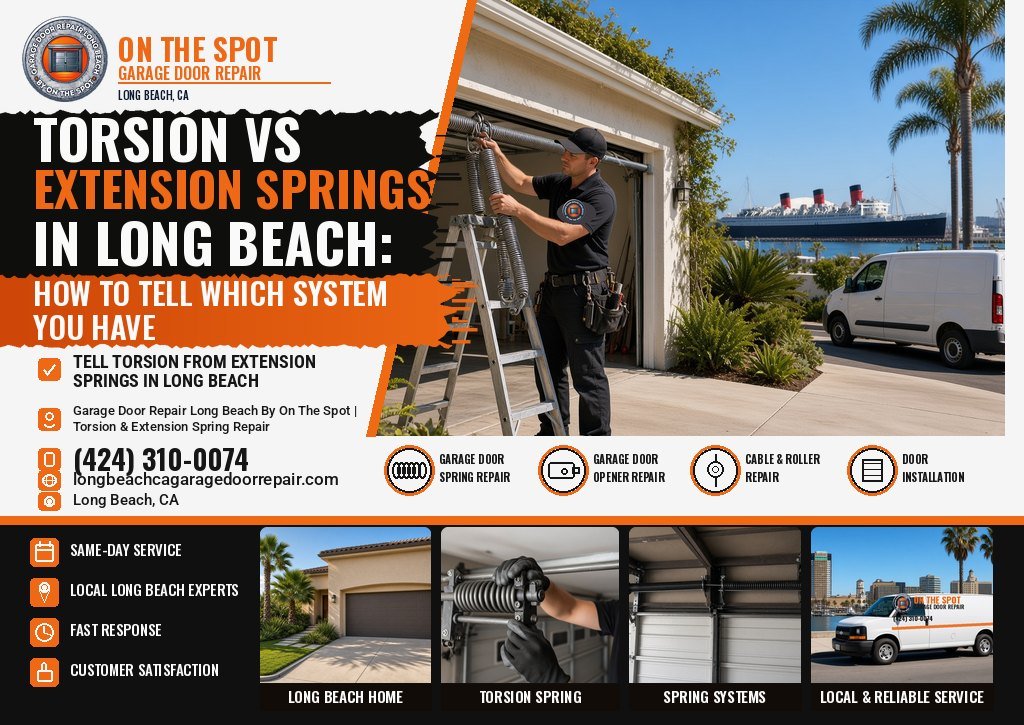
Garage Door Repair Long Beach By On The Spot · Spring Systems Guide
Torsion vs Extension Springs in Long Beach: How to Tell Which System You Have
Torsion vs extension springs in Long Beach is a distinction worth making before anyone talks about a repair. Both systems lift the weight of the door. They sit in different places, fail in different ways, and need different hardware. A torsion system uses one or two springs wound around a bar above the door. An extension system uses long stretch springs along the horizontal tracks. This guide shows you how to tell which one you have from a safe viewing distance, what each failure usually looks like, and why a worn spring is typically replaced rather than ‘repaired.’
How can I tell whether my Long Beach garage door has torsion or extension springs?
Look up from inside the garage, with the door closed, and do not touch the hardware. If you see a spring or a pair of springs wound around a metal bar directly above the door opening, that is a torsion system. If you see long, thinner springs running above the horizontal tracks along each side of the garage, that is an extension system. Some older or mixed setups can have remnants of both, but one system should be doing the lifting.
The distinction matters because the parts, the safety steps, and the usual repair are not the same. In both cases, leave winding, loosening, or removing springs to a technician.
Related reading: Garage Door Spring Replacement, Garage Door Spring Replacement Service, Garage Door Cable Repair, and Garage Door Repair Long Beach. Safety guidance from the CPSC guidance on automatic residential garage door operators and DASMA garage door system safety tips, including DASMA Technical Data Sheet 190 on torsion spring life; outage information from the SCE Outage Center.
Why Torsion vs Extension Matters on a Long Beach Door
People search for spring repair in Long Beach when the door suddenly feels heavy, the opener sounds strained, or they heard a bang. The next useful question is which spring system is on the door. A torsion spring and an extension spring both store a lot of energy, which is why DASMA garage door system safety tips tells homeowners not to adjust or remove them. They are not interchangeable parts, and a repair quoted for one system will not fit the other.
Most modern sectional doors in Long Beach use torsion springs. Many older one-car doors, tilt-up doors, and some mid-century homes still have extension springs. Neighborhood guides such as Garage Door Repair in Los Altos, Long Beach and Garage Door Repair in Bixby Knolls: Older Doors mention those older setups often. If you have just bought a house, or if the door has been patched over the years, it is worth identifying the system before you approve any work. See Garage Door Inspection After Buying a Home if this is a new house to you.
Torsion springs
One or two springs wound around a bar, called a torsion shaft, mounted above the door opening.
Extension springs
Long stretch springs that run above the horizontal tracks, usually one on each side.
What they both do
They lift most of the door’s weight so the opener, or a person, is not lifting a few hundred pounds alone.
How they usually fail
A torsion spring often breaks with a bang and a visible gap in the coils. An extension spring may snap, stretch unevenly, or come off a pulley.
The usual repair
A worn or broken spring is replaced, as a matched set when the door uses a pair, not patched or rewound as a shortcut.
The safety rule
Look, photograph, and describe. Do not wind, loosen, clamp, or cut a spring.
This page is about identification and the differences in how each system is serviced. For warning signs that a spring is already failing, see Garage Door Spring Replacement. For the visit itself on a torsion door, a companion guide covers what to expect during a replacement. Cost factors, without invented prices, are in Garage Door Repair Cost in Long Beach: What Affects the Price.
How to Look, Without Touching the Springs
You can usually tell the systems apart in a minute, from the garage floor, with the door closed. Unplug the opener first if the door has been acting unpredictably. Stay out from under a door that is stuck partway or hanging crooked.
- Stand inside the garage, a few feet back from the closed door, and look at the wall and ceiling just above the opening.
- If a round metal bar runs across the opening, with a spring (or two) sitting on that bar, you have a torsion system. Cable drums, which look like spools, usually sit at each end of the bar.
- If there is no bar above the door, look along the sides, above the tracks that run back into the garage. Long springs there, often with a pulley and a cable, are extension springs.
- Look, but do not reach, for a safety cable running through the center of each extension spring. If that cable is missing, mention it when you call. Do not try to thread one yourself.
- If you can take a photo of the hardware above the door and along the tracks without climbing under an open door or touching anything, that photo helps a technician confirm the system before the visit.
What a Torsion System Looks Like and How It Works
A torsion spring is wound tightly around a shaft above the door. As the door closes, the spring winds up and stores energy. As the door opens, that energy helps lift the door. Lift cables run from drums on the shaft down to the bottom corners of the door, keeping the door level.
One spring or two
A one-car door often has a single torsion spring in the middle of the shaft, or a pair of smaller springs. A two-car door more often has two springs, one on each side of the center bearing plate, wound in opposite directions. When a door uses a matched pair, both springs should be replaced together even if only one has broken. They have done the same amount of work. See the related post on replacing both springs after a break.
What failure usually looks like
A broken torsion spring often announces itself with a loud bang, then a door that is suddenly very heavy or will not lift. You may see a gap in the coils, as if the spring has split into two shorter springs on the bar. A spring that is worn but not yet broken can make the door feel heavier over weeks, leave the opener straining, or keep the door from staying put at mid-height if it were disconnected (do not disconnect it to test this if you already suspect a break). See Garage Door Spring Replacement, Garage Door Slams Shut, and Garage Door Will Not Open.
What the repair involves
The spring, or the pair, is replaced with hardware matched to the door’s height, width, and weight, including any insulation or windows that have been added since the last job. The technician secures the door, controls the shaft, installs the new spring or springs, sets the turns, and then tests balance and the safety reverse. Cables, drums, and rollers should be inspected at the same time. This is a replacement, not a weld, a clamp, or a few extra turns on a tired spring.
What an Extension System Looks Like and How It Works
Extension springs stretch as the door closes and contract as it opens. They usually sit above the horizontal tracks, one on each side, and work with pulleys and cables. They were common on older and lighter doors, and on one-piece tilt-up doors that swing up as a single panel.
Safety cables
Each extension spring should have a containment cable, sometimes called a safety cable, running through its center and anchored at both ends. If the spring breaks, the cable is there to keep the spring from flying across the garage. A missing safety cable is worth fixing even if the door still moves. Do not reach over a live spring to add one yourself.
What failure usually looks like
An extension spring may snap with a bang, hang loose, or look much more stretched on one side than the other. The door may hang crooked, bind in the tracks, or feel heavy on one side. Because these springs work in pairs, replacing only the broken one leaves the door uneven and shortens the life of the new spring.
What the repair involves
Both springs are typically replaced as a pair, with safety cables installed if they are missing. Pulleys, cables, and the track area should be checked, because a broken spring can slap hardware on the way past. On some older Long Beach doors, a conversation about converting to a torsion system comes up at the same time. That is a separate decision, based on the door, the headroom, and the condition of the opening, not an automatic upgrade. See Garage Door Cable Repair if a cable is loose or off a pulley.
A Side-by-Side Comparison
| Question | Torsion system | Extension system |
|---|---|---|
| Where do I look? | On a bar above the door opening. | Above the horizontal tracks, along each side. |
| How many springs? | One, or a matched pair on the same shaft. | Almost always a pair, one per side. |
| Typical doors in Long Beach | Most sectional doors, including newer steel and insulated doors. | Older one-car doors, some mid-century homes, and many tilt-up doors. |
| Common first sign of failure | A bang and a gap in the coils, or a door that has gotten steadily heavier. | A bang, a spring hanging loose, or one side of the door sitting lower. |
| Safety feature to look for | Correct winding, set screws, and sound cables and drums. Do not test those yourself. | A safety cable through the center of each spring. |
| Usual repair | Replace the spring or the matched pair; inspect cables, drums, and rollers. | Replace both springs; add or confirm safety cables; inspect pulleys and cables. |
| Can the opener hide the problem? | Yes. A raised force setting can lift a door with a weak torsion spring for a while. | Yes. The same thing happens, often with a crooked door as well. |
If the hardware you see does not match either description, or if you see a bar above the door and leftover springs along the tracks, tell the technician. A door that was converted from one system to the other can leave unused brackets in place, which is confusing in a photo but usually clear in person.
How Long Beach Housing Affects What You Will Find
Long Beach does not have one standard garage. Coastal streets, mid-century ranches, and postwar family homes each tend toward slightly different hardware, which is why the same ‘spring repair’ call can mean two different jobs.
Older and historic-area homes
In Bixby Knolls, California Heights, and some other older pockets, one-car doors and even some tilt-up or carriage-style doors still run on extension springs. Retrofitted openers on those doors are common. See Garage Door Repair in Bixby Knolls: Older Doors and Garage Door Repair in Bixby Knolls and Cal Heights. The identification step matters more here, because a quote written for a torsion pair will not apply.
Mid-century and postwar family homes
Los Altos, North Long Beach, and many inland tracts have a mix: some original extension systems, many replacement steel doors that were given torsion springs later, and some doors still on the first opener they ever had. Heat and daily school-and-work use wear springs regardless of type. See Garage Door Repair in Los Altos, Long Beach.
Coastal streets
Near Belmont Shore, Naples, and other coastal blocks, rust on springs, cables, and fasteners can shorten life on either system. Extension springs and their pulleys sit in a place that collects damp air; torsion springs sit in the same garage air but on a shaft that also has drums and bearings to watch. See How Salt Air Affects Garage Door Cables, Hinges, Tracks, and Springs, Garage Door Rust Near the Beach: Which Parts Corrode First, and Garage Door Repair in Belmont Shore: Common Problems in Older Coastal Homes.
Problems That Get Blamed on the Wrong Part
“The opener died”
An opener that hums, clicks off, or lifts only a few inches is often trying to raise a door that has lost its spring balance. Replacing the opener first leaves the same heavy door in place. Garage Door Will Not Open walks through that split. Check the spring system, then the opener, not the other way around.
“It is just a cable”
A cable can come off a drum or a pulley because a spring has failed and the door has gone crooked. Putting the cable back without fixing the spring is temporary at best, and it is unsafe to do by hand. See Garage Door Cable Repair.
“We can turn the force up for now”
Raising the opener force can mask a weak spring and can make the opener less likely to reverse if it hits something. That is not a repair. The spring system needs to carry the door again, and then the force can be set back to a normal range.
Why a Worn Spring Is Usually Replaced, Not Repaired
The search phrase is often ‘spring repair,’ and that is a fair way to describe the job. The work itself is almost always a replacement. A spring that has broken, stretched beyond its useful life, or rusted through cannot be safely restored to a known, correct tension. Clamps, welds, and ‘just a few more turns’ are not a sound fix.
DASMA Technical Data Sheet 190 on torsion spring life discusses how torsion spring life is measured in cycles. Daily use in a Long Beach household, plus rust in coastal air, uses those cycles up. When the spring is done, the matching replacement is the repair. The door, the opener, and the tracks may still be worth keeping.
What should be replaced together
- A matched torsion pair, when the door uses two torsion springs.
- Both extension springs, when the door uses that system.
- A frayed or damaged lift cable found during the same inspection.
- Missing safety cables on an extension system.
What can often stay
A sound door, a sound opener (once the door is balanced again), and tracks that are still straight can stay. That is a different question from whether the spring itself can be saved. It usually cannot.
What You Can Safely Check, and What You Should Not
A short checklist is enough. Anything that involves tools on the spring is past the line.
- Look at the closed door from inside and decide whether you see a torsion bar or side-mounted extension springs.
- Look for a gap in a torsion spring, or a loose or uneven extension spring, without touching it.
- Look at both lift cables. They should be on their drums or pulleys, not hanging slack.
- See whether the door is sitting level.
- Confirm the opener has power. If the block is dark, check the SCE Outage Center. See Garage Door Will Not Open After a Power Outage.
- Try the wall button, not only the remotes.
When to Call, and What to Say
Call if the door is heavy, crooked, off-track, or will not lift; if you heard a bang; or if you are simply unsure which system you have and want it identified before it fails. Garage Door Repair Long Beach By On The Spot can be reached at (424) 310-0074 or through our contact page.
Helpful details: whether you see a bar above the door or springs along the tracks, whether anyone heard a bang, whether the door is open, closed, or stuck, and whether children or a vehicle are involved. You do not need the right technical name. ‘The spring is on a bar above the door’ or ‘the springs run along the sides’ is enough.
Example Scenarios
These are composite situations, not quotes from a particular address. They show why naming the system first avoids a wrong repair.
The opener that was not the problem
A two-car steel door in inland Long Beach starts opening slowly. The family assumes the opener is dying. From the floor, a torsion pair is visible on the bar, and one spring has a gap in the coils. Replacing the opener would have left a door that the new motor still could not lift safely. Replacing the torsion pair, then resetting the opener force, solved it.
The one-car door with side springs
A 1950s one-car garage still has extension springs and no safety cables. One spring has stretched much more than the other, and the door hangs slightly low on that side. The repair is a new pair of extension springs with safety cables, plus a look at the pulleys. A torsion quote would have been the wrong job unless the owner also wanted a conversion, which needs enough headroom and a plan for the opening.
The coastal door with rust on both systems’ hardware
A house a few blocks from the water has a torsion system, but leftover extension-spring brackets from an older door are still on the tracks. The owner thought they still had extension springs. A photo of the bar above the door settled it. The torsion springs and cables were rust-pitted and due for replacement; the old side brackets were just leftovers. See How Salt Air Affects Garage Door Cables, Hinges, Tracks, and Springs.
The mixed parts after a prior repair
A door got a new steel section set years ago, but the extension springs were reused or replaced cheaply on a door that is now heavier. The door works, but the opener strains in the afternoon heat. Identifying the system, then asking whether the springs were sized for the current door, is the useful conversation. The opener may still be fine.
Questions to Ask Before Anyone Works on the Springs
Ask which system is on the door, whether springs will be replaced as a pair, whether safety cables will be fitted on an extension system, what else will be inspected, and whether you will get a written price before work begins. Look the company up on the California Contractors State License Board (CSLB) license lookup. See Garage Door Repair Scams to Avoid for red flags. This guide does not claim a particular license for any company, including us.
- Ask them to point to the spring system on your door, not only to name it.
- Ask whether the replacement springs will be matched to the current door weight, including insulation or glass.
- Ask how they will test balance and the safety reverse afterward.
- Be wary of a firm spring price given without seeing the door, or of an offer to ‘just add tension’ to a broken spring.
What a Visit Looks Like Once the System Is Identified
Once the technician knows whether they are looking at torsion or extension springs, the visit follows a similar path even though the parts differ. The door is inspected and made safe. You hear what failed and what the written price covers. The springs are replaced in a controlled way. Balance, travel, and the safety reverse are tested. Garage Door Repair Long Beach By On The Spot works to that sequence. Our address is 151 E 5th St, Long Beach, CA 90802.
- Identify the system and inspect springs, cables, tracks, rollers, and the opener.
- Explain the findings, including any related parts that should be replaced at the same time.
- Give a written price before work starts.
- Secure the door and replace the spring or the matched pair, with safety cables on extension systems.
- Test the door by hand-balance and on the opener, including the safety reverse described by the CPSC.
For a closer walk-through of a torsion job specifically, see the process guide on this site once it is published, and the service page Garage Door Spring Replacement Service. For general repair in the city, see Garage Door Repair Long Beach and Garage Door Repair in Long Beach.
Spring Terms You Will Hear
Torsion shaft
The metal bar above the door that carries the torsion spring or springs and the cable drums.
Winding cone
The end fitting on a torsion spring. It is not something to put a bar into at home.
Cable drum
The spool at the end of the torsion shaft that the lift cable wraps around.
Extension pulley
The pulley an extension-spring cable runs through along the track.
Safety cable
A cable through the center of an extension spring that contains the spring if it breaks.
Cycle rating
A way of describing how many times a spring is designed to be opened and closed. See DASMA TDS 190.
Balance
Whether the springs carry the door so it can be moved by hand and will hold mid-height.
Daily Use, Rust, and Spring Life in Long Beach
Spring life is usually described in cycles, which is the language DASMA Technical Data Sheet 190 on torsion spring life uses for torsion springs. A cycle is one open and one close. A family that uses the door four or six times a day will use up those cycles faster than a house where the door opens once in the morning and once at night. That is true for torsion springs and for extension springs, even though the hardware looks different. Long Beach daily life, school runs, and work commutes are a bigger factor than most people expect when they search for spring repair.
Coastal air adds a second kind of wear. Salt and moisture pit the surface of a spring, a cable, a pulley, or a fastener, and a pitted spring can fail sooner than its cycle rating would suggest. This shows up more often near Belmont Shore, Naples, and other streets close to the water, but inland houses are not immune, especially if the garage stays damp. How Salt Air Affects Garage Door Cables, Hinges, Tracks, and Springs, Garage Door Rust Near the Beach: Which Parts Corrode First, and Why Galvanized Springs Matter for Coastal Homes cover the coastal side in more detail. A rusty spring that has not broken yet is still a reason to have it inspected; see Garage Door Spring Is Rusty but Not Broken: Should It Be Replaced Yet?.
Heat matters too, especially on west- or south-facing garages in North Long Beach and other inland tracts. A spring that is already weak, plus an opener that has been turned up to compensate, plus a hot afternoon, is a common combination for a door that ‘worked this morning and will not move now.’ The system type does not change that pattern. Identifying the system just tells you which parts will be replaced when the repair is done.
Sounds that are worth a look
A sudden bang is the classic sign of a break. Popping, creaking, or a twanging sound on a torsion bar, or a squeal from an extension spring and pulley, can be earlier warnings. They can also be dry rollers or a tight track, which is why a look at the whole door is better than guessing from the sound alone. Garage Door Spring Makes Popping or Creaking Sounds and Garage Door Noise Only When Opening are useful if the door still moves but the sound has changed.
Uneven stretch and a crooked door
If one extension spring looks longer or more tired than the other, or if a torsion pair is no longer sharing the load, the door may start to hang crooked or feel heavier on one side. That is a balance problem, and it is unsafe to ‘even up’ by winding or stretching one side at home. See Garage Door Spring Stretching Unevenly and Uneven Gaps Along the Sides of a Garage Door.
Single and Dual Torsion Springs, and Why Pairs Are Replaced Together
Once you have identified a torsion system, the next detail is whether the door uses one spring or two. A single spring in the middle of the shaft is common on smaller or lighter doors. Two springs, wound in opposite directions and sitting on either side of a center bearing plate, are common on wider or heavier doors, including many two-car openings and insulated steel doors.
When a door is built around a matched pair, replacing only the broken spring leaves a new spring working against a tired partner. The door can look fine for a short time and then fail again. Do I need to replace both springs, or just the broken one? walks through that decision. The same logic applies to extension springs, which almost always work as a pair. This page is about telling the systems apart; the ‘replace the pair’ question is the follow-up once you know what you have.
A technician measures the door and reads the existing spring, when the markings are still visible, rather than guessing from the width of the opening alone. Insulation, glass, and a heavier replacement door can all mean the old spring size is no longer right. That is another reason a phone quote given without seeing the door is a weak starting point.
Cables, Drums, and Pulleys: Parts That Get Mixed Up With Springs
Lift cables are part of both systems, and a loose or off-track cable is often the first thing a homeowner notices. On a torsion door, the cables wrap around drums at the ends of the shaft. On an extension door, the cables run through pulleys along the tracks. A cable can come loose because the spring has failed and the door has shifted, or because the cable itself has frayed. My garage door cable came loose: does that usually mean the spring is broken too? covers that overlap, and Garage Door Cable Repair is the service page for cable work.
It is not safe to put a cable back on a drum or a pulley by hand if the spring may be broken or the door is hanging unevenly. The door can drop. Mention the cable when you call, and leave it alone. The same visit that replaces the springs should include a look at the cables, the drums or pulleys, and the bottom brackets, because those parts share the load.
Tracks and rollers get blamed too. A door that binds in the track may have a spring or cable problem that pulled it out of line, or it may have a bent track from a bump in a tight alley. See Off-Track Garage Door Repair and Garage Door Track Repair. The identification step still comes first: once you know whether the lifting system is torsion or extension, the rest of the inspection has a place to start.
Why You Should Not Replace a Spring Yourself
A common follow-up search, after ‘which springs do I have,’ is whether the job can be done at home. The short answer from safety agencies is no. The CPSC guidance on automatic residential garage door operators and DASMA garage door system safety tips treat garage door springs as high-tension parts. A torsion spring is wound under load on a shaft above the door. An extension spring is stretched along the track and can fly if it breaks or is released the wrong way. Can I replace a garage door spring myself? covers that question in more detail. This page will not give winding steps, tool lists, or turn counts, because those would be instructions for a job that should not be done without training.
What you can do at home is identify the system from a safe distance, stop using a door that has become heavy or crooked, keep people and cars clear, and describe what you see when you call. If the door is stuck open, do not pull the emergency release to ‘get it down.’ If it is stuck shut, do not force the opener. If a vehicle is inside, wait for a technician rather than trying to lift the door by hand.
Online videos make the work look shorter than it is. They also skip the part where a winding bar slips, a cone lets go, or an extension spring comes off a pulley. Long Beach homeowners who have tried it often end up with a door that is more damaged than when they started, plus a risk of serious injury. Leave the winding, the stretching, and the removal to someone who does this work and will stand behind a written price. See also Garage Door Repair Scams to Avoid if a stranger at the door offers to ‘just tension it’ without explaining the system on your door.
Photos That Help on the Phone, and What Happens Next
A few photos, taken from the garage floor with the door closed, can confirm the system before anyone arrives. Stand back far enough that you are not under a door that might move. Do not climb a ladder next to the springs.
- One photo of the wall and ceiling just above the door opening, showing whether a torsion bar and spring are there.
- One photo of each side, above the horizontal tracks, showing whether extension springs are present.
- If you can see them without getting close, a photo of the cables at the bottom corners of the door.
- A photo of the door from the driveway, so the size and style are clear.
- A short note about any bang, heaviness, or crooked movement, and whether the opener still tries to run.
You will still get a written price after the door is inspected in person, because photos cannot always show rust inside a spring, a cracked drum, or a door that has been made heavier with insulation. The photos just reduce the guessing. Garage Door Repair Long Beach By On The Spot can take that information by phone at (424) 310-0074 or through the contact page.
After you know the system
If it is a torsion system, the usual path is a replacement of the spring or the matched pair, plus a check of cables, drums, rollers, and opener force. If it is an extension system, the usual path is a replacement of both springs, safety cables if they are missing, and a check of pulleys and cables. In both cases, ask for the safety reverse to be tested when the job is done, following the kind of check described by the CPSC guidance on automatic residential garage door operators. For citywide repair, see Garage Door Repair Long Beach and Garage Door Repair in Long Beach. For the spring service itself, see Garage Door Spring Replacement Service.
Maintenance You Can Do Around the Springs, Not To Them
You do not need to touch a spring to take better care of the door. Keep the photo-eye sensors clean and unblocked, which matters on family driveways where bins and bikes collect. Look at the bottom seal and the side seals if dust or light is coming in; Garage Door Weather Seal Replacement covers that work. Listen for new sounds, and notice if the door has started to look crooked or feel heavier. Those are reasons to schedule a look, not reasons to bring out a winding bar.
A tune-up can include lubrication of rollers and hinges, a balance check, and a safety test, as long as the person doing it treats the springs as a qualified task and not as a DIY add-on. See Garage Door Tune-Up and Garage Door Maintenance. If a technician says the springs are worn, ask them to show you which system you have and why replacement, rather than adjustment, is the recommendation. Coastal homes may also hear a recommendation for hardware that holds up better in salt air; that is a materials choice, not a reason to invent a new system on the spot. See Rust-Resistant Garage Door Hardware for Coastal Homes.
If You Just Moved In, Identify the System Early
A house sale in Long Beach often includes a garage door that was ‘working on the day of the inspection’ and then fails in the first months of new, heavier use. The previous owner may not have known whether the door used torsion or extension springs, or may have replaced only one spring of a pair. A short identification and inspection after you move in is cheaper than finding out during a morning when someone needs the car. Garage Door Inspection After Buying a Home is the companion guide for that visit.
If you are getting the house ready to sell, a broken or mismatched spring system is one of the items buyers and inspectors notice, because the door either will not lift or looks unsafe. Garage Door Repair Before Selling a Home covers the broader pre-sale list. In both cases, start by naming the system, then decide what actually needs to be replaced.
Property managers and landlords run into the same mix of systems across a group of units, which is why a one-size ‘spring repair’ work order can lead to the wrong parts on the truck. A photo of the bar or the side tracks, plus the door width, is enough to start. See Garage Door Repair for Property Managers and Garage Door Repair for Rental Properties.
What “Spring Repair” Usually Means on a Long Beach Search
The phrase most people type is ‘spring repair,’ sometimes with Long Beach in the query, sometimes with ‘torsion spring replacement’ when they already know the system. Those searches point at the same family of problems: a door that is heavy, a bang in the garage, a spring that looks wrong, or an opener that is straining. The useful split is not the wording of the search. It is which system is on the door, and whether the work will be a torsion replacement, an extension-spring replacement, or something else entirely, such as a cable or an opener.
If you only remember one thing from this page, remember the look-from-the-floor test. A spring on a bar above the door is torsion. Long springs above the side tracks are extension springs. From that point, the repair is almost always a replacement of the worn spring or the matched pair, with a written price before work begins. Garage Door Spring Replacement Service is the service page for that work. Garage Door Repair Long Beach and Garage Door Repair in Long Beach cover general repair in the city.
Neighboring cities use the same two systems. A door in Signal Hill, Lakewood, Seal Beach, or Los Alamitos is identified the same way, even if the house style differs. This page is written for Long Beach homes, including the coastal and inland mix described earlier, but the identification steps travel. If your door is in one of those neighboring cities, the same safety rules apply: look, do not wind, and have the system named before you approve a repair.
A last practical note about leftover hardware: older Long Beach garages sometimes keep brackets, pulleys, or even a length of track from a system that is no longer in use. A conversion from extension springs to torsion, or a door replacement that left the old side hardware in place, can make a photo confusing. If you see a bar above the door and also springs or brackets along the tracks, describe both when you call. The technician will tell you which system is actually lifting the door. That is a better starting point than guessing from a leftover bracket. For the signs that the lifting system is already failing, return to Garage Door Spring Replacement. For a loose cable that may be part of the same failure, see Garage Door Cable Repair and My garage door cable came loose: does that usually mean the spring is broken too?.
If you have already identified a torsion system and want the visit itself explained, use the process guide that accompanies this one, or go straight to Garage Door Spring Replacement Service. If you have identified extension springs, ask about a matched pair and about safety cables, and do not assume a torsion quote applies. Either way, Garage Door Repair Long Beach By On The Spot can help you name the system and plan the repair. Call (424) 310-0074, write through the contact page, or visit 151 E 5th St, Long Beach, CA 90802.
One more pattern is worth naming because it shows up often in family homes. A door that still opens, but more slowly than it did last year, is easy to live with until a morning when it will not open at all. That slow change is often a torsion or extension spring wearing through its remaining cycles, sometimes with rust in the mix. Identifying the system now, while the door still moves, gives you time to book a replacement on a day that works for the household rather than on the morning the spring finally lets go. Why Is My Garage Door Too Heavy to Open Manually? is useful if the door already feels too heavy to lift by hand, and Garage Door Spring Replacement if you are seeing earlier warning signs.
Keep the written notes from any past spring work if you have them. They often say whether the last job was a torsion pair, a single spring, or an extension pair, and whether safety cables were added. If you do not have those notes, the look-from-the-floor test and a current inspection are enough. The goal is simply to stop guessing about the system on your door before anyone starts a repair you did not mean to approve.
Torsion vs extension springs: FAQ
How can I tell torsion springs from extension springs in Long Beach?
Look from inside, with the door closed, and do not touch the hardware. A spring on a bar above the door is torsion. Long springs above the side tracks are extension springs.
Is one system safer than the other?
Both store a lot of energy and should be left to a technician. Extension springs should have safety cables through the center. Torsion springs sit on a shaft above the door and fail differently, but they are not a do-it-yourself part either. See DASMA garage door system safety tips.
Can I convert extension springs to torsion springs?
Sometimes, if the opening has the headroom and the door is a good candidate. It is a separate decision from replacing a failed extension pair, and it should be based on an inspection, not on a phone guess.
If one spring breaks, do both need to be replaced?
On a matched pair, yes, in almost every case. The remaining spring has done the same work. This applies to torsion pairs and to extension pairs.
My opener sounds weak. Could it still be the springs?
Yes. A weak or broken spring makes the opener lift weight it was not designed to lift. See Garage Door Will Not Open and have the spring system checked before you replace the opener.
Are springs repaired or replaced?
The job is usually a replacement. A broken or worn-out spring is not safely restored to a known tension. The door and the opener may still be reusable once the springs are right.
Does coastal air change which system I should have?
Coastal air rusts hardware on both systems. It is a reason to inspect springs and cables sooner, and to choose hardware that holds up in that air, not an automatic reason to switch systems. See How Salt Air Affects Garage Door Cables, Hinges, Tracks, and Springs.
What should I do if I heard a bang and the door is heavy?
Stop using the door and the opener, keep people clear, and do not pull the emergency release if the door is open. Call (424) 310-0074. See Garage Door Spring Replacement.
Do I need to know the system name when I call?
No. Describing where the springs sit, what the door is doing, and whether anyone heard a bang is enough.
Where are you located?
Garage Door Repair Long Beach By On The Spot is at 151 E 5th St, Long Beach, CA 90802. Call (424) 310-0074, use our contact page, or find us on Google Maps.
Garage Door Repair Long Beach By On The Spot on Google Maps
View Garage Door Repair Long Beach By On The Spot on Google Maps · 151 E 5th St, Long Beach, CA 90802
Not Sure Which Spring System You Have?
Garage Door Repair Long Beach By On The Spot will look at the door, identify the spring system, explain what failed, and give you a written price before any work begins. Call (424) 310-0074, use our contact page, or find us on Google Maps. Our address is 151 E 5th St, Long Beach, CA 90802.
Garage Door Repair Long Beach By On The Spot · 151 E 5th St, Long Beach, CA 90802
(424) 310-0074 · office.onthespotgaragedoor@gmail.com · longbeachcagaragedoorrepair.com