
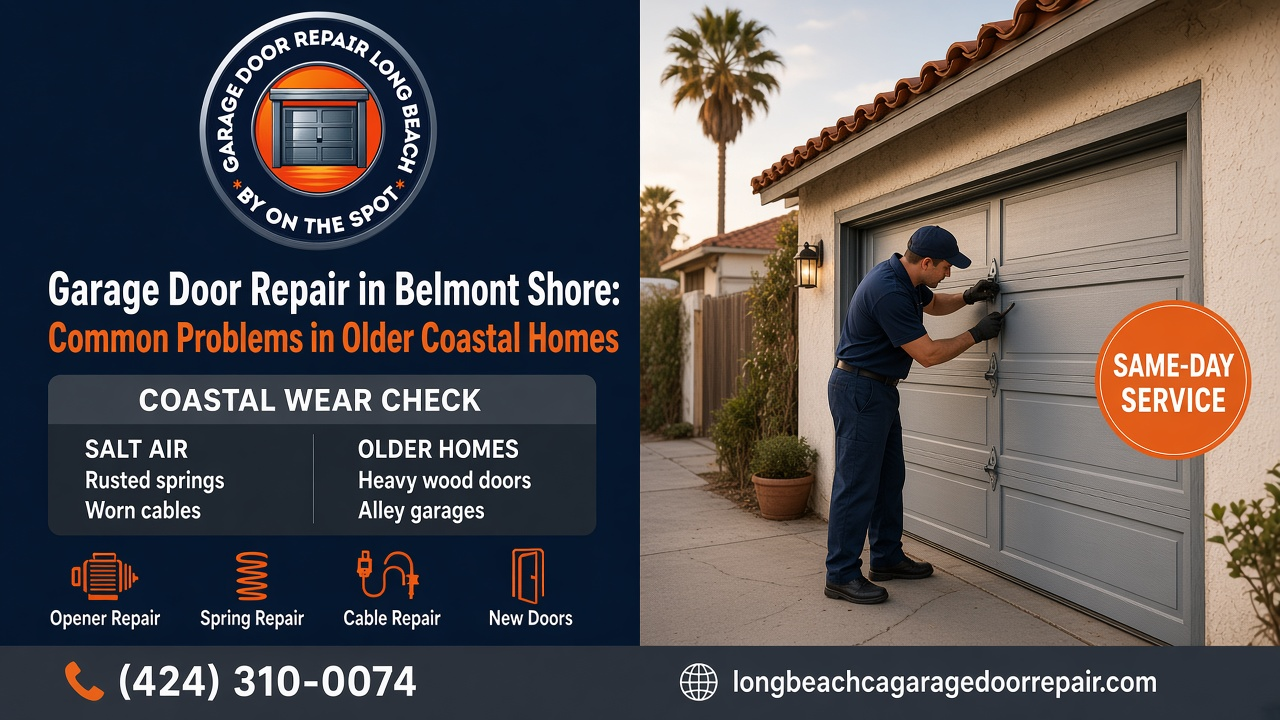
Garage Door Repair Long Beach By On The Spot · Belmont Shore (90803) Guide
Garage Door Repair in Belmont Shore: Common Problems in Older Coastal Homes
Belmont Shore has some of the most charming streets in Long Beach: Spanish-style bungalows, Craftsman cottages, and small apartment buildings on narrow lots, most of them a short walk from the sand and Alamitos Bay. The same things that make the neighborhood special also make its garages hard on doors. Many homes were built between the 1920s and the 1950s, their garages sit on alleys behind the house, and every part of the door lives in salt air and morning marine layer. This guide explains the garage door problems we see most often in older Belmont Shore homes, why they happen, what you can safely check yourself, and how to decide whether a repair or a new door makes more sense.
What are the most common garage door problems in older Belmont Shore homes?
The most common garage door problems in older Belmont Shore homes are rusted springs, cables, rollers, and bottom brackets caused by salt air; aging or rotting wood doors that have grown heavier than their springs; worn one-piece tilt-up hardware; doors damaged by vehicles in narrow alleys; and older openers that lack modern safety sensors or battery backup. Small, short, or out-of-square detached garages add their own problems, such as tight headroom, binding doors, and gaps under the door from settled slabs.
Most of these problems are repairable, and catching them early keeps them inexpensive. The key is to have the whole door checked, not just the part that failed, because coastal corrosion and age usually affect several parts at once.
Related reading: Garage Door Repair in Belmont Shore (90803), Marine-Grade vs. Standard Steel for Belmont Shore Garages, The Long Beach Coastal Rust Guide (90803 and 90802), and Top Causes of Off-Track Garage Doors in Long Beach Alleys. Safety guidance from the CPSC guidance on automatic residential garage door operators and DASMA garage door system safety tips; outage information from the SCE Outage Center.
Why Belmont Shore Garages Are Different
Belmont Shore was laid out and built mostly in the 1920s, when developers Warren McGrath and Samuel Selover turned low coastal land beside Alamitos Bay into a residential neighborhood, according to the Pacific Coast Architecture Database entry on Belmont Shore. The area filled in through the 1930s, 1940s, and 1950s with small single-family homes, duplexes, and courtyard apartments. Much of that original housing is still standing. That history shapes almost every garage door call in the 90803 ZIP code.
Three conditions come up again and again. First, the neighborhood sits between the ocean and the bay, so salt air and moisture reach every garage, not just the ones on Ocean Boulevard. Second, lots are narrow and many garages are detached structures at the back of the lot, opening onto an alley. Third, many of those garages were built for the cars of their time, with smaller openings, lower ceilings, and wood framing that has now been standing for seventy to a hundred years.
Salt air from two sides
The ocean to the south and Alamitos Bay to the east mean salt and moisture reach the whole neighborhood. Steel parts rust faster here than in inland Long Beach.
Marine layer mornings
Damp, cool mornings leave condensation on springs, tracks, and opener parts. The cycle of wetting and drying speeds corrosion.
Alley-facing garages
Most garages open onto narrow alleys, where tight turns, trash bins, and passing cars lead to dented panels and bent tracks.
Older garage structures
Detached garages from the 1920s to the 1950s often have small openings, low headroom, wood jambs, and slabs that have settled over time.
Older or original doors
Wood doors, one-piece tilt-up doors, and doors with many coats of paint are common, and each brings its own repair issues.
Dense, busy streets
Parking is scarce near Second Street, so a garage that works matters. A stuck door can mean nowhere to park.
None of this means Belmont Shore garage doors are doomed to fail. It means they age differently, and that a repair approach that works in a newer inland tract may not be enough here. The rest of this guide goes problem by problem. If you need help now, our Garage Door Repair in Belmont Shore (90803) page and Emergency Garage Door Repair in Belmont Shore page explain how to reach us.
Problem 1: Salt-Air Corrosion on Springs, Cables, and Hardware
Corrosion is the single most common root cause behind garage door repairs in Belmont Shore. Salt particles carried by the sea breeze settle on steel parts. Moisture from the marine layer dissolves them into a thin, corrosive film. Over months and years, that film eats into bare steel. DASMA Technical Data Sheet 190 on torsion spring life explains why this matters for springs in particular: rust reduces the effective cross-section of the spring wire, and corrosion pits become starting points for fatigue cracks. A rusted spring is weaker and more likely to break early.
Which parts rust first
- Torsion springs: bare oil-tempered springs show surface rust quickly. Pitting along the coils is a warning sign.
- Bottom brackets: they sit at the lowest, wettest corner of the door, often in contact with water and sand. Rusted bottom brackets are dangerous because they hold the lift cables under tension.
- Lift cables: rust and broken strands usually start near the bottom bracket, where the cable is wettest.
- Rollers and bearings: steel rollers seize or wobble when their bearings rust, which makes the door loud and rough.
- Track fasteners and hinges: rusted bolts loosen or snap, letting tracks shift out of alignment.
- Opener rail and trolley: chains rust, and moisture can reach the circuit board and sensor connections.
Our article Garage Door Rust Near the Beach: Which Parts Corrode First covers the order in which parts tend to corrode, and How Salt Air Affects Garage Door Cables, Hinges, Tracks, and Springs explains how salt air affects each component. For springs specifically, see Why Galvanized Springs Matter for Coastal Homes.
What helps
Corrosion cannot be stopped completely near the beach, but it can be slowed. Coated or galvanized springs, sealed nylon rollers with stainless or sealed bearings, galvanized cables, and stainless or coated fasteners all resist rust better than standard bare steel. A gentle wipe-down of exposed hardware a few times a year, a light coat of garage-door lubricant on springs and hinges, and keeping sand swept away from the bottom of the door all help. Avoid heavy grease in the tracks, which traps sand and grit. See Preventing Salt-Air Corrosion on Garage Door Tracks and Rust-Resistant Garage Door Hardware for Coastal Homes for practical steps.
Problem 2: Aging Wood Doors That Have Grown Too Heavy
Many Belmont Shore garages still have wood doors, either originals or replacements chosen to match a Spanish or Craftsman house. Wood suits the neighborhood’s look, but it reacts to coastal moisture. Over time, wood absorbs water, especially at the bottom rail where it meets the slab, and gains weight. Owners repaint it every few years to protect it, and each coat adds more weight. Some doors have had trim, windows, or decorative hardware added. By the time a door is thirty or forty years old, it can weigh noticeably more than when its springs were first sized.
That matters because the springs, not the opener, are supposed to carry the door’s weight. DASMA’s DASMA Technical Data Sheet 190 on torsion spring life notes that added weight from paint and components can push a door past what its springs were designed for. When the door outgrows its springs, several things happen at once: the door feels heavy when lifted by hand, the opener strains and wears its gears, and the springs work harder on every cycle and break sooner. For a full explanation of the symptom, read Why Is My Garage Door Too Heavy to Open Manually?.
Signs your wood door is in trouble
- Dark, soft, or crumbling wood along the bottom rail or the lower corners.
- Paint peeling in sheets or bubbling, which often means moisture is trapped underneath.
- Panels that have split, warped, or pulled away from the frame.
- A door that drifts down or feels very heavy when the opener is disconnected.
- An opener that slows near the top of travel or reverses for no clear reason.
- Gaps at the sides or bottom where the door no longer sits flat against the stops.
Repair options for wood doors
Rot at the bottom rail can sometimes be cut out and replaced, and loose joints can be glued and pinned. After any wood repair, the door should be weighed or checked for balance and the springs adjusted or replaced to match. A properly sealed and painted bottom edge, combined with a good bottom seal, slows the next round of rot. When rot has spread through several panels or the frame, replacement is usually more practical. Our guides Repairing Wood Garage Doors and Refurbishing vs. Replacing Historic Garage Doors go deeper into wood door repair choices.
Problem 3: One-Piece Tilt-Up Doors and Old Extension Springs
Older detached garages in Belmont Shore sometimes still have one-piece doors that tilt up and swing out as a single panel instead of rolling up in sections. These doors usually ride on pivot hardware mounted to the jambs, with large extension springs on each side. Some have been converted to use an opener; many are still opened by hand.
One-piece doors can work for decades, but they bring specific problems in an older coastal garage:
- Worn pivot hardware: the arms and brackets that guide the door wear, rust, and loosen, so the door swings unevenly or drops on one side.
- Missing containment cables: older extension springs often have no safety cable running through them. If one breaks, it can whip across the garage.
- Swing-out clearance: the bottom of the door swings outward as it opens, which can strike a car parked too close, a trash bin, or a passerby in a narrow alley.
- Rotting jambs: the hardware is bolted into the wood jambs, so if the jambs soften, the hardware pulls loose.
- Hard-to-find parts: some tilt-up hardware is no longer widely stocked, so repairs may mean adapting parts.
A tilt-up door with worn hardware can often be repaired, and containment cables can be added to extension springs. But if the door is heavy, rotting, or fighting an opener it was never designed for, converting to a modern sectional door is often safer and more reliable. A sectional door rolls straight up without swinging into the alley, which is a real advantage on Belmont Shore’s narrow lanes. See Garage Door Replacement in Long Beach and How to Modernize a Historic Garage Door.
Problem 4: Springs That Break Sooner Than Expected
Spring breaks are the most common urgent call in any neighborhood, but in Belmont Shore they often come earlier in a spring’s life. DASMA Technical Data Sheet 190 on torsion spring life explains that a standard residential torsion spring is designed for a minimum of about 10,000 cycles, where one cycle is one open and one close. In a neighborhood where street parking is scarce, many households use the garage several times a day, and many use the garage door as the main way in and out. Add corrosion that shortens spring life and wood doors that have gained weight, and springs can fail well before the age homeowners expect.
The classic sign is a loud bang from the garage, followed by a door that will not lift or rises only a few inches before the opener gives up. Looking up from a safe distance, you may see a gap of a few inches in the spring coil above the door.
- Stop using the opener. Repeated attempts can bend the top section and strip the opener’s gears.
- Keep people, pets, and vehicles away from the door.
- If the door is open, do not try to close it by hand unless it is light and stable; a door with a broken spring can drop suddenly.
- Call for service and mention that you hear or see a broken spring.
When springs are replaced on a coastal door, ask about coated or galvanized springs and about longer-life springs for heavy daily use. On doors with two springs, both should usually be replaced together. For more detail on pricing and options, see Garage Door Spring Replacement, Garage Door Spring Replacement Service, and Garage Door Spring Replacement Cost in Long Beach, CA.
Problem 5: Alley Impacts, Bent Tracks, and Off-Track Doors
Belmont Shore’s alleys were laid out long before today’s larger cars and trucks. Backing into a narrow garage from a narrow alley leaves little room for error, and the garage door takes the hit. Bumpers clip the bottom section, mirrors catch the side track, and trucks turning in the alley can scrape a door that is partly open. Trash and recycling bins parked against the door, and delivery vans squeezing past, add more chances for damage.
Even a small impact can move a track a fraction of an inch, crack a roller, or bend a hinge. The door may keep working for a while, but it starts to grind, shake, or bind at the same spot each time. Eventually a roller jumps out of the track and the door hangs crooked or jams halfway.
Signs of impact damage
- A crease or dent across the bottom one or two sections.
- A gap that is wider on one side between the door and the track.
- A roller sitting outside the track or rubbing the track’s edge.
- The door shudders or pauses at the same height every time.
- One side of the door rises before the other.
A door that has come off its track is a stop-using-it situation. It is still under spring tension, and pulling or forcing it can bring it down. Read Off-Track Garage Door Repair and Top Causes of Off-Track Garage Doors in Long Beach Alleys for causes and what a proper fix involves, and Garage Door Track Repair if the track itself is bent.
Problem 6: Small, Short, and Low-Headroom Garages
Many Belmont Shore garages were built when cars were smaller and nobody stored kayaks, bikes, surfboards, and a second refrigerator in the garage. Openings can be narrower or shorter than today’s common door sizes, ceilings can be low, and the space between the top of the opening and the ceiling, called headroom, can be tight. Depth can be limited too, especially on lots that are often only about 30 feet wide.
These dimensions affect repairs in a few ways:
- Non-standard sizes: an opening that does not match common door sizes may need a custom-sized replacement door or section, which takes longer to order.
- Low headroom: a standard torsion setup needs room above the door. Low-headroom track kits, rear-mounted torsion springs, or wall-mount openers can solve this, but they change the parts list.
- Short depth: a long opener rail may not fit, or may hang over where a car or storage sits.
- Storage conflicts: ceiling racks, shelves, and lofts can block the door’s travel or the opener rail, causing binding or damage.
A wall-mount, or jackshaft, opener is often a good fit in low or crowded Belmont Shore garages, because it mounts beside the door and frees the ceiling. It needs a torsion spring system and a compatible door, so it is not an option for every older door. See Garage Door Opener Repair Service and Garage Door Opener Replacement in Long Beach, CA for how opener types compare.
Problem 7: Settled Slabs, Out-of-Square Openings, and Gaps
After decades on low, filled coastal land, many garage slabs and foundations have settled unevenly. Wood jambs and headers may have shifted, softened, or been patched. The result is an opening that is no longer perfectly square and a floor that is no longer level. A garage door is a precise machine that expects a square opening and a flat floor, so this mismatch causes recurring problems.
- Uneven gaps under the door: daylight, sand, water, and pests get in on one side even with a new bottom seal.
- Binding against the stops: the door rubs against the side trim when the jambs lean.
- Track alignment problems: tracks mounted to soft or out-of-plumb jambs drift out of alignment.
- Loose hardware: lag screws lose their grip in soft wood.
Fixes range from a thicker or tapered bottom seal and adjusted stops to new jamb wood and reinforced track mounting. Structural problems with the garage itself are outside garage door work and may need a carpenter or general contractor. For seal options, see Garage Door Bottom Seal Replacement, Cracked or Brittle Weather Seals, and Garage Door Letting In Dust, Bugs, and Coastal Air.
Problem 8: Water, Sand, and Low-Lying Lots
Parts of Belmont Shore sit close to sea level, and some blocks near the beach and bay fall within mapped flood hazard areas. You can check your own address on the FEMA Flood Map Service Center. Even outside a mapped zone, heavy rain, high tides, and wind-blown sand reach garage floors. Water that pools at the bottom of a garage door speeds up rust on bottom brackets, cables, and the bottom of the tracks, and rots wood doors from the bottom rail up.
A good bottom seal, a threshold seal where the floor is uneven, and a door bottom that is kept clear of sand all help. After a storm or an unusually high tide, it is worth looking at the bottom brackets and cable ends for fresh rust. If the garage took on water, have the opener’s low-mounted photo-eye sensors and wiring checked before relying on them.
Problem 9: Older Openers and Marine-Layer Electronics
Openers in older Belmont Shore garages range from brand-new smart units to machines that are thirty years old or more. Very old openers can lack the photo-eye sensors that federal rules have required on automatic residential openers made since 1993; the CPSC guidance on automatic residential garage door operators explains why that entrapment protection matters. Many openers installed before mid-2019 also lack the battery backup that California SB 969 (battery backup law) now requires on new openers sold or installed in California.
Even newer openers have a hard time near the coast. Moisture and salt reach the circuit board, the sensor connections, and the wiring along the wall. Corroded sensor terminals cause the door to reverse or refuse to close. Rust on a chain-drive rail makes the opener louder and rougher. Remotes lose range as batteries and contacts corrode, and dense housing with many nearby openers and devices can add radio interference.
| Opener symptom | Common coastal or age-related cause | Usual next step |
|---|---|---|
| Door reverses or blinks and will not close | Misaligned or corroded photo-eyes, damaged low-voltage wire | Clean, realign, or replace sensors and wire |
| Remote works only close to the door | Weak battery, corroded contacts, antenna position, interference | Replace battery, check antenna, reprogram or replace remote |
| Opener hums, door does not move | Broken spring or stripped gear from a heavy door | Check door balance before any opener work |
| Opener dead after a power outage | No battery backup, or a backup battery that has worn out | Check breaker and outlet; replace battery or upgrade opener |
| Loud, rough operation | Rusted chain, dry rail, worn rollers on the door | Lubricate, adjust, replace rollers, or consider a belt drive |
If your opener is old, has no photo-eyes, or has no battery backup, replacement is usually the better long-term choice. If it is newer and the fault is isolated, a repair often makes sense. Either way, the door should be balanced first, because a heavy door wears out any opener. See Signs the Marine Layer Is Hurting Your Opener, Garage Door Sensor Repair, Garage Door Remote Repair, Garage Door Will Not Open After a Power Outage, and Garage Door Opener Repair.
Older garage wiring
Some older detached garages have limited electrical service, such as a single outlet, an outlet in the wrong place, or extension cords running to the opener. An opener should plug into a properly installed outlet near the motor, and sensor wires should be secured, not draped across the floor. Electrical changes in the garage are a job for a qualified electrician, and it is worth having older wiring checked if you are adding a new opener with lights, cameras, or a battery backup.
Problem 10: Security for Alley-Facing Garages
Alley garages are out of sight of the street, and in Belmont Shore many store bikes, boards, tools, and other valuables. An older door that does not close fully, a broken lock, or an opener with an outdated fixed-code remote can make the garage an easy target. A door that reverses and stays open after you leave is a common and avoidable risk.
- Make sure the door closes fully and stays closed; a door that bounces back up usually has a sensor, limit, or force problem.
- Upgrade very old fixed-code remotes to rolling-code remotes and keypads.
- Change keypad codes after moving in or after work crews or tenants leave.
- Consider a shield or tie for the emergency release so it cannot be pulled through the top of the door, while keeping it usable from inside.
- Keep remotes out of cars parked in the alley or on the street.
- Ask about openers with closing alerts or smartphone control if you often wonder whether the door is closed.
If a door will not close or stays stuck open, see Garage Door Stuck Open and Garage Door Sensor Repair.
Problem 11: Duplexes, Courtyard Buildings, and Shared Garages
Belmont Shore has many duplexes, triplexes, and small apartment buildings, often with a row of garages along the alley. Shared garages bring their own patterns. Doors used by several households wear faster. Tenants may not report a noisy or heavy door until it fails. Different doors on the same building may be different ages and types, so one repair does not always match the next.
- For owners and managers: a yearly inspection of every door on the building is usually less expensive than reacting to failures one at a time, and it documents safety checks.
- For tenants: report loud bangs, crooked doors, frayed cables, or a door that reverses unexpectedly right away; do not try to fix tension parts.
- For everyone: label which opener and remote belong to which door, and keep the safety reversal working on every unit.
Our article Garage Door Repair in Condos and HOA Communities covers shared garages in condo and HOA settings; many of the same principles apply to small rental buildings.
Problem 12: Garages Used for Storage or Rarely Opened
Not every Belmont Shore garage holds a car. Some are storage rooms, workshops, or home gyms, and some are being converted for other uses. A door that is rarely opened can still fail. Springs and cables corrode just as fast when sitting still, rollers seize in rusted bearings, and when the door is finally opened, the strain can snap a spring or a cable. Heavy items stored against the door or hung from the ceiling near the tracks can also bend sections or block travel.
If your garage door is rarely used, run it through a full cycle at least once a month, listen for new noises, and keep stored items clear of the tracks, springs, and opener rail. If you are converting the garage, ask a contractor how the door will be handled, since some conversions remove the door entirely and others keep it.
Is Your Belmont Shore Garage Door Showing Its Age?
Garage Door Repair Long Beach By On The Spot inspects the whole door, from springs and cables to rollers, seals, and the opener, and explains what the coast and time have done to it. Call (424) 310-0074 for a written price before any work begins.
Problem 13: Worn Seals, Sand, and Pests
Rubber and vinyl weather seals age quickly near the coast. Sun, salt, and sand make them stiff, cracked, and flattened, and settled slabs leave uneven gaps that a worn seal can no longer close. Once the seal fails, sand blows in from the alley, rainwater reaches the bottom brackets, and insects and rodents find an easy way into a garage full of stored items. In Belmont Shore, where many garages hold bikes, boards, and household storage, that matters.
Replacing the bottom seal is one of the simplest repairs, but on older coastal doors the bottom retainer that holds the seal is often rusted or bent, and on wood doors the seal may be nailed directly to a softening bottom rail. A good repair addresses the retainer and the bottom edge, not just the rubber. Side and top stops can be replaced at the same time to close gaps along the jambs. See Garage Door Bottom Seal Replacement, Cracked or Brittle Weather Seals, and Garage Door Letting In Dust, Bugs, and Coastal Air.
Problem 14: Noisy Doors in Close Quarters
Belmont Shore homes sit close together, and many garages are directly below or beside bedrooms, home offices, or rear units. A door that rattles, squeals, or bangs is more than an annoyance when the neighbors are a few feet away. Most noise comes from rusted or worn steel rollers, dry hinges, loose hardware, a chain-drive opener with a rusty chain, or a door out of balance that slams at the end of travel. Replacing rollers with sealed nylon ones, tightening hardware, lubricating hinges and springs, and balancing the door usually make a large difference. Switching to a belt-drive or wall-mount opener can quiet things further. See Noisy Garage Door Repair and Garage Door Roller Replacement.
How Problems Stack Up: Typical Belmont Shore Scenarios
Older coastal garages rarely have a single, isolated problem. The following scenarios are composites of the kinds of situations we commonly see in the neighborhood. They are illustrations, not specific customer stories, but they show why a whole-door inspection matters.
The heavy wood door with a broken spring
A Spanish-style home has an original-style wood door that has been repainted many times. One morning the spring breaks. Replacing the spring with the same size as before would leave the door underbalanced, because the door has gained weight since that spring was chosen. The better repair includes checking the door’s weight, sizing new springs to it, replacing rusted cables and bottom brackets found during the inspection, and sealing the softening bottom rail. Fixing only the spring would likely have led to another call within months.
The alley-clipped door that keeps jamming
A rental duplex has a steel door that was clipped by a bumper months ago. The door kept working, so nobody called. Over time a cracked roller and a slightly bent track caused the door to bind at the same height every day, the opener strained, and eventually the door came off the track. What started as a roller and a track adjustment became a track replacement, new rollers, new hinges, and a cable re-seat.
The rarely opened storage garage
A garage used only for storage has a door that is opened a few times a year. Corrosion has been working on the springs and bottom brackets the whole time. When the owner finally opens it to move furniture, a cable snaps at a rusted bottom bracket and the door drops on one side. Running the door monthly and having it inspected once a year would likely have caught the rust early.
In each case, the problem that triggered the call was only part of the story. That is why we inspect the whole door and explain what we find before quoting. For emergencies in the neighborhood, see Emergency Garage Door Repair in Belmont Shore and Emergency Garage Door Repair in Long Beach.
Repairs, Character, and Historic Review
Many Belmont Shore owners care about keeping their home’s original look. The good news is that most garage door repairs, such as springs, cables, rollers, hinges, seals, and opener work, do not change how the door looks from the street or alley. The bigger questions come up when a section, the whole door, or the opening itself is being changed.
The City of Long Beach maintains a list of designated historic districts. Based on the City of Long Beach historic districts list, Belmont Shore itself is not currently listed as one of the city’s historic districts, while nearby areas such as Belmont Heights, Bluff Heights, and Bluff Park are. Properties can also be designated individually, so it is worth checking your own address on the city’s map before changing the exterior. In designated areas, exterior changes such as a new garage door generally need a Certificate of Appropriateness, while ordinary maintenance and repairs that do not change the exterior generally do not. The City of Long Beach Certificate of Appropriateness page explains the process.
Matching Spanish and Craftsman homes
Belmont Shore’s Spanish-style homes often pair well with doors that have simple recessed panels, a carriage-house look, or small square windows near the top. Craftsman bungalows tend to suit doors with vertical boards, a row of divided windows, and plain strap hardware. When a section must be replaced, matching the existing style and color keeps the house looking intact. When the whole door is replaced, today’s steel, composite, and fiberglass doors come in carriage-house and wood-look styles that hold up better to salt air than real wood. See Spanish vs. Craftsman Garage Doors in Long Beach and How to Modernize a Historic Garage Door.
Repair or Replace in an Older Coastal Home?
Most problems covered in this guide can be repaired. Replacement starts to make sense when several problems stack up on an older door, or when the door’s design itself is the problem. The table below summarizes how we think about the decision for Belmont Shore homes. For costs, see our Garage Door Repair in Belmont Shore (90803) page and Garage Door Repair Cost in Long Beach.
| Situation | Usually repair | Usually replace |
|---|---|---|
| Broken spring on a sound door | Yes, with matched springs suited to the coast | Only if the door has other major problems |
| Rusted cables and bottom brackets | Yes, replace as a set | If sections are also rusted through |
| Noisy or rough door | Yes, rollers, hinges, lubrication, adjustment | Rarely |
| Dented bottom section from an alley impact | Yes, if a matching section is available | If sections are discontinued or several are damaged |
| Rot limited to the bottom rail of a wood door | Often, with repair, sealing, and spring adjustment | If rot has spread across several panels or the frame |
| One-piece tilt-up door with worn hardware | Possibly, with new hardware and containment cables | Often, especially if heavy, rotting, or opener-driven |
| Opener without photo-eyes or battery backup | Rarely worth repairing | Yes, after the door is balanced |
| Door with multiple failing parts at once | Compare the total with a new door | Often the better long-term value |
A useful rule is to look at the whole door, not just today’s failure. If a spring breaks on a door that is otherwise solid, fix it. If a spring breaks on a door that is also rotting, rusted through at the bottom, and binding in an out-of-square opening, the money may be better spent on a new door sized and hung for the opening as it is now. Our guides Refurbishing vs. Replacing Historic Garage Doors, Garage Door Replacement in Long Beach, and New Garage Door Installation cover the replacement side.
Choosing Materials and Parts for Belmont Shore
Whether you are repairing or replacing, part and material choices matter more near the water. A replacement that would last fifteen years inland may not last nearly as long a few blocks from the sand. Our article Marine-Grade vs. Standard Steel for Belmont Shore Garages compares coastal options in detail; here is a short version.
Steel doors
Strong, widely available, and often the most practical choice. Look for galvanized steel with a good factory finish, and touch up scratches promptly so rust does not start at the edges.
Aluminum and glass
Aluminum does not rust like steel, which helps near the beach, though it dents more easily and its finish and fasteners still need care.
Fiberglass and composite
Resist rot and rust and can imitate wood grain, which suits Spanish and Craftsman homes. Quality and durability vary by product.
Wood
Matches historic homes best but needs regular sealing and painting near the coast. Heavier than most alternatives, so springs must be sized correctly.
Springs and cables
Coated or galvanized springs and galvanized cables resist corrosion better than bare steel. Longer-life springs suit busy households.
Rollers and fasteners
Sealed nylon rollers run quietly and do not rust like plain steel rollers. Stainless or coated fasteners hold up better in salt air.
Whatever you choose, ask what parts are going into the door, not just what the door looks like. A beautiful new door hung on bare steel springs, cables, and fasteners will still show rust at the hardware within a few years near the beach. See Why Galvanized Springs Matter for Coastal Homes, Rust-Resistant Garage Door Hardware for Coastal Homes, and Coastal Garage Door Repair Long Beach.
Insulation and noise
Many older Belmont Shore garages share a wall with the house or sit right under a bedroom or a rear unit. An insulated door is quieter, more rigid, and helps keep the garage cooler on warm afternoons and less damp on foggy mornings. If the garage is used as a workshop, gym, or storage for things that do not like humidity, an insulated door and good seals make a noticeable difference. A quieter belt-drive or wall-mount opener also helps where people sleep near the garage.
A Coastal Maintenance Schedule for Belmont Shore Garage Doors
Regular care is the cheapest way to keep an older coastal garage door working. None of the steps below involve springs, cables, or other tension parts. They are safe for most homeowners and take only a few minutes.
| How often | What to do | Why it matters near the coast |
|---|---|---|
| Monthly | Run the door through a full cycle, watch and listen, and test the safety reversal with a roll of paper towels on the floor | Catches new noises and safety problems early, and keeps rarely used doors moving |
| Monthly | Wipe photo-eye lenses and check that both sensor lights are steady | Salt film and condensation on lenses cause false reversals |
| Every 2 to 3 months | Wipe down exposed hardware, tracks, and the bottom of the door with a damp cloth, then dry | Removes salt and sand before they start corrosion |
| Every 3 to 6 months | Apply garage-door lubricant to hinges, roller bearings, and springs; do not grease inside the tracks | Slows rust and keeps parts moving smoothly |
| Every 6 months | Check the bottom seal and side seals for cracks, gaps, and stiffness | Keeps out sand, water, and pests |
| Every 6 months | Replace remote batteries and test the opener battery backup if you have one | Batteries wear faster and contacts corrode in damp air |
| Once a year | Have a professional inspection and tune-up, including balance and spring condition | Finds rust, wear, and imbalance before they cause a failure |
| After storms or high tides | Look at bottom brackets, cable ends, and the bottom of the tracks for fresh rust or water | Water at the floor line speeds corrosion where tension parts are mounted |
A yearly professional inspection is worth more near the beach than inland. A technician can measure balance, spot early pitting on springs, catch fraying cables at the bottom bracket, and adjust the opener before small problems become a broken door. See Garage Door Tune-Up, Garage Door Maintenance Packages and Tune-Ups, and Garage Door Maintenance.
Seasonal Patterns We See in Belmont Shore
Coastal Long Beach has a mild climate, but the seasons still show up in garage door calls. The National Weather Service Los Angeles/Oxnard office tracks the marine layer and storm patterns that drive them.
- May through early summer: the persistent morning marine layer keeps hardware damp for hours. Doors may feel stiffer in the morning and opener sensors may act up. See Garage Door Harder to Open in the Morning.
- Summer: heavy daily use, more visitors, and more cars in the alleys mean more impacts and more cycles on springs.
- Fall: dry, warm wind events can blow sand and dust under worn seals and into tracks.
- Winter: rain, storm surge, and high tides bring water to low-lying garage floors, speeding rust on bottom brackets and rot on wood doors.
Power outages during storms are another seasonal pattern. If your opener has no battery backup, learn how to use the emergency release safely before you need it, and check the SCE Outage Center for outage updates. Our article Garage Door Will Not Open After a Power Outage explains what to do.
What You Can Safely Check Yourself
You do not need tools or special skills to spot most problems early. From a safe distance and with the door closed, look and listen for the following.
- Look at the springs above the door. A gap in a torsion spring means it has broken. Heavy rust, flaking, or pitting means it is weakening.
- Look at the cables at the bottom corners. Broken strands, rust, or a cable that looks loose on one side are warning signs.
- Look at the bottom brackets. Rust that has eaten into the metal around the bracket is a reason to call, not to wait.
- Look at the rollers. Cracked, wobbling, or flat-spotted rollers make noise and can come out of the track.
- Watch the door move. It should rise and fall smoothly and evenly, without jerking, shaking, or one side leading.
- Test the balance, if you are comfortable doing so. With the door closed, pull the emergency release, lift the door halfway by hand, and let go carefully. It should stay roughly in place. If it falls or rises, the springs need attention. Reconnect the opener afterward.
- Test the safety reversal. With the opener, close the door on a roll of paper towels. It should reverse on contact. If it does not, stop using the opener and call for service.
When to Stop Using the Door and Call
Some garage door problems can wait for a convenient appointment. Others mean the door should not be used until it is repaired, because continuing to run it can cause injury or turn a modest repair into a large one. Stop using the door and call if you notice any of the following.
- A loud bang followed by a door that will not lift, or a visible gap in a spring.
- A cable that is frayed, loose, or off its drum, or a door hanging lower on one side.
- A door that slams down, closes too fast, or will not stay in place when partly open.
- A roller out of the track, or a door that jams, shudders, or tilts while moving.
- A bottom bracket that is rusted through, cracked, or pulling away from the door.
- A door that does not reverse when it touches an object, or photo-eyes that have been bypassed or removed.
- Smoke, a burning smell, or grinding from the opener.
If the door is stuck open and you need to secure the garage, do not force it. Call for help and keep people and vehicles clear. See Garage Door Closes Too Fast, Garage Door Stuck Closed, and Emergency Garage Door Repair: What to Expect After Hours for what to expect.
What to Expect When You Call for Repair
When Garage Door Repair Long Beach By On The Spot visits a Belmont Shore home, the visit follows a simple order. We listen to what the door has been doing, inspect the whole door and opener, test balance and safety features, and explain what we found in plain language. You get a written price before any work starts, with required repairs separate from optional upgrades such as coated springs or sealed rollers. After the work, we test the door with you, including the safety reversal and photo-eyes.
A few things help the visit go smoothly in Belmont Shore: let us know whether the garage is reached from the alley or the street, where a van can park nearby, and whether the door is currently stuck open, stuck closed, or crooked. If the door is stuck closed with a car inside, mention it so we can plan the visit. If the alley is very narrow, a photo of the door and springs sent ahead of time can help us bring the right parts.
Nearby Neighborhoods With Similar Problems
Belmont Shore’s neighbors share many of the same garage door issues. Naples, on the islands in Alamitos Bay, deals with even more salt exposure and tight access; see Garage Door Repair in Naples, Long Beach. The Peninsula, between the ocean and the bay, has narrow lots and constant wind. Belmont Heights, just to the north, has many older homes and a historic district. Bluff Park and Bluff Heights to the west have older Craftsman and Spanish homes and historic district rules. For the rest of the city, see Garage Door Repair in Long Beach, Garage Door Repair Long Beach, and Garage Door Repair Long Beach, CA: Complete Guide.
Quick Checklist for Belmont Shore Owners
- Have springs, cables, and bottom brackets inspected yearly for rust and wear.
- Ask for coated or galvanized springs and galvanized cables when replacing them.
- Choose sealed nylon rollers and corrosion-resistant fasteners for coastal doors.
- Keep wood doors sealed and painted, especially the bottom rail, and check balance after any repair or repainting.
- Add containment cables to extension springs that lack them.
- Protect alley-facing doors from bumpers and bins.
- Replace openers that lack photo-eyes or battery backup.
- Check historic status before changing the door’s appearance.
- Run rarely used doors through a full cycle monthly.
Belmont Shore garage door FAQ
Why do garage door springs break so often in Belmont Shore?
Salt air and marine-layer moisture rust the spring wire, which weakens it and creates pits where cracks start, according to DASMA technical guidance. Many households also use the garage heavily because street parking is scarce, and older wood doors may have grown heavier than their springs. Together these shorten spring life.
Is rust on my garage door springs dangerous?
Surface rust is an early warning. Heavy rust, flaking, or pitting means the spring is weakening and may break. Rust on cables and bottom brackets is more serious because those parts hold the door under tension. Have the door inspected rather than waiting for a failure.
Can an old wood garage door be repaired?
Often, yes. Rot limited to the bottom rail or a single panel can usually be repaired, sealed, and repainted. After the repair, the door’s balance should be checked and the springs adjusted to the door’s current weight. If rot has spread through several panels or the frame, replacement is usually more practical.
What should I do with an old one-piece tilt-up garage door?
Have the pivot hardware and springs inspected. Worn hardware can often be replaced and containment cables added to extension springs. If the door is heavy, rotting, or struggling with an opener, converting to a sectional door is often safer and avoids the door swinging out into a narrow alley.
Do I need city approval to repair my Belmont Shore garage door?
Ordinary repairs that do not change the exterior, such as springs, cables, rollers, and openers, generally do not need historic review. Belmont Shore is not currently listed among Long Beach’s historic districts, but individual properties can be designated and nearby areas are districts. Check your address with the city before changing the door’s appearance.
What garage door material lasts longest near the beach?
Galvanized steel with a good finish, aluminum, and fiberglass or composite doors all hold up well when paired with corrosion-resistant hardware. Wood suits historic homes but needs regular sealing and painting. The hardware matters as much as the door: coated springs, galvanized cables, sealed nylon rollers, and stainless or coated fasteners.
Why does my garage door reverse or refuse to close on foggy mornings?
Moisture and salt film on the photo-eye lenses, corroded sensor terminals, or a door that binds when hardware is damp can all cause false reversals. Clean the lenses, check that both sensor lights are steady, and have the sensors and door checked if it keeps happening.
My garage is short and has low headroom. What are my options?
Low-headroom track kits, rear-mounted torsion springs, and wall-mount openers are common solutions. A wall-mount opener frees the ceiling but needs a torsion spring system and a compatible door. A technician can measure the space and suggest what will fit.
How often should a Belmont Shore garage door be serviced?
At least once a year by a professional, with simple monthly and seasonal checks by the homeowner. Near the beach, rust and wear move faster than inland, so a yearly inspection catches problems before they become urgent.
Is it safe to keep using my garage door if it is noisy?
Usually for a short time, but noise is a sign of wear such as dry hinges, failing rollers, or a door out of balance. If the noise is new, loud, or comes with jerking, crooked movement, or a door that slams, stop using it and have it checked.
Should I replace my opener if it has no battery backup?
If the opener is old or lacks photo-eye sensors, replacing it with a compliant model is usually worth it. California requires new openers sold or installed in the state to have battery backup. Have the door balanced first so the new opener is not overworked.
What should I do if a car hits my alley garage door?
Stop using the door, keep people away, and do not try to force it. Impacts can bend tracks, crack rollers, and twist sections while the door is still under spring tension. Take photos for insurance and have the door inspected before using it again.
Garage Door Repair Long Beach By On The Spot on Google Maps
View Garage Door Repair Long Beach By On The Spot on Google Maps · 151 E 5th St, Long Beach, CA 90802
Garage Door Help for Belmont Shore Homes
If your Belmont Shore garage door is rusty, heavy, noisy, or not closing right, Garage Door Repair Long Beach By On The Spot will inspect the whole door, explain what the coast and time have done to it, and give you a written price before any work begins. Call (424) 310-0074 or find us on Google Maps.
Garage Door Repair Long Beach By On The Spot · 151 E 5th St, Long Beach, CA 90802
(424) 310-0074 · office.onthespotgaragedoor@gmail.com · longbeachcagaragedoorrepair.com