
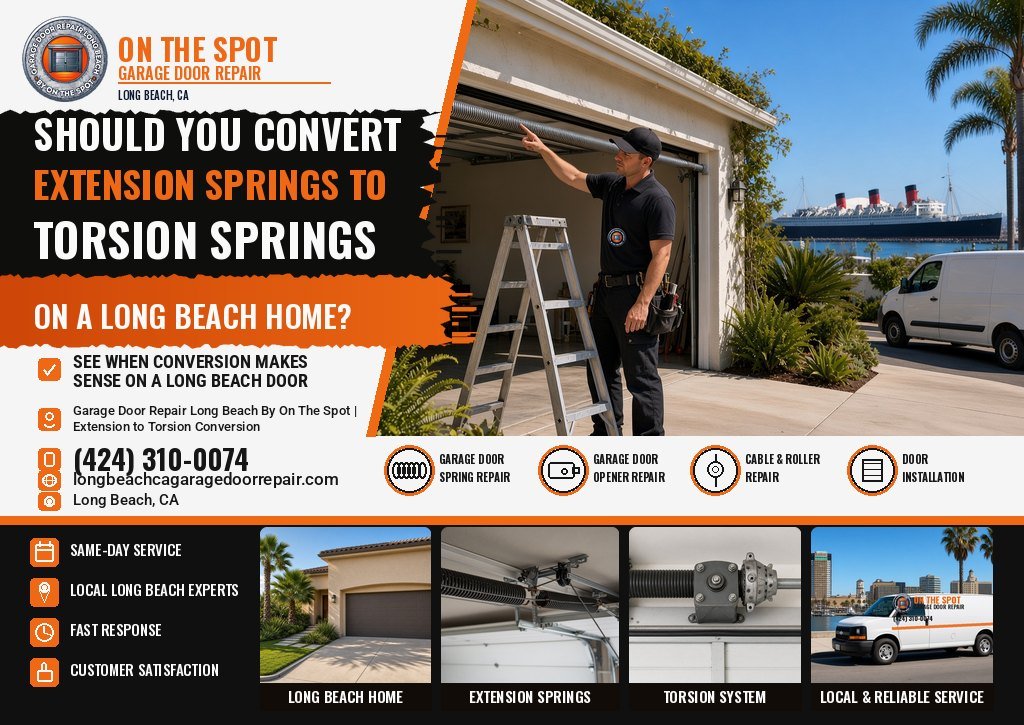
Garage Door Repair Long Beach By On The Spot · Spring Conversion Guide
Should You Convert Extension Springs to Torsion Springs on a Long Beach Home?
Converting extension springs to torsion springs on a Long Beach home is a system change, not a same-for-same spring swap. The long stretch springs along the tracks come off, and a shaft with one or two torsion springs is mounted above the door. That change can make sense on a heavier door, a door that keeps fighting its pulleys and cables, or an opening with enough room for the new hardware. It is not an automatic upgrade. A sound extension system with safety cables can stay in place, and a tight header may not accept a standard torsion shaft. This guide covers how to tell whether conversion is a real option, what the visit actually changes, and what you should leave alone until a technician looks at the door.
Should you convert extension springs to torsion springs on a Long Beach home?
Only if the door is a good candidate and the opening has room for the new hardware. Conversion replaces the stretch springs along the tracks with a torsion shaft above the door. It can help a heavier door, a door with repeated pulley or cable trouble, or an opening where you want the springs contained on a shaft. It is a larger job than replacing a worn extension pair, and it is not the default fix for every older Long Beach door.
A missing safety cable is a reason to call, but it is not, by itself, a reason to convert. DASMA’s guidance is to have a containment cable through each extension spring. That can be done while keeping an extension system that otherwise works.
Related reading: Garage Door Spring Replacement, Garage Door Spring Replacement Service, Garage Door Cable Repair, Do I need to replace both springs, or just the broken one?, and Garage Door Repair Long Beach. Safety guidance from the CPSC guidance on automatic residential garage door operators and DASMA garage door system safety tips, including DASMA Technical Data Sheet 167, the residential door and operator checklist and DASMA Technical Data Sheet 190 on torsion spring life; outage information from the SCE Outage Center.
What Conversion Actually Changes on the Door
A conversion is a change of counterbalance systems. Extension springs stretch and contract along the horizontal tracks, usually one on each side, and work with pulleys and lift cables. Torsion springs sit on a shaft above the door opening. As the door closes, those springs wind and store energy. As it opens, that energy helps lift the door, and cables run from drums on the shaft down to the bottom corners.
When a technician converts the door, the extension springs, pulleys, and the cables that belonged to that system come off. A torsion shaft, end bearing plates, a center anchor, drums, new lift cables, and one or two torsion springs go on. The door panels, tracks, and opener may stay if they are in good condition and are compatible with the new setup. That is why this is not the same job as replacing a broken extension pair and leaving the rest alone.
What comes off
The stretch springs above the tracks, their pulleys, and the lift cables that belong to the extension system.
What goes on
A shaft above the opening, bearing plates, drums, new cables, and torsion springs matched to the door’s weight and height.
What may stay
The door sections, much of the track, and the opener, if they are sound and can work with a torsion system.
What has to be measured
Clear space above the door, the condition of the header, and the actual weight of the door, including windows or insulation added later.
What does not change automatically
Coastal rust, a worn track, or a door that is already at the end of its life. Conversion does not reset those problems.
The safety rule
Look and photograph from a safe distance. Do not unhook an extension spring, and do not try to mount a torsion shaft yourself.
Both systems lift most of the door’s weight so the opener, or a person, is not lifting a few hundred pounds alone. DASMA garage door system safety tips treats springs in either system as high-tension parts that a homeowner should not adjust or remove. The difference is how the energy is stored and how a break is contained. On a torsion system, the shaft itself holds the spring. On an extension system, a containment cable running through the center of each spring is what keeps a broken spring from flying across the garage. See DASMA Technical Data Sheet 167, the residential door and operator checklist.
Confirm You Have Extension Springs Before You Decide
People ask about conversion after a bang, a crooked door, or a conversation with a neighbor who already had a torsion system installed. Before anyone prices a conversion, you need to know which system is on the door now. You can usually tell from the garage floor, with the door closed, without touching the hardware.
- Stand inside, a few feet back from the closed door, and look at the wall and ceiling just above the opening.
- If a round metal bar runs across the opening, with a spring or a pair of springs on that bar, you already have a torsion system. Conversion does not apply. The usual conversation is about replacing those springs, which is a different job. See Garage Door Spring Replacement and Garage Door Spring Replacement Service.
- If there is no bar above the door, look along each side, above the tracks that run back into the garage. Long, thinner springs there, often with a pulley and a cable, are extension springs.
- Look, but do not reach, for a cable running through the center of each extension spring and anchored at both ends. Mention it if that cable is missing. Do not try to thread one yourself.
- If you can photograph the area above the door and along the tracks without climbing under an open door, those photos help confirm the system before a visit.
Older one-car doors, some mid-century homes, and some tilt-up doors in Long Beach still use extension springs. Neighborhood pages such as Garage Door Repair in Los Altos, Long Beach and Garage Door Repair in Bixby Knolls: Older Doors mention those older setups often. If you have just moved in, identifying the system early saves a confused call later. See Garage Door Inspection After Buying a Home.
Reasons Homeowners Consider a Conversion
Conversion comes up for a handful of practical reasons, not because torsion springs are fashionable. Each reason is worth testing against the actual door. A reason that is true for a heavy two-car door in Los Altos may not apply to a light one-car door that still balances well.
Containment
Torsion springs are held on a shaft, which is a form of containment if a spring breaks. Extension springs need a separate safety cable through the center. DASMA garage door system safety tips is direct about that cable: if you have extension springs and no safety cable, the next step is a safety inspection, not a weekend experiment. Some homeowners hear that and assume the only fix is to convert. Adding the missing cables, and replacing a worn pair if the springs are tired, is often the smaller, appropriate job. Conversion is a larger way to get containment, and it can be the right way when other conditions also point that direction.
A heavier or uneven door
Extension springs are sized mainly by door weight. Torsion springs are sized by weight and door height, and they work with a chosen drum. On a heavier sectional door, or a door that had insulation or glass added after it was installed, a torsion system can be easier to balance correctly. If the door already hangs crooked, binds, or feels much heavier on one side, the cause might be a failed extension spring, a cable off a pulley, or a track problem. Those should be diagnosed first. See Garage Door Cable Repair, Uneven Gaps Along the Sides of a Garage Door, and Garage Door Spring Stretching Unevenly.
Repeated pulley and cable trouble
Some extension systems keep coming back with a cable off a pulley, a worn pulley bearing, or a spring that looks more stretched on one side than the other. Replacing the worn parts can stop that cycle. If the hardware is old, the tracks have shifted, and the springs have already been replaced more than once, a conversion can remove a system that is fighting itself. That is a judgment made on the door, not a sales default.
Clearance along the tracks
Extension springs live above the horizontal tracks and take up space along the ceiling. Storage racks, a loft, or a tight parking layout sometimes make that hardware a daily nuisance. Moving the springs to a shaft above the opening can free that space. This only matters if the header can accept the new shaft.
A door that is already being replaced
If the door itself is due for replacement because of rotten stiles, failing joints, or panels that no longer sit true, the new door will usually arrive as a torsion system. In that case you are not converting the old springs so much as installing a complete new door. See Garage Door Replacement in Long Beach and New Garage Door Installation. Conversion of a door you mean to keep is a different decision.
Safety Cables Versus a Full Conversion
DASMA garage door system safety tips‘s safety tips say that each extension spring needs a safety cable running through the spring and secured to the wall or ceiling at each end. When the door is down, those springs are under high tension. If one breaks, the cable is there to keep it from flying. DASMA Technical Data Sheet 167, the residential door and operator checklist, written for home inspectors and homeowners, asks the same question in checklist form: are the counterbalance springs restrained by a cable or by a shaft?
That distinction matters when you are deciding what to approve. A missing safety cable is a real hazard. It can be corrected on an extension system that is otherwise in good condition. Conversion also results in contained springs, because they sit on a shaft, but it changes much more of the door. If someone tells you the only safe option is conversion, ask what they found besides the missing cable: spring condition, pulley wear, door weight, and headroom. A clear answer helps you compare two honest paths.
Do not crawl along the tracks to add a cable yourself. The spring is still under tension with the door closed, and the ends of the cable have to be anchored correctly. If you can see, from the floor, that the cable is missing or is loose at one end, say so when you call. For related cable problems on either system, see Garage Door Cable Repair and My garage door cable came loose: does that usually mean the spring is broken too?.
When Conversion Is a Poor Fit
Conversion is a poor fit more often than marketing language suggests. The point of an assessment is to find those cases early, so you do not pay for a system change the opening cannot support, or for an upgrade the door does not need.
- The extension system is balanced, the springs are in fair condition, and safety cables are already in place. There is no problem here that conversion solves.
- The header is too tight for a standard torsion shaft, and low-headroom or rear-mount hardware is not a clean fit either. Forcing a shaft into a cramped, soft, or crowded header is a bad trade.
- The door itself is the failing part: delaminating sections, a rotting wood frame, or a one-piece door that is already hard to keep in plane. Money spent converting springs on a door that should be replaced is money in the wrong place.
- The ‘conversion’ being quoted is incomplete: a shaft with no proper center anchor, reused worn drums, or leftover extension brackets left in the way. A partial job can be worse than the system you started with.
- The opener, the tracks, or the bottom brackets are in such poor shape that the visit needs to start with those repairs, or with a conversation about a new door, before anyone talks about a new spring system.
Coastal rust, by itself, is also a weak reason to convert. Salt air attacks extension springs, torsion springs, cables, hinges, and tracks. Moving the springs to a shaft does not take the garage out of the marine layer. It may make the springs easier to inspect and contain, which is useful, but you still want hardware that can stand up to that air, and you still need regular inspection. See How Salt Air Affects Garage Door Cables, Hinges, Tracks, and Springs, Garage Door Rust Near the Beach: Which Parts Corrode First, and Garage Door Maintenance.
If the only symptom is a door that feels heavy after a bang, the first job is usually to replace the failed springs in the system you already have, as a matched pair. That is true for extension springs and for torsion springs. See Garage Door Spring Replacement and Do I need to replace both springs, or just the broken one?. Conversion can be discussed on the same visit if the door and the opening support it, and if you want that change for reasons that will still be true after the emergency is over.
Headroom, Low-Headroom Hardware, and the Header
Headroom is the clear space above the door opening, from the top of the opening up to the lowest obstruction: a joist, a soffit, a pipe, a storage shelf, or the ceiling itself. A standard torsion shaft, the springs, and the end bearing plates need some of that space. Manufacturers publish different minimums depending on track radius and hardware, often in the neighborhood of a foot for a common residential setup, and more when the track has a larger radius. Those published numbers are a starting point, not a measurement of your garage. The only reliable figure is the one taken on the opening, with the actual obstructions in view.
When the space is tight
Low-headroom torsion hardware exists for openings that cannot take a standard shaft position. Rear-mount or double-track arrangements are used on some doors when the space directly above the opening is limited but there is room farther back. Each of those options changes how the cables and the opener mount are laid out. They are not automatic substitutes, and they are not something to improvise from a bag of leftover brackets.
The header has to be solid
The center anchor for a torsion spring has to be lagged into solid framing, not into a thin, split, or water-damaged pad. Older Long Beach garages sometimes have a narrow header, a pad that was added later, or a beam with earlier holes from a previous opener or shelf. If the wood is soft, the first work may be reinforcing that header so the new shaft has something honest to bolt to. A conversion quoted without looking at the header is a guess.
From the floor, you can notice obvious problems: a shelf built tight to the top of the door, a low dropped ceiling, or almost no space between the opening and the joists. You cannot, from a phone photo alone, confirm that a low-headroom kit will fit. That is one of the reasons a conversion should be priced after someone has stood in the garage, not from a model number recited on the call.
What Comes Off and What Goes On
It helps to picture the visit as a change of systems, not as a single part swap. The technician secures the door so it cannot move, then relieves the tension in the extension springs in a controlled way and removes that hardware. How that is done is a trained-tech procedure. It is not a sequence to copy from a video, and this page will not walk through tools, hook positions, or winding steps.
The new torsion assembly
A typical residential torsion assembly includes the shaft, one or two springs, a center bearing plate or anchor, end bearing plates, and a cable drum at each end. The springs are selected for the door’s weight and height, and for the drums being used. If the door uses a pair, those springs are a matched set, wound in opposite directions. Lift cables are new in almost every conversion, because the old extension-system cables are the wrong type or are already worn.
Tracks, brackets, and the opener
Some conversions leave the existing vertical and horizontal tracks in place. Others need hanger adjustments, a track-radius change, or new horizontal tracks so the door clears the new shaft and the opener rail. DASMA garage door system safety tips reminds homeowners that tracks and door sections work as a system; leftover track from an old setup is not always a safe match. The opener’s travel and force settings are checked at the end, because a correctly balanced torsion door should not need the opener to muscle the door through the travel. If the opener was already failing, or was undersized for a heavier door, that may show up on the same visit. See Garage Door Opener Repair and Signs Your Garage Door Opener Is About to Fail.
Bottom brackets and cables
Bottom brackets are under spring tension on both systems and should be left alone by the homeowner. During a conversion they are inspected, and they may be replaced if they are bent, rusted, or not compatible with the new cables. A frayed cable or a loose bottom bracket is its own hazard. See Garage Door Cable Repair and the related notes in DASMA garage door system safety tips‘s safety tips on cables and tamper-resistant brackets.
At the end of a proper conversion, the extension hardware is gone, the torsion hardware is secured, the door is balanced, and the safety reverse on the opener is tested. Leftover pulleys, old stretch springs hanging in a corner, or a shaft sitting on the tracks without a finished anchor are signs the job was not finished.
How Long Beach Housing Affects the Decision
Long Beach does not have one garage type. The housing stock is a mix of tight older one-car garages, mid-century two-car openings, coastal wood doors, and newer steel sectional doors. That mix is why a conversion that was straightforward on one street can be a poor fit two miles away.
Older and tighter garages
Many older one-car garages in neighborhoods such as California Heights, Bixby Knolls, and parts of Belmont Shore have limited space above the door. Storage was often built in later. Some of those doors are still original wood, and some are lighter steel replacements hung on older track. See Garage Door Repair in Belmont Shore: Common Problems in Older Coastal Homes, Garage Door Repair in Bixby Knolls: Older Doors, and California Heights Spring Repair Study. A tight header does not forbid conversion, but it pushes the conversation toward low-headroom hardware, header reinforcement, or leaving a sound extension system in place.
Heavier doors and added glass
Carriage-style doors, insulated sections, and decorative windows add weight that the original extension springs were never sized for. Mid-century homes in Los Altos and similar tracts often have wider doors that have been updated in pieces over the years. See Garage Door Repair in Los Altos, Long Beach and Carriage Garage Doors for Bixby Knolls and California Heights. If the door has gained weight, a conversion can be a way to put a correctly engineered torsion system on it. If the door has also aged poorly, replacing the door may be cleaner than converting the springs on a tired slab.
Coastal air
Homes closer to the water, including Belmont Shore, the peninsula, and the 90802 and 90803 areas, see rust sooner on springs, cables, and fasteners. That is true of both systems. Conversion does not create a rust-proof door. It can put the springs in a location that is easier to inspect, and it can be paired with hardware chosen for a coastal garage. It should also be paired with the kind of upkeep described in Garage Door Maintenance and How Salt Air Affects Garage Door Cables, Hinges, Tracks, and Springs, not treated as a one-time cure.
Shared and downtown garages
Condo and shared garages downtown have their own limits: common-area rules, tighter ceiling space, and doors that other households rely on. Conversion in those buildings is as much a coordination question as a hardware question. See Garage Door Repair in Condos and HOA Communities and Garage Door Repair for Property Managers.
Conversion Versus Replacing the Extension Springs You Have
This is the decision most Long Beach homeowners are actually making. An extension spring has broken, or both look tired, and someone has mentioned ‘upgrading’ to torsion while they are already in the garage. Those are two different scopes.
| Question | Replace the extension pair | Convert to torsion |
|---|---|---|
| What the job is | Install a matched pair of extension springs, with safety cables if they are missing, and inspect pulleys and cables. | Remove the extension system and install a torsion shaft, springs, drums, and new cables, then retest the door and opener. |
| When it is usually enough | The door is a good weight for extension springs, the tracks and header are fine, and you want the door working again without changing the system. | The door is a strong candidate, the header can take the hardware, and you have a reason that will still matter after the break is fixed. |
| What you should hear first | The door weight, the spring size, whether both springs are being replaced, and whether safety cables are included. | The headroom measurement, how the shaft will be anchored, what happens to the opener and tracks, and a written price for the full conversion. |
| What it does not do | It does not move the springs to the header or change how the door is contained. | It does not repair a failing door, and it does not replace the need for later spring replacement when the new torsion springs reach the end of their life. |
A written price should make the scope obvious. If the quote is for ‘spring repair’ but the conversation was about conversion, ask which of the two jobs is on the page. If the quote is for conversion, ask what is included besides the springs: shaft, plates, drums, cables, safety testing, and any header work. You should not have to guess.
Either path still ends with replaced springs, not a patched coil. Worn springs are replaced because the wire has already done its work. That is true in an extension pair and in a torsion pair. A longer discussion of why a spring is replaced rather than ‘repaired’ belongs with the spring-repair-versus-replacement question, and with Garage Door Spring Replacement and Do I need to replace both springs, or just the broken one?.
The Opener, Tracks, and Cables After a Conversion
A conversion changes how the door is balanced. The opener should then be a helper, not the thing doing the heavy lifting. After the new torsion springs are set, the technician checks whether the door stays put around mid-travel when it is operated by hand (with the opener disconnected only if it is safe to do so as part of that test). Force and travel settings on the opener are adjusted as needed, and the safety reverse is tested. That last test is not optional. Federal rules for automatic residential garage door operators, described by the CPSC guidance on automatic residential garage door operators, exist because a door that does not reverse can injure someone.
If the opener had been straining for months, the motor, gears, or travel assembly may already be worn. A new torsion system will not rewind that wear. The honest sequence is to balance the door first, then decide whether the opener still does its job. See Garage Door Opener Repair, Signs Your Garage Door Opener Is About to Fail, and Garage Door Opener Replacement in Long Beach, CA.
Tracks deserve the same second look. Horizontal tracks that sagged under old extension hardware, hangers pulled from tired lumber, or a track knocked out of plumb will still interfere with a torsion door. A conversion visit that ignores the tracks can leave you with a nicely contained spring system and a door that still binds. See Garage Door Track Repair and Off-Track Garage Door Repair.
Cables are new on a proper conversion, but they still need a clear path and sound bottom brackets. If a cable later comes off a drum, that is a sign to stop using the door and call, not to feed it back on by hand. See Garage Door Cable Repair and My garage door cable came loose: does that usually mean the spring is broken too?. If the house loses power after the visit and you need to operate the door by hand, use the release only if the door is balanced and you know where it will go. For outage steps, see Garage Door Will Not Open After a Power Outage and the SCE Outage Center.
What a Conversion Assessment Looks Like
A useful visit starts with the door as it is, not with a predetermined upgrade. The technician should confirm that you have extension springs, look for safety cables, and look at the condition of those springs, pulleys, and cables. Then they measure the headroom, inspect the header and the tracks, and account for the door’s weight, including glass or insulation that may not have been on the original door. You should hear a clear recommendation: replace the extension pair, convert to torsion, repair something else first, or talk about a new door. Garage Door Repair Long Beach By On The Spot gives you a written price before any of that work begins.
- Describe what the door is doing, whether anyone heard a bang, and whether you can see long springs along the tracks or a bar above the door.
- Clear the floor under and just inside the door so the door and the header can be reached safely. Move cars out if you can.
- Do not try to ‘help’ by unhooking a spring or by disconnecting the opener on a door that will not stay up.
- Ask to see the headroom measurement and the header condition, not only the spring recommendation.
- If you approve a conversion, ask what happens to the old extension hardware, which new parts are included, and how the door and the opener will be tested at the end.
How long the visit takes depends on what is found. Replacing an extension pair is a smaller job than a conversion that also needs header work or track adjustments. No honest company can promise a clock time from a phone description alone. For a general sense of how repair visits vary, see How Long Does Garage Door Repair Take in Long Beach, CA?. If the door is already stuck closed or will not open, say that when you call. See Garage Door Stuck Closed and Garage Door Will Not Open.
Photos help if you cannot wait at the house for a first look. A shot of the area above the closed door, a shot along each horizontal track, and a shot of the header and ceiling give a technician a head start. They do not replace the measurements taken on site, and they should be taken from the floor, not from a ladder under an unsecured door.
Why This Is Not a Do-It-Yourself Project
Extension springs under tension can release with enough force to injure someone or damage a car. Torsion springs store the same kind of energy on a shaft and are wound with dedicated bars, not with a screwdriver or a pair of pliers. DASMA garage door system safety tips recommends trained door systems technicians for spring work and for garage door installation. The CPSC guidance on automatic residential garage door operators treats automatic door operators as regulated safety equipment, which is another reason the end of the job includes a reverse test, not a shrug and a closed garage.
Conversion combines both kinds of risk. The old extension springs have to come off under control. The new torsion springs have to be installed, wound, and secured to a shaft that is anchored in solid framing. A missed step can leave a heavy door unsupported or a spring under uncontrolled tension. This is also why Can I replace a garage door spring myself? exists as a standalone warning for spring replacement in general. Conversion is not a beginner version of that job. It is a larger one.
- Do not unhook an extension spring, even if it already looks slack or broken.
- Do not stand under a door that is stuck partway or hanging crooked while you investigate.
- Do not use C-clamps, vise grips, or winding bars unless you are the technician who brought the right tools for this door.
- Do not reuse a random torsion shaft or springs pulled from another door. Springs are matched to weight, height, and drums.
- Do not skip the balance and safety-reverse tests at the end, and do not assume an opener will ‘just learn’ a new system.
If you already started a conversion and stopped, leave the door alone, keep people clear, and call. Say what has already been removed. That information matters more than finishing the job yourself. For hiring caution in general, see Garage Door Repair Scams to Avoid.
Leftover Hardware From Older Jobs
Long Beach doors that have been serviced over many years sometimes wear a mix of parts that no longer belong to one system. You might see extension spring brackets still on the tracks after a previous owner started a conversion. You might see a torsion shaft with one spring, plus a leftover pulley. You might see safety cables on one side only. Mixed hardware is a reason to pause, not a reason to assume the door is ‘already converted.’
A technician should tell you which system is actually lifting the door, which leftover parts are doing nothing, and which leftovers are in the way. Removing dead hardware is often part of a clean conversion. Leaving it in place can interfere with cables or hide rust and loose fasteners. If a prior job left a shaft sitting on the tracks without bearing plates or a center anchor, treat that as unfinished work, not as a usable torsion system.
One-Piece Tilt-Up Doors Are a Different Case
Some older Long Beach garages still have a one-piece tilt-up door: a single slab that swings out and up, often with extension springs along the sides or with a different hardware kit than a modern sectional door. Those doors do not convert in the same way a sectional door does. The tracks, the pivot, and the way the door moves through the opening are different. In some cases the honest recommendation is to keep servicing the tilt-up hardware if the door is sound. In others, the better path is a new sectional door with a torsion system, which is a door replacement, not a spring conversion.
If you are not sure whether the door is one piece or sectional, look at the face of the door from outside. A sectional door has horizontal joints between panels and folds as it goes up. A one-piece door stays flat and usually kicks out from the opening as it rises. Do not test this by forcing a stuck door. A photo of the closed door, plus a photo of the side hardware from inside, is enough to start the conversation. See Garage Door Replacement in Long Beach if the door itself is the question.
After a Conversion: What You Should Notice
A finished conversion should leave the door moving smoothly by hand, staying roughly in place around the middle of its travel when it is balanced correctly, and running through the opener’s travel without straining or slamming. The old stretch springs should be gone from the tracks. You should be able to see the new shaft, springs, and drums above the opening, with cables seated on the drums and running cleanly to the bottom corners.
In the days after the visit, listen for new rubbing, a door that starts to hang to one side, or an opener that reverses on a clear floor. Those are reasons to call back, not to add more turns to a spring or to tighten a drum set screw. For popping or creaking that starts later, see Garage Door Spring Makes Popping or Creaking Sounds and Noisy Garage Door Repair. For a door that later feels heavy again, see Why Is My Garage Door Too Heavy to Open Manually? and Garage Door Spring Replacement. New torsion springs still have a service life. DASMA Technical Data Sheet 190 on torsion spring life discusses torsion spring life; daily use, rust, and added door weight all affect how long a new set lasts.
Routine upkeep around the new system is the same as around any Long Beach door: keep the tracks clean, lubricate the points a technician recommends, test the safety reverse, and do not oil a spring in the hope of stretching its life. See Garage Door Tune-Up and Garage Door Maintenance.
Example Situations (Composite, Not a Quote)
These are composite situations, written to make the decision clearer. They are not job records, and they are not prices.
A light one-car door with a missing safety cable
A 1920s bungalow in California Heights has a light wooden one-car door and extension springs along both tracks. The springs still look even. There is no cable through either spring. Headroom is tight because a storage shelf was built close to the opening. The first work here is usually to replace any tired springs as a pair and install safety cables, not to force a standard torsion shaft under that shelf. Conversion would come back into the conversation only if the shelf can be changed, low-headroom hardware is a clean fit, or the door itself is being replaced.
A heavier two-car door that keeps throwing a cable
A mid-century two-car door in Los Altos had windows added years ago. The extension springs have been replaced before. A cable keeps coming off a pulley, and one spring looks more stretched than the other. The header has clear space and solid framing. This is a stronger conversion candidate: the door is heavier than the original system, the extension hardware is repeating the same failure, and the opening can take a shaft. The visit should still start with weight, headroom, and a written scope, not with a verbal ‘we should just upgrade.’ See Garage Door Repair in Los Altos, Long Beach.
A bang, a heavy door, and a conversion pitch on the same afternoon
A homeowner in East Long Beach hears a bang, the door will not lift, and one extension spring is clearly broken. A conversion may be possible, but the urgent need is to get a failed counterbalance system under control and the door working again. Replacing the extension pair, with safety cables, solves that need. Conversion can be scheduled or declined once the door is safe, if the opening and the door support it and the homeowner still wants it. Deciding under the stress of a door that will not open is how people approve a larger job than they meant to buy. See Garage Door Spring Replacement, Garage Door Will Not Open, and Garage Door Repair in East Long Beach (90815).
A coastal wood door that is already failing
A Belmont Shore door has rusted extension hardware and also has soft bottom stiles and a panel that no longer sits flat. Converting the springs would leave the failing door in place. The more useful conversation is whether the door should be replaced with a new sectional door, which would arrive with a torsion system. See Garage Door Repair in Belmont Shore: Common Problems in Older Coastal Homes, Garage Door Rust Near the Beach: Which Parts Corrode First, and Garage Door Replacement in Long Beach.
Questions to Ask Before You Approve a Conversion
- Which system is on the door now, and did you see safety cables on the extension springs?
- What did you measure for headroom, and can this opening take a standard shaft, low-headroom hardware, or neither?
- What is the door made of, and has any weight been added with glass, insulation, or a new skin?
- If we only replaced the extension pair and added safety cables, would the door work safely?
- What new parts are included in the conversion: shaft, springs, drums, cables, plates, and any track or header work?
- What happens to the opener’s force and travel settings, and will you test the safety reverse before you leave?
- If the header needs reinforcement, is that in the written price or a separate item?
- If you find the door itself is a poor candidate, will you say so before starting?
You should get plain answers to those questions, and a written price that matches the scope you approved. Garage Door Repair Long Beach By On The Spot will not ask you to approve spring work without that writing. If a quote is hard to parse, or if someone is pushing a conversion as the only safe choice without explaining the header or the current springs, slow down. See Garage Door Repair Scams to Avoid and Garage Door Repair Cost in Long Beach: What Affects the Price for how scope affects price without invented numbers. To book a visit, call (424) 310-0074 or use our contact page.
Photos That Help on the Phone, and What to Say
When you call, you do not need the words ‘extension’ or ‘torsion’ if you are not sure. It is enough to say where the springs sit, what the door is doing, whether anyone heard a bang, and whether you can see a cable running through the long springs along the tracks. Mention the neighborhood or the type of house if you know it, because a tight older one-car garage and a wide mid-century opening are different starting points.
- A photo of the closed door from inside, showing the wall above the opening.
- A photo along each horizontal track, showing any long springs, pulleys, and cables.
- A photo of the ceiling just above the opening, so the available headroom is visible.
- A photo of anything obviously broken, taken from the floor, not from under a hanging door.
If the door is stuck open, keep people and cars away from it and do not pull the release if you are not sure the door will stay put. If it is stuck closed, do not force it. For stuck-door starting points, see Garage Door Stuck Open and Garage Door Stuck Closed. If a recent outage is part of the story, check Garage Door Will Not Open After a Power Outage and the SCE Outage Center before assuming the springs failed.
Converting extension springs to torsion springs: FAQ
Should I convert extension springs to torsion springs on my Long Beach home?
Only if the door is a good candidate and the opening has room for the new hardware. Conversion is a system change, not the default fix for every worn extension pair. A sound extension system with safety cables can stay in place.
How do I know I have extension springs?
Look from inside with the door closed, and do not touch the hardware. Long springs above the horizontal tracks, usually with pulleys, are extension springs. A spring or pair of springs on a bar above the door is already a torsion system, so conversion does not apply.
Is a torsion system safer than an extension system?
Both store a lot of energy and should be left to a technician. Extension springs need a safety cable through the center of each spring. Torsion springs are contained by the shaft. A missing cable is a reason to call, not an automatic reason to convert. See DASMA garage door system safety tips and DASMA Technical Data Sheet 167, the residential door and operator checklist.
Can I just add safety cables instead of converting?
Often, yes, if the extension system is otherwise sound. Adding correctly anchored containment cables, and replacing a worn pair if needed, addresses the containment problem without changing the whole system.
How much headroom do I need?
Enough clear space above the opening for the shaft, springs, and plates, after real obstructions are taken into account. Manufacturer minimums vary with the hardware and track radius. Some doors can use low-headroom or rear-mount hardware when the space is tight. The number that matters is the one measured on your opening.
Does conversion cost more than replacing extension springs?
It is a larger job, because more hardware changes. This page does not list prices. A written price after an inspection is the only useful number, and it should spell out the shaft, springs, drums, cables, and any header or track work.
Will conversion stop rust near the beach?
No. Coastal air rusts hardware on both systems. Conversion may make the springs easier to inspect and contain, but you still need hardware that can stand up to that air, and you still need regular inspection. See How Salt Air Affects Garage Door Cables, Hinges, Tracks, and Springs.
Can I convert the springs myself?
No. The work involves high-tension parts on the way off and on the way on, plus a safety-reverse test of the opener at the end. See Can I replace a garage door spring myself?, DASMA garage door system safety tips, and the CPSC guidance on automatic residential garage door operators.
What if my door is a one-piece tilt-up door?
Those doors do not convert the same way a sectional door does. The recommendation may be to service the existing hardware or to replace the door with a sectional torsion system, which is a door replacement, not a spring conversion.
Where are you located?
Garage Door Repair Long Beach By On The Spot is at 151 E 5th St, Long Beach, CA 90802. Call (424) 310-0074, use our contact page, or find us on Google Maps.
Garage Door Repair Long Beach By On The Spot on Google Maps
View Garage Door Repair Long Beach By On The Spot on Google Maps · 151 E 5th St, Long Beach, CA 90802
Want to Know Whether Conversion Is a Fit for Your Door?
Garage Door Repair Long Beach By On The Spot will look at the spring system, the headroom, and the door itself, then explain whether a conversion, an extension-spring replacement, or another repair is the better path. You get a written price before any work begins. Call (424) 310-0074, use our contact page, or find us on Google Maps. Our address is 151 E 5th St, Long Beach, CA 90802.
Garage Door Repair Long Beach By On The Spot · 151 E 5th St, Long Beach, CA 90802
(424) 310-0074 · office.onthespotgaragedoor@gmail.com · longbeachcagaragedoorrepair.com